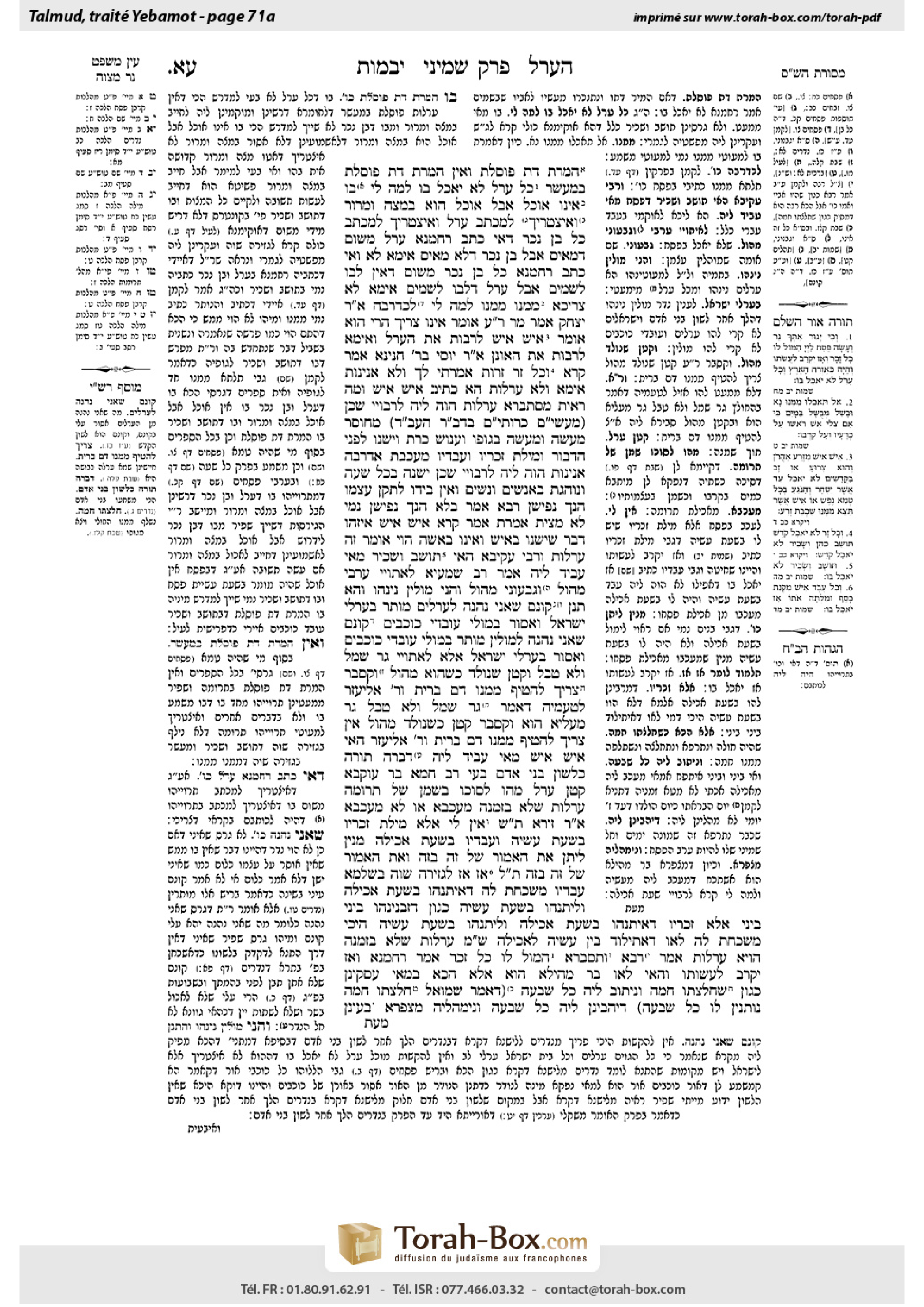
Yevamot 71a: Talmud study for Daf Yomi
Daf Yomi is the daily study of one Talmud folio. Explore 37 tractates with scans, Hebrew text, Sefaria English and AI-generated French translations where annotated.
Passage selection and English or AI-generated French translation are available where the scan has annotations. Daf Study is independent of Torah-Box and Sefaria.
Browse Yevamot · יבמות · All tractatesYevamot 71a text and translations
This page of Yevamot includes the Aramaic text, an English translation and an AI-generated French translation, alongside the scan above.
יבמות ע״א א · Aramaic and Hebrew text
מְשׁוּמָּדוּת פּוֹסֶלֶת, וְאֵין מְשׁוּמָּדוּת פּוֹסֶלֶת בְּמַעֲשֵׂר.
״כׇּל עָרֵל לֹא יֹאכַל בּוֹ״ לְמָה לִי? בּוֹ אֵינוֹ אוֹכֵל, אֲבָל אוֹכֵל הוּא בְּמַצָּה וּמָרוֹר.
וְאִיצְטְרִיךְ לְמִכְתַּב ״עָרֵל״, וְאִיצְטְרִיךְ לְמִכְתַּב ״כׇּל בֶּן נֵכָר״. דְּאִי כְּתַב רַחֲמָנָא ״עָרֵל״, מִשּׁוּם דִּמְאִיס. אֲבָל בֶּן נֵכָר, דְּלָא מְאִיס — אֵימָא לָא. וְאִי כְּתַב רַחֲמָנָא ״כׇּל בֶּן נֵכָר״, מִשּׁוּם דְּאֵין לִבּוֹ לַשָּׁמַיִם, אֲבָל עָרֵל, דְּלִבּוֹ לַשָּׁמַיִם — אֵימָא לָא, צְרִיכָא.
״מִמֶּנּוּ״ ״מִמֶּנּוּ״. לְמָה לִי? לְכִדְרַבָּה אָמַר רַבִּי יִצְחָק.
אָמַר מָר, רַבִּי עֲקִיבָא אוֹמֵר: אֵינוֹ צָרִיךְ, הֲרֵי הוּא אוֹמֵר ״אִישׁ אִישׁ״, לְרַבּוֹת אֶת הֶעָרֵל. וְאֵימָא: לְרַבּוֹת אֶת הָאוֹנֵן? אָמַר רַבִּי יוֹסֵי בְּרַבִּי חֲנִינָא, אָמַר קְרָא: ״וְכׇל זָר״ — זָרוּת אָמַרְתִּי לְךָ, וְלֹא אֲנִינוּת.
אֵימָא: וְלֹא עֲרֵלוּת? הָא כְּתִיב ״אִישׁ אִישׁ״.
וּמָה רָאִיתָ? מִסְתַּבְּרָא עֲרֵלוּת הֲוָה לֵיהּ לְרַבּוֹיֵי, שֶׁכֵּן: מַעֲשִׂים, כְּרוּתִים, בִּדְבַר, הָעֶבֶד. מְחוּסַּר מַעֲשֶׂה, וּמַעֲשֶׂה בְּגוּפוֹ, וְעָנוּשׁ כָּרֵת, וְיֶשְׁנוֹ לִפְנֵי הַדִּבּוּר, וּמִילַת זְכָרָיו וַעֲבָדָיו מְעַכֶּבֶת.
אַדְּרַבָּה: אֲנִינוּת הֲוָה לֵיהּ לְרַבּוֹיֵי, שֶׁכֵּן: יֶשְׁנָהּ בְּכׇל שָׁעָה, וְנוֹהֶגֶת בַּאֲנָשִׁים וְנָשִׁים, וְאֵין בְּיָדוֹ לְתַקֵּן עַצְמוֹ!
הָנָךְ נְפִישָׁן. רָבָא אָמַר: בְּלָא הָנָךְ נְפִישָׁן נָמֵי לָא מָצֵית אָמְרַתְּ. אָמַר קְרָא ״אִישׁ אִישׁ״, אֵיזֶהוּ דָּבָר שֶׁיֶּשְׁנוֹ בָּאִישׁ וְאֵינוֹ בָּאִשָּׁה — הָוֵי אוֹמֵר זֶה עֲרֵלוּת.
וְרַבִּי עֲקִיבָא, הַאי ״תּוֹשָׁב וְשָׂכִיר״ מַאי עָבֵיד לֵיהּ? אָמַר רַב שְׁמַעְיָא: לְאֵתוֹיֵי עַרְבִי מָהוּל וְגִבְעוֹנִי מָהוּל.
וְהָנֵי מוּלִין נִינְהוּ? וְהָא תְּנַן: ״קֻוֽנָּם שֶׁאֲנִי נֶהֱנֶה לַעֲרֵלִים״ — מוּתָּר בְּעַרְלֵי יִשְׂרָאֵל, וְאָסוּר בְּמוּלֵי אוּמּוֹת הָעוֹלָם. ״קֻוֽנָּם שֶׁאֲנִי נֶהֱנֶה לְמוּלִין״ — מוּתָּר בְּמוּלֵי אוּמּוֹת הָעוֹלָם, וְאָסוּר בְּעַרְלֵי יִשְׂרָאֵל!
אֶלָּא, לְאֵתוֹיֵי גֵּר שֶׁמָּל וְלֹא טָבַל, וְקָטָן שֶׁנּוֹלַד כְּשֶׁהוּא מָהוּל. וְקָסָבַר: צָרִיךְ לְהַטִּיף מִמֶּנּוּ דַּם בְּרִית.
וְרַבִּי אֱלִיעֶזֶר לְטַעְמֵיהּ, דְּאָמַר: גֵּר שֶׁמָּל וְלֹא טָבַל — גֵּר מְעַלְּיָא הוּא, וְקָסָבַר: קָטָן כְּשֶׁנּוֹלַד מָהוּל — אֵין צָרִיךְ לְהַטִּיף מִמֶּנּוּ דַּם בְּרִית.
וְרַבִּי אֱלִיעֶזֶר, הַאי ״אִישׁ אִישׁ״ מַאי עָבֵיד לֵיהּ? דִּבְּרָה תּוֹרָה כִּלְשׁוֹן בְּנֵי אָדָם.
בָּעֵי רַב חָמָא בַּר עוּקְבָא: קָטָן עָרֵל מַהוּ לְסוּכוֹ בְּשֶׁמֶן שֶׁל תְּרוּמָה? עֲרֵלוּת שֶׁלֹּא בִּזְמַנָּהּ מְעַכְּבָא, אוֹ לָא מְעַכְּבָא?!
אָמַר רַבִּי זֵירָא, תָּא שְׁמַע: אֵין לִי אֶלָּא מִילַת זְכָרָיו בִּשְׁעַת עֲשִׂיָּה, וַעֲבָדָיו בִּשְׁעַת אֲכִילָה. מִנַּיִן לִיתֵּן אֶת הָאָמוּר שֶׁל זֶה בָּזֶה, וְאֶת הָאָמוּר שֶׁל זֶה בָּזֶה — תַּלְמוּד לוֹמַר: ״אָז״ ״אָז״ לִגְזֵירָה שָׁוָה.
בִּשְׁלָמָא עֲבָדָיו, מַשְׁכַּחַתְּ לַהּ דְּאִיתַנְהוּ בִּשְׁעַת אֲכִילָה וְלֵיתַנְהוּ בִּשְׁעַת עֲשִׂיָּה, כְּגוֹן דְּזַבְנִינְהוּ בֵּינֵי בֵּינֵי.
אֶלָּא זְכָרָיו, דְּאִיתַנְהוּ בִּשְׁעַת אֲכִילָה וְלֵיתַנְהוּ בִּשְׁעַת עֲשִׂיָּה הֵיכִי מַשְׁכַּחַתְּ לַהּ — לָאו דְּאִתְיְלוּד בֵּין עֲשִׂיָּה לַאֲכִילָה? שְׁמַע מִינַּהּ: עֲרֵלוּת שֶׁלֹּא בִּזְמַנָּהּ הָוְיָא עֲרֵלוּת!
אָמַר רָבָא: וְתִסְבְּרָא? ״הִמּוֹל לוֹ כׇל זָכָר״ אָמַר רַחֲמָנָא, ״וְאָז יִקְרַב לַעֲשׂוֹתוֹ״. וְהַאי לָאו בַּר מְהִילָא הוּא. אֶלָּא, הָכָא בְּמַאי עָסְקִינַן — כְּגוֹן שֶׁחֲלָצַתּוּ חַמָּה.
וְנִיתֵּוב לֵיהּ כׇּל שִׁבְעָה. דְּאָמַר שְׁמוּאֵל: חֲלָצַתּוּ חַמָּה — נוֹתְנִין לוֹ כׇּל שִׁבְעָה! דְּיָהֲבִינַן לֵיהּ כׇּל שִׁבְעָה. וְנִימְהֲלֵיהּ מִצַּפְרָא! בָּעֵינַן
Yevamot 71a · English translation
that apostasy [meshumadut] disqualifies, as the term “stranger” in this context is understood to refer to a Jew whose conduct makes him estranged from God, and he is disqualified from eating the Paschal lamb, but apostasy does not disqualify one from eating tithe.
The Gemara asks further: If so, with regard to the phrase “from it” in the verse “No uncircumcised person shall eat from it” (Exodus 12:48), which again emphasizes “from it” and not from another item, why do I need it? The Gemara answers: This teaches that only from it, the Paschal lamb, one who is uncircumcised may not eat, but he eats matza and bitter herbs. One who is uncircumcised is obligated to eat matza and bitter herbs on Passover, just like any other Jew.
The Gemara continues: And it was necessary for the Torah to write the prohibition with regard to an uncircumcised man, and it was necessary for the Torah to write a separate prohibition with regard to any stranger. As, if the Merciful One had written only about an uncircumcised man, one might have thought that only for him is it prohibited to eat from the Paschal lamb because the foreskin is repulsive, but with regard to a stranger, who is not repulsive, say that it is not prohibited. And if the Merciful One had written only about any stranger, one might have concluded that only for him is it prohibited to eat from the Paschal lamb because his heart is not directed toward Heaven due to his apostasy, but with regard to an uncircumcised man, whose heart is directed toward Heaven, and it is only on account of unavoidable circumstances that he has not undergone circumcision, say that there is no prohibition against his eating the Paschal lamb. Therefore, it is necessary to teach both cases.
The Gemara asks: With regard to the phrase “of it” in the verse “Do not eat of it raw, nor boiled in water, but roasted in fire” (Exodus 12:9), and the phrase “of it” in the verse “And you shall let nothing of it remain until the morning” (Exodus 12:10), both of which are terms of exclusion, why do I need them? The Gemara answers that they are necessary for that which Rabba said that Rabbi Yitzḥak said, as will be explained later (74a).
The Master said above in the baraita: Rabbi Akiva says that it is not necessary to derive by way of a verbal analogy the halakha that an uncircumcised priest may not eat teruma, as the verse says: “Any man [ish ish] from the seed of Aaron who is a leper or a zav shall not eat of the holy things” (Leviticus 22:4). The repetition of the word ish comes to include an uncircumcised man and indicate that he too may not partake of consecrated food. The Gemara asks: But say that the verse comes to include an acute mourner in the prohibition against eating teruma. Rabbi Yosei, son of Rabbi Ḥanina, said: The verse states: “No foreigner may eat of the holy thing” (Leviticus 22:10), which indicates: A disqualification stemming from foreignness I told you prevents one from eating teruma, but not a disqualification based on acute mourning.
The Gemara asks: Say that the verse comes to teach that a disqualification stemming from foreignness prevents one from eating teruma, but not a disqualification based on the priest’s lack of circumcision, and so it should be permitted for an uncircumcised priest to partake of teruma. The Gemara answers: Isn’t it written: “Any man [ish ish],” where the repetition of the word ish comes to include an uncircumcised priest in the prohibition?
The Gemara asks: And what did you see that led you to include an uncircumcised priest in the prohibition against eating teruma and exclude an acute mourner? The Gemara answers: It stands to reason that lack of circumcision should be included and should preclude a priest’s eating teruma, as the halakhot governing an uncircumcised man are stringent in several respects, as alluded to by the following mnemonic of key words: Acts; karetim; the divine word; the slave. The Gemara explains: An uncircumcised man lacks the act of circumcision, and this act is performed on his body; the failure to perform circumcision is punishable by karet; circumcision existed before the divine word was spoken at Mount Sinai, as the mitzva of circumcision had already been given to Abraham; and the lack of circumcision of one’s male children and slaves precludes one’s eating the Paschal lamb.
The Gemara counters: On the contrary, acute mourning should be included and it should prevent a priest from eating teruma, as acute mourning is relevant at any time, it applies to both men and women, and it is not in the mourner’s power to render himself fit until after the deceased is buried.
The Gemara answers: These arguments for including an uncircumcised priest in the prohibition are more numerous. Rava said: Even without the rationale that these arguments are more numerous, you still cannot say that an acute mourner should be included and an uncircumcised priest should be excluded, as the verse states: “Any man [ish ish],” emphasizing maleness. Now, what matter applies to a man and not to a woman? You must say that it is lack of circumcision, and therefore it cannot be that the phrase comes to include acute mourning in the prohibition.
The Gemara asks: And what does Rabbi Akiva do with this phrase: “A sojourner and a hired servant,” as it is not needed for the Paschal lamb? Rav Shemaya said: It serves to include a circumcised Arab and a circumcised Gibeonite in the prohibition against the eating of the Paschal lamb. Although they have been circumcised, it is prohibited for them to partake of the offering.
The Gemara poses a question: And are these considered circumcised? But didn’t we learn in a mishna (Nedarim 31b): If one vowed: The benefit that I might gain from the uncircumcised is konam to me, i.e., forbidden to me like consecrated property, then it is permitted for him to derive benefit from uncircumcised Jews, and it is prohibited for him to derive benefit from the circumcised of the nations of the world, as gentiles are considered uncircumcised even if they have their foreskins removed. And conversely, if he vowed: The benefit that I might gain from the circumcised is konam to me, it is permitted for him to derive benefit from the circumcised of the nations of the world, as they are not considered circumcised, and it is prohibited for him to derive benefit from uncircumcised Jews. This indicates that the circumcision of gentiles is disregarded.
Rather, the phrase “a sojourner and a hired servant” comes to include in the prohibition against eating of the Paschal lamb a convert to Judaism who was circumcised but did not yet immerse in a ritual bath, and a child who was born circumcised, i.e., without a foreskin. Although he does not have a foreskin, he is still seen as lacking the act of circumcision. And he, Rabbi Akiva, maintains that it is necessary to drip covenantal blood from him, in lieu of circumcision, in order to usher him into the covenant of Abraham, even though he has no foreskin that can be removed.
And Rabbi Eliezer, who uses the words “a sojourner and a hired servant” for a verbal analogy, conforms to his standard line of reasoning, as he said: A convert who was circumcised but did not yet immerse is a proper convert in every way. Therefore, the verse cannot come to exclude such an individual. And he maintains that in the case of a child who was born circumcised, it is not necessary to drip covenantal blood from him. Since he was born without a foreskin, no additional procedure is necessary.
The Gemara asks: And what does Rabbi Eliezer do with this inclusive phrase “any man [ish ish]”? The Gemara answers: He maintains that the Torah spoke in the language of men, meaning that no special halakha is derived from this expression, as it is common biblical vernacular.
Rav Ḥama bar Ukva raises a dilemma: With regard to an uncircumcised child who is less than eight days old and not yet fit for circumcision, what is the halakha with respect to anointing him with oil of teruma? The Gemara explains the two sides of the question: Does lack of circumcision not at its appointed time, meaning before the obligation of circumcision goes into effect, preclude the infant’s benefiting from teruma, as he has the status of one who is uncircumcised, or perhaps it does not preclude his benefiting from teruma, as he is not considered uncircumcised until the mitzva of circumcision is applicable?
Rabbi Zeira said: Come and hear a proof from the following baraita: I have derived only the halakha concerning the circumcision of one’s male children at the time of the preparation, i.e., the slaughter, of the Paschal lamb, as it is stated: “Let all his males be circumcised, and then let him come near and keep it” (Exodus 12:48), and the halakha concerning the circumcision of one’s slaves at the time of the eating of the Paschal lamb, as it is stated: “But every man’s servant…when you have circumcised him, then shall he eat from it” (Exodus 12:44). From where do I derive that it is proper to apply the prohibition that was stated about this case to that case, and the prohibition that was said about that case to this case, i.e., that the circumcision of both one’s male children and one’s slaves is indispensable both at the time of the preparation of the Paschal lamb and at the time of its consumption? The tanna answers that the verse states the term “then” with regard to male children and the term “then” with regard to slaves as a verbal analogy.
The Gemara comments: Granted, with regard to one’s slaves you find a case where they are present at the time of eating but they were not present at the time of preparation; for example, if he purchased them in the meantime, i.e., they did not belong to him when the Paschal lamb was slaughtered but he bought them immediately afterward, before it was time to eat it.
However, with regard to his male children, how can you find a case where they are present at the time of eating, but they were not present at the time of preparation? Does it not involve a situation where they were born between the time of the Paschal lamb’s preparation and the time of its eating? Learn from this that lack of circumcision, even not at, i.e., before, its appointed time, is nevertheless considered lack of circumcision that prevents the father from partaking of the offering.
Rava said: And how can you understand it that way? How can you think that the lack of circumcision of a newborn child precludes his father’s eating from the Paschal lamb? Doesn’t the Merciful One state: “Let all his males be circumcised,” followed by “and then let him come near and keep it” (Exodus 12:48), and as this infant is not yet fit for circumcision he cannot possibly preclude the father’s partaking of the offering? Rather, with what case are we dealing here? With the case, for example, of a baby who was exempt from circumcision at the time of the preparation of the Paschal lamb because he was sick with a high fever, and subsequently the fever left him and he recovered. In such a case, failure to immediately circumcise his son precludes the father’s eating from the Paschal lamb.
The Gemara raises a difficulty: If the case is one of a child recovering from an illness, let us give him the full seven days that he needs to recuperate properly. As Shmuel said: In the case of a baby that was sick with a high fever, and subsequently the fever left him, one gives him a full seven days to heal and only then is he circumcised, but not before. The Gemara answers: The case is in fact one where we already gave him a full seven days to heal, but they culminated on the eve of Passover. The Gemara asks: But if the seven-day recovery period ended on the eve of Passover, why did the father wait until the time of eating the Paschal lamb, i.e., the first night of Passover? He should have circumcised him already in the morning, before the time of the preparation of the Paschal lamb. The Gemara answers: We require
Yevamot 71a · Traduction française (IA)
que l’apostasie [meshumadut] disqualifie, car le terme « étranger » désigne ici un Juif dont la conduite l’a éloigné de Dieu. Celui-ci est donc disqualifié pour manger l’agneau pascal, tandis que l’apostasie ne disqualifie pas quelqu’un pour manger la dîme.
La Guemara demande encore : Si tel est le cas, pourquoi faut-il l’expression « de celui-ci » dans le verset « Aucun incirconcis n’en mangera » (Exode 12,48), qui souligne une nouvelle fois « de celui-ci », et non d’un autre aliment ? La Guemara répond : Cela enseigne que l’incirconcis ne peut manger que de celui-ci, l’agneau pascal, mais qu’il mange de la matsa et des herbes amères. Un incirconcis est tenu de manger de la matsa et des herbes amères à Pessa’h, comme tout autre Juif.
La Guemara poursuit : Il était nécessaire que la Torah énonce l’interdiction concernant un incirconcis, et il était nécessaire qu’elle énonce une interdiction distincte concernant tout étranger. En effet, si le Miséricordieux avait seulement écrit au sujet d’un incirconcis, on aurait pu penser que l’interdiction de manger l’agneau pascal ne s’applique qu’à lui, parce que le prépuce est répugnant ; mais que, s’agissant d’un étranger, qui n’est pas répugnant, cela ne serait pas interdit. Et si le Miséricordieux avait seulement écrit au sujet de tout étranger, on aurait pu conclure que l’interdiction de manger l’agneau pascal ne s’applique qu’à lui, parce que son cœur n’est pas tourné vers le Ciel en raison de son apostasie ; mais que, s’agissant d’un incirconcis, dont le cœur est tourné vers le Ciel et qui n’a pas été circoncis uniquement en raison de circonstances indépendantes de sa volonté, manger l’agneau pascal ne serait pas interdit. Il fallait donc enseigner les deux cas.
La Guemara demande : Pourquoi faut-il l’expression « de celui-ci » dans le verset « N’en mangez pas cru, ni bouilli dans l’eau, mais rôti au feu » (Exode 12,9), et l’expression « de celui-ci » dans le verset « Vous n’en laisserez rien jusqu’au matin » (Exode 12,10), alors que toutes deux sont des termes d’exclusion ? La Guemara répond qu’elles sont nécessaires pour la règle que Rabba a rapportée au nom de Rabbi Yitzḥak, comme on l’expliquera plus loin (74a).
Le Maître a dit plus haut dans la baraïta : Rabbi Akiva affirme qu’il n’est pas nécessaire de déduire au moyen d’une analogie verbale qu’un prêtre incirconcis ne peut pas manger de terouma, car le verset dit : « Tout homme [ish ish] de la descendance d’Aaron qui est lépreux ou atteint d’un flux ne mangera pas des choses saintes » (Lévitique 22,4). La répétition du mot ish vient inclure un incirconcis et indiquer que lui aussi ne peut pas manger d’aliments consacrés. La Guemara demande : Mais ne pourrait-on pas dire que le verset vient inclure l’endeuillé en période d’aninut dans l’interdiction de manger de la terouma ? Rabbi Yosei, fils de Rabbi Ḥanina, dit : Le verset dit : « Aucun étranger ne mangera de ce qui est saint » (Lévitique 22,10), ce qui indique : Je t’ai dit qu’une disqualification due au statut d’étranger empêche de manger de la terouma, mais pas une disqualification due à l’aninut.
La Guemara demande : Ne pourrait-on pas dire que le verset enseigne qu’une disqualification due au statut d’étranger empêche de manger de la terouma, mais pas une disqualification due au fait que le prêtre n’est pas circoncis, de sorte qu’un prêtre incirconcis serait autorisé à manger de la terouma ? La Guemara répond : N’est-il pas écrit « tout homme [ish ish] », la répétition du mot ish venant inclure le prêtre incirconcis dans l’interdiction ?
La Guemara demande : Qu’est-ce qui vous a amenés à inclure le prêtre incirconcis dans l’interdiction de manger de la terouma et à en exclure l’endeuillé en période d’aninut ? La Guemara répond : Il est logique d’inclure l’absence de circoncision, qui doit empêcher le prêtre de manger de la terouma, car les règles relatives à l’incirconcis sont rigoureuses à plusieurs égards, comme le rappelle le moyen mnémotechnique suivant : actes ; kareth ; parole divine ; esclave. La Guemara explique : Un incirconcis n’a pas accompli l’acte de la circoncision, qui s’effectue sur son corps ; le défaut de circoncision est passible de kareth ; la circoncision existait avant que la parole divine ne soit prononcée au mont Sinaï, puisque la mitsva de la circoncision avait déjà été donnée à Abraham ; enfin, l’absence de circoncision de ses enfants mâles et de ses esclaves empêche quelqu’un de manger l’agneau pascal.
La Guemara objecte : Au contraire, il faudrait inclure l’endeuillé en période d’aninut, et cela devrait empêcher un prêtre de manger de la terouma, car l’aninut peut survenir à tout moment, concerne aussi bien les hommes que les femmes, et l’endeuillé ne peut pas se rendre apte de lui-même avant que le défunt soit enterré.
La Guemara répond : Les arguments en faveur de l’inclusion du prêtre incirconcis dans l’interdiction sont plus nombreux. Rava dit : Même sans invoquer le fait que ces arguments sont plus nombreux, on ne peut pas dire qu’il faudrait inclure l’endeuillé en période d’aninut et exclure le prêtre incirconcis, car le verset dit : « Tout homme [ish ish] », en soulignant le masculin. Or, quelle situation concerne un homme et non une femme ? Il faut dire qu’il s’agit de l’absence de circoncision ; l’expression ne peut donc pas venir inclure l’aninut dans l’interdiction.
La Guemara demande : Et que fait Rabbi Akiva de l’expression « un résident et un salarié », puisqu’elle n’est pas nécessaire au sujet de l’agneau pascal ? Rav Shemaya dit : Elle sert à inclure un Arabe circoncis et un Gabaonite circoncis dans l’interdiction de manger l’agneau pascal. Bien qu’ils aient été circoncis, il leur est interdit de prendre part à l’offrande.
La Guemara soulève une difficulté : Sont-ils considérés comme circoncis ? N’avons-nous pas appris dans une Michna (Nedarim 31b) : Si quelqu’un a fait le vœu suivant : « Que le profit que je pourrais tirer des incirconcis me soit konam », c’est-à-dire interdit comme un bien consacré, il lui est permis de tirer profit des Juifs incirconcis, mais il lui est interdit d’en tirer profit des circoncis parmi les nations du monde, car les non-Juifs sont considérés comme incirconcis même si leur prépuce a été retiré. À l’inverse, s’il a fait le vœu suivant : « Que le profit que je pourrais tirer des circoncis me soit konam », il lui est permis de tirer profit des circoncis parmi les nations du monde, puisqu’ils ne sont pas considérés comme circoncis, et il lui est interdit d’en tirer profit des Juifs incirconcis. Cela indique que la circoncision des non-Juifs n’est pas prise en compte.
En réalité, l’expression « un résident et un salarié » vient inclure dans l’interdiction de manger l’agneau pascal un converti au judaïsme qui a été circoncis, mais ne s’est pas encore immergé dans un bain rituel, ainsi qu’un enfant né circoncis, c’est-à-dire sans prépuce. Bien qu’il n’ait pas de prépuce, il est considéré comme n’ayant pas subi l’acte de la circoncision. Rabbi Akiva estime qu’il faut lui faire couler du sang de l’alliance, en remplacement de la circoncision, afin de le faire entrer dans l’alliance d’Abraham, même s’il n’a pas de prépuce à retirer.
Quant à Rabbi Eliezer, qui utilise les mots « un résident et un salarié » pour une analogie verbale, il suit son raisonnement habituel : il a dit qu’un converti circoncis qui ne s’est pas encore immergé est un converti à part entière à tous égards. Le verset ne peut donc pas venir exclure un tel individu. Il estime également que, dans le cas d’un enfant né circoncis, il n’est pas nécessaire de lui faire couler le sang de l’alliance. Puisqu’il est né sans prépuce, aucune intervention supplémentaire n’est nécessaire.
La Guemara demande : Et que fait Rabbi Eliezer de l’expression inclusive « tout homme [ish ish] » ? La Guemara répond : Il estime que la Torah s’est exprimée dans le langage des hommes, ce qui signifie qu’aucune halakha particulière ne se déduit de cette expression, puisqu’il s’agit d’un tour courant de la langue biblique.
Rav Ḥama bar Ukva soulève un dilemme : Quel est le statut d’un enfant incirconcis âgé de moins de huit jours, qui n’est pas encore apte à être circoncis, quant au fait de l’oindre avec de l’huile de terouma ? La Guemara expose les deux aspects du doute : L’absence de circoncision avant le moment prévu, c’est-à-dire avant que l’obligation de circoncision n’entre en vigueur, empêche-t-elle le nourrisson de bénéficier de la terouma, puisqu’il a le statut d’un incirconcis ? Ou bien ne l’en empêche-t-elle pas, puisqu’il n’est considéré comme incirconcis qu’à partir du moment où la mitsva de la circoncision s’applique ?
Rabbi Zeira dit : Viens et écoute une preuve tirée de la baraïta suivante : Je n’ai déduit que la halakha concernant la circoncision des enfants mâles d’un homme au moment de la préparation, c’est-à-dire de l’abattage, de l’agneau pascal, comme il est dit : « Que tous ses mâles soient circoncis, puis qu’il s’approche et l’accomplisse » (Exode 12,48), et la halakha concernant la circoncision de ses esclaves au moment où l’on mange l’agneau pascal, comme il est dit : « Mais tout esclave d’un homme… lorsque tu l’auras circoncis, alors il en mangera » (Exode 12,44). D’où déduis-je qu’il convient d’appliquer à un cas l’interdiction énoncée à propos de l’autre, et inversement, c’est-à-dire que la circoncision de ses enfants mâles comme celle de ses esclaves est indispensable tant au moment de la préparation de l’agneau pascal qu’au moment de sa consommation ? Le tanna répond que le verset emploie le terme « alors » au sujet des enfants mâles et le terme « alors » au sujet des esclaves, établissant ainsi une analogie verbale.
La Guemara fait remarquer : Pour ses esclaves, il est possible qu’ils soient présents au moment de la consommation, mais pas au moment de la préparation ; par exemple, s’il les a achetés entre-temps, c’est-à-dire qu’ils ne lui appartenaient pas lorsque l’agneau pascal a été abattu, mais qu’il les a achetés juste après, avant l’heure de le manger.
Cependant, s’agissant de ses enfants mâles, comment peut-on trouver un cas où ils sont présents au moment de la consommation, mais pas au moment de la préparation ? N’est-ce pas nécessairement une situation où ils sont nés entre la préparation de l’agneau pascal et le moment de sa consommation ? Déduis-en que l’absence de circoncision, même avant le moment prévu pour celle-ci, est néanmoins considérée comme une absence de circoncision qui empêche le père de prendre part à l’offrande.
Rava dit : Comment peut-on comprendre les choses ainsi ? Comment peut-on penser que l’absence de circoncision d’un nouveau-né empêche son père de manger l’agneau pascal ? Le Miséricordieux ne dit-il pas : « Que tous ses mâles soient circoncis », puis « qu’il s’approche et l’accomplisse » (Exode 12,48) ? Or, cet enfant n’étant pas encore apte à être circoncis, il ne peut certainement pas empêcher son père de prendre part à l’offrande. En réalité, de quel cas s’agit-il ici ? Par exemple, d’un bébé qui n’était pas tenu d’être circoncis au moment de la préparation de l’agneau pascal parce qu’il était malade et avait une forte fièvre, puis dont la fièvre est tombée et qui a guéri. Dans un tel cas, le fait de ne pas circoncire immédiatement son fils empêche le père de manger l’agneau pascal.
La Guemara soulève une difficulté : S’il s’agit d’un enfant qui se remet d’une maladie, accordons-lui les sept jours complets dont il a besoin pour bien se rétablir. Car Shmuel a dit : Dans le cas d’un bébé qui était malade et avait une forte fièvre, puis dont la fièvre est tombée, on lui accorde sept jours complets pour guérir, et on ne le circoncit qu’ensuite, pas avant. La Guemara répond : En fait, il s’agit d’un cas où on lui a déjà accordé sept jours complets pour guérir, mais où ces jours se sont achevés la veille de Pessa’h. La Guemara demande : Mais si la période de rétablissement de sept jours s’est achevée la veille de Pessa’h, pourquoi le père a-t-il attendu jusqu’au moment où l’on mange l’agneau pascal, c’est-à-dire la première nuit de Pessa’h ? Il aurait dû le circoncire dès le matin, avant le moment de la préparation de l’agneau pascal. La Guemara répond : Nous avons besoin de
Traduction française générée par IA à partir de l’édition anglaise de Sefaria. Vérifie toujours un passage avec le texte source.
Text from Sefaria: William Davidson Edition - Vocalized Aramaic (CC BY NC); William Davidson Edition - English (CC BY NC).