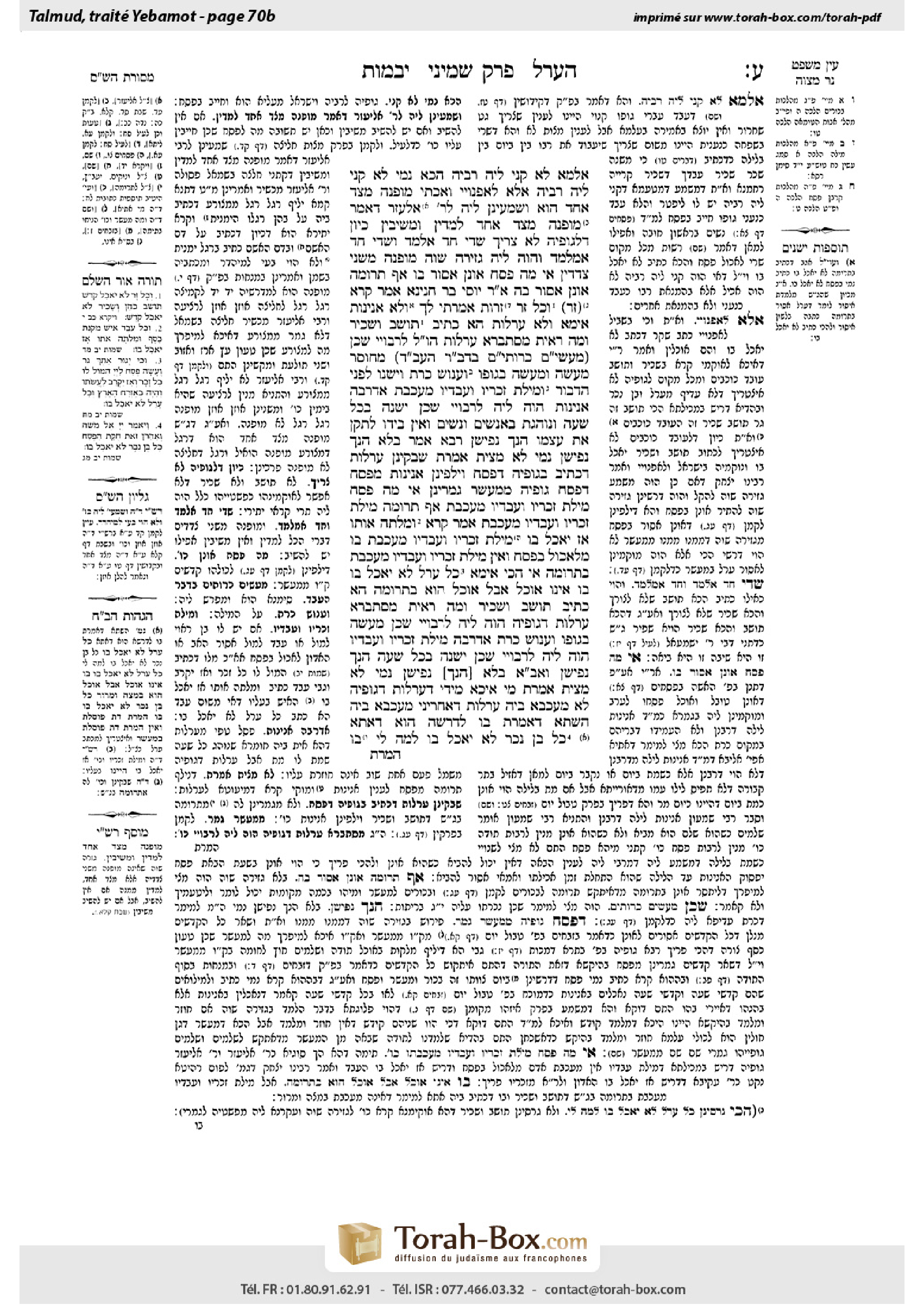
Yevamot 70b: Talmud study for Daf Yomi
Daf Yomi is the daily study of one Talmud folio. Explore 37 tractates with scans, Hebrew text, Sefaria English and AI-generated French translations where annotated.
Passage selection and English or AI-generated French translation are available where the scan has annotations. Daf Study is independent of Torah-Box and Sefaria.
Browse Yevamot · יבמות · All tractatesYevamot 70b text and translations
This page of Yevamot includes the Aramaic text, an English translation and an AI-generated French translation, alongside the scan above.
יבמות ע׳ ב · Aramaic and Hebrew text
אַלְמָא לָא קָנֵי לֵיהּ רַבֵּיהּ. הָכָא נָמֵי לָא קָנֵי לֵיהּ רַבֵּיהּ, אֶלָּא לְאַפְנוֹיֵי.
וְאַכַּתִּי מוּפְנֶה מִצַּד אֶחָד הוּא, וְשָׁמְעִינַן לֵיהּ לְרַבִּי אֶלְעָזָר דְּאָמַר: מוּפְנֶה מִצַּד אֶחָד, לְמֵדִין וּמְשִׁיבִין?
כֵּיוָן דִּלְגוּפֵיהּ לָא צְרִיךְ — שְׁדִי חַד אַלָּמֵד וּשְׁדִי חַד אַמְּלַמֵּד, וְהָוֵה לֵיהּ גְּזֵירָה שָׁוָה מוּפְנָה מִשְּׁנֵי צְדָדִין.
אִי: מָה פֶּסַח אוֹנֵן אָסוּר בּוֹ — אַף תְּרוּמָה אוֹנֵן אָסוּר בָּהּ.
אָמַר רַבִּי יוֹסֵי בַּר חֲנִינָא, אָמַר קְרָא: (״זָר״) ״וְכׇל זָר״, זָרוּת אָמַרְתִּי לְךָ, וְלֹא אֲנִינוּת. אֵימָא: וְלֹא עֲרֵלוּת! הָא כְּתִיב ״תּוֹשָׁב וְשָׂכִיר״.
וּמָה רָאִיתָ? מִסְתַּבְּרָא עֲרֵלוּת הֲוָה לֵיהּ לְרַבּוֹיֵי, שֶׁכֵּן (מַעֲשִׂים. כְּרוּתִים. בִּדְבַר. הָעֶבֶד.) מְחוּסַּר מַעֲשֶׂה, וּמַעֲשֶׂה בְּגוּפוֹ, וְעָנוּשׁ כָּרֵת, וְיֶשְׁנוֹ לִפְנֵי הַדִּבּוּר, וּמִילַת זְכָרָיו וַעֲבָדָיו מְעַכֶּבֶת!
אַדְּרַבָּה: אֲנִינוּת הֲוָה לֵיהּ לְרַבּוֹיֵי, שֶׁכֵּן יֶשְׁנָהּ בְּכׇל שָׁעָה, וְנוֹהֶגֶת בָּאֲנָשִׁים וְנָשִׁים, וְאֵין בְּיָדוֹ לְתַקֵּן אֶת עַצְמוֹ! הָנָךְ נְפִישָׁן.
רָבָא אָמַר: בְּלָא הָנָךְ נְפִישָׁן נָמֵי לָא מָצֵית אָמְרַתְּ. שָׁבְקִינַן עֲרֵלוּת דִּכְתִיב בְּגוּפֵיהּ דְּפֶסַח, וְיָלְפִינַן אֲנִינוּת מִפֶּסַח?! דְּפֶסַח גּוּפֵיהּ מִמַּעֲשֵׂר גָּמְרִינַן.
אִי: מָה פֶּסַח מִילַת זְכָרָיו וַעֲבָדָיו מְעַכֶּבֶת, אַף תְּרוּמָה מִילַת זְכָרָיו וַעֲבָדָיו מְעַכֶּבֶת!
אָמַר קְרָא: ״וּמַלְתָּה אוֹתוֹ אָז יֹאכַל בּוֹ״. מִילַת זְכָרָיו וַעֲבָדָיו מְעַכֶּבֶת בּוֹ מִלֶּאֱכוֹל בְּפֶסַח, וְאֵין מִילַת זְכָרָיו וַעֲבָדָיו מְעַכֶּבֶת בִּתְרוּמָה.
אִי הָכִי, אֵימָא: ״כׇּל עָרֵל לֹא יֹאכַל בּוֹ״, בּוֹ אֵינוֹ אוֹכֵל, אֲבָל אוֹכֵל הוּא בִּתְרוּמָה! הָא כְּתִיב ״תּוֹשָׁב וְשָׂכִיר״!
וּמָה רָאִיתָ? מִסְתַּבְּרָא עֲרֵלוּת דְּגוּפֵיהּ הֲוָה לֵיהּ לְרַבּוֹיֵי, שֶׁכֵּן מַעֲשֶׂה בְּגוּפוֹ, וְעָנוּשׁ כָּרֵת. אַדְּרַבָּה: מִילַת זְכָרָיו וַעֲבָדָיו הֲוָה לֵיהּ לְרַבּוֹיֵי, שֶׁכֵּן יֶשְׁנָהּ בְּכׇל שָׁעָה!
הָנָךְ נְפִישָׁן. וְאִיבָּעֵית אֵימָא: בְּלָא [הָנָךְ] נְפִישָׁן נָמֵי לָא מָצֵית אָמְרַתְּ. מִי אִיכָּא מִידֵּי דַּעֲרֵלוּת דְּגוּפֵיהּ לָא מְעַכְּבָא בֵּיהּ, עֲרֵלוּת דְּאַחֲרִינֵי מְעַכְּבָא בֵּיהּ?!
הַשְׁתָּא דְּאָמְרַתְּ: ״בּוֹ״ לִדְרָשָׁה הוּא דַּאֲתָא, ״כׇּל בֶּן נֵכָר לֹא יֹאכַל בּוֹ״ — לְמָה לִי? בּוֹ
Yevamot 70b · English translation
Apparently his master does not acquire his body and thereby effect a change in his personal status; rather, he remains a Jew in every sense. Here too, then, with regard to the Paschal lamb, his master does not acquire his body as a slave, and so he is obviously obligated in the mitzva of the Paschal lamb. Rather, the phrase is superfluous and was written only to be available to teach a different matter.
The Gemara poses a question: And yet there is still a difficulty: The verbal analogy is available from only one side, as only the phrase with regard to the Paschal lamb is superfluous in its context, and we heard Rabbi Elazar, who said with regard to a verbal analogy available from only one side that one can derive from it, and one can also refute it logically if there is reason to distinguish between the two cases. Since there are grounds here for differentiating between the two halakhot in this case, why is the verbal analogy upheld?
The Gemara answers: Since the phrase “a sojourner and a hired servant” is not needed for its own matter, there are two superfluous terms, and one may cast one superfluous term on the halakha with regard to which it is learned that teruma may not be eaten by one who is uncircumcised, and one may cast the other one on the halakha with regard to the Paschal lamb that teaches this, and in this manner it is like a verbal analogy that is available from both sides, which cannot be refuted.
The Gemara raises a question: There is a principle that there cannot be half a verbal analogy. Consequently, if this verbal analogy is accepted, the following halakha that can be derived by way of the same analogy should be accepted as well: Just as with regard to the Paschal lamb, one who is an acute mourner, i.e., whose relative died that same day and has not yet been buried, is prohibited from eating it, so too, with regard to teruma, an acute mourner should be prohibited from eating it, but in fact this is not the case.
Rabbi Yosei bar Ḥanina said: The verse states: “No foreigner may eat of the holy thing” (Leviticus 22:10), which indicates: A disqualification stemming from foreignness I told you prevents one from eating teruma, but not a disqualification based on acute mourning. The Gemara asks: Say that the verse comes to teach that a disqualification stemming from foreignness prevents one from eating teruma, but not a disqualification based on a priest’s lack of circumcision, and so it should be permitted for an uncircumcised priest to partake of teruma. The Gemara answers: Isn’t it written with regard to both teruma and the Paschal lamb: “A sojourner and a hired servant”? From this it is derived by way of a verbal analogy that it is prohibited for an uncircumcised priest to eat teruma.
The Gemara asks: And what did you see that led you to include an uncircumcised priest in the prohibition against eating teruma and exclude an acute mourner? Perhaps just the opposite is true. The Gemara answers: It stands to reason that lack of circumcision should be included and should prevent a priest from eating teruma, as the halakhot governing an uncircumcised man are stringent in several respects, as alluded to by the following mnemonic of key words: Acts; karetim; the divine word; the slave. The Gemara spells out these stringencies: An uncircumcised man lacks the act of circumcision, and this act is performed on his body; the failure to perform circumcision is punishable by karet; circumcision existed before the divine word was spoken at Mount Sinai, as the mitzva of circumcision had already been given to Abraham; and the lack of circumcision of one’s male children and slaves precludes one’s eating the Paschal lamb, as is explicitly stated in the Torah (Exodus 12:48).
The Gemara counters: On the contrary, acute mourning should be included and should prevent a priest from eating teruma, as acute mourning is also subject to several stringencies: It is relevant at any time after the death of a close relative, unlike circumcision, which is performed only once in a lifetime; it applies to both men and women, unlike circumcision, which is restricted to men; and it is not in the mourner’s power to render himself fit until after the deceased is buried, unlike an uncircumcised man, who can render himself fit at any time by undergoing circumcision. The Gemara responds: Even so, these arguments for including an uncircumcised priest in the prohibition are more numerous.
Rava said: Even without the rationale that these arguments are more numerous, you still could not say that the verbal analogy renders it prohibited for an acute mourner to eat teruma. As, is it possible to say that we should leave out the lack of circumcision from the prohibition against eating teruma even though it is written explicitly with regard to the Paschal lamb itself, and learn the halakha that acute mourning is included in the prohibition by way of a verbal analogy from the Paschal lamb when this halakha that an acute mourner is barred from bringing the Paschal lamb is never stated explicitly? As the prohibition against acute mourning with respect to the Paschal lamb itself we learn only from the halakha governing tithes.
The Gemara raises another question: If the verbal analogy is valid, then the following halakha that can be derived by way of the same analogy should be accepted as well: Just as with regard to the Paschal lamb, the lack of circumcision of one’s male children and slaves prevents one from eating of the offering until he ensures that all of the male members of his household have been circumcised, so too, with regard to teruma, the lack of circumcision of one’s male children and slaves should prevent one from partaking of teruma. However, in reality this is not the halakha.
The Gemara rejects this argument: The verse states with regard to the Paschal lamb: “When you have circumcised him, then he shall eat from it” (Exodus 12:44). The words “from it” teach that the lack of circumcision of one’s male children and slaves prevents one from eating the Paschal lamb, but the lack of circumcision of one’s male children and slaves does not prevent one from eating teruma, if he himself is eligible to eat it.
The Gemara raises a difficulty: If so, that the words “from it” come to exclude any other case, say a similar exposition with regard to the uncircumcised. As it is stated with regard to the Paschal lamb: “No uncircumcised person shall eat from it” (Exodus 12:48), indicating that “from it,” the Paschal lamb, an uncircumcised man may not eat, but he may eat from teruma. The Gemara answers: Isn’t it written with regard to both teruma and the Paschal lamb: “A sojourner and a hired servant”? From this it is derived by way of a verbal analogy that an uncircumcised priest may not partake of teruma.
The Gemara asks: And what did you see that led you to include an uncircumcised priest in the prohibition against eating teruma, and not one whose male children and slaves have not been circumcised? The Gemara answers: It stands to reason that one’s own lack of circumcision should be included and should preclude his eating teruma, as an uncircumcised man lacks an act that is performed on his own body, and the failure to perform circumcision is punishable by karet. The Gemara counters: On the contrary, the lack of circumcision of one’s male children and slaves should be included and should preclude a priest’s eating teruma, as it is relevant at any time, since whenever one has a male child or slave under his authority he is commanded to circumcise him.
The Gemara answers: These arguments for including one’s own circumcision in the prohibition are more numerous. And if you wish, say: Even without the rationale that these arguments are more numerous, you still could not say that the verbal analogy comes to include in the prohibition against eating teruma one whose male children or slaves have not been circumcised. As, is there anything that his own lack of circumcision does not preclude him from doing but the lack of circumcision of others does preclude him from doing? Rather, it must be that the verbal analogy comes to teach that the priest’s own lack of circumcision precludes his eating teruma, while that of his male children and slaves does not.
The Gemara poses a question: Now that you have said that the phrase “from it” used in this context comes for an exposition and serves to exclude other cases, with regard to the phrase “from it” in the verse “No stranger shall eat from it” (Exodus 12:43), why do I need it? The Gemara answers: This, too, teaches that it is only from it, eating the Paschal lamb,
Yevamot 70b · Traduction française (IA)
Il apparaît que son maître n’acquiert pas sa personne et ne modifie donc pas son statut personnel ; il reste juif à tous égards. Ici aussi, par conséquent, en ce qui concerne l’agneau pascal, son maître n’acquiert pas sa personne comme esclave ; il est donc manifestement tenu d’accomplir la mitsva de l’agneau pascal. La formule est donc superflue et n’a été écrite que pour servir à enseigner une autre règle.
La Guemara soulève une question : Pourtant, une difficulté subsiste : l’analogie verbale ne repose que sur un seul côté, car seule la formule concernant l’agneau pascal est superflue dans son contexte. Or, nous avons entendu Rabbi Elazar dire qu’à propos d’une analogie verbale qui ne repose que sur un seul côté, on peut en tirer une déduction, mais on peut aussi la réfuter par un raisonnement logique s’il existe une raison de distinguer les deux cas. Puisqu’il y a ici des motifs de distinguer les deux halakhot, pourquoi l’analogie verbale est-elle maintenue ?
La Guemara répond : Puisque la formule « un résident et un salarié » n’est pas nécessaire dans son contexte, il y a deux termes superflus. On peut donc attribuer l’un de ces termes à la halakha selon laquelle celui qui n’est pas circoncis ne peut pas manger de terouma, et l’autre à la halakha concernant l’agneau pascal qui enseigne cette règle. Ainsi, l’analogie verbale repose sur les deux côtés et ne peut être réfutée.
La Guemara soulève une question : Il existe un principe selon lequel une analogie verbale ne peut être appliquée que partiellement. Par conséquent, si cette analogie verbale est acceptée, il faut également accepter la halakha suivante, que l’on peut déduire par la même analogie : de même que, concernant l’agneau pascal, une personne en deuil immédiat, c’est-à-dire dont un proche est mort ce jour-là et n’a pas encore été enterré, n’a pas le droit d’en manger, de même, concernant la terouma, une personne en deuil immédiat devrait être empêchée d’en manger ; or, en réalité, ce n’est pas le cas.
Rabbi Yosei bar Ḥanina a dit : Le verset énonce : « Aucun étranger ne mangera de la chose sacrée » (Lévitique 22, 10), ce qui indique : je t’ai dit qu’une inaptitude due au statut d’étranger empêche de manger de la terouma, mais non une inaptitude due au deuil immédiat. La Guemara demande : Dis plutôt que le verset vient enseigner qu’une inaptitude due au statut d’étranger empêche de manger de la terouma, mais non une inaptitude due au fait qu’un prêtre ne soit pas circoncis ; il devrait donc être permis à un prêtre non circoncis de manger de la terouma. La Guemara répond : N’est-il pas écrit, à propos de la terouma comme de l’agneau pascal : « un résident et un salarié » ? On en déduit par une analogie verbale qu’il est interdit à un prêtre non circoncis de manger de la terouma.
La Guemara demande : Qu’as-tu vu qui t’a conduit à inclure un prêtre non circoncis dans l’interdiction de manger de la terouma et à en exclure une personne en deuil immédiat ? C’est peut-être l’inverse. La Guemara répond : Il est raisonnable d’inclure l’absence de circoncision, qui doit empêcher un prêtre de manger de la terouma, car les halakhot concernant un homme non circoncis sont rigoureuses à plusieurs égards, comme l’indique le moyen mnémotechnique suivant : acte ; peines de karet ; parole divine ; esclave. La Guemara détaille ces rigueurs : un homme non circoncis n’a pas accompli l’acte de la circoncision, acte effectué sur son corps ; le défaut de circoncision est passible de karet ; la circoncision existait avant la parole divine prononcée au mont Sinaï, puisque la mitsva de circoncision avait déjà été donnée à Abraham ; enfin, l’absence de circoncision de ses enfants mâles et de ses esclaves l’empêche de manger l’agneau pascal, comme cela est explicitement énoncé dans la Torah (Exode 12, 48).
La Guemara objecte : Au contraire, il faudrait inclure le deuil immédiat, qui devrait empêcher un prêtre de manger de la terouma, car le deuil immédiat comporte lui aussi plusieurs rigueurs : il peut se présenter à tout moment après la mort d’un proche, contrairement à la circoncision, qui n’est accomplie qu’une seule fois dans une vie ; il concerne les hommes comme les femmes, contrairement à la circoncision, qui ne concerne que les hommes ; enfin, la personne en deuil ne peut pas elle-même se rendre apte avant que le défunt soit enterré, contrairement à l’homme non circoncis, qui peut se rendre apte à tout moment en se faisant circoncire. La Guemara répond : Malgré tout, les arguments en faveur de l’inclusion du prêtre non circoncis dans l’interdiction sont plus nombreux.
Rava a dit : Même sans l’argument selon lequel ces considérations sont plus nombreuses, tu ne pourrais pas dire que l’analogie verbale interdit à une personne en deuil immédiat de manger de la terouma. En effet, peut-on dire qu’il faut exclure l’absence de circoncision de l’interdiction de manger de la terouma, alors qu’elle est explicitement mentionnée à propos de l’agneau pascal lui-même, et déduire par une analogie verbale avec l’agneau pascal que le deuil immédiat est inclus dans l’interdiction, alors que l’interdiction faite à une personne en deuil immédiat de présenter l’agneau pascal n’est jamais énoncée explicitement ? En effet, l’interdiction liée au deuil immédiat concernant l’agneau pascal lui-même, nous ne la déduisons que de la halakha relative aux dîmes.
La Guemara soulève une autre question : Si l’analogie verbale est valable, il faut également accepter la halakha suivante, que l’on peut déduire par la même analogie : de même que, concernant l’agneau pascal, l’absence de circoncision de ses enfants mâles et de ses esclaves l’empêche d’en manger tant qu’il ne s’est pas assuré que tous les membres mâles de sa maisonnée ont été circoncis, de même, concernant la terouma, l’absence de circoncision de ses enfants mâles et de ses esclaves devrait l’empêcher d’en manger. Pourtant, en réalité, telle n’est pas la halakha.
La Guemara rejette cet argument : Le verset concernant l’agneau pascal énonce : « Quand tu l’auras circoncis, il pourra alors en manger » (Exode 12, 44). Les mots « en manger » enseignent que l’absence de circoncision de ses enfants mâles et de ses esclaves l’empêche de manger l’agneau pascal, mais qu’elle ne l’empêche pas de manger de la terouma, s’il est lui-même apte à en manger.
La Guemara soulève une difficulté : Dans ce cas, puisque les mots « en manger » viennent exclure tout autre cas, propose une interprétation similaire à propos de l’homme non circoncis. En effet, il est dit au sujet de l’agneau pascal : « Aucun incirconcis n’en mangera » (Exode 12, 48), ce qui indique que, « de celui-ci », l’agneau pascal, un homme non circoncis ne peut pas manger, mais qu’il peut manger de la terouma. La Guemara répond : N’est-il pas écrit, à propos de la terouma comme de l’agneau pascal : « un résident et un salarié » ? On en déduit par une analogie verbale qu’un prêtre non circoncis ne peut pas manger de la terouma.
La Guemara demande : Qu’as-tu vu qui t’a conduit à inclure un prêtre non circoncis dans l’interdiction de manger de la terouma, mais non celui dont les enfants mâles et les esclaves n’ont pas été circoncis ? La Guemara répond : Il est raisonnable d’inclure sa propre absence de circoncision, qui doit l’empêcher de manger de la terouma, car un homme non circoncis n’a pas accompli un acte qui s’effectue sur son propre corps, et le défaut de circoncision est passible de karet. La Guemara objecte : Au contraire, il faudrait inclure l’absence de circoncision de ses enfants mâles et de ses esclaves, qui devrait empêcher un prêtre de manger de la terouma, car cela se présente à tout moment : chaque fois qu’un enfant mâle ou un esclave est sous son autorité, il a l’obligation de le faire circoncire.
La Guemara répond : Les arguments en faveur de l’inclusion de sa propre circoncision dans l’interdiction sont plus nombreux. Et si tu le souhaites, dis plutôt : même sans l’argument selon lequel ces considérations sont plus nombreuses, tu ne pourrais pas dire que l’analogie verbale vient inclure dans l’interdiction de manger de la terouma celui dont les enfants mâles ou les esclaves n’ont pas été circoncis. En effet, existe-t-il quelque chose que sa propre absence de circoncision ne l’empêche pas de faire, mais que l’absence de circoncision d’autrui l’empêcherait de faire ? Il faut plutôt conclure que l’analogie verbale vient enseigner que l’absence de circoncision du prêtre lui-même l’empêche de manger de la terouma, tandis que celle de ses enfants mâles et de ses esclaves ne l’en empêche pas.
La Guemara soulève une question : Maintenant que tu as dit que la formule « en manger » employée dans ce contexte sert à une interprétation et exclut d’autres cas, à quoi sert la formule « en manger » dans le verset « Aucun étranger n’en mangera » (Exode 12, 43) ? La Guemara répond : Cela aussi enseigne que c’est uniquement de celui-ci, l’agneau pascal,
Traduction française générée par IA à partir de l’édition anglaise de Sefaria. Vérifie toujours un passage avec le texte source.
Text from Sefaria: William Davidson Edition - Vocalized Aramaic (CC BY NC); William Davidson Edition - English (CC BY NC).