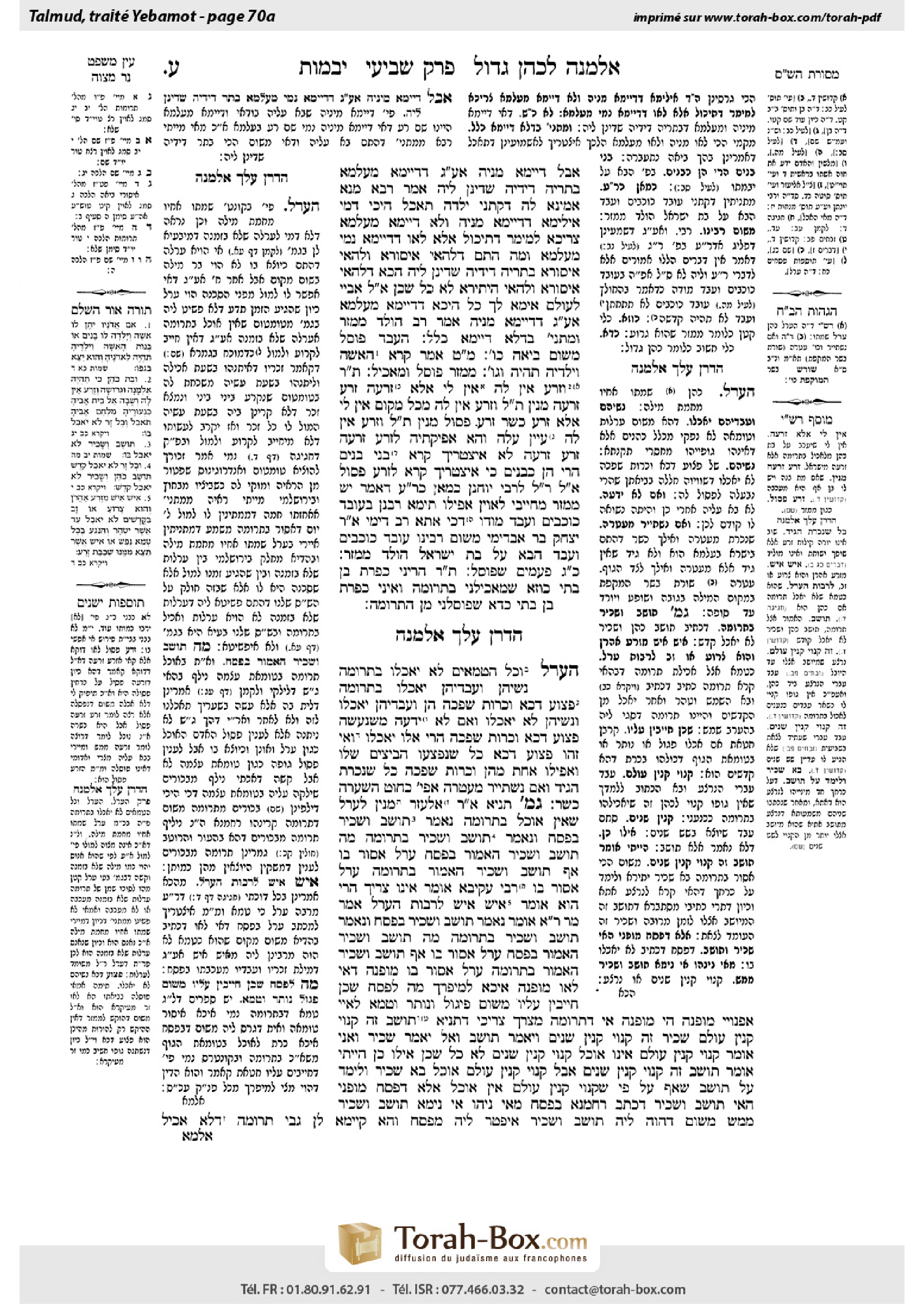
Yevamot 70a: Talmud study for Daf Yomi
Daf Yomi is the daily study of one Talmud folio. Explore 37 tractates with scans, Hebrew text, Sefaria English and AI-generated French translations where annotated.
Passage selection and English or AI-generated French translation are available where the scan has annotations. Daf Study is independent of Torah-Box and Sefaria.
Browse Yevamot · יבמות · All tractatesYevamot 70a text and translations
This page of Yevamot includes the Aramaic text, an English translation and an AI-generated French translation, alongside the scan above.
יבמות ע׳ א · Aramaic and Hebrew text
אֲבָל דָּיְימָא מִנֵּיהּ, אַף עַל גַּב דְּדָיְימָא מֵעָלְמָא — בָּתְרֵיהּ דִּידֵיהּ שָׁדֵינַן לֵיהּ.
אָמַר רָבָא: מְנָא אָמֵינָא לַהּ — דְּקָתָנֵי: יָלְדָה — תֹּאכַל. הֵיכִי דָמֵי? אִילֵּימָא דְּדָיְימָא מִנֵּיהּ וְלָא דָּיְימָא מֵעָלְמָא — צְרִיכָא לְמֵימַר דְּתֵיכוֹל?! אֶלָּא לָאו — דְּדָיְימָא נָמֵי מֵעָלְמָא,
וּמָה הָתָם, דִּלְהַאי אִיסּוּרָא וּלְהַאי אִיסּוּרָא — בָּתְרֵיהּ דִּידֵיהּ שָׁדֵינַן לֵיהּ, הָכָא, דִּלְהַאי אִיסּוּרָא וּלְהַאי הֶיתֵּירָא — לֹא כׇּל שֶׁכֵּן?!
אֲמַר לֵיהּ אַבָּיֵי: לְעוֹלָם אֵימָא לָךְ כׇּל הֵיכָא דְּדָיְימָא מֵעָלְמָא, אַף עַל גַּב דְּדָיְימָא מִנֵּיהּ, אֲמַר רַב: הַוָּלָד מַמְזֵר. וּמַתְנִיתִין בִּדְלָא דָּיְימָא כְּלָל.
הָעֶבֶד פּוֹסֵל מִשּׁוּם בִּיאָה כּוּ׳. מַאי טַעְמָא — אָמַר קְרָא: ״הָאִשָּׁה וִילָדֶיהָ תִּהְיֶה וְגוֹ׳״.
מַמְזֵר פּוֹסֵל וּמַאֲכִיל. תָּנוּ רַבָּנַן: ״וְזֶרַע אֵין לָהּ״, אֵין לִי אֶלָּא זַרְעָהּ, זֶרַע זַרְעָהּ מִנַּיִן? תַּלְמוּד לוֹמַר: ״וְזֶרַע אֵין לָהּ״ — מִכׇּל מָקוֹם.
אֵין לִי אֶלָּא זֶרַע כָּשֵׁר, זֶרַע פָּסוּל מִנַּיִן — תַּלְמוּד לוֹמַר: ״וְזֶרַע אֵין לָהּ״, עַיֵּין עָלֶיהָ.
וְהָא אַפֵּיקְתֵּיהּ לְזֶרַע זַרְעָהּ! זֶרַע זַרְעָהּ לָא אִיצְטְרִיךְ קְרָא, בְּנֵי בָנִים הֲרֵי הֵן כְּבָנִים. כִּי אִיצְטְרִיךְ קְרָא, לְזֶרַע פָּסוּל.
אֲמַר לֵיהּ רֵישׁ לָקִישׁ לְרַבִּי יוֹחָנָן: כְּמַאן — כְּרַבִּי עֲקִיבָא, דְּאָמַר: יֵשׁ מַמְזֵר מֵחַיָּיבֵי לָאוִין? אֲפִילּוּ תֵּימָא רַבָּנַן, בְּגוֹי וְעֶבֶד מוֹדוּ, דְּכִי אֲתָא רַב דִּימִי, אָמַר רַבִּי יִצְחָק בַּר אַבְדִּימִי מִשּׁוּם רַבֵּינוּ: גּוֹי וְעֶבֶד הַבָּא עַל בַּת יִשְׂרָאֵל — הַוָּלָד מַמְזֵר.
כֹּהֵן גָּדוֹל, פְּעָמִים שֶׁפּוֹסֵל. תָּנוּ רַבָּנַן: הֲרֵינִי כַּפָּרַת בֶּן בִּתִּי כּוּזָא — שֶׁמַּאֲכִילֵנִי בַּתְּרוּמָה, וְאֵינִי כַּפָּרַת בֶּן בִּתִּי כַּדָּא — שֶׁפּוֹסְלֵנִי מִן הַתְּרוּמָה.
הֲדַרַן עֲלָךְ אַלְמָנָה
הֶעָרֵל וְכׇל הַטְּמֵאִים — לֹא יֹאכְלוּ בִּתְרוּמָה. נְשֵׁיהֶן וְעַבְדֵיהֶן יֹאכְלוּ בִּתְרוּמָה.
פְּצוּעַ דַּכָּא וּכְרוּת שׇׁפְכָה — הֵן וְעַבְדֵיהֶן יֹאכֵלוּ, וּנְשֵׁיהֶן לֹא יֹאכֵלוּ. וְאִם לֹא יָדְעָה מִשֶּׁנַּעֲשָׂה פְּצוּעַ דַּכָּא וּכְרוּת שׇׁפְכָה — הֲרֵי אֵלּוּ יֹאכֵלוּ.
וְאֵי זֶהוּ פְּצוּעַ דַּכָּא — כׇּל שֶׁנִּפְצְעוּ הַבֵּיצִים שֶׁלּוֹ, וַאֲפִילּוּ אַחַת מֵהֶן. וּכְרוּת שׇׁפְכָה — כׇּל שֶׁנִּכְרַת הַגִּיד, וְאִם נִשְׁתַּיֵּיר מֵעֲטָרָה אֲפִילּוּ כְּחוּט הַשַּׂעֲרָה — כָּשֵׁר.
גְּמָ׳ תַּנְיָא, אָמַר רַבִּי אֶלְעָזָר: מִנַּיִן לֶעָרֵל שֶׁאֵין אוֹכֵל בִּתְרוּמָה? נֶאֱמַר ״תּוֹשָׁב וְשָׂכִיר״ בַּפֶּסַח, וְנֶאֱמַר ״תּוֹשָׁב וְשָׂכִיר״ בַּתְּרוּמָה. מָה ״תּוֹשָׁב וְשָׂכִיר״ הָאָמוּר בַּפֶּסַח — עָרֵל אָסוּר בּוֹ, אַף ״תּוֹשָׁב וְשָׂכִיר״ הָאָמוּר בַּתְּרוּמָה — עָרֵל אָסוּר בּוֹ.
רַבִּי עֲקִיבָא אוֹמֵר: אֵינוֹ צָרִיךְ, הֲרֵי הוּא אוֹמֵר ״אִישׁ אִישׁ״ — לְרַבּוֹת הֶעָרֵל.
אָמַר מָר, רַבִּי אֱלִיעֶזֶר אוֹמֵר: נֶאֱמַר ״תּוֹשָׁב וְשָׂכִיר״ בַּפֶּסַח, וְנֶאֱמַר ״תּוֹשָׁב וְשָׂכִיר״ בַּתְּרוּמָה. מָה ״תּוֹשָׁב וְשָׂכִיר״ הָאָמוּר בַּפֶּסַח — עָרֵל אָסוּר בּוֹ, אַף ״תּוֹשָׁב וְשָׂכִיר״ הָאָמוּר בַּתְּרוּמָה — עָרֵל אָסוּר בּוֹ.
מוּפְנֶה. דְּאִי לָאו מוּפְנֶה אִיכָּא לְמִיפְרַךְ: מָה לְפֶסַח, שֶׁכֵּן חַיָּיבִין עָלָיו מִשּׁוּם פִּיגּוּל וְנוֹתָר וְטָמֵא. לָאיֵי, אַפְנוֹיֵי מוּפְנֶה.
הֵי מוּפְנֶה? אִי דִּתְרוּמָה — מִצְרָךְ צְרִיכִי, דְּתַנְיָא: ״תּוֹשָׁב״ זֶה קָנוּי קִנְיַן עוֹלָם, ״שָׂכִיר״ — זֶה קָנוּי קִנְיַן שָׁנִים.
וְיֵאָמֵר ״תּוֹשָׁב״ וְאַל יֵאָמֵר ״שָׂכִיר״, וַאֲנִי אוֹמֵר: קָנוּי קִנְיַן עוֹלָם אֵינוֹ אוֹכֵל — קָנוּי קִנְיַן שָׁנִים לֹא כׇּל שֶׁכֵּן!
אִילּוּ כֵּן, הָיִיתִי אוֹמֵר ״תּוֹשָׁב״ — זֶה קָנוּי קִנְיַן שָׁנִים, אֲבָל קָנוּי קִנְיַן עוֹלָם — אוֹכֵל, בָּא שָׂכִיר וְלִימֵּד עַל תּוֹשָׁב, שֶׁאַף עַל פִּי שֶׁקָּנוּי קִנְיַן עוֹלָם — אֵין אוֹכֵל.
אֶלָּא דְּפֶסַח מוּפְנֵי. הַאי ״תּוֹשָׁב וְשָׂכִיר״ דִּכְתַב רַחֲמָנָא בְּפֶסַח מַאי נִיהוּ? אִי נֵימָא תּוֹשָׁב וְשָׂכִיר מַמָּשׁ, מִשּׁוּם דְּהָוֵה לֵיהּ תּוֹשָׁב וְשָׂכִיר אִיפְּטַר לֵיהּ מִפֶּסַח?! וְהָא קַיְימָא לַן גַּבֵּי תְּרוּמָה דְּלָא אָכֵיל!
Yevamot 70a · English translation
However, if she is rumored to have engaged in intercourse with him, even if she is also rumored to have engaged in intercourse with others, we cast the child after him.
Rava said: From where do I say that? My source is the mishna that teaches that if a priest engaged in extramarital intercourse with an Israelite woman and she gave birth, she may partake of teruma due to her child. What are the circumstances? If we say that she is rumored to have engaged in intercourse with him and she is not rumored to have engaged in intercourse with others, need it be said that she may partake of teruma? It can easily be assumed that the priest is the father. Rather, is it not a case where she is rumored to have engaged in intercourse with others as well?
And if there, where for her to engage in intercourse with this priest is in violation of a prohibition and to engage in intercourse with that non-priest is in violation of a prohibition of the same degree, and she is rumored to have engaged in intercourse with both, nevertheless, we cast the child after the priest, then here, where for her to engage in intercourse with that man who is not her betrothed is in violation of a Torah prohibition and to engage in intercourse with this man, her betrothed, is permitted by Torah law, is it not all the more so that he should be considered the father?
Abaye said to him: Actually, I could say to you that anywhere that she is rumored to have engaged in intercourse with others, even if she is also rumored to have engaged in intercourse with him, Rav said that the offspring is a mamzer. And the mishna, which you cited as support for your claim, is referring to a situation where she is not rumored to have engaged in intercourse with anyone at all. Therefore, if they both concur that he is the father, the child is considered his.
§ It is stated in the mishna that a slave disqualifies a woman from partaking of teruma due to his engaging in intercourse with her, but not due to his being her offspring. The Gemara asks: What is the reason that he does not disqualify a woman whose offspring he is? The verse states with regard to a maidservant married to a Hebrew slave, that when he is released, “the wife and her children shall be her master’s” (Exodus 21:4). This indicates that the maidservant’s children are considered her own and are not considered their father’s offspring at all. Therefore, a maidservant’s child does not disqualify his paternal grandmother from partaking of teruma.
§ It is stated in the mishna that a mamzer disqualifies a woman from partaking of teruma, and he also enables a woman to partake of teruma. The Sages taught: The Torah states, “But if a priest’s daughter be a widow, or divorced, and have no child…she may eat of her father’s bread” (Leviticus 22:13). I have derived only that her own child disqualifies her from partaking of teruma; from where do I derive that her child’s child disqualifies her as well? The verse states: “And she has no child [zera]” at all, indicating that even her grandchild disqualifies her, as zera means offspring.
I have derived only that an unflawed child disqualifies her; from where do I derive that an unfit child disqualifies her as well? The verse states: “And she has no [ein la] child,” which can be homiletically interpreted as examine her [ayyein ala] to check if she has any offspring, fit or unfit.
The Gemara asks: But didn’t you already derive from that phrase that her child’s child disqualifies her? The Gemara answers: To derive the halakha with regard to her child’s child, no verse was necessary, as the children of children are considered like children. The verse was therefore necessary for deriving the halakha of an unfit child.
Reish Lakish said to Rabbi Yoḥanan: In accordance with whose opinion is the assumption of the mishna that the child of a Jewess and a slave or a gentile is a mamzer? Is it in accordance only with the opinion of Rabbi Akiva, who said that the offspring of relations for which one is liable for violating a prohibition is a mamzer? The Gemara answers: You can even say that it is in accordance with the Rabbis, who hold that the offspring is a mamzer only if the parents are liable to receive karet. This is because they concede with regard to a slave and a gentile, as when Rav Dimi came from Eretz Yisrael to Babylonia, he said that Rabbi Yitzḥak bar Avdimi said in the name of Rabbi Yehuda HaNasi: With regard to a gentile or a slave who engaged in intercourse with a Jewish woman, the offspring is a mamzer.
§ It was taught in the mishna that even a High Priest sometimes disqualifies his grandmother from partaking of teruma. The Sages taught that she can say in disapproval: I am hereby atonement for my daughter’s son, the small jug [kuza], i.e., the mamzer. He is dear to me and I am willing to suffer to atone for him, as he is my offspring from a priest and therefore enables me to partake of teruma. However, I am not willing to be atonement for my daughter’s son, the large jug [kada], the High Priest, as he is my offspring from an Israelite and therefore disqualifies me from partaking of teruma.
MISHNA: An uncircumcised priest, e.g., one for whom circumcision was considered too dangerous, and all those who are ritually impure with any type of impurity, may not partake of teruma, the portion of produce that must be set aside for the priests. However, their wives and their slaves may partake of teruma.
With regard to both a man with crushed testicles or with other wounds to his genitals [petzua dakka] and one whose penis has been severed [kerut shofkha], it is prohibited for them to marry a woman who was born Jewish. If they are priests they and their slaves may partake of teruma, as this condition does not disqualify them or their property. However, their wives may not partake of teruma, because if a priest has relations with his wife after suffering his injury, he renders her a ḥalala, a woman who is disqualified from marrying a priest, as he has engaged in forbidden sexual relations with her. If such a priest did not know his wife, i.e., did not engage in sexual relations with her, after his testicles were crushed or his penis was severed, she may partake of teruma, as she had married the priest in a permitted manner.
And who is deemed a man with crushed testicles? It is anyone whose testicles have been wounded, even one of them. And one whose penis has been severed is anyone whose sexual member has been cut off. As for the measure that renders him unfit, if there remains a portion of the corona, even as much as a hairsbreadth, he is still fit. However, if nothing at all is left of the corona, he is considered as one with a severed penis, for whom it is prohibited by Torah law to marry a Jewish woman.
GEMARA: It is taught in a baraita that Rabbi Elazar said: From where is it derived that an uncircumcised priest may not partake of teruma? It is stated: “A sojourner and a hired servant shall not eat thereof” (Exodus 12:45) with regard to the Paschal lamb, and it is stated: “A sojourner of a priest and a hired servant shall not eat of the holy thing” (Leviticus 22:10) with regard to teruma. Just as “a sojourner and a hired servant” stated with regard to the Paschal lamb indicates that an uncircumcised man is prohibited from eating it, so too, “a sojourner and a hired servant” stated with regard to teruma teaches that an uncircumcised man is prohibited from eating it.
Rabbi Akiva says: This proof is not necessary, as the verse states: “Any man [ish ish] from the seed of Aaron who is a leper or a zav shall not eat of the holy things until he be pure” (Leviticus 22:4). The repetition of the word ish, meaning man, comes to include an uncircumcised man, indicating that he is like one who is ritually impure and therefore may not partake of consecrated food.
The Gemara analyzes this baraita in detail. The Master said: Rabbi Eliezer says that it is stated: “A sojourner and a hired servant” with regard to the Paschal lamb, and it is stated: “A sojourner and a hired servant” with regard to teruma. Just as “a sojourner and a hired servant” stated with regard to the Paschal lamb indicates that an uncircumcised man is prohibited from eating it, so too, “a sojourner and a hired servant” stated with regard to teruma teaches that an uncircumcised man is prohibited from eating it.
With regard to this verbal analogy the Gemara comments: The phrase “a sojourner and a hired servant” must be available, i.e., superfluous in its context and therefore available for the purpose of establishing a verbal analogy. As, if it is not available, the verbal analogy can be refuted logically, as it is possible to say: What is unique to the Paschal lamb? It is that one is liable to receive karet for eating it due to its being piggul, an offering that was sacrificed with the intent to consume it after its appointed time, or due to its being notar, the flesh of an offering that is left over beyond its allotted time, or due to the one consuming it being ritually impure. Therefore, it could be argued that it is owing to the Paschal lamb’s special sanctity and severity that an uncircumcised man may not partake of it. But from where is it derived that an uncircumcised priest may not eat teruma? The Gemara concludes: This is not so [la’ei], as the phrase is in fact available for establishing the verbal analogy.
The Gemara asks: Which of the instances of the phrase “a sojourner and a hired servant” is not needed in its own context and is therefore available for establishing a verbal analogy? If one would claim that it is that which is stated with regard to teruma, certainly those words are necessary, as it is taught in a baraita: “A sojourner”; this is referring to a Hebrew slave who was acquired as a permanent acquisition until the Jubilee Year, i.e., a slave who did not wish to terminate his servitude and underwent a ceremony in which his ear was pierced with an awl. “A hired servant”; this is referring to a Hebrew slave who was acquired as an acquisition for a period of six years.
The baraita asks: And let the verse state only that “a sojourner” may not eat teruma, and not state anything about “a hired servant,” and I would say by way of an a fortiori inference: If a slave who was acquired as a permanent acquisition may not partake of teruma, then with regard to one who was acquired as an acquisition for only six years, all the more so is it not clear that he should be prohibited from eating it?
The baraita answers: If it was written so, I would have said with regard to “a sojourner” that this is referring to a slave who was acquired as an acquisition for a period of six years, as he may not eat teruma; but one who was acquired as a permanent acquisition may in fact partake of teruma. Therefore, the term “a hired servant” comes and teaches that “a sojourner” is referring to a slave who had his ear pierced and must now remain with his master until the Jubilee Year, and that although he was acquired as a permanent acquisition, he may not partake of teruma.
The Gemara proposes: Rather, it is the phrase with regard to the Paschal lamb that is available for establishing a verbal analogy. This phrase: “A sojourner and a hired servant,” that the Merciful One writes with regard to the Paschal lamb, to what is it referring? If we say that the verse is referring to an actual sojourner and to a hired servant, i.e., a Hebrew slave who was acquired permanently or for a fixed number of years, can it possibly be that because he is a sojourner or a hired servant he is exempt from the mitzva of the Paschal lamb? If one answers in the affirmative and argues that a Hebrew slave, like his Canaanite counterpart, is considered his master’s property and is therefore no longer obligated in all the mitzvot like a freeman, this conclusion is difficult, as we maintain with regard to teruma that a Hebrew slave may not partake of it on account of his priestly master.
Yevamot 70a · Traduction française (IA)
Cependant, si l’on dit qu’elle a eu des relations sexuelles avec lui, même si l’on dit aussi qu’elle en a eu avec d’autres, nous attribuons l’enfant à cet homme.
Rava dit : D’où est-ce que je tire cela ? De la Michna, qui enseigne que si un prêtre a eu des relations extraconjugales avec une femme israélite et qu’elle a accouché, elle peut consommer la terouma grâce à son enfant. De quelle situation s’agit-il ? Si l’on dit qu’elle a eu des relations avec lui, mais pas avec d’autres, est-il nécessaire de préciser qu’elle peut consommer la terouma ? On peut aisément supposer que le prêtre est le père. Il s’agit donc, n’est-ce pas, d’un cas où l’on dit qu’elle a également eu des relations avec d’autres ?
Et si, dans ce cas, avoir des relations avec ce prêtre constitue une transgression et en avoir avec cet homme qui n’est pas prêtre constitue une transgression du même degré, et que l’on dit qu’elle a eu des relations avec les deux, nous attribuons néanmoins l’enfant au prêtre, alors ici, où avoir des relations avec cet homme qui n’est pas son fiancé constitue une transgression d’une interdiction de la Torah, tandis qu’avoir des relations avec cet homme, son fiancé, est permis par la Torah, à plus forte raison ne devrait-on pas le considérer comme le père ?
Abayé lui dit : En réalité, je pourrais te dire que partout où l’on dit qu’elle a eu des relations avec d’autres, même si l’on dit aussi qu’elle en a eu avec lui, Rav considère que l’enfant est un mamzer. Quant à la Michna que tu as citée à l’appui de ton argument, elle parle d’une situation où l’on ne dit pas qu’elle a eu des relations avec qui que ce soit. Par conséquent, si tous deux reconnaissent qu’il est le père, l’enfant est considéré comme le sien.
§ La Michna indique qu’un esclave disqualifie une femme pour la consommation de la terouma en ayant des relations avec elle, mais non parce qu’il est son descendant. La Guemara demande : Pourquoi ne disqualifie-t-il pas une femme dont il est le descendant ? Le verset dit, au sujet d’une servante mariée à un esclave hébreu, qu’à la libération de celui-ci, « la femme et ses enfants appartiendront à son maître » (Exode 21:4). Cela indique que les enfants de la servante sont considérés comme les siens et ne sont nullement considérés comme la descendance de leur père. Par conséquent, l’enfant d’une servante ne disqualifie pas sa grand-mère paternelle pour la consommation de la terouma.
§ La Michna indique qu’un mamzer disqualifie une femme pour la consommation de la terouma, mais peut aussi lui permettre d’en consommer. Les Sages ont enseigné : La Torah dit : « Mais si la fille d’un prêtre est veuve ou divorcée et n’a pas d’enfant […] elle pourra manger du pain de son père » (Lévitique 22:13). J’ai déduit de là que seul son propre enfant la disqualifie pour la consommation de la terouma ; d’où déduis-je que l’enfant de son enfant la disqualifie également ? Le verset dit : « et qu’elle n’a pas d’enfant [zera] », sans aucune restriction, ce qui indique que même son petit-enfant la disqualifie, car zera signifie « descendance ».
J’ai déduit de là qu’un enfant sans défaut la disqualifie ; d’où déduis-je qu’un enfant inapte la disqualifie également ? Le verset dit : « et elle n’a pas [ein la] d’enfant », expression qui peut être interprétée par homilétique comme suit : examine-la [ayyein ala] pour vérifier si elle a des descendants, aptes ou inaptes.
La Guemara demande : Mais n’as-tu pas déjà déduit de cette expression que l’enfant de son enfant la disqualifie ? La Guemara répond : Pour déduire la halakha concernant l’enfant de son enfant, aucun verset n’était nécessaire, puisque les enfants des enfants sont considérés comme des enfants. Le verset était donc nécessaire pour déduire la halakha relative à un enfant inapte.
Reish Lakish dit à Rabbi Yoḥanan : Selon l’opinion de qui la Michna présume-t-elle que l’enfant d’une femme juive et d’un esclave ou d’un non-Juif est un mamzer ? Est-ce uniquement selon l’opinion de Rabbi Akiva, qui dit que la descendance issue de relations dont les parents sont passibles d’une peine pour avoir transgressé une interdiction est un mamzer ? La Guemara répond : Tu peux même dire que c’est selon l’opinion des Rabbins, qui soutiennent que la descendance n’est mamzer que si les parents sont passibles de karet. En effet, ils sont d’accord au sujet d’un esclave et d’un non-Juif, car lorsque Rav Dimi vint d’Eretz Israël en Babylonie, il dit que Rabbi Yitzḥak bar Avdimi avait rapporté au nom de Rabbi Yehuda HaNasi : Lorsqu’un non-Juif ou un esclave a des relations avec une femme juive, l’enfant est un mamzer.
§ La Michna enseigne que même un grand prêtre disqualifie parfois sa grand-mère pour la consommation de la terouma. Les Sages ont enseigné qu’elle peut dire avec dépit : « Je suis prête à servir d’expiation pour le fils de ma fille, la petite cruche [kuza] », c’est-à-dire le mamzer. Il m’est cher et je suis prête à souffrir pour lui servir d’expiation, car il est le descendant d’un prêtre et me permet donc de consommer la terouma. « Mais je ne suis pas prête à servir d’expiation pour le fils de ma fille, la grande cruche [kada] », c’est-à-dire le grand prêtre, car il est le descendant d’un Israélite et me disqualifie donc pour la consommation de la terouma.
MICHNA : Un prêtre incirconcis, par exemple celui pour qui la circoncision est jugée trop dangereuse, ainsi que toute personne atteinte d’une quelconque impureté rituelle, ne peut consommer la terouma, la part des produits agricoles qui doit être prélevée pour les prêtres. En revanche, leurs épouses et leurs esclaves peuvent consommer la terouma.
Un homme aux testicules écrasés ou présentant d’autres blessures aux organes génitaux [petzua dakka], ainsi qu’un homme dont le pénis a été sectionné [kerut shofkha], ne peuvent épouser une femme née juive. S’ils sont prêtres, eux-mêmes et leurs esclaves peuvent consommer la terouma, car cette condition ne les disqualifie pas, eux ni leurs biens. En revanche, leurs épouses ne peuvent pas consommer la terouma, car si un prêtre a des relations avec son épouse après avoir subi sa blessure, il fait d’elle une ḥalala, une femme disqualifiée pour épouser un prêtre, puisqu’il a eu avec elle des relations interdites. Si un tel prêtre n’a pas connu son épouse, c’est-à-dire n’a pas eu de relations sexuelles avec elle, après que ses testicules ont été écrasés ou son pénis sectionné, elle peut consommer la terouma, car elle a épousé le prêtre dans des conditions permises.
Et qui est considéré comme un homme aux testicules écrasés ? Quiconque a subi une blessure aux testicules, même à un seul d’entre eux. Et un homme dont le pénis a été sectionné est quiconque a eu son organe sexuel coupé. Quant au seuil qui le rend inapte, s’il reste une partie du gland, même large comme un cheveu, il demeure apte. Mais si rien du tout ne reste du gland, il est considéré comme ayant le pénis sectionné, et il lui est interdit par la Torah d’épouser une femme juive.
GUEMARA : Une baraïta enseigne que Rabbi Elazar a dit : D’où déduit-on qu’un prêtre incirconcis ne peut pas consommer la terouma ? À propos de l’agneau pascal, il est dit : « L’habitant et le mercenaire n’en mangeront pas » (Exode 12:45), et à propos de la terouma, il est dit : « L’habitant d’un prêtre et le mercenaire ne mangeront pas de la chose sainte » (Lévitique 22:10). De même que « l’habitant et le mercenaire », à propos de l’agneau pascal, indique qu’un homme incirconcis ne peut pas en manger, de même « l’habitant et le mercenaire », à propos de la terouma, enseigne qu’un homme incirconcis ne peut pas en manger.
Rabbi Akiva dit : Cette preuve n’est pas nécessaire, car le verset dit : « Tout homme [ish ish] de la descendance d’Aaron qui est lépreux ou atteint de gonorrhée ne mangera pas des choses saintes avant d’être purifié » (Lévitique 22:4). La répétition du mot ish, qui signifie « homme », vient inclure un homme incirconcis, indiquant qu’il est comparable à une personne rituellement impure et ne peut donc pas consommer de nourriture consacrée.
La Guemara analyse cette baraïta en détail. Le Maître a dit : Rabbi Eliezer dit qu’il est écrit « l’habitant et le mercenaire » à propos de l’agneau pascal, et « l’habitant et le mercenaire » à propos de la terouma. De même que « l’habitant et le mercenaire », à propos de l’agneau pascal, indique qu’un homme incirconcis ne peut pas en manger, de même « l’habitant et le mercenaire », à propos de la terouma, enseigne qu’un homme incirconcis ne peut pas en manger.
À propos de cette analogie verbale, la Guemara fait remarquer : L’expression « l’habitant et le mercenaire » doit être disponible, c’est-à-dire superflue dans son contexte et donc utilisable pour établir une analogie verbale. Car, si elle n’était pas disponible, on pourrait réfuter l’analogie par un raisonnement logique, en disant : Qu’est-ce qui distingue l’agneau pascal ? On encourt le karet pour en manger lorsqu’il est piggoul, c’est-à-dire une offrande sacrifiée avec l’intention de la consommer après le délai prescrit, ou lorsqu’il est notar, c’est-à-dire que sa chair est restée au-delà du délai qui lui était imparti, ou encore si celui qui le consomme est rituellement impur. On pourrait donc soutenir que c’est en raison de la sainteté et de la rigueur particulières de l’agneau pascal qu’un homme incirconcis ne peut pas en manger. Mais d’où déduit-on qu’un prêtre incirconcis ne peut pas consommer la terouma ? La Guemara conclut : Ce n’est pas le cas [la’ei], car l’expression est bel et bien disponible pour établir l’analogie verbale.
La Guemara demande : Quelle occurrence de l’expression « l’habitant et le mercenaire » n’est-elle pas nécessaire dans son propre contexte et est donc disponible pour établir une analogie verbale ? Si l’on prétend que c’est celle qui figure à propos de la terouma, ces mots sont certainement nécessaires, comme l’enseigne une baraïta : « L’habitant » désigne un esclave hébreu acquis à titre permanent jusqu’à l’année du Jubilé, c’est-à-dire un esclave qui n’a pas voulu mettre fin à sa servitude et a subi une cérémonie au cours de laquelle son oreille a été percée avec un poinçon. « Le mercenaire » désigne un esclave hébreu acquis pour une période de six ans.
La baraïta demande : Que le verset dise seulement qu’un « habitant » ne peut pas consommer la terouma, sans rien dire au sujet d’un « mercenaire » ; je pourrais alors déduire a fortiori : si un esclave acquis à titre permanent ne peut pas consommer la terouma, ne va-t-il pas de soi que celui qui a été acquis pour seulement six ans ne peut pas non plus en manger ?
La baraïta répond : Si le verset était formulé ainsi, j’aurais dit au sujet de l’« habitant » qu’il s’agit d’un esclave acquis pour six ans, qui ne peut pas consommer la terouma, tandis que celui qui a été acquis à titre permanent peut effectivement en consommer. C’est pourquoi le terme « mercenaire » vient enseigner que l’« habitant » désigne un esclave dont l’oreille a été percée et qui doit désormais rester auprès de son maître jusqu’à l’année du Jubilé et que, bien qu’il ait été acquis à titre permanent, il ne peut pas consommer la terouma.
La Guemara propose : C’est donc l’expression concernant l’agneau pascal qui est disponible pour établir une analogie verbale. Cette expression, « l’habitant et le mercenaire », que le Miséricordieux fait figurer à propos de l’agneau pascal, à quoi fait-elle référence ? Si l’on dit que le verset parle d’un véritable habitant et d’un véritable mercenaire, c’est-à-dire d’un esclave hébreu acquis à titre permanent ou pour un nombre fixe d’années, peut-on vraiment dire qu’il serait exempt de la mitsva de l’agneau pascal parce qu’il est un habitant ou un mercenaire ? Si l’on répond par l’affirmative en soutenant qu’un esclave hébreu, comme son équivalent cananéen, est considéré comme appartenant à son maître et n’est donc plus tenu d’accomplir toutes les mitsvot au même titre qu’un homme libre, cette conclusion pose problème, car nous soutenons, à propos de la terouma, qu’un esclave hébreu ne peut pas en consommer du fait de son maître prêtre.
Traduction française générée par IA à partir de l’édition anglaise de Sefaria. Vérifie toujours un passage avec le texte source.
Text from Sefaria: William Davidson Edition - Vocalized Aramaic (CC BY NC); William Davidson Edition - English (CC BY NC).