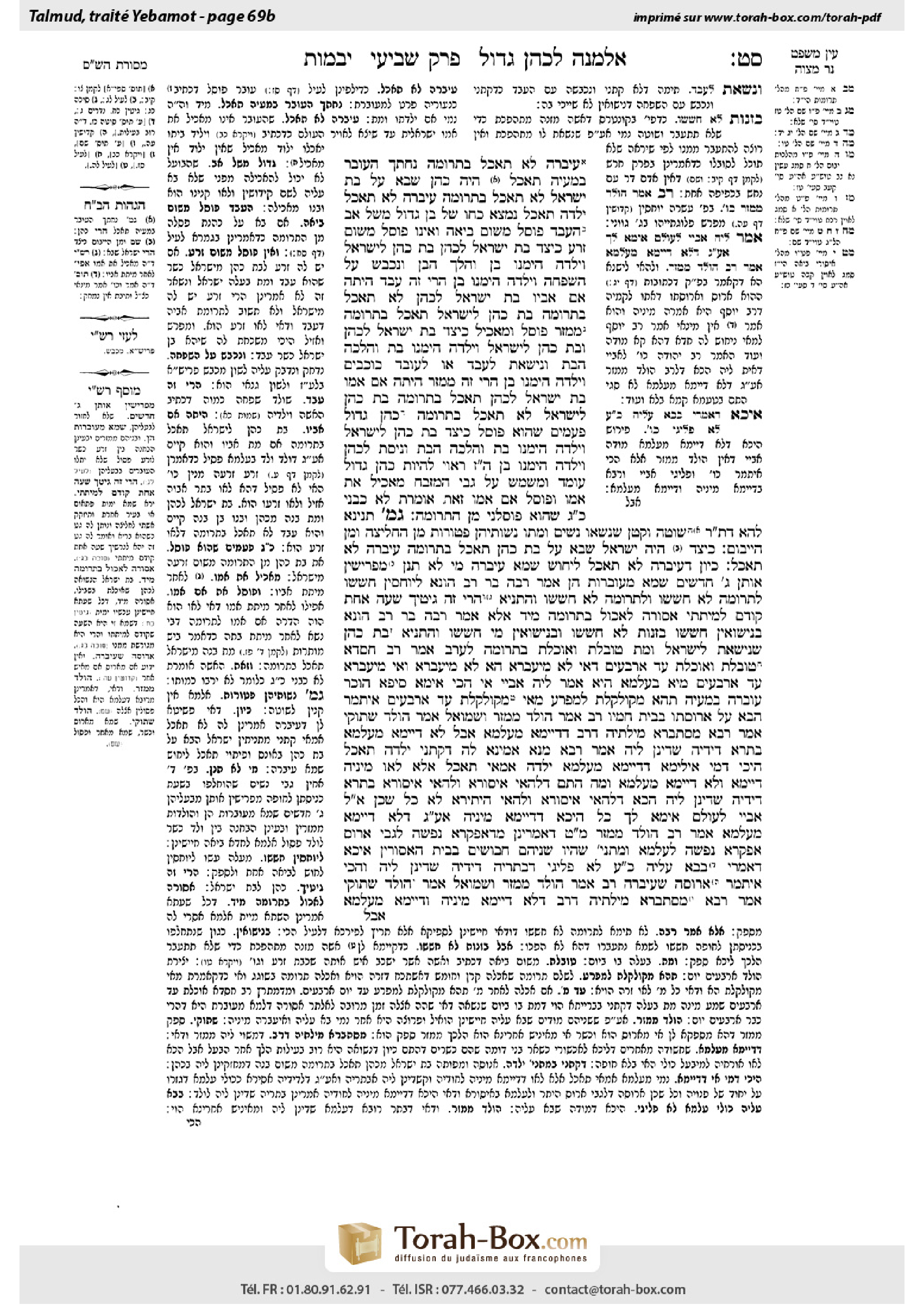
Yevamot 69b: Talmud study for Daf Yomi
Daf Yomi is the daily study of one Talmud folio. Explore 37 tractates with scans, Hebrew text, Sefaria English and AI-generated French translations where annotated.
Passage selection and English or AI-generated French translation are available where the scan has annotations. Daf Study is independent of Torah-Box and Sefaria.
Browse Yevamot · יבמות · All tractatesYevamot 69b text and translations
This page of Yevamot includes the Aramaic text, an English translation and an AI-generated French translation, alongside the scan above.
יבמות ס״ט ב · Aramaic and Hebrew text
עִיבְּרָה — לֹא תֹּאכַל בִּתְרוּמָה. נֶחְתַּךְ הָעוּבָּר בְּמֵעֶיהָ — תֹּאכַל. הָיָה כֹּהֵן שֶׁבָּא עַל בַּת יִשְׂרָאֵל — לֹא תֹּאכַל בִּתְרוּמָה, עִיבְּרָה — לֹא תֹּאכַל. יָלְדָה — תֹּאכַל. נִמְצָא כֹּחוֹ שֶׁל בֵּן גָּדוֹל מִשֶּׁל אָב.
הָעֶבֶד פּוֹסֵל מִשּׁוּם בִּיאָה, וְאֵינוֹ פּוֹסֵל מִשּׁוּם זֶרַע. כֵּיצַד? בַּת יִשְׂרָאֵל לְכֹהֵן, בַּת כֹּהֵן לְיִשְׂרָאֵל, וְיָלְדָה הֵימֶנּוּ בֵּן, וְהָלַךְ הַבֵּן וְנִכְבַּשׁ עַל הַשִּׁפְחָה, וְיָלְדָה הֵימֶנּוּ בֵּן — הֲרֵי זֶה עֶבֶד. הָיְתָה אֵם אָבִיו בַּת יִשְׂרָאֵל לְכֹהֵן — לֹא תֹּאכַל בִּתְרוּמָה. בַּת כֹּהֵן לְיִשְׂרָאֵל — תֹּאכַל בִּתְרוּמָה.
מַמְזֵר פּוֹסֵל וּמַאֲכִיל. כֵּיצַד? בַּת יִשְׂרָאֵל לְכֹהֵן, וּבַת כֹּהֵן לְיִשְׂרָאֵל, וְיָלְדָה הֵימֶנּוּ בַּת, וְהָלְכָה הַבַּת וְנִישֵּׂאת לְעֶבֶד אוֹ לְגוֹי וְיָלְדָה הֵימֶנּוּ בֵּן — הֲרֵי זֶה מַמְזֵר. הָיְתָה אֵם אִמּוֹ בַּת יִשְׂרָאֵל לְכֹהֵן — תֹּאכַל בִּתְרוּמָה. בַּת כֹּהֵן לְיִשְׂרָאֵל — לֹא תֹּאכַל בִּתְרוּמָה.
כֹּהֵן גָּדוֹל, פְּעָמִים שֶׁהוּא פּוֹסֵל. כֵּיצַד? בַּת כֹּהֵן לְיִשְׂרָאֵל וְיָלְדָה הֵימֶנּוּ בַּת, וְהָלְכָה הַבַּת וְנִיסֵּת לַכֹּהֵן, וְיָלְדָה הֵימֶנּוּ בֵּן — הֲרֵי זֶה רָאוּי לִהְיוֹת כֹּהֵן גָּדוֹל עוֹמֵד וּמְשַׁמֵּשׁ עַל גַּבֵּי הַמִּזְבֵּחַ. מַאֲכִיל אֶת אִמּוֹ, וּפוֹסֵל אֵם אִמּוֹ. זֹאת אוֹמֶרֶת: לֹא כִּבְנִי כֹּהֵן גָּדוֹל, שֶׁהוּא פּוֹסְלֵנִי מִן הַתְּרוּמָה.
גְּמָ׳ תְּנֵינָא לְהָא דְּתָנוּ רַבָּנַן: שׁוֹטֶה וְקָטָן שֶׁנָּשְׂאוּ נָשִׁים, וּמֵתוּ נְשׁוֹתֵיהֶן — פְּטוּרוֹת מִן הַחֲלִיצָה וּמִן הַיִּיבּוּם.
כֵּיצַד? הָיָה יִשְׂרָאֵל שֶׁבָּא עַל בַּת כֹּהֵן — תֹּאכַל בִּתְרוּמָה, עִיבְּרָה — לֹא תֹּאכַל. כֵּיוָן דְּעִיבְּרָה לֹא תֹּאכַל? לֵיחוּשׁ שֶׁמָּא עִיבְּרָה! מִי לָא תְּנַן: מַפְרִישִׁין אוֹתָן שְׁלֹשָׁה חֳדָשִׁים, שֶׁמָּא מְעוּבָּרוֹת הֵן?
אָמַר רַבָּה בַּר רַב הוּנָא: לְיוּחֲסִין חָשְׁשׁוּ, לִתְרוּמָה לֹא חָשְׁשׁוּ. וְלִתְרוּמָה לֹא חָשְׁשׁוּ? וְהָתַנְיָא: ״הֲרֵי זֶה גִּיטֵּיךְ שָׁעָה אַחַת קוֹדֶם לְמִיתָתִי״ — אֲסוּרָה לֶאֱכוֹל בִּתְרוּמָה מִיָּד!
אֶלָּא אָמַר רַבָּה בַּר רַב הוּנָא: בְּנִישּׂוּאִין חָשְׁשׁוּ, בִּזְנוּת לֹא חָשְׁשׁוּ.
וּבְנִישּׂוּאִין מִי חָשְׁשׁוּ? וְהָתַנְיָא: בַּת כֹּהֵן שֶׁנִּישֵּׂאת לְיִשְׂרָאֵל, וָמֵת — טוֹבֶלֶת, וְאוֹכֶלֶת בִּתְרוּמָה לְעָרֵב!
אָמַר רַב חִסְדָּא: טוֹבֶלֶת וְאוֹכֶלֶת עַד אַרְבָּעִים, דְּאִי לָא מִיעַבְּרָא — הָא לָא מִיעַבְּרָא, וְאִי מִיעַבְּרָא — עַד אַרְבָּעִים מַיָּא בְּעָלְמָא הִיא.
אֲמַר לֵיהּ אַבָּיֵי: אִי הָכִי, אֵימָא סֵיפָא: הוּכַּר עוּבָּרָהּ בְּמֵעֶיהָ — תְּהֵא מְקוּלְקֶלֶת לְמַפְרֵעַ. מַאי מְקוּלְקֶלֶת — עַד אַרְבָּעִים.
אִיתְּמַר: הַבָּא עַל אֲרוּסָתוֹ בְּבֵית חָמִיו — רַב אָמַר: הַוָּלָד מַמְזֵר, וּשְׁמוּאֵל אָמַר: הַוָּלָד שְׁתוּקִי. אָמַר רָבָא: מִסְתַּבְּרָא מִילְּתֵיהּ דְּרַב דְּדָיְימָא מֵעָלְמָא, אֲבָל לָא דָּיְימָא מֵעָלְמָא — בָּתְרֵיהּ דִּידֵיהּ שָׁדֵינַן לֵיהּ.
אָמַר רָבָא: מְנָא אָמֵינָא לַהּ — דְּקָתָנֵי: יָלְדָה — תֹּאכַל. הֵיכִי דָמֵי? אִילֵּימָא דְּדָיְימָא מֵעָלְמָא, יָלְדָה אַמַּאי תֹּאכַל? אֶלָּא לָאו: מִינֵיהּ דָּיְימָא, וְלָא דָּיְימָא מֵעָלְמָא.
וּמָה הָתָם, דִּלְהַאי אִיסּוּרָא וּלְהַאי אִיסּוּרָא — בָּתְרָא דִּידֵיהּ שָׁדֵינַן לֵיהּ, הָכָא, דִּלְהַאי אִיסּוּרָא וּלְהַאי הֶיתֵּירָא — לֹא כׇּל שֶׁכֵּן?!
אֲמַר לֵיהּ אַבָּיֵי: לְעוֹלָם אֵימָא לָךְ כׇּל הֵיכָא דְּדָיְימָא מִינֵּיהּ אַף עַל גַּב דְּלָא דָּיְימָא מֵעָלְמָא אָמַר רַב הַוָּלָד מַמְזֵר. מַאי טַעְמָא — דְּאָמְרִינַן: מִדְּאַפְקַרָא נַפְשָׁהּ לְגַבֵּי אָרוּס — אַפְקַרָא נַפְשָׁהּ לְעָלְמָא, וּמַתְנִיתִין שֶׁהָיוּ שְׁנֵיהֶם חֲבוּשִׁים בְּבֵית הָאֲסוּרִין.
אִיכָּא דְּאָמְרִי: בְּבָא עָלֶיהָ — כּוּלֵּי עָלְמָא לָא פְּלִיגִי דְּבָתְרֵיהּ דִּידֵיהּ שָׁדֵינַן לֵיהּ. וְהָכִי אִיתְּמַר: אֲרוּסָה שֶׁעִיבְּרָה, רַב אָמַר: הַוָּלָד מַמְזֵר. וּשְׁמוּאֵל אָמַר: הַוָּלָד שְׁתוּקִי. אָמַר רָבָא: מִסְתַּבְּרָא מִילְּתֵיהּ דְּרַב דְּלָא דָּיְימָא מִינֵּיהּ וְדָיְימָא מֵעָלְמָא,
Yevamot 69b · English translation
If he impregnated her, she may not partake of teruma, as she is carrying an Israelite fetus. If the fetus was cut in her womb, i.e., she miscarried, she may partake of teruma. If the man was a priest who engaged in intercourse with an Israelite woman, she may not partake of teruma. If he impregnated her, she still may not partake of teruma, as a fetus does not enable its mother to partake. If she gave birth she may partake due to her child, a priest. It is therefore found in this case that the power of the son is greater than that of the father, as the father of this child does not enable the woman to partake of teruma, but the son does.
A slave disqualifies a woman from partaking of teruma due to his engaging in intercourse with her, and he does not disqualify a woman because he is her offspring. How so? In what case would a slave theoretically disqualify a woman because he is her offspring? If an Israelite woman was married to a priest, or the daughter of a priest was married to an Israelite; and she bore him a son; and the son went and pressed himself onto a maidservant, an epithet for intercourse used in this context due to the shame involved in having intercourse with a maidservant; and she bore him a son, then this son is a slave. If the latter’s father’s mother was an Israelite who was married to a priest, and her husband died, she may not partake of teruma due to her grandson, as he is not a priest but a slave. On the other hand, if she was the daughter of a priest married to an Israelite, and he died, leaving only this grandson, she may partake of teruma, as the grandson is not considered his father’s offspring.
A mamzer disqualifies a woman from partaking of teruma, and he also enables a woman to partake of teruma. How so? If an Israelite woman was married to a priest, or the daughter of a priest was married to an Israelite, and she bore him a daughter, and the daughter went and married a slave or a gentile and bore him a son, this son is a mamzer. If his mother’s mother was an Israelite woman married to a priest, even if her husband died, she may partake of teruma, as she has surviving offspring from a priest. Conversely, if she is the daughter of a priest married to an Israelite, she may not partake of teruma, even after her Israelite husband’s death, as she has offspring from him.
Even with regard to a High Priest, sometimes he disqualifies his grandmother from partaking of teruma. How so? If the daughter of a priest was married to an Israelite, and she bore him a daughter, and the daughter went and married a priest and bore him a son, this son is fit to be a High Priest, who stands and serves on the altar. This son enables his mother to partake of teruma, as he is a priest. And yet, he disqualifies his mother’s mother from partaking of teruma, as he is her offspring from her Israelite husband. This grandmother can say in disapproval: Let there not be many like my daughter’s son, the High Priest, as he disqualifies me from partaking of teruma.
GEMARA: We already learned that the marriage of an imbecile is invalid, as the Sages taught in a baraita: With regard to an imbecile and a minor boy who married women and died, their wives are exempt from ḥalitza and from levirate marriage.
§ It is stated in the mishna: How so? If an Israelite engaged in extramarital intercourse with the daughter of a priest, she may partake of teruma. If he impregnated her, she may not partake of teruma. The Gemara asks: Since if he impregnated her she may not partake, let us be concerned in any case of intercourse between an Israelite and the daughter of a priest lest he impregnated her, thereby rendering it prohibited for her to partake of teruma. Didn’t we learn in a mishna that if two men betrothed two women, and then at the time that they entered the wedding canopy, they accidently switched wives, and engaged in relations with each other’s wives that night, in this case, after the accident is discovered, the court removes the wives from their husbands for three months, lest they are pregnant from the men they presumed to be their husbands and the fetus is therefore a mamzer, although they engaged in intercourse only once (33b)?
The Gemara answers that Rabba, son of Rav Huna, said: About lineage the Sages were concerned, and they therefore decreed a three-month separation of the husbands and wives, to prevent the possibility of a child being of uncertain lineage. However, about the prohibition against a non-priest eating teruma they were not concerned. The Gemara asks: And for teruma were they not concerned? Isn’t it taught in a baraita that if a husband says to his wife: This is your bill of divorce one hour before my death, if she is an Israelite woman married to a priest it is prohibited for her to partake of teruma immediately, as the Sages were concerned that her husband might die within the hour?
Rather, Rabba, son of Rav Huna, said: About impregnation through an act of marriage they were concerned, but about impregnation through licentious intercourse they were not concerned, as the woman generally takes precautions to ensure that she will not become pregnant.
The Gemara asks: And about marriage were they concerned? Isn’t it taught in a baraita: In the case of the daughter of a priest who married an Israelite and her husband died on that same day, she immerses to purify herself, as she is ritually impure due to their intercourse, and she may partake of teruma that same evening? Evidently, the Sages were not concerned that she became pregnant from the initial act of intercourse, even that of marriage.
Rav Ḥisda said: She immerses and partakes of teruma only until forty days after her husband’s death, when there is still no reason for concern, as if she is not pregnant then she is not pregnant. And if she is pregnant, until forty days from conception the fetus is merely water. It is not yet considered a living being, and therefore it does not disqualify its mother from partaking of teruma.
Abaye said to him: If so, say the latter clause of the baraita: Once her fetus in her womb is noticeable, she is ruined retroactively. Her prior consumption of teruma is retroactively prohibited. Evidently, pregnancy immediately disqualifies her from partaking of teruma. Therefore, the reason that she may partake of teruma immediately after her husband’s death is that the Sages were not concerned that she became pregnant. Rav Ḥisda responded: What is the period in which she is retroactively ruined? It is from the moment the fetus is noticeable and back in time until forty days from the beginning of her pregnancy. During the first forty days of the pregnancy, she is not retroactively ruined, as the fetus is not yet considered a living being.
It was stated: With regard to a man who engaged in intercourse with his betrothed in his father-in-law’s house, i.e., before they got married, Rav said that the offspring is a mamzer, as the future husband is not considered his father. And Shmuel said that the offspring is a shetuki, a child of unknown paternity. Rava said: Rav’s statement stands to reason in a case where she is rumored to have engaged in intercourse with others. However, if she is not rumored to have engaged in intercourse with others, we cast the child after him, i.e., we assume that the child is the betrothed’s son.
Rava said: From where do I say that? What is the source for my assertion? The source is the mishna, which teaches that if a priest engaged in extramarital intercourse with an Israelite woman and she gave birth, she may partake of teruma due to her child, who is a priest. What are the circumstances? If we say that she is rumored to have engaged in intercourse with others, even if she gave birth, why may she partake of teruma? Shouldn’t there be concern that the child’s father is not the priest? Rather, is it not a case where she is rumored to have engaged in intercourse with him and is not rumored to have engaged in intercourse with others?
And if there, in the case of the mishna, where for her to engage in intercourse with this priest is a prohibition, and to engage in intercourse with that non-priest, with whom she is not rumored to have engaged in intercourse, is a prohibition of the same degree, nevertheless, we cast the child after the priest, then here, where for her to engage in intercourse with that man who is not her betrothed is a Torah prohibition, and to engage in intercourse with this man, her betrothed, is permitted by Torah law, is it not all the more so that her betrothed should be considered the father? Therefore, Rav’s statement stands to reason only if the woman is rumored to have engaged in intercourse with others as well.
Abaye said to him in rejection of his proof: Actually, I could say to you that anywhere that she is rumored to have engaged in intercourse with him, her betrothed, even if she is not rumored to have engaged in intercourse with others, Rav said that the offspring is a mamzer. What is the reason? It is that we say that since she exposed herself to her betrothed, although they were not married yet, she apparently exposed herself to others as well. And the mishna that you cited as support for your assertion is referring to a situation where they were both incarcerated alone together in prison. Therefore, there is no concern that she engaged in intercourse with another man. This is one version of the dispute between Rav and Shmuel.
Some say that when the betrothed admits that he engaged in intercourse with her, everyone agrees that we cast the child after him. Rather, their dispute was stated as follows: In the case of a betrothed woman who became pregnant, if her betrothed denies that he engaged in intercourse with her, Rav said that the offspring is a mamzer, and Shmuel said that the offspring is a child whose father’s identity is not known. Rava said: Rav’s statement stands to reason in a case where the woman is not rumored to have engaged in intercourse with him and she is rumored to have engaged in intercourse with others. Therefore, it is assumed that the child is a mamzer.
Yevamot 69b · Traduction française (IA)
S’il l’a fécondée, elle ne peut pas consommer de terouma, car elle porte un fœtus israélite. Si le fœtus a été expulsé de son ventre, c’est-à-dire si elle a fait une fausse couche, elle peut consommer de terouma. Si l’homme était un prêtre qui a eu des rapports avec une Israélite, elle ne peut pas consommer de terouma. Même s’il l’a fécondée, elle ne peut toujours pas en consommer, car un fœtus ne permet pas à sa mère d’en consommer. Si elle a accouché, elle peut en consommer grâce à son enfant, qui est prêtre. On trouve donc dans ce cas que le pouvoir du fils est supérieur à celui du père : le père de cet enfant ne permet pas à la femme de consommer de terouma, mais le fils, lui, le permet.
Un esclave disqualifie une femme de la consommation de terouma en ayant des rapports avec elle, mais il ne la disqualifie pas en tant que descendant. Comment cela ? Dans quel cas un esclave pourrait-il théoriquement disqualifier une femme en tant que descendant ? Si une Israélite était mariée à un prêtre, ou si la fille d’un prêtre était mariée à un Israélite, et qu’elle lui avait donné un fils ; puis que ce fils était allé s’unir à une servante — expression désignant ici les rapports sexuels, en raison de la honte qu’il y a à avoir des rapports avec une servante — et qu’elle lui avait donné un fils, ce dernier est un esclave. Si la grand-mère paternelle de ce dernier était une Israélite mariée à un prêtre et que son mari était mort, elle ne peut pas consommer de terouma à cause de son petit-fils, car celui-ci n’est pas prêtre, mais esclave. En revanche, si elle était la fille d’un prêtre mariée à un Israélite et que celui-ci était mort en ne laissant que ce petit-fils, elle peut consommer de terouma, car le petit-fils n’est pas considéré comme un descendant de son père.
Un mamzer disqualifie une femme de la consommation de terouma, mais il peut aussi lui permettre d’en consommer. Comment cela ? Si une Israélite était mariée à un prêtre, ou si la fille d’un prêtre était mariée à un Israélite, et qu’elle lui avait donné une fille ; puis que cette fille était allée épouser un esclave ou un non-Juif et lui avait donné un fils, ce fils est un mamzer. Si la grand-mère maternelle de celui-ci était une Israélite mariée à un prêtre, elle peut consommer de terouma même après la mort de son mari, car elle a un descendant survivant issu d’un prêtre. À l’inverse, si elle est la fille d’un prêtre mariée à un Israélite, elle ne peut pas consommer de terouma, même après la mort de son mari israélite, car elle a un descendant issu de lui.
Même un grand prêtre peut parfois disqualifier sa grand-mère de la consommation de terouma. Comment cela ? Si la fille d’un prêtre était mariée à un Israélite et qu’elle lui avait donné une fille ; puis que cette fille était allée épouser un prêtre et lui avait donné un fils, ce fils peut devenir grand prêtre et se tenir au service de l’autel. Il permet à sa mère de consommer de terouma, car il est prêtre. Pourtant, il disqualifie sa grand-mère maternelle de la consommation de terouma, car il est un descendant qu’elle a eu de son mari israélite. Cette grand-mère peut s’exclamer avec dépit : « Qu’il n’y en ait pas beaucoup comme le fils de ma fille, le grand prêtre, car il m’empêche de consommer de terouma. »
GUEMARA : Nous avons déjà appris que le mariage d’un déficient mental n’est pas valable, comme les Sages l’ont enseigné dans une baraïta : Lorsqu’un déficient mental ou un garçon mineur épouse une femme et meurt, son épouse est dispensée de la ḥalitsa et du lévirat.
§ Il est dit dans la Michna : Comment cela ? Si un Israélite a eu des rapports hors mariage avec la fille d’un prêtre, elle peut consommer de terouma. S’il l’a fécondée, elle ne peut pas en consommer. La Guemara demande : Puisqu’elle ne peut pas consommer de terouma s’il l’a fécondée, ne faut-il pas craindre, dans tous les cas de rapports entre un Israélite et la fille d’un prêtre, qu’il l’ait fécondée et qu’il lui soit ainsi interdit de consommer de terouma ? N’avons-nous pas appris dans une Michna que, si deux hommes ont fiancé deux femmes puis, au moment d’entrer sous le dais nuptial, ont échangé leurs épouses par erreur et ont eu cette nuit-là des rapports avec les épouses l’un de l’autre, le tribunal, une fois l’erreur découverte, sépare les épouses de leurs maris pendant trois mois, de crainte qu’elles ne soient enceintes des hommes qu’elles croyaient être leurs maris et que le fœtus soit donc un mamzer, bien qu’elles n’aient eu qu’un seul rapport (33b) ?
La Guemara répond que Rabba, fils de Rav Houna, a dit : Les Sages se sont préoccupés de la filiation et ont donc décrété que les époux soient séparés pendant trois mois, afin d’écarter la possibilité qu’un enfant ait une filiation incertaine. En revanche, ils ne se sont pas préoccupés de l’interdiction faite à un non-prêtre de consommer de terouma. La Guemara demande : Ne se sont-ils donc pas préoccupés de la terouma ? N’est-il pas enseigné dans une baraïta que, si un mari dit à sa femme : « Voici ton acte de divorce, valable une heure avant ma mort », et si elle est une Israélite mariée à un prêtre, il lui est immédiatement interdit de consommer de terouma, car les Sages ont craint que son mari ne meure dans l’heure ?
Rabba, fils de Rav Houna, a plutôt dit : Les Sages se sont préoccupés d’une fécondation résultant de rapports dans le cadre du mariage, mais non d’une fécondation résultant de rapports illicites, car la femme prend généralement des précautions pour ne pas tomber enceinte.
La Guemara demande : Se sont-ils donc préoccupés des rapports dans le cadre du mariage ? N’est-il pas enseigné dans une baraïta : Dans le cas de la fille d’un prêtre qui a épousé un Israélite et dont le mari est mort le jour même, elle s’immerge pour se purifier, car elle est rituellement impure à la suite de leurs rapports, et elle peut consommer de terouma le soir même ? Il ressort de là que les Sages n’ont pas craint qu’elle soit tombée enceinte lors de leur premier rapport, même s’il s’agissait de rapports dans le cadre du mariage.
Rav Ḥisda a dit : Elle s’immerge et consomme de terouma uniquement jusqu’à quarante jours après la mort de son mari, période durant laquelle il n’y a pas encore lieu de s’inquiéter : si elle n’est pas enceinte à ce moment-là, elle ne l’est pas. Et si elle est enceinte, jusqu’à quarante jours après la conception, le fœtus n’est que de l’eau. Il n’est pas encore considéré comme un être vivant et ne disqualifie donc pas sa mère de la consommation de terouma.
Abayé lui dit : Dans ce cas, considère la fin de la baraïta : « Dès que son fœtus dans son ventre devient visible, elle est disqualifiée rétroactivement. » Sa consommation antérieure de terouma est donc interdite rétroactivement. Il ressort de là que la grossesse la disqualifie immédiatement de la consommation de terouma. Par conséquent, si elle peut consommer de terouma immédiatement après la mort de son mari, c’est parce que les Sages n’ont pas craint qu’elle soit tombée enceinte. Rav Ḥisda répondit : Quelle est la période pour laquelle elle est disqualifiée rétroactivement ? Elle va du moment où le fœtus devient visible jusqu’à quarante jours après le début de sa grossesse. Pendant les quarante premiers jours de la grossesse, elle n’est pas disqualifiée rétroactivement, car le fœtus n’est pas encore considéré comme un être vivant.
Il a été rapporté : Au sujet d’un homme qui a eu des rapports avec sa fiancée dans la maison de son beau-père, c’est-à-dire avant leur mariage, Rav a dit que l’enfant est un mamzer, car le futur mari n’est pas considéré comme son père. Chmouel a dit que l’enfant est un chetoki, un enfant dont la paternité est inconnue. Rava a dit : La déclaration de Rav est fondée dans le cas où la femme est soupçonnée d’avoir eu des rapports avec d’autres hommes. Mais si elle n’est pas soupçonnée d’en avoir eu avec d’autres, nous attribuons l’enfant à cet homme, c’est-à-dire que nous présumons qu’il est le fils du fiancé.
Rava a dit : D’où est-ce que je tire cela ? Quelle est la source de mon affirmation ? La source est la Michna, qui enseigne que si un prêtre a eu des rapports hors mariage avec une Israélite et qu’elle a accouché, elle peut consommer de terouma grâce à son enfant, qui est prêtre. Dans quelles circonstances ? Si nous disons qu’elle est soupçonnée d’avoir eu des rapports avec d’autres hommes, même si elle a accouché, pourquoi pourrait-elle consommer de terouma ? Ne faudrait-il pas craindre que le père de l’enfant ne soit pas le prêtre ? Ne s’agit-il pas plutôt d’un cas où elle est soupçonnée d’avoir eu des rapports avec lui, mais non avec d’autres hommes ?
Et si, dans le cas de la Michna, alors qu’avoir des rapports avec ce prêtre est interdit et qu’avoir des rapports avec cet autre homme, un non-prêtre dont elle n’est pas soupçonnée d’avoir été la partenaire, est tout aussi interdit, nous attribuons néanmoins l’enfant au prêtre, alors ici, où avoir des rapports avec un homme qui n’est pas son fiancé constitue une interdiction de la Torah, tandis qu’avoir des rapports avec son fiancé est permis par la Torah, n’est-il pas à plus forte raison nécessaire de considérer son fiancé comme le père ? La déclaration de Rav n’est donc fondée que si la femme est également soupçonnée d’avoir eu des rapports avec d’autres hommes.
Abayé lui répondit pour rejeter sa preuve : En réalité, je pourrais te dire que, partout où elle est soupçonnée d’avoir eu des rapports avec son fiancé, même si elle n’est pas soupçonnée d’en avoir eu avec d’autres, Rav dit que l’enfant est un mamzer. Pourquoi ? Nous disons que, puisqu’elle s’est offerte à son fiancé alors qu’ils n’étaient pas encore mariés, elle s’est apparemment aussi offerte à d’autres. Quant à la Michna que tu as citée à l’appui de ton affirmation, elle concerne une situation où ils étaient tous deux seuls ensemble en prison. Il n’y a donc pas lieu de craindre qu’elle ait eu des rapports avec un autre homme. Voilà une des versions du différend entre Rav et Chmouel.
Certains disent que, lorsque le fiancé reconnaît avoir eu des rapports avec elle, tous conviennent que nous lui attribuons l’enfant. Leur différend a plutôt été formulé ainsi : Dans le cas d’une femme fiancée qui est tombée enceinte, si son fiancé nie avoir eu des rapports avec elle, Rav dit que l’enfant est un mamzer, et Chmouel dit que l’identité de son père est inconnue. Rava a dit : La déclaration de Rav est fondée dans le cas où la femme n’est pas soupçonnée d’avoir eu des rapports avec son fiancé, mais où elle est soupçonnée d’en avoir eu avec d’autres. On présume donc que l’enfant est un mamzer.
Traduction française générée par IA à partir de l’édition anglaise de Sefaria. Vérifie toujours un passage avec le texte source.
Text from Sefaria: William Davidson Edition - Vocalized Aramaic (CC BY NC); William Davidson Edition - English (CC BY NC).