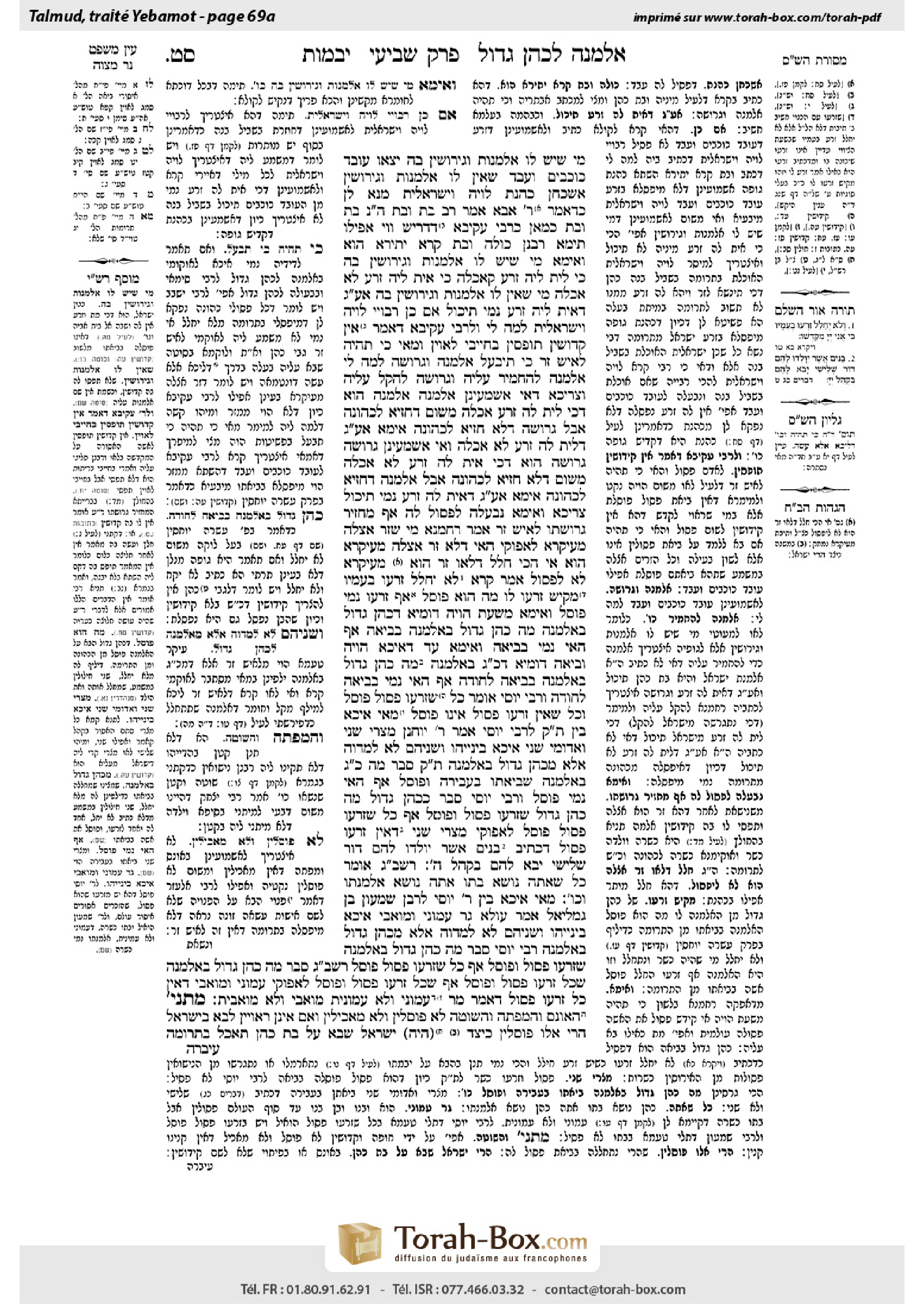
Yevamot 69a: Talmud study for Daf Yomi
Daf Yomi is the daily study of one Talmud folio. Explore 37 tractates with scans, Hebrew text, Sefaria English and AI-generated French translations where annotated.
Passage selection and English or AI-generated French translation are available where the scan has annotations. Daf Study is independent of Torah-Box and Sefaria.
Browse Yevamot · יבמות · All tractatesYevamot 69a text and translations
This page of Yevamot includes the Aramaic text, an English translation and an AI-generated French translation, alongside the scan above.
יבמות ס״ט א · Aramaic and Hebrew text
מִי שֶׁיֵּשׁ לוֹ אַלְמְנוּת וְגֵירוּשִׁין בָּהּ, יָצְאוּ גּוֹי וְעֶבֶד שֶׁאֵין לוֹ אַלְמְנוּת וְגֵירוּשִׁין.
אַשְׁכְּחַן כֹּהֶנֶת — לְוִיָּה וְיִשְׂרְאֵלִית מְנָא לַן? כִּדְאָמַר רַבִּי אַבָּא אָמַר רַב: ״בַּת״ ״וּבַת״, הָכָא נָמֵי ״בַּת״ ״וּבַת״.
כְּמַאן — כְּרַבִּי עֲקִיבָא דְּדָרֵישׁ וָוֵי? אֲפִילּוּ תֵּימָא רַבָּנַן — כּוּלֵּהּ ״וּבַת״ קְרָא יַתִּירָא הוּא.
וְאֵימָא: מִי שֶׁיֵּשׁ לוֹ אַלְמְנוּת וְגֵירוּשִׁין בָּהּ, כִּי לֵית לֵיהּ זֶרַע — קָאָכְלָה, כִּי אִית לֵיהּ זֶרַע — לָא אָכְלָה. מִי שֶׁאֵין לוֹ אַלְמְנוּת וְגֵירוּשִׁין בָּהּ, אַף עַל גַּב דְּאִית לֵיהּ זֶרַע נָמֵי תֵּיכוֹל!
אִם כֵּן, רַבּוֹיֵי לְוִיָּה וְיִשְׂרְאֵלִית לְמָה לִי?
וּלְרַבִּי עֲקִיבָא דְּאָמַר: אֵין קִדּוּשִׁין תּוֹפְסִין בְּחַיָּיבֵי לָאוִין, וּמַאי ״כִּי תִהְיֶה לְאִישׁ זָר״ — כִּי תִּיבָּעֵל, אַלְמָנָה וּגְרוּשָׁה לְמָה לִי?
אַלְמָנָה לְהַחְמִיר עָלֶיהָ, וּגְרוּשָׁה לְהָקֵל עָלֶיהָ. וּצְרִיכָא. דְּאִי אַשְׁמְעִינַן אַלְמָנָה: אַלְמָנָה הוּא דְּכִי לֵית לַהּ זֶרַע — אָכְלָה, מִשּׁוּם דְּחַזְיָא לִכְהוּנָּה. אֲבָל גְּרוּשָׁה, דְּלָא חַזְיָא לִכְהוּנָּה, אֵימָא אַף עַל גַּב דְּלֵית לַהּ זֶרַע — לָא אָכְלָה. וְאִי אַשְׁמְעִינַן גְּרוּשָׁה: גְּרוּשָׁה הוּא דְּכִי אִית לַהּ זֶרַע — לָא אָכְלָה, מִשּׁוּם דְּלָא חַזְיָא לִכְהוּנָּה. אֲבָל אַלְמָנָה, דְּחַזְיָא לִכְהוּנָּה, אֵימָא אַף עַל גַּב דְּאִית לַהּ זֶרַע — נָמֵי תֵּיכוֹל, צְרִיכָא.
וְאֵימָא נִבְעֲלָה לְפָסוּל לָהּ אַף מַחְזִיר גְּרוּשָׁתוֹ! ״לְאִישׁ זָר״ אָמַר רַחֲמָנָא, מִי שֶׁזָּר אֶצְלָהּ מֵעִיקָּרָא. לְאַפּוֹקֵי הַאי, דְּלֹא זָר אֶצְלָהּ מֵעִיקָּרָא הוּא.
אִי הָכִי, חָלָל, דְּלָאו זָר הוּא מֵעִיקָּרָא, לָא לִפְסוֹל! אָמַר קְרָא: ״לֹא יְחַלֵּל זַרְעוֹ בְּעַמָּיו״, מַקִּישׁ זַרְעוֹ לוֹ, מָה הוּא פּוֹסֵל — אַף זַרְעוֹ נָמֵי פּוֹסֵל.
וְאֵימָא מִשְּׁעַת הֲוָיָה! דּוּמְיָא דְּכֹהֵן גָּדוֹל בְּאַלְמָנָה: מָה כֹּהֵן גָּדוֹל בְּאַלְמָנָה בְּבִיאָה, אַף הַאי נָמֵי בְּבִיאָה.
וְאֵימָא: עַד דְּאִיכָּא הֲוָיָה וּבִיאָה?! דּוּמְיָא דְּכֹהֵן גָּדוֹל בְּאַלְמָנָה: מָה כֹּהֵן גָּדוֹל בְּאַלְמָנָה בְּבִיאָה לְחוּדַּהּ, אַף הַאי נָמֵי בְּבִיאָה לְחוּדַּהּ.
וְרַבִּי יוֹסֵי אוֹמֵר: כֹּל שֶׁזַּרְעוֹ פָּסוּל — פּוֹסֵל, וְכֹל שֶׁאֵין זַרְעוֹ פָּסוּל — אֵינוֹ פּוֹסֵל. מַאי אִיכָּא בֵּין תַּנָּא קַמָּא לְרַבִּי יוֹסֵי?
אָמַר רַבִּי יוֹחָנָן: מִצְרִי שֵׁנִי וַאֲדוֹמִי שֵׁנִי אִיכָּא בֵּינַיְיהוּ.
וּשְׁנֵיהֶם לֹא לְמָדוּהָ אֶלָּא מִכֹּהֵן גָּדוֹל בְּאַלְמָנָה. תַּנָּא קַמָּא סָבַר: מָה כֹּהֵן גָּדוֹל בְּאַלְמָנָה, שֶׁבִּיאָתוֹ בַּעֲבֵירָה וּפוֹסֵל — אַף הַאי נָמֵי פּוֹסֵל.
וְרַבִּי יוֹסֵי סָבַר: כְּכֹהֵן גָּדוֹל. מָה כֹּהֵן גָּדוֹל שֶׁזַּרְעוֹ פָּסוּל וּפוֹסֵל, אַף כֹּל שֶׁזַּרְעוֹ פָּסוּל — פּוֹסֵל. לְאַפּוֹקֵי מִצְרִי שֵׁנִי דְּאֵין זַרְעוֹ פָּסוּל. דִּכְתִיב: ״בָּנִים אֲשֶׁר יִוָּלְדוּ לָהֶם דּוֹר שְׁלִישִׁי יָבֹא לָהֶם בִּקְהַל ה׳״.
רַבָּן שִׁמְעוֹן בֶּן גַּמְלִיאֵל אוֹמֵר: כֹּל שֶׁאַתָּה נוֹשֵׂא בִּתּוֹ — אַתָּה נוֹשֵׂא אַלְמְנָתוֹ וְכוּ׳. מַאי אִיכָּא בֵּין רַבִּי יוֹסֵי לְרַבָּן שִׁמְעוֹן בֶּן גַּמְלִיאֵל?
אָמַר עוּלָּא: גֵּר עַמּוֹנִי וּמוֹאָבִי אִיכָּא בֵּינַיְיהוּ, וּשְׁנֵיהֶם לֹא לְמָדוּהָ אֶלָּא מִכֹּהֵן גָּדוֹל בְּאַלְמָנָה. רַבִּי יוֹסֵי סָבַר: מָה כֹּהֵן גָּדוֹל בְּאַלְמָנָה שֶׁזַּרְעוֹ פָּסוּל וּפוֹסֵל, אַף כֹּל שֶׁזַּרְעוֹ פָּסוּל — פּוֹסֵל.
רַבָּן שִׁמְעוֹן בֶּן גַּמְלִיאֵל סָבַר: מָה כֹּהֵן גָּדוֹל בְּאַלְמָנָה שֶׁכׇּל זַרְעוֹ פָּסוּל וּפוֹסֵל, אַף שֶׁכׇּל זַרְעוֹ פָּסוּל וּפוֹסֵל. לְאַפּוֹקֵי עַמּוֹנִי וּמוֹאָבִי, דְּאֵין כָּל זַרְעוֹ פָּסוּל. דְּאָמַר מָר: ״עַמּוֹנִי״, וְלֹא עַמּוֹנִית, ״מוֹאָבִי״ וְלֹא מוֹאָבִית.
מַתְנִי׳ הָאוֹנֵס וְהַמְפַתֶּה וְהַשּׁוֹטֶה — לֹא פּוֹסְלִין וְלֹא מַאֲכִילִין. וְאִם אֵינָן רְאוּיִין לָבֹא בְּיִשְׂרָאֵל — הֲרֵי אֵלּוּ פּוֹסְלִין. כֵּיצַד? (הָיָה) יִשְׂרָאֵל שֶׁבָּא עַל בַּת כֹּהֵן — תֹּאכַל בִּתְרוּמָה.
Yevamot 69a · English translation
This verse is referring to a man who has potential widowhood and divorce with her, excluding a gentile and a slave, who do not have widowhood and divorce with her, as they cannot marry Jews at all. Therefore, they disqualify a woman from marrying into the priesthood through sexual intercourse, even if she does not have a child with them.
The Gemara asks: We have found a source for the halakha that a gentile and a slave disqualify a priestess. From where do we derive this with regard to a Levite and an Israelite woman? The Gemara answers: It is as Rabbi Abba said that Rav said: The verse “But if a priest’s daughter be a widow, or divorced” (Leviticus 22:13) could have begun with the words: If a priest’s daughter. The word “but,” the prefix vav, expands the prohibition to include additional women. Here too, it may be derived from the distinction between the phrase: If a priest’s daughter, and the phrase as it actually appears in the verse: “But if a priest’s daughter,” that Levite and Israelite women are subject to the prohibition as well.
The Gemara asks: In accordance with whose opinion is this exposition possible? It is in accordance only with the opinion of Rabbi Akiva, as he derives halakhot from the prefix vav. The Gemara responds: Even if you say it is accordance with the Rabbis, the entire phrase: “But if a priest’s daughter,” is superfluous in the verse, as the previous verses had already mentioned the priest’s daughter. Therefore, the inclusion of Levite and Israelite women in the prohibition may be derived from the entire expression.
The Gemara suggests: But perhaps you should say a different interpretation of the mention of widowhood and divorce in the verse: In the case of one who has potential widowhood and divorce with her, if he does not have offspring from her she may partake of teruma upon her widowhood or divorce, whereas if he does have offspring from her she does not partake. However, in the case of one who does not have widowhood and divorce with her, even if she has offspring from him, she should be allowed to partake of teruma, as the offspring is not considered his.
The Gemara answers: If so, why do I need to include a Levite and an Israelite woman? If the daughter of a priest is not disqualified from teruma due to intercourse with a gentile or slave, certainly a Levite or Israelite woman is not. The fact that the verse indicates inclusion of Levite and Israelite women proves that the halakha that is derived from it is a stringency and not a leniency.
The Gemara asks: And according to Rabbi Akiva, who said that betrothal of those who may not engage in intercourse, as they are liable for violating a prohibition, does not take effect, and therefore the meaning of the phrase “And if a priest’s daughter be [tihye] to a common man” (Leviticus 22:12) is not: If she marries him, but rather: If she engages in intercourse with him, why do I need the Torah to mention the phrase “a widow, or divorced” in the verse: “But if a priest’s daughter be a widow, or divorced…she may eat of her father’s bread” (Leviticus 22:13)? It is not necessary for this phrase to teach that a gentile and a slave disqualify a woman from marrying into the priesthood through sexual intercourse, as suggested by Rabbi Yishmael, as they are included in the prohibition proscribing a woman who engaged in intercourse with a man who is unfit for her.
The Gemara answers: A widow is mentioned to be stringent with her, and a divorcée to be lenient with her, and both are necessary. As, had the Torah taught us only the case of a widow, you might have assumed that specifically if this daughter of a priest is a widow she partakes of teruma when she does not have offspring because she is fit for the priesthood, as she may marry a common priest, but with regard to a divorcée, who is not fit for the priesthood at all, you might say that even if she does not have offspring she does not partake of teruma. And had it taught us only the case of a divorcée, you might have assumed that only a divorcée does not partake of teruma when she has offspring from a non-priest because she is not fit for the priesthood, but with regard to a widow, who is fit for the priesthood, you might say that even if she has offspring she should also partake of teruma. It is therefore necessary for both cases to be stated.
The Gemara asks: And perhaps you should say that the category of a woman who engaged in intercourse with a man who is unfit for her and is therefore disqualified from the priesthood applies even to the case of a man remarrying his divorcée after she had been married to another man in the meantime, which is prohibited. The Gemara answers: The Merciful One states in the Torah: “To a common man [ish zar],” literally, a man who is a stranger, “she shall not eat of that which is set apart from the sacred.” The Gemara understands the notion of a stranger to be one whom she was forbidden to marry and interprets homiletically: Only marriage to one who was a stranger, i.e., forbidden, to her from the outset precludes her from partaking of teruma, to the exclusion of one who was not a stranger to her from the outset, such as her ex-husband.
The Gemara asks: If so, a ḥalal, who was not excluded at the outset, as he may marry even the daughter of a priest, should not disqualify a woman from marrying into the priesthood. The Gemara answers that the verse states, with regard to a priest who marries a woman unfit for the priesthood: “He shall not profane his seed among his people” (Leviticus 21:15), thereby juxtaposing his seed to him. Just as he, a priest who married a woman forbidden to him, disqualifies her from the priesthood, so too, his seed, the ḥalal, also disqualifies a woman with whom he engaged in intercourse.
The Gemara asks: And perhaps you should say that a woman who engaged in intercourse with a man unfit for her is disqualified from the time of their betrothal, even before they engaged in intercourse. The Gemara answers that this is similar to a High Priest who engaged in intercourse with a widow: Just as a High Priest who engaged in intercourse with a widow has disqualified her through intercourse, not betrothal, so too, this unfit man has also disqualified her through intercourse.
The Gemara asks: And perhaps you should say that he does not disqualify her until there is both betrothal and intercourse. The Gemara again answers that this is similar to a High Priest who engaged in intercourse with a widow: Just as a High Priest who engaged in intercourse with a widow disqualifies her through intercourse alone, so too, this man also disqualified her through intercourse alone.
§ It was taught in the baraita under discussion (68a) that Rabbi Yosei says: Of the men unfit to enter the assembly of Israel, anyone whose offspring are also unfit disqualifies a woman with whom he engaged in intercourse from the priesthood. However, anyone whose offspring are not unfit does not disqualify her. The Gemara asks: What difference is there between the first tanna of the baraita and Rabbi Yosei?
Rabbi Yoḥanan said: The practical difference between them pertains to a second-generation Egyptian and a second-generation Edomite. The children of these men, i.e., the third generation, may marry Jews of unflawed lineage. Therefore, according to Rabbi Yosei, they too do not disqualify a woman from the priesthood through intercourse with them. The first tanna, however, holds that they have the same status as a first-generation Egyptian or Edomite convert, in that they disqualify a woman from the priesthood through intercourse.
And both tanna’im derived their respective opinions only from the case of a High Priest who engaged in intercourse with a widow, although they reached different conclusions. The first tanna reasoned: Just as with regard to a High Priest who engaged in intercourse with a widow, his act of intercourse with her is a transgression, and therefore he disqualifies her from the priesthood, so too, this man, a second-generation Egyptian or Edomite, also disqualifies her.
And Rabbi Yosei also reasoned: This is like a High Priest who engaged in intercourse with a widow. Just as the High Priest’s children are unfit for the priesthood, and he himself disqualifies the widow from marrying into the priesthood, so too, any man whose children are unfit to marry Jews of unflawed lineage disqualifies a woman with whom he engaged in intercourse from marrying into the priesthood. This inference comes to exclude a second-generation Egyptian, whose children are not unfit, as it is written: “The children of the third generation that are born to them may enter into the assembly of the Lord” (Deuteronomy 23:9).
It is taught in the baraita under discussion that Rabban Shimon ben Gamliel says: Anyone whose daughter you may marry, you may marry his widow; anyone whose daughter you may not marry, you may not marry his widow. The Gemara asks: What difference is there between Rabbi Yosei and Rabban Shimon ben Gamliel? They appear to be stating the same principle, that a man disqualifies a woman from the priesthood only if his children are unfit to marry Jews of unflawed lineage as well.
Ulla said: The practical difference between them is in the case of an Ammonite and a Moabite convert. And both of them derived their respective opinions from none other than the case of a High Priest with a widow. Rabbi Yosei reasoned: Just as with regard to a High Priest who engaged in intercourse with a widow, his children are unfit for the priesthood and he himself disqualifies the widow, so too, any man whose children are unfit disqualifies a woman with whom he engaged in intercourse.
Rabban Shimon ben Gamliel reasoned: Just as in the case of a High Priest who engaged in intercourse with a widow, where all of his children from her are unfit for the priesthood and he disqualifies her as well, so too, in the case of a man all of whose children are unfit, he disqualifies a woman with whom he engaged in intercourse. This is to the exclusion of an Ammonite or a Moabite convert, as not all of his children are unfit to marry Jews of unflawed lineage, as the Master said: An Ammonite man is unfit to enter the assembly but not an Ammonite woman; a Moabite man is unfit but not a Moabite woman. Since only the sons of an Ammonite or Moabite convert are unfit, they do not disqualify a woman with whom they engaged in intercourse from marrying into the priesthood.
MISHNA: In the case of one who rapes a woman without marrying her; or one who seduces a woman without marrying her; or an imbecile who engages in intercourse with a woman, even if he did marry her, if they are non-priests they do not disqualify the daughter of a priest from partaking of teruma, and if they are priests they do not enable an Israelite woman to partake of teruma. And if they are not fit to enter the assembly of Israel through marriage, they disqualify the daughter of a priest from partaking of teruma. How so? If it was an Israelite who engaged in extramarital intercourse with the daughter of a priest, she may partake of teruma, as this act of intercourse does not disqualify her.
Yevamot 69a · Traduction française (IA)
Ce verset fait référence à un homme avec qui elle peut être veuve ou divorcée, excluant un non-Juif et un esclave, avec qui elle ne peut être ni veuve ni divorcée, car ils ne peuvent pas du tout se marier avec des Juives. Par conséquent, ils disqualifient une femme pour le mariage avec le sacerdoce par le rapport sexuel, même si elle n'a pas d'enfant avec eux.
La Guemara demande : Nous avons trouvé une source pour la halakha selon laquelle un non-Juif et un esclave disqualifient une fille de prêtre. D'où déduisons-nous cela concernant une femme lévi et une femme israélite ? La Guemara répond : C'est comme l'a dit Rabbi Abba au nom de Rav : Le verset « Mais si la fille d'un prêtre est veuve ou divorcée » (Lévitique 22:13) aurait pu commencer par les mots : Si la fille d'un prêtre. Le mot « mais », le préfixe vav, étend l'interdiction pour inclure d'autres femmes. Ici aussi, il peut être déduit de la distinction entre la phrase : Si la fille d'un prêtre, et la phrase telle qu'elle apparaît réellement dans le verset : « Mais si la fille d'un prêtre », que les femmes lévi et israélites sont également soumises à l'interdiction.
La Guemara demande : Selon l'opinion de qui cette exégèse est-elle possible ? Elle est conforme uniquement à l'opinion de Rabbi Akiva, car il déduit des halakhot du préfixe vav. La Guemara répond : Même si vous dites que c'est conforme à l'opinion des Sages, l'expression entière : « Mais si la fille d'un prêtre », est superflue dans le verset, car les versets précédents avaient déjà mentionné la fille d'un prêtre. Par conséquent, l'inclusion des femmes lévi et israélites dans l'interdiction peut être déduite de l'expression entière.
La Guemara suggère : Peut-être faut-il plutôt interpréter la mention du veuvage et du divorce dans le verset de la manière suivante : Dans le cas d'une femme avec qui son mari a un potentiel de veuvage ou de divorce, s'il n'a pas d'enfants d'elle, elle peut consommer la terouma en cas de veuvage ou de divorce ; alors que s'il a des enfants d'elle, elle ne peut pas en consommer. Cependant, dans le cas d'une femme avec qui il n'y a pas de potentiel de veuvage ou de divorce, même si elle a des enfants de lui, elle devrait être autorisée à consommer la terouma, car ces enfants ne sont pas considérés comme les siens.
La Guemara répond : Si c'est le cas, pourquoi ai-je besoin d'inclure une femme lévi et une femme israélite ? Si la fille d'un Cohen n'est pas disqualifiée de la terouma en raison d'un rapport sexuel avec un non-Juif ou un esclave, il va de soi qu'une femme lévi ou israélite ne l'est pas non plus. Le fait que le verset indique l'inclusion des femmes lévi et israélite prouve que la halakha qui en est déduite est une rigueur et non une indulgence.
La Guemara demande : Et selon Rabbi Akiva, qui a dit que l'engagement de ceux qui ne peuvent pas avoir de rapports sexuels, car ils sont passibles de la peine de mort pour violation d'une interdiction, n'a pas d'effet, et par conséquent le sens de la phrase « Et si la fille d'un Cohen est [tihye] avec un homme commun » (Lévitique 22:12) n'est pas : Si elle se marie avec lui, mais plutôt : Si elle a des rapports sexuels avec lui, pourquoi ai-je besoin que la Torah mentionne la phrase « une veuve, ou divorcée » dans le verset : « Mais si la fille d'un Cohen est veuve, ou divorcée… elle peut manger du pain de son père » (Lévitique 22:13) ? Cette phrase n'est pas nécessaire pour enseigner qu'un non-Juif et un esclave disqualifient une femme du mariage avec le sacerdoce par le rapport sexuel, comme suggéré par Rabbi Yishmael, car ils sont inclus dans l'interdiction qui proscrit une femme qui a eu des rapports sexuels avec un homme qui n'est pas apte pour elle.
La Guemara répond : La veuve est mentionnée pour être rigoureux à son égard, et la divorcée pour être indulgent à son égard, et les deux cas sont nécessaires. Car, si la Torah ne nous avait enseigné que le cas de la veuve, vous auriez pu supposer que spécifiquement si cette fille de prêtre est veuve, elle consomme la terouma lorsqu'elle n'a pas de descendance, parce qu'elle est apte au sacerdoce, car elle peut se marier avec un prêtre commun ; mais concernant une divorcée, qui n'est pas du tout apte au sacerdoce, vous auriez pu dire que même si elle n'a pas de descendance, elle ne consomme pas la terouma. Et si la Torah ne nous avait enseigné que le cas de la divorcée, vous auriez pu supposer que seule une divorcée ne consomme pas la terouma lorsqu'elle a une descendance d'un non-prêtre, parce qu'elle n'est pas apte au sacerdoce ; mais concernant une veuve, qui est apte au sacerdoce, vous auriez pu dire que même si elle a une descendance, elle devrait aussi consommer la terouma. Il est donc nécessaire que les deux cas soient mentionnés.
La Guemara demande : Et peut-être devriez-vous dire que la catégorie d'une femme qui a eu des rapports sexuels avec un homme qui n'est pas apte pour elle et qui est donc disqualifiée du sacerdoce s'applique même au cas d'un homme qui se remarie avec sa divorcée après qu'elle ait été mariée à un autre homme entre-temps, ce qui est interdit. La Guemara répond : Le Tout-Puissant déclare dans la Torah : « À un homme étranger [ish zar], » littéralement, un homme qui est un étranger, « elle ne mangera pas de ce qui est mis à part du sacré. » La Guemara comprend la notion d'étranger comme étant celui avec qui elle était interdite de se marier et interprète homilétiquement : Seulement le mariage avec celui qui était un étranger, c'est-à-dire interdit, pour elle dès le départ l'empêche de consommer la terouma, à l'exclusion de celui qui n'était pas un étranger pour elle dès le départ, tel que son ex-mari.
La Guemara demande : Si c'est le cas, un ḥalal, qui n'était pas exclu dès le départ, car il peut se marier même avec la fille d'un Cohen, ne devrait-il pas être apte à épouser une femme du sacerdoce ? La Guemara répond que le verset déclare, à propos d'un Cohen qui épouse une femme inapte au sacerdoce : « Il ne profanera pas sa semence parmi son peuple » (Lévitique 21:15), en juxtaposant sa semence à lui-même. Tout comme lui, un Cohen qui a épousé une femme qui lui est interdite, la disqualifie du sacerdoce, de même sa semence, le ḥalal, disqualifie également une femme avec qui il a eu des rapports.
La Guemara demande : Peut-être faudrait-il dire qu'une femme qui a eu des rapports avec un homme inapte pour elle est disqualifiée dès le moment de ses fiançailles, même avant qu'ils n'aient eu des rapports. La Guemara répond que cela est comparable au Grand Prêtre qui a eu des rapports avec une veuve : de même qu'un Grand Prêtre qui a eu des rapports avec une veuve la disqualifie par les rapports et non par les fiançailles, de même cet homme inapte l'a également disqualifiée par les rapports.
La Guemara demande : Peut-être faudrait-il dire qu'il ne la disqualifie pas tant qu'il n'y a pas à la fois fiançailles et rapports. La Guemara répond encore que cela est comparable au Grand Prêtre qui a eu des rapports avec une veuve : de même qu'un Grand Prêtre qui a eu des rapports avec une veuve la disqualifie par les rapports seuls, de même cet homme l'a également disqualifiée par les rapports seuls.
§ Il est enseigné dans la baraïta en discussion (68a) que Rabbi Yosei dit : Parmi les hommes inaptes à entrer dans l'assemblée d'Israël, quiconque dont la descendance est également inapte disqualifie une femme avec laquelle il a eu des rapports de la prêtrise. Cependant, quiconque dont la descendance n'est pas inapte ne la disqualifie pas. La Guemara demande : Quelle est la différence entre le premier tanna de la baraïta et Rabbi Yosei ?
Rabbi Yoḥanan a dit : La différence pratique entre eux concerne un Égyptien de deuxième génération et un Édomite de deuxième génération. Les enfants de ces hommes, c'est-à-dire la troisième génération, peuvent épouser des Juifs de lignée irréprochable. Par conséquent, selon Rabbi Yosei, eux non plus ne disqualifient pas une femme de la prêtrise par des rapports avec eux. Le premier tanna, cependant, soutient qu'ils ont le même statut qu'un converti égyptien ou édomite de première génération, en ce sens qu'ils disqualifient une femme de la prêtrise par des rapports.
Et les deux tanna'im ont dérivé leurs opinions respectives uniquement du cas d'un Grand Prêtre qui a eu des rapports avec une veuve, bien qu'ils aient abouti à des conclusions différentes. Le premier tanna a raisonné : De même qu'en ce qui concerne un Grand Prêtre qui a eu des rapports avec une veuve, son acte de rapport avec elle est une transgression, et par conséquent il la disqualifie de la prêtrise, de même cet homme, un Égyptien ou un Édomite de deuxième génération, la disqualifie également.
Rabbi Yosei a également raisonné : C'est comme un Grand Prêtre qui a eu des rapports avec une veuve. De même que les enfants du Grand Prêtre sont inaptes à la prêtrise, et qu'il disqualifie lui-même la veuve de l'entrée dans la prêtrise, de même tout homme dont les enfants sont inaptes à épouser des Juifs de lignée irréprochable disqualifie une femme avec laquelle il a eu des rapports de l'entrée dans la prêtrise. Cette déduction vise à exclure un Égyptien de deuxième génération, dont les enfants ne sont pas inaptes, car il est écrit : « Les enfants de la troisième génération qui naîtront d'eux pourront entrer dans l'assemblée de l'Éternel » (Deutéronome 23:9).
Il est enseigné dans la baraïta en discussion que Rabban Shimon ben Gamliel dit : Quiconque dont la fille vous est permise en mariage, vous pouvez épouser sa veuve ; quiconque dont la fille vous est interdite en mariage, vous ne pouvez pas épouser sa veuve. La Guemara demande : Quelle est la différence entre Rabbi Yosei et Rabban Shimon ben Gamliel ? Ils semblent énoncer le même principe, à savoir qu'un homme disqualifie une femme de la prêtrise seulement si ses enfants sont inaptes à épouser des Juifs de lignée irréprochable.
Oula a dit : La différence pratique entre eux réside dans le cas d'un converti ammonite et d'un converti moabite. Et tous les deux ont dérivé leurs opinions respectives de rien d'autre que du cas d'un Grand Prêtre avec une veuve. Rabbi Yosei a raisonné : De même qu'en ce qui concerne un Grand Prêtre qui a eu des rapports avec une veuve, ses enfants sont inaptes à la prêtrise et lui-même disqualifie la veuve, de même tout homme dont les enfants sont inaptes disqualifie une femme avec laquelle il a eu des rapports.
Rabban Shimon ben Gamliel a raisonné : De même que dans le cas d'un Grand Prêtre qui a eu des rapports avec une veuve, où tous ses enfants issus d'elle sont inaptes à la prêtrise et où il la disqualifie également, de même, dans le cas d'un homme dont tous les enfants sont inaptes, il disqualifie une femme avec laquelle il a eu des rapports. Cela vise à exclure un converti ammonite ou moabite, car tous ses enfants ne sont pas inaptes à épouser des Juifs de lignée irréprochable, comme l'a dit le Maître : Un homme ammonite est inapte à entrer dans l'assemblée, mais pas une femme ammonite ; un homme moabite est inapte, mais pas une femme moabite. Puisque seuls les fils d'un converti ammonite ou moabite sont inaptes, ils ne disqualifient pas une femme avec laquelle ils ont eu des rapports de l'entrée dans la prêtrise.
MICHNA : Dans le cas d'un homme qui viole une femme sans l'épouser ; ou d'un homme qui séduit une femme sans l'épouser ; ou d'un imbécile qui a des rapports avec une femme, même s'il l'a épousée, s'ils ne sont pas prêtres, ils ne disqualifient pas la fille d'un prêtre de la consommation de la terouma, et s'ils sont prêtres, ils n'autorisent pas une femme israélite à consommer la terouma. Et s'ils ne sont pas aptes à entrer dans l'assemblée d'Israël par le mariage, ils disqualifient la fille d'un prêtre de la consommation de la terouma. Comment cela se présente-t-il ? S'il s'agit d'un Israélite qui a eu des rapports extraconjugaux avec la fille d'un prêtre, elle peut consommer la terouma, car cet acte de rapport ne la disqualifie pas.
Traduction française générée par IA à partir de l’édition anglaise de Sefaria. Vérifie toujours un passage avec le texte source.
Text from Sefaria: William Davidson Edition - Vocalized Aramaic (CC BY NC); William Davidson Edition - English (CC BY NC).