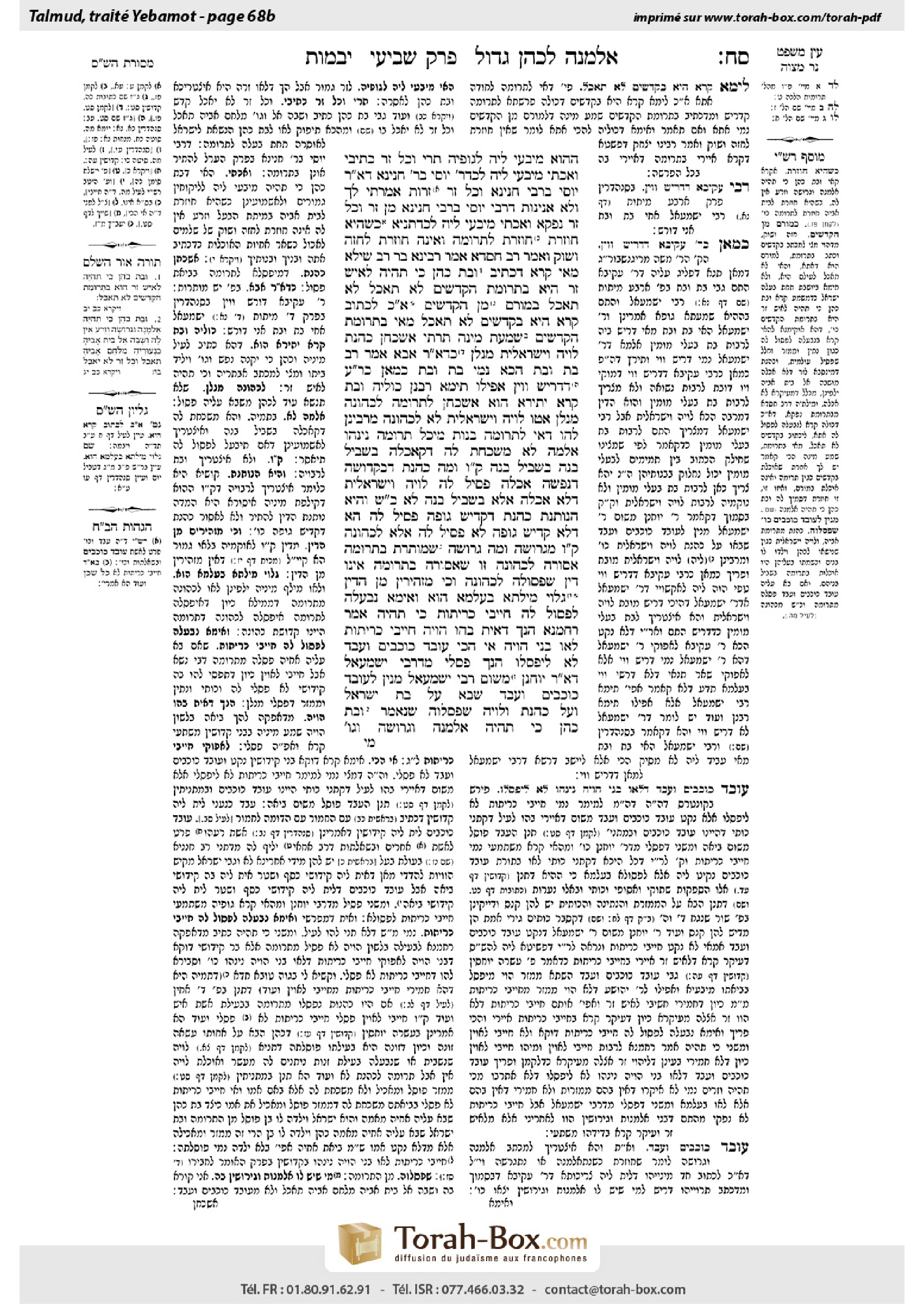
Yevamot 68b: Talmud study for Daf Yomi
Daf Yomi is the daily study of one Talmud folio. Explore 37 tractates with scans, Hebrew text, Sefaria English and AI-generated French translations where annotated.
Passage selection and English or AI-generated French translation are available where the scan has annotations. Daf Study is independent of Torah-Box and Sefaria.
Browse Yevamot · יבמות · All tractatesYevamot 68b text and translations
This page of Yevamot includes the Aramaic text, an English translation and an AI-generated French translation, alongside the scan above.
יבמות ס״ח ב · Aramaic and Hebrew text
הָהוּא מִיבְּעֵי לֵיהּ לְגוּפֵיהּ! תְּרֵי ״וְכׇל זָר״ כְּתִיבִי.
וְאַכַּתִּי מִיבְּעֵי לֵיהּ לְכִדְרַבִּי יוֹסֵי בְּרַבִּי חֲנִינָא, דְּאָמַר רַבִּי יוֹסֵי בְּרַבִּי חֲנִינָא: ״וְכׇל זָר״ — זָרוּת אָמַרְתִּי לְךָ, וְלֹא אֲנִינוּת! דְּרַבִּי יוֹסֵי בְּרַבִּי חֲנִינָא מִן ״זָר״ ״וְכׇל זָר״ נָפְקָא.
וְאַכַּתִּי מִיבְּעֵי לֵיהּ לְכִדְתַנְיָא: כְּשֶׁהִיא חוֹזֶרֶת — חוֹזֶרֶת לִתְרוּמָה וְאֵינָהּ חוֹזֶרֶת לְחָזֶה וָשׁוֹק. וְאָמַר רַב חִסְדָּא אָמַר רָבִינָא בַּר רַב שֵׁילָא: מַאי קְרָא, דִּכְתִיב: ״וּבַת כֹּהֵן כִּי תִהְיֶה לְאִישׁ זָר הִיא בִּתְרוּמַת הַקֳּדָשִׁים לֹא תֹאכֵל״ — לֹא תֹּאכַל בַּמּוּרָם מִן הַקֳּדָשִׁים.
אִם כֵּן, לִכְתּוֹב קְרָא: ״הִיא בַּקֳּדָשִׁים לֹא תֹאכַל״. מַאי ״בִּתְרוּמַת הַקֳּדָשִׁים״? שָׁמְעַתְּ מִינַּהּ תַּרְתֵּי.
אַשְׁכְּחַן כֹּהֶנֶת — לְוִיָּה וְיִשְׂרְאֵלִית מְנָלַן? כִּדְאָמַר רַבִּי אַבָּא אָמַר רַב — ״בַּת״ ״וּבַת״, הָכָא נָמֵי — ״בַּת״ ״וּבַת״.
כְּמַאן — כְּרַבִּי עֲקִיבָא, דְּדָרֵישׁ וָוִין? אֲפִילּוּ תֵּימָא רַבָּנַן, כּוּלֵּיהּ ״וּבַת״ קְרָא יַתִּירָא הוּא.
אַשְׁכְּחַן לִתְרוּמָה, לִכְהוּנָּה מְנָלַן? אַטּוּ לְוִיָּה וְיִשְׂרְאֵלִית לָא לִכְהוּנָּה מְרַבֵּינַן לְהוּ? דְּאִי לִתְרוּמָה, בְּנוֹת מֵיכַל תְּרוּמָה נִינְהוּ?
אַלְּמָה לָא, מַשְׁכַּחַתְּ לַהּ דְּקָאָכְלָה בִּשְׁבִיל בְּנָהּ.
בִּשְׁבִיל בְּנָהּ קַל וָחוֹמֶר: וּמָה כֹּהֶנֶת, דְּבִקְדוּשָּׁה דְנַפְשַׁהּ אָכְלָה — פָּסֵיל לָהּ, לְוִיָּה וְיִשְׂרְאֵלִית, דְּלָא אָכְלָה אֶלָּא בִּשְׁבִיל בְּנָהּ — לֹא כׇּל שֶׁכֵּן?
וְהִיא הַנּוֹתֶנֶת: כֹּהֶנֶת דְּקַדִּישׁ גּוּפַהּ — פָּסֵיל לַהּ, הָא, דְּלָא קַדִּישׁ גּוּפַהּ — לָא פָּסֵיל לַהּ. אֶלָּא לִכְהוּנָּה, קַל וָחוֹמֶר מִגְּרוּשָׁה: וּמָה גְּרוּשָׁה שֶׁמּוּתֶּרֶת בִּתְרוּמָה — אֲסוּרָה לַכְּהוּנָּה, זוֹ שֶׁאֲסוּרָה בִּתְרוּמָה — אֵינוֹ דִּין שֶׁפְּסוּלָה לַכְּהוּנָּה?!
וְכִי מַזְהִירִין מִן הַדִּין? גִּלּוּי מִילְּתָא בְּעָלְמָא הוּא.
וְאֵימָא נִבְעֲלָה לְפָסוּל לָהּ — חַיָּיבֵי כָּרֵיתוֹת, ״כִּי תִהְיֶה״ אָמַר רַחֲמָנָא: הָנָךְ דְּאִית בְּהוּ הֲוָיָה. חַיָּיבֵי כָּרֵיתוֹת לָאו בְּנֵי הֲוָיָה.
אִי הָכִי, גּוֹי וְעֶבֶד לָא לִיפְסְלוּ! הָנָךְ פָּסְלִי מִדְּרַבִּי יִשְׁמָעֵאל. דְּאָמַר רַבִּי יוֹחָנָן מִשּׁוּם רַבִּי יִשְׁמָעֵאל: מִנַּיִן לְגוֹי וְעֶבֶד שֶׁבָּא עַל בַּת יִשְׂרָאֵל וְעַל כֹּהֶנֶת וּלְוִיָּה, שֶׁפְּסָלוּהָ — שֶׁנֶּאֱמַר: ״וּבַת כֹּהֵן כִּי תִהְיֶה אַלְמָנָה וּגְרוּשָׁה וְגוֹ׳״ —
Yevamot 68b · English translation
The Gemara rejects this assertion: That verse is necessary to teach its own basic halakha, that a non-priest is prohibited from partaking of teruma. The Gemara responds: Two prohibitions with regard to a “common man” are written, one in the verse previously cited and the other in Leviticus 22:13: “But there shall no common man eat of it.” One of them prohibits a non-priest from partaking of teruma, while the other is referring to the daughter of a priest married to a non-priest.
The Gemara asks: One of these verses is still necessary to teach another halakha that is taught by Rabbi Yosei, son of Rabbi Ḥanina, as Rabbi Yosei, son of Rabbi Ḥanina, said that the phrase “no common man” indicates that I, God, said to you that commonness, i.e., non-priesthood, renders one unfit to partake of teruma, but acute mourning, i.e., mourning on the day when one’s close relative died, does not render one unfit to eat teruma. The Gemara answers: This teaching of Rabbi Yosei, son of Rabbi Ḥanina, is derived from a superfluous word in the verse, as it could have stated: A common man may not eat of the holy thing, and it actually states: “No common man.”
The Gemara asks: The verse “And if a priest’s daughter be married to a common man” (Leviticus 22:12), from which Rav derived the halakha being discussed, that intercourse with an unfit man renders a woman unfit to partake of teruma and marry a priest, is still necessary for that which is taught in a baraita: When a priest’s daughter returns to her father’s house after the death of her Israelite husband, she resumes partaking of teruma, but she does not resume partaking of the breast and the right hind leg of sacrificial offerings. And Rav Ḥisda said that Ravina, son of Rav Sheila, said: What is the verse from which this is derived? As it is written: “And if a priest’s daughter be married to a common man, she may not eat of that which is set apart from the sacred” (Leviticus 22:12). This implies that even after her husband’s death, she may not partake of the portion separated from consecrated offerings. Therefore, the verse cannot be the source for the above halakha.
The Gemara answers: If so, if this is the only halakha derived from this verse, let the verse merely write: She may not eat of the sacred. What is the significance of the seemingly superfluous expression “that which is set apart from the sacred”? Conclude from this that the prohibition is referring to two deeds: The daughter of a priest who engaged in intercourse with an unfit man may not partake of teruma, and if she weds a non-priest she may not partake of the priestly portion of offerings, the breast and right hind leg.
The Gemara asks: We found a source for a priestess; from where do we derive the same halakha with regard to a Levite or an Israelite woman who engaged in intercourse with an unfit man, i.e., that they do not partake of teruma even if they marry a priest? The Gemara answers that it is as Rabbi Abba said that Rav said: The verse states: “But if a priest’s daughter be a widow, or divorced” (Leviticus 22:13). It could have begun: If a priest’s daughter. The word “but,” the prefix vav, is seemingly superfluous, and therefore it may indicate the expansion of the prohibition to include additional women. Here too, it may be derived from the distinction between the phrase: If a priest’s daughter, and the phrase: “And if a priest’s daughter,” which utilizes the prefix vav, that Levite and Israelite women are subject to the prohibition as well.
The Gemara asks: In accordance with whose opinion is this exposition possible? It is in accordance only with the opinion of Rabbi Akiva, as he derives halakhot from the prefix vav, which means “and” or “but.” The Gemara responds: Even if you say it is in accordance with the Rabbis, who do not derive halakhot from the prefix vav, the entire phrase: “And if a priest’s daughter,” is superfluous in the verse, as the previous verse already mentioned the priest’s daughter. Therefore, the inclusion of Levite and Israelite women in the prohibition may be derived from the entire expression.
The Gemara asks: We found a source for the woman’s disqualification from partaking of teruma; from where do we derive that she is disqualified from marrying into the priesthood? The Gemara counters: Is that to say that we did not include a Levite and an Israelite woman in the verse “But if a priest’s daughter be a widow, or divorced, etc.” (Leviticus 22:13), with regard to their marriage to a member of the priesthood? The derivation that a Levite and an Israelite woman are included in this verse was clearly with regard to their marriage to a priest; as if the inclusion was with regard to teruma, are these women fit to partake of teruma at all, regardless of their having engaged in intercourse with an unfit man? Clearly, their inclusion pertains to their marriage to a priest and their partaking of teruma as his wife.
The Gemara rejects this assertion: Why not? Why can’t the inclusion be referring to the partaking of teruma exclusively? You find that possibility when she partakes of teruma due to her son. If an Israelite woman has a son from a priest, she may partake of teruma. Therefore, it is necessary to include a Levite or Israelite woman in the prohibition against partaking of teruma if she engaged in intercourse with an unfit man.
The Gemara responds: The halakha that this woman does not partake of teruma due to her son is deduced through an a fortiori inference: If a priestess, who partakes of teruma by virtue of her own sanctity, is disqualified from partaking of teruma by an unfit man who engaged in intercourse with her, then with regard to a Levite or Israelite woman, who partakes of teruma only due to her son, is it not all the more so that it should be prohibited for her to partake of teruma after this act?
The Gemara rejects that response: But that provides support for the contrary reasoning. It is logical that a priestess, who is herself sacred, is disqualified by intercourse with an unfit man. However, with regard to this woman, who is not sacred herself, and who eats teruma only due to her son, intercourse with an unfit man should not disqualify her. Rather, the prohibition against these women marrying into the priesthood is derived by an a fortiori inference from the case of a divorcée: If a divorcée who is the daughter of a priest, who is permitted to partake of teruma, is nevertheless prohibited from marrying into the priesthood, as is written in the Torah (Leviticus 21:7), then with regard to this woman, for whom it is prohibited to partake of teruma, is it not right that she should be disqualified from marrying into the priesthood?
The Gemara raises an objection to that inference: But do we warn, i.e., do we deduce a prohibition through logical derivation? The Gemara answers: This is not a new prohibition; rather, it is merely a revelation of the above prohibition’s scope. In other words, the prohibition against marrying a priest is subsumed under the prohibition against partaking of teruma.
Now that the source has been established, the Gemara asks: And perhaps you should say that this halakha pertaining to a woman who engaged in intercourse with a man unfit for her applies only to those liable to receive karet for their act of intercourse, but not to intercourse with a man who is unfit to marry into the assembly of Israel. The Gemara answers that the Merciful One states in the Torah: “If a priest’s daughter be married” (Leviticus 22:12), indicating that this halakha is referring to those who can have a valid marriage, while those liable to receive karet for their act of intercourse are not fit for marriage.
The Gemara asks: If so, a gentile or a slave who engaged in intercourse with a Jewish woman should not have disqualified her from marrying into the priesthood, as they cannot marry her. The Gemara answers: These disqualify her, as derived by Rabbi Yishmael, as Rabbi Yoḥanan said in the name of Rabbi Yishmael: From where is it derived with regard to a gentile or a slave who engaged in intercourse with an Israelite woman, or with a priestess, or a Levite woman, that they have disqualified her? As it is stated: “But if a priest’s daughter be a widow, or divorced, and have no child, and is returned to her father’s house, as in her youth, she may eat of her father’s bread” (Leviticus 22:13).
Yevamot 68b · Traduction française (IA)
La Guemara rejette cette affirmation : ce verset est nécessaire pour enseigner la halakha fondamentale qu’il énonce, à savoir qu’un non-prêtre n’a pas le droit de consommer de terouma. La Guemara répond : Deux interdictions visant un « homme du commun » sont écrites, l’une dans le verset cité précédemment et l’autre en Lévitique 22,13 : « Mais aucun homme du commun n’en mangera. » L’une interdit à un non-prêtre de consommer de terouma, tandis que l’autre concerne la fille d’un prêtre mariée à un non-prêtre.
La Guemara demande : L’un de ces versets est encore nécessaire pour enseigner une autre halakha transmise par Rabbi Yosei, fils de Rabbi Ḥanina. En effet, Rabbi Yosei, fils de Rabbi Ḥanina, a dit que l’expression « aucun homme du commun » indique que Dieu vous a dit que le statut d’homme du commun, c’est-à-dire le fait de ne pas être prêtre, rend inapte à consommer de terouma, mais que le deuil aigu, c’est-à-dire le deuil le jour où un proche parent est décédé, ne rend pas inapte à consommer de terouma. La Guemara répond : Cet enseignement de Rabbi Yosei, fils de Rabbi Ḥanina, est déduit d’un mot superflu dans le verset, car celui-ci aurait pu dire : « Un homme du commun ne mangera pas de la chose sainte », alors qu’il dit : « Aucun homme du commun. »
La Guemara demande : Le verset « Et si la fille d’un prêtre est mariée à un homme du commun » (Lévitique 22,12), dont Rav a déduit la halakha discutée ici — à savoir qu’une relation sexuelle avec un homme qui ne lui est pas permis rend une femme inapte à consommer de terouma et à épouser un prêtre —, est encore nécessaire pour enseigner ce qui est transmis dans une baraïta : lorsqu’une fille de prêtre retourne dans la maison de son père après la mort de son mari israélite, elle reprend la consommation de terouma, mais ne reprend pas sa part du sein et de la cuisse arrière droite des offrandes sacrificielles. Rav Ḥisda a dit que Ravina, fils de Rav Sheila, a dit : De quel verset cela est-il déduit ? Il est écrit : « Et si la fille d’un prêtre est mariée à un homme du commun, elle ne mangera pas de ce qui est prélevé sur les choses consacrées » (Lévitique 22,12). Cela implique que même après la mort de son mari, elle ne peut pas consommer la part prélevée sur les offrandes consacrées. Par conséquent, ce verset ne peut pas être la source de la halakha susmentionnée.
La Guemara répond : Dans ce cas, si c’était la seule halakha déduite de ce verset, qu’il soit simplement écrit : « Elle ne mangera pas des choses saintes. » Que signifie l’expression apparemment superflue « de ce qui est prélevé sur les choses saintes » ? Déduis-en que l’interdiction concerne deux actes : la fille d’un prêtre qui a eu une relation sexuelle avec un homme qui ne lui est pas permis ne peut pas consommer de terouma ; et si elle épouse un non-prêtre, elle ne peut pas consommer la part sacerdotale des offrandes, à savoir le sein et la cuisse arrière droite.
La Guemara demande : Nous avons trouvé une source concernant la fille d’un prêtre ; d’où déduisons-nous la même halakha au sujet d’une femme lévite ou israélite qui a eu une relation sexuelle avec un homme qui ne lui est pas permis, à savoir qu’elle ne consomme pas de terouma même si elle épouse un prêtre ? La Guemara répond que c’est comme l’a dit Rabbi Abba au nom de Rav : le verset dit : « Mais si la fille d’un prêtre est veuve ou divorcée » (Lévitique 22,13). Il aurait pu commencer par : « Si la fille d’un prêtre ». Le mot « mais », la lettre vav préfixée, semble superflu ; il peut donc indiquer que l’interdiction est étendue à d’autres femmes. Ici aussi, on peut déduire de la distinction entre l’expression « si la fille d’un prêtre » et l’expression « et si la fille d’un prêtre », qui comporte la lettre vav préfixée, que les femmes lévites et israélites sont elles aussi soumises à l’interdiction.
La Guemara demande : Selon l’opinion de qui cette interprétation est-elle possible ? Uniquement selon celle de Rabbi Akiva, car il déduit des halakhot de la lettre vav préfixée, qui signifie « et » ou « mais ». La Guemara répond : Même si tu dis que c’est conforme à l’opinion des Rabbins, qui ne déduisent pas de halakhot de la lettre vav préfixée, toute l’expression « et si la fille d’un prêtre » est superflue dans le verset, puisque le verset précédent a déjà mentionné la fille d’un prêtre. On peut donc déduire de l’expression entière que les femmes lévites et israélites sont incluses dans l’interdiction.
La Guemara demande : Nous avons trouvé une source établissant que la femme est inapte à consommer de terouma ; d’où déduisons-nous qu’elle est inapte à épouser un membre de la prêtrise ? La Guemara objecte : Veut-on dire que nous n’avons pas inclus une femme lévite et une femme israélite dans le verset « Mais si la fille d’un prêtre est veuve ou divorcée, etc. » (Lévitique 22,13), en ce qui concerne leur mariage avec un membre de la prêtrise ? La déduction selon laquelle les femmes lévites et israélites sont incluses dans ce verset concernait clairement leur mariage avec un prêtre ; car si cette inclusion concernait la terouma, ces femmes seraient-elles aptes à consommer de la terouma, qu’elles aient ou non eu une relation sexuelle avec un homme qui ne leur est pas permis ? Il est clair que leur inclusion concerne leur mariage avec un prêtre et leur consommation de terouma en tant que son épouse.
La Guemara rejette cette affirmation : Pourquoi pas ? Pourquoi l’inclusion ne pourrait-elle concerner que la consommation de terouma ? Cette possibilité existe lorsqu’elle consomme de la terouma en raison de son fils. Si une femme israélite a un fils d’un prêtre, elle peut consommer de la terouma. Il est donc nécessaire d’inclure une femme lévite ou israélite dans l’interdiction de consommer de la terouma si elle a eu une relation sexuelle avec un homme qui ne lui est pas permis.
La Guemara répond : La halakha selon laquelle cette femme ne consomme pas de terouma en raison de son fils est déduite par raisonnement a fortiori : si la fille d’un prêtre, qui consomme de la terouma en vertu de sa propre sainteté, est rendue inapte à en consommer par une relation sexuelle avec un homme qui ne lui est pas permis, à plus forte raison une femme lévite ou israélite, qui ne consomme de la terouma qu’en raison de son fils, ne devrait-elle pas avoir l’interdiction d’en consommer après cet acte ?
La Guemara rejette cette réponse : Mais cela étaye le raisonnement contraire. Il est logique que la fille d’un prêtre, qui est elle-même sainte, soit rendue inapte par une relation sexuelle avec un homme qui ne lui est pas permis. En revanche, pour cette femme, qui n’est pas elle-même sainte et ne consomme de la terouma qu’en raison de son fils, une relation sexuelle avec un homme qui ne lui est pas permis ne devrait pas la rendre inapte. L’interdiction faite à ces femmes d’épouser un membre de la prêtrise est plutôt déduite par raisonnement a fortiori du cas d’une femme divorcée : si une femme divorcée qui est fille de prêtre et qui est autorisée à consommer de la terouma a néanmoins l’interdiction d’épouser un membre de la prêtrise, comme il est écrit dans la Torah (Lévitique 21,7), à plus forte raison cette femme, à qui la consommation de terouma est interdite, ne devrait-elle pas être déclarée inapte à épouser un membre de la prêtrise ?
La Guemara soulève une objection à cette déduction : Mais peut-on établir une interdiction, c’est-à-dire déduire une interdiction par raisonnement logique ? La Guemara répond : Il ne s’agit pas d’une nouvelle interdiction ; cela ne fait que révéler la portée de l’interdiction susmentionnée. Autrement dit, l’interdiction d’épouser un prêtre est comprise dans l’interdiction de consommer de la terouma.
Maintenant que la source a été établie, la Guemara demande : Et peut-être faut-il dire que cette halakha concernant une femme qui a eu une relation sexuelle avec un homme qui ne lui est pas permis ne s’applique qu’aux relations sexuelles passibles de karet, mais pas à une relation sexuelle avec un homme inapte à épouser une personne appartenant à l’assemblée d’Israël. La Guemara répond que le Miséricordieux dit dans la Torah : « Si la fille d’un prêtre est mariée » (Lévitique 22,12), ce qui indique que cette halakha concerne ceux qui peuvent contracter un mariage valide, tandis que ceux dont les relations sexuelles sont passibles de karet ne sont pas aptes au mariage.
La Guemara demande : Dans ce cas, un non-Juif ou un esclave qui a eu une relation sexuelle avec une femme juive ne devrait pas la rendre inapte à épouser un membre de la prêtrise, puisqu’ils ne peuvent pas l’épouser. La Guemara répond : Ceux-là la rendent inapte, comme l’a déduit Rabbi Yishmael. En effet, Rabbi Yoḥanan a dit au nom de Rabbi Yishmael : D’où déduit-on qu’un non-Juif ou un esclave qui a eu une relation sexuelle avec une femme israélite, une fille de prêtre ou une femme lévite l’a rendue inapte ? Car il est dit : « Mais si la fille d’un prêtre est veuve ou divorcée, qu’elle n’a pas d’enfant et qu’elle retourne dans la maison de son père, comme dans sa jeunesse, elle pourra manger du pain de son père » (Lévitique 22,13).
Traduction française générée par IA à partir de l’édition anglaise de Sefaria. Vérifie toujours un passage avec le texte source.
Text from Sefaria: William Davidson Edition - Vocalized Aramaic (CC BY NC); William Davidson Edition - English (CC BY NC).