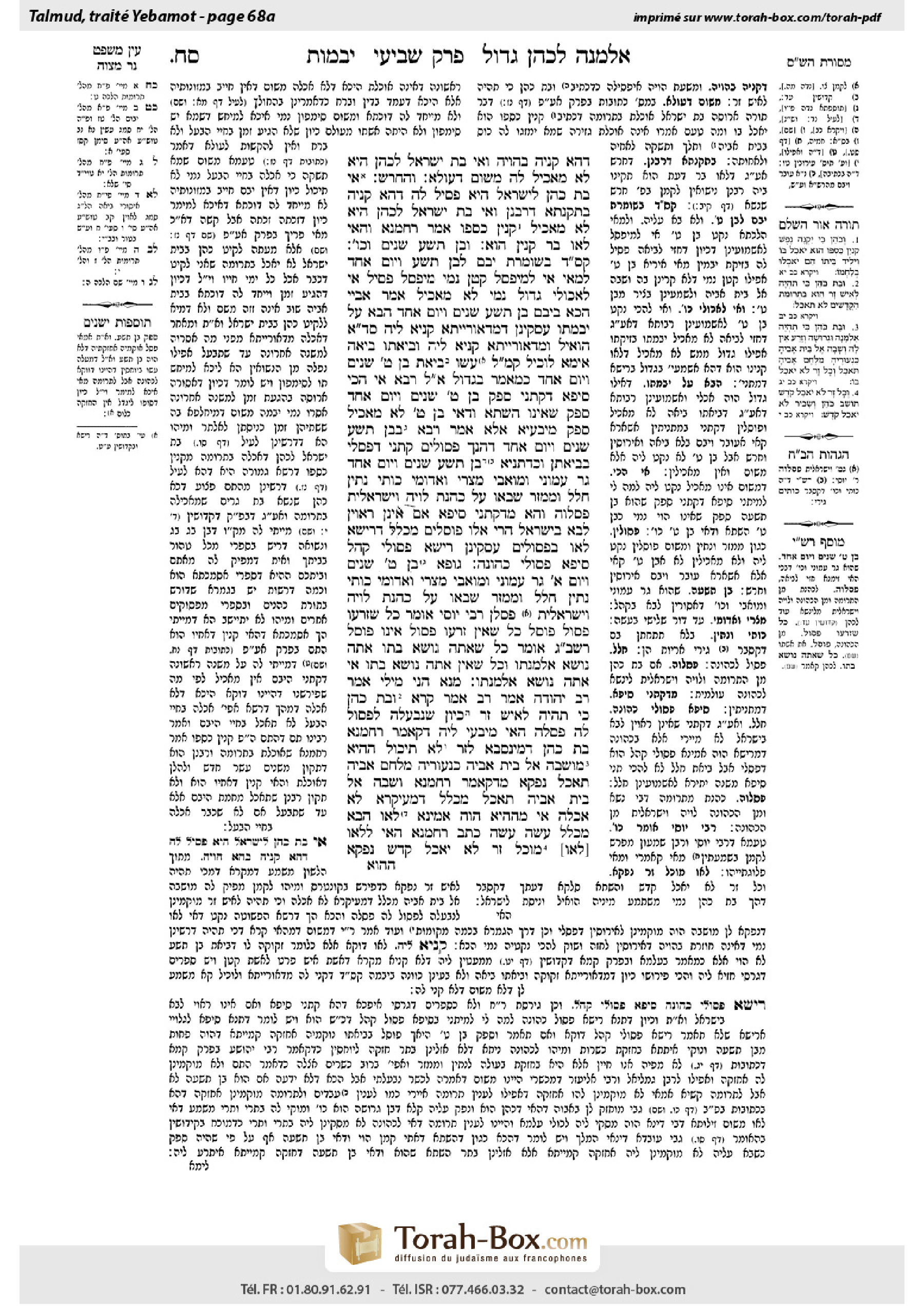
Yevamot 68a: Talmud study for Daf Yomi
Daf Yomi is the daily study of one Talmud folio. Explore 37 tractates with scans, Hebrew text, Sefaria English and AI-generated French translations where annotated.
Passage selection and English or AI-generated French translation are available where the scan has annotations. Daf Study is independent of Torah-Box and Sefaria.
Browse Yevamot · יבמות · All tractatesYevamot 68a text and translations
This page of Yevamot includes the Aramaic text, an English translation and an AI-generated French translation, alongside the scan above.
יבמות ס״ח א · Aramaic and Hebrew text
דְּהָא קַנְיַהּ בַּהֲוָיָה. וְאִי בַּת יִשְׂרָאֵל לְכֹהֵן הִיא — לֹא מַאֲכִיל לָהּ מִשּׁוּם דְּעוּלָּא.
וְהַחֵרֵשׁ. אִי בַּת כֹּהֵן לְיִשְׂרָאֵל הִיא — פָּסֵיל לַהּ, דְּהָא קַנְיַהּ בְּתַקַּנְתָּא דְרַבָּנַן. וְאִי בַּת יִשְׂרָאֵל לְכֹהֵן הִיא — לָא מַאֲכֵיל, ״קִנְיַן כַּסְפּוֹ״ אָמַר רַחֲמָנָא, וְהַאי לָאו בַּר קִנְיָן הוּא.
וּבֶן תֵּשַׁע שָׁנִים וְכוּ׳. קָא סָלְקָא דַּעְתִּין, בְּשׁוֹמֶרֶת יָבָם לְבֶן תֵּשַׁע וְיוֹם אֶחָד. לְמַאי? אִי לְמִיפְסַל — קָטָן נָמֵי מִיפְסָל פָּסֵיל, אִי לְאוֹכוֹלֵי — גָּדוֹל נָמֵי לֹא מַאֲכִיל!
אָמַר אַבָּיֵי: הָכָא בְּיָבָם בֶּן תֵּשַׁע שָׁנִים וְיוֹם אֶחָד הַבָּא עַל יְבִמְתּוֹ עָסְקִינַן. דְּמִדְּאוֹרָיְיתָא קַנְיָא לֵיהּ, סָלְקָא דַּעְתָּךְ אָמֵינָא: הוֹאִיל וּמִדְּאוֹרָיְיתָא קַנְיָא לֵיהּ וּבִיאָתוֹ בִּיאָה, אֵימָא לוֹכֵיל, קָא מַשְׁמַע לַן עָשׂוּ בִּיאַת בֶּן תֵּשַׁע שָׁנִים וְיוֹם אֶחָד כְּמַאֲמָר בְּגָדוֹל.
אֲמַר לֵיהּ רָבָא: אִי הָכִי, סֵיפָא דְּקָתָנֵי: סָפֵק בֶּן תֵּשַׁע שָׁנִים וְיוֹם אֶחָד סָפֵק שֶׁאֵינוֹ — הַשְׁתָּא וַדַּאי בֶּן תֵּשַׁע לֹא מַאֲכִיל, סָפֵק מִיבַּעְיָא?!
אֶלָּא אָמַר רָבָא: בְּבֶן תֵּשַׁע שָׁנִים וְיוֹם אֶחָד דְּהָנָךְ פְּסוּלִים קָתָנֵי, דְּפָסְלִי בְּבִיאָתָן. וְכִדְתַנְיָא: בֶּן תֵּשַׁע שָׁנִים וְיוֹם אֶחָד, גֵּר, עַמּוֹנִי וּמוֹאָבִי, מִצְרִי וַאֲדוֹמִי, כּוּתִי, נָתִין, חָלָל וּמַמְזֵר שֶׁבָּאוּ עַל כֹּהֶנֶת לְוִיָּה וְיִשְׂרְאֵלִית — פְּסָלוּהָ.
וְהָא מִדְּקָתָנֵי סֵיפָא: אִם אֵינָן רְאוּיִן לָבֹא בְּיִשְׂרָאֵל — הֲרֵי אֵלּוּ פּוֹסְלִים, מִכְּלָל דְּרֵישָׁא לָאו בִּפְסוּלִים עָסְקִינַן! רֵישָׁא פְּסוּלֵי קָהָל, סֵיפָא פְּסוּלֵי כְהוּנָּה.
גּוּפָא: בֶּן תֵּשַׁע שָׁנִים וְיוֹם אֶחָד, גֵּר, עַמּוֹנִי וּמוֹאָבִי, מִצְרִי וַאֲדוֹמִי, כּוּתִי, נָתִין, חָלָל וּמַמְזֵר שֶׁבָּאוּ עַל כֹּהֶנֶת לְוִיָּה וְיִשְׂרְאֵלִית — פְּסָלוּהָ.
רַבִּי יוֹסֵי אוֹמֵר: כֹּל שֶׁזַּרְעוֹ פָּסוּל — פּוֹסֵל, כֹּל שֶׁאֵין זַרְעוֹ פָּסוּל — אֵינוֹ פּוֹסֵל. רַבָּן שִׁמְעוֹן בֶּן גַּמְלִיאֵל אוֹמֵר: כֹּל שֶׁאַתָּה נוֹשֵׂא בִּתּוֹ — אַתָּה נוֹשֵׂא אַלְמְנָתוֹ, וְכֹל שֶׁאֵין אַתָּה נוֹשֵׂא בִּתּוֹ — אִי אַתָּה נוֹשֵׂא אַלְמְנָתוֹ.
מְנָא הָנֵי מִילֵּי? אָמַר רַב יְהוּדָה אָמַר רַב, אָמַר קְרָא: ״וּבַת כֹּהֵן כִּי תִהְיֶה לְאִישׁ זָר״, כֵּיוָן שֶׁנִּבְעֲלָה לְפָסוּל לָהּ — פְּסָלָהּ.
הַאי מִיבְּעֵי לֵיהּ דְּקָאָמַר רַחֲמָנָא בַּת כֹּהֵן דְּמִינַּסְבָא לְזָר — לָא תֵּיכוּל!
הָהִיא, מִ״וְּשָׁבָה אֶל בֵּית אָבִיהָ כִּנְעוּרֶיהָ מִלֶּחֶם אָבִיהָ תֹּאכֵל״ נָפְקָא. מִדְּקָאָמַר רַחֲמָנָא: ״וְשָׁבָה אֶל בֵּית אָבִיהָ ... תֹּאכֵל״, מִכְּלָל דְּמֵעִיקָּרָא לָא אָכְלָה.
אִי מֵהַהִיא, הֲוָה אָמֵינָא: לָאו הַבָּא מִכְּלַל עֲשֵׂה — עֲשֵׂה, כְּתַב רַחֲמָנָא הַאי לְלָאו. [לָאו] מִ״וְכָל זָר לֹא יֹאכַל קֹדֶשׁ״ נָפְקָא.
Yevamot 68a · English translation
as he acquired her by means of betrothal. And if she is an Israelite woman betrothed to a priest, he does not enable her to partake of teruma due to the reason given by Ulla: Although by Torah law a priest’s betrothed partakes of teruma, the Sages rendered it prohibited for her to do so, lest she allow other members of her family to eat it.
It is also taught in the mishna that a deaf-mute disqualifies a woman from partaking of teruma and does not enable her to do so. The Gemara elaborates: If she is the daughter of a priest married to a deaf-mute Israelite, he disqualifies her, as he acquired her through marriage sanctioned by an ordinance of the Sages. Although the marriage of a deaf-mute is invalid by Torah law, the Sages instituted an ordinance validating this type of marriage. And if she is an Israelite woman married to a deaf-mute priest, he does not enable her to partake of teruma, as the Merciful One states in the Torah: “The purchase of his money, he may eat of it” (Leviticus 22:11), and this deaf-mute is not capable of acquisition by Torah law, as he is not legally competent.
§ It is also taught in the mishna that a nine-year-old boy disqualifies a woman from partaking of teruma and does not enable her to partake. It enters our mind that the mishna is referring to a widow waiting for her yavam, who is nine years and one day old. The Gemara therefore inquires: With regard to what is this taught? If it is with regard to disqualifying her from partaking of teruma, a younger yavam also disqualifies her, as a levirate bond was created and she cannot return to her father’s house. And if it was with regard to enabling her to partake of teruma, an older yavam does not enable her to partake either, as discussed above.
Abaye said: Here we are dealing with a nine-year-and-one-day-old yavam who already engaged in intercourse with his yevama, as she was thereby acquired by him by Torah law. It might enter your mind to say that since by Torah law she was acquired by him, as the legal status of his act of intercourse is that of intercourse, perhaps he enables her to partake of teruma. The mishna therefore teaches us that the Sages rendered the legal status of the intercourse of a nine-year-and-one-day-old boy like that of levirate betrothal by means of money or a document performed by an adult man, which is not sufficient for her to partake of teruma. Since levirate betrothal is effective only by rabbinic law, the yevama is not considered the acquisition of his money by Torah law and may not partake of teruma.
Rava said to him: If so, consider the latter clause of the mishna, which teaches that a boy with regard to whom there is uncertainty whether he is nine years and one day old and uncertainty whether he is not, disqualifies a woman from partaking of teruma, and he does not enable her to partake. Now that, according to your explanation, one who is definitely nine years old does not enable her to partake of teruma, is it necessary to teach the same concerning a boy with regard to whom there is uncertainty as to whether or not he reached that age?
Rather, Rava said that the mishna is teaching this halakha with regard to a nine-year-and-one-day-old boy who is one of those unfit males listed in a baraita, who disqualify a woman from marrying a priest by their intercourse, as they are unfit to enter the assembly of Israel through marriage, as it is taught in a baraita: A nine-year-and-one-day-old boy who is an Ammonite or a Moabite convert; or who is an Egyptian or an Edomite convert; or who is either a Samaritan [kuti], a Gibeonite, a ḥalal, or a mamzer, when he engaged in intercourse with a priestess, i.e., the daughter of a priest, a Levite, or an Israelite, he thereby disqualified her from marrying a priest, and, in the case of the daughter of a priest, from partaking of teruma.
The Gemara raises a difficulty from the fact that the latter clause, the next mishna (69a), teaches that if men who are unfit to enter the assembly of Israel by marriage engage in extramarital intercourse with women, they disqualify them from marrying into the priesthood: It may be inferred that in the first clause, the mishna above, we are dealing not with unfit individuals but with men fit to marry Jews of unflawed lineage. The Gemara answers: That inference is incorrect. The first clause of the mishna is dealing with those unfit to enter the assembly of Israel by marriage, while the latter clause is dealing with those who are merely unfit for the priesthood. That is why the mishna is referring to them separately. Accordingly, Rava’s explanation that the mishna is referring to an unfit nine-year-old boy is viable.
§ The Gemara addresses the matter itself and cites the complete baraita. A nine-year-and-one-day-old boy who is an Ammonite or a Moabite convert; or who is an Egyptian or an Edomite convert; or who is either a Samaritan, a Gibeonite, a ḥalal, or a mamzer, when he engaged in intercourse with a priestess, or a Levite, or an Israelite, he thereby disqualified her from marrying into the priesthood.
Rabbi Yosei says: Of the individuals mentioned above, anyone whose offspring is unfit to enter the assembly of Israel, disqualifies a woman with whom he engaged in intercourse from marrying into the priesthood. However, anyone whose offspring is not unfit does not disqualify a woman through intercourse. Rabban Shimon ben Gamliel says: Anyone whose daughter you may marry, you may marry his widow, even if you are a priest. Anyone whose daughter may marry a Jew of unflawed lineage does not disqualify a woman with whom he engaged in intercourse from marrying into the priesthood. And anyone whose daughter you may not marry, you may not marry his widow if you are a priest.
The Gemara asks: From where are these matters derived, that intercourse with an unfit man renders a woman unfit to partake of teruma and marry a priest? Rav Yehuda said that Rav said: The verse states: “And if a priest’s daughter be married to a common man [ish zar], she shall not eat of that which is set apart from the sacred” (Leviticus 22:12). It may be derived that since she engaged in intercourse with one who is unfit for her, he disqualified her from marrying into the priesthood, as the literal meaning of the expression ish zar is a man who is excluded.
The Gemara asks: That verse is necessary to teach the halakha that the Merciful One says: The daughter of a priest who marries a non-priest, even one that she is permitted to marry, may not partake of teruma. Therefore, it cannot be the source for the halakha that intercourse with an unfit man renders a woman unfit to partake of teruma and marry a priest.
The Gemara answers: That prohibition is derived from the verse “But if a priest’s daughter be a widow, or divorced, and have no child, and is returned to her father’s house, as in her youth, she may eat of her father’s bread” (Leviticus 22:13). From the fact that the Merciful One says: “And is returned to her father’s house…she may eat,” it may be inferred that initially, while married to a non-priest, she was not permitted to eat. Therefore, the prohibition against a woman who engaged in intercourse with an unfit man partaking of teruma may be derived from the former verse, as it is not necessary for this halakha.
The Gemara rejects this answer: If the prohibition against the daughter of a priest who married a non-priest partaking of teruma had been derived only from that latter verse, I would have said that it is a prohibition that stems from a positive mitzva, as it is stated in positive form, and according to the principle that a prohibition that stems from a positive mitzva is a positive mitzva, she would not be liable to receive a court-imposed punishment. The Merciful One therefore writes that former verse, to establish an explicit prohibition. The Gemara counters: The prohibition against the wife of a non-priest partaking of teruma is derived from a different verse: “No common man may eat of the sacred” (Leviticus 22:10).
Yevamot 68a · Traduction française (IA)
puisqu’il l’a acquise par les kidouchin. Et si elle est une Israélite fiancée à un prêtre, celui-ci ne lui permet pas de consommer la terouma, pour la raison donnée par Oulla : bien que, selon la Torah, la fiancée d’un prêtre puisse consommer la terouma, les Sages le lui ont interdit, de crainte qu’elle ne laisse d’autres membres de sa famille en consommer.
La Michna enseigne également qu’un sourd-muet rend une femme inapte à consommer la terouma et ne lui permet pas d’en consommer. La Guemara précise : si elle est la fille d’un prêtre mariée à un Israélite sourd-muet, celui-ci la rend inapte, car il l’a acquise par un mariage validé par une ordonnance des Sages. Bien que le mariage d’un sourd-muet soit invalide selon la Torah, les Sages ont institué une ordonnance validant ce type de mariage. Et si elle est une Israélite mariée à un prêtre sourd-muet, celui-ci ne lui permet pas de consommer la terouma, car le Miséricordieux dit dans la Torah : « L’acquisition de son argent, il pourra en manger » (Lévitique 22:11), et ce sourd-muet n’est pas capable d’acquérir selon la Torah, puisqu’il n’a pas la capacité juridique requise.
§ La Michna enseigne également qu’un garçon de neuf ans rend une femme inapte à consommer la terouma et ne lui permet pas d’en consommer. Nous pourrions penser que la Michna parle d’une veuve qui attend son yavam, lequel a neuf ans et un jour. La Guemara demande donc : à propos de quoi cette halakha est-elle enseignée ? S’il s’agit de la rendre inapte à consommer la terouma, un yavam plus jeune la rend également inapte, car le lien de lévirat a été créé et elle ne peut retourner dans la maison de son père. Et s’il s’agit de lui permettre de consommer la terouma, un yavam plus âgé ne le lui permet pas non plus, comme on l’a vu plus haut.
Abayé dit : Ici, il s’agit d’un yavam de neuf ans et un jour qui a déjà eu un rapport avec sa yevama, laquelle a ainsi été acquise par lui selon la Torah. On pourrait penser que, puisque la Torah considère qu’elle a été acquise par lui — l’acte de rapport étant juridiquement considéré comme un rapport —, il lui permet peut-être de consommer la terouma. La Michna nous enseigne donc que les Sages ont conféré au rapport d’un garçon de neuf ans et un jour le même statut qu’aux kidouchin léviratiques accomplis par un homme adulte au moyen d’argent ou d’un document, lesquels ne suffisent pas à lui permettre de consommer la terouma. Puisque les kidouchin léviratiques ne sont effectifs que selon le droit rabbinique, la yevama n’est pas considérée comme acquise par lui selon la Torah et ne peut pas consommer la terouma.
Rava lui dit : Dans ce cas, considère la dernière partie de la Michna, qui enseigne qu’un garçon dont on ne sait pas s’il a neuf ans et un jour, ou s’il n’a pas encore atteint cet âge, rend une femme inapte à consommer la terouma et ne lui permet pas d’en consommer. Or, si, selon ton explication, celui qui a certainement neuf ans ne lui permet pas de consommer la terouma, est-il nécessaire d’enseigner la même chose au sujet d’un garçon dont on ne sait pas s’il a atteint cet âge ou non ?
Rava dit plutôt que la Michna enseigne cette halakha au sujet d’un garçon de neuf ans et un jour qui fait partie des hommes inaptes mentionnés dans une baraïta, lesquels rendent une femme inapte à épouser un prêtre par leur rapport, car ils ne sont pas aptes à entrer dans l’assemblée d’Israël par le mariage. Ainsi, une baraïta enseigne : un garçon de neuf ans et un jour qui est un converti ammonite ou moabite, un converti égyptien ou édomite, un Samaritain [kuti], un Gabaonite, un ḥalal ou un mamzer, s’il a un rapport avec une prêtresse, c’est-à-dire la fille d’un prêtre, d’un Lévite ou d’un Israélite, la rend par là même inapte à épouser un prêtre et, dans le cas de la fille d’un prêtre, à consommer la terouma.
La Guemara soulève une difficulté à partir du fait que la dernière partie, la Michna suivante (69a), enseigne que des hommes inaptes à entrer dans l’assemblée d’Israël par le mariage rendent les femmes avec lesquelles ils ont des rapports extraconjugaux inaptes à épouser un prêtre : on peut en déduire que, dans la première partie, la Michna précédente, il s’agit non pas d’individus inaptes, mais d’hommes aptes à épouser des Juives de filiation sans défaut. La Guemara répond : cette déduction est erronée. La première partie de la Michna traite de ceux qui sont inaptes à entrer dans l’assemblée d’Israël par le mariage, tandis que la dernière partie traite de ceux qui sont seulement inaptes à la prêtrise. C’est pourquoi la Michna les mentionne séparément. L’explication de Rava, selon laquelle la Michna parle d’un garçon de neuf ans inapte, est donc valable.
§ La Guemara revient au sujet lui-même et cite la baraïta dans son intégralité. Un garçon de neuf ans et un jour qui est un converti ammonite ou moabite, un converti égyptien ou édomite, un Samaritain, un Gabaonite, un ḥalal ou un mamzer, s’il a un rapport avec une prêtresse, une Lévite ou une Israélite, la rend par là même inapte à épouser un prêtre.
Rabbi Yossei dit : Parmi les individus mentionnés ci-dessus, quiconque a une descendance inapte à entrer dans l’assemblée d’Israël rend la femme avec laquelle il a eu un rapport inapte à épouser un prêtre. En revanche, quiconque a une descendance qui n’est pas inapte ne rend pas une femme inapte par son rapport. Rabban Shimon ben Gamliel dit : Tu peux épouser la veuve de tout homme dont tu peux épouser la fille, même si tu es prêtre. Tout homme dont la fille peut épouser un Juif de filiation sans défaut ne rend pas la femme avec laquelle il a eu un rapport inapte à épouser un prêtre. Et si tu es prêtre, tu ne peux pas épouser la veuve d’un homme dont tu ne peux pas épouser la fille.
La Guemara demande : D’où tire-t-on ces règles, selon lesquelles un rapport avec un homme inapte rend une femme inapte à consommer la terouma et à épouser un prêtre ? Rav Yehouda dit au nom de Rav : Le verset dit : « Si la fille d’un prêtre est mariée à un homme étranger [ish zar], elle ne mangera pas des choses consacrées » (Lévitique 22:12). On peut en déduire que, puisqu’elle a eu un rapport avec quelqu’un qui ne lui convient pas, celui-ci l’a rendue inapte à épouser un prêtre, car le sens littéral de l’expression ish zar est un homme exclu.
La Guemara demande : Ce verset est nécessaire pour enseigner la halakha suivante : la fille d’un prêtre qui épouse un non-prêtre, même un homme qu’elle a le droit d’épouser, ne peut pas consommer la terouma, comme l’indique la Torah. Il ne peut donc pas servir de source à la halakha selon laquelle un rapport avec un homme inapte rend une femme inapte à consommer la terouma et à épouser un prêtre.
La Guemara répond : Cette interdiction est déduite du verset : « Mais si la fille d’un prêtre est veuve ou divorcée, sans enfant, et retourne dans la maison de son père comme dans sa jeunesse, elle pourra manger du pain de son père » (Lévitique 22:13). Du fait que le Miséricordieux dit : « Et retourne dans la maison de son père… elle pourra manger », on peut déduire qu’auparavant, lorsqu’elle était mariée à un non-prêtre, elle n’avait pas le droit de manger. Par conséquent, l’interdiction faite à une femme ayant eu un rapport avec un homme inapte de consommer la terouma peut être déduite du verset précédent, puisqu’il n’est pas nécessaire pour cette halakha.
La Guemara rejette cette réponse : si l’interdiction faite à la fille d’un prêtre mariée à un non-prêtre de consommer la terouma était déduite uniquement de ce dernier verset, j’aurais dit qu’il s’agit d’une interdiction découlant d’une mitsva positive, puisqu’elle est formulée de manière affirmative ; or, selon le principe qu’une interdiction découlant d’une mitsva positive est elle-même une mitsva positive, elle ne serait pas passible d’une sanction imposée par un tribunal. Le Miséricordieux écrit donc le verset précédent afin d’établir une interdiction explicite. La Guemara objecte : l’interdiction faite à l’épouse d’un non-prêtre de consommer la terouma est déduite d’un autre verset : « Aucun homme ordinaire ne mangera des choses consacrées » (Lévitique 22:10).
Traduction française générée par IA à partir de l’édition anglaise de Sefaria. Vérifie toujours un passage avec le texte source.
Text from Sefaria: William Davidson Edition - Vocalized Aramaic (CC BY NC); William Davidson Edition - English (CC BY NC).