Yevamot 67b: Talmud study for Daf Yomi
Daf Yomi is the daily study of one Talmud folio. Explore 37 tractates with scans, Hebrew text, Sefaria English and AI-generated French translations where annotated.
Passage selection and English or AI-generated French translation are available where the scan has annotations. Daf Study is independent of Torah-Box and Sefaria.
Browse Yevamot · יבמות · All tractatesYevamot 67b text and translations
This page of Yevamot includes the Aramaic text, an English translation and an AI-generated French translation, alongside the scan above.
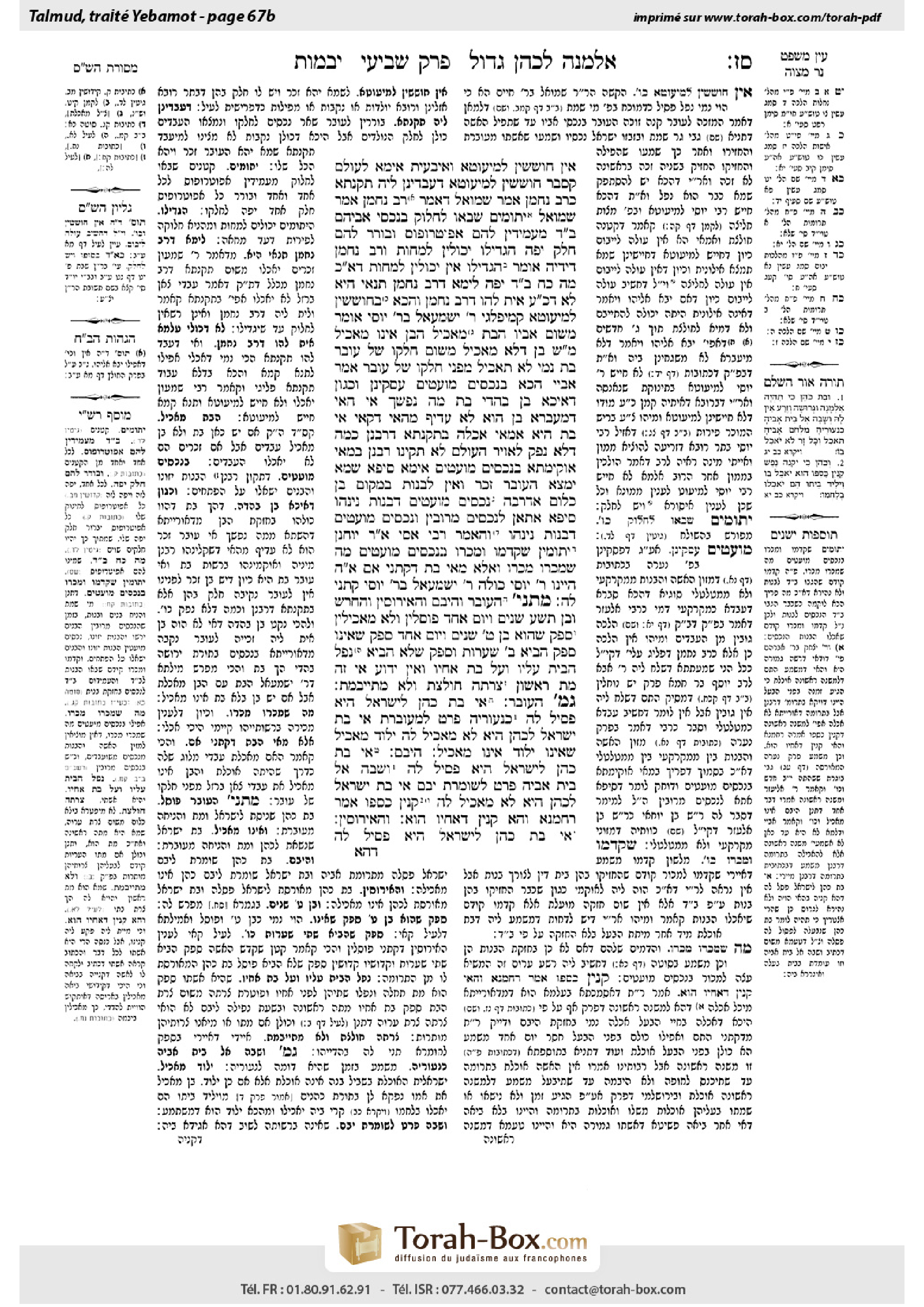
יבמות ס״ז ב · Aramaic and Hebrew text
אֵין חוֹשְׁשִׁין לְמִיעוּטָא. וְאִיבָּעֵית אֵימָא: לְעוֹלָם קָסָבַר חוֹשְׁשִׁין לְמִיעוּטָא, דְּעָבְדִינַן לֵיהּ תַּקַּנְתָּא כְּרַב נַחְמָן אָמַר שְׁמוּאֵל.
דְּאָמַר רַב נַחְמָן אָמַר שְׁמוּאֵל: יְתוֹמִים שֶׁבָּאוּ לַחֲלוֹק בְּנִכְסֵי אֲבִיהֶם, בֵּית דִּין מַעֲמִידִין לָהֶם אַפּוֹטְרוֹפּוֹס, וּבוֹרֵר לָהֶם חֵלֶק יָפֶה. הִגְדִּילוּ — יְכוֹלִין לְמַחוֹת. וְרַב נַחְמָן דִּידֵיהּ אָמַר: הִגְדִּילוּ — אֵין יְכוֹלִין לְמַחוֹת, דְּאִם כֵּן מָה כֹּחַ בֵּית דִּין יָפֶה.
לֵימָא דְּרַב נַחְמָן תַּנָּאֵי הִיא? לָא, דְּכוּלֵּי עָלְמָא אִית לְהוּ דְּרַב נַחְמָן. וְהָכָא בְּחוֹשְׁשִׁין לְמִיעוּטָא קָמִיפַּלְגִי.
רַבִּי יִשְׁמָעֵאל בְּרַבִּי יוֹסֵי אוֹמֵר מִשּׁוּם אָבִיו: הַבַּת מַאֲכֶלֶת, הַבֵּן אֵינוֹ מַאֲכִיל. מַאי שְׁנָא בֵּן דְּלֹא מַאֲכִיל — מִשּׁוּם חֶלְקוֹ שֶׁל עוּבָּר? בַּת נָמֵי לֹא תַּאֲכִיל — מִפְּנֵי חֶלְקוֹ שֶׁל עוּבָּר!
אָמַר אַבָּיֵי: הָכָא בִּנְכָסִים מוּעָטִים עָסְקִינַן. וּכְגוֹן דְּאִיכָּא בֵּן בַּהֲדֵי בַּת,
מָה נַפְשָׁךְ: אִי הַאי דִּמְעַבְּרָא בֵּן הוּא — לָא עֲדִיף מֵהַאי דְּקָאֵי. אִי בַּת הִיא, אַמַּאי אָכְלָה — בְּתַקַּנְתָּא דְרַבָּנַן, כַּמָּה דְּלָא נְפַק לַאֲוִיר הָעוֹלָם לָא תַּקִּינוּ רַבָּנַן.
בְּמַאי אוֹקֵימְתַּאּ — בִּנְכָסִים מוּעָטִים, אֵימָא סֵיפָא: שֶׁמָּא יִמָּצֵא הָעוּבָּר זָכַר, וְאֵין לַבָּנוֹת בִּמְקוֹם בֵּן כְּלוּם. אַדְּרַבָּה, נְכָסִים מוּעָטִים דְּבָנוֹת נִינְהוּ! סֵיפָא אֲתָאן לִנְכָסִים מְרוּבִּין.
וּנְכָסִים מוּעָטִים דְּבָנוֹת נִינְהוּ? וְהָאָמַר רַבִּי אַסִּי אָמַר רַבִּי יוֹחָנָן: יְתוֹמִין שֶׁקָּדְמוּ וּמָכְרוּ בִּנְכָסִים מוּעָטִים — מַה שֶּׁמָּכְרוּ מָכְרוּ?!
וְאֶלָּא, מַאי ״בַּת״ דְּקָתָנֵי — אֵם. אִי הָכִי, הַיְינוּ רַבִּי יוֹסֵי? כּוּלָּהּ רַבִּי יִשְׁמָעֵאל בְּרַבִּי יוֹסֵי קָתָנֵי לַהּ.
מַתְנִי׳ הָעוּבָּר, וְהַיָּבָם, וְהָאֵירוּסִין, וְהַחֵרֵשׁ, וּבֶן תֵּשַׁע שָׁנִים וְיוֹם אֶחָד — פּוֹסְלִין, וְלֹא מַאֲכִילִין.
סָפֵק שֶׁהוּא בֶּן תֵּשַׁע שָׁנִים וְיוֹם אֶחָד סָפֵק שֶׁאֵינוֹ, סָפֵק הֵבִיא שְׁתֵּי שְׂעָרוֹת וְסָפֵק שֶׁלֹּא הֵבִיא,
נָפַל הַבַּיִת עָלָיו וְעַל בַּת אָחִיו, וְאֵין יָדוּעַ אֵי זֶה מֵת רִאשׁוֹן — צָרָתָהּ חוֹלֶצֶת וְלֹא מִתְיַיבֶּמֶת.
גְּמָ׳ הָעוּבָּר. אִי בַּת כֹּהֵן לְיִשְׂרָאֵל הִיא — פָּסֵיל לָהּ. ״כִּנְעוּרֶיהָ״ — פְּרָט לִמְעוּבֶּרֶת. אִי בַּת יִשְׂרָאֵל לְכֹהֵן הִיא — לֹא מַאֲכִיל לָהּ, יָלוּד — מַאֲכִיל, שֶׁאֵינוֹ יָלוּד — אֵינוֹ מַאֲכִיל.
הַיָּבָם. אִי בַּת כֹּהֵן לְיִשְׂרָאֵל הִיא — פָּסֵיל לָהּ. ״וְשָׁבָה אֶל בֵּית אָבִיהָ״ — פְּרָט לְשׁוֹמֶרֶת יָבָם. אִי בַּת יִשְׂרָאֵל לְכֹהֵן הִיא — לָא מַאֲכֵיל לָהּ, ״קִנְיַן כַּסְפּוֹ״ אָמַר רַחֲמָנָא, וְהָא קִנְיָן דְּאָחִיו הוּא.
וְהָאֵירוּסִין. אִי בַּת כֹּהֵן לְיִשְׂרָאֵל הִיא — פָּסֵיל לָהּ,
Yevamot 67b · English translation
that we are not concerned about the minority of cases. Only a minority of fetuses are male inheritors, as roughly half are female, and some are stillborn. Therefore, the majority of fetuses will not become male children. And if you wish, say that actually he holds that we are concerned about the minority. However, we make an arrangement for the slaves, in accordance with what Rav Naḥman said that Shmuel said.
This is as Rav Naḥman said that Shmuel said: With regard to minor orphans who came to court to divide up their father’s property, the court appoints for each of them a steward [apotropos], and he selects for them a fine share. When the orphans have grown up, they may object to the manner in which the property was divided and redistribute it. And Rav Naḥman himself said that when they have grown up they may not object, as, if they may object, what good is the power of the court? Here too, an appointed steward selects a share of the inheritance on behalf of the fetus, and this share does not include any of the slaves. Therefore, the slaves may partake of teruma. However, if all of the children are females, this arrangement is impossible because if the fetus is a son all the property belongs to him.
Based on the use of Rav Naḥman’s ruling to explain Rabbi Shimon’s opinion, the Gemara suggests: Let us say that Rav Naḥman’s opinion is corresponding to one side of a dispute between tanna’im, as the Rabbis disagree with Rabbi Shimon. The Gemara rejects this suggestion: No; it is possible that everyone in the dispute accepts Rav Naḥman’s ruling, and here they disagree only with regard to whether we are concerned about the minority, as previously suggested, in a case where the arrangement was not made.
It was taught in the previous clause of the baraita that Rabbi Yishmael, son of Rabbi Yosei, says in the name of his father: If the priest left behind a daughter, she enables the slaves to partake of teruma; however, a son does not enable them to partake of it. The Gemara asks: What is different about a son, who does not enable them to partake, due to the fetus’s share, as it owns a share of the property if it is a male? A daughter should not enable them to partake either, due to the fetus’s share.
Abaye said: Here we are dealing with a case of an inheritance of insufficient property that is enough only to sustain the daughters until they come of age. With regard to this case, the Sages instituted that the daughters receive their sustenance while the sons get nothing. This is also a case where there is a surviving son together with the daughter.
Therefore, no matter what, the slaves do not partake of teruma. If this fetus, with which she is pregnant, is a son, it is no better than this son who already exists. Just as the existing son does not inherit the insufficient property, the same applies to the male fetus. If it is a daughter, it does not yet receive a share of the inheritance. This can be explained: Why does the daughter partake of the inheritance? It is by virtue of a rabbinic ordinance. Therefore, as long as the fetus has not emerged into the atmosphere of the world, the Sages did not establish that it should receive the inheritance. Consequently, the slaves partake of teruma by virtue of the existing daughter, as only she inherits them.
The Gemara asks: In what manner did you establish the baraita? You established it as referring to insufficient property. However, say the latter clause of the baraita: Lest the fetus be found to be a male, and daughters do not receive any of the inheritance where there is a son. Yet according to Abaye’s explanation, on the contrary, the insufficient property is the daughters’, whether or not there are any sons. The Gemara answers: In the latter clause we have come to a different case, in which there is sufficient property.
The Gemara raises another objection to Abaye’s explanation: Does an inheritance of insufficient property belong to the daughters? Didn’t Rabbi Asi say that Rabbi Yoḥanan said: If the male orphans proceeded to sell the insufficient property, although by rabbinic ordinance it is designated for the daughters’ sustenance, what they sold was sold. Apparently, the Sages did not expropriate the properties from the male inheritors, but merely designated them for the daughters’ sustenance. How, then, can the sons’ ownership be disregarded with regard to the slaves’ partaking of teruma?
Rather, what is the meaning of the word daughter in the context of the ruling that is taught by Rabbi Yishmael? It means female and is referring to the mother of the fetus. She enables her slaves of usufruct property to partake of teruma, as her husband’s heirs have no share in them, whereas the son does not enable the slaves of guaranteed investment to partake, due to the fetus’s share. The Gemara asks: If so, this is the same as Rabbi Yosei’s statement in the first clause. What was added by Rabbi Yishmael? The Gemara answers: Indeed, the entire baraita is taught by Rabbi Yishmael, son of Rabbi Yosei. There are not conflicting versions of Rabbi Yosei’s opinion. Rather, Rabbi Yishmael is clarifying that he is the author of that baraita.
MISHNA: With regard to the fetus of a divorcée or a widow whose husband left her pregnant; and a man whose married brother died childless [yavam]; and betrothal; and a married deaf-mute; and a nine-year-and-one-day-old boy who engaged in intercourse with a woman; if any of these men are Israelites and the woman is the daughter of a priest, they disqualify her from partaking of teruma. But if she is an Israelite and they are priests, they do not enable her to partake of teruma.
Likewise, in the case of a boy with regard to whom there is uncertainty as to whether he is nine years and one day old and uncertainty whether he is not, who engaged in intercourse with a woman; and in the case of a boy who betrothed a woman, with regard to whom there is uncertainty as to whether he has grown two pubic hairs and is considered an adult and uncertainty whether he has not grown, they too can disqualify the woman from partaking of teruma and cannot enable her to partake, as in the previous cases.
If the house fell upon a man and upon his brother’s daughter, to whom he was married, and it is unknown which of them died first, her rival wife performs ḥalitza and does not enter into levirate marriage. Entering into levirate marriage is not possible, as, if the wife died after her husband, the surviving wife would be rendered the rival wife of a forbidden relative, since the yavam is the father of the wife who died. This status prevents the creation of a levirate bond between him and the surviving wife as well. On the other hand, ḥalitza is necessary in case the wife died before her husband, thereby allowing the creation of a levirate bond between her rival wife and her father, the yavam.
GEMARA: It is taught in the mishna that the fetus disqualifies its mother from partaking of teruma and does not enable her to do so. The Gemara explains: If she is the daughter of a priest married to an Israelite, and her husband died and left her pregnant, the fetus disqualifies her from partaking of teruma, as it is stated: “But if a priest’s daughter be a widow, or divorced, and have no child, and is returned to her father’s house, as in her youth, she may eat of her father’s bread” (Leviticus 22:13). The phrase “as in her youth” excludes a pregnant woman, whose body has changed from her youth. If she is an Israelite woman married to a priest, the fetus does not enable her to partake, as one who was born enables others to partake of teruma, whereas one who is not yet born does not enable others to partake.
It is taught in the mishna that the same principle applies to a yavam. The Gemara explains: If she is the daughter of a priest who has a levirate bond to an Israelite, he disqualifies her, as it is stated in the verse cited above: “And is returned to her father’s house,” which excludes a widow waiting for her yavam, who has not returned to her father’s house, as a levirate bond was created with her yavam. If she is an Israelite woman with a levirate bond to a priest, he does not enable her to partake of teruma, as the Merciful One states in the Torah: “The purchase of his money, he may eat of it” (Leviticus 22:11), and this woman is his brother’s acquisition. The bond with her yavam ensued from his late brother’s marriage to her, not through any action of his own.
The mishna teaches that the same principle also applies to betrothal. The Gemara explains: If she is the daughter of a priest betrothed to an Israelite, he disqualifies her,
Yevamot 67b · Traduction française (IA)
que nous ne tenons pas compte des cas minoritaires. Seule une minorité de fœtus sont des héritiers mâles, car environ la moitié sont des filles et certains sont des mort-nés. Par conséquent, la majorité des fœtus ne deviendront pas des enfants mâles. Et si vous le souhaitez, dites qu'en réalité il soutient que nous tenons compte de la minorité. Cependant, nous faisons un arrangement pour les esclaves, conformément à ce que Rav Naḥman a dit que Shmuel a dit.
C'est comme Rav Naḥman a dit que Shmuel a dit : En ce qui concerne des orphelins mineurs qui sont venus devant le tribunal pour diviser les biens de leur père, le tribunal leur désigne à chacun un tuteur [apotropos], et il leur sélectionne une part avantageuse. Lorsque les orphelins ont grandi, ils peuvent contester la manière dont les biens ont été divisés et les redistribuer. Et Rav Naḥman lui-même a dit que lorsqu'ils ont grandi, ils ne peuvent pas contester, car, s'ils peuvent contester, quel est l'intérêt de l'autorité du tribunal ? Ici aussi, un tuteur désigné sélectionne une part de l'héritage au nom du fœtus, et cette part n'inclut aucun des esclaves. Par conséquent, les esclaves peuvent consommer de la terouma. Cependant, si tous les enfants sont des filles, cet arrangement est impossible, car si le fœtus est un fils, tous les biens lui appartiennent.
Sur la base de l'utilisation du jugement de Rav Naḥman pour expliquer l'opinion de Rabbi Shimon, la Guemara suggère : Disons que l'opinion de Rav Naḥman correspond à un côté d'un différend entre des tannaïm, car les Sages désapprouvent Rabbi Shimon. La Guemara rejette cette suggestion : Non ; il est possible que tous les protagonistes du différend acceptent le jugement de Rav Naḥman, et qu'ici ils ne désapprouvent que sur le point de savoir si nous tenons compte de la minorité, comme suggéré précédemment, dans un cas où l'arrangement n'a pas été fait.
Il a été enseigné dans la clause précédente de la baraïta que Rabbi Yishmael, fils de Rabbi Yosei, dit au nom de son père : Si le prêtre a laissé derrière lui une fille, elle permet aux esclaves de consommer de la terouma ; cependant, un fils ne leur permet pas de la consommer. La Guemara demande : Qu'est-ce qui est différent chez un fils, qui ne leur permet pas de consommer, en raison de la part du fœtus, car il possède une part des biens s'il est mâle ? Une fille ne devrait pas non plus leur permettre de consommer, en raison de la part du fœtus.
Abaye a dit : Ici, nous avons affaire à un cas d'héritage de biens insuffisants, qui ne suffisent que pour subvenir aux besoins des filles jusqu'à leur majorité. En ce qui concerne ce cas, les Sages ont institué que les filles reçoivent leur entretien tandis que les fils ne reçoivent rien. C'est aussi un cas où il y a un fils survivant avec la fille.
Par conséquent, quoi qu'il en soit, les esclaves ne consomment pas de la terouma. Si ce fœtus, dont elle est enceinte, est un fils, il n'est pas meilleur que ce fils qui existe déjà. Tout comme le fils existant n'hérite pas des biens insuffisants, il en est de même pour le fœtus mâle. S'il est une fille, elle ne reçoit pas encore une part de l'héritage. Cela peut s'expliquer : Pourquoi la fille consomme-t-elle de l'héritage ? C'est en vertu d'une ordonnance rabbinique. Par conséquent, tant que le fœtus n'est pas sorti dans l'atmosphère du monde, les Sages n'ont pas établi qu'il devait recevoir l'héritage. En conséquence, les esclaves consomment de la terouma en vertu de la fille existante, car c'est elle seule qui les hérite.
La Guemara demande : De quelle manière avez-vous établi la baraïta ? Vous l'avez établie comme se référant à des biens insuffisants. Cependant, la clause finale de la baraïta dit : De peur que le fœtus ne s'avère être un mâle, et que les filles ne reçoivent aucune part de l'héritage lorsqu'il y a un fils. Pourtant, selon l'explication d'Abaye, au contraire, les biens insuffisants appartiennent aux filles, qu'il y ait des fils ou non. La Guemara répond : Dans la clause finale, nous sommes arrivés à un cas différent, dans lequel il y a des biens suffisants.
La Guemara soulève une autre objection à l'explication d'Abaye : Un héritage de biens insuffisants appartient-il aux filles ? N'a-t-il pas été dit que Rabbi Asi a dit que Rabbi Yoḥanan a dit : Si les orphelins mâles ont procédé à la vente des biens insuffisants, bien qu'en vertu d'une ordonnance rabbinique ils soient désignés pour l'entretien des filles, ce qu'ils ont vendu a été vendu. Apparemment, les Sages n'ont pas exproprié les biens des héritiers mâles, mais les ont simplement désignés pour l'entretien des filles. Comment, alors, la propriété des fils peut-elle être ignorée en ce qui concerne la consommation de la terouma par les esclaves ?
Plutôt, quelle est la signification du mot « fille » dans le contexte du jugement enseigné par Rabbi Yishmael ? Cela signifie « femme » et se réfère à la mère du fœtus. Elle permet à ses esclaves de biens d'usufruit de consommer de la terouma, car les héritiers de son mari n'y ont aucune part, tandis que le fils ne permet pas aux esclaves de biens d'investissement garanti de consommer, en raison de la part du fœtus. La Guemara demande : Si c'est le cas, c'est la même chose que l'énoncé de Rabbi Yosei dans la première clause. Qu'a ajouté Rabbi Yishmael ? La Guemara répond : En effet, toute la baraïta est enseignée par Rabbi Yishmael, fils de Rabbi Yosei. Il n'y a pas de versions contradictoires de l'opinion de Rabbi Yosei. Plutôt, Rabbi Yishmael précise qu'il est l'auteur de cette baraïta.
Michna : S'agissant du fœtus d'une divorcée ou d'une veuve dont le mari l'a laissée enceinte ; et d'un homme dont le frère marié est mort sans enfants [yavam] ; et des fiançailles ; et d'un sourd-muet marié ; et d'un garçon de neuf ans et un jour qui a eu des rapports avec une femme ; si l'un de ces hommes est un Israélite et que la femme est la fille d'un prêtre, ils la disqualifient de la consommation de la terouma. Mais si elle est une Israélite et qu'ils sont des prêtres, ils ne lui permettent pas de consommer de la terouma.
De même, dans le cas d'un garçon au sujet duquel il y a incertitude quant à savoir s'il a neuf ans et un jour, et incertitude quant à savoir s'il ne l'a pas, qui a eu des rapports avec une femme ; et dans le cas d'un garçon qui a fiancé une femme, au sujet duquel il y a incertitude quant à savoir s'il a fait pousser deux poils pubiens et est considéré comme adulte, et incertitude quant à savoir s'il ne les a pas faits pousser, eux aussi peuvent disqualifier la femme de la consommation de la terouma et ne peuvent pas lui permettre de consommer, comme dans les cas précédents.
Si une maison s'effondre sur un homme et sur la fille de son frère, à laquelle il est marié, et qu'il est inconnu laquelle des deux est morte en premier, sa rivale effectue la ḥalitza et n'entre pas dans le mariage lévirat. L'entrée dans le mariage lévirat n'est pas possible, car, si l'épouse est morte après son mari, l'épouse survivante serait rendue rivale d'un parent interdit, puisque le yavam est le père de l'épouse décédée. Ce statut empêche la création d'un lien lévirat entre lui et l'épouse survivante également. D'autre part, la ḥalitza est nécessaire au cas où l'épouse serait morte avant son mari, permettant ainsi la création d'un lien lévirat entre sa rivale et son père, le yavam.
GUEMARA : La Michna enseigne que le fœtus disqualifie sa mère de la consommation de la terouma et ne lui permet pas de le faire. La Guemara explique : Si elle est la fille d'un Cohen mariée à un Israélite, et que son mari est mort la laissant enceinte, le fœtus la disqualifie de la consommation de la terouma, car il est écrit : « Mais si la fille d'un Cohen est veuve, ou divorcée, et n'a pas d'enfant, et qu'elle retourne dans la maison de son père, comme dans sa jeunesse, elle peut manger du pain de son père » (Lévitique 22:13). L'expression « comme dans sa jeunesse » exclut une femme enceinte, dont le corps a changé par rapport à sa jeunesse. Si elle est une femme israélite mariée à un Cohen, le fœtus ne lui permet pas de consommer la terouma, car celui qui est né permet aux autres de consommer la terouma, tandis que celui qui n'est pas encore né ne permet pas aux autres de consommer.
La Michna enseigne que le même principe s'applique à un yavam. La Guemara explique : Si elle est la fille d'un Cohen qui a un lien lévirat avec un Israélite, il la disqualifie, car il est écrit dans le verset cité ci-dessus : « Et qu'elle retourne dans la maison de son père », ce qui exclut une veuve en attente de son yavam, qui n'a pas retourné dans la maison de son père, car un lien lévirat a été créé avec son yavam. Si elle est une femme israélite ayant un lien lévirat avec un Cohen, il ne lui permet pas de consommer la terouma, car le Tout-Puissant déclare dans la Torah : « L'acquisition de son argent, il peut en manger » (Lévitique 22:11), et cette femme est l'acquisition de son frère. Le lien avec son yavam découle du mariage de son défunt frère avec elle, et non d'une action de sa propre part.
La Michna enseigne que le même principe s'applique également aux fiançailles. La Guemara explique : Si elle est la fille d'un Cohen fiancée à un Israélite, il la disqualifie,
Traduction française générée par IA à partir de l’édition anglaise de Sefaria. Vérifie toujours un passage avec le texte source.
Text from Sefaria: William Davidson Edition - Vocalized Aramaic (CC BY NC); William Davidson Edition - English (CC BY NC).