Yevamot 67a: Talmud study for Daf Yomi
Daf Yomi is the daily study of one Talmud folio. Explore 37 tractates with scans, Hebrew text, Sefaria English and AI-generated French translations where annotated.
Passage selection and English or AI-generated French translation are available where the scan has annotations. Daf Study is independent of Torah-Box and Sefaria.
Browse Yevamot · יבמות · All tractatesYevamot 67a text and translations
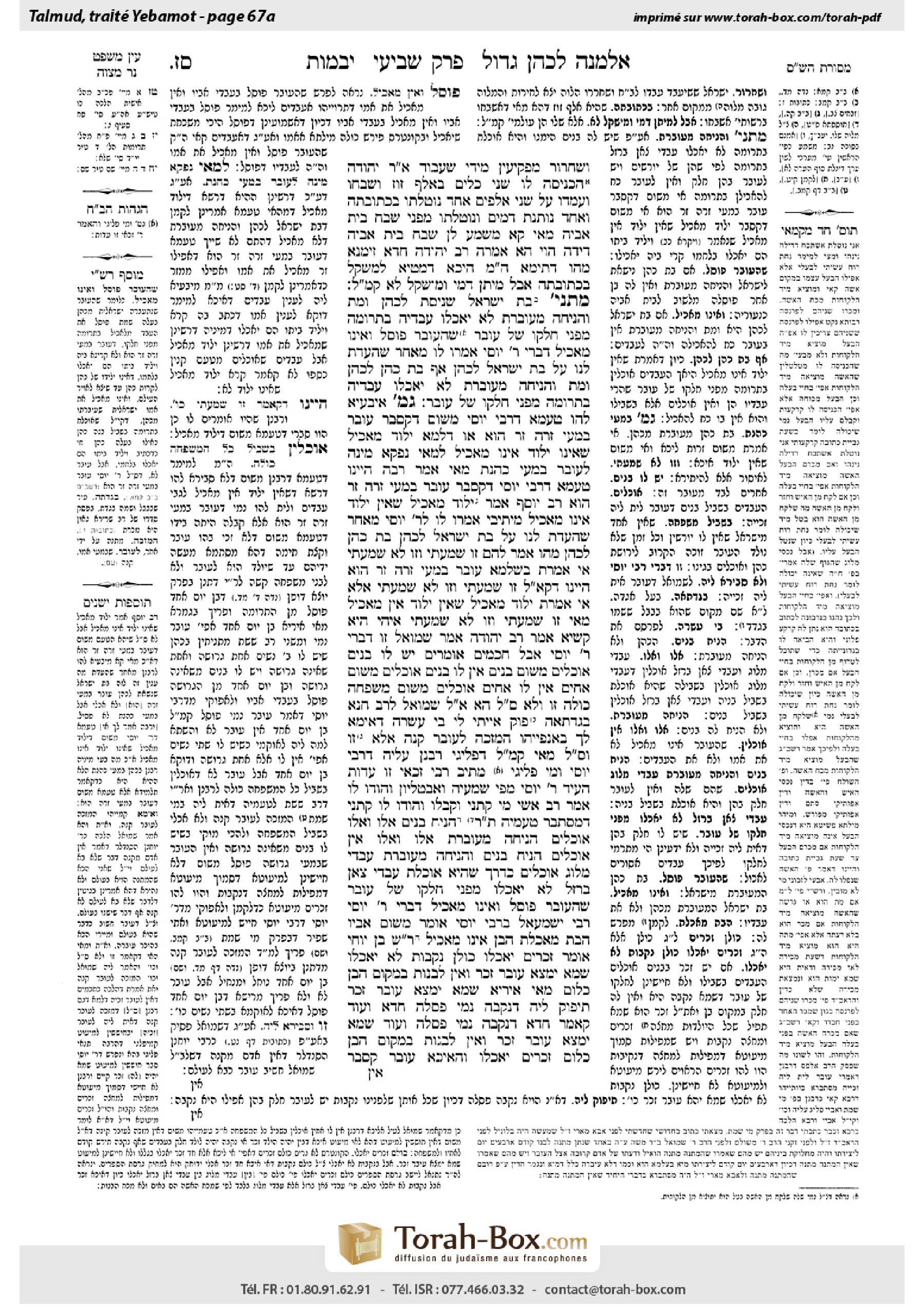
This page of Yevamot includes the Aramaic text, an English translation and an AI-generated French translation, alongside the scan above.
יבמות ס״ז א · Aramaic and Hebrew text
וְשִׁחְרוּר — מַפְקִיעִין מִידֵי שִׁעְבּוּד.
אָמַר רַב יְהוּדָה: הִכְנִיסָה לוֹ שְׁנֵי כֵלִים בְּאֶלֶף זוּז, וְשָׁבְחוּ וְעָמְדוּ עַל שְׁנֵי אֲלָפִים. אֶחָד נוֹטַלְתּוֹ בִּכְתוּבָּתָהּ, וְאֶחָד נוֹתֶנֶת דָּמִים וְנוֹטַלְתּוֹ, מִפְּנֵי שֶׁבַח בֵּית אָבִיהָ.
מַאי קָא מַשְׁמַע לַן — שֶׁבַח בֵּית אָבִיהָ דִּידַהּ הָוֵי? הָא אַמְרַהּ רַב יְהוּדָה חֲדָא זִימְנָא! מַהוּ דְּתֵימָא: הָנֵי מִילֵּי הֵיכָא דְּמָטְיָא לְמִשְׁקַל בִּכְתוּבְּתַהּ, אֲבָל מִיתָּן דְּמֵי וּמִישְׁקָל — לָא, קָא מַשְׁמַע לַן.
מַתְנִי׳ בַּת יִשְׂרָאֵל שֶׁנִּיסֵּת לְכֹהֵן וּמֵת, וְהִנִּיחָהּ מְעוּבֶּרֶת — לֹא יֹאכְלוּ עֲבָדֶיהָ בִּתְרוּמָה, מִפְּנֵי חֶלְקוֹ שֶׁל עוּבָּר, שֶׁהָעוּבָּר פּוֹסֵל. וְאֵינוֹ מַאֲכִיל, דִּבְרֵי רַבִּי יוֹסֵי.
אָמְרוּ לוֹ: מֵאַחַר שֶׁהֵעַדְתָּ לָנוּ עַל בַּת יִשְׂרָאֵל לְכֹהֵן — אַף בַּת כֹּהֵן לְכֹהֵן וּמֵת, וְהִנִּיחָה מְעוּבֶּרֶת — לֹא יֹאכְלוּ עֲבָדֶיהָ בִּתְרוּמָה, מִפְּנֵי חֶלְקוֹ שֶׁל עוּבָּר.
גְּמָ׳ אִיבַּעְיָא לְהוּ: טַעְמָא דְּרַבִּי יוֹסֵי מִשּׁוּם דְּקָסָבַר עוּבָּר בִּמְעֵי זָרָה — זָר הוּא, אוֹ דִלְמָא: יָלוּד — מַאֲכִיל, שֶׁאֵינוֹ יָלוּד — אֵינוֹ מַאֲכִיל?
לְמַאי נָפְקָא מִינַּהּ — לְעוּבָּר בִּמְעֵי כֹהֶנֶת, מַאי? אָמַר רַבָּה, הַיְינוּ טַעְמָא דְּרַבִּי יוֹסֵי: דְּקָסָבַר עוּבָּר בִּמְעֵי זָרָה זָר הוּא. רַב יוֹסֵף אָמַר: יָלוּד — מַאֲכִיל, שֶׁאֵין יָלוּד — אֵינוֹ מַאֲכִיל.
מֵיתִיבִי, אָמְרוּ לוֹ לְרַבִּי יוֹסֵי: מֵאַחַר שֶׁהֵעַדְתָּ לָנוּ עַל בַּת יִשְׂרָאֵל לְכֹהֵן, בַּת כֹּהֵן לְכֹהֵן מַהוּ? אָמַר לָהֶם: זוֹ שָׁמַעְתִּי וְזוֹ לֹא שָׁמַעְתִּי.
אִי אָמְרַתְּ בִּשְׁלָמָא: עוּבָּר בִּמְעֵי זָרָה זָר הוּא — הַיְינוּ דְּקָאָמַר לְהוּ: זוֹ שָׁמַעְתִּי וְזוֹ לֹא שָׁמַעְתִּי. אֶלָּא אִי אָמְרַתְּ: יָלוּד — מַאֲכִיל, שֶׁאֵין יָלוּד — אֵין מַאֲכִיל, מַאי זוֹ שָׁמַעְתִּי וְזוֹ לֹא שָׁמַעְתִּי? אִיהִי הִיא קַשְׁיָא.
אָמַר רַב יְהוּדָה אָמַר שְׁמוּאֵל: זוֹ דִּבְרֵי רַבִּי יוֹסֵי. אֲבָל חֲכָמִים אוֹמְרִים: יֵשׁ לוֹ בָּנִים — אוֹכְלִים מִשּׁוּם בָּנִים. אֵין לוֹ בָּנִים — אוֹכְלִים מִשּׁוּם אַחִים. אֵין לוֹ אַחִים — אוֹכְלִים מִשּׁוּם מִשְׁפָּחָה כּוּלָּהּ.
״זוֹ״ וְלָא סְבִירָא לֵיהּ. הָא אֲמַר לֵיהּ שְׁמוּאֵל לְרַב חָנָא בַּגְדָּתָאָה: פּוֹק אַיְיתִי לִי בֵּי עַשְׂרָה, דְּאֵימָא לָךְ בְּאַנְפַּיְיהוּ: הַמְזַכֶּה לְעוּבָּר — קָנָה. אֶלָּא: ״זוֹ״ וּסְבִירָא לֵיהּ. מַאי קָא מַשְׁמַע לַן — דִּפְלִיגִי רַבָּנַן עֲלֵיהּ דְּרַבִּי יוֹסֵי.
וּמִי פְּלִיגִי? מֵתִיב רַבִּי זַכַּאי: זוֹ עֵדוּת הֵעִיד רַבִּי יוֹסֵי מִפִּי שְׁמַעְיָה וְאַבְטַלְיוֹן, וְהוֹדוּ לוֹ! אָמַר רַב אָשֵׁי: מִי קָתָנֵי ״וְקִבְּלוּ״? ״וְהוֹדוּ לוֹ״ קָתָנֵי, דְּמִסְתַּבַּר טַעְמֵיהּ.
תָּנוּ רַבָּנַן: הִנִּיחַ בָּנִים — אֵלּוּ וָאֵלּוּ אוֹכְלִים. הִנִּיחָהּ מְעוּבֶּרֶת — אֵלּוּ וָאֵלּוּ אֵין אוֹכְלִים. הִנִּיחַ בָּנִים, וְהִנִּיחָהּ מְעוּבֶּרֶת — עַבְדֵי מְלוֹג אוֹכְלִים כְּדֶרֶךְ שֶׁהִיא אוֹכֶלֶת, עַבְדֵי צֹאן בַּרְזֶל — לֹא יֹאכְלוּ, מִפְּנֵי חֶלְקוֹ שֶׁל עוּבָּר. שֶׁהָעוּבָּר פּוֹסֵל וְאֵינוֹ מַאֲכִיל, דִּבְרֵי רַבִּי יוֹסֵי.
רַבִּי יִשְׁמָעֵאל בְּרַבִּי יוֹסֵי אוֹמֵר מִשּׁוּם אָבִיו: הַבַּת — מַאֲכֶלֶת, הַבֵּן — אֵינוֹ מַאֲכִיל. רַבִּי שִׁמְעוֹן בֶּן יוֹחַי אוֹמֵר: זְכָרִים יֹאכְלוּ כּוּלָּן, נְקֵבוֹת לֹא יֹאכֵלוּ, שֶׁמָּא יִמָּצֵא עוּבָּר זָכָר, וְאֵין לַבָּנוֹת בִּמְקוֹם הַבֵּן כְּלוּם.
מַאי אִירְיָא שֶׁמָּא יִמָּצֵא עוּבָּר זָכָר? תִּיפּוֹק לֵיהּ דִּנְקֵבָה נָמֵי פָּסְלָה! חֲדָא וְעוֹד קָאָמַר: חֲדָא, דִּנְקֵבָה נָמֵי פָּסְלָה. וְעוֹד, שֶׁמָּא יִמָּצֵא עוּבָּר זָכָר, וְאֵין לַבָּנוֹת בִּמְקוֹם הַבֵּן כְּלוּם.
זְכָרִים יֹאכֵלוּ: וְהָאִיכָּא עוּבָּר! קָסָבַר:
Yevamot 67a · English translation
and the manumission of a slave release the property from a lien. If someone placed an asset under a lien for his debt and subsequently consecrated it; or if the asset under lien is leavened bread and the festival of Passover arrived; or if the asset is a slave and he freed him, the lien is released, and the creditor must claim his debt from the debtor’s other property. In the case of the robe as well, because it was placed over the corpse, it was consecrated for the dead. Consequently, it is prohibited to derive benefit from it. Therefore, it is released to the woman from under the lien.
Rav Yehuda said: If the wife brought with her into the marriage two belongings of guaranteed investment worth one thousand dinars, and they appreciated until they stood at two thousand, one of them she collects as payment of her marriage contract, as it is now worth her dowry of one thousand dinars. And as for the other one, she pays its monetary value and takes it from her husband because it is an asset of her paternal family.
The Gemara asks: What is he teaching us? Is it that assets of her paternal family are hers? Rav Yehuda already said this once, in his previous statement. The Gemara answers: The latter statement was necessary as well, lest you say that this applies only where she comes to collect her marriage contract, which is rightfully hers, but to give money and take assets that are worth beyond what her husband owes her, you might say that she may not do so, although the property in question is an asset of her paternal family. Rav Yehuda therefore teaches us that she may take all of the assets of her paternal family and pay for what they are worth beyond her husband’s debt to her.
MISHNA: With regard to an Israelite woman who married a priest and he died and left her pregnant, her slaves of guaranteed investment may not partake of teruma during her pregnancy, due to the share of the fetus, as an inheritor of his father, in the ownership of the slaves. In the opposite case, where the Israelite husband of a priest’s daughter died and left her pregnant, the fetus disqualifies her from partaking of teruma. However, in the current case, the fetus does not enable its mother or the slaves to partake of teruma, despite the fact that it is the child of a priest. This is the statement of Rabbi Yosei.
The Rabbis said to him: Since you testified before us about the case of an Israelite woman who was married to a priest, in the case of the daughter of a priest who was married to a priest and he died and left her pregnant, her slaves should not partake of teruma either, due to the fetus’s share. The same halakha should apply whether the woman is an Israelite or the daughter of a priest.
GEMARA: A dilemma was raised before the scholars: Is the reason for the ruling of Rabbi Yosei because he holds that a fetus in the womb of a non-priest is a non-priest, as it is considered part of its mother’s body and it becomes a priest only upon birth, and therefore the slaves in which it owns a share will be allowed to eat teruma only at that stage? Or, is Rabbi Yosei perhaps of the opinion that only one who was born enables others to partake of teruma, whereas one who is not yet born does not enable others to partake, although it is considered a priest?
What is the practical difference between the two possible reasons? It is the case of a fetus in the womb of the priestess, the daughter of a priest. If Rabbi Yosei’s rationale is that the fetus in the womb of a non-priest is a non-priest, that is not the case here, and therefore the slaves should partake of teruma. What is the halakha in this case? Rabba said that this is Rabbi Yosei’s reasoning: He holds that a fetus in the womb of a non-priest is a non-priest. Rav Yosef said: His rationale is that only one who was born enables others to partake of teruma, whereas one who is not yet born does not enable others to partake.
The Gemara raises an objection to Rav Yosef’s opinion from a baraita that continues the last clause of the mishna: The Rabbis said to Rabbi Yosei: Since you testified before us about the case of an Israelite woman married to a priest, in the case of the daughter of a priest married to a priest, what is the halakha? He said to them: With regard to the former case, I heard from my teachers that the slaves do not partake of teruma, but with regard to this one, I did not hear such a thing.
Granted, if you say that Rabbi Yosei’s reasoning is that a fetus in the womb of a non-priest is a non-priest, this is the reason that he said to them: This case I heard but this case I did not hear. There is a logical distinction between the two cases, as in the latter case the fetus is not in the womb of a non-priest. However, if you say that his rationale is that only one who was born enables others to partake of teruma, whereas one who is not yet born does not enable others to partake, what does he mean by saying: This case I heard but this case I did not hear? It is the same case with regard to this principle. The Gemara concludes: This is a difficult objection.
Rav Yehuda said that Shmuel said: This is the statement of Rabbi Yosei. However, the Rabbis say that if the dead husband has children, the slaves partake of teruma due to the children, as they inherit the slaves. If he does not have children, they partake of teruma due to his brothers, who inherit his property. If he does not have brothers either, they partake due to the entire family, which inherits his property. The fetus does not disqualify them, as it does not yet own its share of the inheritance.
The Gemara asks: By saying that this is only Rabbi Yosei’s stance, Shmuel seemingly indicates that he himself does not maintain that opinion. However, Shmuel said to Rav Ḥana of Baghdad: Go and bring me an assembly of ten men and I will say to you before them a halakha that I seek to disseminate: One who transfers ownership of an object to a fetus, the fetus acquires it. Consequently, according to Shmuel, a fetus can own property, which is the premise of Rabbi Yosei’s stance that a fetus shares the inheritance even before he is born. The Gemara answers: Rather, although Shmuel said that this is only Rabbi Yosei’s stance, he holds likewise. What is Shmuel teaching us by saying so? He is teaching us that the Rabbis disagree with Rabbi Yosei.
The Gemara asks: But do they really disagree? Rabbi Zakkai raised an objection to this statement from a baraita: This was a testimony that Rabbi Yosei testified that he heard from the mouths of Shemaya and Avtalyon, and the Rabbis acknowledged his testimony. Apparently, they accepted his opinion. Rav Ashi said: Does that baraita state: And the Rabbis accepted his testimony? It states: And they acknowledged his testimony, which indicates that his opinion is reasonable. However, they did not accept his ruling.
The Sages taught in a baraita: If the priest who was married to an Israelite woman and died left children, both the slaves of usufruct property and the slaves of guaranteed investment may partake of teruma. The slaves of guaranteed investment are owned by the children, who are priests, and the slaves of usufruct property are owned by the woman, who partakes of teruma due to her children. If he left his wife pregnant and did not leave children, both these slaves and those slaves may not partake of teruma. If he left children and left her pregnant, the slaves of usufruct property who belong to her partake of teruma just as she partakes due to her children. However, the slaves of guaranteed investment, who are inherited by the children, may not partake, due to the fetus’s share, as it too inherits them, as a fetus can disqualify one from partaking of teruma but it cannot not enable one to partake. This is the statement of Rabbi Yosei.
Rabbi Yishmael, son of Rabbi Yosei, says in the name of his father: If the priest left behind a daughter, she enables the slaves to partake of teruma; however, a son does not enable them to partake. Rabbi Shimon ben Yoḥai says: If among the priest’s children there are males, the slaves partake of teruma. But if they are all females, they do not partake, lest the fetus be found to be a male, and daughters do not receive any of the inheritance where there is a son. The male fetus would be the sole inheritor, and it does not enable slaves to partake of teruma.
The Gemara asks: Why does Rabbi Shimon ben Yoḥai specifically explain that if the children are females, the slaves may not partake of teruma, lest the fetus be found to be a male? Derive the ruling that the slaves do not partake of teruma from the halakha that a female fetus also disqualifies its slaves from partaking of teruma. Since the priest has only daughters, they inherit from him, and the female fetus receives a share in the inheritance too. The Gemara answers: Rabbi Shimon ben Yoḥai stated one reason and another. One reason is that a female also disqualifies its slaves from partaking of teruma, and another reason is lest the fetus be found to be a male, and daughters have no share in the inheritance at all in a place where there is a son.
The Gemara asks with regard to the first clause of Rabbi Shimon’s statement, that if among the priest’s children there are males, the slaves may partake of teruma: But even though sons inherit from their father, isn’t there a fetus to be accounted for, as perhaps he too is a male, and therefore has a share in the inheritance? The Gemara answers: Rabbi Shimon holds
Yevamot 67a · Traduction française (IA)
et l’affranchissement d’un esclave libèrent le bien de toute sûreté. Si quelqu’un a grevé un bien d’une sûreté pour garantir sa dette, puis l’a consacré ; ou si le bien grevé est du pain levé et que la fête de Pessa’h est arrivée ; ou si le bien est un esclave et qu’il l’a affranchi, la sûreté est levée, et le créancier doit réclamer sa dette sur les autres biens du débiteur. De même, dans le cas du vêtement, puisqu’il a été posé sur le cadavre, il a été consacré au défunt. Il est donc interdit d’en tirer profit. Par conséquent, il est libéré de la sûreté au profit de la femme.
Rav Yehouda a dit : Si l’épouse a apporté dans le mariage deux biens garantis d’une valeur de mille dinars et que leur valeur a augmenté jusqu’à atteindre deux mille dinars, elle en reçoit un au titre du paiement de sa ketouba, puisqu’il vaut désormais sa dot de mille dinars. Quant à l’autre, elle en paie la valeur et le reprend à son mari, car il s’agit d’un bien de sa famille paternelle.
La Guemara demande : Que nous enseigne-t-il ? Que les biens de sa famille paternelle lui appartiennent ? Rav Yehouda l’a déjà dit dans sa déclaration précédente. La Guemara répond : Cette seconde déclaration était également nécessaire, de peur que tu ne dises que cela ne s’applique que lorsqu’elle vient réclamer sa ketouba, qui lui revient de droit, mais que, pour donner de l’argent et reprendre des biens dont la valeur dépasse ce que son mari lui doit, elle n’en a pas le droit, même si les biens en question appartiennent à sa famille paternelle. Rav Yehouda nous enseigne donc qu’elle peut reprendre tous les biens de sa famille paternelle et payer leur valeur au-delà de la dette de son mari envers elle.
Michna : Une femme israélite a épousé un prêtre, puis son mari est mort en la laissant enceinte : ses esclaves garantis ne peuvent pas consommer de terouma pendant sa grossesse, en raison de la part que le fœtus, héritier de son père, possède dans les esclaves. Dans le cas inverse, où le mari israélite de la fille d’un prêtre est mort en la laissant enceinte, le fœtus la rend inapte à consommer de la terouma. Cependant, dans le cas présent, le fœtus ne permet ni à sa mère ni aux esclaves de consommer de la terouma, bien qu’il soit l’enfant d’un prêtre. Telle est la déclaration de Rabbi Yossi.
Les Sages lui dirent : Puisque tu nous as apporté ton témoignage au sujet d’une femme israélite mariée à un prêtre, dans le cas de la fille d’un prêtre mariée à un prêtre qui est mort en la laissant enceinte, ses esclaves ne devraient-ils pas eux aussi être empêchés de consommer de la terouma, en raison de la part du fœtus ? La même halakha devrait s’appliquer, que la femme soit israélite ou fille d’un prêtre.
Guemara : Un dilemme fut soulevé devant les Sages : La raison de la décision de Rabbi Yossi est-elle qu’il considère que le fœtus dans le ventre d’une femme qui n’est pas prêtresse n’est pas prêtre, puisqu’il est considéré comme faisant partie du corps de sa mère et ne devient prêtre qu’à la naissance, et que, par conséquent, les esclaves dont il possède une part ne pourront consommer de terouma qu’à ce moment-là ? Ou bien Rabbi Yossi est-il d’avis que seul celui qui est né permet à d’autres de consommer de la terouma, tandis que celui qui n’est pas encore né ne le permet pas, bien qu’il soit considéré comme prêtre ?
Quelle est la différence pratique entre ces deux raisons possibles ? Le cas d’un fœtus dans le ventre d’une prêtresse, la fille d’un prêtre. Si le raisonnement de Rabbi Yossi est que le fœtus dans le ventre d’une femme qui n’est pas prêtresse n’est pas prêtre, cela ne s’applique pas ici ; les esclaves devraient donc consommer de la terouma. Quelle est la halakha dans ce cas ? Rabba a dit que tel est le raisonnement de Rabbi Yossi : il considère que le fœtus dans le ventre d’une femme qui n’est pas prêtresse n’est pas prêtre. Rav Yossef a dit : Son raisonnement est que seul celui qui est né permet à d’autres de consommer de la terouma, tandis que celui qui n’est pas encore né ne le permet pas.
La Guemara soulève une objection contre l’avis de Rav Yossef à partir d’une baraïta qui poursuit la dernière clause de la Michna : Les Sages dirent à Rabbi Yossi : Puisque tu nous as apporté ton témoignage au sujet d’une femme israélite mariée à un prêtre, quelle est la halakha dans le cas de la fille d’un prêtre mariée à un prêtre ? Il leur dit : Pour le premier cas, j’ai entendu de mes maîtres que les esclaves ne consomment pas de terouma, mais pour celui-ci, je n’ai rien entendu de tel.
Il est logique que, si l’on dit que le raisonnement de Rabbi Yossi est que le fœtus dans le ventre d’une femme qui n’est pas prêtresse n’est pas prêtre, il leur ait dit : « Ce cas, je l’ai entendu, mais celui-ci, je ne l’ai pas entendu. » Il y a une distinction logique entre les deux cas, car, dans le second, le fœtus n’est pas dans le ventre d’une femme qui n’est pas prêtresse. Mais si l’on dit que son raisonnement est que seul celui qui est né permet à d’autres de consommer de la terouma, tandis que celui qui n’est pas encore né ne le permet pas, que veut-il dire par : « Ce cas, je l’ai entendu, mais celui-ci, je ne l’ai pas entendu » ? Le même principe s’applique aux deux cas. La Guemara conclut : C’est une objection difficile.
Rav Yehouda a dit au nom de Chmouel : Telle est la déclaration de Rabbi Yossi. Cependant, les Sages disent que si le mari défunt a des enfants, les esclaves consomment de la terouma grâce à eux, car ils héritent des esclaves. S’il n’a pas d’enfants, les esclaves consomment de la terouma grâce à ses frères, qui héritent de ses biens. S’il n’a pas non plus de frères, ils en consomment grâce à toute la famille, qui hérite de ses biens. Le fœtus ne les rend pas inaptes, puisqu’il ne possède pas encore sa part de l’héritage.
La Guemara demande : En disant que telle est uniquement la position de Rabbi Yossi, Chmouel semble indiquer qu’il ne soutient pas lui-même cet avis. Pourtant, Chmouel a dit à Rav Ḥana de Bagdad : « Va me réunir une assemblée de dix hommes, et je vous exposerai devant eux une halakha que je souhaite diffuser : celui qui transfère la propriété d’un objet à un fœtus, le fœtus en acquiert la propriété. » Ainsi, selon Chmouel, un fœtus peut posséder des biens, ce qui est la prémisse de la position de Rabbi Yossi selon laquelle un fœtus a une part dans l’héritage avant même sa naissance. La Guemara répond : En réalité, bien que Chmouel ait dit que telle est uniquement la position de Rabbi Yossi, il partage cet avis. Que nous enseigne Chmouel en disant cela ? Il nous enseigne que les Sages ne sont pas d’accord avec Rabbi Yossi.
La Guemara demande : Mais sont-ils réellement en désaccord ? Rabbi Zakkaï souleva une objection à cette affirmation à partir d’une baraïta : « C’était un témoignage que Rabbi Yossi avait rapporté après l’avoir entendu de la bouche de Shemaya et d’Avtalyon, et les Sages reconnurent son témoignage. » Apparemment, ils acceptèrent son avis. Rav Achi dit : La baraïta dit-elle : « Et les Sages acceptèrent son témoignage » ? Elle dit : « Et ils reconnurent son témoignage », ce qui indique que son avis est raisonnable. Toutefois, ils n’acceptèrent pas sa décision.
Les Sages enseignèrent dans une baraïta : Si le prêtre qui avait épousé une femme israélite est mort en laissant des enfants, les esclaves tant des biens en usufruit que des biens garantis peuvent consommer de la terouma. Les esclaves garantis appartiennent aux enfants, qui sont prêtres, et les esclaves des biens en usufruit appartiennent à la femme, qui consomme de la terouma grâce à ses enfants. S’il a laissé son épouse enceinte sans laisser d’enfants, ni les uns ni les autres ne peuvent consommer de terouma. S’il a laissé des enfants et son épouse enceinte, les esclaves des biens en usufruit qui lui appartiennent consomment de la terouma, tout comme elle en consomme grâce à ses enfants. Cependant, les esclaves garantis, dont les enfants héritent, ne peuvent pas consommer de terouma, en raison de la part du fœtus, qui en hérite lui aussi : un fœtus peut rendre quelqu’un inapte à consommer de la terouma, mais il ne peut pas lui permettre d’en consommer. Telle est la déclaration de Rabbi Yossi.
Rabbi Yichmaël, fils de Rabbi Yossi, dit au nom de son père : Si le prêtre a laissé une fille, elle permet aux esclaves de consommer de la terouma ; cependant, un fils ne le leur permet pas. Rabbi Chimon ben Yo’haï dit : Si parmi les enfants du prêtre il y a des garçons, les esclaves consomment de la terouma. Mais s’ils sont tous des filles, ils n’en consomment pas, de peur qu’il ne s’avère que le fœtus est un garçon et que les filles ne reçoivent aucune part de l’héritage lorsqu’il y a un fils. Le fœtus mâle serait l’unique héritier, et il ne permet pas aux esclaves de consommer de la terouma.
La Guemara demande : Pourquoi Rabbi Chimon ben Yo’haï explique-t-il précisément que, si les enfants sont des filles, les esclaves ne peuvent pas consommer de terouma, de peur qu’il ne s’avère que le fœtus est un garçon ? On peut déduire que les esclaves ne consomment pas de terouma de la halakha selon laquelle un fœtus féminin rend lui aussi ses esclaves inaptes à consommer de la terouma. Puisque le prêtre n’a que des filles, elles héritent de lui, et le fœtus féminin reçoit lui aussi une part de l’héritage. La Guemara répond : Rabbi Chimon ben Yo’haï a donné une raison puis une autre. L’une est qu’un fœtus féminin rend lui aussi ses esclaves inaptes à consommer de la terouma ; l’autre est qu’il faut craindre que le fœtus ne soit un garçon, auquel cas les filles n’ont aucune part dans l’héritage lorsqu’il y a un fils.
La Guemara pose une question au sujet de la première clause de la déclaration de Rabbi Chimon, selon laquelle, si parmi les enfants du prêtre il y a des garçons, les esclaves peuvent consommer de la terouma : même si les fils héritent de leur père, ne faut-il pas tenir compte du fœtus, puisqu’il pourrait lui aussi être un garçon et avoir ainsi une part dans l’héritage ? La Guemara répond : Rabbi Chimon considère
Traduction française générée par IA à partir de l’édition anglaise de Sefaria. Vérifie toujours un passage avec le texte source.
Text from Sefaria: William Davidson Edition - Vocalized Aramaic (CC BY NC); William Davidson Edition - English (CC BY NC).