Yevamot 66b: Talmud study for Daf Yomi
Daf Yomi is the daily study of one Talmud folio. Explore 37 tractates with scans, Hebrew text, Sefaria English and AI-generated French translations where annotated.
Passage selection and English or AI-generated French translation are available where the scan has annotations. Daf Study is independent of Torah-Box and Sefaria.
Browse Yevamot · יבמות · All tractatesYevamot 66b text and translations
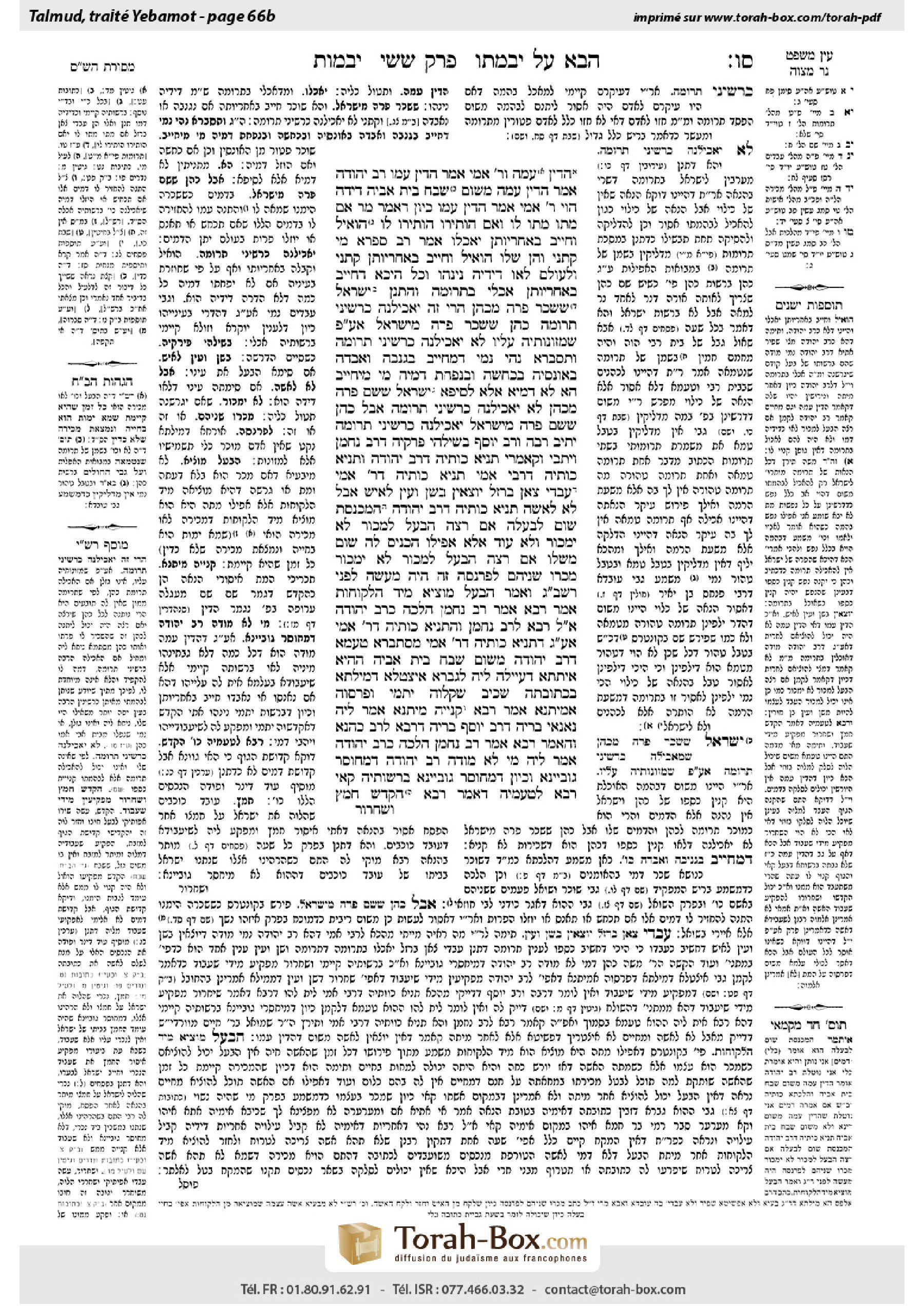
This page of Yevamot includes the Aramaic text, an English translation and an AI-generated French translation, alongside the scan above.
יבמות ס״ו ב · Aramaic and Hebrew text
הַדִּין עִמָּהּ, וְרַב אַמֵּי אָמַר: הַדִּין עִמּוֹ.
רַב יְהוּדָה אָמַר הַדִּין עִמָּהּ — מִשּׁוּם שֶׁבַח בֵּית אָבִיהָ דִּידַהּ הָוֵי. רַבִּי אַמֵּי אָמַר: הַדִּין עִמּוֹ — כֵּיוָן דְּאָמַר מָר: אִם מֵתוּ — מֵתוּ לוֹ, וְאִם הוֹתִירוּ — הוֹתִירוּ לוֹ, הוֹאִיל וְחַיָּיב בְּאַחְרָיוּתָן — יֹאכֵלוּ. אָמַר רַב סָפְרָא: מִי קָתָנֵי ״וְהֵן שֶׁלּוֹ״? ״הוֹאִיל וְחַיָּיב בְּאַחְרָיוּתָן״ קָתָנֵי, וּלְעוֹלָם לָאו דִּידֵיהּ נִינְהוּ.
וְכׇל הֵיכָא דְּחַיָּיב בְּאַחְרָיוּתָן אָכְלִי בִּתְרוּמָה? וְהָתְנַן: יִשְׂרָאֵל שֶׁשָּׂכַר פָּרָה מִכֹּהֵן — הֲרֵי זֶה יַאֲכִילֶנָּה כַּרְשִׁינֵּי תְרוּמָה. כֹּהֵן שֶׁשָּׂכַר פָּרָה מִיִּשְׂרָאֵל, אַף עַל פִּי שֶׁמְּזוֹנוֹתֶיהָ עָלָיו — לָא יַאֲכִילֶנָּה כַּרְשִׁינֵּי תְרוּמָה!
וְתִסְבְּרָא? נְהִי נָמֵי דִּמְחַיֵּיב בִּגְנֵבָה וַאֲבֵדָה, בְּאוֹנְסֶיהָ בְּכַחְשָׁהּ וּבְנִפְחַת דָּמֶיהָ — מִי מִיחַיַּיב? הָא לָא דָּמְיָא אֶלָּא לְסֵיפָא: יִשְׂרָאֵל שֶׁשָּׁם פָּרָה מִכֹּהֵן, לָא יַאֲכִילֶנָּה כַּרְשִׁינֵּי תְרוּמָה. אֲבָל כֹּהֵן שֶׁשָּׁם פָּרָה מִיִּשְׂרָאֵל — יַאֲכִילֶנָּה כַּרְשִׁינֵּי תְרוּמָה.
יָתֵיב רַבָּה וְרַב יוֹסֵף בְּשִׁילְהֵי פִּרְקֵיהּ דְּרַב נַחְמָן וְיָתְבִי וְקָאָמְרִי: תַּנְיָא כְּוָתֵיהּ דְּרַב יְהוּדָה, וְתַנְיָא כְּוָתֵיהּ דְּרַבִּי אַמֵּי. תַּנְיָא כְּוָתֵיהּ דְּרַבִּי אַמֵּי: עַבְדֵי צֹאן בַּרְזֶל יוֹצְאִין בְּשֵׁן וָעַיִן. לָאִישׁ, אֲבָל לֹא לָאִשָּׁה.
תַּנְיָא כְּוָתֵיהּ דְּרַב יְהוּדָה: הַמַּכְנֶסֶת שׁוּם לְבַעְלָהּ, אִם רָצָה הַבַּעַל לִמְכּוֹר — לֹא יִמְכּוֹר. וְלֹא עוֹד אֶלָּא אֲפִילּוּ הִכְנִיס לָהּ שׁוּם מִשֶּׁלּוֹ, אִם רָצָה הַבַּעַל לִמְכּוֹר — לֹא יִמְכּוֹר. מָכְרוּ שְׁנֵיהֶם לְפַרְנָסָה, זֶה הָיָה מַעֲשֶׂה לִפְנֵי רַבָּן שִׁמְעוֹן בֶּן גַּמְלִיאֵל, וְאָמַר: הַבַּעַל מוֹצִיא מִיַּד הַלָּקוֹחוֹת.
אָמַר רָבָא אָמַר רַב נַחְמָן: הֲלָכָה כְּרַב יְהוּדָה. אֲמַר לֵיהּ רָבָא לְרַב נַחְמָן: וְהָתַנְיָא כְּוָתֵיהּ דְּרַבִּי אַמֵּי! אַף עַל גַּב דְּתַנְיָא כְּוָתֵיהּ דְּרַבִּי אַמֵּי, מִסְתַּבְּרָא טַעְמָא דְּרַב יְהוּדָה, מִשּׁוּם שֶׁבַח בֵּית אָבִיהָ.
הָהִיא אִיתְּתָא דְּעַיִּילָה לֵיהּ לְגַבְרַאּ אִיצְטְלָא דְמֵילָתָא בִּכְתוּבְּתַהּ. שְׁכֵיב, שַׁקְלוּהָ יַתְמֵי וּפַרְסוּהָ אַמִּיתָנָא.
אֲמַר רָבָא: קַנְיַיהּ מִיתָנָא. אֲמַר לֵיהּ נָאנַאי בְּרֵיהּ דְּרַב יוֹסֵף בְּרֵיהּ דְּרָבָא לְרַב כָּהֲנָא: וְהָאָמַר רָבָא אָמַר רַב נַחְמָן: הֲלָכָה כְּרַב יְהוּדָה? אֲמַר לֵיהּ: מִי לָא מוֹדֶה רַב יְהוּדָה דִּמְחוּסַּר גּוּבְיָינָא. וְכֵיוָן דִּמְחוּסַּר גּוּבְיָינָא — בִּרְשׁוּתֵיהּ קָאֵי.
רָבָא לְטַעְמֵיהּ, דְּאָמַר רָבָא: הֶקְדֵּשׁ, חָמֵץ,
Yevamot 66b · English translation
The halakha favors her; she may take the belongings. And Rav Ami said: The halakha favors him; he may retain the items and return their value.
The Gemara explains that Rav Yehuda said that the halakha favors her because they are the assets of her paternal family, whose prestige will suffer if they aren’t returned. Therefore, they are hers. Rabbi Ami said that the halakha favors him, since the Master said in the mishna, with regard to guaranteed property: If they die, their death is his loss, and if they increase in value, their increase is his gain. Since he bears financial responsibility for their loss, they partake of teruma. Apparently, the slaves belong to the husband. Therefore, he is obligated to return only their monetary value. Rav Safra said in rejection of Rabbi Ami’s reasoning: Does the mishna teach that they are his? It teaches only that he bears financial responsibility for their loss, but actually they are not his.
The Gemara asks: And do they partake of teruma wherever he bears financial responsibility for their loss, even if they are not his actual possession? But didn’t we learn in a mishna (Terumot 11:9): An Israelite who rented a cow from a priest may feed it vetches [karshinin] of teruma, since the animal belongs to a priest? With regard to a priest who rented a cow from an Israelite, although its feed is incumbent upon him, he may not feed it vetches of teruma, as it does not belong to him. This indicates that the requirement for enabling an acquisition to eat teruma is possession, not responsibility.
The Gemara rejects this proof: And how can you understand that the case of the rented cow is parallel to the case of guaranteed property? Though the renter is indeed liable for theft and loss, is he liable for unavoidable accidents, for emaciation, i.e., the cow became thinner or weaker for any reason, or for any other decrease in its value? Certainly he is not. In fact, the case of guaranteed property is similar only to the latter clause of that mishna: In the case of an Israelite who appraised a cow upon renting it from a priest under an arrangement where he guaranteed its value to the owner, he may not feed it vetches of teruma, as it is considered his own. However, a priest who appraised a cow upon renting it from an Israelite may feed it vetches of teruma. This indicates that guaranteed property is considered the acquisition of its recipient with regard to enabling it to eat teruma.
Rabba and Rav Yosef sat at the conclusion of Rav Naḥman’s sermon, and they sat and said: It is taught in a baraita in accordance with the opinion of Rav Yehuda, and it is taught in another baraita in accordance with the opinion of Rabbi Ami. It is taught in accordance with the opinion of Rabbi Ami in the following baraita: If a slave’s owner strikes him and knocks out his tooth or blinds him in an eye, he is set free. Slaves of guaranteed investment go free at the loss of a tooth or an eye caused by the husband, but not at such loss caused by the wife. This indicates that they belong to the husband.
Conversely, it is taught in a baraita in accordance with the opinion of Rav Yehuda: When a woman brings appraised, guaranteed property into her marriage to her husband, if the husband wishes to sell it, he may not sell it, as it belongs to her. And not only that, but even when her husband brought property into the marriage and added it to her dowry as an appraised, guaranteed gift of his own, even if the husband wishes to sell that gift he may not sell it. With regard to a case in which either the husband or wife unlawfully sold this property for subsistence, there was an incident like this that came before Rabban Shimon ben Gamliel, and he said: Although the husband executed the sale, he may repossess the property from the purchasers, as the sale is void.
Rava said that Rav Naḥman said: The halakha is in accordance with the opinion of Rav Yehuda. Rava said to Rav Naḥman: But isn’t it taught in a baraita in accordance with the opinion of Rabbi Ami? He replied: Although it is taught in accordance with the opinion of Rabbi Ami, Rav Yehuda’s rationale, that the wife may take the objects in question because they are assets of her paternal family and their complete removal from her domain would hurt the family’s prestige, is more reasonable.
The Gemara relates an incident: A certain woman brought into her marriage to her husband a robe [itztela] of fine wool [meileta], which was deemed guaranteed property by her marriage contract. Her husband subsequently died, and the orphans took that robe and spread it over the corpse as a shroud. The woman demanded that the robe be returned to her.
Rava said: The dead has acquired it, as deriving benefit from anything consecrated for the dead is prohibited. Nanai, son of Rav Yosef, son of Rava, said to Rav Kahana: But didn’t Rava say that Rav Naḥman said that the halakha is in accordance with the opinion of Rav Yehuda? Accordingly, the woman’s robe must be returned. He said to him: Doesn’t Rav Yehuda admit that the robe has not yet been collected? And since it has not yet been collected, it remains in his possession, and his inheritors can render its use as a burial shroud prohibited.
The Gemara adds that in this regard Rava conforms to his standard line of reasoning, as Rava said: Consecration of property, the prohibition against benefiting from leavened bread on Passover,
Yevamot 66b · Traduction française (IA)
La halakha est en faveur de la femme : elle peut reprendre les biens. Rav Ami dit : la halakha est en faveur du mari ; il peut conserver les biens et en restituer la valeur.
La Guemara explique que Rav Yehuda dit que la halakha est en faveur de la femme, car il s’agit des biens de sa famille paternelle, dont le prestige serait atteint s’ils n’étaient pas restitués. Ils lui appartiennent donc. Rabbi Ami dit que la halakha est en faveur du mari, puisque le Maître a enseigné dans la Michna, au sujet des biens garantis : s’ils meurent, leur mort est à sa charge ; s’ils prennent de la valeur, le gain lui revient. Puisqu’il assume la responsabilité financière de leur perte, les esclaves peuvent consommer la terouma. Il semble donc qu’ils appartiennent au mari. Celui-ci n’est donc tenu de restituer que leur valeur monétaire. Rav Safra rejette le raisonnement de Rabbi Ami : la Michna enseigne-t-elle qu’ils lui appartiennent ? Elle enseigne seulement qu’il assume la responsabilité financière de leur perte ; en réalité, ils ne lui appartiennent pas.
La Guemara demande : Peuvent-ils donc consommer la terouma chaque fois qu’il assume la responsabilité de leur perte, même s’ils ne sont pas effectivement en sa possession ? N’avons-nous pas appris dans une Michna (Teroumot 11:9) : Un Israélite qui loue une vache à un prêtre peut la nourrir de vesces [karshinin] de terouma, puisque l’animal appartient à un prêtre. Quant à un prêtre qui loue une vache à un Israélite, bien que la charge de la nourrir lui incombe, il ne peut pas la nourrir de vesces de terouma, car elle ne lui appartient pas. Cela indique que, pour qu’un bien puisse donner à son acquéreur le droit de consommer la terouma, il faut qu’il en ait la possession, et non qu’il en assume seulement la responsabilité.
La Guemara rejette cette preuve : comment peut-on comparer le cas de la vache louée à celui des biens garantis ? Certes, le locataire est responsable en cas de vol ou de perte, mais l’est-il en cas d’accident inévitable, d’amaigrissement — c’est-à-dire si la vache devient plus maigre ou plus faible, quelle qu’en soit la raison — ou de toute autre baisse de sa valeur ? Certainement pas. En réalité, le cas des biens garantis correspond seulement à la dernière clause de cette Michna : lorsqu’un Israélite a estimé la valeur d’une vache en la louant à un prêtre dans le cadre d’un arrangement où il en garantissait la valeur au propriétaire, il ne peut pas la nourrir de vesces de terouma, car elle est considérée comme sa propriété. En revanche, un prêtre qui a estimé la valeur d’une vache en la louant à un Israélite peut la nourrir de vesces de terouma. Cela indique que, pour ce qui est du droit de consommer la terouma, les biens garantis sont considérés comme acquis par leur bénéficiaire.
Rabba et Rav Yosef étaient assis à la fin du sermon de Rav Naḥman. Ils dirent alors : une baraïta est enseignée conformément à l’opinion de Rav Yehuda, et une autre baraïta conformément à celle de Rabbi Ami. La baraïta suivante est enseignée conformément à l’opinion de Rabbi Ami : si le propriétaire d’un esclave le frappe et lui casse une dent ou lui crève un œil, l’esclave est libéré. Les esclaves faisant l’objet d’un investissement garanti sont libérés si le mari leur casse une dent ou leur crève un œil, mais pas si la perte est causée par la femme. Cela indique qu’ils appartiennent au mari.
À l’inverse, une baraïta est enseignée conformément à l’opinion de Rav Yehuda : lorsqu’une femme apporte dans son mariage des biens estimés et garantis, son mari ne peut pas les vendre, même s’il le souhaite, car ils lui appartiennent. Et ce n’est pas tout : même si son mari apporte des biens dans le mariage et les ajoute à sa dot sous la forme d’un don personnel estimé et garanti, il ne peut pas vendre ce don, même s’il le souhaite. Dans un cas où le mari ou la femme a vendu illicitement ces biens pour subvenir à ses besoins, un incident de ce genre fut porté devant Rabban Shimon ben Gamliel, qui déclara : bien que le mari ait conclu la vente, il peut reprendre les biens aux acheteurs, car la vente est nulle.
Rava dit au nom de Rav Naḥman : la halakha est conforme à l’opinion de Rav Yehuda. Rava dit à Rav Naḥman : Mais une baraïta n’est-elle pas enseignée conformément à l’opinion de Rabbi Ami ? Il lui répondit : Bien qu’une baraïta soit enseignée conformément à l’opinion de Rabbi Ami, le raisonnement de Rav Yehuda est plus convaincant : la femme peut reprendre les objets en question parce qu’ils sont des biens de sa famille paternelle et que leur retrait complet de son domaine porterait atteinte au prestige de sa famille.
La Guemara rapporte un incident : une certaine femme avait apporté dans son mariage à son mari une robe [itztela] en laine fine [meileta], considérée comme un bien garanti selon son contrat de mariage. Son mari mourut par la suite, et les orphelins prirent cette robe et en couvrirent le défunt comme d’un linceul. La femme réclama la restitution de la robe.
Rava dit : le mort l’a acquise, car il est interdit de tirer profit de tout ce qui est consacré aux morts. Nanai, fils de Rav Yosef, fils de Rava, dit à Rav Kahana : Mais Rava n’a-t-il pas dit que Rav Naḥman avait déclaré que la halakha est conforme à l’opinion de Rav Yehuda ? La robe doit donc être rendue à la femme. Il lui répondit : Rav Yehuda ne reconnaît-il pas que la robe n’a pas encore été réclamée ? Puisqu’elle n’a pas encore été réclamée, elle reste en possession du mari, et ses héritiers peuvent interdire qu’on l’utilise comme linceul.
La Guemara ajoute qu’à cet égard, Rava suit son raisonnement habituel, car Rava dit : la consécration des biens, l’interdiction de tirer profit du pain levé pendant Pessaḥ,
Traduction française générée par IA à partir de l’édition anglaise de Sefaria. Vérifie toujours un passage avec le texte source.
Text from Sefaria: William Davidson Edition - Vocalized Aramaic (CC BY NC); William Davidson Edition - English (CC BY NC).