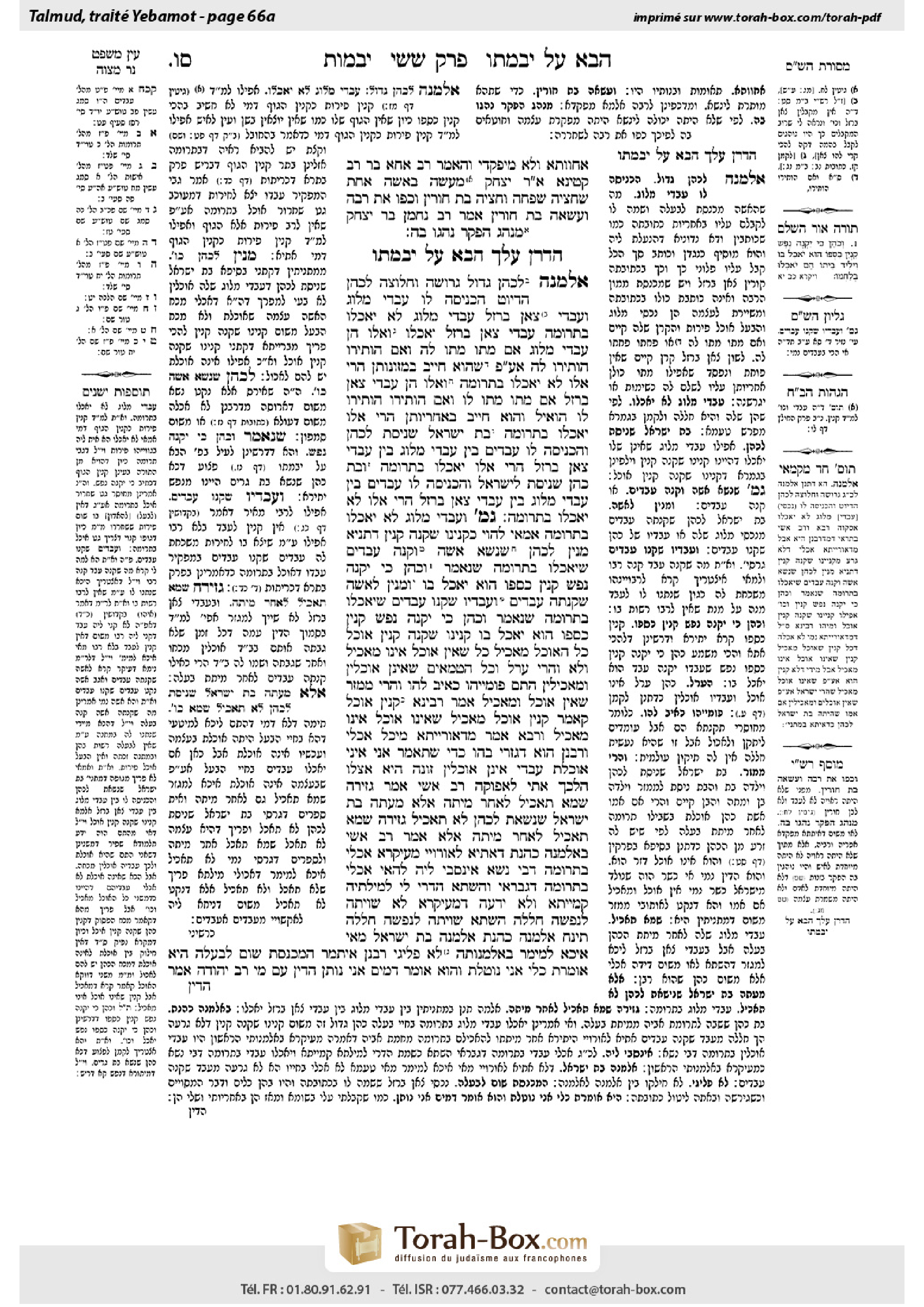
Yevamot 66a: Talmud study for Daf Yomi
Daf Yomi is the daily study of one Talmud folio. Explore 37 tractates with scans, Hebrew text, Sefaria English and AI-generated French translations where annotated.
Passage selection and English or AI-generated French translation are available where the scan has annotations. Daf Study is independent of Torah-Box and Sefaria.
Browse Yevamot · יבמות · All tractatesYevamot 66a text and translations
This page of Yevamot includes the Aramaic text, an English translation and an AI-generated French translation, alongside the scan above.
יבמות ס״ו א · Aramaic and Hebrew text
אַחְווֹתָא.
וְלָא מִיפַּקְדִי? וְהָאָמַר רַב אַחָא בַּר רַב קַטִּינָא אָמַר רַבִּי יִצְחָק: מַעֲשֶׂה בְּאִשָּׁה אַחַת שֶׁחֶצְיָהּ שִׁפְחָה וְחֶצְיָהּ בַּת חוֹרִין, וְכָפוּ אֶת רַבָּהּ וַעֲשָׂאָהּ בַּת חוֹרִין! אָמַר רַב נַחְמָן בַּר יִצְחָק: מִנְהַג הֶפְקֵר נָהֲגוּ בָּהּ.
הֲדַרַן עֲלָךְ הַבָּא עַל יְבִמְתּוֹ
אַלְמָנָה לְכֹהֵן גָּדוֹל, גְּרוּשָׁה וַחֲלוּצָה לְכֹהֵן הֶדְיוֹט, הִכְנִיסָה לוֹ עַבְדֵי מְלוֹג וְעַבְדֵי צֹאן בַּרְזֶל, עַבְדֵי מְלוֹג — לֹא יֹאכְלוּ בִּתְרוּמָה, עַבְדֵי צֹאן בַּרְזֶל — יֹאכֵלוּ.
וְאֵלּוּ הֵן עַבְדֵי מְלוֹג: אִם מֵתוּ — מֵתוּ לָהּ, וְאִם הוֹתִירוּ — הוֹתִירוּ לָהּ, אַף עַל פִּי שֶׁהוּא חַיָּיב בִּמְזוֹנוֹתָן הֲרֵי אֵלּוּ לֹא יֹאכְלוּ בִּתְרוּמָה. וְאֵלּוּ הֵן עַבְדֵי צֹאן בַּרְזֶל: אִם מֵתוּ — מֵתוּ לוֹ, וְאִם הוֹתִירוּ — הוֹתִירוּ לוֹ, הוֹאִיל וְהוּא חַיָּיב בְּאַחְרָיוּתָן — הֲרֵי אֵלּוּ יֹאכְלוּ בִּתְרוּמָה.
בַּת יִשְׂרָאֵל שֶׁנִּיסֵּת לְכֹהֵן וְהִכְנִיסָה לוֹ עֲבָדִים, בֵּין עַבְדֵי מְלוֹג, בֵּין עַבְדֵי צֹאן בַּרְזֶל — הֲרֵי אֵלּוּ יֹאכְלוּ בִּתְרוּמָה. וּבַת כֹּהֵן שֶׁנִּיסֵּת לְיִשְׂרָאֵל וְהִכְנִיסָה לוֹ עֲבָדִים, בֵּין עַבְדֵי מְלוֹג, בֵּין עַבְדֵי צֹאן בַּרְזֶל — הֲרֵי אֵלּוּ לֹא יֹאכְלוּ בִּתְרוּמָה.
גְּמָ׳ וְעַבְדֵי מְלוֹג לֹא יֹאכְלוּ בִּתְרוּמָה, אַמַּאי? לֶהֱוֵי כְּקִנְיָנוֹ שֶׁקָּנָה קִנְיָן! דְּתַנְיָא: מִנַּיִן לְכֹהֵן שֶׁנָּשָׂא אִשָּׁה וְקָנָה עֲבָדִים שֶׁיֹּאכְלוּ בִּתְרוּמָה, שֶׁנֶּאֱמַר: ״וְכֹהֵן כִּי יִקְנֶה נֶפֶשׁ קִנְיַן כַּסְפּוֹ הוּא יֹאכַל בּוֹ״.
וּמִנַּיִן לְאִשָּׁה שֶׁקָּנְתָה עֲבָדִים, וַעֲבָדָיו שֶׁקָּנוּ עֲבָדִים, שֶׁיֹּאכְלוּ בִּתְרוּמָה — שֶׁנֶּאֱמַר: ״וְכֹהֵן כִּי יִקְנֶה נֶפֶשׁ קִנְיַן כַּסְפּוֹ הוּא יֹאכַל בּוֹ״, קִנְיָנוֹ שֶׁקָּנָה קִנְיָן — אוֹכֵל.
כׇּל הָאוֹכֵל — מַאֲכִיל, כֹּל שֶׁאֵין אוֹכֵל — אֵינוֹ מַאֲכִיל.
וְלָא? וַהֲרֵי עָרֵל, וְכׇל הַטְּמֵאִים שֶׁאֵינָן אוֹכְלִין, וּמַאֲכִילִין! הָתָם, פּוּמַּיְיהוּ כָּאֵיב לְהוּ.
וַהֲרֵי מַמְזֵר, שֶׁאֵין אוֹכֵל, וּמַאֲכִיל!
אָמַר רָבִינָא: קִנְיָן אוֹכֵל קָאָמַר, קִנְיָן אוֹכֵל — מַאֲכִיל, שֶׁאֵינוֹ אוֹכֵל — אֵינוֹ מַאֲכִיל.
וְרָבָא אָמַר: מִדְּאוֹרָיְיתָא מֵיכָל אָכְלִי, וְרַבָּנַן הוּא דְּגָזְרִי בְּהוּ, כְּדֵי שֶׁתֹּאמַר: אֲנִי אֵינִי אוֹכֶלֶת, עֲבָדַי אֵינָן אוֹכְלִין — זוֹנָה הִיא אֶצְלוֹ?! הִלְכָּךְ אָתֵי לְאַפּוֹקַהּ.
רַב אָשֵׁי אָמַר: גְּזֵירָה שֶׁמָּא תַּאֲכִיל לְאַחַר מִיתָה.
אֶלָּא מֵעַתָּה, בַּת יִשְׂרָאֵל שֶׁנִּשֵּׂאת לְכֹהֵן לֹא תַּאֲכִיל, גְּזֵירָה שֶׁמָּא תַּאֲכִיל לְאַחַר מִיתָה!
אֶלָּא אָמַר רַב אָשֵׁי: בְּאַלְמָנָה כֹּהֶנֶת, דְּאָתְיָא לְאוֹרוֹיֵי: מֵעִיקָּרָא אֲכַלִי בִּתְרוּמָה דְּבֵי נָשָׁא, אִינְּסֵבִי לֵיהּ לְהַאי — אֲכַלִי בִּתְרוּמָה דְגַבְרַאי, וְהַשְׁתָּא הֲדַרִי לִי לְמִילְּתַאי קַמַּיְיתָא. וְלָא יָדְעָה דְּמֵעִיקָּרָא לָא שַׁוֵּיתַהּ לְנַפְשַׁהּ חֲלָלָה, הַשְׁתָּא שַׁוֵּיתַהּ לְנַפְשַׁהּ חֲלָלָה.
תִּינַח אַלְמָנָה כֹּהֶנֶת, אַלְמָנָה בַּת יִשְׂרָאֵל מַאי אִיכָּא לְמֵימַר? בְּאַלְמְנוּתַהּ לָא פְּלִיגִי רַבָּנַן.
אִיתְּמַר: הַמַּכְנֶסֶת שׁוּם לְבַעְלָהּ, הִיא אוֹמֶרֶת: כֵּלַי אֲנִי נוֹטֶלֶת, וְהוּא אוֹמֵר: דָּמִים אֲנִי נוֹתֵן, הַדִּין עִם מִי? רַב יְהוּדָה אָמַר:
Yevamot 66a · English translation
were twin sisters, and became the matriarchs of families of distinguished Torah scholars.
The Gemara asks: Are women not commanded to be fruitful and multiply? Didn’t Rav Aḥa bar Rav Ketina say that Rabbi Yitzḥak said: There was an incident with a certain woman who was half-slave and half-free woman and therefore could marry neither a Canaanite slave nor a Jew, and they forced her master and he made her a free woman. Presumably, the reason the court forced her master to free her was so that she could fulfill the mitzva to be fruitful and multiply. Rav Naḥman bar Yitzḥak said: The reason they forced her master to free her was because others treated her in a loose manner. Since she knew that she could not marry she engaged in promiscuous activity, and the court forced her master to free her in order to save her and others from sin.
MISHNA: A widow married to a High Priest, and a divorcée or a yevama who performed ḥalitza [ḥalutza] married to a common priest are all unions prohibited by Torah law. If one of these women brought with her into the marriage slaves of usufruct [melog] property or slaves of guaranteed investment, then the slaves of usufruct property do not partake of teruma but the slaves of guaranteed investment do partake of teruma.
And these are slaves of usufruct property: They are those with regard to whom the couple stipulated that if the slaves die, their death is her loss, and if they increase in value, their increase is her gain. Although the husband is obligated in their sustenance, they do not partake of teruma, as they belong to her, not to him. He owns only the right of their use while he is married to her. And these are slaves of guaranteed investment: They are those with regard to whom the couple stipulated that if they die, their death is his loss, and if they increase in value, their increase is his gain. Since he bears financial responsibility for compensating her in the event of their loss, they partake of teruma, as they are considered his property.
In the case of an Israelite woman who married a priest in a halakhic marriage and who brought slaves with her into the marriage, whether they are slaves of usufruct property or slaves of guaranteed investment, they partake of teruma. And in the case of the daughter of a priest who married an Israelite and who brought slaves with her into the marriage, whether they are slaves of usufruct property or slaves of guaranteed investment, they do not partake of teruma, although, as she is the daughter of a priest, it is permitted for her and her slaves to partake of teruma beforehand.
GEMARA: The mishna states that if a priest married a woman forbidden to him, his wife’s slaves of usufruct property do not partake of teruma. The Gemara asks: Why is this so? Let this case be like that of his acquisition who acquired an acquisition, as it is taught in a baraita: From where is it derived with regard to a priest who married a woman and acquired slaves that they partake of teruma? As it is stated: “But if a priest buys any soul, the purchase of his money, he may eat of it” (Leviticus 22:11).
And from where is it derived with regard to both the wife of a priest who acquired slaves and a priest’s slaves who acquired slaves, that the acquired slaves may also partake of teruma? As it is stated: “But if a priest buys any soul, the purchase of his money, he may eat of it,” which is interpreted to mean: If his acquisition acquired an acquisition, the latter partakes of teruma. Here too, since the slaves of usufruct property belong to his wife, it should be permitted for them to partake of teruma.
The Gemara answers: The principle is that anyone who is fit to partake of teruma can enable others to partake of teruma, and anyone who does not partake of teruma cannot enable others to partake. Since the priest’s wife in this case does not partake of teruma, as her marriage is forbidden, her slaves do not partake of teruma either.
The Gemara asks: And is it so that one who does not partake of teruma cannot enable others to partake? But aren’t there the cases of a priest who is uncircumcised because it was considered too dangerous for him and all impure priests, who do not partake of teruma, and yet they enable their wives and slaves to partake of teruma? The Gemara answers: The difference is that there, in those cases, there is no inherent disqualification rendering them unfit to partake of teruma. The hindrance to their partaking of teruma is tantamount to a situation where their mouths hurt, and that is why they refrain from eating teruma. They retain, however, the fundamental right to partake of teruma, and therefore they can enable others to partake as well.
The Gemara asks: But isn’t there the case of a son born from an incestuous or adulterous relationship [mamzer], who does not partake of teruma yet enables others to partake? If an Israelite woman was married to a priest and was subsequently widowed or divorced, and a child from that union married a mamzer and then had a child, in that case, even if the woman’s child is dead, she partakes of teruma due to her grandchild, as she has a living descendant from a priest, although that descendant is a mamzer. Although this child does not partake of teruma, he enables his grandmother to partake of it.
Ravina said that the above principle is referring to the case of an acquisition who partakes of teruma. If the acquisition of a priest partakes of teruma, he enables others to partake, whereas an acquisition who does not partake, e.g., his forbidden wife, cannot enable others to partake.
And Rava said a different solution. By Torah law, the forbidden wife’s slaves indeed partake of teruma, as they are included in the category of: His acquisition who acquired an acquisition. And it was the Sages who issued a decree prohibiting them from partaking of teruma, so that the woman unlawfully married to a priest would say: I do not partake of his teruma and my slaves do not partake of it either, so that she will realize that she is not a valid wife, but rather she is like a prostitute to him. Her husband will therefore come to divorce her, which is the desired outcome.
Rav Ashi said a different reason for the prohibition: It is a rabbinic decree lest she have those slaves partake of teruma even after the death of her husband the priest. As long as he is alive, they are permitted to partake of teruma, as she is considered his acquisition and they belong to her. Once he dies, she is no longer his acquisition.
The Gemara asks: However, if that is so, that the decree is lest she have those slaves partake of teruma after her husband’s death, any Israelite woman who marries a priest should not enable her slaves of usufruct property to partake of teruma either, due to the same rabbinic decree, lest she have them partake of teruma after her husband’s death.
Rather, Rav Ashi said that the decree is dealing with a widowed priestess, the daughter of a priest, who then married the High Priest, as she is likely to rationalize enabling her slaves to partake of teruma after the death of the High Priest as follows: Initially, my slaves partook of the teruma of my father’s house. I then married this man, and they partook of the teruma of my husband. And now that my husband died, I have returned to the original circumstance, and therefore they may once again partake of my father’s teruma. And she does not realize that this is not so, as initially she did not render herself a woman disqualified from marrying a priest [ḥalala], but now, by marrying a High Priest unlawfully, she rendered herself a ḥalala, and both she and her slaves do not partake of teruma even upon returning to her father’s house.
The Gemara asks: This works out well as an explanation of the mishna, with regard to a widowed priestess. However, if that widow who married a High Priest was an Israelite woman, what can be said? There is no reason for the decree in that case. The Gemara answers: With regard to widowhood, the Sages did not distinguish between one type of widow and another. Once they issued a decree due to one widow, they applied it to all widows.
It was stated: With regard to a woman who brings appraised, guaranteed property into her marital contract with her husband, he is obligated to return it at the conclusion of the marriage. Upon collection of her marriage contract, e.g., following divorce, if she says: I am taking my belongings, and he says: I am willing to give you only their monetary value, the halakha favors whom? Rav Yehuda said:
Yevamot 66a · Traduction française (IA)
étaient des sœurs jumelles et devinrent les matriarches de familles de grands érudits en Torah.
La Guemara demande : Les femmes ne sont-elles donc pas tenues à la mitsva de procréer ? Rav Aḥa bar Rav Ketina n’a-t-il pas dit que Rabbi Yitzḥak avait dit : « Il y eut un cas concernant une femme qui était à moitié esclave et à moitié libre, et qui ne pouvait donc épouser ni un esclave cananéen ni un Juif. On contraignit son maître, qui l’affranchit. » On peut en déduire que le tribunal contraignit son maître à l’affranchir afin qu’elle puisse accomplir la mitsva de procréer. Rav Naḥman bar Yitzḥak dit : On contraignit son maître à l’affranchir parce que d’autres la traitaient avec légèreté. Sachant qu’elle ne pouvait pas se marier, elle se livrait à la débauche ; le tribunal contraignit donc son maître à l’affranchir afin de la sauver, elle et les autres, de la faute.
MICHNA : Une veuve mariée à un grand prêtre, ainsi qu’une divorcée ou une yevama ayant accompli la ḥalitsa [ḥalutza] et mariée à un prêtre ordinaire, sont toutes unies à leur mari par des unions interdites par la Torah. Si l’une de ces femmes a apporté dans le mariage des esclaves faisant partie de ses biens en usufruit [melog] ou des esclaves faisant partie de ses biens garantis, les esclaves faisant partie de ses biens en usufruit ne consomment pas de terouma, tandis que ceux faisant partie de ses biens garantis en consomment.
Et voici ce que sont les esclaves faisant partie des biens en usufruit : ce sont ceux pour lesquels le couple a stipulé que, s’ils meurent, la perte est à sa charge à elle et que, s’ils prennent de la valeur, le gain lui revient. Bien que le mari soit tenu de pourvoir à leur entretien, ils ne consomment pas de terouma, car ils lui appartiennent à elle, et non à lui. Il ne possède que le droit d’en jouir tant qu’il est marié avec elle. Et voici ce que sont les esclaves faisant partie des biens garantis : ce sont ceux pour lesquels le couple a stipulé que, s’ils meurent, la perte est à sa charge à lui et que, s’ils prennent de la valeur, le gain lui revient. Puisqu’il assume la responsabilité financière de la dédommager en cas de perte, ils consomment de la terouma, car ils sont considérés comme sa propriété.
Dans le cas d’une femme israélite qui épouse un prêtre dans le cadre d’un mariage conforme à la halakha et apporte des esclaves dans le mariage, ceux-ci consomment de la terouma, qu’il s’agisse d’esclaves faisant partie de ses biens en usufruit ou de biens garantis. En revanche, dans le cas de la fille d’un prêtre qui épouse un Israélite et apporte des esclaves dans le mariage, ceux-ci ne consomment pas de terouma, qu’il s’agisse d’esclaves faisant partie de ses biens en usufruit ou de biens garantis, bien qu’auparavant, puisqu’elle est fille de prêtre, elle et ses esclaves aient eu le droit d’en consommer.
GUEMARA : La Michna enseigne que si un prêtre épouse une femme qui lui est interdite, les esclaves faisant partie des biens en usufruit de son épouse ne consomment pas de terouma. La Guemara demande : Pourquoi en est-il ainsi ? Que ce cas soit assimilé à celui de l’acquisition de son acquisition, comme l’enseigne une baraïta : D’où sait-on qu’un prêtre qui épouse une femme et acquiert des esclaves peut leur permettre de consommer de la terouma ? Car il est dit : « Si un prêtre achète une personne, acquisition de son argent, celle-ci pourra en manger » (Lévitique 22, 11).
Et d’où sait-on que les esclaves acquis par l’épouse d’un prêtre, ainsi que ceux acquis par les esclaves d’un prêtre, peuvent eux aussi consommer de la terouma ? Car il est dit : « Si un prêtre achète une personne, acquisition de son argent, celle-ci pourra en manger », ce qui est interprété ainsi : si son acquisition acquiert une autre acquisition, cette dernière consomme de la terouma. Ici aussi, puisque les esclaves faisant partie des biens en usufruit appartiennent à son épouse, ils devraient pouvoir consommer de la terouma.
La Guemara répond : Le principe est que quiconque est apte à consommer de la terouma peut permettre à d’autres d’en consommer, tandis que quiconque ne consomme pas de terouma ne peut pas permettre à d’autres d’en consommer. Puisque, dans ce cas, l’épouse du prêtre ne consomme pas de terouma, car son mariage est interdit, ses esclaves n’en consomment pas non plus.
La Guemara demande : Est-il vrai que celui qui ne consomme pas de terouma ne peut pas permettre à d’autres d’en consommer ? Pourtant, il y a le cas d’un prêtre incirconcis parce que la circoncision était considérée comme trop dangereuse pour lui, ainsi que celui des prêtres impurs : ils ne consomment pas de terouma et permettent pourtant à leurs épouses et à leurs esclaves d’en consommer. La Guemara répond : La différence est que, dans ces cas-là, rien ne les disqualifie intrinsèquement de la consommation de terouma. L’empêchement de consommer de la terouma équivaut à une situation où ils auraient mal à la bouche, raison pour laquelle ils s’abstiennent d’en manger. Ils conservent néanmoins le droit fondamental d’en consommer et peuvent donc aussi permettre à d’autres d’en consommer.
La Guemara demande : Mais n’y a-t-il pas le cas d’un enfant né d’une relation incestueuse ou adultère [mamzer], qui ne consomme pas de terouma et permet pourtant à d’autres d’en consommer ? Si une femme israélite a été mariée à un prêtre, puis est devenue veuve ou a été divorcée, et si un enfant issu de cette union a épousé un mamzer et a ensuite eu un enfant, alors, même si l’enfant de la femme est mort, elle consomme de la terouma grâce à son petit-enfant, car elle a un descendant vivant issu d’un prêtre, bien que ce descendant soit un mamzer. Cet enfant ne consomme pas de terouma, mais il permet à sa grand-mère d’en consommer.
Ravina dit que le principe énoncé plus haut concerne le cas d’une acquisition qui consomme de la terouma. Si l’acquisition d’un prêtre consomme de la terouma, elle peut permettre à d’autres d’en consommer ; en revanche, une acquisition qui n’en consomme pas, par exemple son épouse qui lui est interdite, ne peut pas permettre à d’autres d’en consommer.
Rava proposa une autre solution. Selon la Torah, les esclaves de l’épouse interdite consomment bel et bien de la terouma, puisqu’ils entrent dans la catégorie de l’acquisition de son acquisition. Ce sont les Sages qui décrétèrent qu’il leur était interdit d’en consommer, afin que la femme illicitement mariée à un prêtre se dise : « Je ne consomme pas de sa terouma, et mes esclaves n’en consomment pas non plus », et comprenne ainsi qu’elle n’est pas une épouse légitime, mais qu’elle est à ses yeux comme une prostituée. Son mari en viendra donc à la répudier, ce qui est le résultat recherché.
Rav Ashi donna une autre raison à cette interdiction : il s’agit d’un décret visant à éviter qu’elle ne fasse consommer de la terouma à ces esclaves même après la mort de son mari, le prêtre. Tant qu’il est vivant, ils sont autorisés à consommer de la terouma, puisqu’elle est considérée comme son acquisition et qu’ils lui appartiennent à elle. Une fois qu’il meurt, elle n’est plus son acquisition.
La Guemara demande : Cependant, si tel est le cas, si le décret vise à éviter qu’elle ne fasse consommer de la terouma à ces esclaves après la mort de son mari, toute femme israélite qui épouse un prêtre ne devrait-elle pas, elle aussi, être empêchée de permettre à ses esclaves faisant partie de ses biens en usufruit de consommer de la terouma, en vertu du même décret, de crainte qu’elle ne les fasse en consommer après la mort de son mari ?
Rav Ashi dit plutôt que le décret concerne une femme veuve, fille de prêtre, qui épouse ensuite le grand prêtre, car elle risque de justifier ainsi le fait de permettre à ses esclaves de consommer de la terouma après la mort du grand prêtre : « Auparavant, mes esclaves consommaient la terouma de la maison de mon père. J’ai ensuite épousé cet homme, et ils consommaient la terouma de mon mari. Maintenant que mon mari est mort, je suis revenue à ma situation initiale ; ils peuvent donc de nouveau consommer la terouma de mon père. » Elle ne se rend pas compte qu’il n’en est pas ainsi : auparavant, elle ne s’était pas rendue inapte à épouser un prêtre [ḥalala], mais maintenant, en épousant illicitement un grand prêtre, elle est devenue ḥalala ; ni elle ni ses esclaves ne consomment donc de terouma, même après son retour à la maison de son père.
La Guemara demande : Cette explication convient à la Michna dans le cas d’une veuve fille de prêtre. Mais que dire si la veuve qui a épousé un grand prêtre était une femme israélite ? Dans ce cas, il n’y a aucune raison de prendre ce décret. La Guemara répond : En matière de veuvage, les Sages n’ont pas distingué entre les différentes catégories de veuves. Une fois le décret pris à cause d’une veuve, ils l’ont appliqué à toutes les veuves.
Il a été enseigné : Lorsqu’une femme apporte dans son contrat de mariage des biens dont la valeur a été estimée et garantie, son mari est tenu de les lui restituer à la fin du mariage. Lorsqu’elle fait valoir son contrat de mariage, par exemple à la suite d’un divorce, si elle dit : « Je reprends mes biens », et qu’il répond : « Je suis disposé à ne te donner que leur valeur monétaire », en faveur de qui la halakha tranche-t-elle ? Rav Yehuda dit :
Traduction française générée par IA à partir de l’édition anglaise de Sefaria. Vérifie toujours un passage avec le texte source.
Text from Sefaria: William Davidson Edition - Vocalized Aramaic (CC BY NC); William Davidson Edition - English (CC BY NC).