Yevamot 65b: Talmud study for Daf Yomi
Daf Yomi is the daily study of one Talmud folio. Explore 37 tractates with scans, Hebrew text, Sefaria English and AI-generated French translations where annotated.
Passage selection and English or AI-generated French translation are available where the scan has annotations. Daf Study is independent of Torah-Box and Sefaria.
Browse Yevamot · יבמות · All tractatesYevamot 65b text and translations
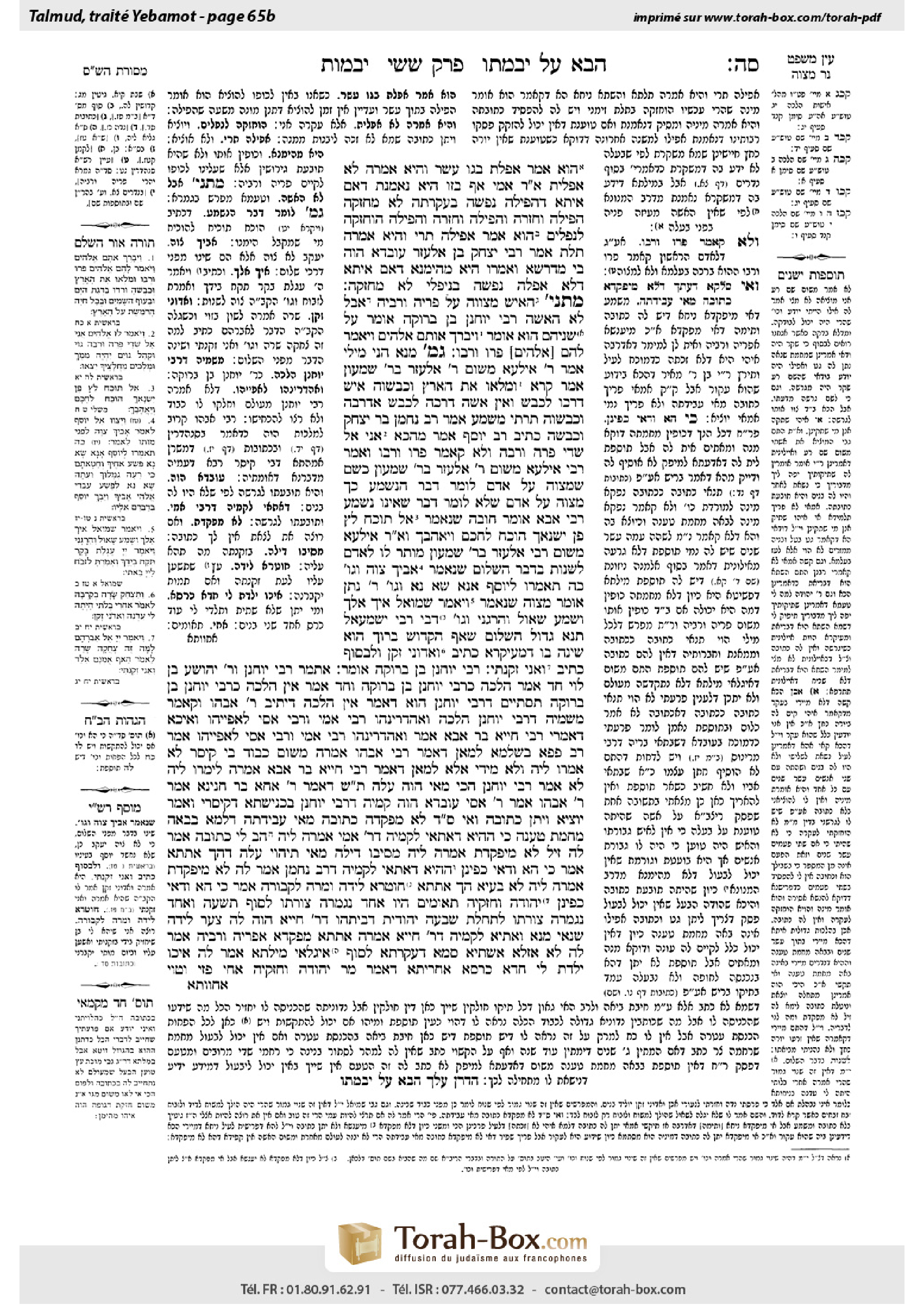
This page of Yevamot includes the Aramaic text, an English translation and an AI-generated French translation, alongside the scan above.
יבמות ס״ה ב · Aramaic and Hebrew text
הוּא אָמַר: אַפִּלַת בְּגוֹ עֲשַׂר. וְהִיא אָמְרָה: לָא אַפֵּלִית. אָמַר רַבִּי אַמֵּי: אַף בְּזוֹ הִיא נֶאֱמֶנֶת. דְּאִם אִיתָא דְּאַפִּלָה — נַפְשַׁהּ בְּעַקְרְתָה לָא מַחְזְקָה.
הִפִּילָה, וְחָזְרָה וְהִפִּילָה, וְחָזְרָה וְהִפִּילָה — הוּחְזְקָה לִנְפָלִים. הוּא אָמַר: אַפִּילָה תְּרֵי, וְהִיא אָמְרָה: תְּלָת, אָמַר רַבִּי יִצְחָק בֶּן אֶלְעָזָר: עוֹבָדָא הֲוָה בֵּי מִדְרְשָׁא, וַאֲמַרוּ: הִיא מְהֵימְנָא, דְּאִם אִיתָא דְּלָא אַפִּלָה — נַפְשַׁהּ בְּנִיפְלֵי לָא מַחְזְקָה.
מַתְנִי׳ הָאִישׁ מְצֻוֶּוה עַל פְּרִיָּה וּרְבִיָּה, אֲבָל לֹא הָאִשָּׁה. רַבִּי יוֹחָנָן בֶּן בְּרוֹקָה אוֹמֵר: עַל שְׁנֵיהֶם הוּא אוֹמֵר: ״וַיְבָרֶךְ אוֹתָם אֱלֹהִים וַיֹּאמֶר לָהֶם [אֱלֹהִים] פְּרוּ וּרְבוּ״.
גְּמָ׳ מְנָא הָנֵי מִילֵּי? אָמַר רַבִּי אִילְעָא מִשּׁוּם רַבִּי אֶלְעָזָר בְּרַבִּי שִׁמְעוֹן: אָמַר קְרָא: ״וּמִלְאוּ אֶת הָאָרֶץ וְכִבְשׁוּהָ״. אִישׁ דַּרְכּוֹ לְכַבֵּשׁ, וְאֵין אִשָּׁה דַּרְכָּהּ לְכַבֵּשׁ.
אַדְּרַבָּה: ״וְכִבְשׁוּהָ״ תַּרְתֵּי מַשְׁמַע! אָמַר רַב נַחְמָן בַּר יִצְחָק: ״וְכׇבְשֶׁהָ״ כְּתִיב. רַב יוֹסֵף אָמַר, מֵהָכָא: ״אֲנִי אֵל שַׁדַּי פְּרֵה וּרְבֵה״, וְלָא קָאָמַר ״פְּרוּ וּרְבוּ״.
וְאָמַר רַבִּי אִילְעָא מִשּׁוּם רַבִּי אֶלְעָזָר בְּרַבִּי שִׁמְעוֹן: כְּשֵׁם שֶׁמִּצְוָה עַל אָדָם לוֹמַר דָּבָר הַנִּשְׁמָע — כָּךְ מִצְוָה עַל אָדָם שֶׁלֹּא לוֹמַר דָּבָר שֶׁאֵינוֹ נִשְׁמָע. רַבִּי אַבָּא אוֹמֵר: חוֹבָה, שֶׁנֶּאֱמַר: ״אַל תּוֹכַח לֵץ פֶּן יִשְׂנָאֶךָּ הוֹכַח לְחָכָם וְיֶאֱהָבֶךָּ״.
וְאָמַר רַבִּי אִילְעָא מִשּׁוּם רַבִּי אֶלְעָזָר בְּרַבִּי שִׁמְעוֹן: מוּתָּר לוֹ לָאָדָם לְשַׁנּוֹת בִּדְבַר הַשָּׁלוֹם, שֶׁנֶּאֱמַר: ״אָבִיךְ צִוָּה וְגוֹ׳ כֹּה תֹאמְרוּ לְיוֹסֵף אָנָּא שָׂא נָא וְגוֹ׳״.
רַבִּי נָתָן אוֹמֵר: מִצְוָה, שֶׁנֶּאֱמַר: ״וַיֹּאמֶר שְׁמוּאֵל אֵיךְ אֵלֵךְ וְשָׁמַע שָׁאוּל וַהֲרָגָנִי וְגוֹ׳״.
דְּבֵי רַבִּי יִשְׁמָעֵאל תָּנָא: גָּדוֹל הַשָּׁלוֹם, שֶׁאַף הַקָּדוֹשׁ בָּרוּךְ הוּא שִׁינָּה בּוֹ, דְּמֵעִיקָּרָא כְּתִיב: ״וַאֲדוֹנִי זָקֵן״, וּלְבַסּוֹף, כְּתִיב: ״וַאֲנִי זָקַנְתִּי״.
רַבִּי יוֹחָנָן בֶּן בְּרוֹקָה אוֹמֵר. אִתְּמַר, רַבִּי יוֹחָנָן וְרַבִּי יְהוֹשֻׁעַ בֶּן לֵוִי, חַד אָמַר: הֲלָכָה כְּרַבִּי יוֹחָנָן בֶּן בְּרוֹקָה, וְחַד אָמַר: אֵין הֲלָכָה כְּרַבִּי יוֹחָנָן בֶּן בְּרוֹקָה.
תִּסְתַּיַּים דְּרַבִּי יוֹחָנָן הוּא דְּאָמַר אֵין הֲלָכָה: דִּיתֵיב רַבִּי אֲבָהוּ וְקָאָמַר מִשְּׁמֵיהּ דְּרַבִּי יוֹחָנָן: הֲלָכָה, וְאַהְדְּרִינְהוּ רַבִּי אַמֵּי וְרַבִּי אַסִּי לְאַפַּיְיהוּ.
וְאִיכָּא דְּאָמְרִי: רַבִּי חִיָּיא בַּר אַבָּא אָמַר, וְאַהְדְּרִינְהוּ רַבִּי אַמֵּי וְרַבִּי אַסִּי לְאַפַּיְיהוּ. אָמַר רַב פָּפָּא: בִּשְׁלָמָא לְמַאן דְּאָמַר רַבִּי אֲבָהוּ אַמְרַהּ, מִשּׁוּם כְּבוֹד בֵּי קֵיסָר לָא אָמְרוּ לֵיהּ וְלָא מִידֵּי. אֶלָּא לְמַאן דְּאָמַר רַבִּי חִיָּיא בַּר אַבָּא אַמְרַהּ — לֵימְרוּ לֵיהּ: לָא אָמַר רַבִּי יוֹחָנָן הָכִי.
מַאי הֲוָה עֲלַהּ? תָּא שְׁמַע, דְּאָמַר רַבִּי אַחָא בַּר חֲנִינָא אָמַר רַבִּי אֲבָהוּ אָמַר רַבִּי אַסִּי: עוֹבָדָא הֲוָה קַמֵּיהּ דְּרַבִּי יוֹחָנָן בִּכְנִישְׁתָּא דְקֵיסָרִי, וַאֲמַר: יוֹצִיא וְיִתֵּן כְּתוּבָּה. וְאִי סָלְקָא דַּעְתָּךְ לָא מְפַקְּדָה — כְּתוּבָּה מַאי עֲבִידְתַּהּ?
דִּלְמָא בְּבָאָה מֵחֲמַת טַעֲנָה.
כִּי הַהִיא דַּאֲתַאי לְקַמֵּיהּ דְּרַבִּי אַמֵּי. אֲמַרָה לֵיהּ: הַב לִי כְּתוּבָּה! אֲמַר לַהּ: זִיל, לָא מִיפַּקְּדַתְּ! אֲמַרָה לֵיהּ: מִסֵּיבוּ דִּילַהּ מַאי תֶּיהְוֵי עֲלַהּ דְּהָךְ אִתְּתָא? אָמַר: כִּי הָא — וַדַּאי כָּפֵינַן.
הָהִיא דַּאֲתַאי לְקַמֵּיהּ דְּרַב נַחְמָן. אֲמַר לַהּ: לָא מִיפַּקְּדַתְּ. אֲמַרָה לֵיהּ: לָא בָּעֲיָא הָךְ אִתְּתָא חוּטְרָא לִידָה וּמָרָה לִקְבוּרָה? אֲמַר: כִּי הָא וַדַּאי כָּפֵינַן.
יְהוּדָה וְחִזְקִיָּה תְּאוֹמִים הָיוּ, אֶחָד נִגְמְרָה צוּרָתוֹ לְסוֹף תִּשְׁעָה, וְאֶחָד נִגְמְרָה צוּרָתוֹ לִתְחִלַּת שִׁבְעָה. יְהוּדִית, דְּבֵיתְהוּ דְּרַבִּי חִיָּיא, הֲוָה לַהּ צַעַר לֵידָה. שַׁנַּאי מָנַהּ, וַאֲתַאי לְקַמֵּיהּ דְּרַבִּי חִיָּיא, אֲמַרָה: אִתְּתָא מְפַקְּדָא אַפְּרִיָּה וּרְבִיָּה? אֲמַר לַהּ: לָא. אֲזַלָא אִשְׁתְּיָא סַמָּא דַעֲקַרְתָּא.
לְסוֹף אִיגַּלַּאי מִילְּתָא. אֲמַר לַהּ: אִיכּוֹ יְלַדְתְּ לִי חֲדָא כַּרְסָא אַחְרִיתָא, דְּאָמַר מָר: יְהוּדָה וְחִזְקִיָּה אַחֵי, פַּזִּי וְטָוִי
Yevamot 65b · English translation
The Gemara addresses another case in which the court forces a man to divorce his wife who has not had children after ten years. If he said: You miscarried within the ten years of our marriage, and since less than ten years have elapsed since that time he should not have to divorce her, and she said: I did not miscarry, Rabbi Ami said: Even in this case she is believed, because if it is so that she miscarried she would not establish herself as barren through denying his claim.
If she miscarried, and then miscarried again, and miscarried again, she has been established to be a woman who is prone to miscarriages, and her husband must divorce her so that he can have children with another woman. If he said she miscarried twice, and she said it occurred three times, Rabbi Yitzḥak ben Elazar said: There was an incident of this kind that was adjudicated in the study hall and they said that she is believed, because if it is so that she had not miscarried a third time she would not establish herself as one who is prone to miscarriages.
MISHNA: A man is commanded with regard to the mitzva to be fruitful and multiply, but not a woman. Rabbi Yoḥanan ben Beroka says that a woman is also commanded, as the verse states with regard to both of them: “And God blessed them, and God said to them: Be fruitful and multiply” (Genesis 1:28).
GEMARA: From where are these matters derived, that a woman is not obligated in the mitzva to be fruitful and multiply? Rabbi Ile’a said in the name of Rabbi Elazar, son of Rabbi Shimon: The verse states: “Be fruitful and multiply, and fill the land and conquer it” (Genesis 1:28). It is the manner of a man to conquer and it is not the manner of a woman to conquer. Consequently, it is evident that the entire command, including the mitzva to be fruitful and multiply, was given only to men and not to women.
The Gemara raises a difficulty. On the contrary, the plural term: “And conquer it [vekhivshuha],” indicates that the two of them are included. Rav Naḥman bar Yitzḥak said: It is written in the Torah without the letter vav, so that it can be read: And conquer it [vekhivsha], in the singular. Rav Yosef said: The proof is from here: “And God said to him: I am God Almighty, be fruitful and multiply [perei urvei]” (Genesis 35:11), which is in singular, and it does not state: Be fruitful and multiply [peru urvu] in the plural.
The Gemara cites other statements made by Rabbi Ile’a in the name of Rabbi Elazar, son of Rabbi Shimon. And Rabbi Ile’a said in the name of Rabbi Elazar, son of Rabbi Shimon: Just as it is a mitzva for a person to say that which will be heeded, so is it a mitzva for a person not to say that which will not be heeded. One should not rebuke those who will be unreceptive to his message. Rabbi Abba says: It is obligatory for him to refrain from speaking, as it is stated: “Do not reprove a scorner lest he hate you; reprove a wise man and he will love you” (Proverbs 9:8).
And Rabbi Ile’a further said in the name of Rabbi Elazar, son of Rabbi Shimon: It is permitted for a person to depart from the truth in a matter that will bring peace, as it is stated: “Your father commanded before he died, saying: So you shall say to Joseph: Please pardon your brothers’ crime, etc.” (Genesis 50:16–17). Jacob never issued this command, but his sons falsely attributed this statement to him in order to preserve peace between them and Joseph.
Rabbi Natan says: It is a mitzva to depart from the truth in order to preserve peace, as it is stated: “And Samuel said: How can I go, and Saul will hear and kill me” (I Samuel 16:2). God responded in the next verse that Samuel should say he went to sacrifice an offering, indicating that God commands one to lie in order to preserve peace.
It was taught in the school of Rabbi Yishmael: Great is peace, as even the Holy One, Blessed be He, departed from the truth for it. As, initially it is written that Sarah said of Abraham: “And my lord is old” (Genesis 18:12), and in the end it is written that God told Abraham that Sarah said: “And I am old” (Genesis 18:13). God adjusted Sarah’s words in order to spare Abraham hurt feelings that might lead Abraham and Sarah to quarrel.
§ It is taught in the mishna that Rabbi Yoḥanan ben Beroka says that women are also included in the mitzva to be fruitful and multiply. It was stated that two amora’im, Rabbi Yoḥanan and Rabbi Yehoshua ben Levi, disagreed concerning this matter. One said that the halakha is in accordance with the opinion of Rabbi Yoḥanan ben Beroka, and one said that the halakha is not in accordance with the opinion of Rabbi Yoḥanan ben Beroka.
The Gemara comments: Conclude that it was Rabbi Yoḥanan who said that the halakha is not in accordance with the opinion of Rabbi Yoḥanan ben Beroka, as Rabbi Abbahu sat and said in the name of Rabbi Yoḥanan that the halakha is in accordance with the opinion of Rabbi Yoḥanan ben Beroka, and Rabbi Ami and Rabbi Asi, who were sitting across from him, turned their faces as an indication that they disagreed with this report of Rabbi Yoḥanan’s opinion, but did not want to explicitly contradict Rabbi Abbahu’s statement out of respect for him.
And some say a different version of the incident, that it was Rabbi Ḥiyya bar Abba who said this statement, and Rabbi Ami and Rabbi Asi turned their faces. Rav Pappa said: Granted, according to the one who said that Rabbi Abbahu said it, it makes sense that due to the honor of Caesar’s court, where Rabbi Abbahu maintained close ties, Rabbi Ami and Rabbi Asi did not say anything to him and merely hinted at their disagreement. However, according to the one who said that Rabbi Ḥiyya bar Abba said it, let them say to him explicitly: Rabbi Yoḥanan did not say this. In any event, it is clear that according to Rabbi Ami and Rabbi Asi, Rabbi Yoḥanan disagreed with the opinion of Rabbi Yoḥanan ben Beroka.
The Gemara asks: What conclusion was reached about this issue? The Gemara suggests: Come and hear, as Rabbi Aḥa bar Ḥanina said that Rabbi Abbahu said that Rabbi Asi said: There was an incident that came before Rabbi Yoḥanan in the synagogue of Caesarea involving a woman who wanted a divorce from her husband after ten years of childless marriage, and he said that the husband must divorce her and give her the payment for her marriage contract. If it enters your mind to say that she is not commanded to be fruitful and multiply, what is payment for a marriage contract doing here? Why does she have a right to demand to be divorced and to receive the payment for her marriage contract?
The Gemara responds: Perhaps that was in a case when she came to demand a divorce due to another claim, i.e., she wanted children for a reason other than the fulfillment of the mitzva to be fruitful and multiply. Since this claim has merit, her husband must divorce her and pay her marriage contract.
This is like the case of a certain woman who came before Rabbi Ami and requested a divorce due to her husband’s inability to father children. She said to him: Give me the payment for my marriage contract. He said to her: Go away, as you are not commanded to be fruitful and multiply and have no right to demand a divorce. She said to him: In her old age, what will be with this woman, i.e., if I have no children, who will take care of me when I grow old? Rabbi Ami said: In a situation such as this, we certainly force the husband to divorce her and pay her marriage contract.
The Gemara relates a similar incident: A certain woman came before Rav Naḥman and requested a divorce due to her husband’s inability to father children. He said to her: You are not commanded to be fruitful and multiply. She said to him: Does this woman not require a staff for her hand and a hoe for her burial? In other words, the woman said that she wanted children so that they could care for her in her old age and bury her when she would die. Rav Naḥman said: In a case such as this, we certainly force the husband to divorce her.
The Gemara relates that Rabbi Ḥiyya’s sons, Yehuda and Ḥizkiyya, were twins, but one of them was fully developed after nine months of pregnancy and one was fully developed at the beginning of the seventh month, and they were born two months apart. Yehudit, the wife of Rabbi Ḥiyya, had acute birthing pain from these unusual deliveries. She changed her clothes to prevent Rabbi Ḥiyya from recognizing her and came before Rabbi Ḥiyya to ask him a halakhic question. She said: Is a woman commanded to be fruitful and multiply? He said to her: No. She went and drank an infertility potion.
Eventually the matter was revealed, and Rabbi Ḥiyya found out about what Yehudit had done. He said to her: If only you had given birth to one more belly for me, i.e., another set of twins. As the Master said: Yehuda and Ḥizkiyya were twin brothers and became prominent Torah scholars, and Pazi and Tavi, Rabbi Ḥiyya’s daughters,
Yevamot 65b · Traduction française (IA)
La Guemara examine un autre cas où le tribunal contraint un homme à divorcer de sa femme, qui n’a pas eu d’enfant après dix ans. S’il dit : « Tu as fait une fausse couche au cours des dix années de notre mariage », et que, puisque moins de dix ans se sont écoulés depuis cette fausse couche, il ne devrait pas être tenu de divorcer d’elle, tandis qu’elle dit : « Je n’ai pas fait de fausse couche », Rabbi Ami dit : même dans ce cas, elle est crue, car si elle avait fait une fausse couche, elle ne prétendrait pas être stérile en niant son affirmation.
Si elle fait une fausse couche, puis une deuxième, puis une troisième, il est établi qu’elle est sujette aux fausses couches ; son mari doit alors divorcer d’elle afin de pouvoir avoir des enfants avec une autre femme. S’il dit qu’elle a fait deux fausses couches et qu’elle dit qu’elle en a fait trois, Rabbi Yitsḥak ben Elazar dit : un cas de ce genre a été jugé à la maison d’étude, et il a été décidé qu’elle était crue, car si elle n’avait pas fait une troisième fausse couche, elle ne prétendrait pas être sujette aux fausses couches.
MICHNA : L’homme est soumis à l’obligation d’accomplir la mitsva d’avoir des enfants et de se multiplier, mais pas la femme. Rabbi Yoḥanan ben Beroka dit que la femme y est également soumise, comme l’indique le verset à propos des deux : « Dieu les bénit et Dieu leur dit : Soyez féconds et multipliez-vous » (Genèse 1,28).
GUEMARA : D’où déduit-on que la femme n’est pas obligée d’accomplir la mitsva d’avoir des enfants et de se multiplier ? Rabbi Iléa a dit au nom de Rabbi Elazar, fils de Rabbi Shimon : le verset dit : « Soyez féconds et multipliez-vous, remplissez la terre et soumettez-la » (Genèse 1,28). Il est dans la nature de l’homme de conquérir, mais non dans celle de la femme. Il en ressort donc que le commandement tout entier, y compris la mitsva d’avoir des enfants et de se multiplier, n’a été donné qu’aux hommes, et non aux femmes.
La Guemara soulève une difficulté : au contraire, le terme au pluriel « et soumettez-la [vekhivshuha] » indique que tous deux sont concernés. Rav Naḥman bar Yitsḥak dit : dans la Torah, le mot est écrit sans la lettre vav, de sorte qu’on peut le lire « et soumets-la [vekhivsha] », au singulier. Rav Yossef dit : la preuve se trouve ici : « Dieu lui dit : Je suis Dieu tout-puissant ; sois fécond et multiplie-toi [perei urvei] » (Genèse 35,11), au singulier, et non « soyez féconds et multipliez-vous [peru urvu] », au pluriel.
La Guemara cite d’autres paroles prononcées par Rabbi Iléa au nom de Rabbi Elazar, fils de Rabbi Shimon. Rabbi Iléa a dit en son nom : de même qu’il est une mitsva pour une personne de dire ce qui sera écouté, il est également une mitsva de ne pas dire ce qui ne sera pas écouté. Il ne faut pas réprimander ceux qui ne seront pas réceptifs à son message. Rabbi Abba dit : il est obligatoire de s’abstenir de parler, comme il est dit : « Ne reprends pas le moqueur, de peur qu’il ne te haïsse ; reprends le sage, et il t’aimera » (Proverbes 9,8).
Rabbi Iléa a également dit au nom de Rabbi Elazar, fils de Rabbi Shimon : il est permis de s’écarter de la vérité dans une affaire qui contribuera à la paix, comme il est dit : « Ton père a donné cet ordre avant sa mort : Vous direz ainsi à Joseph : Je t’en prie, pardonne la faute de tes frères, etc. » (Genèse 50,16-17). Jacob n’a jamais donné cet ordre ; ses fils lui ont faussement attribué ces paroles afin de préserver la paix entre eux et Joseph.
Rabbi Natan dit : c’est une mitsva de s’écarter de la vérité afin de préserver la paix, comme il est dit : « Samuel dit : Comment pourrais-je y aller ? Saül l’apprendra et me tuera » (I Samuel 16,2). Au verset suivant, Dieu répondit à Samuel qu’il devait dire qu’il était allé offrir un sacrifice, ce qui indique que Dieu ordonne de mentir afin de préserver la paix.
Il a été enseigné dans l’école de Rabbi Yishmaël : la paix est une grande valeur, car même le Saint, béni soit-Il, s’est écarté de la vérité pour elle. En effet, il est d’abord écrit que Sarah dit à propos d’Abraham : « Et mon seigneur est vieux » (Genèse 18,12), puis que Dieu dit à Abraham que Sarah avait dit : « Et moi, je suis vieille » (Genèse 18,13). Dieu a modifié les paroles de Sarah afin d’épargner à Abraham une blessure qui aurait pu provoquer une dispute entre lui et Sarah.
§ La Michna enseigne que, selon Rabbi Yoḥanan ben Beroka, les femmes sont également soumises à la mitsva d’avoir des enfants et de se multiplier. Il a été rapporté que deux amoraïm, Rabbi Yoḥanan et Rabbi Yehoshua ben Levi, étaient en désaccord sur cette question. L’un disait que la halakha suit l’opinion de Rabbi Yoḥanan ben Beroka, et l’autre disait qu’elle ne la suit pas.
La Guemara fait remarquer : concluons que c’est Rabbi Yoḥanan qui disait que la halakha ne suit pas l’opinion de Rabbi Yoḥanan ben Beroka. En effet, Rabbi Abbahu était assis et disait au nom de Rabbi Yoḥanan que la halakha suit l’opinion de Rabbi Yoḥanan ben Beroka ; Rabbi Ami et Rabbi Asi, assis en face de lui, détournèrent le visage pour indiquer qu’ils étaient en désaccord avec ce compte rendu de l’opinion de Rabbi Yoḥanan, mais ne voulaient pas contredire ouvertement Rabbi Abbahu, par respect pour lui.
Certains rapportent une autre version de l’incident : c’est Rabbi Ḥiyya bar Abba qui prononça cette déclaration, et Rabbi Ami et Rabbi Asi détournèrent le visage. Rav Pappa dit : à supposer que ce soit Rabbi Abbahu qui l’ait prononcée, il est logique que, par égard pour la cour de César, avec laquelle Rabbi Abbahu entretenait des liens étroits, Rabbi Ami et Rabbi Asi ne lui aient rien dit et se soient contentés de signaler leur désaccord. Mais si c’est Rabbi Ḥiyya bar Abba qui l’a prononcée, pourquoi ne lui disent-ils pas explicitement : « Rabbi Yoḥanan n’a pas dit cela » ? Quoi qu’il en soit, il est clair que, selon Rabbi Ami et Rabbi Asi, Rabbi Yoḥanan était en désaccord avec l’opinion de Rabbi Yoḥanan ben Beroka.
La Guemara demande : quelle conclusion a-t-on tirée sur cette question ? Elle propose : « Viens et entends », car Rabbi Aḥa bar Ḥanina a dit au nom de Rabbi Abbahu, qui l’a dit au nom de Rabbi Asi : un cas s’est présenté devant Rabbi Yoḥanan, dans la synagogue de Césarée. Il s’agissait d’une femme qui voulait divorcer de son mari après dix ans de mariage sans enfant. Rabbi Yoḥanan a dit que le mari devait divorcer d’elle et lui verser la somme prévue par sa ketouba. Si l’on admet qu’elle n’est pas tenue d’avoir des enfants et de se multiplier, que vient faire ici le versement de la somme prévue par sa ketouba ? Pourquoi aurait-elle le droit d’exiger le divorce et de recevoir cette somme ?
La Guemara répond : peut-être s’agissait-il d’un cas où elle demandait le divorce pour un autre motif, c’est-à-dire qu’elle voulait des enfants pour une raison autre que l’accomplissement de la mitsva d’avoir des enfants et de se multiplier. Puisque sa demande est fondée, son mari doit divorcer d’elle et lui verser la somme prévue par sa ketouba.
C’est comparable au cas d’une certaine femme qui se présenta devant Rabbi Ami et demanda le divorce parce que son mari était incapable d’engendrer des enfants. Elle lui dit : « Verse-moi la somme prévue par ma ketouba. » Il lui répondit : « Va-t’en, car tu n’es pas tenue d’avoir des enfants et de te multiplier, et tu n’as pas le droit d’exiger le divorce. » Elle lui dit : « Que deviendra cette femme dans sa vieillesse ? » Autrement dit, si je n’ai pas d’enfants, qui prendra soin de moi quand je serai vieille ? Rabbi Ami dit : dans une situation comme celle-ci, nous contraignons certainement le mari à divorcer d’elle et à lui verser la somme prévue par sa ketouba.
La Guemara rapporte un incident semblable : une certaine femme se présenta devant Rav Naḥman et demanda le divorce parce que son mari était incapable d’engendrer des enfants. Il lui dit : « Tu n’es pas tenue d’avoir des enfants et de te multiplier. » Elle lui dit : « Cette femme n’a-t-elle pas besoin d’un bâton pour sa main et d’une houe pour son enterrement ? » Autrement dit, elle voulait des enfants afin qu’ils prennent soin d’elle dans sa vieillesse et l’enterrent à sa mort. Rav Naḥman dit : dans un cas comme celui-ci, nous contraignons certainement le mari à divorcer d’elle.
La Guemara rapporte que les fils de Rabbi Ḥiyya, Yehuda et Ḥizkiyya, étaient jumeaux, mais que l’un était arrivé à terme après neuf mois de grossesse et l’autre au début du septième mois ; ils naquirent donc à deux mois d’intervalle. Yehudit, l’épouse de Rabbi Ḥiyya, souffrait de douleurs aiguës lors de ces accouchements inhabituels. Elle changea de vêtements pour empêcher Rabbi Ḥiyya de la reconnaître, puis se présenta devant lui pour lui poser une question de halakha. Elle lui demanda : « Une femme est-elle tenue d’avoir des enfants et de se multiplier ? » Il lui répondit : « Non. » Elle s’en alla et but une potion stérilisante.
Finalement, l’affaire fut révélée, et Rabbi Ḥiyya apprit ce que Yehudit avait fait. Il lui dit : « Si seulement tu m’avais encore donné une portée », c’est-à-dire une autre paire de jumeaux. Car le Maître a dit : Yehuda et Ḥizkiyya étaient des frères jumeaux et devinrent d’éminents érudits de la Torah ; et Pazi et Tavi, les filles de Rabbi Ḥiyya,
Traduction française générée par IA à partir de l’édition anglaise de Sefaria. Vérifie toujours un passage avec le texte source.
Text from Sefaria: William Davidson Edition - Vocalized Aramaic (CC BY NC); William Davidson Edition - English (CC BY NC).