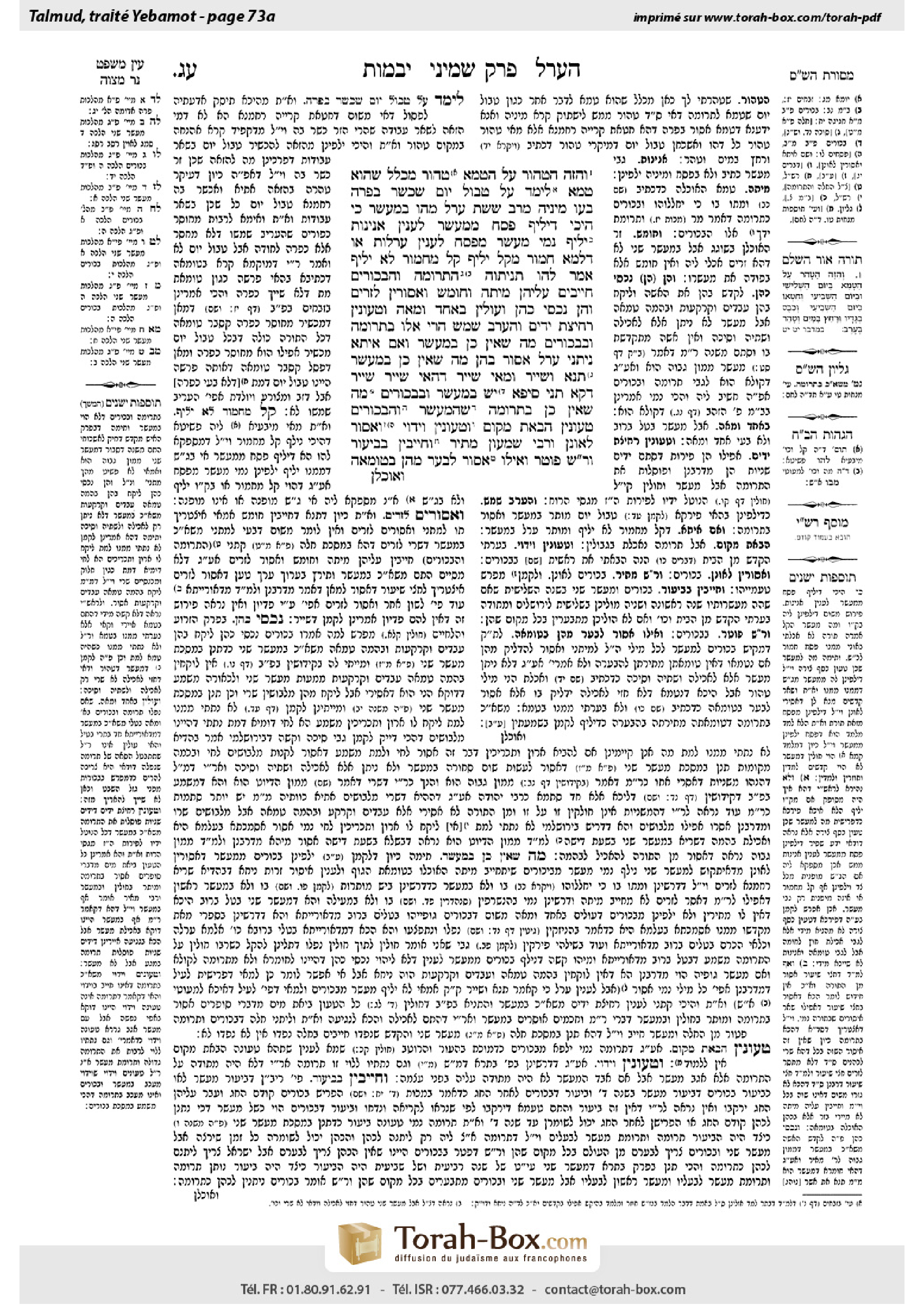
Yevamot 73a: Talmud study for Daf Yomi
Daf Yomi is the daily study of one Talmud folio. Explore 37 tractates with scans, Hebrew text, Sefaria English and AI-generated French translations where annotated.
Passage selection and English or AI-generated French translation are available where the scan has annotations. Daf Study is independent of Torah-Box and Sefaria.
Browse Yevamot · יבמות · All tractatesYevamot 73a text and translations
This page of Yevamot includes the Aramaic text, an English translation and an AI-generated French translation, alongside the scan above.
יבמות ע״ג א · Aramaic and Hebrew text
״וְהִזָּה הַטָּהוֹר עַל הַטָּמֵא״, ״טָהוֹר״ — מִכְּלָל שֶׁהוּא טָמֵא, לִימֵּד עַל טְבוּל יוֹם שֶׁכָּשֵׁר בַּפָּרָה.
בְּעוֹ מִינֵּיהּ מֵרַב שֵׁשֶׁת: עָרֵל מַהוּ בַּמַּעֲשֵׂר? כִּי הֵיכִי דְּיָלֵיף פֶּסַח מִמַּעֲשֵׂר לְעִנְיַן אֲנִינוּת, יָלֵיף נָמֵי מַעֲשֵׂר מִפֶּסַח לְעִנְיַן עֲרֵלוּת,
אוֹ דִלְמָא: חָמוּר מִקַּל יָלֵיף, קַל מֵחָמוּר לָא יָלֵיף.
אֲמַר לְהוּ, תְּנֵיתוּהָ: הַתְּרוּמָה וְהַבִּכּוּרִים חַיָּיבִים עֲלֵיהֶן מִיתָה וָחוֹמֶשׁ, וַאֲסוּרִין לְזָרִים,
וְהֵן נִכְסֵי כֹהֵן, וְעוֹלִין בְּאֶחָד וּמֵאָה, וּטְעוּנִין רְחִיצַת יָדַיִם וְהֶעֱרֵב שֶׁמֶשׁ. הֲרֵי אֵלּוּ בַּתְּרוּמָה וּבַבִּכּוּרִים, מַה שֶּׁאֵין כֵּן בַּמַּעֲשֵׂר.
וְאִם אִיתָא — נִיתְנֵי: עָרֵל אָסוּר בָּהֶן, מַה שֶּׁאֵין כֵּן בַּמַּעֲשֵׂר!
תְּנָא וְשַׁיַּיר. וּמַאי שַׁיַּיר דְּהַאי שַׁיַּיר?
שַׁיַּיר דְּקָא תָנֵי סֵיפָא: יֵשׁ בַּמַּעֲשֵׂר וּבַבִּכּוּרִים מַה שֶּׁאֵין כֵּן בַּתְּרוּמָה, שֶׁהַמַּעֲשֵׂר וְהַבִּכּוּרִים טְעוּנִין הֲבָאַת מָקוֹם, וּטְעוּנִין וִידּוּי, וַאֲסוּרִין לְאוֹנֵן, וְרַבִּי שִׁמְעוֹן מַתִּיר. וְחַיָּיבִין בְּבִיעוּר, וְרַבִּי שִׁמְעוֹן פּוֹטֵר.
וְאִילּוּ אָסוּר לְבַעֵר מֵהֶן בְּטוּמְאָה,
Yevamot 73a · English translation
It is further stated: “And the pure person shall sprinkle upon the impure” (Numbers 19:19). The verse states “pure”; this indicates by inference that he is in some way ritually impure. In other words, the verse speaks of one who is pure only in relation to one who is impure. Were this not the case, there would have been no need at all to mention his purity, as it would have been understood that since the red heifer is called a sin-offering, with regard to which purity is paramount, the one performing the ritual must be pure. Of necessity, then, this “pure” individual is not completely pure in all regards. This teaches that one who immersed himself that day is fit to perform the rites connected to the red heifer.
The Gemara returns to the previous discussion. They raised a dilemma before Rav Sheshet: In the case of an uncircumcised man, what is the halakha with regard to his eating second tithe? Can one claim that just as the halakha governing the Paschal lamb is derived from the halakha governing second tithe with regard to acute mourning, in that an acute mourner, who may not eat second tithe, is likewise prohibited from partaking of the Paschal lamb, so too, the halakha concerning second tithe is derived from the halakha concerning the Paschal lamb with regard to lack of circumcision, in that an uncircumcised man, who may not partake of the Paschal lamb, is likewise prohibited from eating second tithe?
Or perhaps the halakha governing the stringent case of the Paschal lamb is derived from the halakha governing the lenient case of second tithe, but the halakha concerning the lenient case of second tithe is not derived from the halakha concerning the stringent case of the Paschal lamb, and therefore it is prohibited for an uncircumcised man to partake of the Paschal lamb, but he may eat second tithe.
Rav Sheshet said to them: You already learned the answer to this question in a mishna (Ḥalla 1:9): The following halakhot apply to both teruma and the first fruits of the new harvest, which must be given to the priests: If a priest ate of them while in a state of ritual impurity, he is liable to the punishment of death at the hand of Heaven; and if a non-priest ate of them unintentionally, he must restore the value of the produce he ate, adding one-fifth of its value as a fine; and they are both forbidden to non-priests.
The mishna continues: And they are considered in all regards the private property of the priest to whom they were given; and they are nullified, i.e., rendered permitted for consumption by non-priests, in a mixture of one hundred and one, when there are at least one hundred parts of permitted food for each part of teruma or first fruits; and they both require washing of the hands before they may be eaten; and if a priest is ritually impure, he may not eat of teruma or first fruits, even after immersion, until after sunset on the day of his immersion. All of these halakhot apply to teruma and first fruits, which is not the case with regard to second tithe.
Rav Sheshet resumes his argument: And if it is so that one who is uncircumcised may eat second tithe, let the tanna also teach: It is prohibited for an uncircumcised man to eat of teruma and first fruits, which is not the case with regard to second tithe.
The Gemara rejects this argument: This is no proof, as the tanna of the mishna taught only some of the differences between teruma and first fruits on the one hand and second tithe on the other, and he omitted others. The Gemara asks: The mishna is sometimes not exhaustive, but it never omits only one case. What other difference did he omit that you say that he also omitted this difference?
The Gemara answers: He omitted the following, as he teaches in the latter clause of the mishna: There are halakhot that apply to second tithe and first fruits, which is not the case with regard to teruma. As second tithe and first fruits require that they be brought to a particular place, Jerusalem, where they must be eaten, whereas teruma may be consumed in all places; and they both require a declaration, as a declaration must be made on the last day of Passover in the fourth and seventh years of the Sabbatical cycle, stating that one’s agricultural obligations with regard to tithes have been fulfilled properly, and so too a declaration must be made when first fruits are brought to the Temple; and they are forbidden to an acute mourner; and Rabbi Shimon permits an acute mourner to partake of first fruits. And they both require eradication before Passover in the fourth and seventh years of the Sabbatical cycle if one failed to bring them beforehand; and Rabbi Shimon exempts first fruits from the obligation of eradication.
And yet second tithe and first fruits differ from teruma in that it is prohibited to burn the former and benefit from the burning, even when the produce is in a state of ritual impurity and therefore unfit to be eaten, e.g., one may not burn impure oil for light;
Yevamot 73a · Traduction française (IA)
Il est également dit : « Et l’homme pur aspergera l’impur » (Nombres 19:19). Le verset précise « pur » ; on en déduit qu’il est impur à certains égards. Autrement dit, le verset parle de quelqu’un qui n’est pur que par rapport à une personne impure. S’il n’en était pas ainsi, il n’aurait pas été nécessaire de mentionner sa pureté, puisqu’on aurait compris que, la vache rousse étant appelée sacrifice expiatoire, et la pureté étant primordiale à son sujet, celui qui accomplit le rite doit être pur. Il faut donc conclure que cet homme « pur » n’est pas entièrement pur à tous égards. Cela enseigne que celui qui s’est immergé ce jour-là est apte à accomplir les rites liés à la vache rousse.
La Guemara revient à la discussion précédente. On soumit à Rav Chéchet le dilemme suivant : dans le cas d’un homme incirconcis, quelle est la halakha concernant la consommation de la seconde dîme ? Peut-on soutenir que, de même que la halakha relative au sacrifice pascal est déduite de celle de la seconde dîme concernant le deuil aigu — un endeuillé aigu, qui ne peut consommer la seconde dîme, n’a également pas le droit de prendre part au sacrifice pascal —, de même la halakha relative à la seconde dîme est déduite de celle du sacrifice pascal concernant l’absence de circoncision, de sorte qu’un homme incirconcis, qui ne peut prendre part au sacrifice pascal, n’a également pas le droit de consommer la seconde dîme ?
Ou peut-être la halakha relative au cas rigoureux du sacrifice pascal est-elle déduite de celle du cas plus souple de la seconde dîme, mais la halakha relative au cas plus souple de la seconde dîme n’est-elle pas déduite de celle du cas rigoureux du sacrifice pascal ? Il serait donc interdit à un homme incirconcis de prendre part au sacrifice pascal, mais il pourrait consommer la seconde dîme.
Rav Chéchet leur dit : Vous avez déjà appris la réponse à cette question dans une Michna (Ḥalla 1:9) : les halakhot suivantes s’appliquent à la fois à la terouma et aux prémices de la nouvelle récolte, qui doivent être donnés aux prêtres : si un prêtre en a consommé alors qu’il était en état d’impureté rituelle, il est passible de mort par la main du Ciel ; si un non-prêtre en a consommé par inadvertance, il doit restituer la valeur des produits consommés, en y ajoutant un cinquième à titre de pénalité ; et ces deux catégories sont interdites aux non-prêtres.
La Michna poursuit : elles sont à tous égards considérées comme la propriété privée du prêtre auquel elles ont été données ; elles sont annulées, c’est-à-dire rendues permises à la consommation pour les non-prêtres, dans un mélange au taux de cent contre un, lorsqu’il y a au moins cent parts d’aliments permis pour chaque part de terouma ou de prémices ; toutes deux exigent le lavage des mains avant leur consommation ; et si un prêtre est en état d’impureté rituelle, il ne peut consommer ni terouma ni prémices, même après l’immersion, avant le coucher du soleil le jour de son immersion. Toutes ces halakhot s’appliquent à la terouma et aux prémices, contrairement à la seconde dîme.
Rav Chéchet reprend son raisonnement : s’il est vrai qu’un homme incirconcis peut consommer la seconde dîme, que le tanna enseigne aussi ceci : un homme incirconcis n’a pas le droit de consommer la terouma ni les prémices, contrairement à la seconde dîme.
La Guemara rejette cet argument : cela ne prouve rien, car le tanna de la Michna n’a enseigné que certaines des différences entre la terouma et les prémices, d’une part, et la seconde dîme, d’autre part, et en a omis d’autres. La Guemara demande : certes, la Michna n’est pas toujours exhaustive, mais elle n’omet jamais un seul cas. Quelle autre différence a-t-elle omise, pour que tu dises qu’elle a également omis cette différence ?
La Guemara répond : il a omis le point suivant, qu’il enseigne dans la dernière partie de la Michna : certaines halakhot s’appliquent à la seconde dîme et aux prémices, mais pas à la terouma. En effet, la seconde dîme et les prémices doivent être apportées en un lieu déterminé, Jérusalem, où elles doivent être consommées, tandis que la terouma peut être consommée partout ; toutes deux exigent également une déclaration : le dernier jour de Pessa’h, au cours de la quatrième et de la septième année du cycle sabbatique, il faut déclarer que les obligations agricoles relatives aux dîmes ont été correctement accomplies ; de même, une déclaration doit être faite lorsque les prémices sont apportées au Temple. Elles sont interdites à un endeuillé aigu, mais Rabbi Chimon permet à un endeuillé aigu de consommer les prémices. Toutes deux doivent être éliminées avant Pessa’h, au cours de la quatrième et de la septième année du cycle sabbatique, si l’on a omis de les apporter auparavant ; et Rabbi Chimon exempte les prémices de l’obligation d’élimination.
Et pourtant, la seconde dîme et les prémices diffèrent de la terouma en ceci : il est interdit de brûler les premières et de tirer profit de leur combustion, même lorsque les produits sont en état d’impureté rituelle et donc impropres à la consommation ; par exemple, il est interdit de brûler de l’huile impure pour s’éclairer ;
Traduction française générée par IA à partir de l’édition anglaise de Sefaria. Vérifie toujours un passage avec le texte source.
Text from Sefaria: William Davidson Edition - Vocalized Aramaic (CC BY NC); William Davidson Edition - English (CC BY NC).