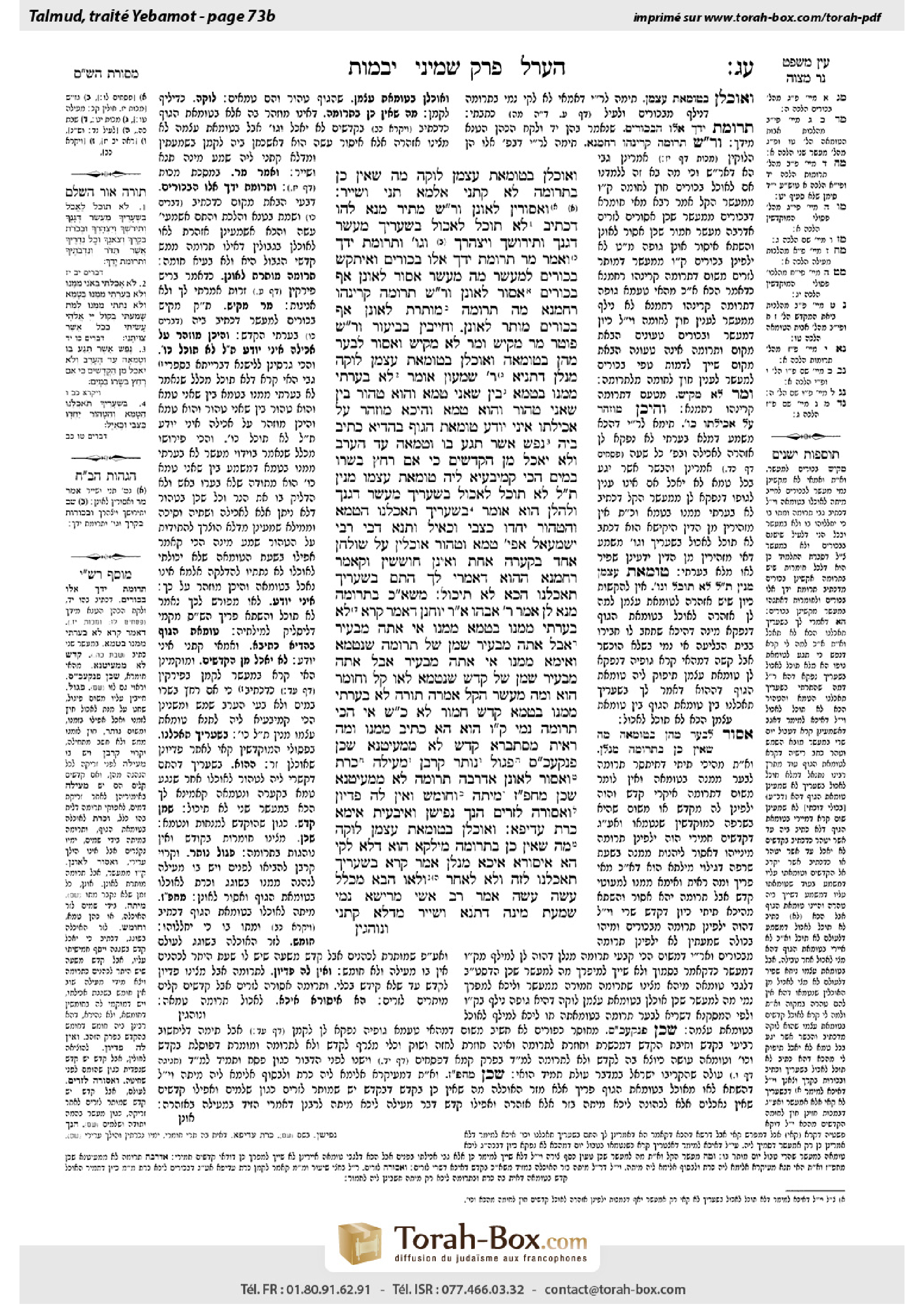
Yevamot 73b: Talmud study for Daf Yomi
Daf Yomi is the daily study of one Talmud folio. Explore 37 tractates with scans, Hebrew text, Sefaria English and AI-generated French translations where annotated.
Passage selection and English or AI-generated French translation are available where the scan has annotations. Daf Study is independent of Torah-Box and Sefaria.
Browse Yevamot · יבמות · All tractatesYevamot 73b text and translations
This page of Yevamot includes the Aramaic text, an English translation and an AI-generated French translation, alongside the scan above.
יבמות ע״ג ב · Aramaic and Hebrew text
וְאוֹכְלָן בְּטוּמְאַת עַצְמָן לוֹקֶה, מַה שֶּׁאֵין כֵּן בַּתְּרוּמָה — לָא קָתָנֵי. אַלְמָא תָּנֵי וְשַׁיַּיר.
וַאֲסוּרִין לְאוֹנֵן, וְרַבִּי שִׁמְעוֹן מַתִּיר. מְנָא לְהוּ — דִּכְתִיב: ״לֹא תוּכַל לֶאֱכוֹל בִּשְׁעָרֶיךָ מַעְשַׂר דְּגָנְךָ וְתִירֹשְׁךָ וְיִצְהָרֶךָ וְגוֹ׳ וּתְרוּמַת יָדֶךָ״, וְאָמַר מָר: ״תְּרוּמַת יָדֶךָ״ — אֵלּוּ בִּכּוּרִים, וְאִיתַּקַּשׁ בִּכּוּרִים לְמַעֲשֵׂר: מָה מַעֲשֵׂר אָסוּר לְאוֹנֵן — אַף בִּכּוּרִים אָסוּר לְאוֹנֵן.
וְרַבִּי שִׁמְעוֹן: תְּרוּמָה קְרִינְהוּ רַחֲמָנָא, מָה תְּרוּמָה מוּתֶּרֶת לְאוֹנֵן — אַף בִּכּוּרִים מוּתָּרִים לְאוֹנֵן.
וְחַיָּיבִין בְּבִיעוּר, וְרַבִּי שִׁמְעוֹן פּוֹטֵר. מָר מַקֵּישׁ וּמָר לָא מַקֵּישׁ.
וְאָסוּר לְבַעֵר מֵהֶן בְּטוּמְאָה, וְאוֹכְלָן בְּטוּמְאַת עַצְמָן לוֹקֶה, מְנָלַן — דְּתַנְיָא, רַבִּי שִׁמְעוֹן אוֹמֵר: ״לֹא בִעַרְתִּי מִמֶּנּוּ בְּטָמֵא״, בֵּין שֶׁאֲנִי טָמֵא וְהוּא טָהוֹר, בֵּין שֶׁאֲנִי טָהוֹר וְהוּא טָמֵא.
וְהֵיכָא מוּזְהָר עַל אֲכִילָתוֹ אֵינִי יוֹדֵעַ. טוּמְאַת הַגּוּף בְּהֶדְיָא כְּתִיב בֵּיהּ: ״נֶפֶשׁ אֲשֶׁר תִּגַּע בּוֹ וְטָמְאָה עַד הָעָרֶב וְלֹא יֹאכַל מִן הַקֳּדָשִׁים כִּי אִם רָחַץ בְּשָׂרוֹ בַּמָּיִם״!
הָכִי קָמִיבַּעְיָא לֵיהּ: טוּמְאַת עַצְמוֹ מִנַּיִן? תַּלְמוּד לוֹמַר: ״לֹא תוּכַל לֶאֱכוֹל בִּשְׁעָרֶיךָ מַעְשַׂר דְּגָנְךָ״, וּלְהַלָּן הוּא אוֹמֵר ״בִּשְׁעָרֶיךָ תֹּאכְלֶנּוּ הַטָּמֵא וְהַטָּהוֹר יַחְדָּו כַּצְּבִי וְכָאַיָּל״, וְתָנָא דְּבֵי רַבִּי יִשְׁמָעֵאל: אֲפִילּוּ טָמֵא וְטָהוֹר אוֹכְלִין עַל שׁוּלְחָן אֶחָד בִּקְעָרָה אַחַת וְאֵינָן חוֹשְׁשִׁין, וְקָאָמַר רַחֲמָנָא: הָהוּא דַּאֲמַרִי לָךְ הָתָם ״בִּשְׁעָרֶיךָ תֹּאכְלֶנּוּ״ — הָכָא לָא תֵּיכוֹל.
מַה שֶּׁאֵין כֵּן בַּתְּרוּמָה. מְנָא לַן? אָמַר רַבִּי אֲבָהוּ אָמַר רַבִּי יוֹחָנָן, דְּאָמַר קְרָא: ״לֹא בִעַרְתִּי מִמֶּנּוּ בְּטָמֵא״ — מִמֶּנּוּ אִי אַתָּה מַבְעִיר, אֲבָל אַתָּה מַבְעִיר שֶׁמֶן שֶׁל תְּרוּמָה שֶׁנִּטְמָא.
וְאֵימָא: מִמֶּנּוּ אִי אַתָּה מַבְעִיר, אֲבָל אַתָּה מַבְעִיר שֶׁמֶן שֶׁל קֹדֶשׁ שֶׁנִּטְמָא! לָאו קַל וָחוֹמֶר הוּא? וּמָה מַעֲשֵׂר הַקַּל אָמְרָה תּוֹרָה ״לֹא בִעַרְתִּי מִמֶּנּוּ בְּטָמֵא״ — קֹדֶשׁ חָמוּר לֹא כׇּל שֶׁכֵּן?!
אִי הָכִי, תְּרוּמָה נָמֵי קַל וָחוֹמֶר הוּא! הָא כְּתִיב ״מִמֶּנּוּ״!
וּמָה רָאִיתָ? מִסְתַּבְּרָא קֹדֶשׁ לָא מְמַעֵיטְנָא שֶׁכֵּן פנקעכ״ס:
פִּגּוּל, נוֹתָר, קׇרְבָּן, מְעִילָה, כָּרֵת, וְאָסוּר לְאוֹנֵן.
אַדְּרַבָּה, תְּרוּמָה לָא מְמַעֵיטְנָא שֶׁכֵּן מחפ״ז: מִיתָה וָחוֹמֶשׁ, וְאֵין לָהּ פִּדְיוֹן, וַאֲסוּרָה לְזָרִים!
הָנָךְ נְפִישָׁן. וְאִיבָּעֵית אֵימָא: כָּרֵת עֲדִיפָא.
וְאוֹכְלָן בְּטוּמְאַת עַצְמָן לוֹקֶה, מַה שֶּׁאֵין כֵּן בַּתְּרוּמָה. מִילְקָא הוּא דְּלָא לָקֵי, הָא אִיסּוּרָא אִיכָּא — מְנָלַן? אָמַר קְרָא: ״בִּשְׁעָרֶיךָ תֹּאכְלֶנּוּ״ — לָזֶה וְלֹא לְאַחֵר. וְלָאו הַבָּא מִכְּלַל עֲשֵׂה — עֲשֵׂה.
אָמַר רַב אָשֵׁי: מֵרֵישָׁא נָמֵי שָׁמְעַתְּ מִינַּהּ דִּתְנָא וְשַׁיַּיר — מִדְּלָא קָתָנֵי
Yevamot 73b · English translation
and one who eats them when they themselves, the second tithe and first fruits, are ritually impure is flogged, even though he himself is ritually pure, which is not the case with regard to teruma; and these differences the tanna does not teach. Apparently, the tanna of the mishna taught certain differences between the cases and omitted others. Therefore, the omission of the halakha governing an uncircumcised man does not prove that it is permitted for him to eat second tithe.
§ Having cited the mishna, the Gemara proceeds to discuss it. It was taught in the baraita that second tithe and first fruits are forbidden to an acute mourner; and Rabbi Shimon permits an acute mourner to partake of first fruits. The Gemara asks: From where do the Rabbis derive that first fruits are forbidden to one who is in acute mourning? As it is written: “You may not eat within your gates the tithe of your grain, or of your wine, or of your oil…nor the offering of your hand” (Deuteronomy 12:17), and the Master said: “The offering [teruma] of your hand,” these are the first fruits. And first fruits are juxtaposed in this verse to second tithe: Just as the second tithe is forbidden to an acute mourner, so too, first fruits are forbidden to an acute mourner.
And Rabbi Shimon counters that since the Merciful One calls first fruits “teruma,” the halakha governing them is similar to that which governs teruma: Just as teruma is permitted to an acute mourner, so too, first fruits are permitted to an acute mourner.
The baraita continues: And both second tithe and first fruits require eradication before Passover in the fourth and seventh years of the Sabbatical cycle; and Rabbi Shimon exempts first fruits from the obligation of eradication. One Sage, the Rabbis, juxtaposes first fruits to second tithe: Just as second tithe is subject to eradication, so too are first fruits. And one Sage, Rabbi Shimon, does not juxtapose the two halakhot and derive one from the other.
It was stated above that it is prohibited to burn second tithe and first fruits even when they are in a state of ritual impurity, and that one who eats them when they themselves, the second tithe and first fruits, are ritually impure is flogged, even though he himself is ritually pure. From where do we derive these halakhot? As it is taught in a baraita: Rabbi Shimon says: The verse with regard to the confession of tithes states: “I did not consume of it while impure” (Deuteronomy 26:14), a general statement that means whether I, the one who ate it, was ritually impure, and the tithe was ritually pure, or whether I was ritually pure and the tithe was ritually impure. Regardless, the tithe may not be consumed through burning or eating in a state of impurity.
The tanna adds: And where one is actually warned against eating second tithe in a state of impurity, this I do not know. Although it is obvious from the verse that this is prohibited, the source for the prohibition is unclear. The Gemara is puzzled by this last statement: The prohibition against eating second tithe when one is in a state of ritual impurity of the body is explicitly written, as it is stated with regard to the ritual impurity imparted by a creeping animal: “The soul that touches it shall be impure until the evening, and he shall not eat from the holy things unless he has washed his flesh in water” (Leviticus 22:6). This is referring to second tithe, as will be explained later (74b).
The Gemara explains: Rather, this is the dilemma he is raising: From where is it derived that one may not eat it when the tithe itself is in a state of ritual impurity? The verse states: “You may not eat within your gates the tithe of your grain” (Deuteronomy 12:17), and later it states with regard to offerings that have been disqualified: “You shall eat it within your gates, the impure and the pure alike, as the gazelle and as the hart” (Deuteronomy 15:22). And a Sage of the school of Rabbi Yishmael taught: Even a ritually impure and a ritually pure person may eat together on one table and out of one bowl without concern. And the Merciful One states: That which I said to you there, with regard to disqualified offerings: “You shall eat it within your gates,” means regardless of whether it is the individual or the meat that is impure; but here, with regard to second tithe, you may not eat it in that state. From here it is derived that one may not eat second tithe when the tithe itself is ritually impure.
It was stated above that one is prohibited from burning second tithe and first fruits even when they are ritually impure, which is not the case with regard to teruma. The Gemara asks: From where do we derive that this halakha does not apply to teruma? Rabbi Abbahu said that Rabbi Yoḥanan said: As the verse with regard to the declaration of tithes states: “I did not consume of it while impure” (Deuteronomy 26:14), and the words “of it” teach that of it, i.e., tithe, you may not burn when it is impure, but you may burn and derive benefit from the oil of teruma that has become ritually impure.
The Gemara asks: But say perhaps as follows: Of it you may not burn, but you may burn and derive benefit from consecrated oil that became ritually impure. The Gemara refutes this suggestion: That possibility is unacceptable. Is it not an a fortiori inference? If with regard to the tithe, which is lenient, the Torah said: “I did not burn of it while impure,” then with regard to consecrated oil, which is more stringent, is it not all the more so prohibited to burn them while ritually impure?
The Gemara retorts: If so, then with regard to teruma as well, say that it is an a fortiori inference, as teruma is certainly more sacred than tithes. If it is prohibited to benefit from second tithe while it is burning, all the more so would it be prohibited to benefit from teruma while it is burning. The Gemara answers: Isn’t it written “of it”? From there it is derived that there is an item excluded from the prohibition against burning in a state of ritual impurity.
The Gemara asks: And what did you see that led you to conclude that “of it” comes to exclude teruma? Perhaps it comes to exclude consecrated items. The Gemara replies: It is reasonable that I do not exclude consecrated items from the prohibition against benefiting from their burning, as with regard to consecrated items there are many stringent elements. Their Hebrew acronym is peh, nun, kuf, ayin, kaf, samekh, which is a mnemonic for the following stringencies that apply to consecrated items and not to teruma:
Piggul: If, during one of the rites involved in the sacrifice of an offering, i.e., slaughter, receiving the blood, bringing it to the altar, or sprinkling it on the altar, the priest or the one bringing the offering entertains the thought of eating the offering at a time that is unfit for eating, the offering is thereby invalidated. Notar: Meat of an offering that remained beyond its allotted time may not be eaten and must be burned. Offering [korban]: It is an offering to God. Misuse of consecrated objects [me’ila]: One who unwittingly derives benefit from consecrated items is required to bring a guilt-offering for misuse of consecrated objects. Karet: The punishment of one who eats consecrated items while ritually impure is karet. Forbidden to an acute mourner [asur le’onen]: An acute mourner is prohibited from eating consecrated items. None of these halakhot apply to teruma. Therefore, consecrated items are more stringent than teruma, and accordingly they are not excluded from the prohibition against deriving benefit while ritually impure.
The Gemara rejects this argument. On the contrary, it is teruma that I would not exclude from the prohibition, as with regard to teruma there are many stringent elements, represented by the acronym mem, ḥet, peh, zayin, which is a mnemonic for the following: Death [mita]: One who is prohibited from eating teruma but ate it intentionally is liable to the punishment of death at the hand of Heaven. One-fifth [ḥomesh]: A non-priest, to whom teruma is forbidden, who unwittingly ate teruma is obligated to pay its value to the priest plus one-fifth of the sum. And teruma does not have the possibility of redemption [pidyon]: Once it is sanctified, teruma may not be redeemed and rendered non-sacred. And it is forbidden to non-priests [zarim]. These stringencies do not apply to consecrated items.
The Gemara answers: Those stringencies that apply to consecrated items are more numerous than those that apply to teruma. Therefore, it is appropriate to be more stringent with consecrated items and exclude impure teruma from the prohibition against deriving benefit from it while it is burned. And if you wish, say instead a different reason, without counting the number of stringencies: Consecrated items are more stringent because one who eats them while ritually impure is liable to receive karet, which is more severe than death at the hand of Heaven, the punishment in the case of teruma.
It was further stated above that one who eats second tithe and first fruits when they themselves, the second tithe and first fruits, are ritually impure is flogged, which is not the case with regard to teruma. The Gemara infers from this that it is lashes that he does not receive when he eats teruma that is ritually impure; however, the transgression of a prohibition is involved. From where do we derive that this is prohibited? The verse referring to offerings that have been disqualified states: “You shall eat it within your gates” (Deuteronomy 15:22). The word “it” indicates that it is only this, disqualified offerings, that may be eaten in a state of impurity, but not another type of consecrated food. This is a prohibition that is derived by inference from a positive mitzva, i.e., it is not stated in the Torah in the form of a prohibition. And there is a principle that a prohibition that stems from a positive mitzva is classified as a positive mitzva, for which no lashes are administered.
The Gemara demonstrated earlier that no proof can be adduced from the mishna cited by Rav Sheshet, as the tanna of that mishna taught only some of the differences between second tithe and teruma. Rav Ashi said: From the first part of the mishna as well, you can conclude that he taught certain differences and omitted others, from the fact that he does not teach the following additional difference:
Yevamot 73b · Traduction française (IA)
et celui qui les consomme alors qu’elles-mêmes, la seconde dîme et les prémices, sont rituellement impures reçoit la flagellation, même s’il est lui-même rituellement pur, contrairement à ce qui vaut pour la terouma ; or, le tanna n’enseigne pas ces différences. Il apparaît donc que le tanna de la Michna a enseigné certaines différences entre les cas et en a omis d’autres. Par conséquent, l’omission de la halakha concernant un homme incirconcis ne prouve pas qu’il lui soit permis de consommer la seconde dîme.
§ Après avoir cité la Michna, la Guemara entreprend de l’examiner. La baraïta enseignait que la seconde dîme et les prémices sont interdites à une personne en deuil immédiat, tandis que Rabbi Shimon permet à une telle personne de consommer les prémices. La Guemara demande : d’où les Rabbins déduisent-ils que les prémices sont interdites à une personne en deuil immédiat ? Car il est écrit : « Tu ne mangeras pas dans tes portes la dîme de ton grain, de ton vin ou de ton huile… ni le prélèvement de ta main » (Deutéronome 12:17), et le Maître a dit : « Le prélèvement [terouma] de ta main », ce sont les prémices. Or, dans ce verset, les prémices sont rapprochées de la seconde dîme : de même que la seconde dîme est interdite à une personne en deuil immédiat, les prémices lui sont également interdites.
Rabbi Shimon réplique que, puisque le Miséricordieux appelle les prémices « terouma », la halakha qui les régit est analogue à celle de la terouma : de même que la terouma est permise à une personne en deuil immédiat, les prémices lui sont également permises.
La baraïta poursuit : la seconde dîme et les prémices doivent toutes deux être éliminées avant Pessa’h, lors des quatrième et septième années du cycle sabbatique ; Rabbi Shimon exempte les prémices de l’obligation d’élimination. Un Sage, les Rabbins, rapproche les prémices de la seconde dîme : de même que la seconde dîme doit être éliminée, les prémices doivent l’être également. L’autre Sage, Rabbi Shimon, ne rapproche pas les deux halakhot et ne déduit pas l’une de l’autre.
Il a été dit plus haut qu’il est interdit de brûler la seconde dîme et les prémices même lorsqu’elles sont rituellement impures, et que celui qui les consomme alors qu’elles-mêmes, la seconde dîme et les prémices, sont rituellement impures reçoit la flagellation, même s’il est lui-même rituellement pur. D’où déduisons-nous ces halakhot ? Comme l’enseigne une baraïta : Rabbi Shimon dit : le verset relatif à la déclaration sur les dîmes énonce : « Je n’en ai pas consommé alors que j’étais impur » (Deutéronome 26:14). Cette formulation générale signifie : que j’aie été, moi qui en ai consommé, rituellement impur tandis que la dîme était rituellement pure, ou que j’aie été rituellement pur tandis que la dîme était rituellement impure. Dans tous les cas, la dîme ne peut être consommée ni par combustion ni par ingestion en état d’impureté.
Le tanna ajoute : quant à savoir où il est effectivement formulé qu’il est interdit de consommer la seconde dîme en état d’impureté, cela, je ne le sais pas. Bien que le verset montre clairement que cela est interdit, la source de l’interdiction n’est pas évidente. Cette dernière affirmation laisse la Guemara perplexe : l’interdiction de consommer la seconde dîme lorsque la personne est atteinte d’impureté rituelle est explicitement écrite, comme il est dit à propos de l’impureté transmise par un reptile : « La personne qui le touche sera impure jusqu’au soir, et elle ne mangera pas des choses saintes avant d’avoir lavé sa chair dans l’eau » (Lévitique 22:6). Cela désigne la seconde dîme, comme on l’expliquera plus loin (74b).
La Guemara explique : il soulève plutôt cette difficulté : d’où déduit-on qu’on ne peut pas la consommer lorsque la dîme elle-même est rituellement impure ? Le verset énonce : « Tu ne mangeras pas dans tes portes la dîme de ton grain » (Deutéronome 12:17), puis il est dit plus loin au sujet des offrandes disqualifiées : « Tu la mangeras dans tes portes, l’impur comme le pur, comme la gazelle et le cerf » (Deutéronome 15:22). Et un Sage de l’école de Rabbi Yishmael enseigna : même une personne rituellement impure et une personne rituellement pure peuvent manger ensemble à la même table et dans le même plat, sans qu’il y ait lieu de s’en inquiéter. Or, le Miséricordieux dit : ce que je vous ai dit là-bas, au sujet des offrandes disqualifiées — « Tu la mangeras dans tes portes » — signifie que cela vaut que ce soit la personne ou la viande qui soit impure ; mais ici, pour la seconde dîme, vous ne pouvez pas la manger dans cet état. On en déduit qu’on ne peut pas consommer la seconde dîme lorsque la dîme elle-même est rituellement impure.
Il a été dit plus haut qu’il est interdit de brûler la seconde dîme et les prémices même lorsqu’elles sont rituellement impures, contrairement à ce qui vaut pour la terouma. La Guemara demande : d’où déduisons-nous que cette halakha ne s’applique pas à la terouma ? Rabbi Abbahu dit au nom de Rabbi Yoḥanan : le verset relatif à la déclaration sur les dîmes énonce : « Je n’en ai pas consommé alors que j’étais impur » (Deutéronome 26:14), et les mots « de cela » enseignent que l’on ne peut pas brûler cela, c’est-à-dire la dîme, lorsqu’elle est impure ; en revanche, on peut brûler l’huile de terouma devenue rituellement impure et en tirer profit.
La Guemara demande : Mais ne pourrait-on pas dire plutôt ceci : on ne peut pas brûler cela, mais on peut brûler de l’huile consacrée devenue rituellement impure et en tirer profit. La Guemara réfute cette hypothèse : cette possibilité est irrecevable. N’est-ce pas une déduction a fortiori ? Si, pour la dîme, qui est de moindre sainteté, la Torah a dit : « Je n’ai pas brûlé cela alors que j’étais impur », à plus forte raison est-il interdit de brûler de l’huile consacrée lorsqu’elle est rituellement impure.
La Guemara rétorque : dans ce cas, dis aussi qu’il en va de même pour la terouma, par déduction a fortiori, car la terouma est assurément plus sainte que les dîmes. S’il est interdit de tirer profit de la seconde dîme pendant qu’elle brûle, à plus forte raison serait-il interdit de tirer profit de la terouma pendant qu’elle brûle. La Guemara répond : les mots « de cela » ne sont-ils pas écrits ? On en déduit qu’un élément est exclu de l’interdiction de brûler en état d’impureté rituelle.
La Guemara demande : et qu’est-ce qui t’a amené à conclure que « de cela » vient exclure la terouma ? Peut-être ces mots viennent-ils exclure les objets consacrés. La Guemara répond : il est logique que je n’exclue pas les objets consacrés de l’interdiction de tirer profit de leur combustion, car les objets consacrés sont soumis à de nombreux éléments de rigueur. Leur acronyme hébreu est peh, nun, kuf, ayin, kaf, samekh, moyen mnémotechnique des rigueurs suivantes qui s’appliquent aux objets consacrés et non à la terouma :
Piggul : si, au cours de l’un des rites accomplis pour le sacrifice d’une offrande — l’abattage, la réception du sang, son transport à l’autel ou son aspersion sur l’autel —, le prêtre ou celui qui apporte l’offrande pense la consommer à un moment où sa consommation n’est pas permise, l’offrande est ainsi invalidée. Notar : la viande d’une offrande qui a été conservée au-delà du délai prévu ne peut pas être consommée et doit être brûlée. Offrande [korban] : c’est une offrande destinée à Dieu. Détournement d’objets consacrés [me’ila] : celui qui tire involontairement profit d’objets consacrés doit apporter un sacrifice de culpabilité pour ce détournement. Karet : celui qui consomme des objets consacrés alors qu’il est rituellement impur encourt le karet. Interdit à une personne en deuil immédiat [asur le’onen] : une personne en deuil immédiat n’a pas le droit de consommer des objets consacrés. Aucune de ces halakhot ne s’applique à la terouma. Les objets consacrés sont donc soumis à des règles plus rigoureuses que la terouma et, par conséquent, ils ne sont pas exclus de l’interdiction d’en tirer profit lorsqu’ils sont rituellement impurs.
La Guemara rejette cet argument. Au contraire, c’est la terouma que je n’exclurais pas de l’interdiction, car elle est soumise à de nombreux éléments de rigueur, représentés par l’acronyme mem, ḥet, peh, zayin, moyen mnémotechnique des éléments suivants : Mort [mita] : celui qui n’a pas le droit de consommer de terouma mais en consomme intentionnellement est passible de mort par la main du Ciel. Cinquième [ḥomesh] : un non-prêtre, à qui la terouma est interdite, qui en consomme involontairement doit en rembourser la valeur au prêtre, majorée d’un cinquième. En outre, la terouma ne peut pas être rachetée [pidyon] : une fois sanctifiée, elle ne peut pas être rachetée et rendue profane. Enfin, elle est interdite aux non-prêtres [zarim]. Ces rigueurs ne s’appliquent pas aux objets consacrés.
La Guemara répond : les rigueurs qui s’appliquent aux objets consacrés sont plus nombreuses que celles qui s’appliquent à la terouma. Il convient donc d’être plus strict à l’égard des objets consacrés et d’exclure la terouma impure de l’interdiction d’en tirer profit pendant qu’elle brûle. Et si tu préfères, donne une autre raison, sans compter le nombre de rigueurs : les objets consacrés sont soumis à des règles plus strictes, car celui qui les consomme en état d’impureté rituelle encourt le karet, peine plus sévère que la mort par la main du Ciel, qui est la peine dans le cas de la terouma.
Il a également été dit plus haut que celui qui consomme la seconde dîme et les prémices alors qu’elles-mêmes, la seconde dîme et les prémices, sont rituellement impures reçoit la flagellation, contrairement à ce qui vaut pour la terouma. La Guemara en déduit que, lorsqu’il consomme de la terouma rituellement impure, il ne reçoit pas la flagellation ; toutefois, une transgression d’une interdiction est en cause. D’où déduisons-nous que cela est interdit ? Le verset relatif aux offrandes disqualifiées énonce : « Tu la mangeras dans tes portes » (Deutéronome 15:22). Le mot « la » indique que seule celle-ci, l’offrande disqualifiée, peut être consommée en état d’impureté, et non un autre type d’aliment consacré. Il s’agit d’une interdiction déduite d’un commandement positif, c’est-à-dire qu’elle n’est pas formulée comme une interdiction dans la Torah. Or, selon un principe, une interdiction qui découle d’un commandement positif est considérée comme un commandement positif, pour lequel la flagellation n’est pas administrée.
La Guemara a démontré plus haut qu’on ne peut tirer aucune preuve de la Michna citée par Rav Sheshet, car le tanna de cette Michna n’a enseigné que certaines des différences entre la seconde dîme et la terouma, et en a omis d’autres. Rav Ashi dit : même de la première partie de la Michna, on peut conclure qu’il a enseigné certaines différences et en a omis d’autres, puisqu’il n’enseigne pas la différence supplémentaire suivante :
Traduction française générée par IA à partir de l’édition anglaise de Sefaria. Vérifie toujours un passage avec le texte source.
Text from Sefaria: William Davidson Edition - Vocalized Aramaic (CC BY NC); William Davidson Edition - English (CC BY NC).