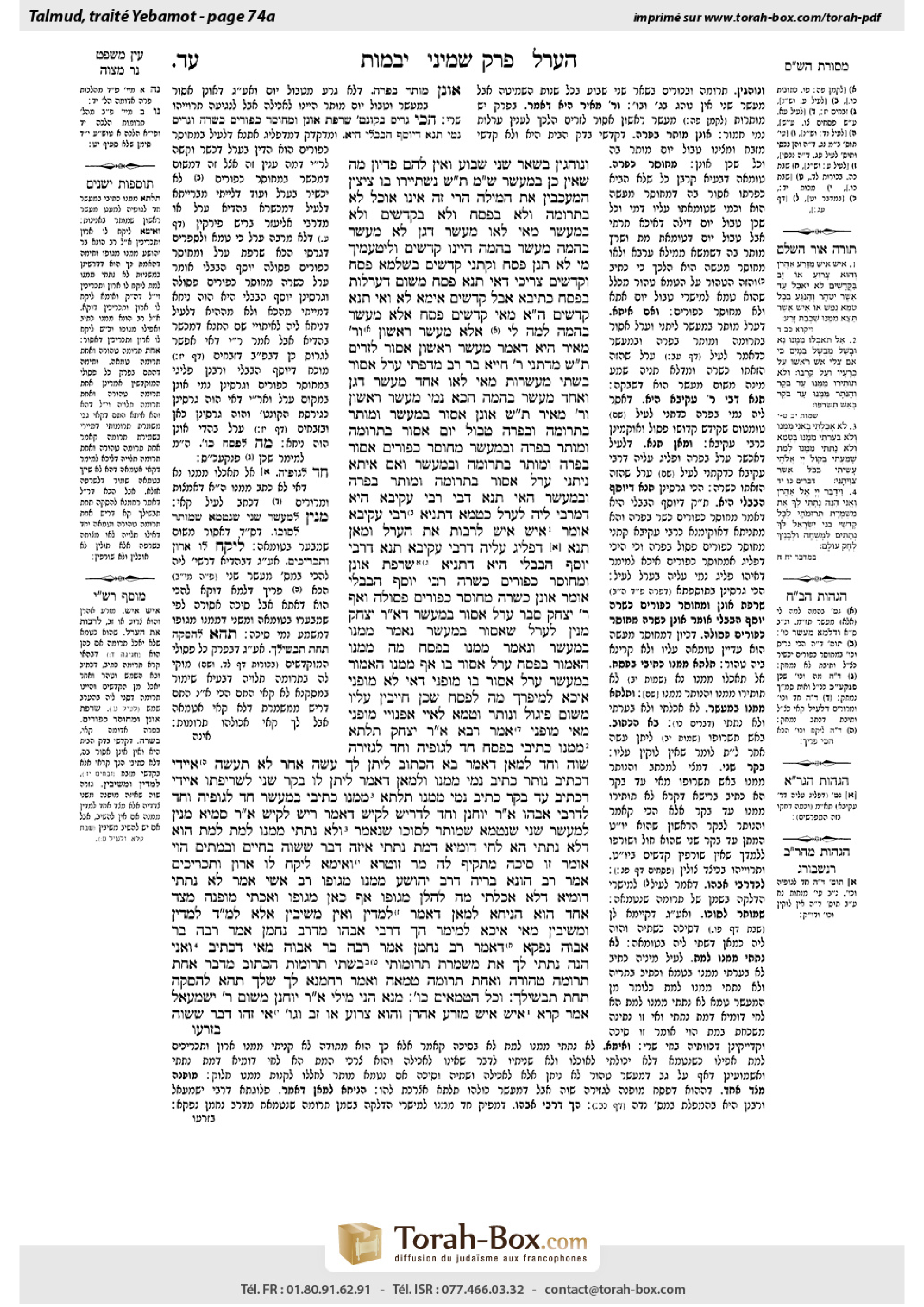
Yevamot 74a: Talmud study for Daf Yomi
Daf Yomi is the daily study of one Talmud folio. Explore 37 tractates with scans, Hebrew text, Sefaria English and AI-generated French translations where annotated.
Passage selection and English or AI-generated French translation are available where the scan has annotations. Daf Study is independent of Torah-Box and Sefaria.
Browse Yevamot · יבמות · All tractatesYevamot 74a text and translations
This page of Yevamot includes the Aramaic text, an English translation and an AI-generated French translation, alongside the scan above.
יבמות ע״ד א · Aramaic and Hebrew text
וְנוֹהֲגִין בִּשְׁאָר שְׁנֵי שָׁבוּעַ, וְאֵין לָהֶם פִּדְיוֹן. מַה שֶּׁאֵין כֵּן בַּמַּעֲשֵׂר. שְׁמַע מִינַּהּ.
תָּא שְׁמַע: נִשְׁתַּיְּירוּ בּוֹ צִיצִין הַמְעַכְּבִין אֶת הַמִּילָה — הֲרֵי זֶה אֵינוֹ אוֹכֵל לֹא בַּתְּרוּמָה, וְלֹא בַּפֶּסַח, וְלֹא בַּקֳּדָשִׁים, וְלֹא בַּמַּעֲשֵׂר. מַאי לָאו מַעְשַׂר דָּגָן, לָא — מַעְשַׂר בְּהֵמָה.
מַעְשַׂר בְּהֵמָה הַיְינוּ קָדָשִׁים? וְלִיטַעְמָיךְ, מִי לָא תְּנַן פֶּסַח וְקָתָנֵי קָדָשִׁים!
בִּשְׁלָמָא פֶּסַח וְקָדָשִׁים צְרִיכִי, דְּאִי תְּנָא פֶּסַח — מִשּׁוּם דַּעֲרֵלוּת בְּפֶסַח כְּתִיבָא, אֲבָל קָדָשִׁים — אֵימָא לָא. וְאִי תְּנָא קָדָשִׁים, הֲוָה אָמֵינָא: מַאי קָדָשִׁים — פֶּסַח. אֶלָּא מַעְשַׂר בְּהֵמָה לְמָה לִי?
אֶלָּא מַעֲשֵׂר רִאשׁוֹן, וְרַבִּי מֵאִיר הִיא, דְּאָמַר: מַעֲשֵׂר רִאשׁוֹן אָסוּר לְזָרִים.
תָּא שְׁמַע, מִדְּתָנֵי רַבִּי חִיָּיא בַּר רַב מִדִּפְתִּי: עָרֵל אָסוּר בִּשְׁתֵּי מַעַשְׂרוֹת. מַאי לָאו: אֶחָד מַעְשַׂר דָּגָן וְאֶחָד מַעְשַׂר בְּהֵמָה! הָכָא נָמֵי, מַעֲשֵׂר רִאשׁוֹן וְרַבִּי מֵאִיר.
תָּא שְׁמַע: אוֹנֵן — אָסוּר בַּמַּעֲשֵׂר, וּמוּתָּר בַּתְּרוּמָה וּבַפָּרָה. טְבוּל יוֹם — אָסוּר בִּתְרוּמָה, וּמוּתָּר בַּפָּרָה וּבַמַּעֲשֵׂר. מְחוּסַּר כִּפּוּרִים — אָסוּר בַּפָּרָה, וּמוּתָּר בַּתְּרוּמָה וּבַמַּעֲשֵׂר. וְאִם אִיתָא — נִיתְנֵי: עָרֵל אָסוּר בַּתְּרוּמָה, וּמוּתָּר בַּפָּרָה וּבַמַּעֲשֵׂר!
הַאי תַּנָּא — דְּבֵי רַבִּי עֲקִיבָא הִיא, דִּמְרַבֵּי לֵיהּ לְעָרֵל כְּטָמֵא. דְּתַנְיָא, רַבִּי עֲקִיבָא אוֹמֵר: ״אִישׁ אִישׁ״ — לְרַבּוֹת אֶת הֶעָרֵל.
וּמַאן תַּנָּא דִּפְלִיג עֲלֵיהּ דְּרַבִּי עֲקִיבָא תַּנָּא דְּ(רַבִּי) יוֹסֵף הַבַּבְלִי הִיא. דְּתַנְיָא: שְׂרֵפַת אוֹנֵן וּמְחוּסַּר כִּפּוּרִים — כְּשֵׁרָה. (רַבִּי) יוֹסֵף הַבַּבְלִי אוֹמֵר: אוֹנֵן — כְּשֵׁרָה, מְחוּסַּר כִּפּוּרִים — פְּסוּלָה.
וְאַף רַבִּי יִצְחָק סָבַר עָרֵל אָסוּר בְּמַעֲשֵׂר, דְּאָמַר רַבִּי יִצְחָק: מִנַּיִן לֶעָרֵל שֶׁאָסוּר בַּמַּעֲשֵׂר — נֶאֱמַר ״מִמֶּנּוּ״ בַּמַּעֲשֵׂר, וְנֶאֱמַר ״מִמֶּנּוּ״ בַּפֶּסַח. מָה ״מִמֶּנּוּ״ הָאָמוּר בַּפֶּסַח — עָרֵל אָסוּר בּוֹ, אַף ״מִמֶּנּוּ״ הָאָמוּר בַּמַּעֲשֵׂר — עָרֵל אָסוּר בּוֹ.
מוּפְנֵי. דְּאִי לָא מוּפְנֵי, אִיכָּא לְמִיפְרַךְ: מָה לְפֶסַח, שֶׁכֵּן חַיָּיבִין עָלָיו מִשּׁוּם פִּיגּוּל וְנוֹתָר וְטָמֵא. לָאיֵי אַפְנוֹיֵי מוּפְנֵי.
מַאי מוּפְנֵי? אָמַר רָבָא אָמַר רַבִּי יִצְחָק: תְּלָתָא ״מִמֶּנּוּ״ כְּתִיבִי בְּפֶסַח: חַד לְגוּפֵיהּ, וְחַד לִגְזֵירָה שָׁוָה, וְחַד —
לְמַאן דְּאָמַר: בָּא הַכָּתוּב לִיתֵּן לְךָ עֲשֵׂה אַחַר לֹא תַעֲשֶׂה — אַיְּידֵי דִּכְתִיב ״נוֹתָר״, כְּתִיב נָמֵי ״מִמֶּנּוּ״. וּלְמַאן דְּאָמַר לִיתֵּן לוֹ בֹּקֶר שֵׁנִי לִשְׂרֵיפָתוֹ — אַיְּידֵי דִּכְתִיב ״עַד בֹּקֶר״, כְּתִיב נָמֵי ״מִמֶּנּוּ״.
תְּלָתָא ״מִמֶּנּוּ״ כְּתִיבִי בְּמַעֲשֵׂר: חַד לְגוּפֵיהּ, וְחַד לִדְרַבִּי אֲבָהוּ אָמַר רַבִּי יוֹחָנָן, וְחַד לִדְרֵישׁ לָקִישׁ.
דְּאָמַר רֵישׁ לָקִישׁ אָמַר רַבִּי סִימַאי: מִנַּיִן לְמַעֲשֵׂר שֵׁנִי שֶׁנִּטְמָא שֶׁמּוּתָּר לְסוּכוֹ — שֶׁנֶּאֱמַר: ״וְלֹא נָתַתִּי מִמֶּנּוּ לְמֵת״. לְמֵת הוּא דְּלֹא נָתַתִּי, הָא לְחַי דֻּומְיָא דְמֵת — נָתַתִּי. אֵיזֶהוּ דָּבָר שֶׁשָּׁוֶה בַּחַיִּים וּבַמֵּתִים? הֱוֵי אוֹמֵר זוֹ סִיכָה.
מַתְקֵיף לַהּ מָר זוּטְרָא: וְאֵימָא לִיקַּח לוֹ אָרוֹן וְתַכְרִיכִים? אָמַר רַב הוּנָא בְּרֵיהּ דְּרַב יְהוֹשֻׁעַ: ״מִמֶּנּוּ״ — מִגּוּפוֹ. רַב אָשֵׁי אָמַר: ״לָא נָתַתִּי״ דֻּומְיָא דְּ״לֹא אָכַלְתִּי״: מָה לְהַלָּן מִגּוּפוֹ — אַף כָּאן מִגּוּפוֹ.
וְאַכַּתִּי מוּפְנֶה מִצַּד אֶחָד הוּא. הָנִיחָא לְמַאן דְּאָמַר לְמֵדִין וְאֵין מְשִׁיבִין. אֶלָּא לְמַאן דְּאָמַר לְמֵדִין וּמְשִׁיבִין, מַאי אִיכָּא לְמֵימַר?
הָךְ דְּרַבִּי אֲבָהוּ — מִדְּרַב נַחְמָן אָמַר רַבָּה בַּר אֲבוּהּ נָפְקָא. דְּאָמַר רַב נַחְמָן אָמַר רַבָּה בַּר אֲבוּהּ: מַאי דִּכְתִיב: ״וַאֲנִי הִנֵּה נָתַתִּי לְךָ אֶת מִשְׁמֶרֶת תְּרוּמֹתָי״ — בִּשְׁתֵּי תְרוּמוֹת הַכָּתוּב מְדַבֵּר: אַחַת תְּרוּמָה טְהוֹרָה, וְאַחַת תְּרוּמָה טְמֵאָה. וְאָמַר רַחֲמָנָא: ״לְךָ״ — שֶׁלְּךָ תְּהֵא, לְהַסָּקָה תַּחַת תַּבְשִׁילְךָ.
וְכׇל הַטְּמֵאִים כּוּ׳. מְנָא הָנֵי מִילֵּי? אָמַר רַבִּי יוֹחָנָן מִשּׁוּם רַבִּי יִשְׁמָעֵאל, אָמַר קְרָא: ״אִישׁ אִישׁ מִזֶּרַע אַהֲרֹן וְהוּא צָרוּעַ אוֹ זָב וְגוֹ׳״. אֵי זֶהוּ דָּבָר שֶׁשָּׁוֶה
Yevamot 74a · English translation
Teruma and first fruits apply in all the years of the seven-year Sabbatical cycle, including the third and the sixth years, and they do not have the possibility of redemption, as once they are sanctified they may not be redeemed and rendered non-sacred. This is not the case with regard to second tithe, which applies only in the first, second, fourth, and fifth years of the cycle and which can be redeemed. The Gemara concludes: Learn from here that the tanna did not list all of the differences between second tithe and teruma.
The Gemara resumes its discussion of whether or not an uncircumcised man is prohibited from eating second tithe. Come and hear a proof with regard to this question from the following baraita: If shreds of flesh that invalidate the circumcision remain after the foreskin was removed, one may not eat teruma, nor the Paschal lamb, nor sacrificial food, nor tithe. What, is it not referring to tithe of produce, and so the dilemma is resolved? The Gemara refutes this suggestion: No, the tithe mentioned in this baraita is animal tithe. The baraita teaches that the meat of the animal tithe was forbidden to one who is uncircumcised.
The Gemara expresses surprise: Animal tithe is the same as sacrificial food, as it too is an offering the meat of which is eaten by the animal’s owner; why would the tanna single it out? The Gemara counters: And according to your reasoning that the baraita would not have singled out specific offerings, didn’t we learn in the baraita that an uncircumcised man may not eat the Paschal lamb, and yet it also teaches that the same halakha applies to sacrificial food?
The Gemara rejects this argument: Granted, it is necessary to mention both the Paschal lamb and sacrificial food. As, if the baraita had taught only the halakha in the case of the Paschal lamb, one might have said that an uncircumcised man may not eat the Paschal lamb because the disqualification resulting from lack of circumcision is written explicitly with regard to the Paschal lamb, but with regard to other sacrificial food, concerning which the Bible says nothing about circumcision, one might say that there is no such prohibition. And conversely, if the baraita had taught only the halakha with respect to sacrificial food, I would say: What is meant here by sacrificial food? This is referring specifically to the Paschal lamb, concerning which the prohibition with regard to an uncircumcised man is stated explicitly, but other sacrificial food is permitted to him. But why do I need animal tithe to be mentioned at all? It is no different than any other sacrificial food. In that case, the tithe mentioned in the baraita is referring to second tithe.
The Gemara suggests a different refutation of this proof: Rather, the tithe mentioned in the baraita is referring to first tithe, the one-tenth of the produce that is given to the Levites, and the baraita is in accordance with the opinion of Rabbi Meir, who said that first tithe is forbidden to common Israelites. Since first tithe is forbidden to an ordinary Israelite, it may similarly be forbidden to an uncircumcised man. However, there is no proof from here that second tithe is forbidden to one who is uncircumcised, as second tithe is permitted even to ordinary Israelites.
The Gemara suggests: Come and hear a different proof from that which Rabbi Ḥiyya bar Rav of Difti taught in the following baraita: An uncircumcised man is prohibited from eating of two different tithes. What, is it not that one is the tithe of produce and one is animal tithe? The Gemara refutes this argument: Here, too, the baraita is referring to first tithe, and the baraita is in accordance with the opinion of Rabbi Meir.
Come and hear a proof from yet another baraita: It is prohibited for an acute mourner to eat second tithe, but it is permitted for him to eat teruma and to participate in the preparation of the red heifer. It is prohibited for one who immersed himself that day but does not become completely purified until nightfall to eat teruma, but it is permitted for him to participate in the preparation of the red heifer and to eat second tithe. It is prohibited for one who lacks atonement, e.g., a zav or leper who immersed at the conclusion of his period of impurity but has not yet brought an offering for his atonement, to participate in the preparation of the red heifer, but it is permitted for him to eat teruma and second tithe. And if it is so that an uncircumcised man may eat second tithe, let the baraita also teach: It is prohibited for an uncircumcised man to eat teruma, but it is permitted for him to participate in the preparation of the red heifer and to eat second tithe. The fact that the baraita omits this ruling proves that an uncircumcised man is in fact prohibited from eating second tithe.
The Gemara rejects this argument: No proof can be adduced from here, as this baraita was taught by a tanna from the school of Rabbi Akiva, who includes an uncircumcised man in the same halakha as that which governs one who is ritually impure. As it is taught in a baraita, Rabbi Akiva says: The words “any man” in the verse “Any man from the seed of Aaron who is a leper or a zav shall not eat of the holy things until he be pure” (Leviticus 22:4) come to include one who is uncircumcised; he, too, is prohibited from partaking of consecrated food or participating in the preparation of the red heifer.
With regard to the issue itself, the Gemara inquires: And who is the tanna who disagrees with Rabbi Akiva? It is the tanna who disagrees with Rabbi Yosef the Babylonian. As it is taught in a baraita: The burning of the red heifer by an acute mourner or by one who lacks atonement is valid. Rabbi Yosef the Babylonian says: If the burning is performed by an acute mourner, it is valid; but if it is performed by one who lacks atonement, it is invalid. The anonymous first tanna clearly disagrees with Rabbi Akiva, as the previous baraita, which was attributed to Rabbi Akiva, states that one who lacks atonement is prohibited from participating in the preparation of the red heifer. It may be presumed that this tanna disagrees with Rabbi Akiva with respect to one who is uncircumcised as well.
The Gemara further comments on this issue. And Rabbi Yitzḥak, too, maintains that an uncircumcised man is prohibited from eating second tithe, as Rabbi Yitzḥak said: From where is it derived that an uncircumcised man is prohibited from eating second tithe? It is stated: “And I did not consume of it while impure” (Deuteronomy 26:14) with regard to second tithe, and it is stated: “Do not eat of it raw” (Exodus 12:9) with regard to the Paschal lamb. Just as in the case of the Paschal lamb, with regard to which “of it” is stated, an uncircumcised man is prohibited from eating it, so too, in the case of second tithe, with regard to which “of it” is stated, an uncircumcised man is prohibited from eating it.
With regard to this verbal analogy, the Gemara comments: It must be that this phrase “of it” is available, i.e., it is superfluous in its own context and therefore available for the purpose of establishing a verbal analogy. As, if it is not available, the verbal analogy can be refuted logically, as it is possible to say: What is unique to the Paschal lamb? It is that one is liable to receive karet for eating it due to it being piggul or notar, or due to him being ritually impure. It could therefore be argued that it is owing to the Paschal lamb’s special sanctity and severity that an uncircumcised man may not partake of it. But from where is it derived that an uncircumcised man may not eat second tithe? The Gemara concludes: This is not so, as the phrase “of it” is indeed available for establishing the verbal analogy.
The Gemara asks: Which of the phrases “of it” is not needed in its own context and is therefore available for establishing a verbal analogy? Rava said that Rabbi Yitzḥak said: “Of it” is written three times with regard to the Paschal lamb: “Do not eat of it raw… And you shall not leave any of it until morning, and that which remains of it until the morning you shall burn with fire” (Exodus 12:9–10). The three instances of “of it” are expounded as follows: One for itself, to teach that the prohibition relates to the Paschal lamb; and one for the verbal analogy; and one for another purpose.
According to the one who says that the verse comes to provide you with a positive mitzva to burn that which is left over after it has taught the prohibition against leaving it over until the morning, to teach that one is not flogged for violating the prohibition, because any prohibition that can be rectified by the performance of a positive mitzva does not carry a punishment of lashes; since “that which remains [notar]” is written, “of it” is also written. And according to the one who says that the verse comes to provide him with the second morning for burning, i.e., to teach that the leftover meat of the Paschal lamb is not burned on the following morning, which is a Festival, but rather on the following morning, the first of the intermediate days of the Festival; since “until morning” is written, “of it” is also written.
Similarly, “of it” is written three times with regard to second tithe: “I did not eat of it in my mourning, and I did not consume of it while impure, and I did not give of it for the dead” (Deuteronomy 26:14). The three instances of “of it” are expounded as follows: One for itself; and one for that which Rabbi Abbahu said that Rabbi Yoḥanan said, that the verse comes to permit a priest to burn impure teruma oil and derive benefit from its light; and one for the following teaching of Reish Lakish.
As Reish Lakish said that Rabbi Samya said: From where is it derived that if the second tithe became ritually impure, it is permitted for one to anoint one’s body with it? As it is stated: “Nor did I give of it for the dead.” It is for the dead that I did not give of it, but for the living in a manner similar to the way it is given for the dead, I gave of it. Now, what usage of tithe is the same for the living and the dead? You must say it is anointing.
Mar Zutra strongly objects to this: But say that the verse is referring not to anointing but to purchasing a coffin and shrouds for one who is deceased with money received in exchange for the second tithe; this is prohibited, but buying clothing and the like for one who is living is permitted. Rav Huna, son of Rav Yehoshua, said: “Of it” indicates benefit derived from the tithe itself and not from the money acquired in exchange for the tithe. Rav Ashi said a different answer: “I did not give” must be similar to “I did not eat”; just as there, eating is from the tithe itself, so too here, giving is from the tithe itself. In any event, the three instances of “of it” written with regard to second tithe are required for different expositions.
The Gemara asks: And yet there is still a difficulty, as the verbal analogy is available only from one side, since only the verse with regard to the Paschal lamb is superfluous in its own context. Granted, this works out well according to the one who says that one can derive from a verbal analogy that is available only from one side and one cannot refute it logically, even if there are valid counterarguments. But according to the one who said that one can derive from such an analogy and one can also refute it logically, if there are grounds to distinguish between the two cases, what can be said? As explained above, the analogy between the Paschal lamb and second tithe can be refuted.
The Gemara answers: This halakha of Rabbi Abbahu with regard to the burning of impure teruma oil is derived from what Rav Naḥman said that Rabba bar Avuh said. As Rav Naḥman said that Rabba bar Avuh said: What is the meaning of that which is written: “And I, behold, I have given you the charge of My terumot” (Numbers 18:8)? From the amplification of the plural “My terumot,” it is derived that the verse is speaking of two terumot, one teruma that is ritually pure and one teruma that is ritually impure. And the Merciful One states: “I have given you,” i.e., it shall be yours, and you may derive benefit from it. Since there is a stringent prohibition against eating impure teruma, the benefit that is permitted is to burn it beneath your cooked dish. As the allowance to benefit from the burning of impure teruma is derived from here, the phrase “of it” is available on both sides.
§ It is taught in the mishna that all those who are ritually impure with any type of ritual impurity may not eat teruma. The Gemara asks: From where are these matters derived? Rabbi Yoḥanan said in the name of Rabbi Yishmael: The verse states: “Any man from the seed of Aaron who is a leper or a zav shall not eat of the holy things until he be pure” (Leviticus 22:4). Now, what matter is the same
Yevamot 74a · Traduction française (IA)
La terouma et les prémices s’appliquent pendant toutes les années du cycle sabbatique de sept ans, y compris les troisième et sixième années, et ne peuvent pas être rachetées : une fois sanctifiées, elles ne peuvent être rachetées pour redevenir profanes. Il n’en va pas de même pour la seconde dîme, qui s’applique seulement pendant les première, deuxième, quatrième et cinquième années du cycle et qui peut être rachetée. La Guemara conclut : Apprends de là que le tanna n’a pas énuméré toutes les différences entre la seconde dîme et la terouma.
La Guemara reprend la discussion sur la question de savoir si un homme incirconcis a ou non l’interdiction de manger la seconde dîme. Viens et entends une preuve à ce sujet tirée de la baraïta suivante : Si des lambeaux de chair qui invalident la circoncision subsistent après le retrait du prépuce, on ne peut manger ni de la terouma, ni de l’agneau pascal, ni des aliments consacrés, ni de la dîme. Ne s’agit-il pas de la dîme des produits agricoles, de sorte que le doute soit tranché ? La Guemara réfute cette suggestion : Non, la dîme mentionnée dans cette baraïta est la dîme animale. La baraïta enseigne que la viande de l’animal soumis à la dîme animale est interdite à celui qui est incirconcis.
La Guemara s’étonne : La dîme animale revient au même que les aliments consacrés, puisqu’elle aussi est une offrande dont le propriétaire mange la viande ; pourquoi le tanna la mentionnerait-il à part ? La Guemara objecte : Et selon ton raisonnement, d’après lequel la baraïta n’aurait pas mentionné séparément certaines offrandes, n’avons-nous pas appris dans la baraïta qu’un homme incirconcis ne peut manger l’agneau pascal, alors qu’elle enseigne aussi que la même halakha s’applique aux aliments consacrés ?
La Guemara rejette cet argument : Certes, il est nécessaire de mentionner à la fois l’agneau pascal et les aliments consacrés. En effet, si la baraïta avait enseigné uniquement la halakha concernant l’agneau pascal, on aurait pu dire qu’un homme incirconcis ne peut manger l’agneau pascal parce que la disqualification due à l’absence de circoncision est explicitement mentionnée à son sujet ; mais, concernant les autres aliments consacrés, à propos desquels la Bible ne dit rien sur la circoncision, on aurait pu dire qu’une telle interdiction n’existe pas. À l’inverse, si la baraïta avait enseigné uniquement la halakha concernant les aliments consacrés, j’aurais dit : Que désigne ici l’expression « aliments consacrés » ? Elle désigne précisément l’agneau pascal, au sujet duquel l’interdiction visant l’homme incirconcis est explicitement énoncée, tandis que les autres aliments consacrés lui sont permis. Mais pourquoi faudrait-il mentionner la dîme animale ? Elle ne diffère pas des autres aliments consacrés. Dans ce cas, la dîme mentionnée dans la baraïta désigne la seconde dîme.
La Guemara propose une autre réfutation de cette preuve : La dîme mentionnée dans la baraïta désigne plutôt la première dîme, le dixième des produits agricoles donné aux Lévites, et la baraïta suit l’opinion de Rabbi Meir, qui dit que la première dîme est interdite aux Israélites ordinaires. Puisque la première dîme est interdite à un Israélite ordinaire, elle peut également être interdite à un homme incirconcis. Toutefois, cela ne prouve pas que la seconde dîme est interdite à celui qui est incirconcis, puisque la seconde dîme est permise même aux Israélites ordinaires.
Viens et entends une autre preuve, tirée de l’enseignement suivant de Rabbi Ḥiyya bar Rav de Difti dans une baraïta : Un homme incirconcis a l’interdiction de manger deux dîmes différentes. Ne s’agit-il pas, d’une part, de la dîme des produits agricoles et, d’autre part, de la dîme animale ? La Guemara réfute cet argument : Ici aussi, la baraïta parle de la première dîme et suit l’opinion de Rabbi Meir.
Viens et entends une preuve tirée d’une autre baraïta : Il est interdit à une personne en deuil le jour de la mort de son proche de manger la seconde dîme, mais elle peut manger de la terouma et participer à la préparation de la vache rousse. Il est interdit à celui qui s’est immergé ce jour-là, mais ne sera complètement purifié qu’à la tombée de la nuit, de manger de la terouma, mais il peut participer à la préparation de la vache rousse et manger la seconde dîme. Il est interdit à celui qui doit encore obtenir l’expiation, par exemple un zav ou un lépreux qui s’est immergé à la fin de sa période d’impureté mais n’a pas encore apporté d’offrande pour son expiation, de participer à la préparation de la vache rousse ; toutefois, il peut manger de la terouma et de la seconde dîme. Or, si un homme incirconcis peut manger la seconde dîme, que la baraïta enseigne également : Il est interdit à un homme incirconcis de manger de la terouma, mais il peut participer à la préparation de la vache rousse et manger la seconde dîme. Le fait que la baraïta omette cette règle prouve qu’un homme incirconcis a bien l’interdiction de manger la seconde dîme.
La Guemara rejette cet argument : On ne peut tirer aucune preuve de là, car cette baraïta a été enseignée par un tanna de l’école de Rabbi Akiva, qui assimile l’homme incirconcis à celui qui est rituellement impur. En effet, il est enseigné dans une baraïta que Rabbi Akiva dit : Les mots « tout homme » dans le verset « Tout homme de la descendance d’Aaron qui est lépreux ou zav ne mangera pas des choses saintes avant d’être purifié » (Lévitique 22:4) viennent inclure celui qui est incirconcis ; lui aussi a l’interdiction de consommer des aliments consacrés ou de participer à la préparation de la vache rousse.
À propos de cette question, la Guemara demande : Et qui est le tanna en désaccord avec Rabbi Akiva ? C’est le tanna en désaccord avec Rabbi Yosef le Babylonien. En effet, il est enseigné dans une baraïta : La combustion de la vache rousse par une personne en deuil le jour de la mort de son proche ou par quelqu’un qui doit encore obtenir l’expiation est valide. Rabbi Yosef le Babylonien dit : Si la combustion est effectuée par une personne en deuil le jour de la mort de son proche, elle est valide ; mais si elle est effectuée par quelqu’un qui doit encore obtenir l’expiation, elle est invalide. Le premier tanna, anonyme, est clairement en désaccord avec Rabbi Akiva, puisque la baraïta précédente, attribuée à Rabbi Akiva, dit que celui qui doit encore obtenir l’expiation a l’interdiction de participer à la préparation de la vache rousse. On peut supposer que ce tanna est également en désaccord avec Rabbi Akiva au sujet de celui qui est incirconcis.
La Guemara fait encore un commentaire à ce sujet. Rabbi Yitzḥak soutient lui aussi qu’un homme incirconcis a l’interdiction de manger la seconde dîme, car Rabbi Yitzḥak a dit : D’où apprend-on qu’un homme incirconcis a l’interdiction de manger la seconde dîme ? Il est dit, au sujet de la seconde dîme : « Je n’en ai pas consommé étant impur » (Deutéronome 26:14), et il est dit, au sujet de l’agneau pascal : « N’en mangez pas cru » (Exode 12:9). De même que, dans le cas de l’agneau pascal, au sujet duquel l’expression « de cela » est employée, un homme incirconcis a l’interdiction d’en manger, de même, dans le cas de la seconde dîme, au sujet de laquelle l’expression « de cela » est employée, un homme incirconcis a l’interdiction d’en manger.
À propos de cette analogie verbale, la Guemara fait remarquer que l’expression « de cela » doit être disponible, c’est-à-dire superflue dans son contexte propre et donc utilisable pour établir une analogie verbale. En effet, si elle n’était pas disponible, on pourrait réfuter logiquement l’analogie verbale en disant : Qu’est-ce qui distingue l’agneau pascal ? Celui qui en mange est passible de retranchement s’il le mange alors qu’il est piggul ou notar, ou alors qu’il est rituellement impur. On pourrait donc soutenir que c’est en raison de la sainteté et de la gravité particulières de l’agneau pascal qu’un homme incirconcis ne peut en manger. Mais d’où apprend-on qu’un homme incirconcis ne peut manger la seconde dîme ? La Guemara conclut : Il n’en est pas ainsi, car l’expression « de cela » est effectivement disponible pour établir l’analogie verbale.
La Guemara demande : Laquelle des expressions « de cela » n’est pas nécessaire dans son contexte propre et est donc disponible pour établir une analogie verbale ? Rava a dit au nom de Rabbi Yitzḥak : L’expression « de cela » apparaît trois fois au sujet de l’agneau pascal : « N’en mangez pas cru… Et vous n’en laisserez rien jusqu’au matin, et ce qui en restera jusqu’au matin, vous le brûlerez au feu » (Exode 12:9-10). Les trois occurrences de « de cela » sont interprétées ainsi : l’une pour elle-même, afin d’enseigner que l’interdiction porte sur l’agneau pascal ; l’une pour l’analogie verbale ; et l’une à une autre fin.
Selon celui qui dit que le verset vient prescrire une mitsva positive de brûler ce qui reste, après avoir enseigné l’interdiction de laisser ce reste jusqu’au matin, il enseigne que l’on ne reçoit pas de coups de fouet pour avoir transgressé cette interdiction, car une interdiction à laquelle on peut remédier en accomplissant une mitsva positive n’entraîne pas de châtiment de coups de fouet ; puisque le mot « reste [notar] » est écrit, l’expression « de cela » est également écrite. Et selon celui qui dit que le verset vient fournir un second matin pour la combustion, c’est-à-dire enseigner que la viande restante de l’agneau pascal n’est pas brûlée le lendemain matin, qui est un jour de fête, mais le matin suivant, premier des jours intermédiaires de la fête ; puisque l’expression « jusqu’au matin » est écrite, l’expression « de cela » est également écrite.
De même, l’expression « de cela » apparaît trois fois au sujet de la seconde dîme : « Je n’en ai pas mangé dans mon deuil, je n’en ai pas consommé étant impur et je n’en ai pas donné pour le mort » (Deutéronome 26:14). Les trois occurrences de « de cela » sont interprétées ainsi : l’une pour elle-même ; l’une pour ce que Rabbi Abbahu a dit au nom de Rabbi Yoḥanan, à savoir que le verset vient permettre à un prêtre de brûler de l’huile de terouma impure et de tirer profit de sa lumière ; et l’une pour l’enseignement suivant de Reish Lakish.
Car Reish Lakish a dit au nom de Rabbi Samya : D’où apprend-on que, si la seconde dîme est devenue rituellement impure, il est permis de s’en oindre le corps ? Car il est dit : « Je n’en ai pas donné pour le mort. » C’est pour le mort que je n’en ai pas donné, mais j’en ai donné pour le vivant d’une manière semblable à celle dont on en donne pour le mort. Or, quel usage de la dîme est le même pour les vivants et les morts ? Il faut dire qu’il s’agit de l’onction.
Mar Zutra objecte vivement : Mais on pourrait dire que le verset parle non pas de l’onction, mais de l’achat d’un cercueil et de linceuls pour un défunt avec l’argent obtenu en échange de la seconde dîme ; cela est interdit, mais acheter des vêtements et autres choses semblables pour un vivant est permis. Rav Huna, fils de Rav Yehoshua, a dit : L’expression « de cela » indique un bénéfice tiré de la dîme elle-même, et non de l’argent obtenu en échange de la dîme. Rav Ashi a donné une autre réponse : « Je n’ai pas donné » doit être semblable à « Je n’ai pas mangé » ; de même que, dans ce dernier cas, on mange de la dîme elle-même, de même, ici, on donne la dîme elle-même. Quoi qu’il en soit, les trois occurrences de l’expression « de cela » écrites au sujet de la seconde dîme sont nécessaires pour différentes interprétations.
La Guemara demande : Pourtant, une difficulté subsiste, car l’analogie verbale n’est disponible que d’un côté, puisque seul le verset concernant l’agneau pascal est superflu dans son contexte propre. Certes, cela fonctionne bien selon celui qui dit qu’on peut déduire une halakha à l’aide d’une analogie verbale disponible d’un seul côté et qu’on ne peut pas la réfuter logiquement, même s’il existe des contre-arguments valables. Mais que peut-on répondre selon celui qui dit qu’on peut déduire une halakha à l’aide d’une telle analogie et qu’on peut aussi la réfuter logiquement s’il existe des raisons de distinguer les deux cas ? Comme cela a été expliqué plus haut, l’analogie entre l’agneau pascal et la seconde dîme peut être réfutée.
La Guemara répond : Cette halakha de Rabbi Abbahu concernant la combustion de l’huile de terouma impure est déduite de ce que Rav Naḥman a dit au nom de Rabba bar Avuh. En effet, Rav Naḥman a dit au nom de Rabba bar Avuh : Que signifie ce qui est écrit : « Et moi, voici que je vous ai donné la charge de mes teroumot » (Nombres 18:8) ? La forme plurielle « mes teroumot » indique que le verset parle de deux teroumot, l’une rituellement pure et l’autre rituellement impure. Et le Miséricordieux dit : « Je vous ai donné », c’est-à-dire qu’elle vous appartient et que vous pouvez en tirer profit. Puisqu’il existe une interdiction stricte de manger de la terouma impure, le bénéfice permis consiste à la brûler sous le plat que vous faites cuire. Puisque l’autorisation de tirer profit de la combustion de la terouma impure est déduite de là, l’expression « de cela » est disponible des deux côtés.
§ Il est enseigné dans la Michna que tous ceux qui sont rituellement impurs, quelle que soit la forme de leur impureté rituelle, ont l’interdiction de manger de la terouma. La Guemara demande : D’où ces règles sont-elles déduites ? Rabbi Yoḥanan a dit au nom de Rabbi Yishmael : Le verset dit : « Tout homme de la descendance d’Aaron qui est lépreux ou zav ne mangera pas des choses saintes avant d’être purifié » (Lévitique 22:4). Or, quelle est la chose qui est la même
Traduction française générée par IA à partir de l’édition anglaise de Sefaria. Vérifie toujours un passage avec le texte source.
Text from Sefaria: William Davidson Edition - Vocalized Aramaic (CC BY NC); William Davidson Edition - English (CC BY NC).