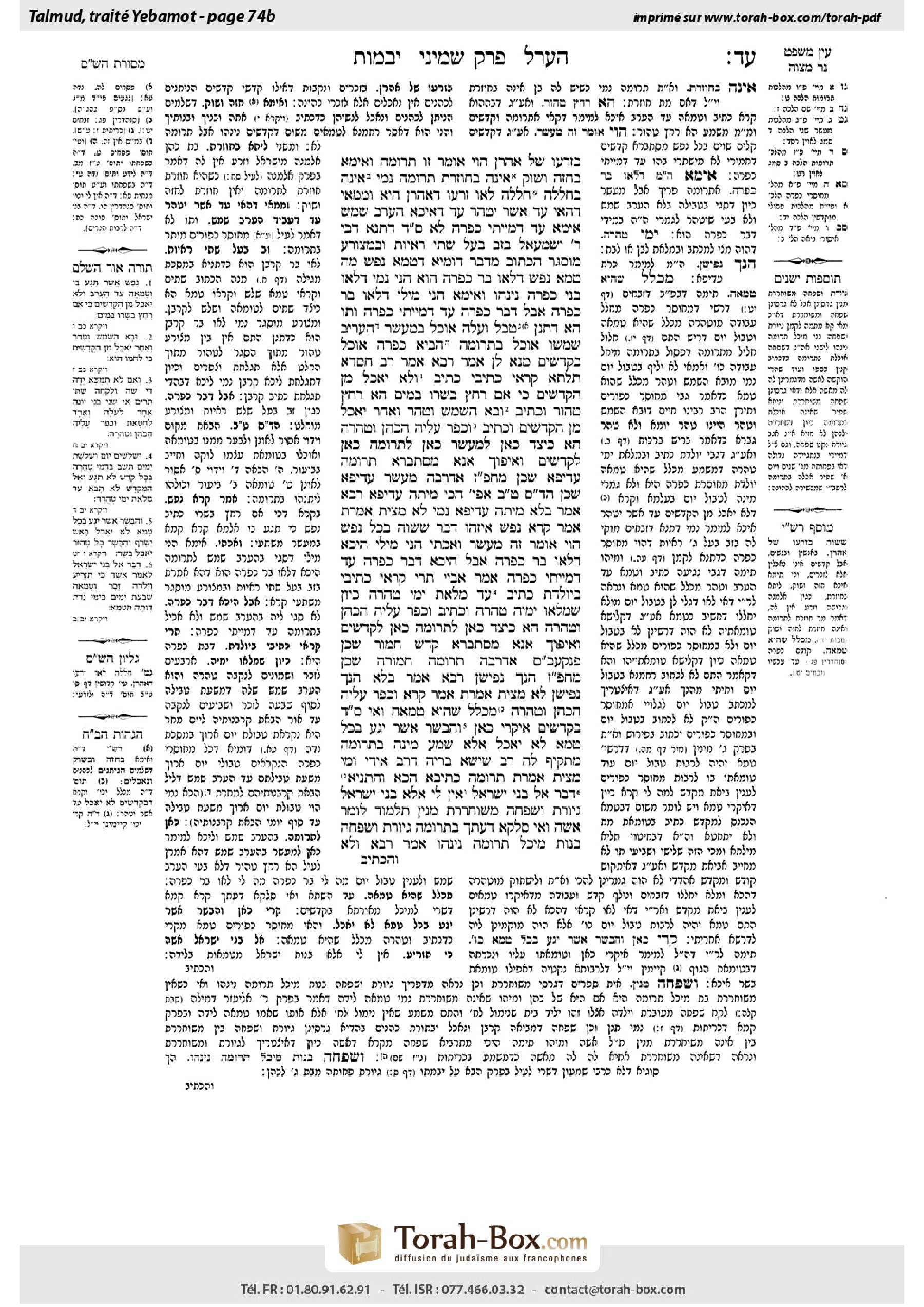
Yevamot 74b: Talmud study for Daf Yomi
Daf Yomi is the daily study of one Talmud folio. Explore 37 tractates with scans, Hebrew text, Sefaria English and AI-generated French translations where annotated.
Passage selection and English or AI-generated French translation are available where the scan has annotations. Daf Study is independent of Torah-Box and Sefaria.
Browse Yevamot · יבמות · All tractatesYevamot 74b text and translations
This page of Yevamot includes the Aramaic text, an English translation and an AI-generated French translation, alongside the scan above.
יבמות ע״ד ב · Aramaic and Hebrew text
בְּזַרְעוֹ שֶׁל אַהֲרֹן — הֱוֵי אוֹמֵר זוֹ תְּרוּמָה. וְאֵימָא בְּחָזֶה וָשׁוֹק? אֵינָהּ בְּחוֹזֶרֶת.
תְּרוּמָה נָמֵי, אֵינָהּ בַּחֲלָלָה! חֲלָלָה לָאו זַרְעוֹ דְּאַהֲרֹן הִיא.
וּמִמַּאי דְּהַאי ״עַד אֲשֶׁר יִטְהָר״, עַד דְּאִיכָּא הֶעֱרֵב שֶׁמֶשׁ, אֵימָא: עַד דְּמַיְיתֵי כַּפָּרָה?
לָא סָלְקָא דַּעְתָּךְ, דְּתָנָא דְּבֵי רַבִּי יִשְׁמָעֵאל: בְּזָב בַּעַל שְׁתֵּי רְאִיּוֹת וּבִמְצוֹרָע מוּסְגָּר הַכָּתוּב מְדַבֵּר, דּוּמְיָא דִּ״טְמֵא נֶפֶשׁ״, מָה ״טְמֵא נֶפֶשׁ״ דְּלָאו בַּר כַּפָּרָה הוּא — הָנֵי נָמֵי דְּלָאו בְּנֵי כַּפָּרָה נִינְהוּ.
וְאֵימָא, הָנֵי מִילֵּי דְּלָאו בַּר כַּפָּרָה, אֲבָל דְּבַר כַּפָּרָה, עַד דְּמַיְיתֵי כַּפָּרָה?!
וְתוּ, הָא דִּתְנַן: טָבַל וְעָלָה — אוֹכֵל בַּמַּעֲשֵׂר, הֶעֱרִיב שִׁמְשׁוֹ — אוֹכֵל בַּתְּרוּמָה, הֵבִיא כַּפָּרָה — אוֹכֵל בַּקֳּדָשִׁים, מְנָא לַן?
אָמַר רָבָא אָמַר רַב חִסְדָּא: תְּלָתָא קְרָאֵי כְּתִיבִי. כְּתִיב: ״וְלֹא יֹאכַל מִן הַקֳּדָשִׁים כִּי אִם רָחַץ בְּשָׂרוֹ בַּמָּיִם״, הָא רָחַץ — טָהוֹר. וּכְתִיב: ״וּבָא הַשֶּׁמֶשׁ וְטָהֵר וְאַחַר יֹאכַל מִן הַקֳּדָשִׁים״. וּכְתִיב: ״וְכִפֶּר עָלֶיהָ הַכֹּהֵן וְטָהֵרָה״. הָא כֵּיצַד? כָּאן לְמַעֲשֵׂר, כָּאן לִתְרוּמָה, כָּאן לְקָדָשִׁים.
וְאֵיפוֹךְ אֲנָא? מִסְתַּבְּרָא תְּרוּמָה עֲדִיפָא, שֶׁכֵּן מחפ״ז.
אַדְּרַבָּה: מֵעֶשֶׂר עֲדִיפָא, שֶׁכֵּן הֲדַ״ס טָ״ב?
אֲפִילּוּ הָכִי, מִיתָה עֲדִיפָא.
רָבָא אָמַר: בְּלָא מִיתָה עֲדִיפָא, נָמֵי לָא מָצֵית אָמְרַתְּ, אָמַר קְרָא: ״נֶפֶשׁ״, אֵיזֶהוּ דָּבָר שֶׁשָּׁוֶה בְּכׇל נֶפֶשׁ? הֱוֵי אוֹמֵר זֶה מַעֲשֵׂר.
וְאַכַּתִּי, הָנֵי מִילֵּי הֵיכָא דְּלָאו בַּר כַּפָּרָה, אֲבָל הֵיכָא דְּבַר כַּפָּרָה — עַד דְּמַיְיתֵי כַּפָּרָה!
אָמַר אַבָּיֵי: תְּרֵי קְרָאֵי כְּתִיבִי. בְּיוֹלֶדֶת כְּתִיב: ״עַד מְלֹאת יְמֵי טׇהֳרָהּ״, כֵּיוָן שֶׁמָּלְאוּ יָמֶיהָ — טָהֵרָה. וּכְתִיב: ״וְכִפֶּר עָלֶיהָ הַכֹּהֵן וְטָהֵרָה״. הָא כֵּיצַד? כָּאן לִתְרוּמָה, כָּאן לְקׇדָשִׁים.
וְאֵיפוֹךְ אֲנָא! מִסְתַּבְּרָא קֹדֶשׁ חָמוּר, שֶׁכֵּן פנקעכ״ס.
אַדְּרַבָּה תְּרוּמָה חֲמוּרָה, שֶׁכֵּן מחפ״ז? הָנָךְ נְפִישָׁן!
רָבָא אָמַר: בְּלָא הָנָךְ נְפִישָׁן לָא מָצֵית אָמְרַתְּ, אָמַר קְרָא: ״וְכִפֶּר עָלֶיהָ הַכֹּהֵן וְטָהֵרָה״, מִכְּלָל שֶׁהִיא טְמֵאָה. וְאִי סָלְקָא דַעְתָּךְ בְּקָדָשִׁים, אִיקְּרִי כָּאן: ״וְהַבָּשָׂר אֲשֶׁר יִגַּע בְּכׇל טָמֵא לֹא יֵאָכֵל״. אֶלָּא שְׁמַע מִינַּהּ בִּתְרוּמָה.
מַתְקֵיף לַהּ רַב שִׁישָׁא בְּרֵיהּ דְּרַב אִידִי: וּמִי מָצֵית אָמְרַתְּ תְּרוּמָה כְּתִיבָא הָכָא? וְהָתַנְיָא: ״דַּבֵּר אֶל בְּנֵי יִשְׂרָאֵל״, אֵין לִי אֶלָּא בְּנֵי יִשְׂרָאֵל — גִּיּוֹרֶת וְשִׁפְחָה מְשׁוּחְרֶרֶת מִנַּיִן? תַּלְמוּד לוֹמַר: ״אִשָּׁה״. וְאִי סָלְקָא דַעְתָּךְ בִּתְרוּמָה, גִּיּוֹרֶת וְשִׁפְחָה בְּנוֹת מֵיכַל תְּרוּמָה נִינְהוּ?
אָמַר רָבָא: וְלָא?
Yevamot 74b · English translation
for all the seed of Aaron, both sons and daughters? You must say it is teruma. The Gemara raises a difficulty: But say that perhaps the verse is referring to the breast and thigh of a peace-offering, which also may be eaten by all the seed of Aaron, both male and female? The Gemara answers: The breast and thigh are not permitted to males and females in equal manner, as they are not permitted to the daughter of a priest who returns to the home of her father. If the daughter of a priest marries a non-priest, it is prohibited for her to partake of teruma or sacrificial food. If she is widowed or divorced and has no living descendants by her non-priest husband, it is once again permitted for her to eat teruma, but she may not partake of the breast and thigh of the offerings.
The Gemara asks: If so, the same may be said about teruma as well, as it is not permitted to a ḥalala, a woman who is disqualified from marrying a priest, even though she is the daughter of a priest. The Gemara answers: A ḥalala is not considered the seed of Aaron.
The Gemara challenges the halakha recorded in the baraita that one who lacks atonement may eat teruma. And from where do you know that this verse: “Any man from the seed of Aaron who is a leper or a zav shall not eat of the holy things until he be pure,” means that he may not eat of the holy things until sunset? Say that perhaps it means that he may not eat of them until he brings his atonement offering and is entirely pure.
The Gemara answers: This cannot enter your mind, as a tanna of the school of Rabbi Yishmael taught that the verse is speaking of a zav who experienced only two sightings of an emission, and of a quarantined leper, i.e., a suspected leper who has not yet been declared conclusively ritually impure by a priest. Both of these individuals are ritually impure, but they need not bring an offering as part of the purification process. When understood in this way, the leper and zav are similar to one who touches any object that is impure with ritual impurity imparted by a corpse, mentioned later in the verse: Just as one who touches anything that is impure with ritual impurity imparted by a corpse does not require an atonement offering for his impurity, these too, the zav and leper referred to in this verse, do not require an atonement offering; rather, they achieve complete purification at sunset.
The Gemara raises a question: But say that this halakha that sunset alone suffices to permit the eating of teruma applies only to one who does not require an atonement offering but merely has to wait until sunset to achieve complete purification. However, with regard to one who does require an atonement offering, perhaps he may not eat teruma until he brings his atonement offering.
And furthermore, the Gemara raises a question with regard to that which we learned in a mishna (Nega’im 14:3): When the period of ritual impurity of a zav or a leper has been completed and he immersed during the day and emerged, he may immediately partake of second tithe; once the sun has set for him, he may partake of teruma; once he has brought his atonement offering, he may eat sacrificial food. From where do we derive these different halakhot?
Rava said that Rav Ḥisda said: Three verses are written with regard to purity for eating sacred food. It is written: “And he shall not eat of the holy things, unless he has bathed his flesh in water” (Leviticus 22:6); but if he has bathed, i.e., immersed, he is immediately pure and may partake of sacred food. And it is written: “And when the sun has set, he shall be pure, and afterward he may eat from the holy things” (Leviticus 22:7), which indicates that he must wait until sunset. And it is further written: “And the priest shall make atonement for her, and she shall be pure” (Leviticus 12:8), which indicates that following childbirth a woman is not completely pure until she has brought her offering. How so? How can the apparent discrepancy between these three verses be resolved? Here, in the first verse, it is referring to second tithe; there, in the second verse, it is referring to teruma; and here, in the third verse, it is referring to sacrificial food.
The Gemara asks: But I can reverse this construct and apply the more stringent condition to tithe. The Gemara answers: It is reasonable to say that teruma is subject to the more stringent condition, as it is already subject to many stringent elements represented by the acronym mem, ḥet, peh, zayin, which is a mnemonic for the following: One who is prohibited from eating teruma but ate it intentionally is liable to the punishment of death [mita] at the hand of Heaven; a non-priest who unwittingly ate teruma is obligated to pay its value to the priest plus one-fifth [ḥomesh] of the sum; teruma does not have the possibility of redemption [pidyon]; and it is prohibited to non-priests [zarim]. These stringencies do not apply to second tithe.
The Gemara counters: On the contrary, second tithe should be governed by the more stringent condition, as it has the stringencies represented by the acronym heh, dalet, samekh, tet, beit, which is a mnemonic for the following: Second tithe must be brought [hava’a] to Jerusalem; it requires that a declaration [viddui] be made on the last day of Passover in the fourth and seventh year of the Sabbatical cycle, stating that one’s agricultural obligations with regard to tithes have been properly fulfilled; it is prohibited [asur] to be eaten by one in acute mourning; it may not be burned in a state of impurity [tuma]; and it must be removed [biur] from one’s house before Passover in the fourth and seventh years of the Sabbatical cycle, if one failed to do so beforehand.
The Gemara responds: Even so, the punishment of death is a greater stringency, and therefore it is appropriate that teruma should be subject to the additional stringency of waiting until sunset.
Rava said: Even without the rationale that the punishment of death is a greater stringency, you still could not say that the first verse that speaks only of immersion is referring to teruma. As the verse states in the continuation: “The soul that touches it” (Leviticus 22:6). Now, what matter is the same for every soul? You must say it is tithe, as teruma may be eaten only by priests.
The Gemara raises a difficulty with the mishna: But still, say that this halakha that sunset alone is enough for the eating of teruma applies only to one who does not require an atonement offering but merely has to wait until sunset when he is completely purified. However, with regard to one who does require an atonement offering, such as a confirmed leper, perhaps he may not eat teruma until he brings his atonement offering.
Abaye said: Two verses are written with regard to a woman after childbirth: It is written: “She shall touch no hallowed thing, nor come into the Sanctuary, until the days of her purification are completed” (Leviticus 12:4), which suggests that once her days are completed and the sun has set on the last day, she is completely pure and requires nothing more. And elsewhere it is written: “And the priest shall make atonement for her, and she shall be pure” (Leviticus 12:8), which indicates that following childbirth a woman is not completely pure until she has brought her offerings. How so? Here, in the first verse, it is referring to teruma; there, in the second verse, it is referring to sacrificial food. A woman following childbirth falls into the category of one who lacks atonement, but nevertheless the verse teaches that if she has immersed, she may eat teruma after sunset. The same is true of a confirmed leper and all others who lack atonement.
The Gemara asks: But I can reverse this construct and apply the more stringent condition to teruma. The Gemara answers: It is reasonable to say that sacrificial food is subject to the more stringent condition, as it is already subject to many stringent elements represented by the acronym, peh, nun, kuf, ayin, kaf, samekh, which is a mnemonic for the following stringencies that apply to sacrificial food and not to teruma: An offering is disqualified by improper intention during one of the rites involved in its sacrifice with regard to the time it will be eaten [piggul]; meat of an offering that remained beyond its allotted time [notar] may not be eaten and must be burned; it is an offering [korban] to God; one who unwittingly derives benefit from sacrificial food is required to bring a guilt-offering for misuse of consecrated items [me’ila]; the punishment of one who eats sacrificial food while ritually impure is excision [karet]; sacrificial food is prohibited [asur] to an acute mourner.
The Gemara challenges this argument: On the contrary, teruma should be subject to the more stringent condition, as, with regard to teruma, there are many stringent elements represented by the acronym mem, ḥet, peh, zayin. The Gemara answers: Those stringencies that apply to sacrificial food are more numerous than those that apply to teruma.
Rava said: Even without the rationale that those stringencies that apply to sacrificial food are more numerous, you still could not say that the verse that renders a woman pure at sunset refers to sacrificial food, as the verse states: “And the priest shall make atonement for her, and she shall be pure,” which indicates by inference that she remains ritually impure to some degree until she has sacrificed her offerings. And if it enters your mind that she may eat sacrificial food immediately after sunset, you should apply here what is stated in a different verse: “And the flesh that touches anything impure shall not be eaten” (Leviticus 7:19), which indicates that one who is impure with any type of ritual impurity is prohibited from eating sacrificial food. Rather, learn from this that the verse is referring to teruma.
Rav Sheisha, son of Rav Idi, strongly objects to this argument: And how can you say that a halakha governing teruma is written here, in the verse: “Until the days of her purification are completed” (Leviticus 12:4)? Isn’t it taught in a baraita: The section dealing with a woman following childbirth opens with the verse: “Speak to the children of Israel, saying: If a woman delivers and bears a male, then she shall be unclean seven days; as in the days of the impurity of her menstrual affliction shall she be unclean” (Leviticus 12:2). From this verse I have derived only that the children of Israel are included in this halakha; from where do I derive that a convert and an emancipated maidservant are also included? Therefore, the verse states: “A woman,” which includes other women. And if it enters your mind that the verse is speaking of teruma, are a convert and a maidservant eligible to eat teruma? It is prohibited for them to marry priests, so there can be no possibility of their eating teruma.
Rava said: And is the verse not referring to teruma as well?
Yevamot 74b · Traduction française (IA)
pour toute la descendance d’Aaron, hommes et femmes ? Il faut donc dire qu’il s’agit de la terouma. La Guemara soulève une difficulté : Mais dis plutôt que le verset parle de la poitrine et de la cuisse d’un sacrifice de paix, que toute la descendance d’Aaron, hommes et femmes, peut également manger. La Guemara répond : La poitrine et la cuisse ne sont pas permises aux hommes et aux femmes dans les mêmes conditions, car la fille d’un prêtre qui retourne dans la maison de son père ne peut pas en manger. Si la fille d’un prêtre épouse un non-prêtre, il lui est interdit de consommer de la terouma ou des aliments sacrificiels. Si elle devient veuve ou est divorcée et n’a pas de descendants vivants de son mari non-prêtre, elle est de nouveau autorisée à manger de la terouma, mais elle ne peut pas consommer la poitrine et la cuisse des sacrifices.
La Guemara demande : Si c’est le cas, on peut en dire autant de la terouma, puisqu’elle n’est pas permise à une ḥalala, une femme qui n’est pas autorisée à épouser un prêtre, bien qu’elle soit la fille d’un prêtre. La Guemara répond : Une ḥalala n’est pas considérée comme faisant partie de la descendance d’Aaron.
La Guemara conteste la halakha consignée dans la baraïta, selon laquelle celui qui n’a pas encore apporté son offrande expiatoire peut manger de la terouma. D’où sais-tu que ce verset : « Tout homme de la descendance d’Aaron qui est lépreux ou zav ne mangera pas des choses saintes avant d’être pur » signifie qu’il ne peut manger des choses saintes qu’après le coucher du soleil ? Dis plutôt qu’il signifie qu’il ne peut en manger avant d’avoir apporté son offrande expiatoire et d’être entièrement pur.
La Guemara répond : Cela ne saurait te venir à l’esprit, car un tanna de l’école de Rabbi Yishmael a enseigné que le verset parle d’un zav qui n’a eu que deux écoulements, ainsi que d’un lépreux mis en quarantaine, c’est-à-dire d’une personne soupçonnée d’être lépreuse, mais que le prêtre n’a pas encore déclarée définitivement impure sur le plan rituel. Ces deux personnes sont rituellement impures, mais n’ont pas à apporter d’offrande dans le cadre de leur processus de purification. Ainsi compris, le lépreux et le zav sont comparables à celui qui touche un objet atteint d’impureté rituelle transmise par un cadavre, mentionné plus loin dans le verset : de même que celui qui touche une chose impure en raison de l’impureté rituelle transmise par un cadavre n’a pas à apporter d’offrande expiatoire pour son impureté, ces deux personnes aussi, le zav et le lépreux visés par ce verset, n’ont pas à apporter d’offrande expiatoire ; ils achèvent plutôt leur purification au coucher du soleil.
La Guemara soulève une question : Mais dis plutôt que cette halakha, selon laquelle le coucher du soleil suffit à autoriser la consommation de terouma, ne s’applique qu’à celui qui n’a pas besoin d’apporter d’offrande expiatoire, mais doit seulement attendre le coucher du soleil pour parvenir à une purification complète. En revanche, celui qui doit apporter une offrande expiatoire ne peut peut-être pas manger de terouma avant de l’avoir apportée.
En outre, la Guemara soulève une question au sujet de ce que nous avons appris dans une Michna (Nega’im 14:3) : Une fois achevée la période d’impureté rituelle d’un zav ou d’un lépreux, s’il s’est immergé durant la journée puis est sorti de l’eau, il peut immédiatement consommer la seconde dîme ; une fois le soleil couché pour lui, il peut consommer de la terouma ; et une fois qu’il a apporté son offrande expiatoire, il peut manger des aliments sacrificiels. D’où déduisons-nous ces différentes halakhot ?
Rava a dit au nom de Rav Ḥisda : Trois versets sont écrits au sujet de la pureté requise pour consommer des aliments sacrés. Il est écrit : « Il ne mangera pas des choses saintes, à moins d’avoir baigné sa chair dans l’eau » (Lévitique 22:6) ; s’il s’est baigné, c’est-à-dire s’il s’est immergé, il est immédiatement pur et peut consommer des aliments sacrés. Il est aussi écrit : « Lorsque le soleil se sera couché, il sera pur, et ensuite il pourra manger des choses saintes » (Lévitique 22:7), ce qui indique qu’il doit attendre le coucher du soleil. Enfin, il est écrit : « Le prêtre fera expiation pour elle, et elle sera pure » (Lévitique 12:8), ce qui indique qu’après un accouchement, une femme n’est pas entièrement pure avant d’avoir apporté son offrande. Comment concilier cela ? Comment résoudre l’apparente contradiction entre ces trois versets ? Ici, le premier verset parle de la seconde dîme ; là, le deuxième verset parle de la terouma ; et ici, le troisième verset parle des aliments sacrificiels.
La Guemara demande : Mais je peux inverser cette répartition et appliquer la condition la plus stricte à la dîme. La Guemara répond : Il est raisonnable de dire que la terouma est soumise à la condition la plus stricte, puisqu’elle comporte déjà de nombreux éléments de rigueur, représentés par l’acronyme mem, ḥet, peh, zayin, aide-mémoire des éléments suivants : celui qui n’a pas le droit de manger de la terouma mais en a consommé intentionnellement est passible de mort [mita] par la main du Ciel ; un non-prêtre qui a consommé de la terouma par inadvertance doit en payer la valeur au prêtre, augmentée d’un cinquième [ḥomesh] ; la terouma ne peut pas faire l’objet d’un rachat [pidyon] ; et elle est interdite aux non-prêtres [zarim]. Ces rigueurs ne s’appliquent pas à la seconde dîme.
La Guemara objecte : Au contraire, la seconde dîme devrait être soumise à la condition la plus stricte, car elle comporte les rigueurs représentées par l’acronyme heh, dalet, samekh, tet, beit, aide-mémoire des éléments suivants : la seconde dîme doit être apportée [hava’a] à Jérusalem ; une déclaration [viddui] doit être faite le dernier jour de Pessaḥ, durant la quatrième et la septième année du cycle sabbatique, attestant que les obligations agricoles relatives aux dîmes ont été dûment remplies ; il est interdit [asur] à une personne en deuil immédiat d’en manger ; elle ne peut pas être brûlée lorsqu’elle est impure [tuma] ; et elle doit être retirée [biur] de la maison avant Pessaḥ, durant la quatrième et la septième année du cycle sabbatique, si cela n’a pas été fait auparavant.
La Guemara répond : Malgré tout, la peine de mort constitue une rigueur plus grande ; il convient donc que la terouma soit soumise à la rigueur supplémentaire consistant à attendre le coucher du soleil.
Rava a dit : Même sans invoquer le fait que la peine de mort constitue une rigueur plus grande, tu ne pourrais toujours pas dire que le premier verset, qui ne parle que d’immersion, se rapporte à la terouma. En effet, la suite du verset dit : « La personne qui la touche » (Lévitique 22:6). Or, quelle matière concerne-t-elle de la même façon toute personne ? Il faut donc dire qu’il s’agit de la dîme, puisque seuls les prêtres peuvent manger de la terouma.
La Guemara soulève une difficulté au sujet de la Michna : Mais dis tout de même que cette halakha, selon laquelle le coucher du soleil suffit pour pouvoir manger de la terouma, ne s’applique qu’à celui qui n’a pas besoin d’apporter d’offrande expiatoire, mais doit seulement attendre le coucher du soleil pour parvenir à une purification complète. En revanche, celui qui doit apporter une offrande expiatoire, comme un lépreux dont le diagnostic a été confirmé, ne peut peut-être pas manger de terouma avant de l’avoir apportée.
Abaye a dit : Deux versets sont écrits au sujet d’une femme après un accouchement. Il est écrit : « Elle ne touchera à aucune chose consacrée et n’entrera pas dans le Sanctuaire, jusqu’à ce que les jours de sa purification soient achevés » (Lévitique 12:4), ce qui laisse entendre qu’une fois ses jours achevés et le soleil couché le dernier jour, elle est entièrement pure et n’a plus rien à faire. Ailleurs, il est écrit : « Le prêtre fera expiation pour elle, et elle sera pure » (Lévitique 12:8), ce qui indique qu’après un accouchement, une femme n’est pas entièrement pure avant d’avoir apporté ses offrandes. Comment concilier cela ? Ici, le premier verset parle de la terouma ; là, le deuxième verset parle des aliments sacrificiels. Une femme après un accouchement relève de la catégorie de celles qui n’ont pas encore apporté leur offrande expiatoire ; pourtant, le verset enseigne que si elle s’est immergée, elle peut manger de la terouma après le coucher du soleil. Il en va de même pour un lépreux dont le diagnostic a été confirmé et pour tous ceux qui n’ont pas encore apporté leur offrande expiatoire.
La Guemara demande : Mais je peux inverser cette répartition et appliquer la condition la plus stricte à la terouma. La Guemara répond : Il est raisonnable de dire que les aliments sacrificiels sont soumis à la condition la plus stricte, puisqu’ils comportent déjà de nombreux éléments de rigueur, représentés par l’acronyme peh, nun, kuf, ayin, kaf, samekh, aide-mémoire des rigueurs qui s’appliquent aux aliments sacrificiels, mais non à la terouma : une offrande est invalidée par une intention incorrecte, lors de l’un des rites de son sacrifice, concernant le délai de sa consommation [piggul] ; la viande d’un sacrifice qui a été conservée au-delà du délai imparti [notar] ne peut pas être mangée et doit être brûlée ; c’est une offrande [korban] à Dieu ; celui qui a tiré par inadvertance profit d’aliments sacrificiels doit apporter un sacrifice de culpabilité pour détournement d’objets consacrés [me’ila] ; celui qui mange des aliments sacrificiels en état d’impureté rituelle est passible de retranchement [karet] ; les aliments sacrificiels sont interdits [asur] à une personne en deuil immédiat.
La Guemara conteste cet argument : Au contraire, la terouma devrait être soumise à la condition la plus stricte, car elle comporte de nombreux éléments de rigueur représentés par l’acronyme mem, ḥet, peh, zayin. La Guemara répond : Les rigueurs applicables aux aliments sacrificiels sont plus nombreuses que celles qui s’appliquent à la terouma.
Rava a dit : Même sans invoquer le fait que les rigueurs applicables aux aliments sacrificiels sont plus nombreuses, tu ne pourrais toujours pas dire que le verset qui déclare une femme pure au coucher du soleil se rapporte aux aliments sacrificiels, car il est écrit : « Le prêtre fera expiation pour elle, et elle sera pure », ce qui implique qu’elle demeure rituellement impure à un certain degré jusqu’à ce qu’elle ait offert ses sacrifices. Et si l’on pouvait penser qu’elle peut manger des aliments sacrificiels immédiatement après le coucher du soleil, il faudrait lui appliquer ce qui est dit dans un autre verset : « La chair qui touche quoi que ce soit d’impur ne sera pas mangée » (Lévitique 7:19), ce qui indique qu’il est interdit à toute personne en état d’impureté rituelle, quelle qu’en soit la nature, de manger des aliments sacrificiels. Il faut donc en conclure que le verset parle de la terouma.
Rav Sheisha, fils de Rav Idi, s’oppose vivement à cet argument : Comment peux-tu dire qu’une halakha concernant la terouma est énoncée ici, dans le verset : « Jusqu’à ce que les jours de sa purification soient achevés » (Lévitique 12:4) ? N’est-il pas enseigné dans une baraïta : Le passage concernant la femme après un accouchement commence par le verset : « Parle aux enfants d’Israël, en disant : Si une femme accouche et donne naissance à un garçon, elle sera impure pendant sept jours ; elle sera impure comme aux jours de l’impureté de ses règles » (Lévitique 12:2). De ce verset, je n’ai déduit que les enfants d’Israël sont concernés par cette halakha ; d’où déduis-je qu’une convertie et une servante affranchie le sont également ? Le verset dit donc : « Une femme », ce qui inclut d’autres femmes. Et si l’on pouvait penser que le verset parle de la terouma, une convertie et une servante sont-elles autorisées à en manger ? Il leur est interdit d’épouser des prêtres ; il ne saurait donc être question qu’elles mangent de la terouma.
Rava a dit : Le verset ne se rapporte-t-il pas aussi à la terouma ?
Traduction française générée par IA à partir de l’édition anglaise de Sefaria. Vérifie toujours un passage avec le texte source.
Text from Sefaria: William Davidson Edition - Vocalized Aramaic (CC BY NC); William Davidson Edition - English (CC BY NC).