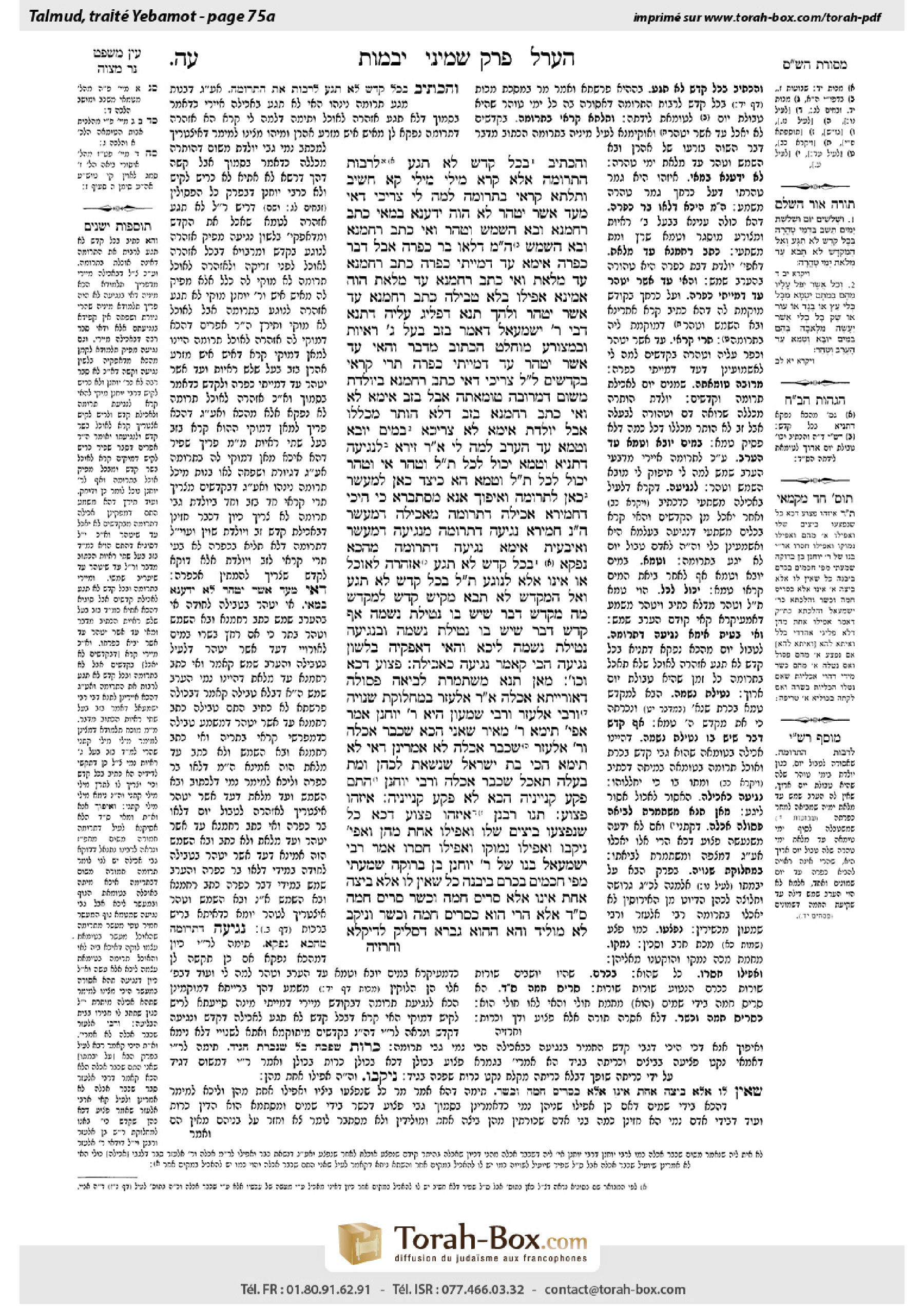
Yevamot 75a: Talmud study for Daf Yomi
Daf Yomi is the daily study of one Talmud folio. Explore 37 tractates with scans, Hebrew text, Sefaria English and AI-generated French translations where annotated.
Passage selection and English or AI-generated French translation are available where the scan has annotations. Daf Study is independent of Torah-Box and Sefaria.
Browse Yevamot · יבמות · All tractatesYevamot 75a text and translations
This page of Yevamot includes the Aramaic text, an English translation and an AI-generated French translation, alongside the scan above.
יבמות ע״ה א · Aramaic and Hebrew text
וְהָכְתִיב: ״בְּכׇל קֹדֶשׁ לֹא תִגָּע״ — לְרַבּוֹת [אֶת] הַתְּרוּמָה! אֶלָּא, קְרָא מִילֵּי מִילֵּי קָא חָשֵׁיב.
וּתְלָתָא קְרָאֵי בִּתְרוּמָה לְמָה לִי? צְרִיכִי, דְּאִי מֵ״עַד אֲשֶׁר יִטְהָר״, לָא הֲוָה יָדַעְנָא בְּמַאי — כְּתַב רַחֲמָנָא: ״וּבָא הַשֶּׁמֶשׁ וְטָהֵר״.
וְאִי כְּתַב רַחֲמָנָא ״וּבָא הַשֶּׁמֶשׁ״, הָנֵי מִילֵּי דְּלָאו בַּר כַּפָּרָה, אֲבָל דְּבַר כַּפָּרָה אֵימָא עַד דְּמַיְיתֵי כַּפָּרָה — כְּתַב רַחֲמָנָא: ״עַד מְלֹאת״.
וְאִי כְּתַב רַחֲמָנָא ״עַד מְלֹאת״ — הֲוָה אָמֵינָא אֲפִילּוּ בְּלֹא טְבִילָה — כְּתַב רַחֲמָנָא: ״עַד אֲשֶׁר יִטְהָר״.
וּלְהָךְ תַּנָּא דִּפְלִיג עֲלֵיהּ דְּתַנָּא דְּבֵי רַבִּי יִשְׁמָעֵאל, דְּאָמַר בְּזָב בַּעַל שָׁלֹשׁ רְאִיּוֹת וּבִמְצוֹרָע מוּחְלָט הַכָּתוּב מְדַבֵּר, וְהַאי ״עַד אֲשֶׁר יִטְהָר״ — עַד דְּמַיְיתֵי כַּפָּרָה, תְּרֵי קְרָאֵי בְּקָדָשִׁים לְמָה לִי?
צְרִיכִי, דְּאִי כְּתַב רַחֲמָנָא בְּיוֹלֶדֶת — מִשּׁוּם דִּמְרוּבָּה טוּמְאָתָהּ, אֲבָל בְּזָב — אֵימָא לָא. וְאִי כְּתַב רַחֲמָנָא בְּזָב — דְּלֹא הוּתַּר מִכְּלָלוֹ, אֲבָל יוֹלֶדֶת — אֵימָא לָא, צְרִיכָא.
״בַּמַּיִם יוּבָא וְטָמֵא עַד הָעֶרֶב״ לְמָה לִי? אָמַר רַבִּי זֵירָא: לִנְגִיעָה.
דְּתַנְיָא: ״וְטָמֵא״ — יָכוֹל לַכֹּל, תַּלְמוּד לוֹמַר: ״וְטָהֵר״. אִי ״וְטָהֵר״ — יָכוֹל לַכֹּל, תַּלְמוּד לוֹמַר: ״וְטָמֵא״. הָא כֵּיצַד? כָּאן לְמַעֲשֵׂר, כָּאן לִתְרוּמָה.
וְאֵיפוֹךְ אֲנָא! מִסְתַּבְּרָא כִּי הֵיכִי דַּחֲמִירָא אֲכִילָה דִתְרוּמָה מֵאֲכִילָה דְמַעֲשֵׂר — הָכִי נָמֵי חֲמִירָא נְגִיעָה דִתְרוּמָה מִנְּגִיעָה דְמַעֲשֵׂר.
וְאִיבָּעֵית אֵימָא נְגִיעָה דִתְרוּמָה מֵהָכָא נָפְקָא: ״בְּכׇל קֹדֶשׁ לֹא תִגָּע״ — אַזְהָרָה לָאוֹכֵל. אוֹ אֵינוֹ אֶלָּא לַנּוֹגֵעַ?
תַּלְמוּד לוֹמַר: ״בְּכׇל קֹדֶשׁ לֹא תִגָּע וְאֶל הַמִּקְדָּשׁ לֹא תָבֹא״, מַקִּישׁ קֹדֶשׁ לַמִּקְדָּשׁ: מָה מִקְדָּשׁ — דָּבָר שֶׁיֵּשׁ בּוֹ נְטִילַת נְשָׁמָה, אַף קֹדֶשׁ — דָּבָר שֶׁיֵּשׁ בּוֹ נְטִילַת נְשָׁמָה. וּבִנְגִיעָה, נְטִילַת נְשָׁמָה לֵיכָּא,
וְהַאי דְּאַפְּקֵיהּ בִּלְשׁוֹן נְגִיעָה, הָכִי קָאָמַר: נְגִיעָה כַּאֲכִילָה.
פְּצוּעַ דַּכָּא וְכוּ׳. מַאן תַּנָּא מִשְׁתַּמֶּרֶת לְבִיאָה פְּסוּלָה, דְּאוֹרָיְיתָא אָכְלָה? אָמַר רַבִּי אֶלְעָזָר: בְּמַחְלוֹקֶת שְׁנוּיָה, וְרַבִּי אֶלְעָזָר וְרַבִּי שִׁמְעוֹן הִיא.
רַבִּי יוֹחָנָן אָמַר: אֲפִילּוּ תֵּימָא רַבִּי מֵאִיר, שָׁאנֵי הָכָא שֶׁכְּבָר אָכְלָה.
וְרַבִּי אֶלְעָזָר, שֶׁכְּבָר אָכְלָה לָא אָמְרִינַן. דְּאִי לָא תֵּימָא הָכִי, בַּת יִשְׂרָאֵל שֶׁנִּשֵּׂאת לְכֹהֵן וּמֵת בַּעְלָהּ — תֹּאכַל, שֶׁכְּבָר אָכְלָה.
וְרַבִּי יוֹחָנָן: הָתָם — פָּקַע קִנְיָינֵיהּ, הָכָא — לָא פָּקַע קִנְיָינֵיהּ.
אֵיזֶהוּ פְּצוּעַ. תָּנוּ רַבָּנַן: אֵיזֶהוּ פְּצוּעַ דַּכָּא — כׇּל שֶׁנִּפְצְעוּ בֵּיצִים שֶׁלּוֹ, וַאֲפִילּוּ אַחַת מֵהֶן, וַאֲפִילּוּ נִיקְּבוּ, וַאֲפִילּוּ נִמּוֹקוּ, וַאֲפִילּוּ חָסְרוּ. אָמַר רַבִּי יִשְׁמָעֵאל בְּנוֹ שֶׁל רַבִּי יוֹחָנָן בֶּן בְּרוֹקָה: שָׁמַעְתִּי מִפִּי חֲכָמִים בַּכֶּרֶם בְּיַבְנֶה: כֹּל שֶׁאֵין לוֹ אֶלָּא בֵּיצָה אַחַת — אֵינוֹ אֶלָּא סְרִיס חַמָּה, וְכָשֵׁר.
סְרִיס חַמָּה סָלְקָא דַּעְתָּךְ?! אֶלָּא: הֲרֵי הוּא כִּסְרִיס חַמָּה, וְכָשֵׁר.
וְנִיקַּב לָא מוֹלֵיד? וְהָא הָהוּא גַּבְרָא דִּסְלֵיק לְדִיקְלָא
Yevamot 75a · English translation
But isn’t it written in that same section dealing with a woman after childbirth: “She shall touch no hallowed thing, nor come into the Sanctuary, until the days of her purification are completed” (Leviticus 12:4), which comes to include teruma? Rather, the Torah considers several distinct matters separately, and not all the verses refer to teruma.
The Gemara asks: And why do I need three verses with regard to teruma? The Gemara answers: They are all necessary, as, had teruma been derived solely from the verse: “He shall not eat of the holy things until he be pure” (Leviticus 22:4), I would not have known by what means ritual purity is achieved, whether by immersion alone or in some other way. Therefore, the Merciful One writes: “And when the sun has set he shall be pure, and afterward he may eat from the holy things” (Leviticus 22:7), to teach that he must also wait for sunset.
And had the Merciful One written only: “And when the sun has set,” I might have said that this applies only to one who does not require an atonement offering, but as for one who requires an atonement offering, one might say that he may not eat teruma until he brings his atonement offering. Therefore, the Merciful One writes: “She shall touch no hallowed thing, nor come into the Sanctuary, until the days of her purification are completed” (Leviticus 12:4), which indicates that she may eat teruma as soon as her days of purification are completed, and she need not wait until after she has brought her atonement offering.
And had the Merciful One written only: “Until the days of her purification are completed,” I would say that upon the completion of the purification period she is immediately purified even without immersion. Therefore, the Merciful One writes: “Until he be pure.”
The Gemara asks: And according to that tanna who disagrees with the tanna of the school of Rabbi Yishmael and says that the verse “Any man from the seed of Aaron who is a leper or a zav shall not eat of the holy things until he be pure” (Leviticus 22:4) is speaking of a zav who already experienced three sightings of an emission, and of a confirmed leper, both of whom must bring an offering as part of their purification process; and, this being the case, that phrase “until he be pure” must mean until he brings his atonement offering; then why do I need two verses with regard to sacrificial food, this verse and the verse with regard to a woman after childbirth: “And the priest shall make atonement for her, and she shall be pure” (Leviticus 12:8), to teach us that sacrificial food may not be eaten until after the atonement offering has been brought?
The Gemara answers: They are both necessary, as had the Merciful One written this halakha only with regard to a woman after childbirth, one might have said that it applies only to her because her period of ritual impurity is so long, as she may not return to eating teruma or sacrificial food for either forty days, in the case of a male child, or eighty days, in the case of a female. But with regard to a zav, say that this is not the case. And had the Merciful One written this halakha only with regard to a zav, one might have said that it applies only to him, as no exemption is ever made from its general prohibition and he is always impure. But as for a woman after childbirth, who is permitted to her husband for thirty-three or sixty-six days of that period, say that this is not the case. Both verses are therefore necessary.
The Gemara asks: As for the verse stated with regard to a vessel that contracted ritual impurity through contact with a creeping animal: “It must be put into water, and it shall be impure until the evening; then shall it be pure” (Leviticus 11:32), why do I need it? Rabbi Zeira said: It is necessary in order to teach about touching. An impure vessel, even after it has been immersed, still imparts ritual impurity to the teruma that it touches until nightfall. The same applies to an impure individual who has already undergone immersion; not only is it prohibited for him to eat teruma, but also he renders it impure if he touches it.
As it is taught in a baraita: Had the verse stated only: “It must be put into water, and it shall be impure until the evening,” one might have thought that it remains ritually impure until the evening in all regards. Therefore, the verse states: “Then shall it be pure,” indicating that it is pure following immersion, even before sunset. And had it stated only: “Then shall it be pure,” one might have thought that it is pure following immersion in all regards. Therefore, the verse states: “And it shall be impure until the evening.” How so; how can the apparent contradiction between the two parts of the verse be resolved? Here, the verse is referring to second tithe, for which immersion alone suffices; and there it is referring to teruma, for which sunset is required.
The Gemara asks: But I can reverse this construct and say that the greater stringency should be applied to second tithe. The Gemara answers: It is reasonable to say that teruma is subject to the greater stringency; just as the eating of teruma is subject to greater stringency than the eating of second tithe, so too, the touching of teruma should be subject to greater stringency than the touching of second tithe.
And if you wish, say that the prohibition with regard to the touching of teruma is derived from here: “She shall touch no hallowed thing, nor come into the Sanctuary, until the days of her purification are completed” (Leviticus 12:4); this is a warning with respect to one who eats teruma after having immersed but before sunset. Or, perhaps, it is nothing other than a warning with respect to one who touches teruma before sunset, as is implied by the plain reading of the verse?
Therefore, the verse states: “She shall touch no hallowed thing, nor come into the Sanctuary, until the days of her purification are completed” (Leviticus 12:4), thereby juxtaposing consecrated food to the Sanctuary. Just as the prohibition against entering the Sanctuary is a matter that involves the taking of life, as one who enters the Sanctuary while impure is liable to receive karet, so too, the prohibition against touching consecrated food must be a matter that involves the taking of life, e.g., eating teruma in a state of ritual impurity; but the prohibition against touching teruma in a state of impurity does not involve the taking of life, as there is no punishment of karet for mere touching.
And as for the fact that the verse expressed this halakha in terms of touching, this is what it is saying: The halakha governing touching is like that of eating, as they are both prohibited to an impure person, even after immersion, until sunset. But the verse is actually speaking of the prohibition against eating teruma in a state of impurity.
§ It is taught in the mishna that the wife of a priest with crushed testicles or a severed penis may eat teruma on his account, provided that they have not engaged in sexual relations since his injury. The Gemara asks: Who is the tanna who taught with regard to a woman awaiting intercourse that would disqualify her from marrying into the priesthood by Torah law, as in this case, where the woman would become disqualified from marrying into the priesthood if she had relations with her injured husband, that such a woman may eat teruma? Rabbi Elazar said: This halakha is subject to dispute, and it is taught in the mishna in accordance with the opinion of Rabbi Elazar and Rabbi Shimon, who similarly stated that a widow betrothed to a High Priest may eat teruma on his account, provided that he has not engaged in sexual relations with her.
Rabbi Yoḥanan said: The mishna can be understood even if you say that it is in accordance with the opinion of Rabbi Meir, who maintains that a widow betrothed to a High Priest may not eat teruma on his account, as it is different here, as she had already eaten teruma on her husband’s account before his injury. Since she has done nothing to disqualify herself, she retains her presumptive status as one for whom it is permitted to eat teruma.
And how does Rabbi Elazar counter this argument? He maintains that we do not say that since she had already eaten teruma on her husband’s account she continues to do so, as, if you do not say that this argument must be rejected, then it should be permitted for an Israelite woman who married a priest and her husband died without children to continue eating teruma on his account, as she had already eaten teruma because of him during his lifetime. However, such a conclusion is clearly incorrect. This halakha indicates that the fact that she had already eaten teruma is irrelevant.
And Rabbi Yoḥanan holds that the two cases are not comparable, as there, where the husband died, his acquisition of his wife has lapsed, i.e., they are no longer married, and therefore she cannot continue to eat teruma on his account, whereas here, where his genitals were injured, his acquisition has not lapsed. While sexual relations between them are forbidden, their marriage remains intact.
§ It is taught in the mishna: Who is deemed a man with crushed testicles? The Sages taught in a baraita: Who is deemed a man with crushed testicles? It is anyone whose testicles have been wounded, even if only one of them. Furthermore, a man is considered to have crushed testicles not only if they have been wounded, but even if they have been punctured, or have decayed as the result of an injury, or are partly deficient for some other reason. Rabbi Yishmael, son of Rabbi Yoḥanan ben Beroka, said: I heard from the Sages in the vineyard in Yavne that anyone who has only one testicle is nothing other than a eunuch by natural causes, and he is fit.
The Gemara is puzzled by the wording of this last teaching: Can it enter your mind that he is a eunuch by natural causes, i.e., from birth? That designation refers to one who was born without testicles, whereas the reference here is to one who lost a testicle as the result of an injury. Rather, say that he resembles a eunuch by natural causes, and he is fit.
The Gemara asks: As for one whose testicles were punctured, is he incapable of having children, so that he should have the status of one whose testicles were crushed? Wasn’t there an incident where a certain man was climbing up a palm tree,
Yevamot 75a · Traduction française (IA)
Mais n’est-il pas écrit dans cette même section consacrée à la femme après l’accouchement : « Elle ne touchera à aucune chose consacrée et n’entrera pas dans le Sanctuaire jusqu’à ce que les jours de sa purification soient accomplis » (Lévitique 12:4), ce qui inclut la terouma ? Il faut donc plutôt dire que la Torah traite séparément plusieurs sujets distincts et que tous les versets ne se rapportent pas à la terouma.
La Guemara demande : Pourquoi faut-il trois versets concernant la terouma ? La Guemara répond : Ils sont tous nécessaires. En effet, si la terouma avait été déduite uniquement du verset : « Il ne mangera pas des choses consacrées avant d’être pur » (Lévitique 22:4), nous n’aurions pas su comment s’acquiert la pureté rituelle : par la seule immersion ou autrement. C’est pourquoi le Miséricordieux écrit : « Lorsque le soleil se sera couché, il sera pur et pourra ensuite manger des choses consacrées » (Lévitique 22:7), pour enseigner qu’il doit aussi attendre le coucher du soleil.
Et si le Miséricordieux n’avait écrit que : « Lorsque le soleil se sera couché », j’aurais pu dire que cela ne s’applique qu’à celui qui n’a pas besoin d’un sacrifice expiatoire ; mais, pour celui qui en a besoin, on aurait pu dire qu’il ne peut manger de terouma qu’après avoir apporté son sacrifice expiatoire. C’est pourquoi le Miséricordieux écrit : « Elle ne touchera à aucune chose consacrée et n’entrera pas dans le Sanctuaire jusqu’à ce que les jours de sa purification soient accomplis » (Lévitique 12:4), ce qui indique qu’elle peut manger de la terouma dès que ses jours de purification sont accomplis, sans devoir attendre d’avoir apporté son sacrifice expiatoire.
Et si le Miséricordieux n’avait écrit que : « Jusqu’à ce que les jours de sa purification soient accomplis », j’aurais dit qu’à la fin de cette période elle est immédiatement purifiée, même sans immersion. C’est pourquoi le Miséricordieux écrit : « Jusqu’à ce qu’il soit pur ».
La Guemara demande : Et selon ce tanna qui conteste l’opinion du tanna de l’école de Rabbi Yishmaël et dit que le verset « Tout homme de la descendance d’Aaron qui est lépreux ou zav ne mangera pas des choses consacrées avant d’être pur » (Lévitique 22:4) parle d’un zav ayant déjà eu trois écoulements et d’un lépreux dont le diagnostic a été confirmé, qui doivent tous deux apporter une offrande dans le cadre de leur purification ; dans ce cas, l’expression « avant d’être pur » doit signifier jusqu’à ce qu’il apporte son sacrifice expiatoire. Pourquoi faut-il alors deux versets concernant les aliments consacrés — celui-ci et celui qui concerne la femme après l’accouchement : « Le prêtre fera expiation pour elle, et elle sera pure » (Lévitique 12:8) — pour enseigner qu’on ne peut manger des aliments consacrés qu’après avoir apporté le sacrifice expiatoire ?
La Guemara répond : Les deux sont nécessaires. En effet, si le Miséricordieux avait enseigné cette halakha uniquement au sujet de la femme après l’accouchement, on aurait pu dire que cela ne s’applique qu’à elle, car sa période d’impureté rituelle est très longue : elle ne peut reprendre la consommation de terouma ou d’aliments consacrés avant quarante jours dans le cas d’un garçon, ou avant quatre-vingts jours dans le cas d’une fille. Mais on aurait pu dire que cela ne s’applique pas au zav. Et si le Miséricordieux avait enseigné cette halakha uniquement au sujet du zav, on aurait pu dire que cela ne s’applique qu’à lui, car aucune dérogation n’est jamais accordée à l’interdiction générale qui le concerne et il est toujours impur. Mais on aurait pu dire que cela ne s’applique pas à la femme après l’accouchement, qui est autorisée à son mari pendant trente-trois ou soixante-six jours de cette période. Les deux versets sont donc nécessaires.
La Guemara demande : Pourquoi faut-il le verset concernant un ustensile devenu rituellement impur au contact d’un animal rampant : « Il sera mis dans l’eau et restera impur jusqu’au soir ; alors il sera pur » (Lévitique 11:32) ? Rabbi Zeira dit : Il est nécessaire pour enseigner la règle relative au contact. Un ustensile impur, même après avoir été immergé, transmet encore l’impureté rituelle à la terouma qu’il touche jusqu’à la tombée de la nuit. Il en va de même pour une personne impure qui a déjà été immergée : non seulement il lui est interdit de manger de la terouma, mais elle la rend aussi impure si elle la touche.
Comme il est enseigné dans une baraïta : Si le verset avait seulement dit : « Il sera mis dans l’eau et restera impur jusqu’au soir », on aurait pu penser qu’il demeure rituellement impur jusqu’au soir à tous égards. C’est pourquoi le verset dit : « Alors il sera pur », indiquant qu’il est pur après l’immersion, même avant le coucher du soleil. Et s’il avait seulement dit : « Alors il sera pur », on aurait pu penser qu’il est pur à tous égards après l’immersion. C’est pourquoi le verset dit : « Et il restera impur jusqu’au soir ». Comment comprendre cela ? Comment résoudre la contradiction apparente entre les deux parties du verset ? Ici, le verset fait référence à la seconde dîme, pour laquelle la seule immersion suffit ; là, il fait référence à la terouma, pour laquelle le coucher du soleil est nécessaire.
La Guemara demande : Mais ne puis-je pas inverser cette distinction et dire que la règle la plus stricte s’applique à la seconde dîme ? La Guemara répond : Il est raisonnable de dire que la terouma est soumise à la règle la plus stricte. De même que la consommation de terouma est soumise à une règle plus stricte que celle de la seconde dîme, de même le contact avec la terouma doit être soumis à une règle plus stricte que le contact avec la seconde dîme.
Et si tu veux, dis que l’interdiction relative au contact avec la terouma est déduite de ce verset : « Elle ne touchera à aucune chose consacrée et n’entrera pas dans le Sanctuaire jusqu’à ce que les jours de sa purification soient accomplis » (Lévitique 12:4). Il s’agit d’un avertissement contre le fait de manger de la terouma après l’immersion, mais avant le coucher du soleil. Ou peut-être s’agit-il uniquement d’un avertissement contre le fait de toucher la terouma avant le coucher du soleil, comme le suggère le sens littéral du verset ?
C’est pourquoi le verset dit : « Elle ne touchera à aucune chose consacrée et n’entrera pas dans le Sanctuaire jusqu’à ce que les jours de sa purification soient accomplis » (Lévitique 12:4), rapprochant ainsi les aliments consacrés du Sanctuaire. De même que l’interdiction d’entrer dans le Sanctuaire concerne une situation passible de la peine de mort, car celui qui entre dans le Sanctuaire alors qu’il est impur encourt le karet, de même l’interdiction de toucher aux aliments consacrés doit concerner une situation passible de la peine de mort, par exemple le fait de manger de la terouma en état d’impureté rituelle. En revanche, l’interdiction de toucher à la terouma en état d’impureté n’est pas passible de la peine de mort, car le simple fait de la toucher n’entraîne pas le karet.
Quant au fait que le verset exprime cette halakha en termes de contact, voici ce qu’il signifie : la halakha régissant le contact est la même que celle régissant la consommation, car toutes deux sont interdites à une personne impure, même après l’immersion, jusqu’au coucher du soleil. Mais, en réalité, le verset parle de l’interdiction de manger de la terouma en état d’impureté.
§ La Michna enseigne que l’épouse d’un prêtre aux testicules écrasés ou au pénis sectionné peut manger de la terouma grâce à lui, à condition qu’ils n’aient pas eu de relations sexuelles depuis sa blessure. La Guemara demande : Qui est le tanna qui enseigne qu’une femme qui attend d’avoir des relations sexuelles, lesquelles la rendraient inapte à épouser un membre de la prêtrise selon la Torah — comme dans ce cas, où elle deviendrait inapte à épouser un membre de la prêtrise si elle avait des relations avec son mari blessé — peut manger de la terouma ? Rabbi Elazar dit : Cette halakha fait l’objet d’une controverse, et la Michna enseigne conformément à l’opinion de Rabbi Elazar et de Rabbi Shimon, qui ont également déclaré qu’une veuve fiancée à un Grand Prêtre peut manger de la terouma grâce à lui, à condition qu’il n’ait pas eu de relations sexuelles avec elle.
Rabbi Yoḥanan dit : On peut comprendre la Michna même si l’on dit qu’elle suit l’opinion de Rabbi Meir, qui soutient qu’une veuve fiancée à un Grand Prêtre ne peut pas manger de la terouma grâce à lui. En effet, le cas présent est différent, car elle mangeait déjà de la terouma grâce à son mari avant qu’il ne soit blessé. Puisqu’elle n’a rien fait pour se disqualifier, elle conserve son statut présumé de femme autorisée à manger de la terouma.
Et comment Rabbi Elazar réfute-t-il cet argument ? Il soutient qu’on ne peut pas dire que, puisqu’elle mangeait déjà de la terouma grâce à son mari, elle continue à en manger. Car si l’on ne rejette pas cet argument, il faudrait alors permettre à une Israélite qui a épousé un prêtre et dont le mari est mort sans enfant de continuer à manger de la terouma grâce à lui, puisqu’elle en mangeait déjà grâce à lui de son vivant. Or, une telle conclusion est manifestement erronée. Cette halakha montre que le fait qu’elle ait déjà mangé de la terouma n’a aucune pertinence.
Et Rabbi Yoḥanan estime que les deux cas ne sont pas comparables. Là, lorsque le mari est mort, le lien matrimonial qui l’unissait à son épouse a pris fin, c’est-à-dire qu’ils ne sont plus mariés ; elle ne peut donc pas continuer à manger de la terouma grâce à lui. Ici, en revanche, où ses organes génitaux ont été blessés, leur lien matrimonial n’a pas pris fin. Bien que les relations sexuelles entre eux soient interdites, leur mariage demeure intact.
§ La Michna enseigne : Qui est considéré comme un homme aux testicules écrasés ? Les Sages ont enseigné dans une baraïta : Qui est considéré comme un homme aux testicules écrasés ? Tout homme dont les testicules ont été blessés, même si un seul l’a été. En outre, un homme est considéré comme ayant les testicules écrasés non seulement s’ils ont été blessés, mais aussi s’ils ont été perforés, s’ils se sont détériorés à la suite d’une blessure ou s’ils sont partiellement absents pour une autre raison. Rabbi Yishmael, fils de Rabbi Yoḥanan ben Beroka, dit : J’ai entendu les Sages, dans le vignoble de Yavné, enseigner que tout homme qui n’a qu’un seul testicule est en réalité un eunuque de naissance et qu’il est apte.
La Guemara s’interroge sur la formulation de ce dernier enseignement : Peut-on vraiment penser qu’il est un eunuque de naissance ? Cette désignation concerne celui qui est né sans testicules, alors qu’il est ici question de celui qui a perdu un testicule à la suite d’une blessure. Il faut plutôt dire qu’il ressemble à un eunuque de naissance et qu’il est apte.
La Guemara demande : Celui dont les testicules ont été perforés est-il incapable d’avoir des enfants, au point d’avoir le statut d’un homme aux testicules écrasés ? N’y a-t-il pas eu un incident où un certain homme était en train de grimper à un palmier,
Traduction française générée par IA à partir de l’édition anglaise de Sefaria. Vérifie toujours un passage avec le texte source.
Text from Sefaria: William Davidson Edition - Vocalized Aramaic (CC BY NC); William Davidson Edition - English (CC BY NC).