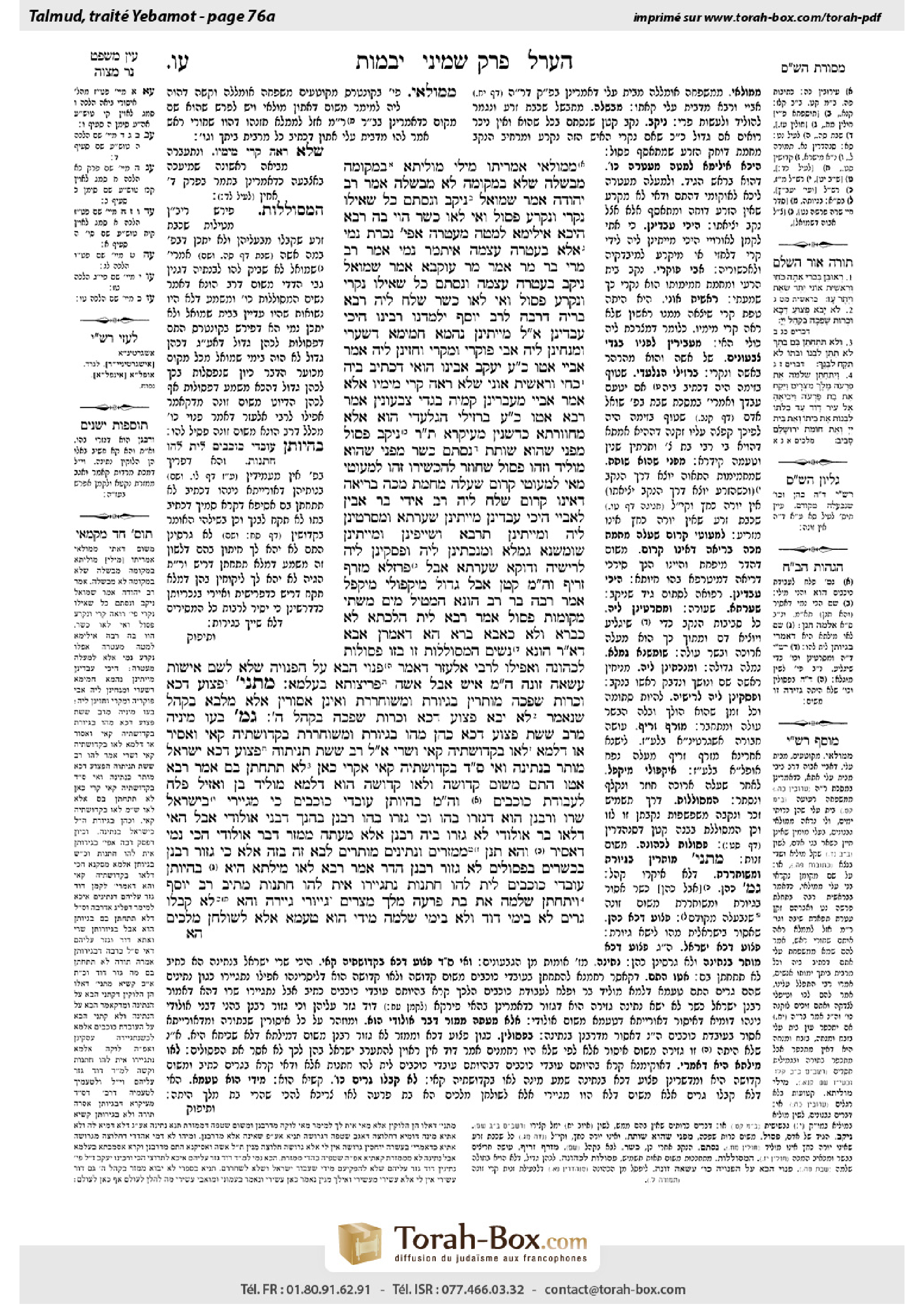
Yevamot 76a: Talmud study for Daf Yomi
Daf Yomi is the daily study of one Talmud folio. Explore 37 tractates with scans, Hebrew text, Sefaria English and AI-generated French translations where annotated.
Passage selection and English or AI-generated French translation are available where the scan has annotations. Daf Study is independent of Torah-Box and Sefaria.
Browse Yevamot · יבמות · All tractatesYevamot 76a text and translations
This page of Yevamot includes the Aramaic text, an English translation and an AI-generated French translation, alongside the scan above.
יבמות ע״ו א · Aramaic and Hebrew text
מִמּוּלָאֵי, אָמְרִיתוּ מִילֵּי מוּלְיָתָא? בִּמְקוֹמָהּ — מְבַשְּׁלָה, שֶׁלֹּא בִּמְקוֹמָהּ — לָא מְבַשְּׁלָה.
אָמַר רַב יְהוּדָה אָמַר שְׁמוּאֵל: נִיקַּב וְנִסְתַּם, כֹּל שֶׁאִילּוּ נִקְרֵי וְנִקְרָע — פְּסוּל. וְאִי לָאו — כָּשֵׁר. הָוֵי בֵּהּ רָבָא: הֵיכָא? אִילֵּימָא לְמַטָּה מֵעֲטָרָה — אֲפִילּוּ נִכְרַת נָמֵי, אֶלָּא בַּעֲטָרָה עַצְמָהּ. אִיתְּמַר נָמֵי, אָמַר רַב מָרִי בַּר מָר אָמַר מָר עוּקְבָא אָמַר שְׁמוּאֵל: נִיקַּב בַּעֲטָרָה עַצְמָהּ וְנִסְתַּם, כֹּל שֶׁאִילּוּ נִקְרֵי וְנִקְרָע פָּסוּל, וְאִי לָאו — כָּשֵׁר.
שְׁלַח לֵיהּ רָבָא בְּרֵיהּ דְּרַבָּה לְרַב יוֹסֵף: יְלַמְּדֵנוּ רַבֵּינוּ, הֵיכִי עָבְדִינַן? אֲמַר לֵיהּ: מַיְיתִינַן נַהֲמָא חַמִּימָא דִּשְׂעָרֵי, וּמַנְּחִינַן לֵיהּ אַבֵּי פוֹקְרֵי, וּמִקְּרֵי, וְחָזֵינַן לֵיהּ.
אָמַר אַבָּיֵי: אַטּוּ כּוּלֵּי עָלְמָא יַעֲקֹב אָבִינוּ הֲוַאי, דִּכְתִיב בֵּיהּ ״כֹּחִי וְרֵאשִׁית אוֹנִי״, שֶׁלֹּא רָאָה קֶרִי מִיָּמָיו!
אֶלָּא, אָמַר אַבָּיֵי: מְעַבְּרִינַן קַמֵּיהּ בִּגְדֵי צִבְעוֹנִין. אָמַר רָבָא: אַטּוּ כּוּלֵּי עָלְמָא בַּרְזִילַּי הַגִּלְעָדִי הוּא?! אֶלָּא מְחַוַּורְתָּא כִּדְשַׁנִּין מֵעִיקָּרָא.
תָּנוּ רַבָּנַן: נִיקַּב — פָּסוּל, מִפְּנֵי שֶׁהוּא שׁוֹתֵת. נִסְתַּם — כָּשֵׁר, מִפְּנֵי שֶׁהוּא מוֹלִיד. וְזֶהוּ פְּסוּל שֶׁחוֹזֵר לְהֶכְשֵׁירוֹ. ״זֶהוּ״ לְמַעוֹטֵי מַאי? לְמַעוֹטֵי קְרוּם שֶׁעָלָה מֵחֲמַת מַכָּה בָּרֵיאָה, דְּאֵינוֹ קְרוּם.
שְׁלַח לֵיהּ רַב אִידִי בַּר אָבִין לְאַבָּיֵי: הֵיכִי עָבְדִינַן? מַיְיתִינַן שְׂעָרְתָּא וּמְסָרְטִינַן לֵיהּ, וּמַיְיתִינַן תַּרְבָּא וְשָׁיְיפִינַן, וּמַיְיתִינַן שׁוּמְשָׁנָא גַּמְלָא וּמְנַכְּתִינַן לֵיהּ, וּפָסְקִינַן לֵיהּ לְרֵישֵׁיהּ. וְדַוְקָא שְׂעָרְתָּא, אֲבָל פַּרְזְלָא — מִזְרָף זָרֵיף. וְהָנֵי מִילֵּי קָטָן, אֲבָל גָּדוֹל — אִיקַּפּוֹלֵי מִיקַּפַּל.
אָמַר רַבָּה בַּר רַב הוּנָא: הַמֵּטִיל מַיִם מִשְּׁתֵּי מְקוֹמוֹת, פָּסוּל. אָמַר רָבָא: לֵית הִלְכְתָא לָא כִּבְרָא וְלָא כְּאַבָּא, בְּרָא — הָא דַּאֲמַרַן. אַבָּא — דְּאָמַר רַב הוּנָא: נָשִׁים הַמְסוֹלְלוֹת זוֹ בָּזוֹ, פְּסוּלוֹת לַכְּהוּנָּה.
וַאֲפִילּוּ לְרַבִּי אֶלְעָזָר, דְּאָמַר: פָּנוּי הַבָּא עַל הַפְּנוּיָה שֶׁלֹּא לְשֵׁם אִישׁוּת עֲשָׂאָהּ זוֹנָה — הָנֵי מִילֵּי אִישׁ, אֲבָל אִשָּׁה פְּרִיצוּתָא בְּעָלְמָא.
מַתְנִי׳ פְּצוּעַ דַּכָּא וּכְרוּת שׇׁפְכָה מוּתָּרִין בְּגִיּוֹרֶת וּמְשׁוּחְרֶרֶת, וְאֵינָן אֲסוּרִין אֶלָּא מִלָּבֹא בַּקָּהָל, שֶׁנֶּאֱמַר: ״לֹא יָבֹא פְצוּעַ דַּכָּא וּכְרוּת שׇׁפְכָה בִּקְהַל ה׳״.
גְּמָ׳ בְּעוֹ מִינֵּיהּ מֵרַב שֵׁשֶׁת: פְּצוּעַ דַּכָּא כֹּהֵן מַהוּ, בְּגִיּוֹרֶת וּמְשׁוּחְרֶרֶת? בִּקְדוּשְׁתֵּיהּ קָאֵי וַאֲסִיר, אוֹ דִלְמָא לָאו בִּקְדוּשְׁתֵּיהּ קָאֵי וּשְׁרֵי?
אֲמַר לְהוּ רַב שֵׁשֶׁת, תְּנֵיתוּהָ: פְּצוּעַ דַּכָּא יִשְׂרָאֵל — מוּתָּר בִּנְתִינָה. וְאִי סָלְקָא דַּעְתָּךְ בִּקְדוּשְׁתֵּיהּ קָאֵי, אִקְרִי כָּאן ״לֹא תִתְחַתֵּן בָּם״.
אָמַר רָבָא: אַטּוּ הָתָם מִשּׁוּם קְדוּשָּׁה וְלָאו קְדוּשָּׁה הוּא? דִּלְמָא מוֹלֵיד בֵּן, וְאָזֵיל פָּלַח לַעֲבוֹדָה זָרָה. וְהָנֵי מִילֵּי — בְּגוֹיוּתָן, כִּי מִגַּיְירִי (בְּיִשְׂרָאֵל) [מִישְׁרָא] שְׁרוּ, וְרַבָּנַן הוּא דִּגְזַרוּ בְּהוּ. וְכִי גְּזַרוּ בְּהוּ רַבָּנַן — בְּהָנָךְ דִּבְנֵי אוֹלוֹדֵי, אֲבָל הַאי דְּלָאו בַּר אוֹלוֹדֵי — לָא גְּזַרוּ בֵּיהּ רַבָּנַן.
אֶלָּא מֵעַתָּה, מַמְזֵר, דְּבַר אוֹלוֹדֵי, הָכִי נָמֵי דַּאֲסִיר? וְהָא תְּנַן: מַמְזֵרִים וּנְתִינִים מוּתָּרִים לָבֹא זֶה בָּזֶה! אֶלָּא: כִּי גְּזוּר רַבָּנַן — בִּכְשֵׁרִים. בִּפְסוּלִים לָא גְּזוּר רַבָּנַן.
הֲדַר אָמַר רָבָא: לָאו מִילְּתָא הִיא, בְּגוֹיוּתָן — לֵית לְהוּ חַתְנוּת, נִתְגַּיְּירוּ — אִית לְהוּ חַתְנוּת.
מֵתִיב רַב יוֹסֵף: ״וַיִּתְחַתֵּן שְׁלֹמֹה אֶת בַּת פַּרְעֹה מֶלֶךְ מִצְרַיִם״! גַּיּיוֹרֵי גַּיְּירַהּ. וְהָא לֹא קִבְּלוּ גֵּרִים לֹא בִּימֵי דָוִד וְלֹא בִּימֵי שְׁלֹמֹה! מִידֵּי הוּא טַעְמָא — אֶלָּא לְשׁוּלְחַן מְלָכִים,
Yevamot 76a · English translation
from truncated [mimula’ei] people, as Rav Beivai’s family traced their lineage to the house of Eli, all of whose descendants were destined to be short-lived (see I Samuel 2:31), you speak truncated [mulayata] and unsound matters. When the semen passes through its proper place, it fertilizes; but if it does not pass through its proper place, it does not fertilize. Since he cannot father children, he is like one whose testicles have been crushed, and therefore he may not enter into the congregation.
Rav Yehuda said that Shmuel said: If a man’s member had been punctured and it later healed and the hole closed up with flesh, in any case where, if he would emit semen, it would tear open again, he is unfit to enter into the congregation; but if not, he is fit. Rava discussed this ruling and raised a question: Where is this perforation? If we say it is below the corona, at the end of the man’s member, why should this perforation render him unfit? Even if the member was entirely severed, he would also be fit. Rather, the hole is in the corona itself, that is, at the point where the corona meets the rest of the member. It was also stated explicitly that this is the case, as Rav Mari bar Mar said that Mar Ukva said that Shmuel said: If a man’s member had been punctured in the corona itself, and it later healed and the hole closed up with flesh, in any case where if he would emit semen it would tear open again, he is unfit; but if not, he is fit.
With regard to this issue, Rava, son of Rabba, sent the following question to Rav Yosef: Let our teacher teach us, what should we do to verify whether or not the perforation was adequately closed? Rav Yosef said to him: We bring warm barley bread and place it upon his anus [bei pukrei], and owing to the heat he emits semen, and we observe what happens and see whether or not the perforation remains closed.
Abaye said: Is that to say that everyone is like our Patriarch Jacob, with regard to whom it is written: “Reuben, you are my firstborn, my might and the first fruits of my strength” (Genesis 49:3), implying that Jacob never experienced an emission of semen in all his days, so that his eldest son Reuben was conceived from his first drop of seed, i.e., “the first fruits of my strength.” The implication is that there is certainly no need for such measures in order to bring a man to ejaculate.
Rather, Abaye said that a different method is used: We pass before him colorful garments of a woman, and thereby bring him to arousal, so that he will experience an emission. Rava said: Is that to say that everyone is like Barzilai the Gileadite, traditionally known for his licentious character? Not all men are brought to excitement when they merely see such clothes. Rather, the Gemara rejects this proposal and states that it is clear as we initially answered, that we follow the former procedure even though not all men require it.
The Sages taught in a baraita: If a man’s member was punctured, he is unfit to enter into the congregation of Israel because his semen is discharged gently and does not fertilize; if the perforation later closed up with flesh, he is fit, because now he can father children. And this is an instance of one who is unfit who returns to his previous state of fitness. The Gemara asks: What does the word this come to exclude? The Gemara explains that it comes to exclude a case involving an entirely different matter, that of a membrane that formed on the lung of an animal in the wake of a wound, which is not considered a proper membrane, as it is likely to rupture. If a puncture in the lung became covered with such a membrane the animal does not regain its former kosher status.
With regard to this issue, Rav Idi bar Avin sent the following question to Abaye: What should we do to expedite the healing of such a perforation? Abaye answered: We bring a sharp-edged grain of barley and lacerate the area around the hole with it. We then bring fat and rub it on the spot, and afterward we bring a large ant [shumshena] and let it bite inside the hole. This leads to bleeding and the formation of a scab, which eventually heals as new flesh grows there. We also cut off the ant’s head so that it should remain in place until the wound is fully healed. The Gemara comments: And this procedure must be done specifically with a grain of barley, but an iron tool would cause inflammation [zareif]. The Gemara adds: And this applies only to a small perforation, but a large one will eventually peel off and reopen.
Rabba bar Rav Huna said: One who passes water from two places, so that he appears to have a hole or some other blemish in his member, is unfit to enter into the congregation of Israel, as is a man with crushed testicles. Rava said: With regard to these matters, the halakha is in accordance neither with the opinion of the son nor with that of the father. The son, this refers to that opinion of Rabba bar Rav Huna, which we just stated. As for the ruling of the father, this is referring to that which Rav Huna said: Women who rub against one another motivated by sexual desire are unfit to marry into the priesthood, as such conduct renders a woman a zona, whom a priest is prohibited from marrying. It was about this that Rava said that the halakha is not in accordance with Rav Huna’s opinion.
And even according to the opinion of Rabbi Elazar, who said that an unmarried man who has intercourse with an unmarried woman not for the sake of marriage renders her a zona, a woman who has had sexual relations with a man forbidden to her by the Torah, this applies only to intercourse with a man, but lewd behavior with another woman is mere licentiousness that does not render her a zona, and therefore she is still permitted to marry into the priesthood.
MISHNA: A man with crushed testicles or with other wounds to his genitals and one whose penis has been severed are permitted to marry a female convert or an emancipated maidservant, and they are prohibited only from entering into the congregation and marrying a woman who was born Jewish, as it is stated: “A man wounded with crushed testicles or a severed penis shall not enter into the congregation of the Lord” (Deuteronomy 23:2).
GEMARA: They raised a dilemma before Rav Sheshet: What is the halakha governing a priest with crushed testicles with respect to a female convert or an emancipated maidservant? The Gemara clarifies the two sides of this dilemma: Does he retain his state of sanctity like any other priest and is therefore prohibited from marrying either one of these women, or perhaps he does not retain his state of sanctity and therefore is permitted to marry a convert, like an ordinary Israelite with crushed testicles?
Rav Sheshet said to them: You already learned the answer to this question in the following baraita: It is permitted for an ordinary Israelite with crushed testicles to marry a Gibeonite woman. Now, if it enters your mind that he retains his sanctity as a Jew, one should apply here the prohibition stated with regard to Canaanites: “You shall not marry them” (Deuteronomy 7:3). Apparently, then, one whose testicles have been crushed loses his former sanctity, and the same should apply to a priest.
Rava said: This is no proof, as is that to say that the prohibition there against marrying Canaanites is due to sanctity or lack of sanctity? Rather, the reason for the prohibition is that perhaps one will father a child from his Canaanite wife and that child will later go off and engage in idolatrous worship. Now, this concern applies only when they are still gentiles, but when they convert, as did the Gibeonites, they are permitted to Jews. And it is the Sages who decreed that Gibeonites are forbidden like mamzerim even after their conversion. And when the Sages decreed that one may not marry them, the decree was limited to those who are capable of having children, but with regard to this one, a man with crushed testicles who is incapable of having children, the Sages did not issue a decree.
The Gemara raises an objection against Rava: However, if that is so, then with regard to a mamzer, who is capable of having children, so too one would say that he is prohibited from marrying a Gibeonite. But didn’t we learn otherwise in a mishna (Kiddushin 69a): Mamzerim and Gibeonites are permitted to marry one another. Rather, retract this explanation and replace it with the following: When the Sages decreed that one may not marry a Gibeonite, they limited their decree to those who are fit, so as to prevent them from mingling with Gibeonites; but with regard to those who are unfit to enter into the congregation, the Sages did not issue a decree.
Rava then reconsidered and said that what he had previously argued, that the prohibition against marrying them applies only when they are gentiles, is not correct. The prohibition cannot be referring to gentiles, as when they are gentiles there can be no valid marriage with them at all. It is only after they have converted that there can be valid marriage with them, and therefore the prohibition against entering into marriage with them applies. Nevertheless, it is permitted for a man with crushed testicles to marry a Gibeonite woman.
Rav Yosef raised an objection from the verse that states: “And Solomon married the daughter of Pharaoh, king of Egypt” (I Kings 3:1), which indicates that there can, in fact, be valid marriage even with gentiles. The Gemara answers: Before Solomon took Pharaoh’s daughter as his wife, he converted her. The Gemara asks: But isn’t it so that they did not accept converts, neither in the days of David nor in the days of Solomon? The Gemara answers: But isn’t the reason that they did not accept converts during those periods only due to concern that the converts were not acting for the sake of Heaven but in fact desired the power of the table of kings, David and Solomon?
Yevamot 76a · Traduction française (IA)
Issus de gens diminués [mimula’ei], puisque la famille de Rav Beivai faisait remonter son ascendance à la maison d’Éli, dont tous les descendants étaient voués à mourir jeunes (voir I Samuel 2:31), tu profères des paroles diminuées [mulayata] et erronées. Lorsque le sperme passe par son canal normal, il féconde ; mais s’il ne passe pas par ce canal, il ne féconde pas. Puisqu’il ne peut pas engendrer d’enfants, il est comme un homme aux testicules écrasés et, par conséquent, il ne peut pas entrer dans l’assemblée.
Rav Yehouda a dit au nom de Chmouel : si le membre d’un homme a été perforé, puis que la blessure a guéri et que l’orifice s’est refermé par de la chair, il est inapte à entrer dans l’assemblée si, lorsqu’il émet du sperme, l’orifice se rouvre ; sinon, il est apte. Rava a examiné cette décision et a soulevé une question : où se trouve cette perforation ? Si l’on dit qu’elle est sous le gland, à l’extrémité du membre, pourquoi cette perforation le rendrait-elle inapte ? Même si son membre avait été entièrement sectionné, il serait également apte. La perforation se trouve donc dans le gland lui-même, à l’endroit où celui-ci rejoint le reste du membre. Cela a également été dit explicitement : Rav Mari bar Mar a dit au nom de Mar Oukva, qui l’a dit au nom de Chmouel : si le membre d’un homme a été perforé dans le gland lui-même, puis que la blessure a guéri et que l’orifice s’est refermé par de la chair, il est inapte si, lorsqu’il émet du sperme, l’orifice se rouvre ; sinon, il est apte.
À ce sujet, Rava, fils de Rabba, a envoyé la question suivante à Rav Yossef : « Que notre maître nous enseigne : que doit-on faire pour vérifier si la perforation s’est suffisamment refermée ? » Rav Yossef lui répondit : « On prend du pain d’orge chaud et on le place sur son anus [bei pukrei] ; sous l’effet de la chaleur, il émet du sperme. On observe alors ce qui se passe pour voir si la perforation reste fermée ou non. »
Abayé a dit : « Faut-il donc croire que tout le monde est comme notre patriarche Jacob, à propos duquel il est écrit : “Ruben, tu es mon premier-né, ma force et les prémices de ma vigueur” (Genèse 49:3), ce qui implique que Jacob n’a jamais eu d’émission de sperme de toute sa vie, de sorte que son fils aîné, Ruben, aurait été conçu à partir de sa première goutte de semence, c’est-à-dire des “prémices de ma vigueur” ? » Il s’ensuit qu’il n’est certainement pas nécessaire de recourir à de telles mesures pour faire éjaculer un homme.
Abayé a plutôt dit qu’on utilise une autre méthode : on fait passer devant lui des vêtements de femme colorés, ce qui l’excite et provoque une émission de sperme. Rava a dit : « Faut-il donc croire que tout le monde est comme Barzilaï le Galaadite, traditionnellement connu pour son caractère licencieux ? » La simple vue de tels vêtements n’excite pas tous les hommes. La Guemara rejette donc cette proposition et conclut qu’il faut procéder comme on l’a indiqué au départ, même si tous les hommes n’ont pas besoin d’une telle procédure.
Les Sages ont enseigné dans une baraïta : si le membre d’un homme a été perforé, il est inapte à entrer dans l’assemblée d’Israël, car son sperme s’écoule doucement et ne féconde pas ; si la perforation s’est ensuite refermée par de la chair, il est apte, car il peut désormais engendrer des enfants. C’est là un cas où une personne inapte retrouve son aptitude antérieure. La Guemara demande : qu’est-ce que le mot « là » vient exclure ? La Guemara explique qu’il vient exclure un cas entièrement différent : celui d’une membrane qui s’est formée sur le poumon d’un animal à la suite d’une blessure. Cette membrane n’est pas considérée comme adéquate, car elle risque de se rompre. Si une perforation du poumon est recouverte par une telle membrane, l’animal ne retrouve pas son statut antérieur d’animal cacher.
À ce sujet, Rav Idi bar Avin a envoyé la question suivante à Abayé : « Que doit-on faire pour accélérer la guérison d’une telle perforation ? » Abayé répondit : « On prend un grain d’orge à arête vive et on lacère avec celui-ci la zone autour de l’orifice. On prend ensuite de la graisse et on en frotte l’endroit, puis on prend une grosse fourmi [shumshena] et on la laisse mordre à l’intérieur de l’orifice. Cela provoque un saignement et la formation d’une croûte, qui finit par guérir à mesure que de la chair neuve se développe à cet endroit. On coupe aussi la tête de la fourmi afin qu’elle reste en place jusqu’à la guérison complète de la blessure. » La Guemara précise que cette procédure doit être pratiquée précisément avec un grain d’orge, car un instrument de fer provoquerait une inflammation [zareif]. La Guemara ajoute que cela ne vaut que pour une petite perforation ; une grande finit par se détacher et se rouvrir.
Rabba bar Rav Houna a dit : celui qui urine par deux endroits, donnant l’impression que son membre présente un orifice ou une autre difformité, est inapte à entrer dans l’assemblée d’Israël, tout comme un homme aux testicules écrasés. Rava a dit : « Sur ces questions, la halakha ne suit ni l’avis du fils ni celui du père. » Le fils désigne Rabba bar Rav Houna, dont nous venons de rapporter l’avis. Quant à la décision du père, elle désigne ce que Rav Houna a dit : les femmes qui se frottent l’une contre l’autre par désir sexuel ne sont pas aptes à épouser un prêtre, car une telle conduite leur confère le statut de zona, qu’un prêtre n’a pas le droit d’épouser. C’est à propos de cette décision que Rava a dit que la halakha ne suit pas l’avis de Rav Houna.
Même selon l’avis de Rabbi Elazar, qui a dit qu’un homme célibataire ayant des rapports avec une femme célibataire sans intention de l’épouser lui confère le statut de zona — une femme qui a eu des relations sexuelles avec un homme que la Torah lui interdit d’épouser —, cela ne s’applique qu’à des rapports avec un homme. Un comportement lascif avec une autre femme relève simplement de la débauche et ne lui confère pas le statut de zona ; elle reste donc autorisée à épouser un prêtre.
MICHNA : Un homme aux testicules écrasés, un homme présentant d’autres blessures aux organes génitaux et un homme dont le membre a été sectionné peuvent épouser une femme convertie ou une servante affranchie. Ils ne peuvent entrer dans l’assemblée ni épouser une femme née juive, comme il est dit : « Celui dont les testicules ont été écrasés ou le membre sectionné n’entrera pas dans l’assemblée de l’Éternel » (Deutéronome 23:2).
GUEMARA : On a soumis à Rav Chéchet la question suivante : quelle est la halakha concernant un prêtre aux testicules écrasés, s’agissant d’épouser une femme convertie ou une servante affranchie ? La Guemara précise les deux aspects de cette question : conserve-t-il son statut de sainteté, comme tout autre prêtre, et lui est-il donc interdit d’épouser l’une ou l’autre de ces femmes ? Ou bien ne conserve-t-il pas ce statut et est-il, par conséquent, autorisé à épouser une convertie, comme un Israélite ordinaire aux testicules écrasés ?
Rav Chéchet leur dit : « Vous avez déjà appris la réponse à cette question dans la baraïta suivante : un Israélite ordinaire aux testicules écrasés a le droit d’épouser une femme guibonite. Or, si l’on devait penser qu’il conserve sa sainteté en tant que Juif, il faudrait lui appliquer l’interdiction énoncée au sujet des Cananéens : “Tu ne contracteras pas de mariage avec eux” (Deutéronome 7:3). Il semble donc que celui dont les testicules ont été écrasés perd son statut antérieur de sainteté ; il devrait en être de même pour un prêtre. »
Rava a dit : « Ce n’est pas une preuve. Peut-on dire que l’interdiction d’épouser des Cananéens est due à la sainteté ou à l’absence de sainteté ? La raison de cette interdiction est plutôt qu’un homme pourrait avoir un enfant avec sa femme cananéenne, et que cet enfant finirait par pratiquer l’idolâtrie. Cette crainte ne s’applique que tant qu’ils sont encore des non-Juifs ; après leur conversion, comme celle des Guibonites, ils sont autorisés aux Juifs. Ce sont les Sages qui ont décrété que les Guibonites restaient interdits au même titre que les mamzérim, même après leur conversion. Lorsqu’ils ont décrété qu’il était interdit de les épouser, ils ont limité cette interdiction aux personnes capables d’avoir des enfants. Quant à cet homme, aux testicules écrasés et incapable d’avoir des enfants, les Sages n’ont pas décrété d’interdiction. »
La Guemara soulève une objection contre Rava : « Si tel est le cas, faudrait-il également dire qu’un mamzer, qui est capable d’avoir des enfants, n’a pas le droit d’épouser une Guibonite ? Pourtant, n’avons-nous pas appris le contraire dans une Michna (Kiddouchin 69a) : les mamzérim et les Guibonites ont le droit de s’épouser entre eux ? » Il faut donc revenir sur cette explication et la remplacer par la suivante : lorsque les Sages ont décrété qu’il était interdit d’épouser une Guibonite, ils ont limité leur décret aux personnes aptes, afin de les empêcher de se mêler aux Guibonites ; mais ils n’ont pas décrété d’interdiction à l’égard de ceux qui ne sont pas aptes à entrer dans l’assemblée.
Rava a ensuite reconsidéré la question et a dit que son argument précédent, selon lequel l’interdiction de les épouser ne s’applique que tant qu’ils sont non-Juifs, n’est pas correct. L’interdiction ne peut pas viser les non-Juifs, car tant qu’ils sont non-Juifs, aucun mariage valide avec eux n’est possible. Un mariage valide avec eux n’est possible qu’après leur conversion ; c’est donc alors que l’interdiction de les épouser s’applique. Néanmoins, un homme aux testicules écrasés a le droit d’épouser une femme guibonite.
Rav Yossef a soulevé une objection à partir du verset qui dit : « Salomon épousa la fille de Pharaon, roi d’Égypte » (I Rois 3:1), ce qui indique qu’un mariage valide avec des non-Juifs est effectivement possible. La Guemara répond : avant que Salomon ne prenne la fille de Pharaon pour épouse, il l’a convertie. La Guemara demande : « Mais n’est-il pas vrai qu’on n’acceptait pas de convertis, ni à l’époque de David ni à celle de Salomon ? » La Guemara répond : « Mais n’est-il pas vrai que la raison pour laquelle on n’acceptait pas de convertis pendant ces périodes était uniquement la crainte qu’ils ne se convertissent pas pour l’amour du Ciel, mais qu’ils désirent en réalité profiter du pouvoir que conférait la table des rois, David et Salomon ? »
Traduction française générée par IA à partir de l’édition anglaise de Sefaria. Vérifie toujours un passage avec le texte source.
Text from Sefaria: William Davidson Edition - Vocalized Aramaic (CC BY NC); William Davidson Edition - English (CC BY NC).