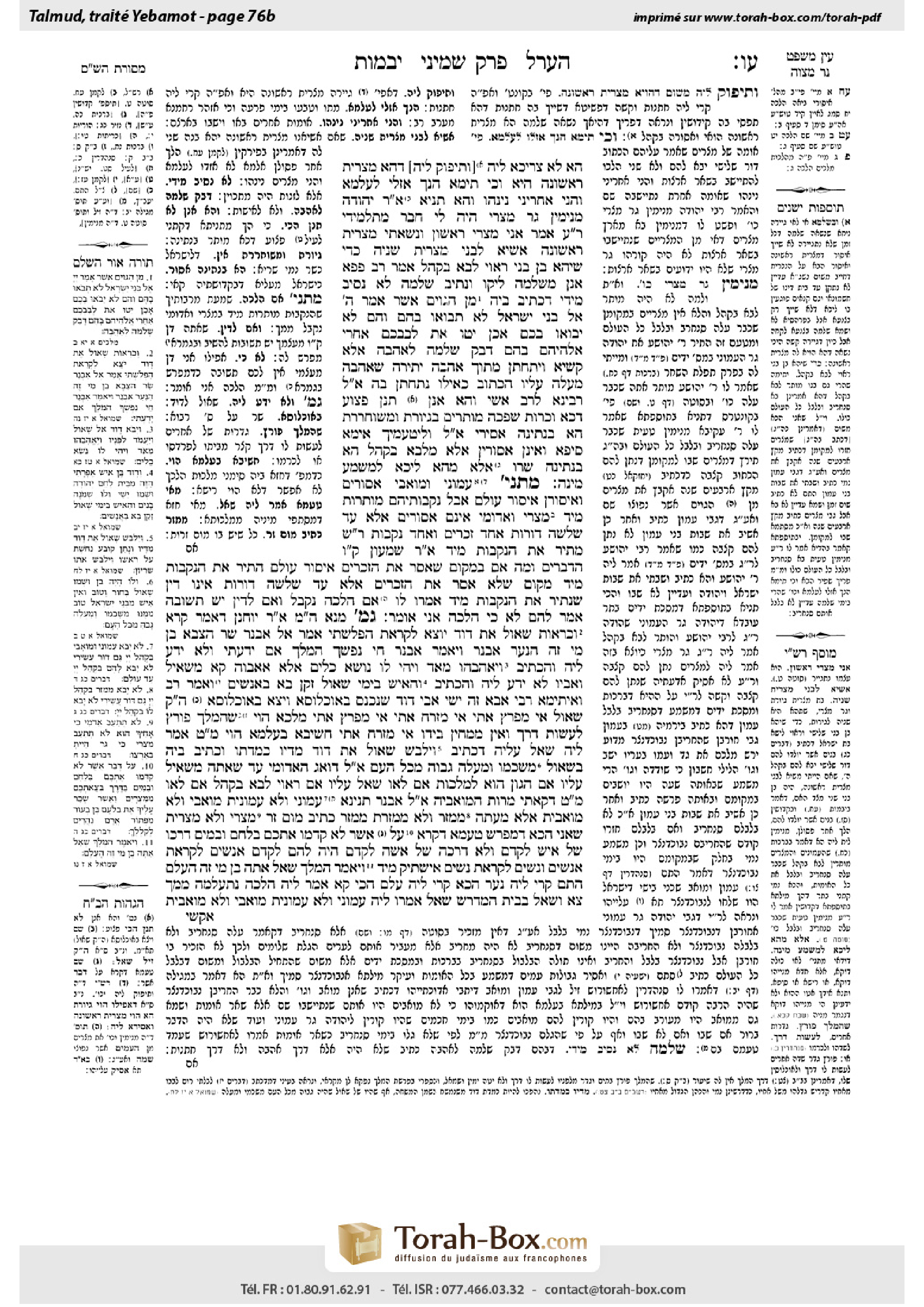
Yevamot 76b: Talmud study for Daf Yomi
Daf Yomi is the daily study of one Talmud folio. Explore 37 tractates with scans, Hebrew text, Sefaria English and AI-generated French translations where annotated.
Passage selection and English or AI-generated French translation are available where the scan has annotations. Daf Study is independent of Torah-Box and Sefaria.
Browse Yevamot · יבמות · All tractatesYevamot 76b text and translations
This page of Yevamot includes the Aramaic text, an English translation and an AI-generated French translation, alongside the scan above.
יבמות ע״ו ב · Aramaic and Hebrew text
הָא לָא צְרִיכָא לֵיהּ.
[וְתִיפּוֹק לֵיהּ] דְּהָא מִצְרִית רִאשׁוֹנָה הִיא! וְכִי תֵּימָא: הָנָךְ אָזְלִי לְעָלְמָא וְהָנֵי אַחֲרִינֵי נִינְהוּ,
וְהָא תַּנְיָא, אָמַר רַבִּי יְהוּדָה: מִנְיָמִין גֵּר מִצְרִי הָיָה לִי חָבֵר מִתַּלְמִידֵי רַבִּי עֲקִיבָא, אָמַר: אֲנִי מִצְרִי רִאשׁוֹן, וְנָשָׂאתִי מִצְרִית רִאשׁוֹנָה. אַשִּׂיא לִבְנִי מִצְרִית שְׁנִיָּה כְּדֵי שֶׁיְּהֵא בֶּן בְּנִי רָאוּי לָבֹא בַּקָּהָל!
אָמַר רַב פָּפָּא: אֲנַן מִשְּׁלֹמֹה לֵיקוּ וְנֹתֵיב? שְׁלֹמֹה לָא נְסֵיב מִידֵּי, דִּכְתִיב בֵּיהּ: ״מִן הַגּוֹיִם אֲשֶׁר אָמַר ה׳ אֶל בְּנֵי יִשְׂרָאֵל לֹא תָבוֹאוּ בָּהֶם וְהֵם לֹא יָבוֹאוּ בָכֶם אָכֵן יַטּוּ אֶת לְבַבְכֶם אַחֲרֵי אֱלֹהֵיהֶם, בָּהֶם דָּבַק שְׁלֹמֹה לְאַהֲבָה״. אֶלָּא קַשְׁיָא ״וַיִּתְחַתֵּן״!
מִתּוֹךְ אַהֲבָה יְתֵירָה שֶׁאֲהֵבָהּ, מַעֲלֶה עָלָיו הַכָּתוּב כְּאִילּוּ נִתְחַתֵּן בָּהּ.
אֲמַר לֵיהּ רָבִינָא לְרַב אָשֵׁי, וְהָא אֲנַן תְּנַן: פְּצוּעַ דַּכָּא וּכְרוּת שׇׁפְכָה מוּתָּרִים בְּגִיּוֹרֶת וּמְשׁוּחְרֶרֶת. הָא בִּנְתִינָה — אֲסִירִי!
אֲמַר לֵיהּ: וְלִיטַעְמָיךְ, אֵימָא סֵיפָא: וְאֵינָן אֲסוּרִין אֶלָּא מִלָּבֹא בַּקָּהָל. הָא בִּנְתִינָה שָׁרוּ! אֶלָּא מֵהָא לֵיכָּא לְמִשְׁמַע מִינַּהּ.
מַתְנִי׳ עַמּוֹנִי וּמוֹאָבִי — אֲסוּרִים, וְאִיסּוּרָן אִיסּוּר עוֹלָם. אֲבָל נְקֵבוֹתֵיהֶם — מוּתָּרוֹת מִיָּד.
מִצְרִי וַאֲדוֹמִי אֵינָם אֲסוּרִים אֶלָּא עַד שְׁלֹשָׁה דּוֹרוֹת, אֶחָד זְכָרִים וְאֶחָד נְקֵבוֹת. רַבִּי שִׁמְעוֹן מַתִּיר אֶת הַנְּקֵבוֹת מִיָּד. אָמַר רַבִּי שִׁמְעוֹן, קַל וָחוֹמֶר הַדְּבָרִים: וּמָה אִם בְּמָקוֹם שֶׁאָסַר אֶת הַזְּכָרִים אִיסּוּר עוֹלָם — הִתִּיר אֶת הַנְּקֵבוֹת מִיָּד, מָקוֹם שֶׁלָּא אָסַר אֶת הַזְּכָרִים אֶלָּא עַד שְׁלֹשָׁה דּוֹרוֹת — אֵינוֹ דִּין שֶׁנַּתִּיר אֶת הַנְּקֵבוֹת מִיָּד?
אָמְרוּ לוֹ: אִם הֲלָכָה — נְקַבֵּל, וְאִם לַדִּין — יֵשׁ תְּשׁוּבָה. אָמַר לָהֶם: לֹא כִּי, הֲלָכָה אֲנִי אוֹמֵר.
גְּמָ׳ מְנָא הָנֵי מִילֵּי? אָמַר רַבִּי יוֹחָנָן, דְּאָמַר קְרָא: ״וְכִרְאוֹת שָׁאוּל אֶת דָּוִד יוֹצֵא לִקְרַאת הַפְּלִשְׁתִּי אָמַר אֶל אַבְנֵר שַׂר הַצָּבָא בֶּן מִי זֶה הַנַּעַר אַבְנֵר וַיֹּאמֶר אַבְנֵר חֵי נַפְשְׁךָ הַמֶּלֶךְ אִם יָדָעְתִּי״. וְלָא יְדַע לֵיהּ? וְהָכְתִיב: ״וַיֶּאֱהָבֵהוּ מְאֹד וַיְהִי לוֹ נוֹשֵׂא כֵּלִים״! אֶלָּא אַאֲבוּהּ קָא מְשַׁאֵיל.
וְאָבִיו לָא יְדַע לֵיהּ? וְהָכְתִיב: ״וְהָאִישׁ בִּימֵי שָׁאוּל זָקֵן בָּא בַאֲנָשִׁים״, וְאָמַר רַב, וְאִיתֵּימָא רַבִּי אַבָּא: זֶה יִשַׁי אֲבִי דָוִד, שֶׁנִּכְנַס בְּאוּכְלוּסָא וְיָצָא בְּאוּכְלוּסָא!
הָכִי קָאָמַר שָׁאוּל: אִי מִפֶּרֶץ אָתֵי, אִי מִזֶּרַח אָתֵי? אִי מִפֶּרֶץ אָתֵי — מַלְכָּא הָוֵי, שֶׁהַמֶּלֶךְ פּוֹרֵץ לַעֲשׂוֹת דֶּרֶךְ וְאֵין מְמַחִין בְּיָדוֹ. אִי מִזֶּרַח אָתֵי — חֲשִׁיבָא בְּעָלְמָא הָוֵי.
מַאי טַעְמָא אֲמַר לֵיהּ שַׁאֵל עֲלֵיהּ, דִּכְתִיב: ״וַיַּלְבֵּשׁ שָׁאוּל אֶת דָּוִד מַדָּיו״, כְּמִדָּתוֹ. וּכְתִיב בֵּיהּ בְּשָׁאוּל: ״מִשִּׁכְמוֹ וָמַעְלָה גָּבוֹהַּ מִכׇּל הָעָם״. אֲמַר לֵיהּ דּוֹאֵג הָאֲדוֹמִי: עַד שֶׁאַתָּה מְשַׁאֵיל עָלָיו אִם הָגוּן הוּא לַמַּלְכוּת אִם לָאו, שְׁאַל עָלָיו אִם רָאוּי לָבֹא בַּקָּהָל אִם לָאו. מַאי טַעְמָא? דְּקָאָתֵי מֵרוּת הַמּוֹאֲבִיָּה.
אֲמַר לֵיהּ אַבְנֵר, תְּנֵינָא: ״עַמּוֹנִי״, וְלֹא עַמּוֹנִית. ״מוֹאָבִי״, וְלֹא מוֹאָבִית. אֶלָּא מֵעַתָּה: ״מַמְזֵר״, וְלֹא מַמְזֶרֶת? ״מַמְזֵר״ כְּתִיב — מוּם זָר.
״מִצְרִי״, וְלֹא מִצְרִית! שָׁאנֵי הָכָא, דִּמְפָרֵשׁ טַעְמָא דִקְרָא: ״עַל אֲשֶׁר לֹא קִדְּמוּ אֶתְכֶם בַּלֶּחֶם וּבַמַּיִם״ — דַּרְכּוֹ שֶׁל אִישׁ לְקַדֵּם, וְלֹא דַּרְכָּהּ שֶׁל אִשָּׁה לְקַדֵּם. הָיָה לָהֶם לְקַדֵּם אֲנָשִׁים לִקְרַאת אֲנָשִׁים וְנָשִׁים לִקְרַאת נָשִׁים! אִישְׁתִּיק.
מִיָּד: ״וַיֹּאמֶר הַמֶּלֶךְ שְׁאַל אַתָּה בֶּן מִי זֶה הָעָלֶם״. הָתָם קָרֵי לֵיהּ ״נַעַר״, הָכָא קָרֵי לֵיהּ ״עֶלֶם״? הָכִי קָא אֲמַר לֵיהּ: הֲלָכָה נִתְעַלְּמָה מִמְּךָ — צֵא וּשְׁאַל בְּבֵית הַמִּדְרָשׁ. שָׁאַל, אֲמַרוּ לֵיהּ: ״עַמּוֹנִי״, וְלֹא עַמּוֹנִית. ״מוֹאָבִי״, וְלֹא מוֹאָבִית.
Yevamot 76b · English translation
But this one, Pharaoh’s daughter, did not require such things, as she herself was the daughter of royalty, and therefore there would have been no reason to doubt the sincerity of her conversion.
The Gemara asks: But let him derive that Pharaoh’s daughter was forbidden to Solomon for a different reason, as she was a first-generation Egyptian convert. Even if she converted, she would still have been an Egyptian convert of the first generation, and as such neither she nor her children would have been permitted to marry a Jew by birth (Deuteronomy 23:8–9). And if you would say that those whom the Torah rendered forbidden have already left Egypt and are now living elsewhere in the world, and those currently living in Egypt are others, there is a difficulty.
As, isn’t it taught in a baraita that Rabbi Yehuda said: Minyamin, an Egyptian convert, was a friend of mine from among the students of Rabbi Akiva, and he said: After I converted I was a first-generation Egyptian convert, and so I married another first-generation Egyptian convert. I will marry off my son, who is a second-generation Egyptian convert, to another second-generation Egyptian convert, so that my grandson will be fit to enter into the congregation. This indicates that first- and second-generation converts of Egyptian extraction were prohibited from entering into the congregation even during the period of the Mishna.
Rav Pappa said: Shall we stand up and raise an objection from Solomon? Solomon did not marry anyone, as it is written in his regard: “Of the nations concerning which the Lord said to the children of Israel, You shall not go among them, neither shall they come among you; for surely they will turn away your heart after their gods; Solomon cleaved to these in love” (I Kings 11:2). Solomon cleaved to these women in love, but was not legally married to them. As Solomon had other forbidden wives, the case of Pharaoh’s daughter presents no special difficulty. In fact, none of these marriages were valid at all. But the phrase “and Solomon married” (I Kings 3:1) that appears in connection with Pharaoh’s daughter is difficult, as it indicates that this marriage was in fact valid.
The Gemara answers: Due to the extraordinary love that he had for her, the verse relates to him as if he had married her through a legally valid marriage, even though this was not the case.
Ravina said to Rav Ashi: But didn’t we learn in the mishna that a man with crushed testicles and one whose penis has been severed are permitted to marry a female convert and an emancipated maidservant? That indicates that it is only these women whom they are permitted to marry, but they are prohibited from marrying a Gibeonite woman. This appears to contradict the baraita that permits a man with crushed testicles to marry a Gibeonite.
Rav Ashi said to Ravina: And according to your line of reasoning, say the latter clause of the mishna as follows: And they are prohibited only from entering into the congregation, and infer just the opposite, that it is only a woman who was born Jewish whom they are prohibited from marrying, but they are permitted to marry a Gibeonite woman, as she is not part of the congregation of the Lord. Rather, no inference is to be learned from this mishna, as the possible inferences are contradictory, and one must therefore rely on the halakha that was expressly taught.
MISHNA: Ammonite and Moabite converts are prohibited from entering into the congregation and marrying a woman who was born Jewish, and their prohibition is eternal, for all generations. However, their female counterparts, even the convert herself, are permitted immediately.
Egyptian and Edomite converts are prohibited from entering into the congregation only for three generations, both males and females. Rabbi Shimon renders permitted Egyptian and Edomite females immediately. Rabbi Shimon said: The matter may be derived by way of an a fortiori inference: If in a place where the Torah rendered prohibited the males with an eternal prohibition, i.e., Ammonites and Moabites, it rendered permitted the females immediately, then in a place where it rendered prohibited the males for only three generations, i.e., Egyptians and Edomites, is it not right that we should render permitted the females immediately?
Rabbi Shimon’s colleagues said to him: If you are reporting a halakha that you received from your teachers, we will accept it from you. But if you merely wish to prove your case with an a fortiori inference based on your own reasoning, there is a refutation of your argument. Rabbi Shimon said to them: That is not so. I disagree with your claim that the a fortiori inference can be refuted, but in any case I am stating a halakha handed down to me by my teachers.
GEMARA: The Gemara asks: From where are these matters derived that female Ammonites and Moabites are permitted immediately? Rabbi Yoḥanan said: As the verse states: “And when Saul saw David go forth against the Philistine, he said to Abner, the captain of the host: Abner, whose son is this youth? And Abner said: As your soul lives, O king, I cannot tell” (I Samuel 17:55). This verse is puzzling: Did Saul really not recognize him? But isn’t it previously written: “And David came to Saul, and stood before him; and he loved him greatly; and he became his armor-bearer” (I Samuel 16:21)? Rather, it must be that he was asking about David’s father.
The Gemara is still puzzled by this verse: And did Saul not recognize David’s father? But isn’t it written with regard to Jesse, David’s father: “And the man in the days of Saul was old, and came among men” (I Samuel 17:12), and Rav, and some say Rabbi Abba, said: This is referring to Jesse, father of David, who always entered with multitudes [ukhlusa] and left with multitudes. As he was clearly a man of importance, everyone must have known who he was.
Rather, this is what Saul was saying, in his attempt to clarify David’s lineage: Does he come from the descendants of Perez, or does he come from the descendants of Zerah? What is the significance of this question? If he comes from Perez he will be king, as a king may breach [poretz] a way for himself and no one can stop him. And if he comes from Zerah he will be merely a man of importance, but not a king.
The Gemara continues with its explanation: For what reason did Saul say to Abner that he should inquire about David? As it is written: “And Saul clad David with his apparel [maddav]” (I Samuel 17:38), which indicates that the clothes were of David’s size [kemiddato]. And it is written with regard to Saul: “From his shoulders and upward he was higher than any of the people” (I Samuel 9:2). Upon seeing that his clothes fit David, Saul began to fear that it might be David who was destined for the throne, and he therefore inquired into his background. At that point, Doeg the Edomite said to Saul: Before you inquire as to whether or not he is fit for kingship, inquire as to whether or not he is even fit to enter into the congregation. What is the reason for such doubts? It is that he descends from Ruth the Moabite, and Moabites are permanently barred from entering the congregation.
Abner said to him: We already learned that there is no room for such concern. As the verse states: “An Ammonite or a Moabite shall not enter into the congregation of the Lord” (Deuteronomy 23:4), teaching that an Ammonite man is barred from entering into the congregation, but not an Ammonite woman; and similarly, a Moabite man is barred from entering into the congregation, but not a Moabite woman. Doeg said to him: However, if that is so, say that the verse that renders it prohibited for a mamzer to enter the congregation renders prohibited only a male mamzer, but not a female mamzer. Abner replied: It is written: “A mamzer,” which should be understood not as a noun but as an adjective, denoting a strange blemish [mum zar], one who is defective due to a forbidden relationship, and this applies to males and females alike.
Doeg retorted: If so, say that it is prohibited for only an Egyptian man to enter into the congregation, but not an Egyptian woman. Abner answered: Here it is different, as the reason for the prohibition recorded in this verse with regard to Ammonites is explicit: “Because they did not meet you with bread and with water on the way, when you came forth out of Egypt” (Deuteronomy 23:5). Since it is the way of a man to go forth to meet guests but it is not the way of a woman to go forth, females were not included in this prohibition. Doeg countered: Still, the men should have gone forth to meet the men, and the women to meet the women. Abner was silent, as he did not know how to respond to this objection.
Immediately: “And the king said, inquire you whose son is this lad” (I Samuel 17:56). The Gemara comments: There, in the previous verse, Saul calls him youth [na’ar], and here he calls him lad [elem]. This change in the wording hints at the following discussion. Saul said to Doeg as follows: The halakha is hidden [nitalma] from you, and you are ignorant of the law. Go and inquire about the matter in the study hall. He went to the study hall and asked. They said to him: The halakha is: An Ammonite man is forbidden, but not an Ammonite woman; a Moabite man is forbidden, but not a Moabite woman.
Yevamot 76b · Traduction française (IA)
Mais ce n’était pas nécessaire dans le cas de la fille de Pharaon, car elle était elle-même de sang royal ; il n’y avait donc aucune raison de douter de la sincérité de sa conversion.
La Guemara demande : Mais ne peut-on pas déduire que la fille de Pharaon était interdite à Salomon pour une autre raison : elle était une convertie égyptienne de première génération. Même après sa conversion, elle serait restée une convertie égyptienne de première génération et, à ce titre, ni elle ni ses enfants n’auraient eu le droit d’épouser un Juif de naissance (Deutéronome 23:8–9). Et si tu dis que ceux que la Torah a rendus interdits ont déjà quitté l’Égypte et vivent désormais ailleurs dans le monde, tandis que ceux qui vivent actuellement en Égypte sont d’autres personnes, une difficulté se pose.
En effet, n’est-il pas enseigné dans une baraïta que Rabbi Yehuda a dit : « Minyamin, un converti égyptien, était un ami à moi parmi les élèves de Rabbi Akiva, et il a dit : “Après ma conversion, j’étais un converti égyptien de première génération ; j’ai donc épousé une autre convertie égyptienne de première génération. Je marierai mon fils, qui sera un converti égyptien de deuxième génération, à une autre convertie égyptienne de deuxième génération, afin que mon petit-fils puisse entrer dans l’assemblée.” » Cela indique que les convertis égyptiens de première et de deuxième génération n’avaient pas le droit d’entrer dans l’assemblée, même à l’époque de la Michna.
Rav Pappa a dit : « Allons-nous nous lever et soulever une objection à partir du cas de Salomon ? » Salomon n’a épousé personne, comme il est écrit à son sujet : « Parmi les nations au sujet desquelles l’Éternel avait dit aux enfants d’Israël : “Vous n’irez pas parmi elles, et elles ne viendront pas parmi vous, car elles détourneront certainement votre cœur vers leurs dieux”, Salomon s’attacha à elles par amour » (I Rois 11:2). Salomon s’attacha à ces femmes par amour, mais ne les épousa pas légalement. Puisque Salomon avait d’autres épouses interdites, le cas de la fille de Pharaon ne présente aucune difficulté particulière. En fait, aucun de ces mariages n’était valide. Mais l’expression « et Salomon épousa » (I Rois 3:1), employée à propos de la fille de Pharaon, pose problème, car elle indique que ce mariage était bel et bien valide.
La Guemara répond : En raison de l’amour extraordinaire qu’il éprouvait pour elle, le verset parle comme s’il l’avait épousée par un mariage juridiquement valide, alors que ce n’était pas le cas.
Ravina dit à Rav Ashi : « Mais n’avons-nous pas appris dans la Michna qu’un homme aux testicules écrasés et un homme dont le pénis a été sectionné ont le droit d’épouser une convertie et une servante affranchie ? Cela indique que seules ces femmes ont le droit d’épouser ces hommes, mais que ceux-ci n’ont pas le droit d’épouser une femme guivonite. Cela semble contredire la baraïta, qui autorise un homme aux testicules écrasés à épouser une Guivonite. »
Rav Ashi dit à Ravina : « Selon ton raisonnement, interprète la dernière clause de la Michna ainsi : “Et il leur est seulement interdit d’entrer dans l’assemblée”, et déduis exactement le contraire : seules les femmes nées juives leur sont interdites en mariage, mais ils ont le droit d’épouser une femme guivonite, puisqu’elle ne fait pas partie de l’assemblée de l’Éternel. En réalité, il ne faut tirer aucune déduction de cette Michna, car les déductions possibles se contredisent ; il faut donc s’en tenir à la halakha enseignée explicitement. »
MICHNA : Les convertis ammonites et moabites n’ont pas le droit d’entrer dans l’assemblée ni d’épouser une femme née juive, et cette interdiction est éternelle, pour toutes les générations. En revanche, leurs homologues féminines, même les converties elles-mêmes, en ont immédiatement le droit.
Les convertis égyptiens et édomites n’ont pas le droit d’entrer dans l’assemblée pendant trois générations seulement, hommes comme femmes. Rabbi Shimon autorise immédiatement les femmes égyptiennes et édomites. Rabbi Shimon a dit : « On peut le déduire par raisonnement a fortiori : là où la Torah a interdit les hommes à perpétuité, c’est-à-dire les Ammonites et les Moabites, elle a autorisé immédiatement les femmes ; là où elle n’a interdit les hommes que pour trois générations, c’est-à-dire les Égyptiens et les Édomites, n’est-il pas à plus forte raison juste d’autoriser immédiatement les femmes ? »
Les collègues de Rabbi Shimon lui dirent : « Si tu rapportes une halakha que tu as reçue de tes maîtres, nous l’accepterons de toi. Mais si tu veux simplement démontrer ta position par un raisonnement a fortiori fondé sur ton propre raisonnement, ton argument peut être réfuté. » Rabbi Shimon leur dit : « Ce n’est pas le cas. Je conteste votre affirmation selon laquelle le raisonnement a fortiori peut être réfuté, mais, quoi qu’il en soit, je rapporte une halakha transmise par mes maîtres. »
GUEMARA : La Guemara demande : D’où tire-t-on que les femmes ammonites et moabites sont autorisées immédiatement ? Rabbi Yoḥanan a dit : Le verset dit : « Lorsque Saül vit David s’avancer contre le Philistin, il dit à Abner, chef de l’armée : “Abner, de qui ce jeune homme est-il le fils ?” Abner répondit : “Par ta vie, ô roi, je ne le sais pas” » (I Samuel 17:55). Ce verset est étonnant : Saül ne le reconnaissait-il vraiment pas ? Pourtant, il est écrit auparavant : « David vint auprès de Saül et se tint devant lui ; il l’aima beaucoup, et David devint son écuyer » (I Samuel 16:21). Il faut donc comprendre qu’il s’enquérait du père de David.
La Guemara reste perplexe au sujet de ce verset : Saül ne reconnaissait-il pas le père de David ? Pourtant, il est écrit au sujet de Jessé, le père de David : « Cet homme, du temps de Saül, était âgé et venait parmi les hommes » (I Samuel 17:12), et Rav — certains disent Rabbi Abba — a dit : « Cela désigne Jessé, père de David, qui entrait toujours accompagné d’une foule [ukhlusa] et repartait accompagné d’une foule. » Puisqu’il était manifestement un homme important, tout le monde devait savoir qui il était.
Il faut plutôt comprendre que Saül disait ceci, en cherchant à éclaircir l’ascendance de David : « Descend-il de Pérets ou de Zérah ? » Quelle est l’importance de cette question ? S’il descend de Pérets, il sera roi, car un roi peut se frayer [poretz] un chemin et nul ne peut l’en empêcher. Et s’il descend de Zérah, il sera seulement un homme important, mais pas un roi.
La Guemara poursuit son explication : Pour quelle raison Saül a-t-il dit à Abner de se renseigner au sujet de David ? Car il est écrit : « Saül revêtit David de ses vêtements [maddav] » (I Samuel 17:38), ce qui indique que les vêtements étaient à la taille de David [kemiddato]. Et il est écrit au sujet de Saül : « Depuis ses épaules et au-dessus, il dépassait de la tête tout le peuple » (I Samuel 9:2). Voyant que ses vêtements allaient à David, Saül commença à craindre que David soit destiné au trône ; il s’enquit donc de ses origines. À ce moment, Doëg l’Édomite dit à Saül : « Avant de chercher à savoir s’il est apte à régner, demande-toi s’il est seulement apte à entrer dans l’assemblée. » Pourquoi avoir de tels doutes ? Parce qu’il descend de Ruth la Moabite, et que les Moabites sont à jamais exclus de l’assemblée.
Abner lui dit : « Nous avons déjà appris qu’il n’y a pas lieu de s’inquiéter ainsi. Le verset dit : “Aucun Ammonite ni Moabite n’entrera dans l’assemblée de l’Éternel” (Deutéronome 23:4), ce qui enseigne qu’un homme ammonite est exclu de l’assemblée, mais pas une femme ammonite ; de même, un homme moabite est exclu de l’assemblée, mais pas une femme moabite. » Doëg lui dit : « Dans ce cas, dis que le verset qui interdit au mamzer d’entrer dans l’assemblée n’interdit qu’un mamzer masculin, mais pas un mamzer féminin. » Abner répondit : « Il est écrit “mamzer”, qui doit être compris non comme un nom, mais comme un adjectif désignant une difformité étrangère [mum zar], une personne rendue défectueuse par une union interdite ; cela s’applique aux hommes comme aux femmes. »
Doëg rétorqua : « Dans ce cas, dis qu’il est interdit à un homme égyptien seulement d’entrer dans l’assemblée, mais pas à une femme égyptienne. » Abner répondit : « Ici, c’est différent, car la raison de l’interdiction énoncée dans ce verset au sujet des Ammonites est explicite : “Parce qu’ils ne sont pas venus à votre rencontre avec du pain et de l’eau sur le chemin, lorsque vous êtes sortis d’Égypte” (Deutéronome 23:5). Comme il est dans la nature d’un homme d’aller à la rencontre des voyageurs, mais pas dans celle d’une femme, les femmes ne sont pas visées par cette interdiction. » Doëg objecta : « Malgré tout, les hommes auraient dû aller à la rencontre des hommes, et les femmes à la rencontre des femmes. » Abner garda le silence, car il ne savait pas quoi répondre à cette objection.
Aussitôt : « Le roi dit : “Demandez de qui ce garçon est le fils” » (I Samuel 17:56). La Guemara fait remarquer : Dans le verset précédent, Saül l’appelle jeune homme [na’ar], et ici il l’appelle garçon [elem]. Ce changement de vocabulaire annonce la discussion suivante. Saül dit alors à Doëg : « La halakha t’échappe [nitalma], et tu ignores la loi. Va te renseigner à ce sujet à la maison d’étude. » Doëg se rendit à la maison d’étude et posa la question. On lui répondit : « La halakha est la suivante : un homme ammonite est interdit, mais pas une femme ammonite ; un homme moabite est interdit, mais pas une femme moabite. »
Traduction française générée par IA à partir de l’édition anglaise de Sefaria. Vérifie toujours un passage avec le texte source.
Text from Sefaria: William Davidson Edition - Vocalized Aramaic (CC BY NC); William Davidson Edition - English (CC BY NC).