Yevamot 77a: Talmud study for Daf Yomi
Daf Yomi is the daily study of one Talmud folio. Explore 37 tractates with scans, Hebrew text, Sefaria English and AI-generated French translations where annotated.
Passage selection and English or AI-generated French translation are available where the scan has annotations. Daf Study is independent of Torah-Box and Sefaria.
Browse Yevamot · יבמות · All tractatesYevamot 77a text and translations
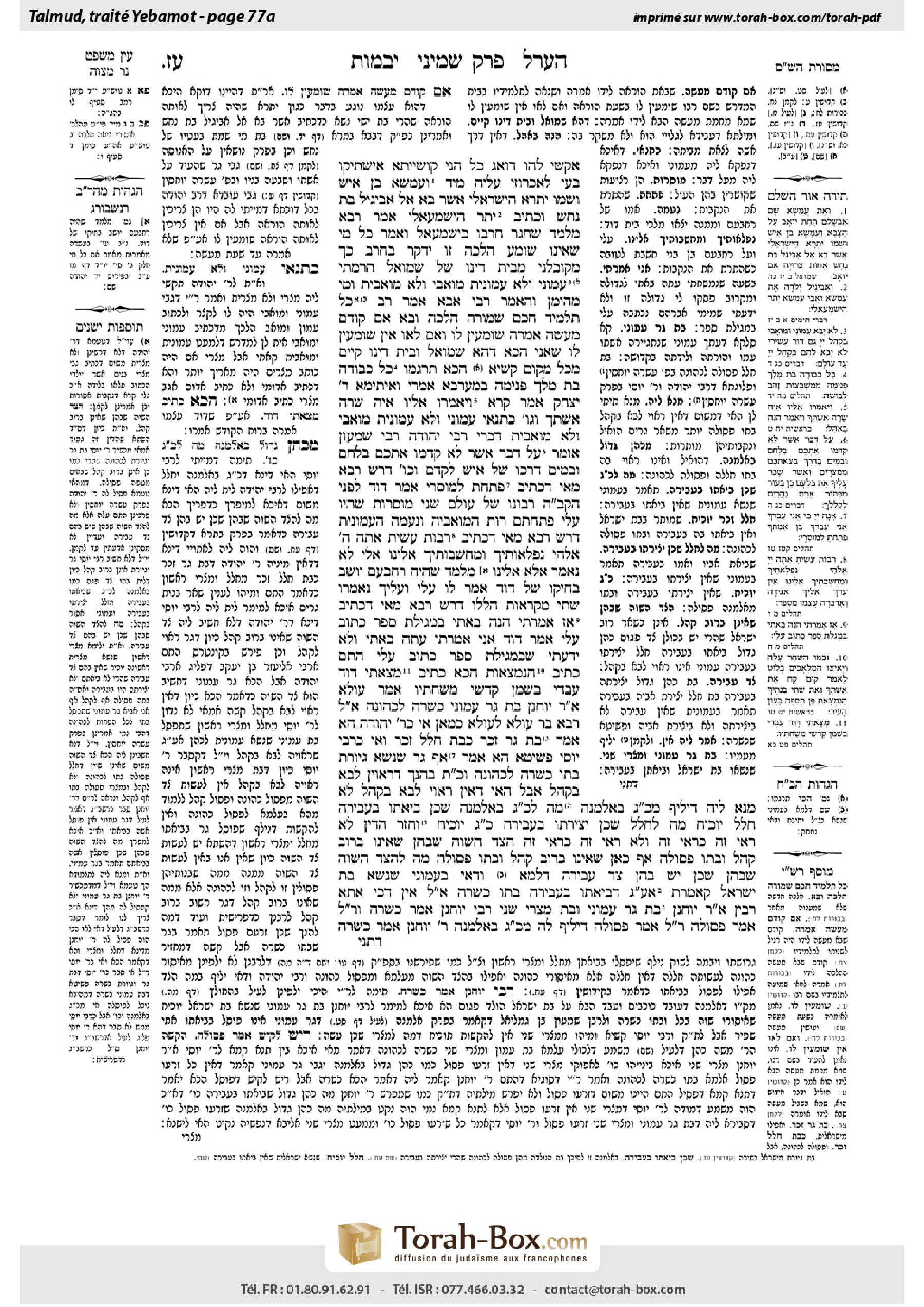
This page of Yevamot includes the Aramaic text, an English translation and an AI-generated French translation, alongside the scan above.
יבמות ע״ז א · Aramaic and Hebrew text
אַקְשִׁי לְהוּ דּוֹאֵג כֹּל הָנֵי קוּשְׁיָיתָא, אִישְׁתִּיקוּ. בָּעֵי לְאַכְרוֹזֵי עֲלֵיהּ. מִיַּד ״וַעֲמָשָׂא בֶן אִישׁ וּשְׁמוֹ יִתְרָא הַיִּשְׂרְאֵלִי אֲשֶׁר בָּא אֶל אֲבִיגַל בַּת נָחָשׁ״, וּכְתִיב, ״יֶתֶר הַיִּשְׁמְעֵאלִי״, אָמַר רָבָא: מְלַמֵּד שֶׁחָגַר חַרְבּוֹ כְּיִשְׁמָעֵאל, וְאָמַר: כׇּל מִי שֶׁאֵינוֹ שׁוֹמֵעַ הֲלָכָה זוֹ — יִדָּקֵר בַּחֶרֶב. כָּךְ מְקוּבְּלַנִי מִבֵּית דִּינוֹ שֶׁל שְׁמוּאֵל הָרָמָתִי: ״עַמּוֹנִי״, וְלֹא עַמּוֹנִית. ״מוֹאָבִי״, וְלֹא מוֹאָבִית.
וּמִי מְהֵימַן? וְהָאָמַר רַבִּי אַבָּא אָמַר רַב: כׇּל תַּלְמִיד חָכָם שֶׁמּוֹרֶה הֲלָכָה וּבָא, אִם קוֹדֶם מַעֲשֶׂה אֲמָרָהּ — שׁוֹמְעִין לוֹ, וְאִם לָאו — אֵין שׁוֹמְעִין לוֹ! שָׁאנֵי הָכָא, דְּהָא שְׁמוּאֵל וּבֵית דִּינוֹ קַיָּים.
מִכׇּל מָקוֹם קַשְׁיָא! הָכָא תַּרְגִּימוּ: ״כׇּל כְּבוּדָּה בַת מֶלֶךְ פְּנִימָה״. בְּמַעְרְבָא אָמְרִי, וְאִיתֵּימָא רַבִּי יִצְחָק, אָמַר קְרָא: ״וַיֹּאמְרוּ אֵלָיו אַיֵּה שָׂרָה אִשְׁתֶּךָ וְגוֹ׳״.
כְּתַנָּאֵי: ״עַמּוֹנִי״, וְלֹא עַמּוֹנִית, ״מוֹאָבִי״, וְלֹא מוֹאָבִית, דִּבְרֵי רַבִּי יְהוּדָה, רַבִּי שִׁמְעוֹן אוֹמֵר: ״עַל דְּבַר אֲשֶׁר לֹא קִדְּמוּ אֶתְכֶם בַּלֶּחֶם וּבַמַּיִם״ — דַּרְכּוֹ שֶׁל אִישׁ לְקַדֵּם וְכוּ׳.
דָּרֵשׁ רָבָא, מַאי דִּכְתִיב: ״פִּתַּחְתָּ לְמוֹסֵרָי״ — אָמַר דָּוִד לִפְנֵי הַקָּדוֹשׁ בָּרוּךְ הוּא: רִבּוֹנוֹ שֶׁל עוֹלָם, שְׁנֵי מוֹסֵרוֹת שֶׁהָיוּ עָלַי, פִּתַּחְתָּם: רוּת הַמּוֹאֲבִיָּה וְנַעֲמָה הָעַמּוֹנִית.
דָּרֵשׁ רָבָא: מַאי דִּכְתִיב ״רַבּוֹת עָשִׂיתָ אַתָּה ה׳ אֱלֹהַי נִפְלְאוֹתֶיךָ וּמַחְשְׁבוֹתֶיךָ אֵלֵינוּ״. ״אֵלַי״ לֹא נֶאֱמַר, אֶלָּא ״אֵלֵינוּ״ — מְלַמֵּד שֶׁהָיָה רְחַבְעָם יוֹשֵׁב בְּחֵיקוֹ שֶׁל דָּוִד, אָמַר לוֹ: עָלַי וְעָלֶיךָ נֶאֶמְרוּ שְׁתֵּי מִקְרָאוֹת הַלָּלוּ.
דָּרֵשׁ רָבָא, מַאי דִּכְתִיב: ״אָז אָמַרְתִּי הִנֵּה בָאתִי בִּמְגִילַּת סֵפֶר כָּתוּב עָלָי״, אָמַר דָּוִד: אֲנִי אָמַרְתִּי ״עַתָּה בָאתִי״, וְלֹא יָדַעְתִּי שֶׁ״בִּמְגִילַּת סֵפֶר כָּתוּב עָלָי״. הָתָם כְּתִיב: ״הַנִּמְצָאוֹת״, הָכָא כְּתִיב: ״מָצָאתִי דָּוִד עַבְדִּי בְּשֶׁמֶן קׇדְשִׁי מְשַׁחְתִּיו״.
אָמַר עוּלָּא אָמַר רַבִּי יוֹחָנָן: בַּת גֵּר עַמּוֹנִי כְּשֵׁרָה לַכְּהוּנָּה. אֲמַר לֵיהּ רָבָא בַּר עוּלָּא לְעוּלָּא: כְּמַאן? אִי כְּרַבִּי יְהוּדָה, הָא אָמַר: בַּת גֵּר זָכָר — כְּבַת חָלָל זָכָר! וְאִי כְּרַבִּי יוֹסֵי, פְּשִׁיטָא, הָא אָמַר: אַף גֵּר שֶׁנָּשָׂא גִּיּוֹרֶת — בִּתּוֹ כְּשֵׁרָה לִכְהוּנָּה.
וְכִי תֵּימָא, בְּהָנָךְ דִּרְאוּיִן לָבֹא בַּקָּהָל, אֲבָל הַאי דְּאֵין רָאוּי לָבֹא בַּקָּהָל — לָא, מְנָא לֵיהּ?
דְּיָלֵיף מִכֹּהֵן גָּדוֹל בְּאַלְמָנָה. מָה לְכֹהֵן גָּדוֹל בְּאַלְמָנָה — שֶׁכֵּן בִּיאָתוֹ בַּעֲבֵירָה.
חָלָל יוֹכִיחַ! מָה לְחָלָל שֶׁכֵּן יְצִירָתוֹ בַּעֲבֵירָה —
כֹּהֵן גָּדוֹל יוֹכִיחַ. וְחָזַר הַדִּין:
לֹא רְאִי זֶה כִּרְאִי זֶה, וְלֹא רְאִי זֶה כִּרְאִי זֶה. הַצַּד הַשָּׁוֶה שֶׁבָּהֶן: שֶׁאֵינוֹ בְּרוֹב קָהָל, וּבִתּוֹ פְּסוּלָה. אַף כָּאן, שֶׁאֵינוֹ בְּרוֹב קָהָל — וּבִתּוֹ פְּסוּלָה.
מָה לְהַצַּד הַשָּׁוֶה שֶׁבָּהֶן שֶׁכֵּן יֵשׁ בָּהֶן צַד עֲבֵירָה!
דִּלְמָא וַדַּאי בְּעַמּוֹנִי שֶׁנָּשָׂא בַּת יִשְׂרָאֵל קָאָמְרַתְּ, אַף עַל גַּב דְּבִיאָתוֹ בַּעֲבֵירָה — בִּתּוֹ כְּשֵׁרָה! אֲמַר לֵיהּ: אִין.
דְּכִי אֲתָא רָבִין אָמַר רַבִּי יוֹחָנָן: בַּת גֵּר עַמּוֹנִי, וּבַת מִצְרִי שֵׁנִי, רַבִּי יוֹחָנָן אָמַר: כְּשֵׁרָה, וְרֵישׁ לָקִישׁ אָמַר: פְּסוּלָה. רֵישׁ לָקִישׁ אָמַר פְּסוּלָה — דְּיָלֵיף לַהּ מִכֹּהֵן גָּדוֹל בְּאַלְמָנָה. רַבִּי יוֹחָנָן אָמַר כְּשֵׁרָה —
Yevamot 77a · English translation
Doeg raised before them all those objections from the others who are disqualified from entering into the congregation, and they were silent, not knowing how to respond. Doeg then wanted to proclaim that David was disqualified from entering into the congregation. He was immediately answered. Here it says: “Now Amasa was the son of a man, whose name was Jithra the Israelite, that went into Abigal the daughter of Nahash” (II Samuel 17:25), and yet elsewhere it is written that Amasa’s father was named “Jether the Ishmaelite” (I Chronicles 2:17). Rava said: This teaches that he girded his sword like Ishmael, i.e., like an Arab, and said: Whoever does not accept this halakha and act accordingly shall be stabbed with the sword. This is the tradition that I received from the court of Samuel from Rama: An Ammonite man is prohibited from entering into the congregation, but not an Ammonite woman; a Moabite man is prohibited from entering into the congregation, but not a Moabite woman.
The Gemara asks about this incident: And is he trusted to offer such testimony? But didn’t Rabbi Abba say that Rav said: With regard to every Torah scholar who issues a halakhic ruling based on a tradition he claims to have received from his teacher, and that ruling has practical ramifications for himself as well, if he stated the ruling already before the incident, i.e., before it had a bearing on his own case, one listens to him; but if not, if he reported the tradition only after it was personally relevant to him, one does not listen to him, as he is an interested party. Since Amasa was the son of Jesse’s daughter Abigail, as stated in the aforementioned verse in Chronicles, the matter certainly affected his own status. The Gemara answers: Here it is different, as Samuel and the other members of his court were still living, and the truth of Amasa’s report could be easily verified.
The Gemara asks: In any case, the unanswered question raised by Doeg is difficult. The Gemara answers: Here, in Babylonia, they explained the matter based on the verse: “The king’s daughter is all glorious within” (Psalms 45:14), which indicates that it is unbefitting for a woman to venture outside at all, and therefore the Ammonite women would not have been expected to go forth to meet the Jewish women. In the West, Eretz Yisrael, they say, and some say it was Rabbi Yitzḥak who said: The verse states: “And they said to him: Where is Sarah your wife? And he said: Behold, in the tent” (Genesis 18:9), which teaches that it is praiseworthy for a woman to remain inside her home.
The Gemara comments that this disagreement with regard to the source of the halakha that it is permitted for an Ammonite or Moabite woman to enter into the congregation is like the following dispute between tanna’im: The verse states: “An Ammonite or a Moabite” (Deuteronomy 23:4); an Ammonite man is barred from entering into the congregation, but not an Ammonite woman, and similarly, a Moabite man is barred from entering into the congregation, but not a Moabite woman. This is the statement of Rabbi Yehuda, who derives the halakha from the masculine form of these two terms. Rabbi Shimon says: The verse states: “Because they did not meet you with bread and with water on the way” (Deuteronomy 23:5). Since it is the way of a man, but not the way of a woman, to go forth to meet guests, females were not included in the prohibition.
With regard to the same issue, Rava taught: What is the meaning of that which is written: “You have loosened my bands” (Psalms 116:16)? David said before the Holy One, Blessed be He: Master of the Universe, You have loosened the two bands that were on me, on account of which I and my entire family might have been disqualified, i.e., Ruth the Moabite woman and Na’ama the Ammonite woman. Owing to the allowance granted to Moabite and Ammonite women, we are permitted to enter the congregation.
Rava further taught: What is the meaning of that which is written: “Many things have You done, O Lord my God, Your wonders and Your thoughts are upon us” (Psalms 40:6)? Upon me is not stated, but rather “upon us,” which teaches that Rehoboam, son of Solomon and grandson of David, was sitting on the lap of David, who said to him: These two verses were stated about me and about you, as Rehoboam’s mother was Na’ama the Ammonite.
With regard to the same issue, Rava also taught: What is the meaning of that which is written: “Then I said: Behold, I have come; in the scroll of a book it is written about me” (Psalms 40:8)? David said: I had said that I have come only now; my life was created only recently, at the time of my birth. But I did not know that it was already written about me in the scroll of a book, that an ancient text already hints at my existence. There, with regard to the daughters of Lot, it is written: “And your two daughters that are found here” (Genesis 19:15), and here, with regard to David, it is written: “I have found David, My servant; I have anointed him with My holy oil” (Psalms 89:21). The lost article that was found among the daughters of Lot, the mothers of Ammon and Moab, is David and his royal house.
Ulla said that Rabbi Yoḥanan said: The daughter of an Ammonite convert is fit not only to marry an ordinary Israelite, but even to marry into the priesthood. Rava bar Ulla said to Ulla: In accordance with whose opinion did you state this halakha? If it is in accordance with the opinion of Rabbi Yehuda, didn’t he say that the daughter of a male convert is like the daughter of a male ḥalal, one rendered unfit for the priesthood, which means that the daughter of any convert should be disqualified from the priesthood? And if you spoke in accordance with the opinion of Rabbi Yosei, it is obvious that this is the case, as he said that even if a male convert marries a female convert, his daughter is fit to marry into the priesthood.
And if you would say that Rabbi Yosei spoke only of those converts who are fit to enter into the congregation, but with regard to this one, an Ammonite convert, who is not fit to enter into the congregation, his daughter is not fit to marry a priest, there is a difficulty: From where does he derive this distinction?
The Gemara answers: He derives this from the case of a High Priest who married a widow, a woman whom he is prohibited from marrying. Just as his daughter is disqualified from marrying into the priesthood, so too is the daughter of an Ammonite convert disqualified from marrying into the priesthood. However, an objection may be raised: What comparison can be made to a High Priest who married a widow, which is a stringent prohibition, as his intercourse involves a transgression? Can one say the same with regard to the daughter of an Ammonite convert, who could be born from a permitted relationship, e.g., from a male Ammonite convert who married a female Ammonite convert?
The Gemara answers: Let the case of a ḥalal prove that this is not relevant, as his intercourse does not involve a transgression and yet his children are also ḥalalim, who are prohibited from marrying into the priesthood. However, another objection may be raised: What comparison can be made to a ḥalal, seeing that his essential formation involved a transgression, and therefore it is understandable that his disqualification extends to his offspring. Can one say the same with regard to the daughter of an Ammonite convert who was not the product of a forbidden union?
The Gemara answers: Let the case of a High Priest who marries a widow prove that this is not relevant, as he was not the product of a forbidden union but nevertheless his daughter is disqualified from marrying into the priesthood. And the derivation has reverted to its starting point, and the discussion can go back and forth.
At this point, however, the halakha can be derived from a combination of the two sources: The aspect of this case, that of a High Priest, is not like the aspect of that case, that of a ḥalal, and the aspect of that case is not like the aspect of this case; their common denominator is that he is not included in the majority of the congregation, i.e., the man is governed by a halakha that differs from that of most Jews. The High Priest’s intercourse with a widow involves a transgression, and the ḥalal is the product of a forbidden union. And in each case, the man’s daughter is disqualified from marrying into the priesthood. So too, an Ammonite convert is not included in the majority of the congregation, as it is prohibited for him to enter the congregation of Israel, and so his daughter is also disqualified from marrying into the priesthood.
The Gemara objects: What is the common denominator between the case of the High Priest and that of the ḥalal that prevents one from utilizing it as a paradigm for other cases? Both of those cases include an aspect of transgression; the High Priest engaged in a forbidden act of intercourse, and the ḥalal is the product of a forbidden union. Perhaps that is the reason that the daughter in each of these cases is prohibited from marrying into the priesthood. In the case of the Ammonite convert, however, there is no transgression.
The Gemara answers: Perhaps you spoke of an Ammonite convert who married the daughter of a Jew, and Rabbi Yoḥanan wished to teach that although his intercourse involves a transgression, as it is prohibited for him to enter into the congregation, his daughter is nevertheless fit to marry into the priesthood. Ulla said to him: Yes, this was Rabbi Yoḥanan’s teaching.
As, when Ravin came from Eretz Yisrael to Babylonia, he said that Rabbi Yoḥanan said: With regard to the daughter of an Ammonite convert who is the offspring of his forbidden marriage with a woman of Jewish birth, and similarly, with regard to the daughter of a second-generation Egyptian convert from his forbidden marriage with a woman of Jewish birth, Rabbi Yoḥanan said that she is fit to marry into the priesthood, whereas Reish Lakish said that she is disqualified from marrying a priest. Reish Lakish said she is disqualified, as he derives from the halakha governing a High Priest who married a widow that the daughter of any forbidden union is disqualified from the priesthood. Rabbi Yoḥanan said she is fit,
Yevamot 77a · Traduction française (IA)
Doëg souleva devant eux toutes les objections concernant les autres personnes qui sont exclues de l’assemblée, et ils gardèrent le silence, ne sachant pas comment répondre. Doëg voulut alors proclamer que David était exclu de l’assemblée. On lui répondit aussitôt : « Or Amasa était le fils d’un homme nommé Yithra l’Israélite, qui s’était uni à Abigaïl, fille de Nahash » (II Samuel 17, 25), alors qu’ailleurs il est écrit que le père d’Amasa s’appelait « Yéter l’Ismaélite » (I Chroniques 2, 17). Rava dit : Cela enseigne qu’il ceignit son épée à la manière d’Ismaël, c’est-à-dire à la manière d’un Arabe, et déclara : « Celui qui n’acceptera pas cette halakha et n’agira pas en conséquence sera transpercé par l’épée. » Telle est la tradition que j’ai reçue du tribunal de Samuel, à Rama : un homme ammonite est exclu de l’assemblée, mais pas une femme ammonite ; un homme moabite est exclu de l’assemblée, mais pas une femme moabite.
La Guemara s’interroge sur cet épisode : Peut-on se fier à son témoignage ? Rabbi Abba n’a-t-il pas dit au nom de Rav : Tout érudit en Torah qui rend une décision de halakha fondée sur une tradition qu’il affirme avoir reçue de son maître, et dont les conséquences pratiques le concernent également, est écouté s’il a énoncé cette décision avant l’incident, c’est-à-dire avant qu’elle ne concerne son propre cas. Mais si ce n’est pas le cas, s’il n’a rapporté cette tradition qu’après qu’elle a pris une importance personnelle pour lui, on ne l’écoute pas, car il est partie intéressée. Puisqu’Amasa était le fils d’Abigaïl, fille de Jessé, comme l’indique le verset des Chroniques cité plus haut, la question touchait certainement à sa propre situation. La Guemara répond : Ici, c’est différent, car Samuel et les autres membres de son tribunal étaient encore en vie, et l’on pouvait facilement vérifier la véracité du témoignage d’Amasa.
La Guemara demande : Quoi qu’il en soit, la question soulevée par Doëg et restée sans réponse demeure difficile. La Guemara répond : Ici, en Babylonie, ils ont expliqué la question à partir du verset : « La fille du roi est toute resplendissante à l’intérieur » (Psaumes 45, 14), qui indique qu’il ne convient pas qu’une femme sorte ; les femmes ammonites n’étaient donc pas censées aller à la rencontre des femmes juives. En Occident, c’est-à-dire en terre d’Israël, on dit — et certains attribuent ces paroles à Rabbi Yitzḥak — que le verset déclare : « Ils lui dirent : “Où est Sarah, ta femme ?” Il répondit : “Voici, elle est dans la tente” » (Genèse 18, 9). Cela enseigne qu’il est louable qu’une femme reste chez elle.
La Guemara fait remarquer que ce désaccord sur la source de la halakha autorisant une femme ammonite ou moabite à entrer dans l’assemblée correspond au désaccord suivant entre tannaïm : le verset déclare : « Un Ammonite ou un Moabite » (Deutéronome 23, 4) ; un homme ammonite est exclu de l’assemblée, mais pas une femme ammonite, et de même, un homme moabite est exclu de l’assemblée, mais pas une femme moabite. Telle est l’opinion de Rabbi Yehouda, qui déduit cette halakha de la forme masculine de ces deux termes. Rabbi Shimon dit : le verset déclare : « Parce qu’ils ne sont pas venus à votre rencontre avec du pain et de l’eau sur le chemin » (Deutéronome 23, 5). Puisqu’il est dans la nature d’un homme, mais non d’une femme, d’aller à la rencontre des voyageurs, les femmes ne sont pas visées par l’interdiction.
À propos de la même question, Rava enseigna : Que signifie ce qui est écrit : « Tu as desserré mes liens » (Psaumes 116, 16) ? David dit devant le Saint, béni soit-Il : « Maître de l’Univers, Tu as desserré les deux liens qui pesaient sur moi et qui auraient pu entraîner mon exclusion ainsi que celle de toute ma famille, à savoir Ruth la Moabite et Naama l’Ammonite. Grâce à l’autorisation accordée aux femmes moabites et ammonites, nous pouvons entrer dans l’assemblée. »
Rava enseigna encore : Que signifie ce qui est écrit : « Tu as accompli beaucoup de choses, ô Éternel, mon Dieu ; Tes merveilles et Tes desseins sont pour nous » (Psaumes 40, 6) ? Il n’est pas écrit « pour moi », mais « pour nous », ce qui enseigne que Roboam, fils de Salomon et petit-fils de David, était assis sur les genoux de David, qui lui dit : « Ces deux versets ont été énoncés à mon sujet et au tien », car la mère de Roboam était Naama l’Ammonite.
À propos de la même question, Rava enseigna également : Que signifie ce qui est écrit : « Alors j’ai dit : “Voici, je viens ; il est écrit à mon sujet dans le rouleau du livre” » (Psaumes 40, 8) ? David dit : « Je pensais n’être venu au monde que maintenant, ma vie n’ayant commencé qu’à ma naissance. Mais j’ignorais qu’il était déjà écrit à mon sujet dans le rouleau d’un livre, qu’un texte ancien faisait déjà allusion à mon existence. » Là, au sujet des filles de Lot, il est écrit : « Tes deux filles qui se trouvent ici » (Genèse 19, 15), et ici, au sujet de David, il est écrit : « J’ai trouvé David, mon serviteur ; je l’ai oint de mon huile sainte » (Psaumes 89, 21). L’objet perdu que l’on a retrouvé parmi les filles de Lot, mères d’Ammon et de Moab, c’est David et sa dynastie royale.
Oulla dit au nom de Rabbi Yoḥanan : La fille d’un converti ammonite est apte non seulement à épouser un Israélite ordinaire, mais même à entrer dans la prêtrise par le mariage. Rava bar Oulla dit à Oulla : Selon l’opinion de qui as-tu énoncé cette halakha ? Si c’est selon Rabbi Yehouda, n’a-t-il pas dit que la fille d’un converti est comme la fille d’un ḥalal, un homme rendu inapte à la prêtrise, ce qui signifie que la fille de tout converti devrait être exclue de la prêtrise ? Et si tu parles selon l’opinion de Rabbi Yosei, cela va de soi, puisqu’il a dit que même si un converti épouse une convertie, leur fille est apte à entrer dans la prêtrise par le mariage.
Et si tu dis que Rabbi Yosei parlait uniquement des convertis aptes à entrer dans l’assemblée, mais que, dans le cas d’un converti ammonite, qui n’est pas apte à entrer dans l’assemblée, sa fille n’est pas apte à épouser un prêtre, une difficulté se pose : d’où tire-t-il cette distinction ?
La Guemara répond : Il déduit cela du cas d’un grand prêtre qui a épousé une veuve, une femme qu’il lui est interdit d’épouser. De même que sa fille est exclue de la prêtrise, de même la fille d’un converti ammonite est exclue de la prêtrise. On peut toutefois soulever une objection : quelle comparaison peut-on faire avec le cas d’un grand prêtre qui a épousé une veuve, alors qu’il s’agit d’une interdiction grave, puisque son rapport sexuel constitue une transgression ? Peut-on en dire autant de la fille d’un converti ammonite, qui peut être issue d’une union permise, par exemple de l’union d’un converti ammonite et d’une convertie ammonite ?
La Guemara répond : Que le cas d’un ḥalal prouve que cela n’est pas pertinent : ses rapports sexuels ne constituent pas une transgression, et pourtant ses enfants sont eux aussi des ḥalalim, interdits d’entrer dans la prêtrise par le mariage. On peut toutefois soulever une autre objection : quelle comparaison peut-on faire avec un ḥalal, puisque sa conception même résulte d’une transgression, et qu’il est donc compréhensible que son exclusion s’étende à sa descendance ? Peut-on en dire autant de la fille d’un converti ammonite, qui n’est pas issue d’une union interdite ?
La Guemara répond : Que le cas d’un grand prêtre qui épouse une veuve prouve que cela n’est pas pertinent : lui-même n’est pas issu d’une union interdite, et pourtant sa fille est exclue de la prêtrise par le mariage. La déduction est ainsi revenue à son point de départ, et la discussion peut se poursuivre dans les deux sens.
À ce stade, toutefois, on peut déduire la halakha en combinant les deux sources : le cas du grand prêtre ne ressemble pas à celui du ḥalal, et celui du ḥalal ne ressemble pas à celui du grand prêtre ; leur dénominateur commun est que l’homme n’appartient pas à la majorité de l’assemblée, c’est-à-dire qu’il est soumis à une halakha différente de celle de la plupart des Juifs. Le rapport sexuel du grand prêtre avec une veuve constitue une transgression, et le ḥalal est issu d’une union interdite. Dans chacun de ces cas, la fille de l’homme est exclue de la prêtrise par le mariage. De même, un converti ammonite n’appartient pas à la majorité de l’assemblée, puisqu’il lui est interdit d’entrer dans l’assemblée d’Israël ; sa fille est donc elle aussi exclue de la prêtrise par le mariage.
La Guemara objecte : Quel dénominateur commun entre le cas du grand prêtre et celui du ḥalal empêche de les prendre pour modèles dans d’autres situations ? Dans les deux cas, il y a un élément de transgression : le grand prêtre a eu un rapport sexuel interdit, et le ḥalal est issu d’une union interdite. C’est peut-être la raison pour laquelle la fille, dans chacun de ces cas, ne peut pas entrer dans la prêtrise par le mariage. Dans le cas du converti ammonite, en revanche, il n’y a pas de transgression.
La Guemara répond : Peut-être parlais-tu d’un converti ammonite qui a épousé la fille d’un Juif, et Rabbi Yoḥanan voulait enseigner que, bien que son rapport sexuel constitue une transgression puisqu’il lui est interdit d’entrer dans l’assemblée, sa fille est néanmoins apte à entrer dans la prêtrise par le mariage. Oulla lui dit : Oui, tel était l’enseignement de Rabbi Yoḥanan.
En effet, lorsque Ravin vint de la terre d’Israël en Babylonie, il dit au nom de Rabbi Yoḥanan : Au sujet de la fille d’un converti ammonite, issue de son union interdite avec une femme de naissance juive, et de même de la fille d’un converti égyptien de deuxième génération, issue de son union interdite avec une femme de naissance juive, Rabbi Yoḥanan dit qu’elle est apte à entrer dans la prêtrise par le mariage, tandis que Reish Lakish dit qu’elle est exclue de la prêtrise par le mariage. Reish Lakish dit qu’elle en est exclue, car il déduit de la halakha concernant un grand prêtre qui a épousé une veuve que la fille de toute union interdite est exclue de la prêtrise. Rabbi Yoḥanan dit qu’elle est apte,
Traduction française générée par IA à partir de l’édition anglaise de Sefaria. Vérifie toujours un passage avec le texte source.
Text from Sefaria: William Davidson Edition - Vocalized Aramaic (CC BY NC); William Davidson Edition - English (CC BY NC).