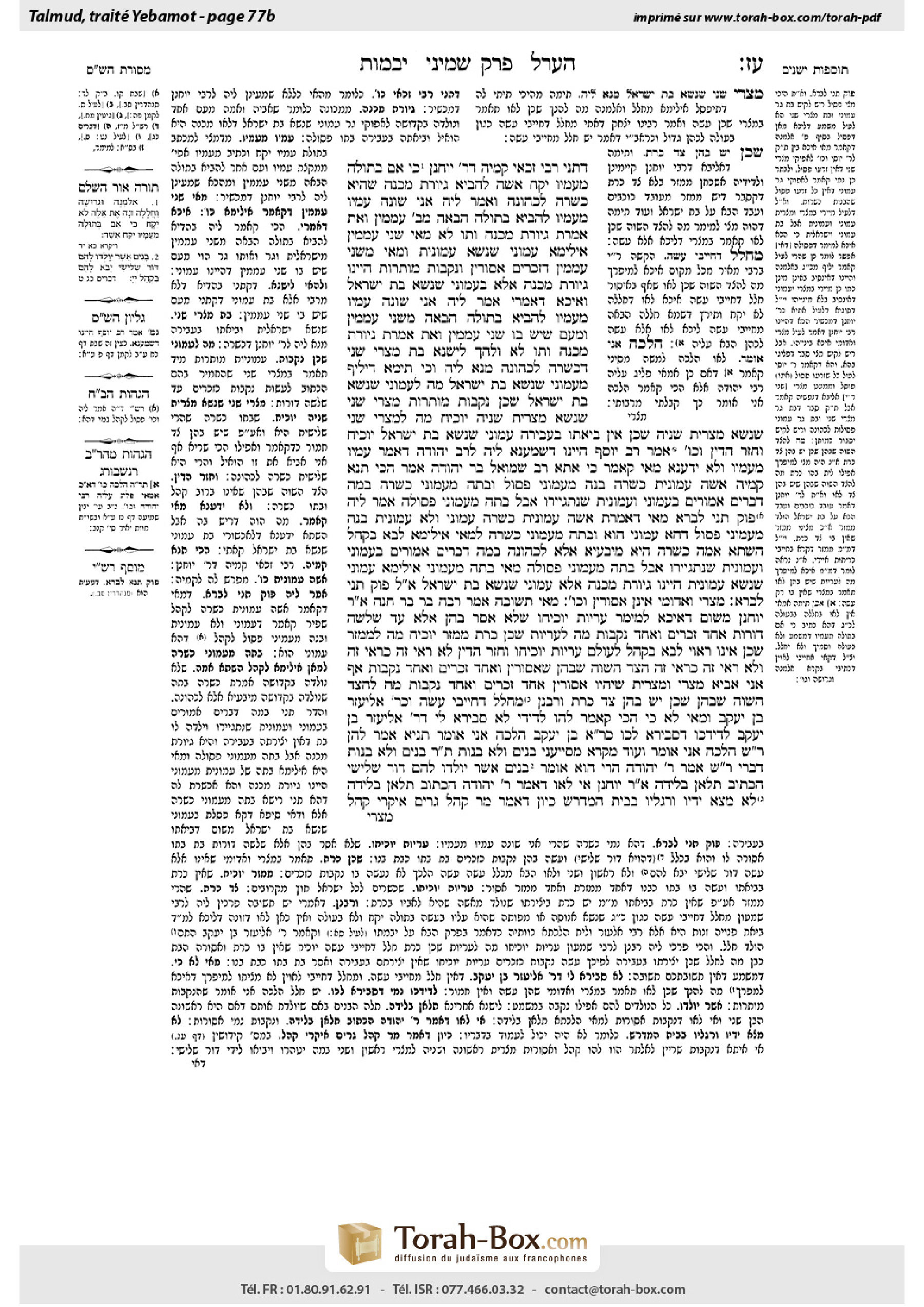
Yevamot 77b: Talmud study for Daf Yomi
Daf Yomi is the daily study of one Talmud folio. Explore 37 tractates with scans, Hebrew text, Sefaria English and AI-generated French translations where annotated.
Passage selection and English or AI-generated French translation are available where the scan has annotations. Daf Study is independent of Torah-Box and Sefaria.
Browse Yevamot · יבמות · All tractatesYevamot 77b text and translations
This page of Yevamot includes the Aramaic text, an English translation and an AI-generated French translation, alongside the scan above.
יבמות ע״ז ב · Aramaic and Hebrew text
דְּתָנֵי רַבִּי זַכַּאי קַמֵּיהּ דְּרַבִּי יוֹחָנָן: ״כִּי אִם בְּתוּלָה מֵעַמָּיו יִקַּח אִשָּׁה״, לְהָבִיא גִּיּוֹרֶת מִכַּנָּהּ — שֶׁהִיא כְּשֵׁרָה לַכְּהוּנָּה. וַאֲמַר לֵיהּ: אֲנִי שׁוֹנֶה ״עַמָּיו״, ״מֵעַמָּיו״ — לְהָבִיא בְּתוּלָה הַבָּאָה מִשְּׁנֵי עַמְמִין, וְאַתְּ אָמְרַתְּ גִּיּוֹרֶת מִכַּנָּהּ וְתוּ לָא?
מַאי ״שְׁנֵי עַמְמִין״? אִילֵּימָא עַמּוֹנִי שֶׁנָּשָׂא עַמּוֹנִית, וּמַאי מִשְּׁנֵי עַמְמִין, דִּזְכָרִים אֲסוּרִין וּנְקֵבוֹת מוּתָּרוֹת, הַיְינוּ גִּיּוֹרֶת מִכַּנָּהּ. אֶלָּא בְּעַמּוֹנִי שֶׁנָּשָׂא בַּת יִשְׂרָאֵל.
וְאִיכָּא דְאָמְרִי, אֲמַר לֵיהּ: אֲנִי שׁוֹנֶה ״עַמָּיו״ ״מֵעַמָּיו״ — לְהָבִיא בְּתוּלָה הַבָּאָה מִשְּׁנֵי עַמְמִין, וּמֵעַם שֶׁיֵּשׁ בּוֹ שְׁנֵי עַמְמִין, וְאַתְּ אָמְרַתְּ גִּיּוֹרֶת מִכַּנָּהּ וְתוּ לָא?
וּלְהָךְ לִישָּׁנָא, בַּת מִצְרִי שֵׁנִי, דִּכְשֵׁרָה לִכְהוּנָּה מְנָא לֵיהּ? וְכִי תֵּימָא דְּיָלֵיף מֵעַמּוֹנִי שֶׁנָּשָׂא בַּת יִשְׂרָאֵל: מָה לְעַמּוֹנִי שֶׁנָּשָׂא בַּת יִשְׂרָאֵל, שֶׁכֵּן נְקֵבוֹת מוּתָּרוֹת.
מִצְרִי שֵׁנִי שֶׁנָּשָׂא מִצְרִית שְׁנִיָּה יוֹכִיחַ!
מָה לְמִצְרִי שֵׁנִי שֶׁנָּשָׂא מִצְרִית שְׁנִיָּה, שֶׁכֵּן אֵין בִּיאָתוֹ בַּעֲבֵירָה.
עַמּוֹנִי שֶׁנָּשָׂא בַּת יִשְׂרָאֵל יוֹכִיחַ. וְחָזַר הַדִּין וְכוּ׳.
אָמַר רַב יוֹסֵף: הַיְינוּ דִּשְׁמַעְנָא לֵיהּ לְרַב יְהוּדָה דְּאָמַר ״עַמָּיו״ ״מֵעַמָּיו״, וְלָא יָדַעְנָא מַאי קָאָמַר.
כִּי אֲתָא רַב שְׁמוּאֵל בַּר יְהוּדָה, אָמַר: הָכִי תַּנָּא קַמֵּיהּ: אִשָּׁה עַמּוֹנִית — כְּשֵׁרָה, בְּנָהּ מֵעַמּוֹנִי — פָּסוּל, וּבִתָּהּ מֵעַמּוֹנִי — כְּשֵׁרָה. בַּמֶּה דְּבָרִים אֲמוּרִים: בְּעַמּוֹנִי וְעַמּוֹנִית שֶׁנִּתְגַּיְּירוּ, אֲבָל בִּתָּהּ מֵעַמּוֹנִי — פְּסוּלָה.
אֲמַר לֵיהּ: פּוֹק תְּנִי לְבָרָא. מַאי דַּאֲמַרְתְּ אִשָּׁה עַמּוֹנִית כְּשֵׁרָה — ״עַמּוֹנִי״ וְלֹא עַמּוֹנִית. בְּנָהּ מֵעַמּוֹנִי פָּסוּל — דְּהָא עַמּוֹנִי הוּא.
וּבִתָּהּ מֵעַמּוֹנִי כְּשֵׁרָה, לְמַאי? אִילֵימָא לָבֹא בַּקָּהָל — הַשְׁתָּא אִמָּהּ כְּשֵׁרָה, הִיא מִיבַּעְיָא? אֶלָּא לִכְהוּנָּה.
בַּמֶּה דְּבָרִים אֲמוּרִים: בְּעַמּוֹנִי וְעַמּוֹנִית שֶׁנִּתְגַּיְּירוּ, אֲבָל בִּתָּהּ מֵעַמּוֹנִי פְּסוּלָה. מַאי בִּתָּהּ מֵעַמּוֹנִי? אִילֵּימָא עַמּוֹנִי שֶׁנָּשָׂא עַמּוֹנִית — הַיְינוּ גִּיּוֹרֶת מִכַּנָּהּ! אֶלָּא עַמּוֹנִי שֶׁנָּשָׂא בַּת יִשְׂרָאֵל, אֲמַר לֵיהּ: פּוֹק תְּנִי לְבָרָא.
מִצְרִי וַאֲדוֹמִי אֵינָן אֲסוּרִין וְכוּ׳. מַאי תְּשׁוּבָה?
אָמַר רַבָּה בַּר בַּר חָנָה אָמַר רַבִּי יוֹחָנָן, מִשּׁוּם דְּאִיכָּא לְמֵימַר: עֲרָיוֹת יוֹכִיחוּ, שֶׁלֹּא אָסַר בָּהֶן אֶלָּא עַד שְׁלֹשָׁה דּוֹרוֹת, אֶחָד זְכָרִים וְאֶחָד נְקֵבוֹת!
מָה לַעֲרָיוֹת, שֶׁכֵּן כָּרֵת! מַמְזֵר יוֹכִיחַ.
מָה לְמַמְזֵר, שֶׁכֵּן אֵינוֹ רָאוּי לָבֹא בַּקָּהָל לְעוֹלָם. עֲרָיוֹת יוֹכִיחוּ, וְחָזַר הַדִּין.
לֹא רְאִי זֶה כִּרְאִי זֶה, וְלֹא רְאִי זֶה כִּרְאִי זֶה. הַצַּד הַשָּׁוֶה שֶׁבָּהֶן שֶׁאֲסוּרִין, וְאֶחָד זְכָרִים וְאֶחָד נְקֵבוֹת. אַף אֲנִי אָבִיא מִצְרִי וּמִצְרִית שֶׁיִּהְיוּ אֲסוּרִין, אֶחָד זְכָרִים וְאֶחָד נְקֵבוֹת.
מָה לְהַצַּד הַשָּׁוֶה שֶׁבָּהֶן, שֶׁכֵּן יֵשׁ בָּהֶן צַד כָּרֵת.
וְרַבָּנַן, מֵחָלָל דְּחַיָּיבֵי עֲשֵׂה, וּכְרַבִּי אֱלִיעֶזֶר בֶּן יַעֲקֹב.
וּמַאי ״לָא כִּי״? הָכִי קָאָמַר לְהוּ: לְדִידִי, לָא סְבִירָא לִי דְּרַבִּי אֱלִיעֶזֶר בֶּן יַעֲקֹב. לְדִידְכוּ, דִּסְבִירָא לְכוּ כְּרַבִּי אֱלִיעֶזֶר בֶּן יַעֲקֹב — הֲלָכָה אֲנִי אוֹמֵר.
תַּנְיָא, אָמַר לָהֶן רַבִּי שִׁמְעוֹן: הֲלָכָה אֲנִי אוֹמֵר, וְעוֹד: מִקְרָא מְסַיְּיעֵנִי, ״בָּנִים״ — וְלֹא בָּנוֹת.
תָּנוּ רַבָּנַן: ״בָּנִים״ וְלֹא בָּנוֹת, דִּבְרֵי רַבִּי שִׁמְעוֹן. אָמַר רַבִּי יְהוּדָה, הֲרֵי הוּא אוֹמֵר: ״בָּנִים אֲשֶׁר יִוָּלְדוּ לָהֶם דּוֹר שְׁלִישִׁי״, הַכָּתוּב תְּלָאָן בְּלֵידָה.
אָמַר רַבִּי יוֹחָנָן: אִי לָאו דְּאָמַר רַבִּי יְהוּדָה הַכָּתוּב תְּלָאָן בְּלֵידָה — לֹא מָצָא יָדָיו וְרַגְלָיו בְּבֵית הַמִּדְרָשׁ. כֵּיוָן דְּאָמַר מָר: קְהַל גֵּרִים אִיקְּרִי קָהָל,
Yevamot 77b · English translation
as Rabbi Zakkai taught the following baraita before Rabbi Yoḥanan: That which is stated with regard to a High Priest: “But a virgin of his own people shall he take to wife” (Leviticus 21:14), comes to include an established female convert, one who was a convert from birth, i.e., who was born to a father and mother who converted after their marriage but prior to her birth, and this indicates that she is fit to marry into the priesthood. And Rabbi Yoḥanan said to him: I teach that the words “his own people” and the more inclusive phrase “of his own people” come to include a virgin who comes from two peoples, from a union of converts hailing from two different peoples, and you say only an established female convert and no more?
The Gemara asks: What are these two peoples? If we say this is referring to an Ammonite man who married an Ammonite woman, and what is the meaning of “from two peoples,” that they are legally considered like two separate peoples, as their males are prohibited from entering into the congregation, whereas their females are permitted to do so, there is a difficulty. In that case, this is the same as an established female convert, as the daughter of such a union is a proper convert in all regards. Rather, it must refer to an Ammonite man who married the daughter of a Jew, as they belong to two separate peoples.
And there are those who say an alternative version of this discussion. Rabbi Yoḥanan said to Rabbi Zakkai: I teach that the words “his own people” and the more inclusive phrase “from his own people” come to include a virgin who comes from two peoples, i.e., whose mother was Jewish from birth and whose father was a convert, and that convert is from a people that itself consists of two peoples, i.e., an Ammonite or a Moabite, who hail from peoples whose males are prohibited from entering into the congregation, while it is permitted for their females to do so, and you say only an established female convert and no more?
The Gemara asks: And according to this second version, from where does Rabbi Yoḥanan derive that the daughter of a second-generation Egyptian convert who had entered into a forbidden marriage with a woman of Jewish birth is fit to marry into the priesthood, as with respect to Egyptian converts, there is no difference between males and females? And if you would say that he derives this from the case of an Ammonite convert who married the daughter of a Jew, the following difficulty arises: What comparison can be made to an Ammonite convert who married the daughter of a Jew and had a daughter, who is permitted to enter the congregation although she is an Ammonite, as female Ammonite converts are entirely permitted? Perhaps for this reason it is permitted for the daughter to marry into the priesthood as well. Can one say the same with regard to the daughter of a second-generation Egyptian convert who had entered into a forbidden marriage with a woman of Jewish birth, when it is prohibited for female Egyptian converts, like their male counterparts, to enter into the congregation until the third generation?
The Gemara responds: Let the case of a second-generation male Egyptian convert who married a second-generation female Egyptian convert prove that this is not relevant, as it is permitted for their daughter, a third-generation Egyptian convert, to enter the congregation, even though she belongs to the Egyptian people, whose female converts are prohibited in the same manner as their male converts.
The Gemara refutes this proof: What comparison can be made to a second-generation male Egyptian convert who married a second-generation female Egyptian convert, seeing that his intercourse does not involve a transgression, as it is permitted for him to marry her? Can one say the same with regard to a second-generation Egyptian convert who entered into a forbidden marriage with the daughter of a Jew?
This leads back to the first proof: Let an Ammonite man who married the daughter of a Jew prove that this is not irrelevant, as they too entered into a forbidden union, and yet it is permitted for the daughter of that marriage to marry into the priesthood. And the derivation has reverted to its starting point, and the discussion can go back and forth. The two cases differ in their particular aspects, but their common denominator is that it is permitted for the daughter to marry into the priesthood. So too, it is permitted for the daughter of a second-generation Egyptian convert who married a woman who was born Jewish to marry into the priesthood.
Rav Yosef said: This is what I heard Rav Yehuda say in his lecture about the phrases “his own people” and “from his own people,” and at the time I did not know what he was saying. Now I understand that he was saying that it is permitted for the daughter of an Ammonite convert who married a Jewish woman to marry into the priesthood, as taught by Rabbi Yoḥanan.
When Rav Shmuel bar Yehuda came from Eretz Yisrael to Babylonia, he said that Rabbi Zakkai taught before Rabbi Yoḥanan as follows: An Ammonite woman is fit, her son from an Ammonite is unfit, and her daughter from an Ammonite is fit. In what case is this statement said? It is said with regard to an Ammonite man and an Ammonite woman who converted, but her daughter from an Ammonite who did not convert is unfit.
Rabbi Yoḥanan said to him: Go out and teach it outside, i.e., this baraita is not in accordance with the accepted halakha, and therefore it should not be made part of the regular learning in the study hall. What you said, that an Ammonite woman is fit, is well known and need not be taught because it is just another way of saying that a male Ammonite is barred from entering the congregation but not a female Ammonite. As for the teaching that her son from an Ammonite is unfit, this too is unnecessary, as he is an Ammonite.
But that which you said: Her daughter from an Ammonite is fit, with regard to what issue did you teach this? If we say that she is fit to enter into the congregation, this too is redundant: Now that it was taught that even her mother is fit to enter the congregation, is it necessary to say that she herself, the daughter, is fit to do so? Rather, you must mean to say that she is fit to marry into the priesthood.
The baraita continues: In what case is this statement said? It is said with regard to an Ammonite man and an Ammonite woman who converted, but her daughter from an Ammonite man is unfit. What is meant here by her daughter from an Ammonite? If we say it means an Ammonite man who married an Ammonite woman, and they converted prior to the birth of their daughter, this is an established female convert, who was previously declared fit to marry into the priesthood. Rather, it must mean an Ammonite convert who unlawfully married the daughter of a Jew, and according to what is stated here, their daughter is unfit to marry a priest. Rabbi Yoḥanan, however, ruled that such a woman is fit, and therefore he said to Rabbi Zakkai: Go out and teach it outside, as this baraita is unreliable.
It is taught in the mishna that Egyptian and Edomite converts are prohibited from entering into the congregation only for three generations, both males and females, while Rabbi Shimon permits females immediately based on the following a fortiori inference. If regarding Ammonites and Moabites, where the Torah prohibited the males with an eternal prohibition, it permitted the females immediately, then regarding Egyptians and Edomites, where it prohibited the males for only three generations, the females should certainly be permitted immediately. Rabbi Shimon’s colleagues informed him that there is a refutation of his argument. The Gemara asks: What is this refutation mentioned by the mishna?
Rabba bar bar Ḥana said that Rabbi Yoḥanan said: It is because it may be said that those with whom relations are forbidden, i.e., incestuous relationships, prove that the above-mentioned factor is irrelevant, as the Torah prohibits them only for up to three generations, i.e., up to his granddaughter, and yet it prohibits both males and females, i.e., the daughter of his son and the daughter of his daughter.
The Gemara rejects this proof: What comparison can be made to those with whom relations are forbidden, which involve stringent prohibitions, as they entail the punishment of karet? The Gemara answers: Let the prohibition with regard to a mamzer prove that this is not relevant, as its violation does not involve the punishment of karet and yet it applies equally to males and females.
The Gemara rejects this argument: What comparison can be made to a mamzer, seeing that he is governed by the stringency that he is forever unfit to enter into the congregation for all generations? The Gemara counters: Let those with whom relations are forbidden prove that this is not relevant, as the Torah prohibits them only for up to three generations. And the derivation has reverted to its starting point, and the discussion can go back and forth.
However, the halakha with regard to an Egyptian can be derived from a combination of the two sources. The aspect of this case, that of incestuous relationships, is not like the aspect of that case, that of a mamzer, and the aspect of that case is not like the aspect of this case; their common denominator is that their prohibition applies to both males and females. I will also bring the additional halakha of a male Egyptian convert and a female Egyptian convert that they are forbidden, both males and females.
The Gemara objects: What is unique about the common denominator between the cases of incestuous relationships and a mamzer that prevents utilizing it as a paradigm for other cases? Both include an aspect of karet, either with respect to the act of incestuous intercourse itself or with respect to the conception of the mamzer, as a mamzer is the offspring of a union punishable by karet. However, the prohibition concerning an Egyptian, which does not include an aspect of karet, may apply only to males, but not females.
And the Rabbis, who reject Rabbi Shimon’s proof, derive the prohibition applying to female Egyptians from the halakha governing a ḥalal, one rendered unfit for the priesthood. A ḥalal is the child of a union for which the parties involved are liable to receive punishment for the transgression of a positive mitzva, e.g., the child of a High Priest and a woman who was not a virgin when he married her, and this status applies to males and females alike. And this is in accordance with the opinion of Rabbi Eliezer ben Ya’akov, who ruled that the child of such a relationship is a ḥalal.
The Gemara asks: And what did Rabbi Shimon mean when he responded: Not so? The Gemara explains that this is what he said to them: According to my own opinion, I do not hold in accordance with the opinion of Rabbi Eliezer ben Ya’akov, and therefore your refutation is not valid for me. But even according to you, who do maintain in accordance with the opinion of Rabbi Eliezer ben Ya’akov, I am nevertheless stating a halakha handed down to me by my teachers that female Egyptians and Edomites are permitted.
It is taught in a baraita that Rabbi Shimon said to them: I am stating a traditional halakha, and furthermore a verse supports me, as the verse with regard to Edomites and Egyptians states: “The sons of the third generation that are born to them may enter to them, the congregation of the Lord” (Deuteronomy 23:9), teaching that the prohibition applies to their sons, but not to their daughters.
The Sages taught a baraita that further clarifies the matter: The prohibition with regard to Egyptians and Edomites applies only to their sons, but not to their daughters; this is the statement of Rabbi Shimon. Rabbi Yehuda said: The verse states: “The sons of the third generation that are born to them may enter to them, the congregation of the Lord,” and the phrase “born to them” indicates that the verse made their prohibition dependent on birth, with regard to which there is no difference between males and females.
Rabbi Yoḥanan says: Had Rabbi Yehuda not said that the verse made their prohibition dependent on birth, so that females are also included in the prohibition, he would not have found his hands and feet in the study hall, i.e., he would have been caught in a self-contradiction. Why? Since the Master said that according to Rabbi Yehuda a congregation of converts is also called a congregation of the Lord,
Yevamot 77b · Traduction française (IA)
Rabbi Zakkaï enseignait la baraïta suivante devant Rabbi Yoḥanan : La formule énoncée au sujet du grand prêtre, « Mais il prendra pour épouse une vierge de son peuple » (Lévitique 21,14), vient inclure une convertie de naissance, c’est-à-dire une femme née d’un père et d’une mère qui s’étaient convertis après leur mariage, mais avant sa naissance. Cela indique qu’elle est apte à épouser un prêtre. Rabbi Yoḥanan lui dit : « Moi, j’enseigne que les mots “son peuple”, ainsi que l’expression plus inclusive “de son peuple”, viennent inclure une vierge issue de deux peuples, née de l’union de convertis originaires de deux peuples différents. Et toi, tu ne mentionnes qu’une convertie de naissance, sans aller plus loin ? »
La Guemara demande : Quels sont ces deux peuples ? Si l’on dit qu’il s’agit d’un Ammonite qui a épousé une Ammonite, et que l’expression « de deux peuples » signifie qu’ils sont considérés juridiquement comme deux peuples distincts, puisque leurs hommes ne peuvent pas entrer dans l’assemblée, tandis que leurs femmes le peuvent, une difficulté se présente. Dans ce cas, cela revient à parler d’une convertie de naissance, puisque la fille d’une telle union est convertie à part entière. Il faut plutôt dire qu’il s’agit d’un Ammonite qui a épousé la fille d’un Juif, car ils appartiennent à deux peuples distincts.
Certains rapportent une autre version de cette discussion. Rabbi Yoḥanan dit à Rabbi Zakkaï : « Moi, j’enseigne que les mots “son peuple”, ainsi que l’expression plus inclusive “de son peuple”, viennent inclure une vierge issue de deux peuples, c’est-à-dire dont la mère est juive de naissance et le père converti. Ce converti est issu d’un peuple qui se compose lui-même de deux peuples, à savoir les Ammonites ou les Moabites, peuples dont les hommes ne peuvent pas entrer dans l’assemblée, alors que leurs femmes le peuvent. Et toi, tu ne mentionnes qu’une convertie de naissance, sans aller plus loin ? »
La Guemara demande : Selon cette seconde version, d’où Rabbi Yoḥanan déduit-il que la fille d’un converti égyptien de deuxième génération, qui a contracté une union interdite avec une femme juive de naissance, est apte à épouser un prêtre ? En effet, pour les convertis égyptiens, il n’y a pas de différence entre les hommes et les femmes. Et si l’on répond qu’il le déduit du cas d’un Ammonite converti qui a épousé la fille d’un Juif, une difficulté se pose : quelle comparaison peut-on établir avec un Ammonite converti qui a épousé la fille d’un Juif et a eu une fille, autorisée à entrer dans l’assemblée bien qu’elle soit ammonite, puisque les femmes ammonites sont entièrement autorisées ? Peut-être est-ce pour cette raison que la fille est également autorisée à épouser un prêtre. Peut-on en dire autant de la fille d’un converti égyptien de deuxième génération qui a contracté une union interdite avec une femme juive de naissance, alors que les femmes égyptiennes, comme les hommes égyptiens, ne peuvent pas entrer dans l’assemblée avant la troisième génération ?
La Guemara répond : Que le cas d’un converti égyptien de deuxième génération qui a épousé une convertie égyptienne de deuxième génération démontre que cela n’a pas d’incidence : leur fille, convertie égyptienne de troisième génération, peut entrer dans l’assemblée, bien qu’elle appartienne au peuple égyptien, dont les femmes sont interdites au même titre que les hommes.
La Guemara réfute cette preuve : quelle comparaison peut-on établir avec un converti égyptien de deuxième génération qui a épousé une convertie égyptienne de deuxième génération, alors que leur union n’implique aucune transgression, puisqu’il lui est permis de l’épouser ? Peut-on en dire autant d’un converti égyptien de deuxième génération qui a contracté une union interdite avec la fille d’un Juif ?
Revenons donc à la première preuve : que le cas d’un Ammonite qui a épousé la fille d’un Juif démontre que cela n’est pas sans pertinence, puisqu’eux aussi ont contracté une union interdite, et pourtant leur fille est autorisée à épouser un prêtre. La déduction revient ainsi à son point de départ, et la discussion peut aller et venir. Les deux cas diffèrent par leurs particularités, mais ils ont en commun que leur fille est autorisée à épouser un prêtre. De même, la fille d’un converti égyptien de deuxième génération qui a épousé une femme juive de naissance est autorisée à épouser un prêtre.
Rav Yossef dit : « Voici ce que j’ai entendu Rav Yehouda dire dans son cours au sujet des expressions “son peuple” et “de son peuple” ; à l’époque, je ne comprenais pas ce qu’il disait. À présent, je comprends qu’il disait que la fille d’un Ammonite converti qui a épousé une femme juive est autorisée à épouser un prêtre, comme l’a enseigné Rabbi Yoḥanan. »
Lorsque Rav Shmuel bar Yehouda arriva de la Terre d’Israël en Babylonie, il dit que Rabbi Zakkaï avait enseigné devant Rabbi Yoḥanan ce qui suit : Une Ammonite est apte ; son fils, né d’un Ammonite, est inapte ; et sa fille, née d’un Ammonite, est apte. Dans quel cas cela a-t-il été dit ? Au sujet d’un Ammonite et d’une Ammonite qui se sont convertis ; mais sa fille, née d’un Ammonite qui ne s’est pas converti, est inapte.
Rabbi Yoḥanan lui dit : « Va l’enseigner au-dehors », c’est-à-dire que cette baraïta n’est pas conforme à la halakha admise et ne doit donc pas faire partie de l’étude régulière à la maison d’étude. Ce que tu as dit, à savoir qu’une Ammonite est apte, est bien connu et n’a pas besoin d’être enseigné, puisqu’il revient simplement à dire qu’un Ammonite ne peut pas entrer dans l’assemblée, contrairement à une Ammonite. Quant à ce que tu as enseigné, à savoir que son fils né d’un Ammonite est inapte, cela non plus n’est pas nécessaire, puisqu’il est lui-même ammonite.
Mais ce que tu as dit, à savoir que sa fille née d’un Ammonite est apte, à quel sujet l’as-tu enseigné ? Si l’on dit qu’elle est apte à entrer dans l’assemblée, cela aussi est superflu : puisque sa mère elle-même a été déclarée apte à entrer dans l’assemblée, faut-il préciser que sa fille l’est aussi ? Il faut plutôt comprendre que tu veux dire qu’elle est apte à épouser un prêtre.
La baraïta poursuit : Dans quel cas cela a-t-il été dit ? Au sujet d’un Ammonite et d’une Ammonite qui se sont convertis ; mais sa fille, née d’un Ammonite, est inapte. Que signifie ici « sa fille, née d’un Ammonite » ? Si l’on dit qu’il s’agit d’un Ammonite qui a épousé une Ammonite et qu’ils se sont convertis avant la naissance de leur fille, celle-ci est une convertie de naissance, dont il a déjà été établi qu’elle est apte à épouser un prêtre. Il faut plutôt comprendre qu’il s’agit d’un Ammonite converti qui a illicitement épousé la fille d’un Juif ; selon l’enseignement rapporté ici, leur fille est inapte à épouser un prêtre. Or Rabbi Yoḥanan a statué qu’une telle femme est apte ; c’est pourquoi il a dit à Rabbi Zakkaï : « Va l’enseigner au-dehors », car cette baraïta n’est pas fiable.
La Michna enseigne que les convertis égyptiens et édomites ne peuvent entrer dans l’assemblée que jusqu’à la troisième génération, aussi bien les hommes que les femmes ; Rabbi Shimon autorise les femmes dès la première génération, sur la base du raisonnement a fortiori suivant : si, dans le cas des Ammonites et des Moabites, dont la Torah interdit éternellement l’entrée aux hommes, elle autorise immédiatement les femmes, alors, dans le cas des Égyptiens et des Édomites, dont elle interdit l’entrée aux hommes pendant trois générations seulement, elle devrait à plus forte raison autoriser immédiatement les femmes. Les collègues de Rabbi Shimon lui signalèrent que son argument pouvait être réfuté. La Guemara demande : quelle est cette réfutation mentionnée par la Michna ?
Rabba bar bar Ḥana dit au nom de Rabbi Yoḥanan : c’est parce que l’on peut avancer que les personnes avec lesquelles les relations sont interdites, c’est-à-dire les relations incestueuses, démontrent que le facteur mentionné plus haut n’est pas pertinent : la Torah les interdit jusqu’à trois générations, c’est-à-dire jusqu’à sa petite-fille, et pourtant l’interdiction s’applique aux hommes comme aux femmes, c’est-à-dire à la fille de son fils et à la fille de sa fille.
La Guemara rejette cette preuve : quelle comparaison peut-on établir avec les personnes avec lesquelles les relations sont interdites, puisque ces interdictions sont rigoureuses et entraînent la peine de karet ? La Guemara répond : que l’interdiction concernant un mamzer démontre que ce facteur n’est pas pertinent, puisque sa transgression n’entraîne pas la peine de karet et qu’elle s’applique pourtant également aux hommes et aux femmes.
La Guemara rejette cet argument : quelle comparaison peut-on établir avec un mamzer, puisque son statut comporte cette rigueur : il est inapte à entrer dans l’assemblée pour toutes les générations, à jamais ? La Guemara réplique : que les personnes avec lesquelles les relations sont interdites démontrent que ce facteur n’est pas pertinent, puisque la Torah ne les interdit que jusqu’à trois générations. La déduction revient ainsi à son point de départ, et la discussion peut aller et venir.
Toutefois, la halakha concernant un Égyptien peut être déduite en combinant les deux sources. Le cas des relations incestueuses diffère de celui du mamzer, et le cas du mamzer diffère de celui des relations incestueuses ; ils ont en commun que leur interdiction s’applique aux hommes comme aux femmes. J’ajouterai également la halakha concernant un converti égyptien et une convertie égyptienne : ils sont tous deux interdits, hommes et femmes.
La Guemara objecte : qu’est-ce qui caractérise le dénominateur commun aux cas des relations incestueuses et du mamzer, et empêche de l’utiliser comme modèle pour d’autres cas ? Dans les deux cas, il y a un aspect de karet, soit en raison de l’acte de relation incestueuse lui-même, soit en raison de la conception du mamzer, puisque celui-ci est le fruit d’une union passible de karet. Cependant, l’interdiction concernant un Égyptien, qui ne comporte aucun aspect de karet, pourrait ne s’appliquer qu’aux hommes, et non aux femmes.
Quant aux Rabbins, qui rejettent la preuve de Rabbi Shimon, ils déduisent l’interdiction concernant les femmes égyptiennes de la halakha régissant un ḥalal, une personne rendue inapte à la prêtrise. Un ḥalal est l’enfant d’une union pour laquelle les personnes concernées sont passibles d’une sanction pour la transgression d’une mitsva positive, par exemple l’enfant d’un grand prêtre et d’une femme qui n’était pas vierge lorsqu’il l’a épousée. Ce statut s’applique aux hommes comme aux femmes. Cela est conforme à l’opinion de Rabbi Eliezer ben Ya’akov, selon laquelle l’enfant d’une telle union est un ḥalal.
La Guemara demande : que voulait dire Rabbi Shimon lorsqu’il a répondu : « Pas ainsi » ? La Guemara explique qu’il leur a dit ceci : « Selon ma propre opinion, je ne suis pas l’opinion de Rabbi Eliezer ben Ya’akov ; votre réfutation ne me concerne donc pas. Mais même selon vous, qui suivez l’opinion de Rabbi Eliezer ben Ya’akov, j’énonce néanmoins une halakha qui m’a été transmise par mes maîtres : les femmes égyptiennes et édomites sont autorisées. »
Une baraïta enseigne que Rabbi Shimon leur dit : « J’énonce une halakha transmise par tradition, et un verset vient en outre à l’appui de ma position, car le verset concernant les Édomites et les Égyptiens dit : “Les fils de la troisième génération, nés d’eux, pourront entrer dans l’assemblée de l’Éternel” (Deutéronome 23,9). Cela enseigne que l’interdiction concerne leurs fils, mais non leurs filles. »
Les Sages enseignèrent une baraïta qui précise encore la question : l’interdiction concernant les Égyptiens et les Édomites s’applique uniquement à leurs fils, mais non à leurs filles ; telle est l’opinion de Rabbi Shimon. Rabbi Yehouda dit : le verset énonce : « Les fils de la troisième génération, nés d’eux, pourront entrer dans l’assemblée de l’Éternel. » L’expression « nés d’eux » indique que le verset a fait dépendre leur interdiction de la naissance, sans distinction entre hommes et femmes.
Rabbi Yoḥanan dit : si Rabbi Yehouda n’avait pas dit que le verset faisait dépendre leur interdiction de la naissance, de sorte que les femmes sont elles aussi incluses dans l’interdiction, il n’aurait pas pu soutenir sa position à la maison d’étude, c’est-à-dire qu’il serait tombé dans une contradiction interne. Pourquoi ? Puisque le Maître a dit que, selon Rabbi Yehouda, une assemblée de convertis est elle aussi appelée « assemblée de l’Éternel »,
Traduction française générée par IA à partir de l’édition anglaise de Sefaria. Vérifie toujours un passage avec le texte source.
Text from Sefaria: William Davidson Edition - Vocalized Aramaic (CC BY NC); William Davidson Edition - English (CC BY NC).