Yevamot 78a: Talmud study for Daf Yomi
Daf Yomi is the daily study of one Talmud folio. Explore 37 tractates with scans, Hebrew text, Sefaria English and AI-generated French translations where annotated.
Passage selection and English or AI-generated French translation are available where the scan has annotations. Daf Study is independent of Torah-Box and Sefaria.
Browse Yevamot · יבמות · All tractatesYevamot 78a text and translations
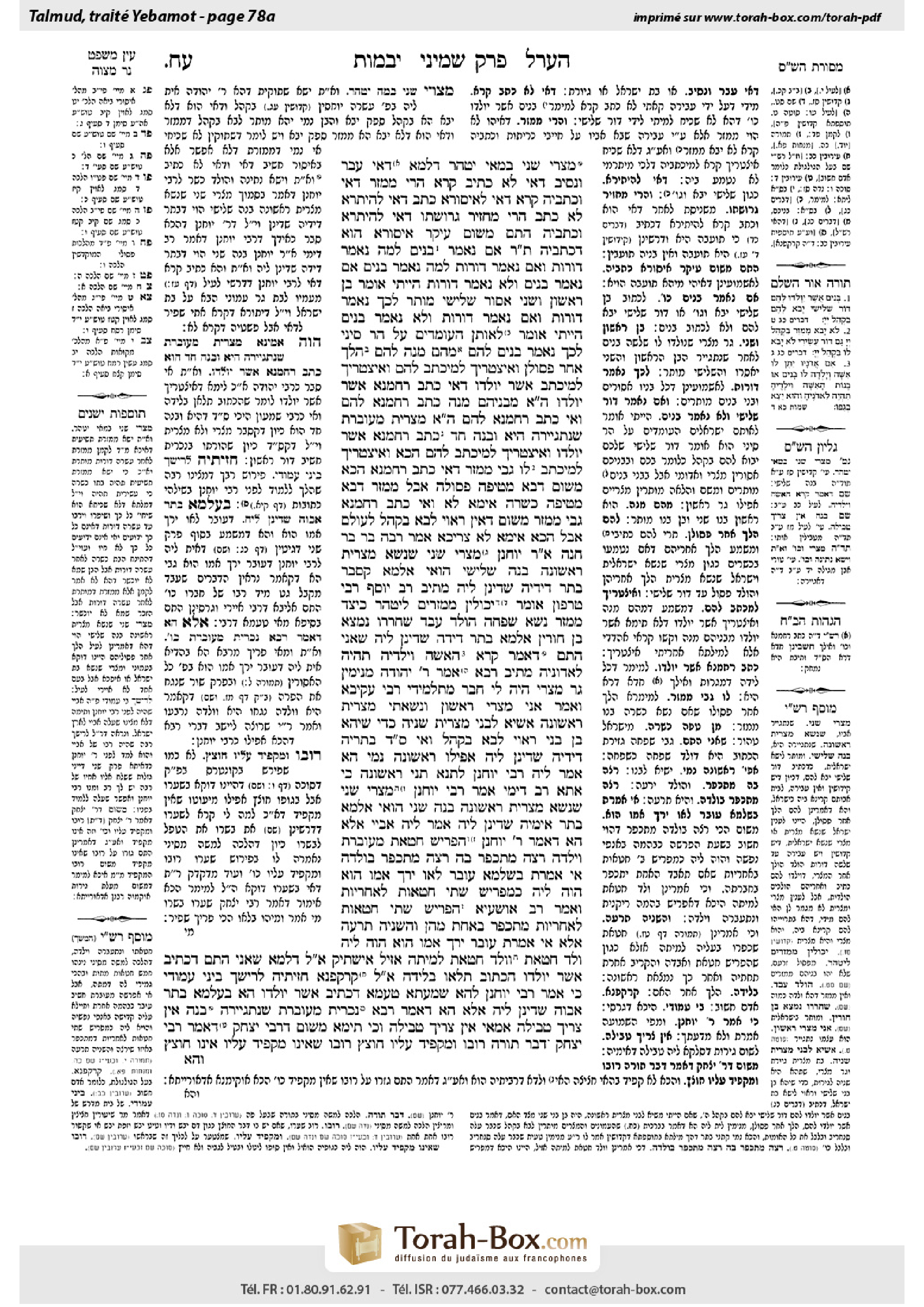
This page of Yevamot includes the Aramaic text, an English translation and an AI-generated French translation, alongside the scan above.
יבמות ע״ח א · Aramaic and Hebrew text
מִצְרִי שֵׁנִי בְּמַאי יִטְהַר? דִּלְמָא דְּאִי עֲבַר וּנְסֵיב. ״דְּאִי״ לָא כְּתִיב קְרָא.
הֲרֵי מַמְזֵר ״דְּאִי״, וְכַתְבֵיהּ קְרָא! ״דְּאִי״ לְאִיסּוּרָא — כְּתַב, ״דְּאִי״ לְהֶיתֵּרָא — לָא כְּתַב.
הֲרֵי מַחֲזִיר גְּרוּשָׁתוֹ, ״דְּאִי״ לְהֶיתֵּרָא וְכַתְבֵיהּ? הָתָם מִשּׁוּם עִיקַּר אִיסּוּרָא הוּא דְּכַתְבֵיהּ.
תָּנוּ רַבָּנַן: אִם נֶאֱמַר ״בָּנִים״, לָמָּה נֶאֱמַר ״דּוֹרוֹת״? וְאִם נֶאֱמַר ״דּוֹרוֹת״, לָמָּה נֶאֱמַר ״בָּנִים״? אִם נֶאֱמַר ״בָּנִים״ וְלֹא נֶאֱמַר ״דּוֹרוֹת״, הָיִיתִי אוֹמֵר: בֵּן רִאשׁוֹן וְשֵׁנִי — אָסוּר, שְׁלִישִׁי — מוּתָּר, לְכָךְ נֶאֱמַר ״דּוֹרוֹת״.
וְאִם נֶאֱמַר ״דּוֹרוֹת״ וְלֹא נֶאֱמַר ״בָּנִים״, הָיִיתִי אוֹמֵר לְאוֹתָן הָעוֹמְדִים עַל הַר סִינַי, לְכָךְ נֶאֱמַר ״בָּנִים״.
״לָהֶם״ — מֵהֶם מְנֵה. ״לָהֶם״ — הַלֵּךְ אַחַר פְּסוּלָן.
וְאִיצְטְרִיךְ לְמִיכְתַּב ״לָהֶם״, וְאִיצְטְרִיךְ לְמִיכְתַּב ״אֲשֶׁר יִוָּלְדוּ״. דְּאִי כְּתַב רַחֲמָנָא ״אֲשֶׁר יִוָּלְדוּ״, הֲוָה אָמֵינָא: מִבְּנֵיהֶם מְנֵה, כְּתַב רַחֲמָנָא ״לָהֶם״. וְאִי כְּתַב רַחֲמָנָא ״לָהֶם״, הֲוָה אָמֵינָא: מִצְרִית מְעוּבֶּרֶת שֶׁנִּתְגַּיְּירָה — הִיא וּבְנָהּ חַד, כְּתַב רַחֲמָנָא ״אֲשֶׁר יִוָּלְדוּ״.
וְאִיצְטְרִיךְ לְמִיכְתַּב ״לָהֶם״ הָכָא, וְאִיצְטְרִיךְ לְמִיכְתַּב ״לוֹ״ גַּבֵּי מַמְזֵר.
דְּאִי כְּתַב רַחֲמָנָא הָכָא, מִשּׁוּם דְּבָא מִטִּיפָּה פְּסוּלָה, אֲבָל מַמְזֵר דְּבָא מִטִּיפָּה כְּשֵׁרָה — אֵימָא לָא.
וְאִי כְּתַב רַחֲמָנָא גַּבֵּי מַמְזֵר, מִשּׁוּם דְּאֵין רָאוּי לָבֹא בַּקָּהָל לְעוֹלָם, אֲבָל הָכָא — אֵימָא לָא, צְרִיכָא.
אָמַר רַבָּה בַּר בַּר חָנָה אָמַר רַבִּי יוֹחָנָן: מִצְרִי שֵׁנִי שֶׁנָּשָׂא מִצְרִית רִאשׁוֹנָה — בְּנָהּ שְׁלִישִׁי הָאוֵי. אַלְמָא קָסָבַר בָּתַר דִּידֵיהּ שָׁדֵינַן לֵיהּ,
מֵתִיב רַב יוֹסֵף, רַבִּי טַרְפוֹן אוֹמֵר: יְכוֹלִין מַמְזֵרִים לִיטָּהֵר. כֵּיצַד? מַמְזֵר נָשָׂא שִׁפְחָה — הַוָּלָד עֶבֶד. שִׁחְרְרוֹ — נִמְצָא בֶּן חוֹרִין. אַלְמָא בָּתַר דִּידַהּ שָׁדֵינַן לֵיהּ! שָׁאנֵי הָתָם, דְּאָמַר קְרָא: ״הָאִשָּׁה וִילָדֶיהָ תִּהְיֶה לַאדוֹנֶיהָ״.
מֵתִיב רָבָא, אָמַר רַבִּי יְהוּדָה: מִנְיָמִין גֵּר מִצְרִי הָיָה לִי חָבֵר מִתַּלְמִידֵי רַבִּי עֲקִיבָא, וְאָמַר: אֲנִי מִצְרִי רִאשׁוֹן, וְנָשָׂאתִי מִצְרִית רִאשׁוֹנָה, אַשִּׂיא לִבְנֵי מִצְרִית שְׁנִיָּה, כְּדֵי שֶׁיְּהֵא בֶּן בְּנִי רָאוּי לָבֹא בַּקָּהָל. וְאִי סָלְקָא דַעְתָּךְ בָּתְרֵיהּ דִּידֵיהּ שָׁדֵינַן לֵיהּ — אֲפִילּוּ רִאשׁוֹנָה נָמֵי! הָא אֲמַר לֵיהּ רַבִּי יוֹחָנָן לְתַנָּא: תְּנִי רִאשׁוֹנָה.
כִּי אֲתָא רַב דִּימִי, אָמַר רַבִּי יוֹחָנָן: מִצְרִי שֵׁנִי שֶׁנָּשָׂא מִצְרִית רִאשׁוֹנָה — בְּנָהּ שֵׁנִי הָוֵי. אַלְמָא בָּתַר אִימֵּיהּ שָׁדֵינַן לֵיהּ.
אֲמַר לֵיהּ אַבָּיֵי: אֶלָּא הָא דְּאָמַר רַבִּי יוֹחָנָן: הִפְרִישׁ חַטָּאת מְעוּבֶּרֶת וְיָלְדָה — רָצָה מִתְכַּפֵּר בָּהּ, רָצָה מִתְכַּפֵּר בִּוְלָדָהּ.
אִי אָמְרַתְּ בִּשְׁלָמָא עוּבָּר לָאו יֶרֶךְ אִמּוֹ הוּא — הָוֵה לֵיהּ כְּמַפְרִישׁ שְׁתֵּי חַטָּאוֹת לְאַחְרָיוּת, וְאָמַר רַב אוֹשַׁעְיָא: הִפְרִישׁ שְׁתֵּי חַטָּאוֹת לְאַחְרָיוּת — מִתְכַּפֵּר בְּאַחַת מֵהֶן, וְהַשְּׁנִיָּה תִּרְעֶה.
אֶלָּא אִי אָמְרַתְּ עוּבָּר יֶרֶךְ אִמּוֹ הוּא, הָוֵה לֵיהּ וְלַד חַטָּאת, וּוְלַד חַטָּאת לְמִיתָה אָזֵיל?
אִישְׁתִּיק. אֲמַר לֵיהּ: דִּלְמָא שָׁאנֵי הָתָם, דִּכְתִיב: ״אֲשֶׁר יִוָּלְדוּ״, הַכָּתוּב תְּלָאוֹ בְּלֵידָה. אֲמַר לֵיהּ: קַרְקַפְנָא, חֲזֵיתֵיהּ לְרֵישָׁךְ בֵּינֵי עַמּוּדֵי כִּי אֲמַר רַבִּי יוֹחָנָן לְהָא שְׁמַעְתָּא.
טַעְמָא דִּכְתִיב ״אֲשֶׁר יִוָּלְדוּ״, הָא בְּעָלְמָא — בָּתַר אֲבוּהּ שָׁדֵינַן לֵיהּ. אֶלָּא הָא דְּאָמַר רָבָא: גּוֹיָה מְעוּבֶּרֶת שֶׁנִּתְגַּיְּירָה — בְּנָהּ אֵין צָרִיךְ טְבִילָה, אַמַּאי אֵין צָרִיךְ טְבִילָה?
וְכִי תֵּימָא מִשּׁוּם דְּרַבִּי יִצְחָק, דְּאָמַר רַבִּי יִצְחָק: דְּבַר תּוֹרָה, רוּבּוֹ וּמַקְפִּיד עָלָיו — חוֹצֵץ, רוּבּוֹ שֶׁאֵינוֹ מַקְפִּיד עָלָיו — אֵינוֹ חוֹצֵץ.
Yevamot 78a · English translation
how could a second-generation Egyptian convert ever achieve purity, so that it is permitted for his offspring, the third generation, to enter into the congregation? He may marry neither a Jew nor a female Egyptian convert. The Gemara answers: Perhaps it means that if he transgressed and married a convert or a Jewish woman, his seed will be purified. The Gemara rejects this suggestion: A case of: That if, is not written in the verse. In other words, the Bible does not speak of situations that can arise only through the commission of a transgression.
The Gemara asks: But isn’t there the halakha of a mamzer, which is a case of that if, as a mamzer is the child of a forbidden union, and yet the verse writes it? The Gemara answers: A case of that if that results in a prohibition, the Torah writes, but a case of that if that leads to an allowance, the Torah does not write. The Torah teaches the halakha of a mamzer, whose very existence is the result of his parents having engaged in forbidden relations, in order to render it prohibited for him to enter into the congregation. However, it would not teach the halakha of a second-generation Egyptian convert who transgressed and married a woman who was forbidden to him, in order to permit his offspring to enter into the congregation.
The Gemara raises an objection: But isn’t there the halakha governing one who remarries his divorcée after she had been married to another man? This is a case of that if that leads to an allowance, and yet the Torah writes it. The words “It is an abomination before the Lord” (Deuteronomy 24:4) stated with regard to this case teach that although the woman herself is forbidden to her first husband, if she nevertheless remarried him, their children are fit to enter into the congregation. The Gemara answers: There, the Torah writes that case due to the basic prohibition, i.e., that a man may not remarry his divorced wife after she has been married to another man, and the allowance with regard to their children is learned incidentally.
The Sages taught in a baraita: The verse states with respect to Egyptian and Edomite converts that “the sons of the third generation that are born to them may enter to them, the congregation of the Lord” (Deuteronomy 23:9). If it is stated “sons” why is it also stated “generation,” and if it is stated “generation” why is it also stated “sons”? One of these terms seems superfluous. The baraita explains: If it had stated only “sons” and not stated “generation,” I would say that the prohibition depends on the number of the son, meaning that the first and second sons of an Egyptian convert are forbidden, whereas the third is permitted. Therefore, it is stated “generation” to indicate that the prohibition depends not on the number of the son but on his generation.
And conversely, if it had stated only “generation” and not stated “sons,” I would say that the generations are counted from those standing on Mount Sinai, so that any Egyptian born after three generations have passed from the time of the giving of the Torah would be permitted. Therefore, it is stated “sons” to indicate that certain sons are prohibited in later generations as well.
The verse states: “The sons of the third generation that are born to them may enter to them, the congregation of the Lord.” The Sages expounded each of the two instances of the words “to them”: The first mention of “to them” teaches that from them you should count. The count of generations begins with the converts themselves, as they are considered the first generation, and therefore their grandchildren are permitted. The second mention of “to them” teaches that you should follow their disqualification. If a male Egyptian convert married a Jewish woman, or if a female Egyptian convert married a Jewish man, the halakha with regard to the offspring born to them is that although one of the parents is not disqualified from entering into marriage, the status of the child follows the unfit parent, who disqualifies his or her offspring until the third generation.
The Gemara comments: And it is necessary to write “to them,” and it is also necessary to write “that are born.” As, if the Merciful One had written only “that are born,” I would say that one should count the generations from the converts’ sons. Therefore, the Merciful One writes “to them” to teach that the converts themselves are counted as the first generation. And if the Merciful One had written only “to them,” I would say that in the case of a pregnant Egyptian woman who converted, she and her child, i.e., the fetus, are considered one generation, as the fetus is deemed to be a part of its mother. Therefore, the Merciful One writes “that are born,” to indicate that each birth marks a new generation, and accordingly the fetus is regarded as a second-generation Egyptian convert.
The verse concerning a mamzer states: “A mamzer shall not enter into the congregation of the Lord; even to the tenth generation shall none of his [lo] enter into the congregation of the Lord” (Deuteronomy 23:3). And it is necessary to write “to them” here, with regard to an Egyptian convert, to teach that the child’s status follows the disqualified parent in his case, and it is also necessary to write “to him [lo]” with regard to a mamzer, to teach that a similar halakha applies to a mamzer. In the translation of the verse, lo is translated as: Of his, i.e., of his ilk. However, lo can also be translated as: To him.
Lo is written with regard to both the Egyptian and the mamzer, as, if the Merciful One had written it only here, with regard to an Egyptian, one might have said that only in this case does the child’s status follow the disqualified parent, because the Egyptian comes from an unfit drop of semen, that of a gentile. But as for a mamzer, who comes from a fit drop of semen, as his parents were proper Jews despite their grave sin, one might say that there is no room for such stringency. Therefore, the Torah teaches that the same halakha applies to a mamzer.
And conversely, if the Merciful One had written this stringent halakha only with regard to a mamzer, one might have said that this is because he is forever unfit to enter into the congregation, but here, with regard to an Egyptian convert, I might say that this is not the case. Therefore, both verses are necessary.
Rabba bar bar Ḥana said that Rabbi Yoḥanan said: If a second-generation male Egyptian convert married a first-generation female Egyptian convert, her child is considered a third-generation convert for whom it is permitted to enter the congregation. The Gemara comments: Apparently Rabbi Yoḥanan maintains that we assign the child to him, the father, and not to the mother.
Rav Yosef raised an objection from the following mishna (Kiddushin 69a): Rabbi Tarfon says: Mamzerim can purify themselves over the course of the generations. How so? If a mamzer married his non-Jewish maidservant, the child born to them is a slave. If the slave’s master, the mamzer who owns the maidservant, subsequently freed the child, he becomes a free man and is fit to enter into the congregation. Apparently we assign the child to her, the mother, and not to the father, as the child is deemed a slave rather than a mamzer. The Gemara answers: It is different there, in the case of the slave, as the verse states: “The wife and her children shall be her master’s” (Exodus 21:4). The words “her children” indicate that the children born to a non-Jewish maidservant are assigned to her.
Rava raised an objection from a previously mentioned baraita: Rabbi Yehuda said: Minyamin, an Egyptian convert, was a friend of mine from among the students of Rabbi Akiva, and he said: Following my conversion I was a first-generation Egyptian convert, and so I married another first-generation Egyptian convert. I will marry off my son, who is a second-generation Egyptian convert, to another second-generation Egyptian convert, so that my grandson will be fit to enter into the congregation. Now, if it enters your mind to say that we assign the child to the father, even if he marries off his son to a first-generation Egyptian convert his grandson should be permitted. The Gemara answers: Didn’t Rabbi Yoḥanan already say to the tanna reciting the baraita: You should teach that Minyamin sought to marry off his son to a first-generation Egyptian convert.
When Rav Dimi came from Eretz Yisrael to Babylonia, he said that Rabbi Yoḥanan said just the opposite: If a second-generation male Egyptian convert married a first-generation female Egyptian convert, her son is considered a second-generation convert who is prohibited from entering the congregation. Apparently, Rabbi Yoḥanan maintains that we assign the child to the mother and not to the father.
Abaye said to him: But what, then, will you say about that which Rabbi Yoḥanan said: If one set aside a pregnant animal as a sin-offering, and the animal later gave birth to a female, if he wishes he may gain atonement with the mother itself, in which case the young is left to graze until it develops a blemish that renders it unfit for sacrifice, whereupon it is sold and the proceeds are used for a gift offering; and if he wishes he may gain atonement with the animal’s young, and the mother is left to graze until it develops a blemish.
Granted, if you say that a fetus is not considered the thigh, i.e., a part, of its mother but rather a separate creature, despite the fact that it is still attached to her, then an individual in this situation is like one who sets aside two sin-offerings as a guarantee, i.e., one who, owing to his concern that his sin-offering might become lost, sets aside two animals from the outset with the intention of using whichever one he chooses. And Rav Oshaya said with regard to such a case: If one set aside two sin-offerings as a guarantee, so that if one is lost he may gain atonement with the other, he gains atonement with one of them, and the second is left to graze until it develops a blemish and can be redeemed.
But if you say that a fetus is considered the thigh of its mother and is regarded as part of her, it is the young of a sin-offering, and the young of a sin-offering goes to its death. Such an animal is not left to graze. Rather, it is put into isolation and caused to die, as it has been sanctified as a sin-offering through its mother but cannot be sacrificed on the altar and used to gain atonement. In summary, it would appear that Rabbi Yoḥanan himself maintains that a fetus is not considered a part of its mother. Why, then, in the case of the Egyptian convert is the child assigned to the mother and not to the father?
Rav Dimi was silent, momentarily unable to find an answer. Abaye said to him: Perhaps it is different there, with regard to Egyptian converts, as it is written with regard to them: “The sons of the third generation that are born to them may enter to them, the congregation of the Lord” (Deuteronomy 23:9), indicating that the verse made their prohibition dependent on birth, and therefore the child of Egyptian converts is assigned to the mother. Rav Dimi said to him: Man of great skull, i.e., man of distinction, I saw your head between the pillars of the study hall when Rabbi Yoḥanan taught this halakha. In other words, you grasped the meaning as though you were actually present in the study hall and heard the statement from Rabbi Yoḥanan himself.
The Gemara draws an inference: The reason that the child is assigned to its Egyptian mother is that it is written: “That are born to them.” But generally, with regard to others for whom it is prohibited to enter into the congregation, we assign the child to the father. The Gemara asks: But what about that which Rava said: If a pregnant gentile woman converted, then her son, who was a fetus at the time of the conversion, does not require immersion after he is born. But if the child is not assigned to its mother, why should he not require immersion?
And if you would say that this is because of a statement of Rabbi Yitzḥak, there is still a difficulty. As Rabbi Yitzḥak said: By Torah law, if some substance is found on a person’s body during immersion, and it covers the majority of his body, and he is particular and wants the substance removed, only then is it considered an interposition that invalidates immersion in a ritual bath. If, however, the substance covers the majority of his body, but he is not particular about that substance, it is not considered an interposition. Accordingly, it may be argued that although the fetus is covered by its mother, since it is not particular about this necessary covering, the fetus itself is regarded as having undergone valid immersion.
Yevamot 78a · Traduction française (IA)
Comment un converti égyptien de deuxième génération pourrait-il jamais atteindre la pureté, de sorte que sa descendance, la troisième génération, soit autorisée à entrer dans l’assemblée ? Il ne peut épouser ni une Juive ni une convertie égyptienne. La Guemara répond : Peut-être s’agit-il du cas où, s’il a transgressé et épousé une convertie ou une Juive, sa descendance sera purifiée. La Guemara rejette cette suggestion : Le verset ne dit pas « si cela arrive ». Autrement dit, la Bible ne parle pas de situations qui ne peuvent survenir qu’à la suite d’une transgression.
La Guemara demande : Mais n’y a-t-il pas la halakha du mamzer, qui relève justement d’un cas de « si cela arrive », puisqu’un mamzer est l’enfant d’une union interdite, et pourtant le verset en parle ? La Guemara répond : La Torah traite d’un cas de « si cela arrive » qui entraîne une interdiction, mais non d’un cas de « si cela arrive » qui entraîne une permission. La Torah enseigne la halakha du mamzer, dont l’existence même résulte des relations interdites de ses parents, afin de lui interdire d’entrer dans l’assemblée. En revanche, elle n’enseignerait pas la halakha d’un converti égyptien de deuxième génération qui aurait transgressé en épousant une femme qui lui était interdite, afin de permettre à sa descendance d’entrer dans l’assemblée.
La Guemara soulève une objection : Mais n’y a-t-il pas la halakha concernant celui qui reprend pour épouse sa femme divorcée après qu’elle a été mariée à un autre homme ? C’est un cas de « si cela arrive » qui entraîne une permission, et pourtant la Torah en parle. Les mots « C’est une abomination devant le Seigneur » (Deutéronome 24:4), énoncés à propos de ce cas, enseignent que, bien que la femme elle-même soit interdite à son premier mari, si elle se remarie néanmoins avec lui, leurs enfants sont aptes à entrer dans l’assemblée. La Guemara répond : Là, la Torah mentionne ce cas en raison de l’interdiction fondamentale, à savoir qu’un homme ne peut reprendre pour épouse sa femme divorcée après qu’elle a été mariée à un autre homme ; la permission concernant leurs enfants est enseignée incidemment.
Les Sages ont enseigné dans une baraïta : À propos des convertis égyptiens et édomites, le verset dit : « Les fils de la troisième génération qui leur naîtront pourront entrer dans l’assemblée du Seigneur » (Deutéronome 23:9). Si le verset dit « fils », pourquoi dit-il aussi « génération » ? Et s’il dit « génération », pourquoi dit-il aussi « fils » ? L’un de ces termes semble superflu. La baraïta explique : S’il avait dit seulement « fils », sans dire « génération », j’aurais dit que l’interdiction dépend du rang du fils, c’est-à-dire que les premier et deuxième fils d’un converti égyptien sont interdits, tandis que le troisième est autorisé. Le terme « génération » est donc employé pour indiquer que l’interdiction dépend non du rang du fils, mais de sa génération.
Inversement, s’il avait dit seulement « génération », sans dire « fils », j’aurais dit que les générations sont comptées à partir de ceux qui se tenaient au mont Sinaï, de sorte que tout Égyptien né après l’écoulement de trois générations depuis le don de la Torah serait autorisé. Le terme « fils » est donc employé pour indiquer que certains fils restent interdits même dans les générations ultérieures.
Le verset dit : « Les fils de la troisième génération qui leur naîtront pourront entrer dans l’assemblée du Seigneur. » Les Sages interprètent chacune des deux occurrences des mots « à eux » : La première occurrence de « à eux » enseigne qu’il faut compter à partir d’eux. Le décompte des générations commence avec les convertis eux-mêmes, qui sont considérés comme la première génération ; leurs petits-enfants sont donc autorisés. La deuxième occurrence de « à eux » enseigne qu’il faut suivre leur statut d’inaptitude. Si un converti égyptien épousait une Juive, ou si une convertie égyptienne épousait un Juif, la halakha concernant leur descendance est que, bien que l’un des parents ne soit pas inapte au mariage, le statut de l’enfant suit celui du parent inapte, qui transmet son inaptitude à sa descendance jusqu’à la troisième génération.
La Guemara fait remarquer : Il est nécessaire d’écrire « à eux », et il est également nécessaire d’écrire « qui leur naîtront ». En effet, si le Miséricordieux avait écrit seulement « qui leur naîtront », j’aurais dit qu’il faut compter les générations à partir des fils des convertis. Le Miséricordieux écrit donc « à eux » pour enseigner que les convertis eux-mêmes sont comptés comme la première génération. Et si le Miséricordieux avait écrit seulement « à eux », j’aurais dit que, dans le cas d’une Égyptienne enceinte qui se convertit, elle et son enfant, c’est-à-dire le fœtus, constituent une seule génération, puisque le fœtus est considéré comme une partie de sa mère. Le Miséricordieux écrit donc « qui leur naîtront » pour indiquer que chaque naissance marque une nouvelle génération ; le fœtus est ainsi considéré comme un converti égyptien de deuxième génération.
Le verset concernant un mamzer dit : « Un mamzer n’entrera pas dans l’assemblée du Seigneur ; même à la dixième génération, aucun des siens [lo] n’entrera dans l’assemblée du Seigneur » (Deutéronome 23:3). Il est nécessaire d’écrire ici « à eux », au sujet d’un converti égyptien, pour enseigner que, dans son cas, le statut de l’enfant suit celui du parent inapte ; et il est également nécessaire d’écrire « à lui [lo] » au sujet d’un mamzer, pour enseigner qu’une halakha semblable s’applique à lui. Dans la traduction du verset, lo est rendu par « des siens », c’est-à-dire « de son espèce ». Mais lo peut aussi se traduire par « à lui ».
Le terme lo apparaît à propos du converti égyptien comme du mamzer. En effet, si le Miséricordieux l’avait écrit seulement ici, à propos d’un converti égyptien, on aurait pu dire que, dans ce seul cas, le statut de l’enfant suit celui du parent inapte, car l’Égyptien descend d’une goutte de semence inapte, celle d’un non-Juif. Mais pour un mamzer, qui descend d’une goutte de semence apte, puisque ses parents étaient des Juifs aptes malgré leur grave faute, on aurait pu dire qu’il n’y a pas lieu d’appliquer une telle rigueur. La Torah enseigne donc que la même halakha s’applique à un mamzer.
Inversement, si le Miséricordieux avait écrit cette halakha rigoureuse seulement à propos d’un mamzer, on aurait pu dire que c’est parce qu’il est à jamais inapte à entrer dans l’assemblée, mais que cela ne s’applique peut-être pas ici, au converti égyptien. Les deux versets sont donc nécessaires.
Rabba bar bar Ḥana a dit au nom de Rabbi Yoḥanan : Si un converti égyptien de deuxième génération épousait une convertie égyptienne de première génération, leur enfant serait considéré comme un converti de troisième génération, autorisé à entrer dans l’assemblée. La Guemara fait remarquer : Il semble que Rabbi Yoḥanan soutienne que nous attribuons l’enfant au père, et non à la mère.
Rav Yosef soulève une objection à partir de la Michna suivante (Kiddushin 69a) : Rabbi Tarfon dit : Les mamzerim peuvent se purifier au fil des générations. Comment cela ? Si un mamzer épousait sa servante non juive, l’enfant qui leur naîtrait serait esclave. Si le maître de l’esclave, le mamzer propriétaire de la servante, affranchissait ensuite l’enfant, celui-ci deviendrait libre et serait apte à entrer dans l’assemblée. Il semble donc que nous attribuions l’enfant à sa mère, et non à son père, puisque l’enfant est considéré comme un esclave plutôt que comme un mamzer. La Guemara répond : Le cas de l’esclave est différent, car le verset dit : « La femme et ses enfants seront à son maître » (Exode 21:4). Les mots « ses enfants » indiquent que les enfants d’une servante non juive lui sont attribués.
Rava soulève une objection à partir d’une baraïta mentionnée précédemment : Rabbi Yehuda a dit : Minyamin, un converti égyptien, était un ami à moi parmi les élèves de Rabbi Akiva, et il a dit : Après ma conversion, j’étais un converti égyptien de première génération, et j’ai donc épousé une autre convertie égyptienne de première génération. Je marierai mon fils, qui est un converti égyptien de deuxième génération, à une autre convertie égyptienne de deuxième génération, afin que mon petit-fils soit apte à entrer dans l’assemblée. Or, si tu penses que nous attribuons l’enfant au père, même s’il mariait son fils à une convertie égyptienne de première génération, son petit-fils devrait être autorisé. La Guemara répond : Rabbi Yoḥanan n’a-t-il pas déjà dit au tanna qui récitait la baraïta : « Tu devrais enseigner que Minyamin cherchait à marier son fils à une convertie égyptienne de première génération » ?
Lorsque Rav Dimi vint d’Eretz Israël en Babylonie, il dit que Rabbi Yoḥanan avait enseigné exactement le contraire : Si un converti égyptien de deuxième génération épousait une convertie égyptienne de première génération, son fils serait considéré comme un converti de deuxième génération, à qui il est interdit d’entrer dans l’assemblée. Il semble donc que Rabbi Yoḥanan soutienne que nous attribuons l’enfant à la mère, et non au père.
Abaye lui dit : Mais que diras-tu alors de ce que Rabbi Yoḥanan a enseigné : Si quelqu’un avait réservé un animal enceinte comme sacrifice expiatoire et que l’animal avait ensuite mis bas une femelle, il peut, s’il le souhaite, obtenir l’expiation par la mère elle-même. Dans ce cas, le petit est laissé au pâturage jusqu’à ce qu’un défaut le rende impropre au sacrifice ; il est alors vendu et le produit de la vente sert à acheter une offrande volontaire. S’il le souhaite, il peut aussi obtenir l’expiation par le petit de l’animal, tandis que la mère est laissée au pâturage jusqu’à ce qu’elle présente un défaut.
Il est logique, si tu dis qu’un fœtus n’est pas considéré comme la cuisse de sa mère, c’est-à-dire comme une partie de celle-ci, mais plutôt comme une créature distincte, bien qu’il soit encore attaché à elle, de considérer l’homme dans cette situation comme celui qui réserve deux sacrifices expiatoires à titre de garantie, c’est-à-dire celui qui, craignant que son sacrifice expiatoire ne se perde, réserve d’emblée deux animaux avec l’intention d’utiliser celui qu’il choisira. Rav Oshaya a enseigné à propos d’un tel cas : Si quelqu’un réserve deux sacrifices expiatoires à titre de garantie, afin que, si l’un se perd, il puisse obtenir l’expiation par l’autre, il obtient l’expiation par l’un d’eux, et le second est laissé au pâturage jusqu’à ce qu’il présente un défaut et puisse être racheté.
Mais si tu dis qu’un fœtus est considéré comme la cuisse de sa mère et fait partie d’elle, alors il s’agit du petit d’un sacrifice expiatoire, et le petit d’un sacrifice expiatoire doit mourir. Un tel animal n’est pas laissé au pâturage. Il est plutôt isolé et laissé mourir, puisqu’il a été consacré comme sacrifice expiatoire par l’intermédiaire de sa mère, mais ne peut être sacrifié sur l’autel ni servir à obtenir l’expiation. En résumé, il semblerait que Rabbi Yoḥanan lui-même soutienne qu’un fœtus n’est pas considéré comme une partie de sa mère. Pourquoi donc, dans le cas du converti égyptien, l’enfant est-il attribué à la mère et non au père ?
Rav Dimi resta silencieux, momentanément incapable de trouver une réponse. Abaye lui dit : Peut-être le cas des convertis égyptiens est-il différent, car il est écrit à leur sujet : « Les fils de la troisième génération qui leur naîtront pourront entrer dans l’assemblée du Seigneur » (Deutéronome 23:9), ce qui indique que le verset a fait dépendre leur interdiction de la naissance ; l’enfant de convertis égyptiens est donc attribué à la mère. Rav Dimi lui dit : Homme à la grande tête, c’est-à-dire homme éminent, j’ai vu ta tête entre les piliers de la maison d’étude lorsque Rabbi Yoḥanan a enseigné cette halakha. Autrement dit, tu en as saisi le sens comme si tu avais été présent dans la maison d’étude et avais entendu la déclaration de Rabbi Yoḥanan lui-même.
La Guemara tire une conclusion : Si l’enfant est attribué à sa mère égyptienne, c’est parce qu’il est écrit : « Qui leur naîtront ». Mais en général, pour les autres personnes auxquelles il est interdit d’entrer dans l’assemblée, nous attribuons l’enfant au père. La Guemara demande : Mais qu’en est-il de ce que Rava a dit : Si une femme non juive enceinte se convertit, son fils, qui était encore un fœtus au moment de la conversion, n’a pas besoin d’une immersion après sa naissance ? Mais si l’enfant n’est pas attribué à sa mère, pourquoi n’aurait-il pas besoin d’une immersion ?
Et si tu dis que cela s’explique par un enseignement de Rabbi Yitzḥak, une difficulté subsiste. Car Rabbi Yitzḥak a dit : Selon la Torah, si une substance se trouve sur le corps d’une personne lors de l’immersion, qu’elle couvre la majeure partie de son corps et que cette personne tient à ce qu’elle soit enlevée, alors seulement cette substance est considérée comme une interposition qui invalide l’immersion dans un mikvé. En revanche, si la substance couvre la majeure partie de son corps, mais que la personne ne tient pas à ce qu’elle soit enlevée, elle n’est pas considérée comme une interposition. On pourrait donc soutenir que, bien que le fœtus soit couvert par sa mère, puisqu’il ne tient pas à cette couverture nécessaire, le fœtus lui-même est considéré comme ayant subi une immersion valide.
Traduction française générée par IA à partir de l’édition anglaise de Sefaria. Vérifie toujours un passage avec le texte source.
Text from Sefaria: William Davidson Edition - Vocalized Aramaic (CC BY NC); William Davidson Edition - English (CC BY NC).