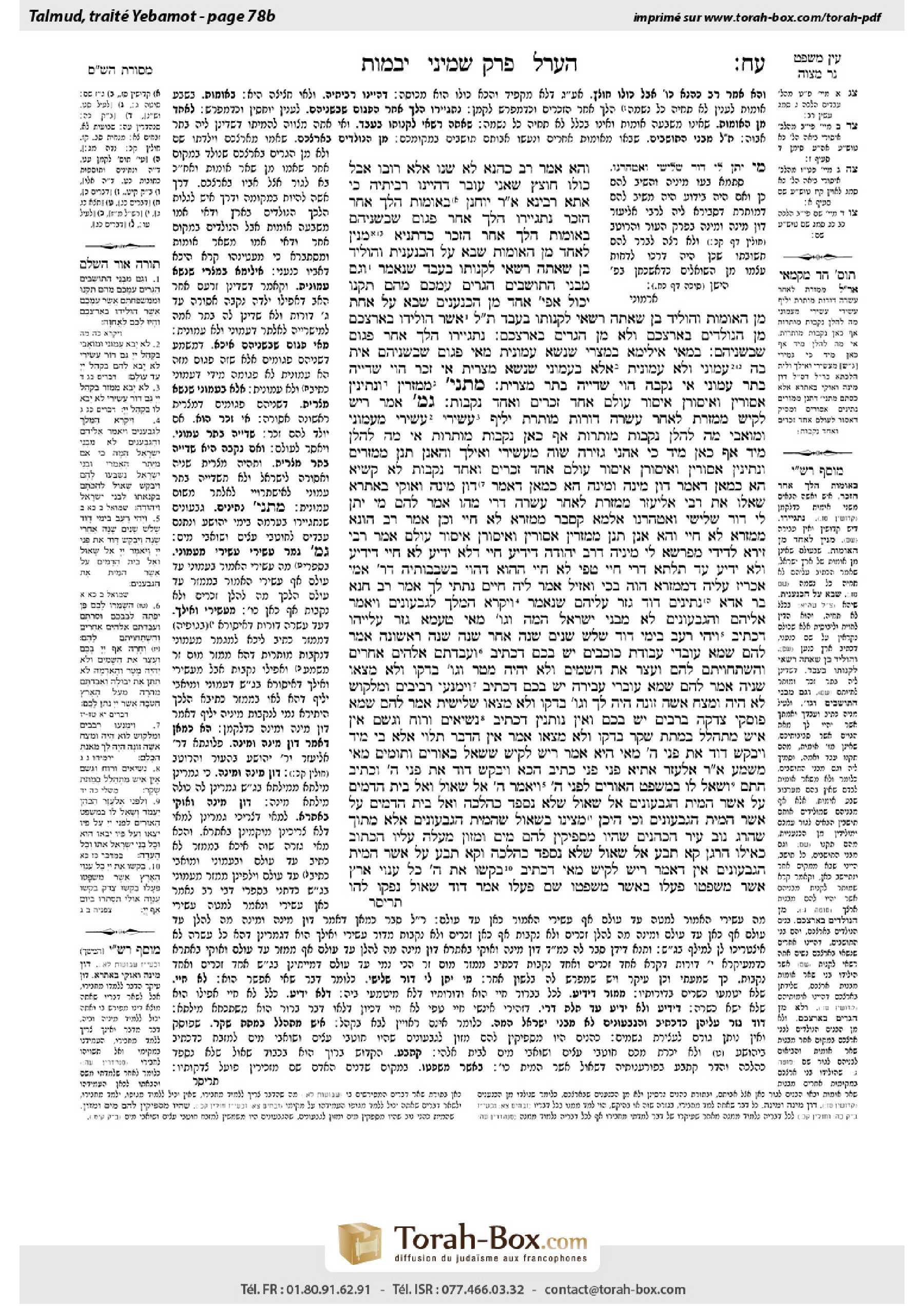
Yevamot 78b: Talmud study for Daf Yomi
Daf Yomi is the daily study of one Talmud folio. Explore 37 tractates with scans, Hebrew text, Sefaria English and AI-generated French translations where annotated.
Passage selection and English or AI-generated French translation are available where the scan has annotations. Daf Study is independent of Torah-Box and Sefaria.
Browse Yevamot · יבמות · All tractatesYevamot 78b text and translations
This page of Yevamot includes the Aramaic text, an English translation and an AI-generated French translation, alongside the scan above.
יבמות ע״ח ב · Aramaic and Hebrew text
וְהָא אָמַר רַב כָּהֲנָא: לֹא שָׁנוּ אֶלָּא רוּבּוֹ, אֲבָל כּוּלּוֹ — חוֹצֵץ! שָׁאנֵי עוּבָּר, דְּהַיְינוּ רְבִיתֵיהּ.
כִּי אֲתָא רָבִינָא, אָמַר רַבִּי יוֹחָנָן: בְּאוּמּוֹת, הַלֵּךְ אַחַר הַזָּכָר. נִתְגַּיְּירוּ, הַלֵּךְ אַחַר פָּגוּם שֶׁבִּשְׁנֵיהֶם. בָּאוּמּוֹת הַלֵּךְ אַחַר הַזָּכָר, כִּדְתַנְיָא: מִנַּיִן לְאֶחָד מִן הָאוּמּוֹת שֶׁבָּא עַל הַכְּנַעֲנִית וְהוֹלִיד בֵּן, שֶׁאַתָּה רַשַּׁאי לִקְנוֹתוֹ בְּעֶבֶד — שֶׁנֶּאֱמַר: ״וְגַם מִבְּנֵי הַתּוֹשָׁבִים הַגָּרִים עִמָּכֶם מֵהֶם תִּקְנוּ״.
יָכוֹל אֲפִילּוּ אֶחָד מִן הַכְּנַעֲנִים שֶׁבָּא עַל אַחַת מִן הָאוּמּוֹת וְהוֹלִיד בֵּן, שֶׁאַתָּה רַשַּׁאי לִקְנוֹתוֹ בְּעֶבֶד — תַּלְמוּד לוֹמַר: ״אֲשֶׁר הוֹלִידוּ בְּאַרְצְכֶם״ — מִן הַנּוֹלָדִים בְּאַרְצְכֶם, וְלֹא מִן הַגָּרִים בְּאַרְצְכֶם.
נִתְגַּיְּירוּ הַלֵּךְ אַחַר פָּגוּם שֶׁבִּשְׁנֵיהֶם. בְּמַאי? אִילֵימָא בְּמִצְרִי שֶׁנָּשָׂא עַמּוֹנִית — מַאי פָּגוּם שֶׁבִּשְׁנֵיהֶם אִית בַּהּ? ״עַמּוֹנִי״ וְלֹא עַמּוֹנִית! אֶלָּא בְּעַמּוֹנִי שֶׁנָּשָׂא מִצְרִית. אִי זָכָר הָוֵי — שִׁדְיֵיהּ בָּתַר עַמּוֹנִי, אִי נְקֵבָה הָוֵי — שִׁדְיַיהּ בָּתַר מִצְרִית.
מַתְנִי׳ מַמְזֵרִין וּנְתִינִין אֲסוּרִין, וְאִיסּוּרָן אִיסּוּר עוֹלָם. אֶחָד זְכָרִים וְאֶחָד נְקֵבוֹת.
גְּמָ׳ אָמַר רֵישׁ לָקִישׁ: מַמְזֶרֶת לְאַחַר עֲשָׂרָה דּוֹרוֹת מוּתֶּרֶת. יָלֵיף ״עֲשִׂירִי״ ״עֲשִׂירִי״ מֵעַמּוֹנִי וּמוֹאָבִי. מָה לְהַלָּן נְקֵבוֹת מוּתָּרוֹת — אַף כָּאן נְקֵבוֹת מוּתָּרוֹת.
אִי: מָה לְהַלָּן מִיָּד, אַף כָּאן מִיָּד! כִּי אַהֲנִי גְּזֵירָה שָׁוָה, מֵעֲשִׂירִי וְאֵילָךְ.
וְהָאֲנַן תְּנַן: מַמְזֵרִים וּנְתִינִין אֲסוּרִין, וְאִיסּוּרָן אִיסּוּר עוֹלָם, אֶחָד זְכָרִים וְאֶחָד נְקֵבוֹת! לָא קַשְׁיָא: הָא כְּמַאן דְּאָמַר דּוּן מִינַּהּ וּמִינַּהּ.
הָא כְּמַאן דְּאָמַר דּוּן מִינַּהּ וְאוֹקֵי בְּאַתְרָא.
שָׁאֲלוּ אֶת רַבִּי אֱלִיעֶזֶר: מַמְזֶרֶת לְאַחַר עַשְׂרָה דָּרֵי מַהוּ? אָמַר לָהֶם: מִי יִתֵּן לִי דּוֹר שְׁלִישִׁי וַאֲטַהֲרֶנּוּ. אַלְמָא קָסָבַר מַמְזֵרָא לָא חָיֵי. וְכֵן אֲמַר רַב הוּנָא: מַמְזֵרָא לָא חָיֵי.
וְהָא אֲנַן תְּנַן: מַמְזֵרִין אֲסוּרִין, וְאִיסּוּרָן אִיסּוּר עוֹלָם! אָמַר רַבִּי זֵירָא: לְדִידִי מִפָּרְשָׁא לִי מִינֵּיהּ דְּרַב יְהוּדָה: דִּידִיעַ — חָיֵי, דְּלָא יְדִיעַ — לָא חָיֵי. דִּידִיעַ וְלָא יְדִיעַ — עַד תְּלָתָא דָּרֵי חָיֵי, טְפֵי — לָא חָיֵי.
הָהוּא דְּהָוֵי בְּשִׁבָבוּתֵיהּ דְּרַבִּי אַמֵּי. אַכְרֵיז עֲלֵיהּ דְּמַמְזֵרָא הֲוָה. בָּכֵי וְאָזֵיל, אֲמַר לֵיהּ: חַיִּים נָתַתִּי לָךְ.
אָמַר רַב חָנָא בַּר אַדָּא: נְתִינִים — דָּוִד גָּזַר עֲלֵיהֶם, שֶׁנֶּאֱמַר: ״וַיִּקְרָא הַמֶּלֶךְ לַגִּבְעוֹנִים וַיֹּאמֶר אֲלֵיהֶם וְהַגִּבְעוֹנִים לֹא מִבְּנֵי יִשְׂרָאֵל הֵמָּה וְגוֹ׳״.
מַאי טַעְמָא גְּזַר עֲלַיְיהוּ? דִּכְתִיב: ״וַיְהִי רָעָב בִּימֵי דָוִד שָׁלֹשׁ שָׁנִים שָׁנָה אַחַר שָׁנָה״. שָׁנָה רִאשׁוֹנָה אָמַר לָהֶם: שֶׁמָּא עוֹבְדֵי עֲבוֹדָה זָרָה יֵשׁ בָּכֶם, דִּכְתִיב: ״וַעֲבַדְתֶּם אֱלֹהִים אֲחֵרִים וְהִשְׁתַּחֲוִיתֶם לָהֶם. וְעָצַר אֶת הַשָּׁמַיִם וְלֹא יִהְיֶה מָטָר וְגוֹ׳״. בָּדְקוּ, וְלֹא מָצְאוּ.
שְׁנִיָּה אָמַר לָהֶם: שֶׁמָּא עוֹבְרֵי עֲבֵירָה יֵשׁ בָּכֶם, דִּכְתִיב: ״וַיִּמָּנְעוּ רְבִיבִים וּמַלְקוֹשׁ לֹא הָיָה וּמֵצַח אִשָּׁה זוֹנָה הָיָה לָךְ וְגוֹ׳״. בָּדְקוּ, וְלֹא מָצְאוּ.
שְׁלִישִׁית אָמַר לָהֶם: שֶׁמָּא פּוֹסְקֵי צְדָקָה בָּרַבִּים יֵשׁ בָּכֶם וְאֵין נוֹתְנִין, דִּכְתִיב: ״נְשִׂיאִים וְרוּחַ וְגֶשֶׁם אָיִן אִישׁ מִתְהַלֵּל בְּמַתַּת שָׁקֶר״. בָּדְקוּ, וְלֹא מָצְאוּ.
אָמַר: אֵין הַדָּבָר תָּלוּי אֶלָּא בִּי, מִיָּד: ״וַיְבַקֵּשׁ דָּוִד אֶת פְּנֵי ה׳״. מַאי הִיא? אָמַר רֵישׁ לָקִישׁ: שֶׁשָּׁאַל בְּאוּרִים וְתוּמִּים.
מַאי מַשְׁמַע? אָמַר רַבִּי אֶלְעָזָר: אָתְיָא ״פְּנֵי״ ״פְּנֵי״. כְּתִיב הָכָא: ״וַיְבַקֵּשׁ דָּוִד אֶת פְּנֵי ה׳״, וּכְתִיב הָתָם: ״וְשָׁאַל לוֹ בְּמִשְׁפַּט הָאוּרִים לִפְנֵי ה׳״.
״וַיֹּאמֶר ה׳ אֶל שָׁאוּל וְאֶל בֵּית הַדָּמִים עַל אֲשֶׁר הֵמִית הַגִּבְעוֹנִים״. ״אֶל שָׁאוּל״ — שֶׁלֹּא נִסְפַּד כַּהֲלָכָה, ״וְאֶל בֵּית הַדָּמִים״ — ״עַל אֲשֶׁר הֵמִית הַגִּבְעוֹנִים״. וְכִי הֵיכָן מָצִינוּ בְּשָׁאוּל שֶׁהֵמִית הַגִּבְעוֹנִים? אֶלָּא מִתּוֹךְ שֶׁהָרַג נוֹב עִיר הַכֹּהֲנִים שֶׁהָיוּ מַסְפִּיקִין לָהֶם מַיִם וּמָזוֹן, מַעֲלֶה עָלָיו הַכָּתוּב כְּאִילּוּ הֲרָגָן.
קָא תָבַע אֶל שָׁאוּל שֶׁלֹּא נִסְפַּד כַּהֲלָכָה, וְקָא תָבַע עַל אֲשֶׁר הֵמִית הַגִּבְעוֹנִים?! אִין, דְּאָמַר רֵישׁ לָקִישׁ: מַאי דִּכְתִיב: ״בַּקְּשׁוּ אֶת ה׳ כׇּל עַנְוֵי אֶרֶץ אֲשֶׁר מִשְׁפָּטוֹ פָּעָלוּ״, בַּאֲשֶׁר מִשְׁפָּטוֹ — שָׁם פׇּעֳלוֹ.
אָמַר דָּוִד: שָׁאוּל, נְפַקוּ לְהוּ
Yevamot 78b · English translation
However, this is difficult, as didn’t Rav Kahana say that they taught this halakha that if one is not particular about the substance it is not considered an interposition only when the substance covers just a majority of his body; but if it covers all of it, it is considered an interposition by Torah law, even if he is not particular about it. The Gemara answers: A fetus is different, as this is its natural manner of growth. Its mother’s womb cannot be considered an interposition, as it is the fetus’ natural place of development, and therefore the fetus itself is regarded as having undergone immersion.
When Ravina came from Eretz Yisrael to Babylonia, he said that Rabbi Yoḥanan said: With respect to lineage, among the other nations of the world, i.e., while they are still gentiles, follow the male, but if they married after they converted, follow the more flawed in lineage of the two. The Gemara explains: Among the nations, follow the male, as it is taught in a baraita: From where is it derived that if one from the other nations had relations with a Canaanite woman and had a son from her, you are permitted to purchase him as a slave, and he is not considered a Canaanite who may not be allowed to remain in Eretz Yisrael? As it is stated: “And also from the children of the strangers that dwell among you, of them may you buy, and of their families that are with you, which they have begotten in your land; and they may be your possession” (Leviticus 25:45).
One might have thought that even if one from the Canaanite nations had relations with a woman from one of the other nations and had a son from her, you are permitted to purchase him as a slave. Therefore, the same verse states: “Which they have begotten in your land,” which indicates that slaves may be bought only from those begotten in your land, i.e., from those whose father was a non-Canaanite and whose mother was a Canaanite. It is the way of women to remain in their own land, and so a child born in Eretz Yisrael was certainly born to a Canaanite mother. But slaves may not be bought from those dwelling in your land. If a child is born to a Canaanite man and a non-Canaanite woman outside of Eretz Yisrael, and that offspring later returns to dwell in Eretz Yisrael, the offspring may not be acquired as a slave, because his lineage follows his father. He is regarded as a Canaanite, who may not be allowed to remain in Eretz Yisrael.
It was taught above in the name of Rabbi Yoḥanan that if they married after they converted, follow the more flawed in lineage of the two. The Gemara asks: To what circumstances is this referring? If we say it is referring to a male Egyptian convert who married a female Ammonite convert, what is the meaning of: More flawed in lineage of the two, in this case? The halakha is that an Ammonite man is barred from entering into the congregation, but not an Ammonite woman, and so she is not flawed at all. Rather, it must be referring to a male Ammonite convert who married a female Egyptian convert. If the child is male, assign him to his Ammonite father, so that he is permanently barred from entering the congregation. If it is a female, assign her to her Egyptian mother, so that she is treated like a second-generation Egyptian convert.
MISHNA: Mamzerim and the Gibeonites who converted to Judaism in the days of Joshua are prohibited from entering into the congregation and marrying a woman who was born Jewish. Their prohibition is eternal, for all generations, and it applies to both males and females.
GEMARA: Reish Lakish said: A mamzeret, a female mamzer, is permitted after ten generations. Why? He derived this halakha by way of a verbal analogy between the word “tenth” stated in relation to an Ammonite and a Moabite in the verse “An Ammonite or a Moabite shall not enter into the congregation of the Lord; even to the tenth generation shall none of them enter into the congregation of the Lord forever” (Deuteronomy 23:4), and the word “tenth” stated in relation to a mamzer in the verse “A mamzer shall not enter into the congregation of the Lord; even to the tenth generation shall none of his enter into the congregation of the Lord” (Deuteronomy 23:3) He explained the analogy as follows: Just as below, with regard to an Ammonite and a Moabite, females are permitted, so too here, with regard to a mamzer, females are permitted.
The Gemara raises a difficulty: Or perhaps one should say that just as below, with regard to an Ammonite and a Moabite, their females are permitted immediately, so too here, a mamzeret is permitted immediately. The Gemara answers: The verbal analogy is effective only from the tenth generation and onward.
The Gemara raises another difficulty: But didn’t we learn in the mishna that mamzerim and Gibeonites are prohibited, and their prohibition is eternal for all generations, and it applies to both males and females? The Gemara answers: This is not difficult for Reish Lakish, as he understands that there is a dispute in this regard: This opinion, that of Reish Lakish, is in accordance with the tanna who said that the application of a verbal analogy is extended by way of the principle: Infer from it, and again from it. In other words, after deducing case B from case A, all of the characteristics of case A are applied to case B. In the case discussed here, although the verbal analogy comes primarily to render a mamzer permanently forbidden, it is extended and understood to mean that a mamzeret is permitted after ten generations.
That other opinion, i.e., the mishna, is in accordance with the tanna who said that the application of a verbal analogy is limited, according to the principle: Infer from it, and then leave it in its place. That is to say, after the main provision of case A is applied to case B, case B is recognized as having its own character and specific rules that apply to it. Accordingly, in the case discussed here, the verbal analogy teaches one specific halakha that a mamzer is prohibited permanently, but nothing else.
The Gemara relates that the students asked Rabbi Eliezer: With regard to a mamzeret after ten generations, what is the halakha? He said to them: Who will give me a third-generation mamzer so that I will declare him pure? The Gemara comments: Apparently he maintains that a mamzer does not survive. Mamzerim perish at the hand of Heaven, and therefore this question is not a practical one. And similarly, Rav Huna said that a mamzer does not survive.
The Gemara raises a difficulty: But didn’t we learn in the mishna that mamzerim are prohibited from entering into the congregation, and their prohibition is eternal for all generations? How is this possible if they do not even live long enough to produce three generations? Rabbi Zeira said: This matter was explained to me by Rav Yehuda himself: One who is known to be a mamzer will survive, as there is no concern that there will be any mingling of his seed. On the other hand, one who is not known as a mamzer will not survive, as he will die at the hand of Heaven so that there will be no mingling of his seed. As for one who is known and not known, i.e., one who is under suspicion, but it is unclear whether or not he is actually a mamzer, his descendants will survive for three generations, but more than this they will not survive.
It is related that a certain person lived in Rabbi Ami’s neighborhood, and following an investigation Rabbi Ami declared him to be a mamzer. The man went about weeping until Rabbi Ami said to him: You should not be upset, as now I have given you life. As explained above, once one is publicly known as a mamzer, he and his descendants may survive.
§ Rav Ḥana bar Adda said: As for the Gibeonites, it was King David who decreed that they may not enter into the congregation, as it is stated: “And the king called the Gibeonites and said to them. Now the Gibeonites are not of the children of Israel, but of the remnant of the Amorites” (II Samuel 21:2). This verse indicates that it was David who ruled that they are not part of the Jewish people and that they are barred from the congregation even though they converted.
The Gemara asks: What is the reason that David decreed that they may not enter into the congregation? In order to answer this question, the Gemara recounts all the relevant background events. As it is written: “And there was a famine in the days of David three years, year after year” (II Samuel 21:1). In the first year David said to the Jewish people: Perhaps there are idol worshippers among you, this being a sin that can lead to drought, as it is written: “Take heed to yourselves, lest your heart be deceived, and you turn aside, and serve other gods, and worship them; and the anger of the Lord be kindled against you, and He shut up the heaven, so that there shall be no rain, and the ground shall not yield her fruit” (Deuteronomy 11:16–17). They examined the matter but did not find sinners of this kind.
In the second year of the drought David said to them: Perhaps there are transgressors in sexual matters among you, as this too can lead to drought, as it is written: “Therefore the showers have been withheld, and there has been no latter rain; yet you had a harlot’s forehead, you refused to be ashamed” (Jeremiah 3:3), which indicates that licentious behavior can lead to a cessation of rainfall. Again they examined the matter, but did not find sinners of this kind either.
In the third year he said to them: Perhaps there are among you those who pledge money to charity in public, but do not actually give any charity. As it is written: “As vapors and wind without rain, so is he that boasts himself of a false gift” (Proverbs 25:14), teaching that one who falsely boasts of making a gift prevents the rain from falling. Once again they examined the matter, but could not find such sinners.
Having unsuccessfully searched the Jewish people for sins that cause drought, David said: The matter depends on nothing other than myself. Immediately it is stated: “And David sought the presence of the Lord” (II Samuel 21:1). The Gemara asks: What is this? How did David seek God? Reish Lakish said: He inquired through the Urim VeTummim, the stones embedded in the High Priest’s breastplate, which served as a means of communicating with God.
The Gemara asks: From where may it be inferred that David’s seeking was by way of the Urim VeTummim? Rabbi Elazar said: This is derived by way of a verbal analogy between the word “presence” used here and the word “presence” used elsewhere. It is written here: “And David sought the presence of the Lord,” and it is written there: “And he shall stand before Eleazar the priest, who shall inquire for him by the judgment of the Urim in the presence of the Lord” (Numbers 27:21). Consequently, the “presence of the Lord” sought by David must have involved the Urim VeTummim.
The verse continues: “And the Lord said: It is for Saul, and for his bloody house, because he put to death the Gibeonites” (II Samuel 21:1). The Gemara explains: “For Saul” means that the Jewish people were punished because he was not eulogized properly. “And for his bloody house” is “because he put to death the Gibeonites.” The Gemara is puzzled by this explanation: Now, where do we find that Saul put to death the Gibeonites? The Gemara clarifies: Rather, because he killed the people of Nob, the city of priests, who would provide the Gibeonites with water and food in exchange for their services, the verse ascribes to him as if he himself had killed them.
The Gemara questions this understanding: On one hand, God demands retribution because Saul was not eulogized properly, while on the other hand, He demands retribution because Saul himself put to death the Gibeonites. The Gemara answers: Yes, this is how it should be. As Reish Lakish said: What is the meaning of that which is written: “Seek the Lord, all the humble of the earth, that have executed [pa’alu] His justice” (Zephaniah 2:3)? Where mention is made of the justice to be carried out against a person, his good deeds [pa’alo] should be mentioned there as well.
David said: With regard to the eulogy for Saul, there have already passed
Yevamot 78b · Traduction française (IA)
Toutefois, cela pose une difficulté, car Rav Kahana n’a-t-il pas dit que cette halakha — selon laquelle une substance ne constitue pas une interposition si l’on n’y attache pas d’importance — n’a été enseignée que lorsque la substance ne couvre qu’une partie majoritaire du corps ; mais si elle le couvre entièrement, elle constitue une interposition selon la Torah, même si l’on n’y attache pas d’importance ? La Guemara répond : le fœtus fait exception, car c’est ainsi qu’il se développe naturellement. Le ventre de sa mère ne peut être considéré comme une interposition, puisqu’il est le lieu naturel de son développement ; le fœtus est donc considéré comme ayant lui-même été immergé.
Lorsque Ravina revint d’Eretz Israël en Babylonie, il rapporta que Rabbi Yoḥanan avait dit : en matière de filiation, parmi les autres nations du monde, c’est-à-dire tant qu’ils sont encore non-Juifs, on suit le père ; mais s’ils se marient après leur conversion, on suit celui des deux dont la filiation est la plus déficiente. La Guemara explique : parmi les nations, on suit le père, comme l’enseigne une baraïta : d’où apprend-on que si un homme d’une autre nation a des relations avec une femme cananéenne et a un fils d’elle, il est permis d’acquérir celui-ci comme esclave, et qu’il n’est pas considéré comme un Cananéen auquel il serait interdit de demeurer en Eretz Israël ? Car il est dit : « Vous pourrez aussi acheter des enfants des étrangers qui séjournent parmi vous, et de leurs familles qui sont avec vous, qu’ils auront engendrés dans votre pays ; ils seront votre propriété » (Lévitique 25:45).
On aurait pu penser que si un homme d’une nation cananéenne avait des relations avec une femme d’une autre nation et avait un fils d’elle, il serait permis de l’acquérir comme esclave. C’est pourquoi le même verset précise : « qu’ils auront engendrés dans votre pays », ce qui indique que l’on ne peut acheter comme esclaves que ceux qui ont été engendrés dans votre pays, c’est-à-dire ceux dont le père n’est pas cananéen et dont la mère est cananéenne. En effet, les femmes ont coutume de rester dans leur propre pays ; un enfant né en Eretz Israël est donc nécessairement né d’une mère cananéenne. En revanche, on ne peut acheter comme esclaves ceux qui résident dans votre pays. Si un enfant né hors d’Eretz Israël d’un père cananéen et d’une mère non cananéenne revient ensuite résider en Eretz Israël, il ne peut être acquis comme esclave, car sa filiation suit celle de son père. Il est considéré comme un Cananéen, auquel il est interdit de demeurer en Eretz Israël.
Il a été enseigné plus haut au nom de Rabbi Yoḥanan que, s’ils se marient après leur conversion, on suit celui des deux dont la filiation est la plus déficiente. La Guemara demande : À quelles circonstances cela se rapporte-t-il ? Si l’on dit qu’il s’agit d’un homme converti d’origine égyptienne qui a épousé une femme convertie d’origine ammonite, que signifie ici « celui des deux dont la filiation est la plus déficiente » ? La halakha est qu’un homme ammonite ne peut entrer dans l’assemblée, mais pas une femme ammonite ; celle-ci n’a donc aucune filiation déficiente. Il faut plutôt parler d’un homme converti d’origine ammonite qui a épousé une femme convertie d’origine égyptienne. Si l’enfant est un garçon, on le rattache à son père ammonite, de sorte qu’il lui est interdit à jamais d’entrer dans l’assemblée. S’il s’agit d’une fille, on la rattache à sa mère égyptienne, de sorte qu’elle est traitée comme une convertie d’origine égyptienne de deuxième génération.
Michna : Les mamzerim et les Gabaonites, qui se convertirent au judaïsme à l’époque de Josué, ne peuvent entrer dans l’assemblée ni épouser une femme née juive. Leur interdiction est éternelle, pour toutes les générations, et s’applique aux hommes comme aux femmes.
Guemara : Reish Lakish a dit : Une mamzeret, c’est-à-dire une femme mamzer, est permise après dix générations. Pourquoi ? Il a déduit cette halakha au moyen d’une analogie verbale entre le mot « dixième », employé au sujet d’un Ammonite et d’un Moabite dans le verset : « Un Ammonite ou un Moabite n’entrera pas dans l’assemblée de l’Éternel ; même à la dixième génération, aucun des leurs n’entrera dans l’assemblée de l’Éternel, à jamais » (Deutéronome 23:4), et le mot « dixième », employé au sujet d’un mamzer dans le verset : « Un mamzer n’entrera pas dans l’assemblée de l’Éternel ; même à la dixième génération, aucun des siens n’entrera dans l’assemblée de l’Éternel » (Deutéronome 23:3). Il expliqua l’analogie ainsi : de même que, dans le premier cas, les femmes ammonites et moabites sont permises, de même, ici, les femmes mamzer sont permises.
La Guemara soulève une difficulté : ou peut-être faudrait-il dire que, de même que, dans le premier cas, les femmes ammonites et moabites sont permises immédiatement, de même, ici, une mamzeret est permise immédiatement ? La Guemara répond : l’analogie verbale ne s’applique qu’à partir de la dixième génération.
La Guemara soulève une autre difficulté : mais n’avons-nous pas appris dans la Michna que les mamzerim et les Gabaonites sont interdits, que leur interdiction est éternelle, pour toutes les générations, et qu’elle s’applique aux hommes comme aux femmes ? Cela ne pose pas de difficulté à Reish Lakish, car il comprend qu’il existe une controverse à ce sujet : l’opinion de Reish Lakish suit le tanna qui a dit que l’application d’une analogie verbale se prolonge selon le principe suivant : « Déduire du cas, puis déduire de nouveau à partir de celui-ci. » Autrement dit, après avoir déduit le cas B du cas A, on applique au cas B toutes les caractéristiques du cas A. Dans le cas présent, bien que l’analogie verbale serve principalement à établir qu’un mamzer est interdit à jamais, on l’étend et on l’interprète comme signifiant qu’une mamzeret est permise après dix générations.
L’autre opinion, c’est-à-dire celle de la Michna, suit le tanna qui a dit que l’application d’une analogie verbale est limitée selon le principe suivant : « Déduire du cas, puis le laisser à sa place. » Cela signifie qu’après avoir appliqué au cas B la disposition principale du cas A, on reconnaît au cas B son caractère propre et les règles particulières qui le régissent. Ainsi, dans le cas présent, l’analogie verbale enseigne une halakha précise : un mamzer est interdit à jamais, mais rien de plus.
La Guemara rapporte que les élèves demandèrent à Rabbi Eliezer : quelle est la halakha concernant une mamzeret après dix générations ? Il leur répondit : « Qui me trouvera un mamzer de troisième génération, afin que je le déclare pur ? » La Guemara commente : apparemment, il estime qu’un mamzer ne survit pas. Les mamzerim périssent par la main du Ciel ; cette question n’a donc pas de portée pratique. De même, Rav Huna a dit qu’un mamzer ne survit pas.
La Guemara soulève une difficulté : mais n’avons-nous pas appris dans la Michna que les mamzerim ne peuvent entrer dans l’assemblée et que leur interdiction est éternelle, pour toutes les générations ? Comment est-ce possible s’ils ne vivent même pas assez longtemps pour engendrer trois générations ? Rabbi Zeira dit : Rav Yehuda lui-même m’a expliqué cette question. Celui dont le statut de mamzer est connu survivra, car on ne craint pas que sa descendance se mêle à celle des autres. En revanche, celui dont le statut de mamzer n’est pas connu ne survivra pas, car il mourra par la main du Ciel afin que sa descendance ne se mêle pas à celle des autres. Quant à celui dont le statut est connu sans l’être vraiment, c’est-à-dire celui qui est soupçonné sans que l’on sache s’il est réellement mamzer, ses descendants survivront pendant trois générations, mais pas au-delà.
Il est rapporté qu’un certain homme habitait le voisinage de Rabbi Ami et qu’après enquête, Rabbi Ami le déclara mamzer. L’homme s’en alla en pleurant, jusqu’à ce que Rabbi Ami lui dise : « Ne sois pas bouleversé, car je viens de te donner la vie. » Comme expliqué plus haut, dès lors qu’un homme est publiquement connu comme mamzer, lui et ses descendants peuvent survivre.
§ Rav Ḥana bar Adda a dit : C’est le roi David qui décréta que les Gabaonites ne pouvaient entrer dans l’assemblée, comme il est dit : « Le roi appela les Gabaonites et leur parla. Or les Gabaonites n’étaient pas des enfants d’Israël, mais un reste des Amoréens » (II Samuel 21:2). Ce verset indique que David statua qu’ils ne faisaient pas partie du peuple juif et qu’ils étaient exclus de l’assemblée, bien qu’ils se fussent convertis.
La Guemara demande : Pourquoi David décréta-t-il qu’ils ne pouvaient entrer dans l’assemblée ? Pour répondre à cette question, la Guemara rappelle tous les événements pertinents. Car il est écrit : « Il y eut une famine à l’époque de David pendant trois années, année après année » (II Samuel 21:1). La première année, David dit au peuple juif : « Peut-être y a-t-il parmi vous des idolâtres », car ce péché peut provoquer la sécheresse, comme il est écrit : « Prenez garde à vous, de peur que votre cœur ne se laisse séduire, que vous ne vous détourniez, que vous ne serviez d’autres dieux et ne vous prosterniez devant eux ; alors la colère de l’Éternel s’enflammerait contre vous, il fermerait les cieux, il n’y aurait pas de pluie et la terre ne donnerait pas ses produits » (Deutéronome 11:16–17). Ils examinèrent la question, mais ne trouvèrent pas de pécheurs de cette catégorie.
La deuxième année de sécheresse, David leur dit : « Peut-être y a-t-il parmi vous des transgresseurs en matière sexuelle », car cela aussi peut provoquer la sécheresse, comme il est écrit : « C’est pourquoi les pluies ont été retenues, et il n’y a pas eu de pluie tardive ; pourtant tu as un front de prostituée, tu refuses d’avoir honte » (Jérémie 3:3), ce qui indique qu’un comportement débauché peut entraîner l’arrêt des pluies. Ils examinèrent de nouveau la question, mais ne trouvèrent pas non plus de pécheurs de cette catégorie.
La troisième année, il leur dit : « Peut-être y a-t-il parmi vous des gens qui promettent publiquement de donner de l’argent à la tsedaka, mais ne donnent en réalité aucune charité. » Car il est écrit : « Des nuées et du vent sans pluie, tel est l’homme qui se vante d’un don mensonger » (Proverbes 25:14), ce qui enseigne que celui qui se vante faussement de faire un don empêche la pluie de tomber. Une nouvelle fois, ils examinèrent la question, mais ne trouvèrent pas de tels pécheurs.
Après avoir cherché en vain parmi le peuple juif les péchés qui provoquent la sécheresse, David dit : « La cause ne peut être que moi. » Aussitôt, il est dit : « David chercha la présence de l’Éternel » (II Samuel 21:1). La Guemara demande : Qu’est-ce que cela signifie ? Comment David consulta-t-il Dieu ? Reish Lakish dit : Il consulta les Ourim et les Toumim, les pierres enchâssées dans le pectoral du grand prêtre, qui servaient à communiquer avec Dieu.
La Guemara demande : D’où peut-on déduire que David consulta Dieu au moyen des Ourim et des Toumim ? Rabbi Elazar dit : On le déduit au moyen d’une analogie verbale entre le mot « présence », employé ici, et le mot « présence », employé ailleurs. Il est écrit ici : « David chercha la présence de l’Éternel », et il est écrit ailleurs : « Il se tiendra devant Éléazar le prêtre, qui consultera pour lui le jugement des Ourim devant l’Éternel » (Nombres 27:21). Par conséquent, la « présence de l’Éternel » recherchée par David impliquait nécessairement le recours aux Ourim et aux Toumim.
Le verset poursuit : « L’Éternel dit : C’est à cause de Saül et de sa maison sanguinaire, parce qu’il a mis à mort les Gabaonites » (II Samuel 21:1). La Guemara explique : « À cause de Saül » signifie que le peuple juif fut puni parce qu’il ne lui avait pas rendu les honneurs funèbres comme il convenait. « Et de sa maison sanguinaire » signifie « parce qu’il a mis à mort les Gabaonites ». La Guemara s’étonne de cette explication : où trouvons-nous que Saül a mis à mort les Gabaonites ? La Guemara précise : c’est plutôt parce qu’il a tué les habitants de Nob, la ville des prêtres, qui fournissaient de l’eau et de la nourriture aux Gabaonites en échange de leurs services, que le verset lui impute leur mort, comme s’il les avait lui-même tués.
La Guemara remet en question cette interprétation : d’un côté, Dieu réclame réparation parce que Saül n’a pas reçu les honneurs funèbres comme il convenait, et de l’autre, Il réclame réparation parce que Saül lui-même a mis à mort les Gabaonites. La Guemara répond : oui, c’est bien ainsi qu’il faut comprendre. Car Reish Lakish a dit : Que signifie ce qui est écrit : « Cherchez l’Éternel, vous tous, humbles de la terre, qui avez pratiqué [pa’alu] son droit » (Sophonie 2:3) ? Lorsqu’il est question du droit à exercer contre une personne, il faut aussi mentionner ses bonnes actions [pa’alo].
David dit : « Quant aux honneurs funèbres rendus à Saül, il s’est déjà écoulé
Traduction française générée par IA à partir de l’édition anglaise de Sefaria. Vérifie toujours un passage avec le texte source.
Text from Sefaria: William Davidson Edition - Vocalized Aramaic (CC BY NC); William Davidson Edition - English (CC BY NC).