Yevamot 79a: Talmud study for Daf Yomi
Daf Yomi is the daily study of one Talmud folio. Explore 37 tractates with scans, Hebrew text, Sefaria English and AI-generated French translations where annotated.
Passage selection and English or AI-generated French translation are available where the scan has annotations. Daf Study is independent of Torah-Box and Sefaria.
Browse Yevamot · יבמות · All tractatesYevamot 79a text and translations
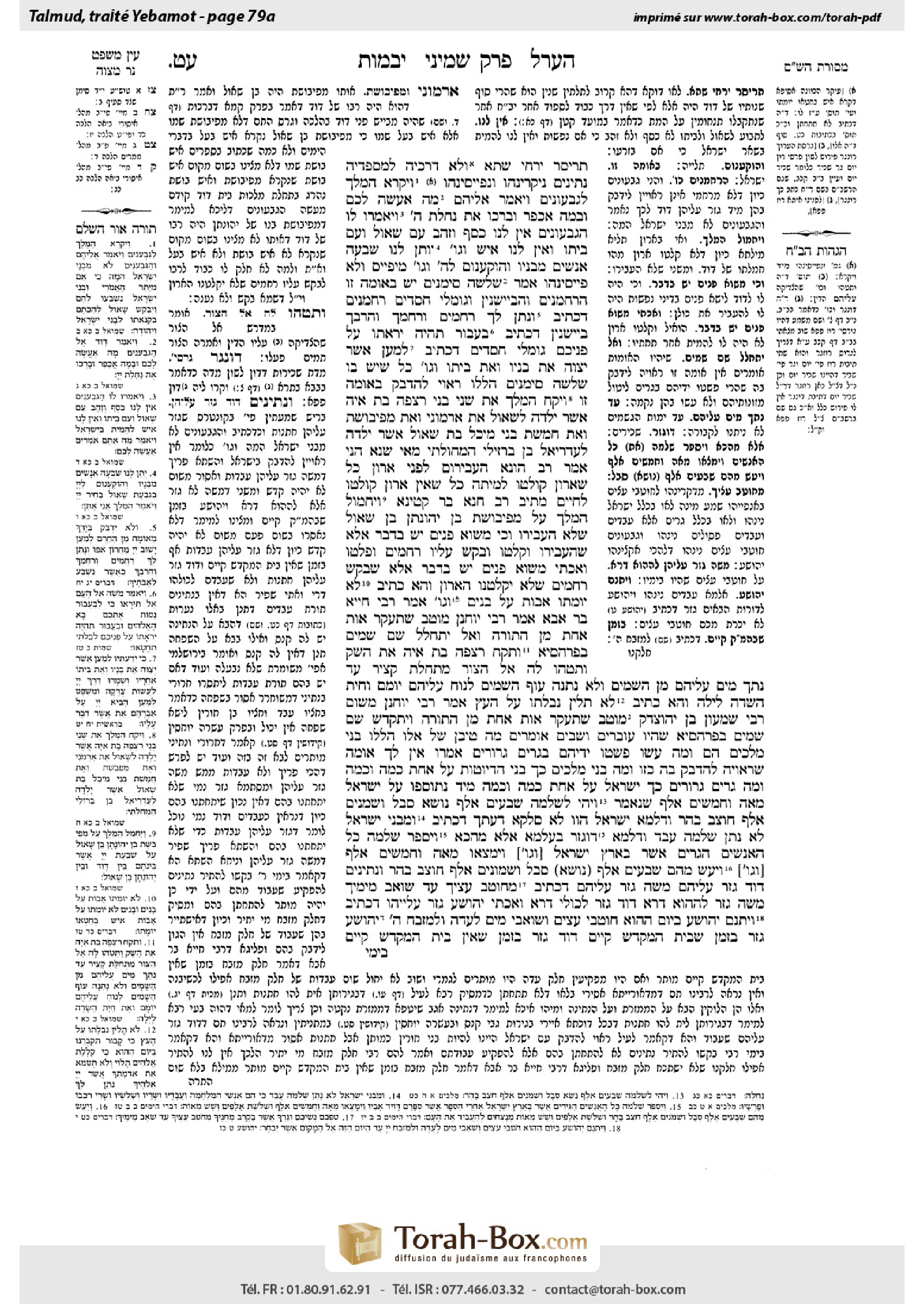
This page of Yevamot includes the Aramaic text, an English translation and an AI-generated French translation, alongside the scan above.
יבמות ע״ט א · Aramaic and Hebrew text
תְּרֵיסַר יַרְחֵי שַׁתָּא, וְלָא דַּרְכֵּיהּ לְמִסְפְּדֵיהּ.
נְתִינִים נִיקְרִינְהוּ וּנְפַיְּיסִינְהוּ: ״וַיִּקְרָא הַמֶּלֶךְ לַגִּבְעוֹנִים וַיֹּאמֶר אֲלֵיהֶם. מָה אֶעֱשֶׂה לָכֶם וּבַמָּה אֲכַפֵּר וּבָרְכוּ אֶת נַחֲלַת ה׳. וַיֹּאמְרוּ לוֹ הַגִּבְעוֹנִים אֵין לָנוּ כֶּסֶף וְזָהָב עִם שָׁאוּל וְעִם בֵּיתוֹ וְאֵין לָנוּ אִישׁ וְגוֹ׳ יֻתַּן לָנוּ שִׁבְעָה אֲנָשִׁים מִבָּנָיו וְהוֹקַעֲנוּם לַה׳ וְגוֹ׳״, פַּיְּיסִינְהוּ וְלָא מִיפַּיְיסוּ.
אָמַר, שְׁלֹשָׁה סִימָנִים יֵשׁ בְּאוּמָּה זוֹ: הָרַחְמָנִים, וְהַבַּיְישָׁנִין, וְגוֹמְלֵי חֲסָדִים. רַחְמָנִים — דִּכְתִיב: ״וְנָתַן לְךָ רַחֲמִים וְרִחַמְךָ וְהִרְבֶּךָ״. בַּיְישָׁנִין — דִּכְתִיב: ״בַּעֲבוּר תִּהְיֶה יִרְאָתוֹ עַל פְּנֵיכֶם״. גּוֹמְלֵי חֲסָדִים — דִּכְתִיב: ״לְמַעַן אֲשֶׁר יְצַוֶּה אֶת בָּנָיו וְאֶת בֵּיתוֹ וְגוֹ׳״. כֹּל שֶׁיֵּשׁ בּוֹ שְׁלֹשָׁה סִימָנִים הַלָּלוּ — רָאוּי לְהִדָּבֵק בְּאוּמָּה זוֹ.
״וַיִּקַּח הַמֶּלֶךְ אֶת שְׁנֵי בְּנֵי רִצְפָּה בַת אַיָּה אֲשֶׁר יָלְדָה לְשָׁאוּל אֶת אַרְמֹנִי וְאֶת מְפִבֹשֶׁת וְאֶת חֲמֵשֶׁת בְּנֵי מִיכַל בַּת שָׁאוּל אֲשֶׁר יָלְדָה לְעַדְרִיאֵל בֶּן בַּרְזִילַּי הַמְּחֹלָתִי״. מַאי שְׁנָא הָנֵי? אָמַר רַב הוּנָא: הֶעֱבִירוּם לִפְנֵי אָרוֹן, כֹּל שֶׁאָרוֹן קוֹלְטוֹ — לְמִיתָה, כֹּל שֶׁאֵין אָרוֹן קוֹלְטוֹ — לְחַיִּים.
מֵתִיב רַב חָנָא בַּר קַטִּינָא: ״וַיַּחְמֹל הַמֶּלֶךְ עַל מְפִבֹשֶׁת בֶּן יְהוֹנָתָן בֶּן שָׁאוּל״ — שֶׁלֹּא הֶעֱבִירוֹ.
וְכִי מַשּׂוֹא פָּנִים יֵשׁ בַּדָּבָר? אֶלָּא: שֶׁהֶעֱבִירוֹ וּקְלָטוֹ, וּבִקֵּשׁ עָלָיו רַחֲמִים, וּפְלָטוֹ. וְאַכַּתִּי: מַשּׂוֹא פָּנִים יֵשׁ בַּדָּבָר? אֶלָּא, שֶׁבִּקֵּשׁ רַחֲמִים שֶׁלֹּא יִקְלְטֶנּוּ הָאָרוֹן.
וְהָא כְּתִיב: ״לֹא יוּמְתוּ אָבוֹת עַל בָּנִים וְגוֹ׳״? אָמַר רַבִּי חִיָּיא בַּר אַבָּא אָמַר רַבִּי יוֹחָנָן: מוּטָב שֶׁתֵּעָקֵר אוֹת אַחַת מִן הַתּוֹרָה, וְאַל יִתְחַלֵּל שֵׁם שָׁמַיִם בְּפַרְהֶסְיָא.
״וַתִּקַּח רִצְפָּה בַת אַיָּה אֶת הַשַּׂק וַתַּטֵּהוּ לָהּ אֶל הַצּוּר מִתְּחִלַּת קָצִיר עַד נִתַּךְ מַיִם עֲלֵיהֶם מִן הַשָּׁמָיִם וְלֹא נָתְנָה עוֹף הַשָּׁמַיִם לָנוּחַ עֲלֵיהֶם יוֹמָם וְחַיַּת הַשָּׂדֶה לַיְלָה״. וְהָא כְּתִיב: ״לֹא תָלִין נִבְלָתוֹ עַל הָעֵץ״!
אָמַר רַבִּי יוֹחָנָן מִשּׁוּם רַבִּי שִׁמְעוֹן בֶּן יְהוֹצָדָק: מוּטָב שֶׁתֵּעָקֵר אוֹת אַחַת מִן הַתּוֹרָה, וְיִתְקַדֵּשׁ שֵׁם שָׁמַיִם בְּפַרְהֶסְיָא. שֶׁהָיוּ עוֹבְרִים וְשָׁבִים אוֹמְרִים: מָה טִיבָן שֶׁל אֵלּוּ? הַלָּלוּ בְּנֵי מְלָכִים הֵם. וּמָה עָשׂוּ? פָּשְׁטוּ יְדֵיהֶם בְּגֵרִים גְּרוּרִים. אָמְרוּ: אֵין לְךָ אוּמָּה שֶׁרְאוּיָה לְהִדָּבֵק בָּהּ כָּזוֹ. וּמָה בְּנֵי מְלָכִים כָּךְ — בְּנֵי הֶדְיוֹטוֹת עַל אַחַת כַּמָּה וְכַמָּה! וּמָה גֵּרִים גְּרוּרִים כָּךְ — יִשְׂרָאֵל עַל אַחַת כַּמָּה וְכַמָּה!
מִיָּד נִתּוֹסְפוּ עַל יִשְׂרָאֵל מֵאָה וַחֲמִשִּׁים אֶלֶף, שֶׁנֶּאֱמַר: ״וַיְהִי לִשְׁלֹמֹה שִׁבְעִים אֶלֶף נוֹשֵׂא סַבָּל וּשְׁמֹנִים אֶלֶף חוֹצֵב בָּהָר״. וְדִלְמָא יִשְׂרָאֵל הֲווֹ? לָא סָלְקָא דַּעְתָּךְ, דִּכְתִיב: ״וּמִבְּנֵי יִשְׂרָאֵל לֹא נָתַן שְׁלֹמֹה עָבֶד״.
וְדִלְמָא דּוּגְזַר בְּעָלְמָא. אֶלָּא מֵהָכָא: ״וַיִּסְפֹּר שְׁלֹמֹה כׇּל הָאֲנָשִׁים הַגֵּרִים אֲשֶׁר בְּאֶרֶץ יִשְׂרָאֵל [וְגוֹ׳] וַיִּמָּצְאוּ מֵאָה וַחֲמִשִּׁים אֶלֶף [וְגוֹ׳] וַיַּעַשׂ מֵהֶם שִׁבְעִים אֶלֶף (נוֹשֵׂא) סַבָּל וּשְׁמוֹנִים אֶלֶף חוֹצֵב בָּהָר״.
וּנְתִינִים דָּוִד גָּזַר עֲלֵיהֶם? מֹשֶׁה גָּזַר עֲלֵיהֶם, דִּכְתִיב: ״מֵחוֹטֵב עֵצֶיךָ עַד שׁוֹאֵב מֵימֶיךָ״! מֹשֶׁה גְּזַר לְהָהוּא דָּרָא, דָּוִד גְּזַר לְכוּלֵּי דָּרֵא.
וְאַכַּתִּי יְהוֹשֻׁעַ גְּזַר עֲלַיְיהוּ, דִּכְתִיב: ״וַיִּתְּנֵם יְהוֹשֻׁעַ בַּיּוֹם הַהוּא חוֹטְבֵי עֵצִים וְשׁוֹאֲבֵי מַיִם לָעֵדָה וּלְמִזְבַּח ה׳״! יְהוֹשֻׁעַ גָּזַר בִּזְמַן שֶׁבֵּית הַמִּקְדָּשׁ קַיָּים, דָּוִד גָּזַר בִּזְמַן שֶׁאֵין בֵּית הַמִּקְדָּשׁ קַיָּים.
Yevamot 79a · English translation
the twelve months of the year of mourning, i.e., several years have elapsed since the twelve-month mourning period for Saul, and it is not the proper way to eulogize after such a long time.
As for the Gibeonites, let us call them and appease them. Consequently, the verse states: “And the king called the Gibeonites and said to them…What shall I do for you, and with what shall I make atonement that you may bless the inheritance of the Lord? And the Gibeonites said to him: It is not a matter of silver or gold between us and Saul or his house; neither is it for us to put any man to death in Israel…Let seven men of his sons be delivered to us, and we will hang them up to the Lord…” (II Samuel 21:1–6). He tried to appease them in other ways, but they would not be appeased.
David said: There are three distinguishing marks of this nation, the Jewish people. They are merciful, they are shamefaced, and they perform acts of kindness.
They are merciful, as it is written: “And He will give you mercy, and have mercy upon you and multiply you” (Deuteronomy 13:18); not only will God have mercy upon you, but He will bestow the attribute of mercy upon you.
They are shamefaced, as it is written: “And that His fear shall be upon your faces” (Exodus 20:17), and the fear that is on one’s face is his shame.
They perform acts of kindness, as it is written: “For I have known him, to the end that he may command his children and his household after him, that they may keep the way of the Lord, to practice righteousness and justice” (Genesis 18:19), i.e., to perform acts of kindness.
Whoever has these three distinguishing marks is fit to cleave to this nation. Those who lack these qualities, however, are unfit to be part of the Jewish people. When David saw the cruelty of the Gibeonites, he decreed that they may never enter into the congregation of Israel.
The Gemara continues with its understanding of the incident: “And the king took the two sons of Rizpah, daughter of Aiah, whom she bore unto Saul, Armoni and Mephibosheth, and the five sons of Michal, daughter of Saul, whom she bore to Adriel the son of Barzillai the Meholathite” (II Samuel 21:8). The Gemara asks: What is different about these sons that David chose them from among all the descendants of Saul? Rav Huna said: He passed all of Saul’s descendants before the Ark of the Covenant. Whoever was held back by the Ark, so that he could not move on, was condemned to death; whoever was not held back by the Ark was set apart for life.
Rav Ḥana bar Ketina raised an objection: The verse states: “And the king had pity on Mephibosheth, son of Jonathan, son of Saul, because of the Lord’s oath that was between them, between David and Jonathan, son of Saul” (II Samuel 21:7). If the seven men were condemned by the Ark, how did the king’s pity affect their sentence? The Gemara answers: It means that he did not pass Mephibosheth before the Ark at all, so that he would not be in danger of being held back at all.
The Gemara questions this behavior: May favoritism be shown in this matter? Once the decision was placed in the hand of Heaven, how could David have intervened in matters of life and death and not pass Mephibosheth before the Ark? Rather, what happened was that David passed Mephibosheth before the Ark and the Ark held him back, but David immediately asked for mercy on his behalf, and the Ark released him. The Gemara asks: But the difficulty still remains: May favoritism be shown in this matter? Once the Ark condemned Mephibosheth to death, how could David have intervened so that another would have to die in his place? Rather, David asked for mercy on his behalf, that the Ark should not hold him back and performed no other action.
The Gemara raises a difficulty with regard to the story as related by the Bible: But isn’t it written: “The fathers shall not be put to death for the children; neither shall the children be put to death for the fathers” (Deuteronomy 24:16)? As Saul’s sons had not sinned, why were they put to death? Rabbi Ḥiyya bar Abba said that Rabbi Yoḥanan said: It is better that one letter and one mitzva be uprooted from the Torah in this manner and thereby the name of Heaven not be desecrated in public [parhesya]. The killing of the Gibeonites by the Jewish people constituted a desecration of God’s name. In order to repair the damage, David acquiesced to the Gibeonites’ demands, even though they contradicted Torah law.
The Gemara continues with its analysis of the incident. The verse states: “And Rizpah, daughter of Aiah, took sackcloth and spread it for her upon the rock, from the beginning of harvest until water was poured upon them from heaven; and she allowed neither the birds of the air to rest on them by day, nor the beasts of the field by night” (II Samuel 21:10). The Gemara raises a difficulty: How could they have left Saul’s executed sons unburied all that time? Isn’t it written: “His body shall not remain all night upon the tree; but you shall surely bury him the same day” (Deuteronomy 21:23)?
Rabbi Yoḥanan said in the name of Rabbi Shimon ben Yehotzadak: It is better that one letter be uprooted from the Torah and thereby the name of Heaven be sanctified in public. How so? As the gentile passersby would say: What is the nature of these people who have been left hanging here for so long? They were told that these are sons of kings. And what did they do to deserve such a fate? They had laid their hands upon and caused harm to calculating converts who had converted for personal gain and were never permitted to enter into the congregation. Those passersby said: There is no nation as worthy of cleaving to it as this one. If the sons of kings who harmed converts are treated in this manner, all the more so would the sons of ordinary people [hedyotot] be. And if calculating converts are related to in this way, all the more so would this apply to members of the Jewish people themselves.
Immediately, one hundred and fifty thousand converts joined the Jewish people, as it is stated: “And Solomon had seventy thousand that bore burdens and eighty thousand that were hewers in the mountains” (I Kings 5:29), all of whom were converts. The Gemara asks: But perhaps these carriers and hewers were Jews? The Gemara answers: This cannot enter your mind, as it is written: “But of the children of Israel Solomon made no slaves” (I Kings 9:22).
The Gemara raises another difficulty: But from where may it be inferred that these men were slaves? Perhaps they were merely workers employed [dogzar] in the ranks of public service, in which case they could have been born Jews and not converts. Rather, the matter is derived from here: “And Solomon counted all the converted men that were in Eretz Yisrael…and they were found to be one hundred and fifty thousand…and he made seventy thousand of them to bear burdens, and eighty thousand to be hewers in the mountains” (II Chronicles 2:16–17). It is apparent from here that these carriers and hewers were in fact converts. These large numbers of converts had been influenced by the sanctification of God’s name in the wake of the punishment meted out to the descendants of Saul.
The Gemara returns to the main issue under discussion. As for the Gibeonites, was it David who issued a decree against them that they may not enter the congregation? Wasn’t it Moses who issued a decree against them, as it is written: “From the hewer of your wood to the drawer of your water” (Deuteronomy 29:10), which indicates that there was a distinct class of wood hewers and water drawers already in the time of Moses. This class must have been composed of insincere converts who constituted a separate group unto themselves, apart from the rest of the Jewish people. The Gemara answers: Moses issued a decree only with regard to that generation that they must remain separate, whereas David decreed for all generations.
The Gemara raises another difficulty: But still, it was Joshua who issued a decree against the Gibeonites, as it is written: “And Joshua made them that day hewers of wood and drawers of water, for the congregation and for the altar of the Lord” (Joshua 9:27). The Gemara answers: Joshua issued a decree for the period when the Temple is standing, as indicated by the phrase “for the altar of the Lord,” whereas David issued a decree even for the period when the Temple is not standing.
Yevamot 79a · Traduction française (IA)
les douze mois de l’année de deuil, c’est-à-dire que plusieurs années se sont écoulées depuis les douze mois de deuil observés pour Saül ; il n’est pas convenable de prononcer une oraison funèbre après un si long délai.
Quant aux Gabaonites, appelons-les et apaisons-les. C’est pourquoi le verset dit : « Le roi appela les Gabaonites et leur dit… Que puis-je faire pour vous, et par quoi puis-je expier, afin que vous bénissiez l’héritage du Seigneur ? Les Gabaonites lui répondirent : Il n’est pas question d’argent ou d’or entre nous et Saül ou sa maison ; nous ne demandons pas non plus que quiconque soit mis à mort en Israël… Qu’on nous livre sept hommes parmi ses descendants, et nous les pendrons pour le Seigneur… » (II Samuel 21, 1-6). Il tenta de les apaiser par d’autres moyens, mais ils refusèrent de se laisser apaiser.
David dit : Le peuple juif se distingue par trois traits : ses membres sont compatissants, pudiques et accomplissent des actes de bonté. Ils sont compatissants, comme il est écrit : « Il te fera miséricorde, aura pitié de toi et te multipliera » (Deutéronome 13, 18) ; non seulement Dieu aura pitié de toi, mais Il te conférera la qualité de miséricorde. Ils sont pudiques, comme il est écrit : « Afin que Sa crainte soit sur vos visages » (Exode 20, 17) ; la crainte qui se lit sur le visage d’une personne est sa pudeur. Ils accomplissent des actes de bonté, comme il est écrit : « Car Je l’ai connu, afin qu’il ordonne à ses fils et à sa maison après lui de garder la voie du Seigneur, en pratiquant la justice et le droit » (Genèse 18, 19), c’est-à-dire en accomplissant des actes de bonté. Quiconque possède ces trois traits distinctifs est digne de se rattacher à ce peuple. En revanche, ceux qui en sont dépourvus ne sont pas aptes à faire partie du peuple juif. Lorsque David vit la cruauté des Gabaonites, il décréta qu’ils ne pourraient jamais entrer dans l’assemblée d’Israël.
La Guemara poursuit son interprétation de l’événement : « Le roi prit les deux fils de Rispah, fille d’Aya, qu’elle avait enfantés à Saül, Armoni et Méfibosheth, ainsi que les cinq fils de Mikal, fille de Saül, qu’elle avait enfantés à Adriel, fils de Barzillaï le Méholathite » (II Samuel 21, 8). La Guemara demande : Qu’avaient de particulier ces fils pour que David les choisisse parmi tous les descendants de Saül ? Rav Houna dit : Il fit passer tous les descendants de Saül devant l’Arche d’alliance. Celui que l’Arche retint, l’empêchant d’avancer, fut condamné à mort ; celui que l’Arche ne retint pas fut épargné.
Rav Ḥana bar Ketina objecta : Le verset dit : « Le roi eut pitié de Méfibosheth, fils de Jonathan, fils de Saül, à cause du serment du Seigneur qui les liait, David et Jonathan, fils de Saül » (II Samuel 21, 7). Si l’Arche avait condamné les sept hommes, en quoi la pitié du roi a-t-elle influé sur leur sentence ? La Guemara répond : Cela signifie qu’il ne fit pas du tout passer Méfibosheth devant l’Arche, afin qu’il ne risque pas d’être retenu par elle.
La Guemara remet cette conduite en question : Peut-on faire preuve de favoritisme dans cette affaire ? Dès lors que la décision avait été remise entre les mains du Ciel, comment David pouvait-il intervenir dans une affaire de vie et de mort en ne faisant pas passer Méfibosheth devant l’Arche ? En réalité, David fit passer Méfibosheth devant l’Arche, qui le retint, mais David implora aussitôt la miséricorde en sa faveur, et l’Arche le libéra. La Guemara demande : Mais la difficulté demeure : peut-on faire preuve de favoritisme dans cette affaire ? Dès lors que l’Arche avait condamné Méfibosheth à mort, comment David pouvait-il intervenir, de sorte qu’un autre meure à sa place ? En réalité, David implora la miséricorde en sa faveur, afin que l’Arche ne le retienne pas, et n’entreprit aucune autre action.
La Guemara soulève une difficulté concernant le récit biblique : N’est-il pas écrit : « Les pères ne seront pas mis à mort pour les fils, et les fils ne seront pas mis à mort pour les pères » (Deutéronome 24, 16) ? Puisque les fils de Saül n’avaient pas péché, pourquoi furent-ils mis à mort ? Rabbi Ḥiyya bar Abba dit au nom de Rabbi Yoḥanan : Il vaut mieux déraciner ainsi une lettre et une mitsva de la Torah, afin que le nom du Ciel ne soit pas profané en public [parhesya]. La mise à mort des Gabaonites par le peuple juif constituait une profanation du nom de Dieu. Pour réparer le tort causé, David consentit aux exigences des Gabaonites, même si elles contredisaient la loi de la Torah.
La Guemara poursuit son analyse de l’événement. Le verset dit : « Rispah, fille d’Aya, prit un sac et l’étendit pour elle sur le rocher, depuis le début de la moisson jusqu’à ce que l’eau fût versée sur eux du ciel ; elle ne laissa ni les oiseaux du ciel se poser sur eux le jour, ni les bêtes des champs la nuit » (II Samuel 21, 10). La Guemara soulève une difficulté : Comment ont-ils pu laisser sans sépulture les fils de Saül exécutés, pendant tout ce temps ? N’est-il pas écrit : « Son cadavre ne passera pas la nuit sur le bois ; tu l’enseveliras le jour même » (Deutéronome 21, 23) ?
Rabbi Yoḥanan dit au nom de Rabbi Shimon ben Yehotzadak : Il vaut mieux déraciner une lettre de la Torah afin que le nom du Ciel soit sanctifié en public. Comment cela ? Les passants non juifs demandaient : « Quelle est la nature de ce peuple, dont les membres restent ainsi pendus si longtemps ? » On leur répondit qu’il s’agissait de fils de rois. « Et qu’ont-ils fait pour mériter un tel sort ? » Ils avaient porté la main sur des convertis calculateurs et leur avaient fait du mal, eux qui s’étaient convertis par intérêt personnel et n’avaient jamais été autorisés à entrer dans l’assemblée. Les passants dirent : « Il n’est pas de peuple auquel il soit plus digne de se rattacher que celui-ci. Si les fils de rois qui ont fait du mal à des convertis sont traités de cette manière, à plus forte raison les fils de gens ordinaires [hedyotot] le seront-ils. Et si l’on traite ainsi des convertis calculateurs, à plus forte raison en irait-il ainsi des membres du peuple juif eux-mêmes. »
Aussitôt, cent cinquante mille convertis rejoignirent le peuple juif, comme il est dit : « Salomon avait soixante-dix mille porteurs de fardeaux et quatre-vingt mille tailleurs de pierre dans les montagnes » (I Rois 5, 29), tous convertis. La Guemara demande : Mais ces porteurs et ces tailleurs de pierre étaient peut-être des Juifs ? La Guemara répond : Cela ne peut être envisagé, car il est écrit : « Mais parmi les enfants d’Israël, Salomon ne fit aucun esclave » (I Rois 9, 22).
La Guemara soulève une autre difficulté : Mais d’où peut-on déduire que ces hommes étaient des esclaves ? Peut-être étaient-ils simplement des travailleurs employés [dogzar] dans les rangs du service public, auquel cas ils auraient pu être juifs de naissance et non convertis. La réponse se trouve plutôt ici : « Salomon dénombra tous les hommes convertis qui se trouvaient au pays d’Israël… et ils furent au nombre de cent cinquante mille… Il en affecta soixante-dix mille au transport des fardeaux et quatre-vingt mille à la taille des pierres dans les montagnes » (II Chroniques 2, 16-17). Il ressort de là que ces porteurs et ces tailleurs de pierre étaient bien des convertis. Ces nombreux convertis avaient été influencés par la sanctification du nom de Dieu qui avait suivi le châtiment infligé aux descendants de Saül.
La Guemara revient au sujet principal de la discussion. Quant aux Gabaonites, était-ce David qui décréta qu’ils ne pourraient pas entrer dans l’assemblée ? N’est-ce pas Moïse qui prit un tel décret, comme il est écrit : « Depuis le tailleur de ton bois jusqu’au puiseur de ton eau » (Deutéronome 29, 10), ce qui indique qu’il existait déjà, du temps de Moïse, une catégorie distincte de tailleurs de bois et de puiseurs d’eau. Cette catégorie devait être composée de convertis peu sincères, qui formaient un groupe à part, séparé du reste du peuple juif. La Guemara répond : Moïse décréta seulement que cette génération devait rester à part, tandis que David décréta cette séparation pour toutes les générations.
La Guemara soulève une autre difficulté : Mais n’est-ce pas Josué qui prit un décret contre les Gabaonites, comme il est écrit : « Josué en fit ce jour-là des tailleurs de bois et des puiseurs d’eau pour l’assemblée et pour l’autel du Seigneur » (Josué 9, 27) ? La Guemara répond : Josué décréta cela pour la période où le Temple est debout, comme l’indique l’expression « pour l’autel du Seigneur », tandis que David décréta cela même pour la période où le Temple n’est pas debout.
Traduction française générée par IA à partir de l’édition anglaise de Sefaria. Vérifie toujours un passage avec le texte source.
Text from Sefaria: William Davidson Edition - Vocalized Aramaic (CC BY NC); William Davidson Edition - English (CC BY NC).