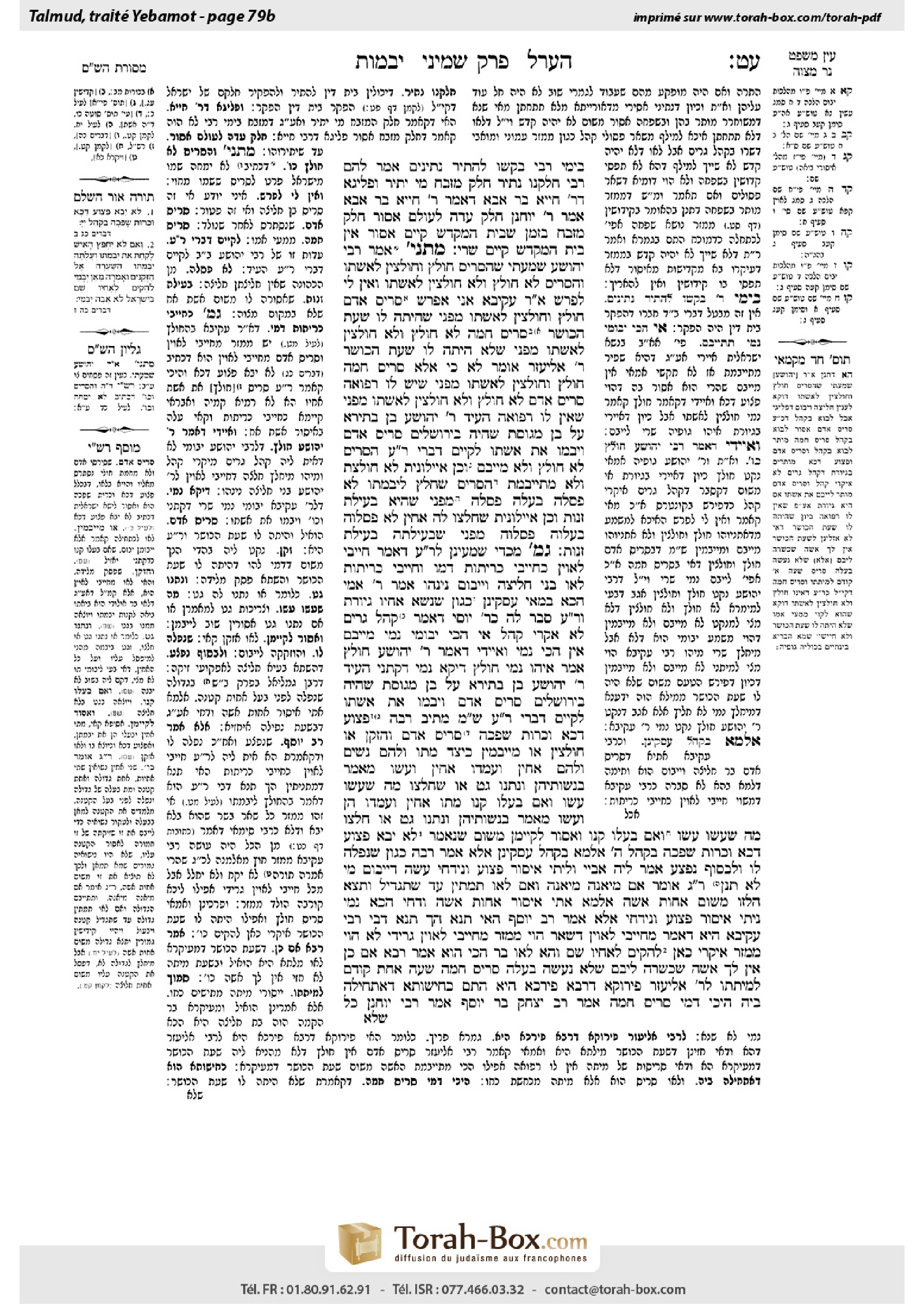
Yevamot 79b: Talmud study for Daf Yomi
Daf Yomi is the daily study of one Talmud folio. Explore 37 tractates with scans, Hebrew text, Sefaria English and AI-generated French translations where annotated.
Passage selection and English or AI-generated French translation are available where the scan has annotations. Daf Study is independent of Torah-Box and Sefaria.
Browse Yevamot · יבמות · All tractatesYevamot 79b text and translations
This page of Yevamot includes the Aramaic text, an English translation and an AI-generated French translation, alongside the scan above.
יבמות ע״ט ב · Aramaic and Hebrew text
בִּימֵי רַבִּי בִּקְּשׁוּ לְהַתִּיר נְתִינִים. אָמַר לָהֶם רַבִּי: חֶלְקֵנוּ נַתִּיר, חֵלֶק מִזְבֵּחַ מִי יַתִּיר?
וּפְלִיגָא דְּרַבִּי חִיָּיא בַּר אַבָּא. דְּאָמַר רַבִּי חִיָּיא בַּר אַבָּא אָמַר רַבִּי יוֹחָנָן: חֵלֶק עֵדָה — לְעוֹלָם אָסוּר, חֵלֶק מִזְבֵּחַ, בִּזְמַן שֶׁבֵּית הַמִּקְדָּשׁ קַיָּים — אָסוּר, אֵין בֵּית הַמִּקְדָּשׁ קַיָּים — שְׁרֵי.
מַתְנִי׳ אָמַר רַבִּי יְהוֹשֻׁעַ: שָׁמַעְתִּי שֶׁהַסָּרִיס חוֹלֵץ וְחוֹלְצִין לְאִשְׁתּוֹ, וְהַסָּרִיס לֹא חוֹלֵץ וְלֹא חוֹלְצִין לְאִשְׁתּוֹ, וְאֵין לִי לְפָרֵשׁ.
אָמַר רַבִּי עֲקִיבָא, אֲנִי אֲפָרֵשׁ: סְרִיס אָדָם — חוֹלֵץ וְחוֹלְצִין לְאִשְׁתּוֹ, מִפְּנֵי שֶׁהָיְתָה לוֹ שְׁעַת הַכּוֹשֶׁר. סְרִיס חַמָּה — לֹא חוֹלֵץ וְלֹא חוֹלְצִין לְאִשְׁתּוֹ, מִפְּנֵי שֶׁלֹּא הָיְתָה לוֹ שְׁעַת הַכּוֹשֶׁר.
רַבִּי אֱלִיעֶזֶר אוֹמֵר: לֹא כִי, אֶלָּא: סְרִיס חַמָּה — חוֹלֵץ וְחוֹלְצִין לְאִשְׁתּוֹ, מִפְּנֵי שֶׁיֵּשׁ לוֹ רְפוּאָה. סְרִיס אָדָם — לֹא חוֹלֵץ וְלֹא חוֹלְצִין לְאִשְׁתּוֹ, מִפְּנֵי שֶׁאֵין לוֹ רְפוּאָה.
הֵעִיד רַבִּי יְהוֹשֻׁעַ בֶּן בְּתֵירָא עַל בֶּן מְגוּסַת שֶׁהָיָה בִּירוּשָׁלַיִם סְרִיס אָדָם, וְיִבְּמוּ אֶת אִשְׁתּוֹ, לְקַיֵּים דִּבְרֵי רַבִּי עֲקִיבָא.
הַסָּרִיס — לֹא חוֹלֵץ וְלֹא מְיַיבֵּם, וְכֵן אַיְילוֹנִית — לֹא חוֹלֶצֶת וְלֹא מִתְיַיבֶּמֶת.
הַסָּרִיס שֶׁחָלַץ לִיבִמְתּוֹ — לֹא פְּסָלָהּ. בְּעָלָהּ — פְּסָלָהּ, מִפְּנֵי שֶׁהִיא בְּעִילַת זְנוּת. וְכֵן אַיְילוֹנִית שֶׁחָלְצוּ לָהּ אַחִין — לֹא פְּסָלוּהָ. בְּעָלוּהָ — פְּסָלוּהָ, מִפְּנֵי שֶׁבְּעִילָתָהּ בְּעִילַת זְנוּת.
גְּמָ׳ מִכְּדִי שָׁמְעִינַן לְרַבִּי עֲקִיבָא דְּאָמַר חַיָּיבֵי לָאוִין כְּחַיָּיבֵי כָּרֵיתוֹת דָּמוּ, וְחַיָּיבֵי כָּרֵיתוֹת לָאו בְּנֵי חֲלִיצָה וְיִיבּוּם נִינְהוּ!
אָמַר רַבִּי אַמֵּי: הָכָא בְּמַאי עָסְקִינַן — כְּגוֹן שֶׁנָּשָׂא אָחִיו גִּיּוֹרֶת, וְרַבִּי עֲקִיבָא סָבַר לַהּ כְּרַבִּי יוֹסֵי, דְּאָמַר: קְהַל גֵּרִים — לָא אִקְּרִי קָהָל.
אִי הָכִי, יַבּוֹמֵי נָמֵי מְיַיבֵּם! אִין הָכִי נָמֵי, וְאַיְּידֵי דְּאָמַר רַבִּי יְהוֹשֻׁעַ חוֹלֵץ, אָמַר אִיהוּ נָמֵי חוֹלֵץ.
דַּיְקָא נָמֵי, דְּקָתָנֵי: הֵעִיד רַבִּי יְהוֹשֻׁעַ בֶּן בְּתֵירָא עַל בֶּן מְגוּסַת שֶׁהָיָה בִּירוּשָׁלַיִם סְרִיס אָדָם, וְיִבְּמוּ אֶת אִשְׁתּוֹ לְקַיֵּים דִּבְרֵי רַבִּי עֲקִיבָא. שְׁמַע מִינַּהּ.
מֵתִיב רַבָּה: פְּצוּעַ דַּכָּא וּכְרוּת שׇׁפְכָה, סְרִיס אָדָם וְהַזָּקֵן — אוֹ חוֹלְצִין אוֹ מְיַיבְּמִין. כֵּיצַד: מֵתוּ וְלָהֶם נָשִׁים, וְלָהֶם אַחִין, וְעָמְדוּ אַחִין וְעָשׂוּ מַאֲמָר בִּנְשׁוֹתֵיהֶן, וְנָתְנוּ גֵּט, אוֹ שֶׁחָלְצוּ — מַה שֶּׁעָשׂוּ עָשׂוּ, וְאִם בָּעֲלוּ — קָנוּ.
מֵתוּ אַחִין, וְעָמְדוּ הֵן וְעָשׂוּ מַאֲמָר בִּנְשׁוֹתֵיהֶן, וְנָתְנוּ גֵּט אוֹ חָלְצוּ — מַה שֶּׁעָשׂוּ עָשׂוּ. וְאִם בָּעֲלוּ — קָנוּ, וְאָסוּר לְקַיְּימָן, מִשּׁוּם שֶׁנֶּאֱמַר: ״לֹא יָבֹא פְצוּעַ דַּכָּא וּכְרוּת שׇׁפְכָה בִּקְהַל ה׳״, אַלְמָא בְּקָהָל עָסְקִינַן!
אֶלָּא אָמַר רַבָּה: כְּגוֹן שֶׁנָּפְלָה לוֹ, וּלְבַסּוֹף נִפְצַע.
אֲמַר לֵיהּ אַבָּיֵי: וְלַיְתֵי אִיסּוּר פָּצוּעַ וְנִידְחֵי עֲשֵׂה דְּיִיבּוּם! מִי לָא תְּנַן, רַבָּן גַּמְלִיאֵל אוֹמֵר: אִם מֵיאֲנָה — מֵיאֲנָה,
וְאִם לָאו — תַּמְתִּין עַד שֶׁתַּגְדִּיל, וְתֵצֵא הַלֵּזוּ מִשּׁוּם אֲחוֹת אִשָּׁה. אַלְמָא: אָתֵי אִיסּוּר אֲחוֹת אִשָּׁה וְדָחֵי. הָכָא נָמֵי: נֵיתֵי אִיסּוּר פָּצוּעַ וְנִידְחֵי!
אֶלָּא אָמַר רַב יוֹסֵף: הַאי תַּנָּא — הָךְ תַּנָּא דְּבֵי רַבִּי עֲקִיבָא הִיא, דְּאָמַר: מֵחַיָּיבֵי לָאוִין דִּשְׁאֵר הָוֵי מַמְזֵר, מֵחַיָּיבֵי לָאוִין גְּרִידִי לָא הָוֵי מַמְזֵר.
אִיקְּרִי כָּאן ״לְהָקִים לְאָחִיו שֵׁם״, וְהָא לָאו בַּר הָכִי הוּא?
אָמַר רָבָא: אִם כֵּן, אֵין לְךָ אִשָּׁה שֶׁכְּשֵׁרָה לְיַבֵּם, שֶׁלֹּא נַעֲשָׂה בַּעְלָהּ סְרִיס חַמָּה שָׁעָה אַחַת קוֹדֶם לְמִיתָתוֹ!
לְרַבִּי אֱלִיעֶזֶר, פֵּירוּקָא דְרָבָא פִּירְכָא הִיא!
הָתָם כְּחִישׁוּתָא דְּאַתְחִילָה בֵּיהּ.
הֵיכִי דָּמֵי סְרִיס חַמָּה? אָמַר רַב יִצְחָק בַּר יוֹסֵף אָמַר רַבִּי יוֹחָנָן: כֹּל
Yevamot 79b · English translation
It is related that in the days of Rabbi Yehuda HaNasi the Sages sought to permit the Gibeonites and treat them like Jews in all regards, thereby allowing them to enter into the congregation. Rabbi Yehuda HaNasi said to them: Even if we permit our share and say that the court nullifies the Jewish people’s right to enslave the Gibeonites, and so they should be treated like emancipated slaves, who can permit the altar’s share? Do they not belong to the Temple and the altar as well?
The Gemara comments: And Rabbi Yehuda HaNasi disagrees with the teaching of Rabbi Ḥiyya bar Abba. As Rabbi Ḥiyya bar Abba said that Rabbi Yoḥanan said: The share in the enslavement of the Gibeonites that belongs to the congregation of Israel is forbidden forever and can never be permitted. However, with regard to the share belonging to the altar, when the Temple is standing it is forbidden, but when the Temple is not standing it is permitted.
MISHNA: Rabbi Yehoshua said: I heard two rulings from my teachers. One ruling is that a eunuch performs ḥalitza with his yevama, and his brothers perform ḥalitza with his wife, and the other ruling is that a eunuch does not perform ḥalitza with his yevama, and his brothers do not perform ḥalitza with his wife. And I cannot explain these two rulings, as I do not remember the circumstances to which each ruling applies.
Rabbi Akiva said: I will explain. A eunuch caused by man, i.e., one who became emasculated after birth, performs ḥalitza with his yevama and his brothers perform ḥalitza with his wife, because he had an hour of fitness, a time when he was fertile. On the other hand, a eunuch by natural causes, i.e., who was entirely lacking in sexual capacity from birth, does not perform ḥalitza with his yevama and his brothers do not perform ḥalitza with his wife, because he did not have an hour of fitness, as he never had the potential to father children.
Rabbi Eliezer says: No; rather, the opposite is the case: A eunuch by natural causes performs ḥalitza with his yevama and his brothers perform ḥalitza with his wife because he can be cured, whereas a eunuch caused by man does not perform ḥalitza with his yevama and his brothers do not perform ḥalitza with his wife because he cannot be cured.
Rabbi Yehoshua ben Beteira testified about a man named ben Megusat, who lived in Jerusalem and was a eunuch caused by man, that his brothers nevertheless entered into levirate marriage with his wife, in order to fulfill and confirm the statement of Rabbi Akiva.
A sexually underdeveloped man does not perform ḥalitza or enter into levirate marriage with his yevama. And similarly, a sexually underdeveloped woman [aylonit], who is incapable of bearing children, does not perform ḥalitza or enter into levirate marriage with her yavam.
If a sexually underdeveloped man performed ḥalitza with his yevama, he has not thereby disqualified her from marrying into the priesthood, as his ḥalitza is invalid. However, if he had intercourse with her, he has disqualified her. This is because it is considered licentious sexual intercourse, since such intercourse does not fulfill the mitzva of levirate marriage and is therefore categorized as forbidden relations with one’s sister-in-law. And similarly, with regard to a sexually underdeveloped woman, if one of the brothers performed ḥalitza with her he has not thereby disqualified her from marrying into the priesthood. However, if he had intercourse with her, he has disqualified her because the intercourse is considered licentious sexual intercourse.
GEMARA: Now, we learned that Rabbi Akiva said: Those liable for violating a prohibition are like those liable to receive karet with regard to the validity of their marriage and all its ramifications, and those liable to receive karet are not eligible to perform ḥalitza or levirate marriage. A eunuch caused by man has the status of a man with crushed testicles, and is therefore prohibited by a standard negative mitzva from marrying a Jewish woman. If he violated the prohibition and married her, his marriage is invalid according to Rabbi Akiva, just as if he had married a woman who is forbidden to him by a prohibition punishable by karet. Why, then, should his ḥalitza be valid?
Rabbi Ami said: With what are we dealing here? We are dealing with a case where the eunuch’s brother had married a convert, and Rabbi Akiva holds in accordance with the opinion of Rabbi Yosei, who said that the congregation of converts is not called a congregation of the Lord. Consequently, it is permitted even for those for whom it is prohibited to enter into the congregation, e.g., a eunuch, to marry converts.
The Gemara raises a difficulty: If so, the eunuch should also be able to perform levirate marriage with the convert. The Gemara answers: Yes, it is indeed so, but since Rabbi Yehoshua said that a eunuch performs ḥalitza with his yevama, Rabbi Akiva as well said that he performs ḥalitza with her, while in fact he may enter into levirate marriage with her if he so chooses.
The Gemara adds: The language of the mishna is also precise in this regard, as it teaches: Rabbi Yehoshua ben Beteira testified about a man named ben Megusat, who lived in Jerusalem and was a eunuch caused by man, that his brothers entered into levirate marriage with his wife, to fulfill the statement of Rabbi Akiva. This indicates that according to Rabbi Akiva, not only ḥalitza but even levirate marriage is permitted. The Gemara concludes: Learn from this that this is the correct understanding of the mishna.
Rabba raised an objection from the following baraita: A man with crushed testicles, and one whose penis has been severed, and a eunuch caused by man, and an elderly man who is no longer capable of fathering children, may either perform ḥalitza or enter into levirate marriage. The baraita clarifies the matter: How so? If these men died and they had wives and they also had brothers, and the brothers proceeded to perform levirate betrothal with their wives, or gave them a bill of divorce, or performed ḥalitza with them, what they did is done, i.e., it is a valid act. And if the brothers had intercourse with the wives, they acquired them in levirate marriage, like any other yevama.
If the brothers of these sexually impaired men died, and the sexually impaired men proceeded to perform levirate betrothal with their brothers’ wives, or gave them a bill of divorce, or performed ḥalitza with them, what they did is done, i.e., it is a valid act. And if they had intercourse with their brothers’ wives they acquired them in levirate marriage, but they are prohibited from maintaining them as their wives because it is stated: “A man with crushed testicles or a severed penis shall not enter into the congregation of the Lord” (Deuteronomy 23:2). Apparently, we are dealing with a case where the eunuch’s brother had married a woman who is in the congregation of the Lord, i.e., a Jew from birth who is governed by this prohibition, and not a convert.
Rather, Rabba said that the case here is one where one’s brother died and his yevama happened before him for levirate marriage, and he was injured only afterward. Since the mitzva of levirate marriage had initially applied to him, he performs ḥalitza with her.
Abaye said to him: If so, let the prohibition applying to a man with crushed testicles come and override the positive mitzva of levirate marriage. Didn’t we learn in a mishna (109a) as follows: With regard to a case of two brothers who were married to two sisters, one of whom was a minor married off by her brothers in a marriage valid only by rabbinic decree, and the brother who was married to the adult sister passed away, Rabban Gamliel says: If the minor sister refuses her husband, declaring that she does not desire the marriage, she has refused him. Since the marriage is valid only by rabbinic decree, the girl may terminate it before she reaches the age of twelve by declaring that she does not wish to remain in the marriage, and no bill of divorce is required. In such a case the marriage is nullified retroactively, and so her former husband, the yavam, may perform levirate marriage with her sister.
The mishna continues: But if she does not refuse him, the minor must wait and her husband must not have relations with her until she reaches adulthood and their marriage is valid by Torah law, since in the meantime she is forbidden to him as the sister of a woman awaiting levirate marriage with him. At that point, when the minor reaches adulthood, this one, the adult sister, goes out free from the yavam without levirate marriage or ḥalitza as his wife’s sister. Apparently, the prohibition with regard to a wife’s sister comes and overrides the mitzva of levirate marriage that had previously been in effect. Here too, then, let the prohibition applying to a man with crushed testicles come and override the positive mitzva of levirate marriage.
Rather, Rav Yosef said: This tanna of our mishna is the tanna of the school of Rabbi Akiva, who said that only the child born of a union between those who are liable for violating prohibitions involving incestuous relationships is a mamzer, but the child born of a union between people who are liable for violating ordinary prohibitions is not a mamzer. The prohibition applying to a man with crushed testicles falls into the latter category, and therefore his marriage is valid and he may perform ḥalitza.
The Gemara asks: Why does the mitzva of levirate marriage apply at all to a eunuch? Read here the verse with regard to levirate marriage: “To establish a name for his brother in Israel” (Deuteronomy 25:7), and this one is no longer capable of this, even if previously he had an hour of fitness when he was fertile earlier in his life.
Rava said: If it is so that anyone who cannot presently father children is exempt from levirate marriage even if he had previously been capable of doing so, there is no instance of a woman who is fit for the yavam, as even if her husband died of natural causes it is impossible that he did not become like a eunuch by natural causes an hour before his death. He had certainly lost his fertility before dying, and therefore he has the status of a eunuch, which means that the mitzva of levirate marriage should not apply in his case at all. Rather, it must be that a man who had previously been capable of fathering children is considered fit for the purposes of levirate marriage.
The Gemara comments: According to the opinion of Rabbi Eliezer in the mishna that a eunuch caused by man does not perform ḥalitza and his marriage is invalid even though he had an hour of fitness when he was fertile, Rava’s answer, his proof from the fact that all men on their deathbeds lack sexual capacity, is undoubtedly a refutation.
The Gemara answers: Rabbi Eliezer maintains that a man who is about to die cannot be compared to a eunuch, as there, he can no longer father children due to the general weakness that begins to take over his body as death approaches, which prevents him from engaging in relations with a woman, but his basic ability to father children remains unimpaired.
The Gemara raises a practical question: What are the circumstances of a eunuch by natural causes? Rav Yitzḥak bar Yosef said that Rabbi Yoḥanan said: Anyone
Yevamot 79b · Traduction française (IA)
Il est rapporté qu'aux jours de Rabbi Yehuda HaNasi, les Sages cherchaient à autoriser les Gibeonites et à les traiter comme des Juifs en tous points, leur permettant ainsi d'entrer dans la communauté. Rabbi Yehuda HaNasi leur dit : Même si nous autorisons notre part et disons que le tribunal annule le droit du peuple juif d'esclavager les Gibeonites, et qu'ils doivent donc être traités comme des esclaves affranchis, qui peut autoriser la part de l'autel ? Ne sont-ils pas également la propriété du Temple et de l'autel ?
La Guemara commente : Et Rabbi Yehuda HaNasi est en désaccord avec l'enseignement de Rabbi Ḥiyya bar Abba. Car Rabbi Ḥiyya bar Abba a dit que Rabbi Yoḥanan a dit : La part de l'esclavage des Gibeonites qui revient à la congrégation d'Israël est interdite à jamais et ne peut jamais être autorisée. Cependant, quant à la part qui revient à l'autel, elle est interdite lorsque le Temple est debout, mais elle est autorisée lorsque le Temple n'est plus debout.
MICHNA : Rabbi Yehoshua a dit : J'ai entendu deux décisions de mes maîtres. L'une est qu'un eunuque effectue la ḥalitza avec sa yevama, et que ses frères effectuent la ḥalitza avec sa femme ; et l'autre est qu'un eunuque n'effectue pas la ḥalitza avec sa yevama, et que ses frères n'effectuent pas la ḥalitza avec sa femme. Et je ne peux pas expliquer ces deux décisions, car je ne me souviens pas des circonstances auxquelles chaque décision s'applique.
Rabbi Akiva a dit : Je vais l'expliquer. Un eunuque causé par l'homme, c'est-à-dire celui qui a été châtré après la naissance, effectue la ḥalitza avec sa yevama et ses frères effectuent la ḥalitza avec sa femme, car il a eu une heure de capacité, un moment où il était fertile. En revanche, un eunuque par causes naturelles, c'est-à-dire celui qui était entièrement dépourvu de capacité sexuelle dès la naissance, n'effectue pas la ḥalitza avec sa yevama et ses frères n'effectuent pas la ḥalitza avec sa femme, car il n'a pas eu d'heure de capacité, puisqu'il n'a jamais eu le potentiel d'avoir des enfants.
Rabbi Eliezer dit : Non ; plutôt, c'est l'inverse : Un eunuque par causes naturelles effectue la ḥalitza avec sa yevama et ses frères effectuent la ḥalitza avec sa femme, car il peut être guéri, tandis qu'un eunuque causé par l'homme n'effectue pas la ḥalitza avec sa yevama et ses frères n'effectuent pas la ḥalitza avec sa femme, car il ne peut pas être guéri.
Rabbi Yehoshua ben Beteira a témoigné au sujet d'un homme nommé ben Megusat, qui vivait à Jérusalem et était un eunuque causé par l'homme, que ses frères ont néanmoins contracté un mariage lévirat avec sa femme, afin d'accomplir et de confirmer l'énoncé de Rabbi Akiva.
Un homme sexuellement sous-développé n'accomplit pas la ḥalitza ni ne contracte un mariage lévirat avec sa yevama. De même, une femme sexuellement sous-développée [aylonit], qui est incapable de procréer, n'accomplit pas la ḥalitza ni ne contracte un mariage lévirat avec son yavam.
Si un homme sexuellement sous-développé a accompli la ḥalitza avec sa yevama, il ne l'a pas par là rendue inapte à épouser un prêtre, car sa ḥalitza est invalide. Cependant, s'il a eu des rapports sexuels avec elle, il l'a rendue inapte. En effet, ces rapports sont considérés comme des relations licencieuses, puisqu'ils n'accomplissent pas la mitsva du mariage lévirat et sont donc classés parmi les relations interdites avec sa belle-sœur. De même, s'agissant d'une femme sexuellement sous-développée, si l'un des frères a accompli la ḥalitza avec elle, il ne l'a pas par là rendue inapte à épouser un prêtre. Cependant, s'il a eu des rapports sexuels avec elle, il l'a rendue inapte, car ces rapports sont considérés comme des relations licencieuses.
GUEMARA : Or, nous avons appris que Rabbi Akiva a dit : Ceux qui sont passibles de transgresser une interdiction sont assimilés à ceux qui sont passibles de la karet en ce qui concerne la validité de leur mariage et toutes ses conséquences, et ceux qui sont passibles de la karet ne sont pas habilités à accomplir la ḥalitza ou le mariage lévirat. Un eunuque causé par l'homme a le statut d'un homme aux testicules écrasés, et est donc interdit, par une mitsva négative, d'épouser une femme juive. S'il a transgressé cette interdiction et l'a épousée, son mariage est invalide selon Rabbi Akiva, tout comme s'il avait épousé une femme qui lui est interdite par une interdiction punie de la karet. Pourquoi, alors, sa ḥalitza devrait-elle être valide ?
Rabbi Ami a dit : De quoi s'agit-il ici ? Il s'agit d'un cas où le frère de l'eunuque avait épousé une convertie, et Rabbi Akiva est en accord avec l'opinion de Rabbi Yosei, qui a dit que la communauté des convertis n'est pas appelée une communauté de l'Éternel. En conséquence, il est permis même à ceux pour qui il est interdit d'entrer dans la communauté, par exemple un eunuque, d'épouser des converties.
La Guemara soulève une difficulté : Si c'est le cas, l'eunuque devrait également pouvoir contracter un mariage lévirat avec la convertie. La Guemara répond : Oui, c'est bien ainsi, mais puisque Rabbi Yehoshua a dit qu'un eunuque effectue la ḥalitza avec sa yevama, Rabbi Akiva a également dit qu'il effectue la ḥalitza avec elle, alors qu'en fait il peut contracter un mariage lévirat avec elle s'il le choisit.
La Guemara ajoute : Le langage de la Michna est également précis à cet égard, car elle enseigne : Rabbi Yehoshua ben Beteira a témoigné au sujet d'un homme nommé ben Megusat, qui vivait à Jérusalem et était un eunuque causé par l'homme, que ses frères ont contracté un mariage lévirat avec sa femme, afin d'accomplir l'énoncé de Rabbi Akiva. Cela indique que selon Rabbi Akiva, non seulement la ḥalitza, mais même le mariage lévirat est permis. La Guemara conclut : Apprenez de cela que c'est la compréhension correcte de la Michna.
Rabba a soulevé une objection à partir de la baraïta suivante : Un homme dont les testicules sont écrasés, celui dont le pénis a été amputé, un eunuque causé par l'homme, et un homme âgé qui n'est plus capable de procréer, peuvent soit effectuer la ḥalitza, soit contracter le mariage de levirat. La baraïta précise la question : Comment cela ? Si ces hommes sont décédés et qu'ils avaient des épouses, et qu'ils avaient aussi des frères, et que les frères ont procédé à l'engagement de levirat avec leurs épouses, ou leur ont donné un acte de divorce, ou ont effectué la ḥalitza avec elles, ce qu'ils ont fait est accompli, c'est-à-dire que c'est un acte valide. Et si les frères ont eu des rapports sexuels avec les épouses, ils les ont acquises par le mariage de levirat, comme toute autre yevama.
Si les frères de ces hommes sexuellement déficients sont décédés, et que les hommes sexuellement déficients ont procédé à l'engagement de levirat avec les épouses de leurs frères, ou leur ont donné un acte de divorce, ou ont effectué la ḥalitza avec elles, ce qu'ils ont fait est accompli, c'est-à-dire que c'est un acte valide. Et s'ils ont eu des rapports sexuels avec les épouses de leurs frères, ils les ont acquises par le mariage de levirat, mais ils sont interdits de les maintenir comme leurs épouses, car il est écrit : « L'homme aux testicules écrasés ou au pénis amputé n'entrera pas dans la congrégation de l'Éternel » (Deutéronome 23:2). Apparemment, nous avons affaire à un cas où le frère de l'eunuque a épousé une femme qui est dans la congrégation de l'Éternel, c'est-à-dire une Juive de naissance qui est soumise à cette interdiction, et non une convertie.
Plutôt, Rabba a dit que le cas ici est celui où le frère d'un homme est décédé et que sa yevama s'est présentée à lui pour le mariage de levirat, et qu'il a été blessé seulement après cela. Puisque la mitsva du mariage de levirat s'appliquait initialement à lui, il effectue la ḥalitza avec elle.
Abaye lui dit : Si c'est ainsi, que l'interdiction s'appliquant à un homme aux testicules écrasés vienne annuler la mitsva positive du mariage de levirat. N'avons-nous pas appris dans une Michna (109a) ce qui suit : Dans le cas de deux frères mariés à deux sœurs, dont l'une était une mineure mariée par ses frères dans un mariage valide uniquement par décret rabbinique, et que le frère marié à la sœur adulte est décédé, Rabban Gamliel dit : Si la sœur mineure refuse son mari, en déclarant qu'elle ne désire pas le mariage, elle l'a refusé. Puisque le mariage est valide uniquement par décret rabbinique, la fille peut le résilier avant d'atteindre l'âge de douze ans en déclarant qu'elle ne souhaite pas rester dans le mariage, et aucun acte de divorce n'est requis. Dans un tel cas, le mariage est annulé rétroactivement, et ainsi son ancien mari, le yavam, peut contracter le mariage de levirat avec sa sœur.
La Michna continue : Mais si elle ne le refuse pas, la mineure doit attendre et son mari ne doit pas avoir de relations avec elle jusqu'à ce qu'elle atteigne la majorité et que leur mariage soit valide par la Torah écrite, car en attendant, elle lui est interdite en tant que sœur d'une femme en attente de mariage de levirat avec lui. À ce moment-là, lorsque la mineure atteint la majorité, celle-ci, la sœur adulte, sort libre du yavam sans mariage de levirat ni ḥalitza en tant que sœur de son épouse. Apparemment, l'interdiction concernant la sœur d'une épouse vient annuler la mitsva du mariage de levirat qui était auparavant en vigueur. Ici aussi, alors, que l'interdiction s'appliquant à un homme aux testicules écrasés vienne annuler la mitsva positive du mariage de levirat.
Plutôt, Rav Yosef a dit : Ce tanna de notre Michna est le tanna de l'école de Rabbi Akiva, qui a dit que seul l'enfant né d'une union entre des personnes passibles de transgresser des interdictions impliquant des relations incestueuses est un mamzer, mais l'enfant né d'une union entre des personnes passibles de transgresser des interdictions ordinaires n'est pas un mamzer. L'interdiction s'appliquant à un homme aux testicules écrasés relève de la seconde catégorie, et par conséquent son mariage est valide et il peut effectuer la ḥalitza.
La Guemara demande : Pourquoi la mitsva du mariage de levirat s'applique-t-elle du tout à un eunuque ? Lisez ici le verset concernant le mariage de levirat : « Pour établir un nom pour son frère en Israël » (Deutéronome 25:7), et celui-ci n'est plus capable de cela, même s'il avait auparavant une heure de capacité lorsqu'il était fertile plus tôt dans sa vie.
Rava a dit : Si c'est ainsi que quiconque ne peut pas actuellement procréer est exempt du mariage de levirat même s'il était auparavant capable de le faire, il n'y a aucun cas d'une femme qui est apte pour le yavam, car même si son mari est décédé de causes naturelles, il est impossible qu'il ne soit pas devenu comme un eunuque par causes naturelles une heure avant sa mort. Il a certainement perdu sa fertilité avant de mourir, et par conséquent il a le statut d'un eunuque, ce qui signifie que la mitsva du mariage de levirat ne devrait pas s'appliquer du tout dans son cas. Plutôt, il doit en être ainsi qu'un homme qui était auparavant capable de procréer est considéré comme apte aux fins du mariage de levirat.
La Guemara commente : Selon l'opinion de Rabbi Eliezer dans la Michna, selon laquelle un eunuque causé par l'homme ne procède pas à la ḥalitza et que son mariage est invalide, même s'il a disposé d'une heure de capacité lorsqu'il était fertile, la réponse de Rava, fondée sur la preuve tirée du fait que tous les hommes sur leur lit de mort perdent leur capacité sexuelle, est sans aucun doute une réfutation.
La Guemara répond : Rabbi Eliezer soutient qu'un homme qui est sur le point de mourir ne peut pas être comparé à un eunuque, car dans ce cas, il ne peut plus procréer en raison de la faiblesse générale qui commence à s'emparer de son corps à l'approche de la mort, ce qui l'empêche d'entretenir des relations avec une femme, mais sa capacité fondamentale à procréer reste intacte.
La Guemara soulève une question pratique : Quelles sont les circonstances d'un eunuque par causes naturelles ? Rav Yitzḥak bar Yosef a dit que Rabbi Yoḥanan a dit : Quiconque
Traduction française générée par IA à partir de l’édition anglaise de Sefaria. Vérifie toujours un passage avec le texte source.
Text from Sefaria: William Davidson Edition - Vocalized Aramaic (CC BY NC); William Davidson Edition - English (CC BY NC).