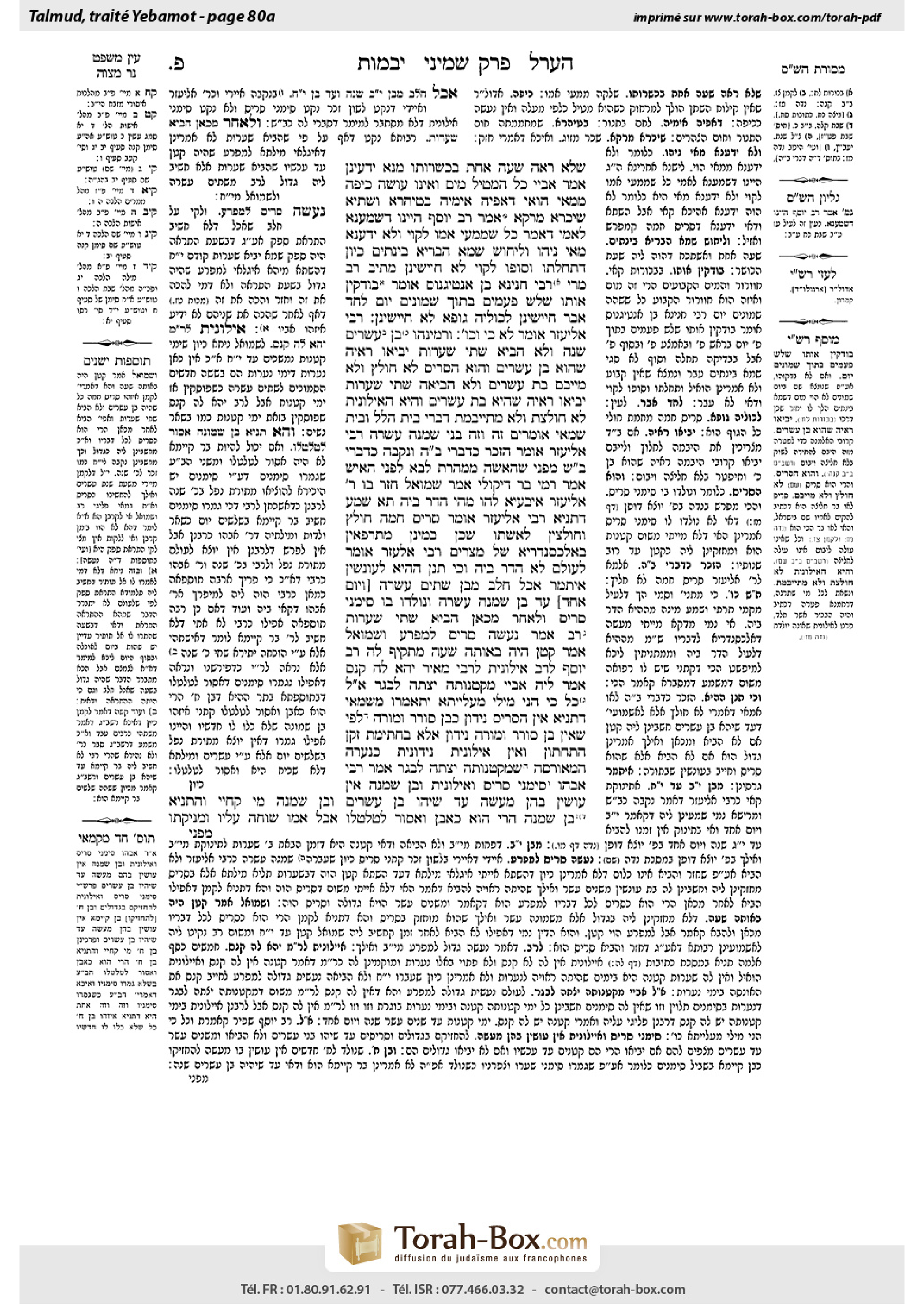
Yevamot 80a: Talmud study for Daf Yomi
Daf Yomi is the daily study of one Talmud folio. Explore 37 tractates with scans, Hebrew text, Sefaria English and AI-generated French translations where annotated.
Passage selection and English or AI-generated French translation are available where the scan has annotations. Daf Study is independent of Torah-Box and Sefaria.
Browse Yevamot · יבמות · All tractatesYevamot 80a text and translations
This page of Yevamot includes the Aramaic text, an English translation and an AI-generated French translation, alongside the scan above.
יבמות פ׳ א · Aramaic and Hebrew text
שֶׁלֹּא רָאָה שָׁעָה אַחַת בְּכַשְׁרוּתוֹ. מְנָא יָדְעִינַן? אָמַר אַבָּיֵי: כׇּל הַמֵּטִיל מַיִם וְאֵינוֹ עוֹשֶׂה כִּיפָּה.
מִמַּאי הָוֵאי? דְּאָפְיָה אִימֵּיהּ בְּטִיהֲרָא וְשָׁתְיָא שִׁיכְרָא מַרְקָא. אָמַר רַב יוֹסֵף: הַיְינוּ דְּשָׁמַעְנָא לְאִמִּי דְּאָמַר: ״כֹּל שֶׁמִּמְּעֵי אִמּוֹ לָקוּי״, וְלָא יָדַעְנָא מַאי נִיהוּ.
וְלֵיחוּשׁ שֶׁמָּא הִבְרִיא בֵּינָתַיִם! כֵּיוָן דִּתְחִלָּתוֹ וְסוֹפוֹ לָקוּי — לָא חָיְישִׁינַן.
מֵתִיב רַב מָרִי, רַבִּי חֲנִינָא בֶּן אַנְטִיגְנוֹס אוֹמֵר: בּוֹדְקִין אוֹתוֹ שָׁלֹשׁ פְּעָמִים בְּתוֹךְ שְׁמוֹנִים יוֹם!
לְחַד אֵבֶר חָיְישִׁינַן, לְכוּלֵּיהּ גּוּפָא לָא חָיְישִׁינַן.
רַבִּי אֱלִיעֶזֶר אוֹמֵר לֹא כִּי וְכוּ׳. וּרְמִינְהוּ: בֶּן עֶשְׂרִים שָׁנָה וְלֹא הֵבִיא שְׁתֵּי שְׂעָרוֹת — יָבִיאוּ רְאָיָה שֶׁהוּא בֶּן עֶשְׂרִים, וְהוּא הַסָּרִיס — לֹא חוֹלֵץ וְלֹא מְיַיבֵּם. בַּת עֶשְׂרִים וְלֹא הֵבִיאָה שְׁתֵּי שְׂעָרוֹת — יָבִיאוּ רְאָיָה שֶׁהִיא בַּת עֶשְׂרִים, וְהִיא הָאַיְלוֹנִית — לֹא חוֹלֶצֶת וְלֹא מִתְיַיבֶּמֶת, דִּבְרֵי בֵּית הִלֵּל. וּבֵית שַׁמַּאי אוֹמְרִים: זֶה וְזֶה בְּנֵי שְׁמֹנֶה עֶשְׂרֵה.
רַבִּי אֱלִיעֶזֶר אוֹמֵר: הַזָּכָר כְּדִבְרֵי בֵּית הִלֵּל, וּנְקֵבָה כְּדִבְרֵי בֵּית שַׁמַּאי, מִפְּנֵי שֶׁהָאִשָּׁה מְמַהֶרֶת לָבֹא לִפְנֵי הָאִישׁ!
אָמַר רָמֵי בַּר דִּיקּוּלֵי אָמַר שְׁמוּאֵל: חָזַר בּוֹ רַבִּי אֱלִיעֶזֶר. אִיבַּעְיָא לְהוּ: מֵהֵי הֲדַר בֵּיהּ? תָּא שְׁמַע, דְּתַנְיָא, רַבִּי אֱלִיעֶזֶר אוֹמֵר: סְרִיס חַמָּה — חוֹלֵץ וְחוֹלְצִין לְאִשְׁתּוֹ, שֶׁכֵּן בְּמִינָן מִתְרַפְּאִין בַּאֲלֶכְּסַנְדְּרִיָּא שֶׁל מִצְרַיִם.
רַבִּי אֶלְעָזָר אוֹמֵר: לְעוֹלָם לָא הֲדַר בֵּיהּ. וְכִי תְּנַן הָהִיא — לָעוֹנָשִׁין.
אִיתְּמַר: אָכַל חֵלֶב, מִבֶּן שְׁתֵּים עֶשְׂרֵה [וְיוֹם אֶחָד] עַד בֶּן שְׁמֹנֶה עֶשְׂרֵה, וְנוֹלְדוּ בּוֹ סִימָנֵי סָרִיס, וּלְאַחַר מִכָּאן הֵבִיא שְׁתֵּי שְׂעָרוֹת. רַב אָמַר: נַעֲשֶׂה סָרִיס לְמַפְרֵעַ. וּשְׁמוּאֵל אָמַר: קָטָן הָיָה בְּאוֹתָהּ שָׁעָה.
מַתְקֵיף לַהּ רַב יוֹסֵף: לְרַב, אַיְלוֹנִית לְרַבִּי מֵאִיר יְהֵא לָהּ קְנָס!
אֲמַר לֵיהּ אַבָּיֵי: מִקַּטְנוּתָהּ יָצְתָה לְבֶגֶר.
אֲמַר לֵיהּ: כֹּל כִּי הָנֵי מִילֵּי מְעַלְּיָיתָא יִתְאַמְּרוּ מִשְּׁמַאי. דְּתַנְיָא: אֵין הַסָּרִיס נִידּוֹן כְּבֵן סוֹרֵר וּמוֹרֶה — לְפִי שֶׁאֵין בֵּן סוֹרֵר וּמוֹרֶה נִידּוֹן אֶלָּא בַּחֲתִימַת זָקָן הַתַּחְתּוֹן. וְאֵין אַיְלוֹנִית נִידּוֹנֶית כְּנַעֲרָה הַמְאוֹרָסָה — שֶׁמִּקַּטְנוּתָהּ יָצְתָה לְבֶגֶר.
אָמַר רַבִּי אֲבָהוּ: סִימָנֵי סָרִיס, וְאַיְלוֹנִית וּבֶן שְׁמֹנֶה אֵין עוֹשִׂין בָּהֶן מַעֲשֶׂה — עַד שֶׁיְּהוּ בֶּן עֶשְׂרִים.
וּבֶן שְׁמֹנֶה מִי קָחָיֵי? וְהָתַנְיָא: בֶּן שְׁמֹנֶה — הֲרֵי הוּא כְּאֶבֶן, וְאָסוּר לְטַלְטְלוֹ, אֲבָל אִמּוֹ שׁוֹחָה עָלָיו וּמְנִיקָתוֹ
Yevamot 80a · English translation
who never saw a single hour of life in a state of fitness, as he was born infertile. The Gemara asks: How do we know that one was born this way and was never capable of having children? Abaye said: Anyone who passes water and does not form an arch with his urine, but rather his urine dribbles out downward, never had sexual capacity.
Incidentally, the Gemara inquires: From what does this defect arise? What is its cause? The Gemara answers: It results from his mother baking bread at noon and drinking strong beer [shikhra marka] while pregnant. The excessive heating of the mother’s body causes her child to be born with defective reproductive organs. Rav Yosef said: This is the meaning of that which I heard Rabbi Ami say: Anyone who is impaired from his mother’s womb, and at the time I did not know what he was referring to. Now I understand that he was speaking about a man who was infertile from birth.
The Gemara asks: Let us be concerned that perhaps he was cured for some period in the meantime, without our having known about it, in which case he would have had an hour of fitness at some point. The Gemara answers: Since both his beginning and his end are impaired, i.e., he was born with a defect and he presently suffers from the same condition, we are not concerned about such a possibility.
Rav Mari raised an objection from the following mishna (Bekhorot 38b): Rabbi Ḥanina ben Antigonus says: One examines a firstborn animal that developed a blemish in its eye three times within eighty days to see whether the defect is permanent. This shows that no presumptions are made in such a case; rather, there is concern that the animal may have been cured in the meantime, even if it had the defect at the beginning and at the end of the period.
The Gemara answers: With respect to a blemish affecting a single organ, e.g., an eye, we are concerned that the blemish might have passed and then later redeveloped, but with regard to a defect affecting the entire body, we are not concerned about such a possibility. A eunuch is not impaired in a single organ; rather, he has a defect that affects his entire body. Consequently, there is no concern that, though he was born with the defect and presently suffers from it, he might have regained his potency for some time in the middle.
§ It is taught in the mishna that Rabbi Eliezer says: No; rather, a eunuch by natural causes performs ḥalitza, whereas a eunuch caused by man does not perform ḥalitza. The Gemara raises a contradiction from the following mishna (Nidda 47b): If a twenty-year-old man has not grown two pubic hairs, a sign of sexual maturity, the relatives of the widow who wish to exempt her from ḥalitza and levirate marriage must bring proof that he is twenty years old, and he, having been established as a sexually underdeveloped man, does not perform ḥalitza or levirate marriage with his yevama. If a twenty-year-old woman has not grown two pubic hairs, the relatives of her deceased husband’s brother must bring proof that she is twenty years old, and she, having been established as a sexually underdeveloped woman, does not perform ḥalitza or enter into levirate marriage with her yavam. This is the statement of Beit Hillel. And Beit Shammai say: With regard to both this and that, males and females, the relevant age is eighteen years old, not twenty.
The mishna continues: Rabbi Eliezer says that for a male the halakha is in accordance with the statement of Beit Hillel, and for a female the halakha is in accordance with the statement of Beit Shammai, because a woman reaches maturity more quickly than does a man, and therefore, if she fails to develop the signs of maturity by the age of eighteen it is assumed that she is a sexually underdeveloped woman. In any case, it is clear from this mishna that even Rabbi Eliezer agrees that one who lacks sexual capacity from birth may neither perform ḥalitza nor enter into levirate marriage.
Rami bar Dikulei said that Shmuel said: Rabbi Eliezer retracted his opinion. A dilemma was raised before the Sages: Which statement did he retract? Did he retract what he said here in the mishna, that a eunuch by natural causes performs ḥalitza with his yevama and his brothers perform ḥalitza with his wife? Alternatively, perhaps the mishna here reflects his final view, after he retracted what he said in the other mishna. The Gemara suggests: Come and hear a resolution to this question, as it is taught in a baraita that Rabbi Eliezer says: A eunuch by natural causes performs ḥalitza with his yevama and his brothers perform ḥalitza with his wife, as such type of men are cured in Alexandria of Egypt. This additional source and its reasoning suggest that Rabbi Eliezer did not retract what he said in the mishna here. Rather, he retracted his statement with regard to the dispute between Beit Hillel and Beit Shammai in the other mishna.
Rabbi Elazar says: Actually, he did not retract anything at all. And when we learned Rabbi Eliezer’s ruling in that mishna with regard to the age of a sexually underdeveloped individual, that ruling was stated with regard to punishments, i.e., the age at which such an individual is considered an adult so that he is liable to receive punishment, and not with regard to ḥalitza or levirate marriage.
And it was stated that the amora’im disagreed on this issue: With regard to one who ate forbidden fats or performed any other transgression for which one is liable to receive lashes or karet, when he was between the age of twelve years and one day and the age of eighteen years, and he developed the signs of one who was a eunuch by natural causes, as explained below, and afterward he grew two pubic hairs, Rav said: He is retroactively considered a eunuch by natural causes. In other words, these hairs are not viewed as a sign of maturity. Rather, he lacked sexual capacity from the outset, which means he became an adult at the standard age of thirteen and is held liable for his actions from that point in time. And Shmuel said: No, he was a minor at the time he committed his offense, as the two hairs are a sign of his maturity, albeit delayed.
Rav Yosef strongly objects to this: If so, according to Rav, a sexually underdeveloped woman according to Rabbi Meir should be entitled to the fine paid by a rapist. Rabbi Meir maintains that a rapist is liable to be fined only if he raped a young woman between the ages of twelve and twelve and a half, but not if he raped a minor. And furthermore, a sexually underdeveloped woman is not entitled to the fine because she is considered a minor, as she never showed the signs of maturity. But according to Rav she should retroactively be viewed as an adult and would therefore be entitled to the fine.
Abaye said to him: A sexually underdeveloped woman passes directly from minority to full adulthood. In other words, she is first considered a minor and then immediately an adult, without passing through the intermediate stage of young womanhood, and an adult woman is not entitled to the rapist’s fine.
Greatly impressed with this answer, Rav Yosef said to Abaye: Would that all such excellent matters be stated in my name. As it is taught in a baraita: A sexually underdeveloped man is not judged as a stubborn and rebellious son, as a boy is judged as a stubborn and rebellious son only when he has the mark of his lower beard, i.e., when his pubic hair begins to grow in. At that point he has reached the age of maturity but is not yet a fully developed man, a stage that parallels young womanhood for women. A sexually underdeveloped man never passes through this intermediate stage between minority and full adulthood. And similarly, a sexually underdeveloped woman who was betrothed and raped is not judged in accordance with the laws governing a betrothed young woman (see Deuteronomy 22:23–27), as she passes directly from minority to full adulthood without the intermediate stage of young womanhood. Therefore, the baraita fully corroborates Abaye’s view.
Rabbi Abbahu said: If one has the signs of a sexually underdeveloped man; or the signs of a sexually underdeveloped woman; or the signs of a child born during the eighth month of pregnancy, whose survival is uncertain; no action is taken in their regard, i.e., the sexually underdeveloped male or female is not treated as an adult and the child born during the eighth month is not deemed viable, until they are twenty years old.
The Gemara asks: Can a child born during the eighth month of pregnancy survive? But isn’t it taught in a baraita: A child born during the eighth month is like a stone with regard to the halakhot of set-aside [muktze] on Shabbat, and therefore it is prohibited to move him on Shabbat, as it may be presumed that he is not viable at all. However, his mother may bend over him and nurse him,
Yevamot 80a · Traduction française (IA)
qui n'a jamais connu une seule heure de vie dans un état de capacité, car il est né stérile. La Guemara demande : Comment savons-nous qu'une personne est née ainsi et n'a jamais été capable d'avoir des enfants ? Abaye a dit : Quiconque urine sans former une arche avec son jet, mais dont l'urine coule plutôt vers le bas, n'a jamais eu de capacité sexuelle.
Au passage, la Guemara s'enquiert : De quoi provient ce défaut ? Quelle en est la cause ? La Guemara répond : Il résulte du fait que sa mère a cuit du pain à midi et bu de la bière forte [shikhra marka] pendant sa grossesse. La surchauffe du corps de la mère fait que son enfant naît avec des organes reproducteurs défectueux. Rav Yosef a dit : C'est le sens de ce que j'ai entendu Rabbi Ami dire : Quiconque est atteint d'une infirmité dès le sein de sa mère, et à l'époque je ne savais pas à quoi il faisait allusion. Maintenant, je comprends qu'il parlait d'un homme stérile de naissance.
La Guemara demande : Devrions-nous craindre qu'il ait été guéri pendant une certaine période entre-temps, sans que nous en ayons eu connaissance, auquel cas il aurait eu une heure de capacité à un moment donné ? La Guemara répond : Puisque son début et sa fin sont affectés, c'est-à-dire qu'il est né avec un défaut et qu'il souffre actuellement de la même condition, nous ne craignons pas une telle possibilité.
Rav Mari a soulevé une objection à partir de la Michna suivante (Bekhorot 38b) : Rabbi Ḥanina ben Antigonus dit : On examine un premier-né d'animal qui a développé un défaut dans son œil trois fois dans les quatre-vingt jours pour voir si le défaut est permanent. Cela montre qu'aucune présomption n'est faite dans un tel cas ; plutôt, on craint que l'animal ait été guéri entre-temps, même s'il avait le défaut au début et à la fin de la période.
La Guemara répond : S'agissant d'un défaut affectant un seul organe, par exemple un œil, nous craignons que le défaut ait disparu puis se soit reformé plus tard, mais s'agissant d'un défaut affectant tout le corps, nous ne craignons pas une telle possibilité. Un eunuque naturel n'est pas affecté dans un seul organe ; plutôt, il a un défaut qui affecte tout son corps. Par conséquent, il n'y a pas de crainte que, bien qu'il soit né avec le défaut et qu'il en souffre actuellement, il ait retrouvé sa puissance pendant un certain temps au milieu.
§ Il est enseigné dans la Michna que Rabbi Eliezer dit : Non ; plutôt, un eunuque naturel effectue la ḥalitza, tandis qu'un eunuque causé par l'homme n'effectue pas la ḥalitza. La Guemara soulève une contradiction à partir de la Michna suivante (Nidda 47b) : Si un homme de vingt ans n'a pas fait pousser deux poils pubiens, signe de la maturité sexuelle, les parents de la veuve qui souhaitent l'exempter de la ḥalitza et du mariage leviratique doivent apporter la preuve qu'il a vingt ans, et lui, ayant été établi comme un homme sexuellement immature, n'effectue ni la ḥalitza ni le mariage leviratique avec sa yevama. Si une femme de vingt ans n'a pas fait pousser deux poils pubiens, les parents du frère de son défunt mari doivent apporter la preuve qu'elle a vingt ans, et elle, ayant été établie comme une femme sexuellement immature, n'effectue pas la ḥalitza ni n'entre dans le mariage leviratique avec son yavam. C'est l'avis de la Maison de Hillel. Et la Maison de Shammaï dit : S'agissant de l'un et de l'autre, des hommes et des femmes, l'âge pertinent est de dix-huit ans, et non de vingt.
La Michna continue : Rabbi Eliezer dit que pour un homme, la halakha est conforme à l'avis de la Maison de Hillel, et pour une femme, la halakha est conforme à l'avis de la Maison de Shammaï, car une femme atteint la maturité plus rapidement qu'un homme, et par conséquent, si elle ne développe pas les signes de maturité à l'âge de dix-huit ans, on présume qu'elle est une femme sexuellement immature. En tout cas, il est clair à partir de cette Michna que même Rabbi Eliezer est d'accord pour dire que quiconque manque de capacité sexuelle de naissance ne peut ni effectuer la ḥalitza ni entrer dans le mariage leviratique.
Rami bar Dikulei a dit que Shmuel a dit : Rabbi Eliezer a rétracté son opinion. Un dilemme a été soulevé devant les Sages : Quelle déclaration a-t-il rétractée ? A-t-il rétracté ce qu'il a dit ici dans la Michna, à savoir qu'un eunuque naturel effectue la ḥalitza avec sa yevama et que ses frères effectuent la ḥalitza avec sa femme ? Ou peut-être que la Michna ici reflète son opinion finale, après qu'il a rétracté ce qu'il a dit dans l'autre Michna. La Guemara suggère : Venez entendre une résolution à cette question, car il est enseigné dans une baraïta que Rabbi Eliezer dit : Un eunuque naturel effectue la ḥalitza avec sa yevama et ses frères effectuent la ḥalitza avec sa femme, car ce type d'hommes est guéri à Alexandrie d'Égypte. Cette source supplémentaire et son raisonnement suggèrent que Rabbi Eliezer n'a pas rétracté ce qu'il a dit dans la Michna ici. Plutôt, il a rétracté sa déclaration concernant le différend entre la Maison de Hillel et la Maison de Shammaï dans l'autre Michna.
Rabbi Elazar dit : En réalité, il n'a rien rétracté du tout. Et lorsque nous avons appris le jugement de Rabbi Eliezer dans cette Michna concernant l'âge d'un individu sexuellement immature, ce jugement a été énoncé s'agissant des punitions, c'est-à-dire l'âge auquel un tel individu est considéré comme adulte pour être tenu responsable de recevoir une punition, et non s'agissant de la ḥalitza ou du mariage leviratique.
Il a été dit que les amoraïm étaient en désaccord sur cette question : S'agissant de quiconque a mangé des graisses interdites ou commis toute autre transgression pour laquelle on est passible de coups de fouet ou de karet, lorsqu'il était entre l'âge de douze ans et un jour et l'âge de dix-huit ans, et qu'il a développé les signes d'un eunuque naturel, comme expliqué ci-dessous, et qu'ensuite il a fait pousser deux poils pubiens, Rav a dit : Il est considéré rétroactivement comme un eunuque naturel. En d'autres termes, ces poils ne sont pas considérés comme un signe de maturité. Plutôt, il manquait de capacité sexuelle dès le départ, ce qui signifie qu'il est devenu adulte à l'âge standard de treize ans et est tenu responsable de ses actes à partir de ce moment. Et Shmuel a dit : Non, il était mineur au moment où il a commis son offense, car les deux poils sont un signe de sa maturité, bien que retardée.
Rav Yosef s'oppose vigoureusement à cela : Si tel est le cas, selon Rav, une femme sexuellement sous-développée devrait, selon Rabbi Meïr, avoir droit à l'amende payée par un violeur. Rabbi Meïr soutient qu'un violeur est passible d'une amende uniquement s'il a violé une jeune femme âgée de douze à douze ans et demi, mais pas s'il a violé une mineure. De plus, une femme sexuellement sous-développée n'a pas droit à l'amende, car elle est considérée comme une mineure, n'ayant jamais manifesté les signes de la maturité. Mais selon Rav, elle devrait être rétroactivement considérée comme une adulte et aurait donc droit à l'amende.
Abaye lui dit : Une femme sexuellement sous-développée passe directement de la minorité à la pleine majorité. Autrement dit, elle est d'abord considérée comme une mineure, puis immédiatement comme une adulte, sans passer par le stade intermédiaire de la jeunesse, et une femme adulte n'a pas droit à l'amende du violeur.
Profondément impressionné par cette réponse, Rav Yosef dit à Abaye : Que tous les excellents enseignements de ce type soient prononcés en mon nom. Comme il est enseigné dans une baraïta : Un homme sexuellement sous-développé n'est pas jugé comme un fils rétif et rebelle, car un garçon n'est jugé comme un fils rétif et rebelle que lorsqu'il a le signe de sa barbe inférieure, c'est-à-dire lorsque ses poils pubiens commencent à pousser. À ce moment-là, il a atteint l'âge de la maturité, mais n'est pas encore un homme pleinement développé, un stade qui correspond à la jeunesse chez les femmes. Un homme sexuellement sous-développé ne passe jamais par ce stade intermédiaire entre la minorité et la pleine majorité. De même, une femme sexuellement sous-développée qui a été fiancée et violée n'est pas jugée selon les lois régissant une jeune femme fiancée (voir Deutéronome 22:23–27), car elle passe directement de la minorité à la pleine majorité sans le stade intermédiaire de la jeunesse. Par conséquent, la baraïta corrobore pleinement la position d'Abaye.
Rabbi Abbahou a dit : Si l'on a les signes d'un homme sexuellement sous-développé ; ou les signes d'une femme sexuellement sous-développée ; ou les signes d'un enfant né au huitième mois de grossesse, dont la survie est incertaine ; aucune action n'est prise à leur égard, c'est-à-dire que l'homme ou la femme sexuellement sous-développé(e) n'est pas traité(e) comme un adulte et que l'enfant né au huitième mois n'est pas considéré viable, jusqu'à ce qu'ils aient vingt ans.
La Guemara demande : Un enfant né au huitième mois de grossesse peut-il survivre ? Mais n'est-il pas enseigné dans une baraïta : Un enfant né au huitième mois est comme une pierre en ce qui concerne les halakhot de la mise de côté [mouktse] le Chabbat, et par conséquent, il est interdit de le déplacer le Chabbat, car on peut présumer qu'il n'est pas viable du tout. Cependant, sa mère peut se pencher sur lui et le nourrir,
Traduction française générée par IA à partir de l’édition anglaise de Sefaria. Vérifie toujours un passage avec le texte source.
Text from Sefaria: William Davidson Edition - Vocalized Aramaic (CC BY NC); William Davidson Edition - English (CC BY NC).