Yevamot 80b: Talmud study for Daf Yomi
Daf Yomi is the daily study of one Talmud folio. Explore 37 tractates with scans, Hebrew text, Sefaria English and AI-generated French translations where annotated.
Passage selection and English or AI-generated French translation are available where the scan has annotations. Daf Study is independent of Torah-Box and Sefaria.
Browse Yevamot · יבמות · All tractatesYevamot 80b text and translations
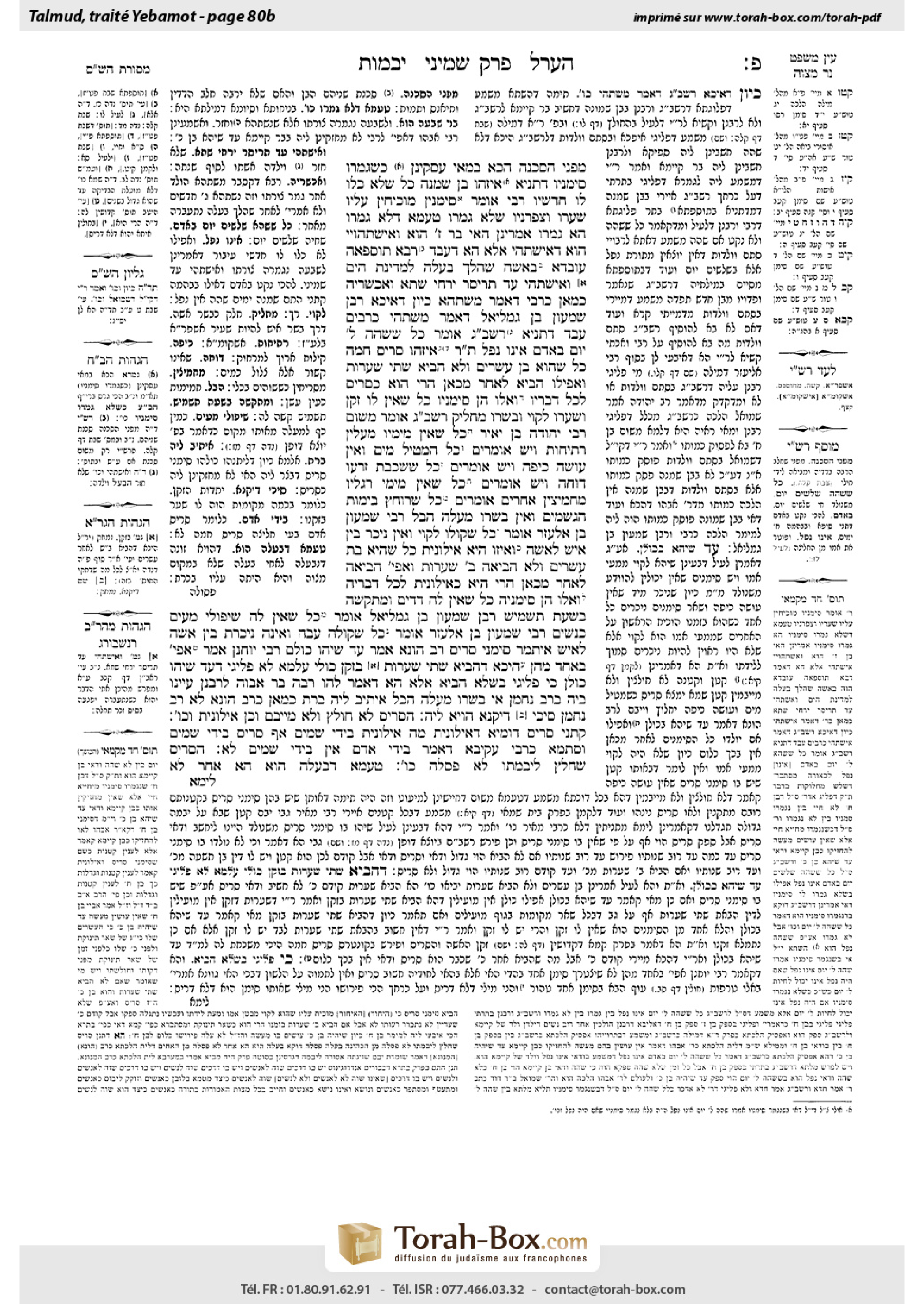
This page of Yevamot includes the Aramaic text, an English translation and an AI-generated French translation, alongside the scan above.
יבמות פ׳ ב · Aramaic and Hebrew text
מִפְּנֵי הַסַּכָּנָה. הָכָא בְּמַאי עָסְקִינַן — כְּשֶׁגָּמְרוּ סִימָנָיו. דְּתַנְיָא: אֵיזֶהוּ בֶּן שְׁמֹנֶה? כֹּל שֶׁלֹּא כָּלוּ לוֹ חֳדָשָׁיו. רַבִּי אוֹמֵר: סִימָנִין מוֹכִיחִין עָלָיו, שְׂעָרוֹ וְצִפׇּרְנָיו שֶׁלֹּא גָּמְרוּ. טַעְמָא דְּלֹא גָּמְרוּ. הָא גָּמְרוּ — אָמְרִינַן הַאי בַּר שִׁבְעָה הוּא, וְאִישְׁתַּהוֹיֵי הוּא דְּאִישְׁתַּהִי.
אֶלָּא הָא דַּעֲבַד רָבָא תּוֹסְפָאָה עוֹבָדָא בְּאִשָּׁה שֶׁהָלַךְ בַּעְלָהּ לִמְדִינַת הַיָּם וְאִישְׁתַּהִי עַד תְּרֵיסַר יַרְחֵי שַׁתָּא, וְאַכְשְׁרֵיהּ. כְּמַאן — כְּרַבִּי, דְּאָמַר מִשְׁתַּהֵא!
כֵּיוָן דְּאִיכָּא רַבָּן שִׁמְעוֹן בֶּן גַּמְלִיאֵל דְּאָמַר מִשְׁתַּהֵי, כְּרַבִּים עֲבַד. דְּתַנְיָא, רַבָּן שִׁמְעוֹן בֶּן גַּמְלִיאֵל אוֹמֵר: כׇּל שֶׁשָּׁהָה שְׁלֹשִׁים יוֹם בָּאָדָם — אֵינוֹ נֵפֶל.
תָּנוּ רַבָּנַן: אֵיזֶהוּ סְרִיס חַמָּה? כׇּל שֶׁהוּא בֶּן עֶשְׂרִים, וְלֹא הֵבִיא שְׁתֵּי שְׂעָרוֹת. וַאֲפִילּוּ הֵבִיא לְאַחַר מִכָּאן הֲרֵי הוּא כְּסָרִיס לְכׇל דְּבָרָיו. וְאֵלּוּ הֵן סִימָנָיו: כֹּל שֶׁאֵין לוֹ זָקָן, וּשְׂעָרוֹ לָקוּי, וּבְשָׂרוֹ מַחְלִיק. רַבָּן שִׁמְעוֹן בֶּן גַּמְלִיאֵל אוֹמֵר מִשּׁוּם רַבִּי יְהוּדָה בֶּן יָאִיר: כֹּל שֶׁאֵין מֵימָיו מַעֲלִין רְתִיחוֹת.
וְיֵשׁ אוֹמְרִים: כׇּל הַמֵּטִיל מַיִם וְאֵין עוֹשֶׂה כִּיפָּה. וְיֵשׁ אוֹמְרִים: כֹּל שֶׁשִּׁכְבַת זַרְעוֹ דּוֹחָה. וְיֵשׁ אוֹמְרִים: כֹּל שֶׁאֵין מֵימֵי רַגְלָיו מַחְמִיצִין. אֲחֵרִים אוֹמְרִים: כֹּל שֶׁרוֹחֵץ בִּימוֹת הַגְּשָׁמִים וְאֵין בְּשָׂרוֹ מַעֲלֶה הֶבֶל. רַבִּי שִׁמְעוֹן בֶּן אֶלְעָזָר אוֹמֵר: כֹּל שֶׁקּוֹלוֹ לָקוּי, וְאֵין נִיכָּר בֵּין אִישׁ לְאִשָּׁה.
וְאֵיזוֹ הִיא אַיְלוֹנִית? כֹּל שֶׁהִיא בַּת עֶשְׂרִים וְלֹא הֵבִיאָה שְׁתֵּי שְׂעָרוֹת, וַאֲפִילּוּ הֵבִיאָה לְאַחַר מִכָּאן — הֲרֵי הִיא כְּאַיְלוֹנִית לְכׇל דְּבָרֶיהָ. וְאֵלּוּ הֵן סִימָנֶיהָ: כֹּל שֶׁאֵין לָהּ דַּדִּים, וּמִתְקַשָּׁה בִּשְׁעַת תַּשְׁמִישׁ. רַבָּן שִׁמְעוֹן בֶּן גַּמְלִיאֵל אוֹמֵר: כֹּל שֶׁאֵין לָהּ שִׁיפּוּלֵי מֵעַיִם כְּנָשִׁים. רַבִּי שִׁמְעוֹן בֶּן אֶלְעָזָר אוֹמֵר: כֹּל שֶׁקּוֹלָה עָבֶה, וְאֵינָהּ נִיכֶּרֶת בֵּין אִשָּׁה לְאִישׁ.
אִיתְּמַר: סִימָנֵי סָרִיס, רַב הוּנָא אָמַר: עַד שֶׁיְּהוּ כּוּלָּם. רַבִּי יוֹחָנָן אָמַר: אֲפִילּוּ בְּאֶחָד מֵהֶן. הֵיכָא דְּהֵבִיא שְׁתֵּי שְׂעָרוֹת בַּזָּקָן — כּוּלֵּי עָלְמָא לָא פְּלִיגִי דְּעַד שֶׁיְּהוּ כּוּלָּן. כִּי פְּלִיגִי — בְּשֶׁלֹּא הֵבִיא.
אֶלָּא הָא דַּאֲמַר לְהוּ רַבָּה בַּר אֲבוּהּ לְרַבָּנַן: עַיִּינוּ בֵּיהּ בְּרַב נַחְמָן, אִי בְּשָׂרוֹ מַעֲלֶה הֶבֶל אִיתֵּיב לֵיהּ בְּרַת. כְּמַאן, כְּרַב הוּנָא! לָא, רַב נַחְמָן סִיכֵּי דִיקְנָא הַוְיָא לֵיהּ.
הַסָּרִיס לֹא חוֹלֵץ וְלֹא מְיַיבֵּם, וְכֵן אַיְלוֹנִית וְכוּ׳. קָתָנֵי סָרִיס דּוּמְיָא דְּאַיְלוֹנִית: מָה אַיְלוֹנִית בִּידֵי שָׁמַיִם, אַף סָרִיס בִּידֵי שָׁמַיִם. וּסְתָמָא כְּרַבִּי עֲקִיבָא, דְּאָמַר: בִּידֵי אָדָם — אִין, בִּידֵי שָׁמַיִם — לָא.
הַסָּרִיס שֶׁחָלַץ לִיבִמְתּוֹ לֹא פְּסָלָהּ כּוּ׳. טַעְמָא דִּבְעָלָהּ הוּא, הָא אַחֵר — לָא,
Yevamot 80b · English translation
due to the danger, both to the baby, who might in fact be viable, as well as to the mother, who might suffer fatal complications if she has to retain all her milk. The Gemara answers: With what are we dealing here? We are dealing with a case where his signs of viability are fully developed, and he has the appearance of a viable child. As it is taught in a baraita: Who is a baby born during the eighth month? It is anyone whose months of gestation have not been completed, i.e., a baby that was born prematurely. Rabbi Yehuda HaNasi says: The signs that prove that the child falls into this category are that his hair and nails are not fully developed. Now, the reason is that they are not fully developed; but if his hair and nails are fully developed, we say that this fetus was fit to be born after seven months but for some reason was delayed in its mother’s womb.
But if so, with regard to the action taken by Rava Tosfa’a concerning a woman whose husband went overseas and her baby was delayed in her womb for the twelve months of the year following her husband’s departure, and Rava Tosfa’a rendered the child fit, arguing that the husband is presumed to be the father and the child is not a mamzer, according to whose opinion did he issue this ruling? It must have been in accordance with the opinion of Rabbi Yehuda HaNasi, who says that a baby can be delayed for an extended period of time in its mother’s womb even after it is fully developed and ready to be born. But how could Rava Tosfa’a have ruled in accordance with the minority opinion of Rabbi Yehuda HaNasi, against the majority opinion of his colleagues?
The Gemara answers: Since there is also Rabban Shimon ben Gamliel, who says that a baby can be delayed in its mother’s womb, Rava Tosfa’a in fact acted in accordance with the majority, as Rabbi Yehuda HaNasi’s opinion is not that of a lone dissenting scholar. As it is taught in a baraita that Rabban Shimon ben Gamliel says: Any human child who stays alive for thirty days is not a stillborn. Even if the child was not carried for a full nine months, once he has survived for thirty days he is no longer treated like an infant whose viability is in doubt. The reason is that he is presumed to be a child that was fit to be born after seven months but for some reason was delayed in his mother’s womb and not born immediately upon reaching full development.
§ The Sages taught: Who is considered a eunuch by natural causes? It is anyone who is twenty years old and has not yet grown two pubic hairs. And even if he grows pubic hairs afterward, he is still considered a eunuch by natural causes with regard to all his matters. And his signs are as follows: Whoever does not have a beard, and his hair is defective, unlike that of ordinary individuals, and his skin is smooth, i.e., hairless. Rabban Shimon ben Gamliel says in the name of Rabbi Yehuda ben Ya’ir: It is anyone whose urine does not raise foam.
And some say: It is anyone who urinates without forming an arch. And some say: It is anyone whose semen dissipates and fails to congeal in the proper manner. And some say: Anyone whose urine does not ferment. Others say: It is anyone who bathes in the rainy season and his flesh does not give off steam. Rabbi Shimon ben Elazar says: It is anyone whose voice is defective, so that it is not evident from it whether he is a man or a woman.
And who is a sexually underdeveloped woman [aylonit]? It is anyone who is twenty years old and has not yet grown two pubic hairs. And even if she grows pubic hairs afterward, she is still considered a sexually underdeveloped woman with regard to all her matters. And her signs are as follows: A sexually underdeveloped woman is anyone who does not have breasts and experiences pain during intercourse. Rabban Shimon ben Gamliel says: It is anyone whose lower abdomen is not formed like that of other women, as she lacks the cushion of flesh that is usually situated above a woman’s genitals. Rabbi Shimon ben Elazar says: It is anyone whose voice is deep, so that it is not evident from it whether she is a woman or a man.
It was stated that amora’im disagreed over the signs of a eunuch. Rav Huna said that one is not categorized as a eunuch unless all these signs are present; Rabbi Yoḥanan said: He is categorized as such even if only one of them is present. The Gemara comments: In a case when he has grown two hairs in his beard, everyone agrees that he is not considered sexually impotent unless all the signs are present. When they disagree, it is with regard to a case when he has not grown two hairs.
The Gemara asks: But if so, with regard to that which Rabba bar Avuh said to the Sages: Examine Rav Naḥman when he bathes and if his flesh gives off steam I will give him my daughter for a wife, in accordance with whose opinion did he issue these instructions? Is it not in accordance with the opinion of Rav Huna, who maintains that all the signs must be present, as presumably he could see that Rav Naḥman did not have a beard? The Gemara answers: No, Rav Naḥman had wisps of a beard, and therefore Rabba bar Avuh wanted to know whether he displayed the other signs of sexual incapacity.
§ It is taught in the mishna that a sexually underdeveloped man does not perform ḥalitza or enter into levirate marriage with his yevama, and similarly, a sexually underdeveloped woman does not perform ḥalitza or enter into levirate marriage with her yavam. The Gemara comments that the tanna teaches the case of a sexually underdeveloped man similarly to that of a sexually underdeveloped woman, from which it can be inferred: Just as in the case of a sexually underdeveloped woman, her disability is by the hand of Heaven, so too, in the case of a sexually underdeveloped man, his disability must be by the hand of Heaven. And this unattributed view in the mishna is in accordance with the opinion of Rabbi Akiva, who said: With regard to one whose incapacity was brought about by the hands of man, yes, he is considered like any other man and performs ḥalitza, whereas one who suffers his condition by the hand of Heaven does not do so.
§ It is further taught in the mishna that if a eunuch performed ḥalitza with his yevama, he has not thereby disqualified her from marrying into the priesthood, but if he had intercourse with her, he has disqualified her. The Gemara infers from this wording that the reason for her disqualification is that he, the yavam, had intercourse with her, as she had intercourse with her yavam outside the framework of permitted levirate marriage. But if a different individual had relations with her she would not be disqualified.
Yevamot 80b · Traduction française (IA)
en raison du danger, tant pour le bébé, qui pourrait en réalité être viable, que pour la mère, qui pourrait subir des complications mortelles si elle devait conserver tout son lait. La Guemara répond : De quel cas s’agit-il ici ? D’un cas où ses signes de viabilité sont pleinement développés et où il a l’apparence d’un enfant viable. En effet, il est enseigné dans une baraïta : Qui est un bébé né au cours du huitième mois ? C’est tout bébé dont la gestation n’est pas arrivée à son terme, c’est-à-dire un bébé né prématurément. Rabbi Yehouda HaNassi dit : Les signes indiquant que l’enfant appartient à cette catégorie sont que ses cheveux et ses ongles ne sont pas pleinement développés. La raison est donc qu’ils ne sont pas pleinement développés ; mais si ses cheveux et ses ongles sont pleinement développés, nous disons que ce fœtus était apte à naître après sept mois, mais que, pour une raison quelconque, il est resté dans le ventre de sa mère.
Mais dans ce cas, concernant la décision prise par Rava Tosfa’a au sujet d’une femme dont le mari était parti outre-mer et dont le bébé était resté dans son ventre pendant les douze mois de l’année suivant le départ de son mari, et par laquelle Rava Tosfa’a a déclaré l’enfant apte, estimant que le mari était présumé être le père et que l’enfant n’était pas un mamzer, selon l’opinion de qui a-t-il rendu cette décision ? Ce devait être selon l’opinion de Rabbi Yehouda HaNassi, qui dit qu’un bébé peut rester longtemps dans le ventre de sa mère, même après avoir atteint son plein développement et être prêt à naître. Mais comment Rava Tosfa’a a-t-il pu statuer selon l’opinion minoritaire de Rabbi Yehouda HaNassi, contre l’opinion majoritaire de ses collègues ?
La Guemara répond : Puisqu’il y a aussi Rabban Shimon ben Gamliel, qui dit qu’un bébé peut rester dans le ventre de sa mère, Rava Tosfa’a a en fait agi conformément à l’opinion majoritaire, car Rabbi Yehouda HaNassi n’est pas le seul sage à soutenir cette opinion. En effet, il est enseigné dans une baraïta que Rabban Shimon ben Gamliel dit : Tout enfant humain qui reste en vie trente jours n’est pas un mort-né. Même si l’enfant n’a pas été porté pendant neuf mois complets, dès lors qu’il a survécu trente jours, il n’est plus considéré comme un nourrisson dont la viabilité est incertaine. La raison en est qu’il est présumé être un enfant qui était apte à naître après sept mois, mais qui, pour une raison quelconque, est resté dans le ventre de sa mère et n’est pas né dès qu’il a atteint son plein développement.
§ Les Sages ont enseigné : Qui est considéré comme un eunuque de naissance ? Tout homme âgé de vingt ans qui n’a pas encore fait pousser deux poils pubiens. Et même s’il fait pousser des poils pubiens par la suite, il reste considéré comme un eunuque de naissance à tous égards. Voici ses signes : celui qui n’a pas de barbe, dont les cheveux sont anormaux, contrairement à ceux des gens ordinaires, et dont la peau est lisse, c’est-à-dire dépourvue de poils. Rabban Shimon ben Gamliel dit au nom de Rabbi Yehouda ben Yaïr : C’est celui dont l’urine ne fait pas de mousse.
Certains disent : C’est celui qui urine sans former d’arc. D’autres disent : C’est celui dont le sperme se disperse et ne coagule pas comme il convient. D’autres encore disent : C’est celui dont l’urine ne fermente pas. D’autres disent : C’est celui qui se baigne pendant la saison des pluies et dont la chair ne dégage pas de vapeur. Rabbi Shimon ben Elazar dit : C’est celui dont la voix est anormale, de sorte qu’on ne peut pas déterminer à la voix s’il s’agit d’un homme ou d’une femme.
Et qui est une femme sexuellement sous-développée [aylonit] ? Toute femme âgée de vingt ans qui n’a pas encore fait pousser deux poils pubiens. Et même si elle fait pousser des poils pubiens par la suite, elle reste considérée comme une femme sexuellement sous-développée à tous égards. Voici ses signes : une femme sexuellement sous-développée est celle qui n’a pas de seins et ressent des douleurs pendant les rapports sexuels. Rabban Shimon ben Gamliel dit : C’est celle dont le bas-ventre n’est pas conformé comme celui des autres femmes, car elle n’a pas le bourrelet de chair qui se trouve habituellement au-dessus des organes génitaux féminins. Rabbi Shimon ben Elazar dit : C’est celle dont la voix est grave, de sorte qu’on ne peut pas déterminer à la voix s’il s’agit d’une femme ou d’un homme.
Il a été rapporté que des amoraïm étaient en désaccord au sujet des signes d’un eunuque. Rav Houna dit qu’un homme n’est catégorisé comme eunuque que si tous ces signes sont présents ; Rabbi Yo’hanan dit : Il est catégorisé comme tel même si un seul de ces signes est présent. La Guemara fait remarquer : Dans le cas où il a fait pousser deux poils dans sa barbe, tous reconnaissent qu’il n’est considéré comme sexuellement impuissant que si tous les signes sont présents. Leur désaccord porte sur le cas où il n’a pas fait pousser deux poils.
La Guemara demande : Mais dans ce cas, concernant ce que Rabba bar Avouh a dit aux Sages : « Examinez Rav Na’hman lorsqu’il se baigne ; si sa chair dégage de la vapeur, je lui donnerai ma fille en mariage », selon l’opinion de qui a-t-il donné ces instructions ? N’était-ce pas selon l’opinion de Rav Houna, qui estime que tous les signes doivent être présents, puisqu’il pouvait vraisemblablement constater que Rav Na’hman n’avait pas de barbe ? La Guemara répond : Non, Rav Na’hman avait quelques poils épars dans la barbe ; Rabba bar Avouh voulait donc savoir s’il présentait les autres signes d’incapacité sexuelle.
§ Il est enseigné dans la Michna qu’un homme sexuellement sous-développé ne fait pas la ḥalitsa et ne contracte pas de mariage léviratique avec sa yevama ; de même, une femme sexuellement sous-développée ne fait pas la ḥalitsa et ne contracte pas de mariage léviratique avec son yavam. La Guemara fait remarquer que le tanna enseigne le cas de l’homme sexuellement sous-développé parallèlement à celui de la femme sexuellement sous-développée, d’où l’on peut déduire ceci : de même que, dans le cas d’une femme sexuellement sous-développée, son infirmité vient de la main du Ciel, de même, dans le cas d’un homme sexuellement sous-développé, son infirmité doit venir de la main du Ciel. Et cette opinion anonyme de la Michna est conforme à celle de Rabbi Akiva, qui a dit : Celui dont l’incapacité a été provoquée par la main de l’homme, oui, il est considéré comme tout autre homme et fait la ḥalitsa, tandis que celui qui souffre de cette condition par la main du Ciel ne le fait pas.
§ Il est également enseigné dans la Michna que si un eunuque a fait la ḥalitsa avec sa yevama, il ne l’a pas pour autant rendue inapte à épouser un membre de la prêtrise, mais que s’il a eu des rapports sexuels avec elle, il l’a rendue inapte. La Guemara déduit de cette formulation que la raison de son inaptitude est que lui, le yavam, a eu des rapports sexuels avec elle, puisqu’elle a eu des rapports avec son yavam en dehors du cadre du mariage léviratique autorisé. Mais si un autre homme avait eu des rapports avec elle, elle n’aurait pas été rendue inapte.
Traduction française générée par IA à partir de l’édition anglaise de Sefaria. Vérifie toujours un passage avec le texte source.
Text from Sefaria: William Davidson Edition - Vocalized Aramaic (CC BY NC); William Davidson Edition - English (CC BY NC).