Yevamot 81a: Talmud study for Daf Yomi
Daf Yomi is the daily study of one Talmud folio. Explore 37 tractates with scans, Hebrew text, Sefaria English and AI-generated French translations where annotated.
Passage selection and English or AI-generated French translation are available where the scan has annotations. Daf Study is independent of Torah-Box and Sefaria.
Browse Yevamot · יבמות · All tractatesYevamot 81a text and translations
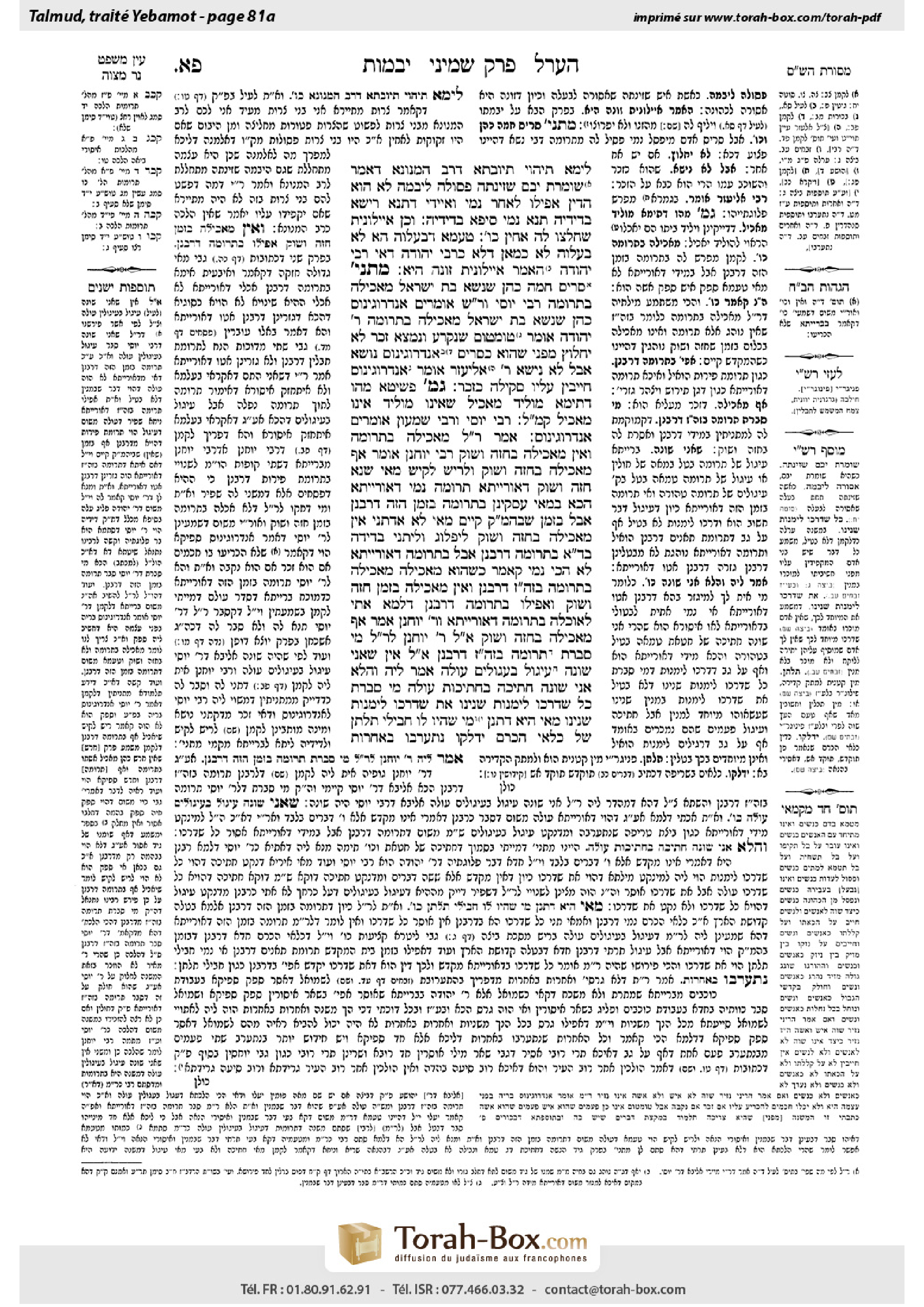
This page of Yevamot includes the Aramaic text, an English translation and an AI-generated French translation, alongside the scan above.
יבמות פ״א א · Aramaic and Hebrew text
לֵימָא תֶּיהְוֵי תְּיוּבְתָּא דְּרַב הַמְנוּנָא, דְּאָמַר: שׁוֹמֶרֶת יָבָם שֶׁזִּינְּתָה פְּסוּלָה לִיבָמָהּ! לֹא: הוּא הַדִּין אֲפִילּוּ לְאַחֵר נָמֵי, וְאַיְּידֵי דִּתְנָא רֵישָׁא בְּדִידֵיהּ, תְּנָא נָמֵי סֵיפָא בְּדִידֵיהּ.
וְכֵן אַיְילוֹנִית שֶׁחָלְצוּ לָהּ אַחִין כּוּ׳. טַעְמָא דִּבְעָלוּהָ. הָא לֹא בְּעָלוּהָ — לָא. כְּמַאן? דְּלָא כְּרַבִּי יְהוּדָה, דְּאִי רַבִּי יְהוּדָה, הָאָמַר: אַיְילוֹנִית זוֹנָה הִיא.
מַתְנִי׳ סְרִיס חַמָּה כֹּהֵן שֶׁנָּשָׂא בַּת יִשְׂרָאֵל — מַאֲכִילָהּ בִּתְרוּמָה. רַבִּי יוֹסֵי וְרַבִּי שִׁמְעוֹן אוֹמְרִים: אַנְדְּרוֹגִינוֹס כֹּהֵן שֶׁנָּשָׂא בַּת יִשְׂרָאֵל — מַאֲכִילָהּ בִּתְרוּמָה.
רַבִּי יְהוּדָה אוֹמֵר: טוּמְטוּם שֶׁנִּקְרַע וְנִמְצָא זָכָר — לֹא יַחְלוֹץ, מִפְּנֵי שֶׁהוּא כְּסָרִיס. אַנְדְּרוֹגִינוֹס נוֹשֵׂא אֲבָל לֹא נִישָּׂא. רַבִּי אֱלִיעֶזֶר אוֹמֵר: אַנְדְּרוֹגִינוֹס חַיָּיבִין עָלָיו סְקִילָה כַּזָּכָר.
גְּמָ׳ פְּשִׁיטָא? מַהוּ דְּתֵימָא: מוֹלִיד — מַאֲכִיל, שֶׁאֵינוֹ מוֹלִיד — אֵינוֹ מַאֲכִיל, קָא מַשְׁמַע לַן.
רַבִּי יוֹסֵי וְרַבִּי שִׁמְעוֹן אוֹמְרִים: אַנְדְּרוֹגִינוֹס. אָמַר רֵישׁ לָקִישׁ: מַאֲכִילָהּ בִּתְרוּמָה, וְאֵין מַאֲכִילָהּ בְּחָזֶה וָשׁוֹק. רַבִּי יוֹחָנָן אוֹמֵר: אַף מַאֲכִילָהּ בְּחָזֶה וָשׁוֹק. וּלְרֵישׁ לָקִישׁ, מַאי שְׁנָא חָזֶה וָשׁוֹק — דְּאוֹרָיְיתָא? תְּרוּמָה נָמֵי דְּאוֹרָיְיתָא!
הָכָא בְּמַאי עָסְקִינַן — בִּתְרוּמָה בַּזְּמַן הַזֶּה דְּרַבָּנַן. אֲבָל בִּזְמַן שֶׁבֵּית הַמִּקְדָּשׁ קַיָּים מַאי — לֹא? אַדְּתָנֵי ״אֵין מַאֲכִילָהּ בְּחָזֶה וָשׁוֹק״, לִיפְלוֹג וְלִיתְנֵי בְּדִידַהּ: בַּמֶּה דְּבָרִים אֲמוּרִים — בִּתְרוּמָה דְּרַבָּנַן, אֲבָל בִּתְרוּמָה דְּאוֹרָיְיתָא — לָא!
הָכִי נָמֵי קָאָמַר: כְּשֶׁהוּא מַאֲכִילָהּ — מַאֲכִילָהּ בִּתְרוּמָה בַּזְּמַן הַזֶּה דְּרַבָּנַן, וְאֵין מַאֲכִילָהּ בִּזְמַן חָזֶה וָשׁוֹק, וַאֲפִילּוּ בִּתְרוּמָה דְּרַבָּנַן, דִּלְמָא אָתֵי לְאוֹכֹלַהּ בִּתְרוּמָה דְּאוֹרָיְיתָא.
וְרַבִּי יוֹחָנָן אָמַר: אַף מַאֲכִילָהּ בְּחָזֶה וָשׁוֹק. אֲמַר לֵיהּ רַבִּי יוֹחָנָן לְרֵישׁ לָקִישׁ: מִי סָבְרַתְּ תְּרוּמָה בַּזְּמַן הַזֶּה דְּרַבָּנַן? אֲמַר לֵיהּ: אִין, שֶׁאֲנִי שׁוֹנֶה: עִיגּוּל בְּעִגּוּלִים עוֹלֶה.
אֲמַר לֵיהּ, וַהֲלֹא אֲנִי שׁוֹנֶה: חֲתִיכָה בַּחֲתִיכוֹת — עוֹלָה. מִי סָבְרַתְּ ״כׇּל שֶׁדַּרְכּוֹ לִימָּנוֹת״ שָׁנִינוּ? ״אֶת שֶׁדַּרְכּוֹ לִימָּנוֹת״ שָׁנִינוּ.
מַאי הִיא — דִּתְנַן: מִי שֶׁהָיוּ לוֹ חֲבִילֵי תִלְתָּן שֶׁל כִּלְאֵי הַכֶּרֶם — יִדְלְקוּ. נִתְעָרְבוּ בַּאֲחֵרוֹת —
Yevamot 81a · English translation
Shall we say that this is a conclusive refutation of the opinion of Rav Hamnuna, who said: A widow waiting for her yavam, who engaged in an act of licentious relations, is disqualified from entering into levirate marriage with her yavam, like an ordinary married woman who committed adultery? The Gemara rejects this argument: No, this presents no difficulty for Rav Hamnuna, as it is possible that the same is true even in a case where she had relations with a different man, that she too would be disqualified from marrying into the priesthood. But since the tanna taught the first clause with regard to the yavam himself, he also taught the latter clause with regard to the yavam himself, even though the same halakha applies if she cohabitated with another.
It is taught in the mishna: And similarly, with regard to a sexually underdeveloped woman, if one of the brothers performed ḥalitza with her he has not disqualified her, but if he engaged in intercourse with her he has disqualified her. The Gemara infers from this wording that the reason for her disqualification is that he had intercourse with her; but if he did not have intercourse with her she is not disqualified. According to whose opinion was this clause of the mishna taught? One must say that it was not taught in accordance with the opinion of Rabbi Yehuda. As, if one would claim that this teaching is in accordance with the opinion of Rabbi Yehuda, didn’t he say that a sexually underdeveloped woman is considered like a woman who has had sexual relations with a man forbidden to her by the Torah [zona], and so she is in any case disqualified from marrying into the priesthood?
MISHNA: If a priest who is a eunuch by natural causes married an Israelite woman, he enables her to eat teruma. Rabbi Yosei and Rabbi Shimon say: If a priest who is a hermaphrodite, possessing both male and female genitals, married an Israelite woman, he enables her to eat teruma.
Rabbi Yehuda says: If a tumtum, whose external sexual organs are indeterminate, was torn open so that his genitals were exposed, and he was found to be a male, he must not perform ḥalitza, because he is treated like a eunuch. A hermaphrodite may marry a woman but he may not be married by a man, as he is considered a man. Rabbi Eliezer says: If one had intercourse with a hermaphrodite, he is liable to receive the punishment of stoning on his account as if he had had relations with a male.
GEMARA: The Gemara questions the mishna’s teaching concerning a priest who was sexually impotent from birth: This is obvious; why should such a priest not enable his wife to partake of teruma? The Gemara answers: This halakha is necessary lest you say that since the verse states: “And such as are born in his house, they eat of his bread” (Leviticus 22:11), the allowance to eat teruma depends on the priest’s capacity to father children, i.e., that only one who can father children enables his wife to eat teruma, but one who cannot father children does not enable his wife to eat teruma. Therefore, the tanna teaches us that the priest’s capacity to have children is irrelevant.
It is taught in the mishna that Rabbi Yosei and Rabbi Shimon say: If a priest who is a hermaphrodite married an Israelite woman, he enables her to eat teruma. Reish Lakish said: He enables her to eat teruma, but he does not enable her to eat the breast and thigh of peace-offerings. Rabbi Yoḥanan says: He even enables her to eat the breast and thigh of peace-offerings. The Gemara asks: And according to Reish Lakish, what is different about the breast and thigh of peace-offerings? If you say it is that they are by Torah law, teruma is also by Torah law. Why, then, is it permitted for her to eat teruma, but not the breast and thigh of peace-offerings?
The Gemara answers: With what are we dealing here? We are dealing with teruma in the present, after the destruction of the Temple, when teruma is in effect only by rabbinic law. The Gemara asks: But when the Temple is standing, what is the halakha? He does not enable his wife to eat teruma. But if so, there is a difficulty. Instead of teaching that he does not enable her to eat the breast and thigh of peace-offerings, let him distinguish and teach it within the case of teruma itself as follows: In what case is this statement said? It is said with regard to teruma that is in effect only by rabbinic law, but with regard to teruma that is in effect by Torah law this ruling does not apply.
The Gemara answers: That is also what he is saying. In other words, this is actually what Reish Lakish means, as his statement should be understood as follows: When he enables her to eat, he enables her to eat teruma in the present, when teruma is in effect only by rabbinic law, but he does not enable her to eat teruma at a time that the breast and thigh are given to the priests, i.e., when the Temple is standing, not even teruma that is in effect only by rabbinic law. This is due to the concern that perhaps he will bring her to eat teruma that is in effect by Torah law.
However, Rabbi Yoḥanan disagrees and says that he even enables her to eat the breast and thigh of peace-offerings. With respect to this dispute, Rabbi Yoḥanan said to Reish Lakish: Since you distinguish between teruma and the breast and thigh, do you maintain that teruma in the present is mandated only by rabbinic law? He said to him: Yes, and the proof is that I teach that a cake of dried figs that became intermingled with other cakes is nullified. If a cake of teruma figs became intermingled with one hundred ordinary cakes, the cake is nullified and it is not necessary to treat them all as teruma. If the cake, which is a food of importance in its own right, is nullified, this must be because the teruma is only by rabbinic law.
Rabbi Yoḥanan said to him: But don’t I teach that even a piece of a sin-offering that became intermingled with other pieces of meat is nullified, as I maintain that the halakha of nullification applies even to Torah prohibitions? Do you maintain that we learned that any object that it is usual to count, i.e., any object that is even occasionally sold by unit, rather than by weight or measure, is considered to be important and therefore cannot be nullified? This is not so, as in fact we learned that only that which it is usual to count, i.e., an object that is always sold by unit and in no other manner, is considered to be important and is therefore not subject to nullification; and cakes of dried figs are not always sold by unit.
The Gemara asks: What is this halakha to which Rabbi Yoḥanan alludes? As we learned in a mishna (Orla 3:6–7): In the case of one who had bundles of clover, a type of legume, of a forbidden mixture of food crops in a vineyard, i.e., clover plants that grew in a vineyard, these bundles must be burned, as it is prohibited for one to derive benefit from a forbidden mixture of food crops in a vineyard. If the forbidden bundles became intermingled with others that are permitted,
Yevamot 81a · Traduction française (IA)
Faut-il en conclure qu’il s’agit d’une réfutation décisive de l’opinion de Rav Hamnuna, qui a dit qu’une veuve en attente de son yavam qui a eu des relations illicites est inapte à contracter un mariage léviratique avec son yavam, comme une femme mariée ordinaire qui a commis un adultère ? La Guemara rejette cet argument : non, cela ne pose aucune difficulté à Rav Hamnuna, car il est possible que même si elle a eu des relations avec un autre homme, elle soit elle aussi inapte à épouser un membre de la prêtrise. Mais puisque le tanna a enseigné la première clause à propos du yavam lui-même, il a également enseigné la dernière clause à propos du yavam lui-même, bien que la même halakha s’applique si elle a cohabité avec un autre homme.
Il est enseigné dans la Michna : de même, au sujet d’une femme sexuellement sous-développée, si l’un des frères a accompli la ḥalitsa avec elle, il ne l’a pas rendue inapte ; mais s’il a eu des relations avec elle, il l’a rendue inapte. La Guemara déduit de cette formulation que la raison de son inaptitude est qu’il a eu des relations avec elle ; mais s’il n’en a pas eu, elle n’est pas inapte. Selon l’opinion de qui cette clause de la Michna a-t-elle été enseignée ? Il faut dire qu’elle n’a pas été enseignée conformément à l’opinion de Rabbi Yehuda. En effet, si l’on prétendait que cet enseignement est conforme à l’opinion de Rabbi Yehuda, n’a-t-il pas dit qu’une femme sexuellement sous-développée est considérée comme une femme ayant eu des relations sexuelles avec un homme qui lui est interdit par la Torah [zona], et qu’elle est donc de toute façon inapte à épouser un membre de la prêtrise ?
Michna : Si un prêtre eunuque de naissance épouse une femme israélite, il lui permet de manger de la terouma. Rabbi Yosei et Rabbi Shimon disent : si un prêtre hermaphrodite, possédant les organes génitaux des deux sexes, épouse une femme israélite, il lui permet de manger de la terouma.
Rabbi Yehuda dit : si un tumtum, dont les organes sexuels externes sont indéterminés, a été ouvert afin que ses organes génitaux soient exposés et qu’on découvre qu’il est de sexe masculin, il ne doit pas accomplir la ḥalitsa, car il est traité comme un eunuque. Un hermaphrodite peut épouser une femme, mais il ne peut pas être épousé par un homme, car il est considéré comme un homme. Rabbi Eliezer dit : si quelqu’un a eu des relations avec un hermaphrodite, il est passible de la lapidation pour cela, comme s’il avait eu des relations avec un homme.
Guemara : La Guemara interroge l’enseignement de la Michna concernant un prêtre sexuellement impuissant depuis sa naissance : cela va de soi ; pourquoi un tel prêtre ne permettrait-il pas à sa femme de manger de la terouma ? La Guemara répond : cette halakha est nécessaire, de peur que tu ne dises que, puisque le verset énonce : « Et ceux qui sont nés dans sa maison mangeront de son pain » (Lévitique 22, 11), le droit de manger de la terouma dépend de la capacité du prêtre à engendrer des enfants, c’est-à-dire que seul celui qui peut engendrer des enfants permet à sa femme de manger de la terouma, tandis que celui qui ne le peut pas ne le lui permet pas. Le tanna nous enseigne donc que la capacité du prêtre à avoir des enfants n’a aucune incidence.
Il est enseigné dans la Michna que Rabbi Yosei et Rabbi Shimon disent : si un prêtre hermaphrodite épouse une femme israélite, il lui permet de manger de la terouma. Reish Lakish a dit : il lui permet de manger de la terouma, mais ne lui permet pas de manger la poitrine et la cuisse des sacrifices de paix. Rabbi Yoḥanan dit : il lui permet même de manger la poitrine et la cuisse des sacrifices de paix. La Guemara demande : selon Reish Lakish, en quoi la poitrine et la cuisse des sacrifices de paix sont-elles différentes ? Si tu dis que c’est parce qu’elles relèvent de la Torah, la terouma relève elle aussi de la Torah. Pourquoi lui est-il alors permis de manger de la terouma, mais pas la poitrine et la cuisse des sacrifices de paix ?
La Guemara répond : de quoi parlons-nous ici ? De la terouma à l’époque actuelle, après la destruction du Temple, où elle n’est en vigueur qu’en vertu d’une loi rabbinique. La Guemara demande : mais lorsque le Temple est debout, quelle est la halakha ? Il ne permet pas à sa femme de manger de la terouma. Mais alors, une difficulté se pose. Au lieu d’enseigner qu’il ne lui permet pas de manger la poitrine et la cuisse des sacrifices de paix, qu’il établisse une distinction dans le cas même de la terouma et enseigne ceci : dans quel cas cette déclaration a-t-elle été formulée ? À propos de la terouma qui n’est en vigueur qu’en vertu d’une loi rabbinique ; mais cette règle ne s’applique pas à la terouma en vigueur en vertu de la Torah.
La Guemara répond : c’est aussi ce qu’il dit. Autrement dit, c’est bien ce que veut dire Reish Lakish, et sa déclaration doit être comprise ainsi : lorsqu’il lui permet de manger, il lui permet de manger de la terouma à l’époque actuelle, où elle n’est en vigueur qu’en vertu d’une loi rabbinique ; mais il ne lui permet pas de manger de la terouma à l’époque où la poitrine et la cuisse sont données aux prêtres, c’est-à-dire lorsque le Temple est debout, même si cette terouma n’est en vigueur qu’en vertu d’une loi rabbinique. Cela tient à la crainte qu’il ne l’amène à manger de la terouma en vigueur en vertu de la Torah.
Cependant, Rabbi Yoḥanan n’est pas d’accord et dit qu’il lui permet même de manger la poitrine et la cuisse des sacrifices de paix. À propos de ce différend, Rabbi Yoḥanan dit à Reish Lakish : puisque tu établis une distinction entre la terouma et la poitrine et la cuisse, soutiens-tu que la terouma à l’époque actuelle n’est obligatoire qu’en vertu d’une loi rabbinique ? Il lui répondit : oui, et la preuve en est que j’enseigne qu’un gâteau de figues sèches qui s’est mêlé à d’autres gâteaux est annulé. Si un gâteau de figues de terouma s’est mêlé à cent gâteaux ordinaires, le gâteau est annulé et il n’est pas nécessaire de traiter tous les gâteaux comme de la terouma. Si ce gâteau, qui est un aliment important en soi, est annulé, c’est nécessairement parce que la terouma n’est en vigueur qu’en vertu d’une loi rabbinique.
Rabbi Yoḥanan lui dit : mais n’enseigné-je pas qu’un morceau de sacrifice expiatoire mêlé à d’autres morceaux de viande est lui aussi annulé, puisque je soutiens que la règle de l’annulation s’applique même aux interdits de la Torah ? Soutiens-tu que nous avons appris que tout objet qu’il est courant de compter, c’est-à-dire tout objet parfois vendu à l’unité plutôt qu’au poids ou à la mesure, est considéré comme important et ne peut donc pas être annulé ? Ce n’est pas le cas, car nous avons en fait appris que seul un objet qu’il est courant de compter, c’est-à-dire un objet toujours vendu à l’unité et jamais autrement, est considéré comme important et ne peut donc pas être annulé ; or les gâteaux de figues sèches ne sont pas toujours vendus à l’unité.
La Guemara demande : à quelle halakha Rabbi Yoḥanan fait-il allusion ? En effet, nous avons appris dans une Michna (Orla 3, 6–7) : dans le cas de quelqu’un qui possédait des bottes de trèfle, une sorte de légumineuse, issues d’un mélange interdit de cultures dans une vigne, c’est-à-dire des plants de trèfle qui avaient poussé dans une vigne, ces bottes doivent être brûlées, car il est interdit de tirer profit d’un mélange interdit de cultures dans une vigne. Si les bottes interdites se sont mêlées à d’autres bottes permises,
Traduction française générée par IA à partir de l’édition anglaise de Sefaria. Vérifie toujours un passage avec le texte source.
Text from Sefaria: William Davidson Edition - Vocalized Aramaic (CC BY NC); William Davidson Edition - English (CC BY NC).