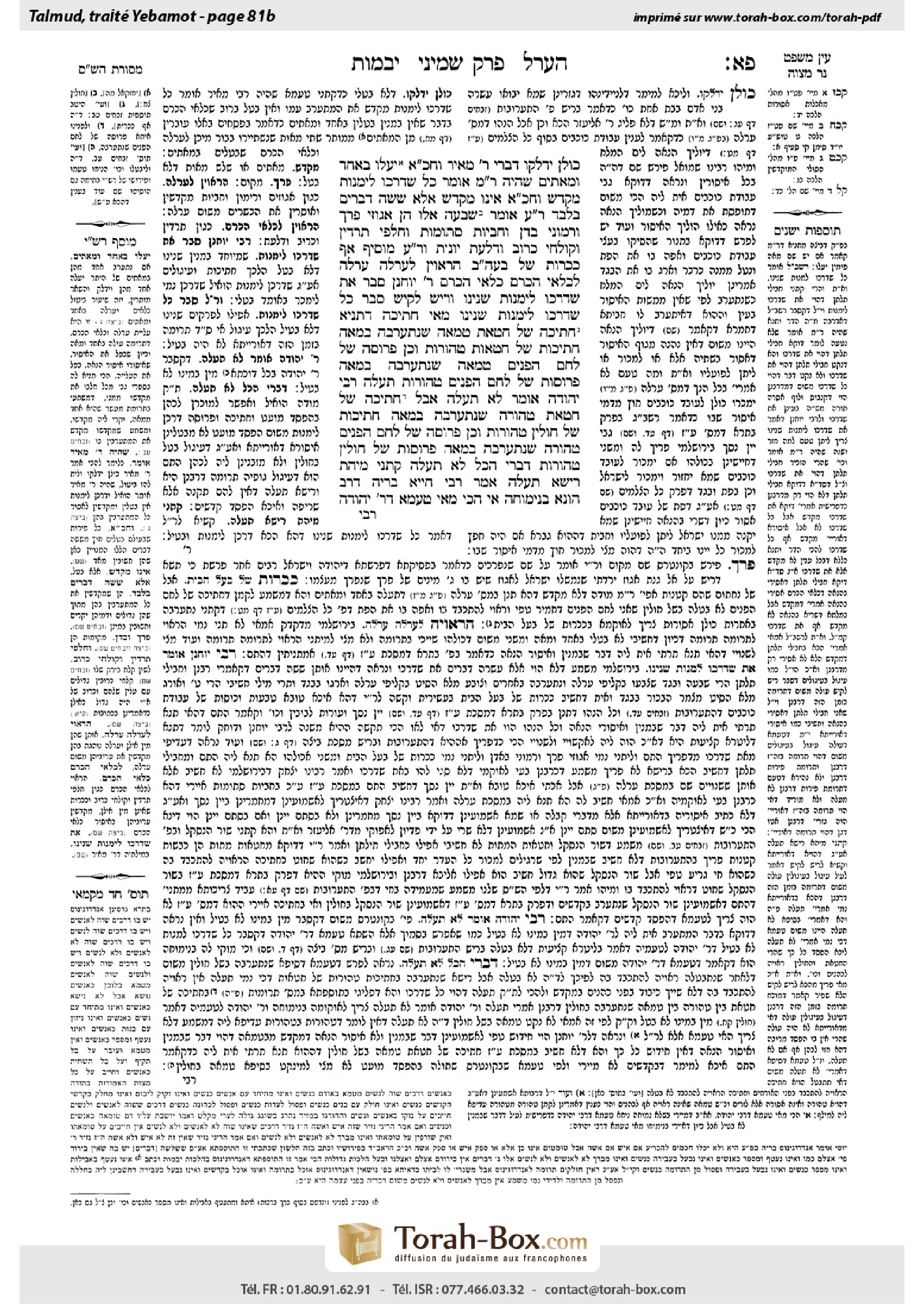
Yevamot 81b: Talmud study for Daf Yomi
Daf Yomi is the daily study of one Talmud folio. Explore 37 tractates with scans, Hebrew text, Sefaria English and AI-generated French translations where annotated.
Passage selection and English or AI-generated French translation are available where the scan has annotations. Daf Study is independent of Torah-Box and Sefaria.
Browse Yevamot · יבמות · All tractatesYevamot 81b text and translations
This page of Yevamot includes the Aramaic text, an English translation and an AI-generated French translation, alongside the scan above.
יבמות פ״א ב · Aramaic and Hebrew text
כּוּלָּן יִדָּלְקוּ, דִּבְרֵי רַבִּי מֵאִיר. וַחֲכָמִים אוֹמְרִים: יַעֲלוּ בְּאֶחָד וּמָאתַיִם. שֶׁהָיָה רַבִּי מֵאִיר אוֹמֵר: כֹּל שֶׁדַּרְכּוֹ לִימָּנוֹת — מְקַדֵּשׁ. וַחֲכָמִים אוֹמְרִים: אֵינוֹ מְקַדֵּשׁ אֶלָּא שִׁשָּׁה דְּבָרִים בִּלְבַד. רַבִּי עֲקִיבָא אוֹמֵר: שִׁבְעָה.
אֵלּוּ הֵן: אֱגוֹזֵי פֶרֶךְ, וְרִמּוֹנֵי בָּדָן, וְחָבִיּוֹת סְתוּמוֹת, וְחִלְפֵי תְרָדִין, וְקוּלְחֵי כְּרוּב, וְדַלַּעַת יְוָנִית. וְרַבִּי עֲקִיבָא מוֹסִיף אַף כִּכָּרוֹת שֶׁל בַּעַל הַבַּיִת. הָרְאוּיִן לְעׇרְלָה — עׇרְלָה. לְכִלְאֵי הַכֶּרֶם — כִּלְאֵי הַכֶּרֶם.
רַבִּי יוֹחָנָן סָבַר: ״אֶת שֶׁדַּרְכּוֹ לִימָּנוֹת״ שָׁנִינוּ. וְרֵישׁ לָקִישׁ סָבַר: ״כֹּל שֶׁדַּרְכּוֹ לִימָּנוֹת״ שָׁנִינוּ.
מַאי חֲתִיכָה — דְּתַנְיָא: חֲתִיכָה שֶׁל חַטָּאת טְמֵאָה שֶׁנִּתְעָרְבָה בְּמֵאָה חֲתִיכוֹת שֶׁל חַטָּאוֹת טְהוֹרוֹת, וְכֵן פְּרוּסָה שֶׁל לֶחֶם הַפָּנִים טְמֵאָה שֶׁנִּתְעָרְבָה בְּמֵאָה פְּרוּסוֹת שֶׁל לֶחֶם הַפָּנִים טְהוֹרוֹת — תַּעֲלֶה. רַבִּי יְהוּדָה אוֹמֵר: לֹא תַּעֲלֶה.
אֲבָל חֲתִיכָה שֶׁל חַטָּאת טְהוֹרָה שֶׁנִּתְעָרְבָה בְּמֵאָה חֲתִיכוֹת שֶׁל חוּלִּין טְהוֹרוֹת, וְכֵן פְּרוּסָה שֶׁל לֶחֶם הַפָּנִים טְהוֹרָה שֶׁנִּתְעָרְבָה בְּמֵאָה פְּרוּסוֹת שֶׁל חוּלִּין טְהוֹרוֹת — דִּבְרֵי הַכֹּל לָא תַּעֲלֶה.
קָתָנֵי מִיהַת רֵישָׁא תַּעֲלֶה! אָמַר רַבִּי חִיָּיא בְּרֵיהּ דְּרַב הוּנָא: בְּנִימּוֹחָה.
אִי הָכִי, מַאי טַעְמָא דְּרַבִּי יְהוּדָה?
Yevamot 81b · English translation
they must all be burned; this is the statement of Rabbi Meir. And the Rabbis say: They are nullified in a mixture of one part forbidden food to two hundred parts permitted food. As Rabbi Meir would say: Any object that it is usual to count renders a mixture prohibited. In other words, objects that are counted and sold by the unit, rather than by weight or estimation, are considered of special importance, and so they cannot be nullified by any majority and therefore must be burned. But the Rabbis say: Only six objects are important enough that they cannot be nullified and therefore render their mixtures forbidden. Rabbi Akiva says: There are seven such objects.
They are as follows: Perekh nuts, high-quality nuts from a place called Perekh; Badan pomegranates, pomegranates from a place called Badan; sealed barrels of wine; shoots of beet; cabbage stalks; and Greek gourd. Rabbi Akiva adds, as his seventh item, a homeowner’s loaves. Different prohibitions apply to these seven items: Those that are fit for the prohibition of orla, fruit that grows in the first three years after a tree has been planted, i.e., the nuts and pomegranates, render the entire mixture orla. Those that are fit for the prohibition proscribing a mixture of food crops in a vineyard, i.e., the beets, cabbage, and gourd, render the entire mixture a mixture of food crops in a vineyard.
And it was stated that amora’im disagreed about the precise wording of this mishna: Rabbi Yoḥanan holds that we learned: That which it is usual to count, i.e., Rabbi Meir’s stringent ruling is limited to objects that are sold exclusively by unit. And Reish Lakish holds that we learned: Any object that it is usual to count, i.e., even items that are only sometimes sold by unit are considered important and cannot be nullified.
The Gemara further explains: What is the case of a piece, referred to by Rabbi Yoḥanan? As it is taught in a baraita: If a piece of a ritually impure sin-offering became intermingled with one hundred pieces of ritually pure sin-offerings, and similarly, if a slice of ritually impure shewbread became intermingled with one hundred slices of ritually pure showbread, the impure piece of a sin-offering or slice of shewbread is nullified in its respective mixture. Rabbi Yehuda says: It is not nullified.
However, if a piece of a ritually pure sin-offering became intermingled with one hundred pieces of ritually pure non-sacred meat, and similarly, if a slice of ritually pure shewbread became intermingled with one hundred slices of ritually pure non-sacred bread, everyone agrees that the pure piece of sin-offering or slice of shewbread is not nullified in its respective mixture.
The Gemara asks: In any event, the first clause of this baraita teaches that a piece of ritually impure sin-offering can be nullified. This poses a difficulty with respect to the opinion of Reish Lakish, as such a piece of meat is an item that is sometimes counted and considered important in its own right, and it is forbidden by Torah law, but nevertheless it can still be nullified. Rabbi Ḥiyya, son of Rav Huna, said: This baraita is referring not to a whole piece of meat but to one that had been crushed and broken into small parts. Once it is no longer a whole piece, it loses its importance and can be nullified.
The Gemara asks: If it is so that the piece has been crushed, what is the reason for Rabbi Yehuda’s opinion that the piece is not nullified?
Yevamot 81b · Traduction française (IA)
Elles doivent toutes être brûlées ; telle est l’opinion de Rabbi Meïr. Les Sages disent : elles sont annulées dans un mélange d’une part d’aliment interdit pour deux cents parts d’aliment permis. Rabbi Meïr disait en effet : tout objet qu’il est d’usage de compter rend le mélange interdit. Autrement dit, les objets vendus à l’unité plutôt qu’au poids ou à l’estimation sont considérés comme particulièrement importants ; ils ne peuvent donc être annulés par aucune majorité et doivent, par conséquent, être brûlés. Mais les Sages disent que seuls six objets sont assez importants pour ne pas pouvoir être annulés et pour rendre ainsi leurs mélanges interdits. Rabbi Akiva dit qu’il y en a sept.
Les voici : des noix de Perekh, des noix de grande qualité provenant d’un lieu appelé Perekh ; des grenades de Badan, provenant d’un lieu appelé Badan ; des tonneaux de vin scellés ; des pousses de betterave ; des tiges de chou ; et des courges grecques. Rabbi Akiva ajoute, comme septième élément, les pains d’un maître de maison. Ces sept éléments sont soumis à différentes interdictions : ceux qui sont concernés par l’interdiction de l’orla — les fruits qui poussent pendant les trois premières années suivant la plantation d’un arbre —, c’est-à-dire les noix et les grenades, rendent l’ensemble du mélange soumis à l’orla. Ceux qui sont concernés par l’interdiction du mélange d’espèces végétales dans une vigne, c’est-à-dire les betteraves, le chou et les courges, rendent l’ensemble du mélange soumis à l’interdiction du mélange d’espèces végétales dans une vigne.
Il a été rapporté que des amoraïm étaient en désaccord sur la formulation précise de cette Michna. Rabbi Yoḥanan soutient que nous avons appris : « Ce qu’il est d’usage de compter », c’est-à-dire que la décision rigoureuse de Rabbi Meïr ne s’applique qu’aux objets vendus exclusivement à l’unité. Reish Lakish soutient, quant à lui, que nous avons appris : « Tout objet qu’il est d’usage de compter », c’est-à-dire que même les objets qui ne sont vendus qu’occasionnellement à l’unité sont considérés comme importants et ne peuvent être annulés.
La Guemara précise encore : de quelle sorte de morceau Rabbi Yoḥanan parle-t-il ? Comme l’enseigne une baraïta : si un morceau de sacrifice expiatoire rituellement impur s’est mélangé à cent morceaux de sacrifices expiatoires rituellement purs, et de même, si une tranche de pain de proposition rituellement impur s’est mélangée à cent tranches de pain de proposition rituellement pur, le morceau impur du sacrifice expiatoire ou la tranche impure de pain de proposition est annulé dans le mélange correspondant. Rabbi Yehouda dit : il n’est pas annulé.
En revanche, si un morceau de sacrifice expiatoire rituellement pur s’est mélangé à cent morceaux de viande profane rituellement pure, et de même, si une tranche de pain de proposition rituellement pur s’est mélangée à cent tranches de pain profane rituellement pur, tous conviennent que le morceau pur de sacrifice expiatoire ou la tranche de pain de proposition n’est pas annulé dans le mélange correspondant.
La Guemara demande : Quoi qu’il en soit, la première partie de cette baraïta enseigne qu’un morceau de sacrifice expiatoire rituellement impur peut être annulé. Cela pose une difficulté à l’opinion de Reish Lakish, car un tel morceau de viande est un objet qu’il arrive de compter et qui est considéré comme important en soi ; il est interdit par la Torah, et pourtant il peut être annulé. Rabbi Ḥiyya, fils de Rav Houna, dit : cette baraïta parle non pas d’un morceau de viande entier, mais d’un morceau qui a été broyé et réduit en petits fragments. Dès lors qu’il n’est plus entier, il perd son importance et peut être annulé.
La Guemara demande : si le morceau a été broyé, pourquoi Rabbi Yehouda soutient-il qu’il n’est pas annulé ?
Traduction française générée par IA à partir de l’édition anglaise de Sefaria. Vérifie toujours un passage avec le texte source.
Text from Sefaria: William Davidson Edition - Vocalized Aramaic (CC BY NC); William Davidson Edition - English (CC BY NC).