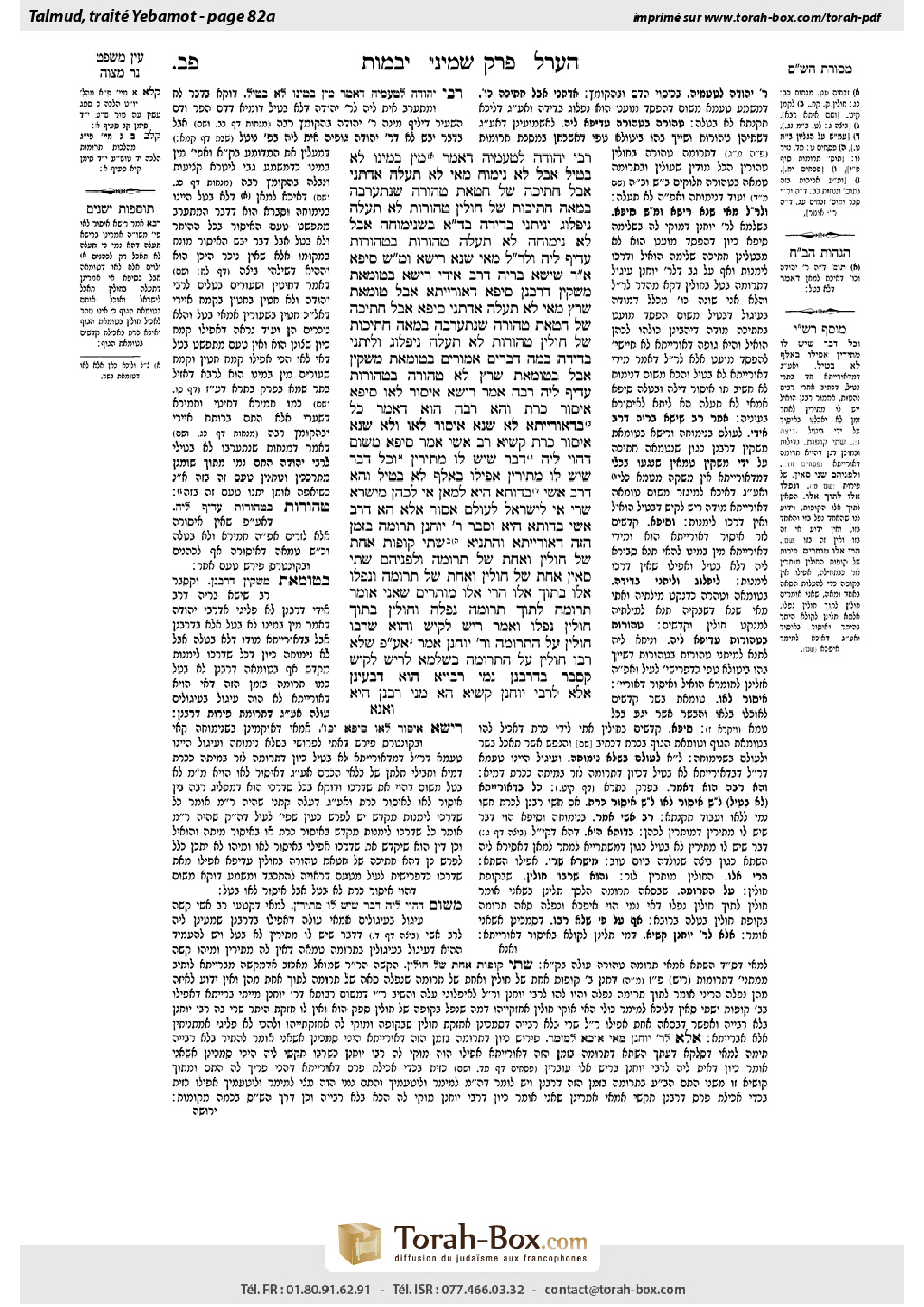
Yevamot 82a: Talmud study for Daf Yomi
Daf Yomi is the daily study of one Talmud folio. Explore 37 tractates with scans, Hebrew text, Sefaria English and AI-generated French translations where annotated.
Passage selection and English or AI-generated French translation are available where the scan has annotations. Daf Study is independent of Torah-Box and Sefaria.
Browse Yevamot · יבמות · All tractatesYevamot 82a text and translations
This page of Yevamot includes the Aramaic text, an English translation and an AI-generated French translation, alongside the scan above.
יבמות פ״ב א · Aramaic and Hebrew text
רַבִּי יְהוּדָה לְטַעְמֵיהּ, דְּאָמַר: מִין בְּמִינוֹ לֹא בָּטֵיל.
אֲבָל לֹא נִימּוֹחָה מַאי — לֹא תַּעֲלֶה, אַדְּתָנֵי: אֲבָל חֲתִיכָה שֶׁל חַטָּאת טְהוֹרָה שֶׁנִּתְעָרְבָה בְּמֵאָה חֲתִיכוֹת שֶׁל חוּלִּין טְהוֹרוֹת לֹא תַּעֲלֶה, נִיפְלוֹג וְנִיתְנֵי בְּדִידַהּ: בַּמֶּה דְּבָרִים אֲמוּרִים, בְּשֶׁנִּימּוֹחָה, אֲבָל לֹא נִימּוֹחָה — לֹא תַּעֲלֶה!
טְהוֹרוֹת בִּטְהוֹרוֹת עֲדִיף לֵיהּ.
וּלְרֵישׁ לָקִישׁ, מַאי שְׁנָא רֵישָׁא וּמַאי שְׁנָא סֵיפָא? אָמַר רַב שִׁישָׁא בְּרֵיהּ דְּרַב אִידִי: רֵישָׁא, בְּטוּמְאַת מַשְׁקִין דְּרַבָּנַן. סֵיפָא, דְּאוֹרָיְיתָא.
אֲבָל טוּמְאַת שֶׁרֶץ מַאי — לֹא תַּעֲלֶה,
אַדְּתָנֵי סֵיפָא: אֲבָל חֲתִיכָה שֶׁל חַטָּאת טְהוֹרָה שֶׁנִּתְעָרְבָה בְּמֵאָה חֲתִיכוֹת שֶׁל חוּלִּין טְהוֹרוֹת לֹא תַּעֲלֶה, נִיפְלוֹג וְלִיתְנֵי בְּדִידַהּ: בַּמֶּה דְּבָרִים אֲמוּרִים — בְּטוּמְאַת מַשְׁקִין, אֲבָל בְּטוּמְאַת שֶׁרֶץ — לֹא! טְהוֹרָה בִּטְהוֹרוֹת עֲדִיף לֵיהּ.
רַבָּה אָמַר: רֵישָׁא — אִיסּוּר לָאו, סֵיפָא — אִיסּוּר כָּרֵת.
וְהָא רַבָּה הוּא דְּאָמַר: כֹּל בִּדְאוֹרָיְיתָא, לָא שְׁנָא אִיסּוּר לָאו, וְלָא שְׁנָא אִיסּוּר כָּרֵת! קַשְׁיָא.
רַב אָשֵׁי אָמַר: סֵיפָא — מִשּׁוּם דְּהָוֵי לֵיהּ דָּבָר שֶׁיֵּשׁ לוֹ מַתִּירִין, וְכׇל דָּבָר שֶׁיֵּשׁ לוֹ מַתִּירִין — אֲפִילּוּ בְּאֶלֶף לֹא בָּטֵיל.
וְהָא דְּרַב אָשֵׁי בְּדוּתָא הִיא. לְמַאן? אִי לְכֹהֵן — מִישְׁרָא שְׁרֵי. אִי לְיִשְׂרָאֵל — לְעוֹלָם אָסוּר! אֶלָּא הָא דְּרַב אָשֵׁי בְּדוּתָא הִיא.
וְסָבַר רַבִּי יוֹחָנָן תְּרוּמָה בִּזְמַן הַזֶּה דְּאוֹרָיְיתָא? וְהָתַנְיָא: שְׁתֵּי קוּפּוֹת, אַחַת שֶׁל חוּלִּין וְאַחַת שֶׁל תְּרוּמָה, וְלִפְנֵיהֶם שְׁתֵּי סְאִין, אַחַת שֶׁל חוּלִּין וְאַחַת שֶׁל תְּרוּמָה, וְנָפְלוּ אֵלּוּ בְּתוֹךְ אֵלּוּ — הֲרֵי אֵלּוּ מוּתָּרִים, שֶׁאֲנִי אוֹמֵר: תְּרוּמָה לְתוֹךְ תְּרוּמָה נָפְלָה, וְחוּלִּין בְּתוֹךְ חוּלִּין נָפְלוּ.
וְאָמַר רֵישׁ לָקִישׁ: וְהוּא שֶׁרַבּוּ חוּלִּין עַל הַתְּרוּמָה, וְרַבִּי יוֹחָנָן אָמַר: אַף עַל פִּי שֶׁלֹּא רַבּוּ חוּלִּין עַל הַתְּרוּמָה.
בִּשְׁלָמָא לְרֵישׁ לָקִישׁ, קָסָבַר בִּדְרַבָּנַן נָמֵי רִבּוּיָא הוּא דְּבָעֵינַן. אֶלָּא לְרַבִּי יוֹחָנָן קַשְׁיָא?
הָא מַנִּי — רַבָּנַן הִיא,
Yevamot 82a · English translation
The Gemara answers: Rabbi Yehuda conforms to his standard line of reasoning, as he stated a principle that if a particular type of food is mixed with food of its own type, it cannot be nullified under any circumstances.
The Gemara asks further: But had the piece of meat not been crushed, what would the halakha be? Presumably, it would not be nullified. If so, there is a difficulty, as instead of teaching a case involving non-sacred meat in the second half of the baraita, as follows: However, if a piece of a ritually pure sin-offering became intermingled with one hundred pieces of ritually pure non-sacred meat, the impure piece of a sin-offering is not nullified; let the tanna distinguish and teach it in the case involving only sacred meat, as follows: In what case is this statement said? It is in a case where the piece of meat has been crushed and broken into small parts, but if it has not been crushed, it is not nullified.
The Gemara answers: Even so, the tanna prefers to address the case of an intermingling of ritually pure items with other ritually pure items and thereby teach a novel halakha, notwithstanding the fact that he could have made a distinction within the case of a ritually impure piece itself.
The Gemara asks: And according to Reish Lakish, who establishes the baraita as referring to a piece of meat that has been crushed, what is different in the first clause of the baraita and what is different in the latter clause? Why is nullification possible in the case of impure pieces, but not in the case of pure ones? Rav Sheisha, son of Rav Idi, said: The first clause is dealing with a piece of a sin-offering that contracted ritual impurity due to liquids, which is imparted by rabbinic law. Since the sacred food contracted impurity that is only rabbinic in origin, it may be nullified rather than allowed to go to waste. The latter clause, on the other hand, deals with sacred food that became intermingled with ordinary non-sacred food. The sacred food is forbidden to non-priests by Torah law, and therefore it is not nullified.
The Gemara asks: But had the piece of meat mentioned in the first clause of the baraita contracted ritual impurity through contact with a creeping animal, which is imparted by Torah law, what would the halakha be? Presumably, it would not be nullified.
If so, there is a difficulty, as instead of teaching a case involving non-sacred meat in the latter clause of the baraita, as follows: However, if a piece of a ritually pure sin-offering became intermingled with one hundred pieces of ritually pure non-sacred meat, the impure piece of a sin-offering is not nullified; let the tanna distinguish and teach it in the case involving only sacred meat, as follows: In what case is this statement said? It is said in a case where the piece of meat contracted ritual impurity due to liquids, but where it contracted ritual impurity through a creeping animal it is not nullified. The Gemara answers: Even so, the tanna prefers to address the novel case of an intermingling of ritually pure items with other ritually pure items.
Rabba said that an alternative explanation may be suggested for the difference between the two clauses of the baraita: In the first clause of the baraita, which deals with the intermingling of impure sacred meat with pure sacred meat, there is concern about the violation of a standard prohibition, i.e., the prohibition against eating impure sacred meat; therefore, the piece of meat is nullified. In the latter clause of the baraita, which deals with the intermingling of sacred meat and non-sacred meat, there is concern about the violation of a prohibition that bears the punishment of karet, which bars a non-priest from eating pure sacrificial food; therefore, the piece of meat is not nullified.
The Gemara asks: But wasn’t it Rabba himself who said: With regard to the nullification of any item forbidden by Torah law that became intermingled with a permitted substance, there is no difference between that which is forbidden due to a standard prohibition and that which is forbidden due to a prohibition that entails the punishment of karet. The Gemara concludes: This is difficult for Rabba.
Rav Ashi said yet another explanation: In the latter clause, where ritually pure sacred meat became intermingled with ritually pure non-sacred meat, the sacred meat does not become nullified because it is an object whose prohibition is temporary. The piece of sacred meat is not absolutely forbidden, as it is permitted for a priest to eat it. And the halakha is that any object whose prohibition is temporary cannot be nullified, no matter how great the amount of permitted substance, even in a mixture of one to one thousand.
The Gemara comments: Now, that teaching ascribed to Rav Ashi is certainly a mistake [beduta], as the application of this principle to the case at hand can easily be shown to be erroneous. With regard to whom is the prohibition temporary? If one would say that it is for a priest, the sacred meat was always permitted to him, even before it became intermingled, as a priest may eat both sacred and non-sacred food, and therefore it was never a forbidden mixture with respect to him. And if one would say that it is for an Israelite, the meat will always be forbidden to him. Rather, that teaching attributed to Rav Ashi is clearly a mistake.
The Gemara raises a question with regard to Rabbi Yoḥanan’s opinion: And does Rabbi Yoḥanan maintain that teruma in the present applies by Torah law? But isn’t it taught in a baraita: There were two large baskets, one filled with non-sacred produce and the other one filled with teruma, and before them were two one-se’a vessels, one filled with non-sacred produce and the other one filled with teruma. And these, the contents of each of the se’a vessels, fell into those, each of the baskets. It is possible that the teruma fell into the non-sacred produce, and it is prohibited for non-priests to eat a mixture of teruma and non-sacred produce. Nevertheless, the produce found in the basket containing the non-sacred produce is permitted, as I say that the teruma fell into the teruma and the non-sacred produce fell into the non-sacred produce.
And Reish Lakish said that this is only the case if the non-sacred produce in the basket was greater in quantity than the teruma in the one-se’a vessel, so that even if the teruma fell into the non-sacred produce, it is nullified. And Rabbi Yoḥanan said: The mixture is permitted even if the non-sacred produce was not greater in quantity than the teruma, as one may rely on the assumption that each type of produce fell into its own type.
Granted, according to Reish Lakish, who maintains that teruma nowadays applies by rabbinic law, this is logical, as he maintains that even with regard to teruma that is in effect only by rabbinic law, we also require the permitted portion of the mixture to be greater in quantity so that it can nullify the forbidden part. But according to Rabbi Yoḥanan, it is difficult because if he maintains that even nowadays teruma is mandated by Torah law, how can one disregard the concern and permit the mixture based merely on the assumption that the events occurred in a way that preserves the produce in its permitted state?
The Gemara answers that Rabbi Yoḥanan can say: In accordance with whose opinion is this baraita taught? It is in accordance with the opinion of the Rabbis, who maintain that teruma nowadays is in effect only by rabbinic law.
Yevamot 82a · Traduction française (IA)
La Guemara répond : Rabbi Yehuda suit sa ligne de raisonnement habituelle, car il a énoncé le principe selon lequel, lorsqu’un aliment est mélangé à un aliment de même espèce, il ne peut en aucun cas être annulé.
La Guemara demande encore : Mais si le morceau de viande n’avait pas été broyé, quelle aurait été la halakha ? Apparemment, il n’aurait pas été annulé. Dès lors, une difficulté se pose : au lieu d’enseigner, dans la seconde partie de la baraïta, un cas impliquant de la viande profane, comme suit : « Toutefois, si un morceau de sacrifice expiatoire rituellement pur s’est mélangé à cent morceaux de viande profane rituellement pure, le morceau impur de sacrifice expiatoire n’est pas annulé », que le tanna établisse une distinction dans le cas impliquant uniquement de la viande consacrée et l’enseigne ainsi : « Dans quel cas cette déclaration s’applique-t-elle ? Lorsque le morceau de viande a été broyé et réduit en petits fragments ; mais s’il n’a pas été broyé, il n’est pas annulé. »
La Guemara répond : Malgré tout, le tanna préfère traiter le cas d’un mélange d’éléments rituellement purs avec d’autres éléments rituellement purs, et enseigner ainsi une halakha nouvelle, bien qu’il aurait pu établir une distinction dans le cas du morceau lui-même, rituellement impur.
La Guemara demande : Et selon Reish Lakish, qui établit que la baraïta parle d’un morceau de viande broyé, quelle différence y a-t-il entre la première partie de la baraïta et la dernière ? Pourquoi l’annulation est-elle possible dans le cas des morceaux impurs, mais pas dans celui des morceaux purs ? Rav Sheisha, fils de Rav Idi, dit : La première partie traite d’un morceau de sacrifice expiatoire qui a contracté une impureté rituelle par des liquides, impureté transmise selon le droit rabbinique. Puisque l’aliment consacré a contracté une impureté dont l’origine est seulement rabbinique, il peut être annulé plutôt que d’être perdu. En revanche, la dernière partie traite d’un aliment consacré mélangé à un aliment profane ordinaire. L’aliment consacré est interdit aux non-prêtres par la Torah ; il n’est donc pas annulé.
La Guemara demande : Mais si le morceau de viande mentionné dans la première partie de la baraïta avait contracté une impureté rituelle au contact d’un animal rampant, impureté transmise par la Torah, quelle aurait été la halakha ? Apparemment, il n’aurait pas été annulé.
Dès lors, une difficulté se pose : au lieu d’enseigner, dans la dernière partie de la baraïta, un cas impliquant de la viande profane, comme suit : « Toutefois, si un morceau de sacrifice expiatoire rituellement pur s’est mélangé à cent morceaux de viande profane rituellement pure, le morceau impur de sacrifice expiatoire n’est pas annulé », que le tanna établisse une distinction dans le cas impliquant uniquement de la viande consacrée et l’enseigne ainsi : « Dans quel cas cette déclaration s’applique-t-elle ? Lorsque le morceau de viande a contracté une impureté rituelle par des liquides ; mais s’il a contracté une impureté rituelle au contact d’un animal rampant, il n’est pas annulé. » La Guemara répond : Malgré tout, le tanna préfère traiter le cas novateur d’un mélange d’éléments rituellement purs avec d’autres éléments rituellement purs.
Rabba dit qu’on peut proposer une autre explication de la différence entre les deux parties de la baraïta : dans la première partie, qui traite du mélange de viande consacrée impure avec de la viande consacrée pure, il s’agit d’éviter la transgression d’une interdiction ordinaire, à savoir l’interdiction de manger de la viande consacrée impure ; le morceau de viande est donc annulé. Dans la dernière partie, qui traite du mélange de viande consacrée et de viande profane, il s’agit d’éviter la transgression d’une interdiction passible de karet, qui interdit à un non-prêtre de manger des aliments sacrificiels purs ; le morceau de viande n’est donc pas annulé.
La Guemara demande : Mais n’est-ce pas Rabba lui-même qui a dit qu’en matière d’annulation d’un élément interdit par la Torah mélangé à une substance permise, il n’y a pas de différence entre ce qui est interdit par une interdiction ordinaire et ce qui l’est par une interdiction passible de karet ? La Guemara conclut : Cela pose une difficulté à Rabba.
Rav Ashi donne encore une autre explication : dans la dernière partie, où de la viande consacrée rituellement pure s’est mélangée à de la viande profane rituellement pure, la viande consacrée n’est pas annulée, car son interdiction est temporaire. Le morceau de viande consacrée n’est pas absolument interdit, puisqu’un prêtre a le droit de le manger. Or, la halakha veut que tout élément dont l’interdiction est temporaire ne puisse être annulé, quelle que soit la quantité de substance permise, même dans un mélange d’un pour mille.
La Guemara fait remarquer : Or, l’enseignement attribué à Rav Ashi est certainement une erreur [beduta], car on peut aisément montrer que l’application de ce principe au cas présent est erronée. Pour qui l’interdiction est-elle temporaire ? Si l’on répond : pour un prêtre, la viande consacrée lui était toujours permise, même avant d’être mélangée, puisqu’un prêtre peut manger aussi bien des aliments consacrés que des aliments profanes ; pour lui, elle n’a donc jamais constitué un mélange interdit. Et si l’on répond : pour un Israélite, cette viande lui sera toujours interdite. Cet enseignement attribué à Rav Ashi est donc manifestement une erreur.
La Guemara soulève une question au sujet de l’opinion de Rabbi Yoḥanan : Rabbi Yoḥanan soutient-il donc que la terouma s’applique de nos jours en vertu de la Torah ? Pourtant, n’est-il pas enseigné dans une baraïta : Il y avait deux grands paniers, l’un rempli de produits profanes et l’autre de terouma, ainsi que, devant eux, deux récipients d’un séa, l’un rempli de produits profanes et l’autre de terouma. Le contenu de chacun de ces récipients d’un séa tomba dans l’un des paniers. Il est possible que la terouma soit tombée dans les produits profanes, auquel cas il est interdit aux non-prêtres de manger le mélange de terouma et de produits profanes. Néanmoins, les produits du panier contenant les produits profanes sont permis, car je suppose que la terouma est tombée dans la terouma et que les produits profanes sont tombés dans les produits profanes.
Et Reish Lakish dit que cela n’est le cas que si la quantité de produits profanes dans le panier était supérieure à celle de la terouma dans le récipient d’un séa, de sorte que, même si la terouma était tombée dans les produits profanes, elle aurait été annulée. Et Rabbi Yoḥanan dit : Le mélange est permis même si la quantité de produits profanes n’était pas supérieure à celle de la terouma, car on peut s’appuyer sur l’hypothèse que chaque type de produit est tombé dans celui de même espèce.
Il est logique que, selon Reish Lakish, qui soutient que la terouma relève de nos jours du droit rabbinique, cela soit ainsi : il soutient que même pour la terouma qui n’est en vigueur qu’en vertu du droit rabbinique, il faut que la partie permise du mélange soit en quantité supérieure afin qu’elle puisse annuler la partie interdite. Mais selon Rabbi Yoḥanan, une difficulté se pose : s’il soutient que, même de nos jours, la terouma est prescrite par la Torah, comment peut-on écarter cette préoccupation et permettre le mélange en se fondant uniquement sur l’hypothèse que les événements se sont déroulés de manière à préserver le statut permis des produits ?
La Guemara répond que Rabbi Yoḥanan peut dire : Selon l’opinion de qui cette baraïta est-elle enseignée ? Selon l’opinion des Rabbins, qui soutiennent que, de nos jours, la terouma n’est en vigueur qu’en vertu du droit rabbinique.
Traduction française générée par IA à partir de l’édition anglaise de Sefaria. Vérifie toujours un passage avec le texte source.
Text from Sefaria: William Davidson Edition - Vocalized Aramaic (CC BY NC); William Davidson Edition - English (CC BY NC).