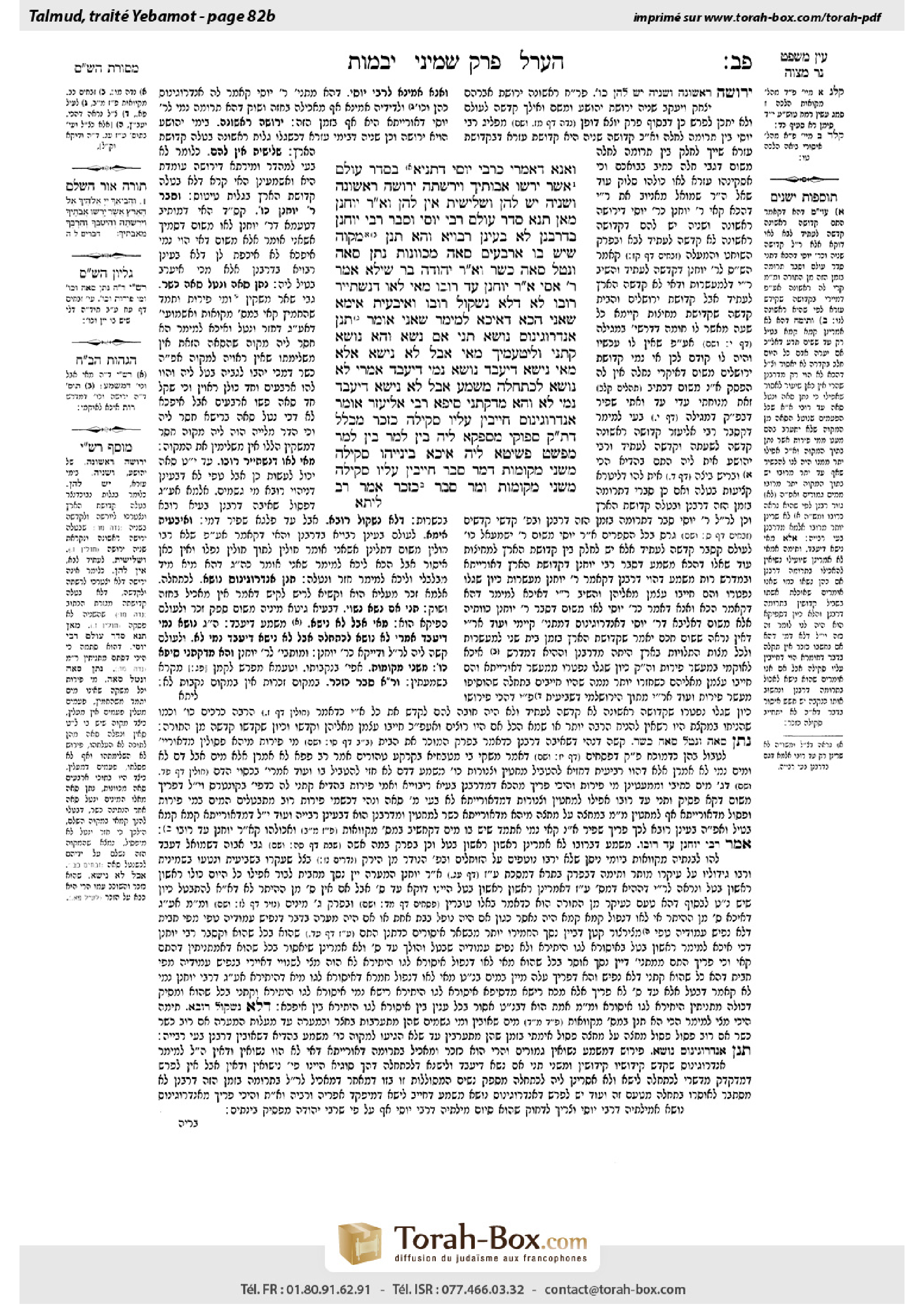
Yevamot 82b: Talmud study for Daf Yomi
Daf Yomi is the daily study of one Talmud folio. Explore 37 tractates with scans, Hebrew text, Sefaria English and AI-generated French translations where annotated.
Passage selection and English or AI-generated French translation are available where the scan has annotations. Daf Study is independent of Torah-Box and Sefaria.
Browse Yevamot · יבמות · All tractatesYevamot 82b text and translations
This page of Yevamot includes the Aramaic text, an English translation and an AI-generated French translation, alongside the scan above.
יבמות פ״ב ב · Aramaic and Hebrew text
וַאֲנָא דְּאָמְרִי כְּרַבִּי יוֹסֵי.
דְּתַנְיָא בְּסֵדֶר עוֹלָם: ״אֲשֶׁר יָרְשׁוּ אֲבוֹתֶיךָ וִירִשְׁתָּהּ״, יְרוּשָּׁה רִאשׁוֹנָה וּשְׁנִיָּה — יֵשׁ לָהֶן, וּשְׁלִישִׁית — אֵין לָהֶן.
וְאָמַר רַבִּי יוֹחָנָן: מַאן תְּנָא סֵדֶר עוֹלָם — רַבִּי יוֹסֵי.
וְסָבַר רַבִּי יוֹחָנָן בִּדְרַבָּנַן לָא בָּעֵינַן רִבּוּיָא? וְהָא תְּנַן: מִקְוֶה שֶׁיֵּשׁ בּוֹ אַרְבָּעִים סְאָה מְכֻוּוֹנוֹת, נָתַן סְאָה וְנָטַל סְאָה — כָּשֵׁר. וְאָמַר רַבִּי יְהוּדָה בַּר שֵׁילָא אָמַר רַבִּי אַסִּי אָמַר רַבִּי יוֹחָנָן: עַד רוּבּוֹ.
מַאי לָאו, דְּנִשְׁתַּיֵּיר רוּבּוֹ! לָא, דְּלָא נִשְׁקוֹל רוּבּוֹ.
וְאִיבָּעֵית אֵימָא: שָׁאנֵי הָכָא, דְּאִיכָּא לְמֵימַר ״שֶׁאֲנִי אוֹמֵר״.
תְּנַן: אַנְדְּרוֹגִינוֹס נוֹשֵׂא! תְּנִי ״אִם נָשָׂא״.
וְהָא ״נוֹשֵׂא״ קָתָנֵי! וְלִיטַעְמָיךְ: מַאי ״אֲבָל לֹא נִישָּׂא״? אֶלָּא מַאי ״נִישָּׂא״ — דִּיעֲבַד, ״נוֹשֵׂא״ נָמֵי — דִּיעֲבַד!
אָמְרִי, לָא: ״נוֹשֵׂא״ — לְכַתְּחִלָּה מַשְׁמַע, ״אֲבָל לֹא נִישָּׂא״ — דִּיעֲבַד נָמֵי לָא.
וְהָא מִדְּקָתָנֵי סֵיפָא, רַבִּי אֱלִיעֶזֶר אוֹמֵר: אַנְדְּרוֹגִינוֹס חַיָּיבִין עָלָיו סְקִילָה כַּזָּכָר, מִכְּלָל דְּתַנָּא קַמָּא סַפּוֹקֵי מְסַפְּקָא לֵיהּ!
בֵּין לְמָר בֵּין לְמָר מִפְשָׁט פְּשִׁיטָא לֵיהּ, אִיכָּא בֵּינַיְיהוּ סְקִילָה מִשְּׁנֵי מְקוֹמוֹת. דְּמָר סָבַר: חַיָּיבִין עָלָיו סְקִילָה מִשְּׁנֵי מְקוֹמוֹת, וּמָר סָבַר: כְּזָכָר.
אָמַר רַב:
Yevamot 82b · English translation
But I, Rabbi Yoḥanan, said what I said in accordance with the opinion of Rabbi Yosei that a priest who is a hermaphrodite enables his wife to eat teruma, and Rabbi Yosei himself maintains that even nowadays the halakha of teruma is in effect by Torah law. Accordingly, I argued that a hermaphrodite enables his wife to eat not only teruma, but even the breast and thigh of peace-offerings.
As it is taught in a baraita in the anthology called Seder Olam, with regard to a verse that speaks of the Jewish people’s return to Eretz Yisrael following their exile: “And the Lord your God will bring you into the land that your fathers inherited, and you shall inherit it” (Deuteronomy 30:5). These two expressions of inheritance teach that they had a first inheritance of Eretz Yisrael in the days of Joshua and a second inheritance at the time of the return from the Babylonian exile. That is to say, since the sanctity of the land had lapsed when the First Temple was destroyed and the Jewish people exiled to Babylonia, a second sanctification was necessary when they returned to their land. But they will not have a third inheritance. In other words, it will never be necessary to sanctify the land for a third time, as the second sanctification was permanent.
And Rabbi Yoḥanan said: Who is the tanna who taught Seder Olam? It is Rabbi Yosei. Since Rabbi Yosei maintains that the second sanctification of Eretz Yisrael never lapsed even after the destruction of the Second Temple, he also holds that teruma nowadays is in effect by Torah law.
The Gemara raises another objection to Rabbi Yoḥanan’s opinion: But does Rabbi Yoḥanan maintain that with regard to a mixture containing an item that is forbidden by rabbinic law, we do not require the permitted portion of the mixture to be greater in quantity so that it can nullify the prohibited part? Didn’t we learn otherwise in a mishna (Mikvaot 7:2): With regard to a ritual bath that contains exactly forty se’a of water, the minimal measure of a fit ritual bath, and one added to it a se’a of liquid other than water, and then removed from it a se’a of the mixture, the ritual bath remains fit, as the liquid that was added was nullified in the forty se’a of water, so that when one se’a of the mixture was removed there still remained the requisite forty se’a of fit water. And Rabbi Yehuda bar Sheila said that Rabbi Asi said that Rabbi Yoḥanan said that this halakha applies up to the greater part of the ritual bath.
The Gemara clarifies the opinion of Rabbi Yoḥanan: What, is it not that its greater part must remain, i.e., that most of the original forty se’a of water must remain in the ritual bath? In other words, up to nineteen se’a of other liquids may be added to the ritual bath, with an equal quantity of the mixture then removed from it, and these other liquids are nullified by the ritual bath water. But if twenty se’a are removed, so that fit water no longer constitutes the majority, the ritual bath is no longer fit for use. Since certain liquids are unfit for a ritual bath only by rabbinic law, this shows that even with respect to rabbinic prohibitions the permitted portion of a mixture must be greater in quantity, so that it can nullify the prohibited part. The Gemara refutes this proof: No, it means that its greater part must not be removed, but if the water and other liquids are present in equal proportion, the ritual bath remains fit.
And if you wish, say an alternative explanation of Rabbi Yoḥanan’s opinion: It is different here, with regard to the case of two baskets, one of which contains teruma, since it may be said: As I say that the teruma fell into the teruma and the non-sacred produce fell into the non-sacred produce, it is therefore assumed that that is what actually took place, and therefore the permitted portion need not be the greater part of the mixture.
§ We learned in the mishna: A hermaphrodite may marry a woman. This formulation indicates that he may do so ab initio, as he is considered a full-fledged male. Accordingly, a hermaphrodite who is a priest should enable his wife to eat the breast and thigh of peace-offerings, as is maintained by Rabbi Yoḥanan, and against the opinion of Reish Lakish. The Gemara rejects this argument and suggests that the text be emended: Teach in the mishna: If he married. That is to say, if he married a woman, the marriage is valid and a bill of divorce is required, as it is possible that he is a male. But even if he married, he does not enable his wife to eat teruma, as he may be a female.
The Gemara raises a difficulty: But doesn’t the mishna teach that he may marry a woman, which indicates that he may do so ab initio? The Gemara rejects this argument: And according to your reasoning, what is the meaning of the next clause: But he may not be married to a man? This teaching is certainly referring to a case after the fact, as, if he is a full-fledged male there would be no reason to say that he may not be married to a man ab initio. Rather, what is the meaning of: He may not be married to a man? It means that even after the fact the marriage is not valid. This being the case, when the mishna states that a hermaphrodite may marry a woman, it is also speaking after the fact.
It may be said in response: No; the words: May marry, indicate that a hermaphrodite may marry a woman ab initio, whereas the words: But he may not be married, mean that his marriage to a man is not valid even after the fact. Accordingly, the difficulty raised against Reish Lakish remains.
The Gemara challenges this understanding: But from the fact that the mishna teaches in the latter clause: Rabbi Eliezer says that if a man had intercourse with a hermaphrodite, he is liable to receive the punishment of stoning on his account as if he had relations with a male, this proves by inference that the first tanna is uncertain as to whether or not a hermaphrodite is considered a full-fledged male, and this presents a difficulty to Rabbi Yoḥanan’s opinion.
The Gemara answers: No, it is obvious both to this Master and to that Master that a hermaphrodite is deemed a full-fledged male. The practical difference between them relates to the question of whether one is liable to receive the punishment of stoning for intercourse with him at only one place or at two places. As one Sage, the first tanna, holds that one is liable to be punished with stoning on a hermaphrodite’s account for intercourse at two places, whether he penetrated him anally, in the manner of homosexual intercourse, or through his female organ. Since the hermaphrodite is deemed a male, one is liable to be punished with stoning for intercourse at either place. And one Sage, Rabbi Eliezer, holds that one is liable to be punished with stoning for relations with a hermaphrodite only if he penetrated him anally, as if he were a male.
Rav said:
Yevamot 82b · Traduction française (IA)
Mais moi, Rabbi Yoḥanan, j’ai dit ce que j’ai dit conformément à l’opinion de Rabbi Yosei, selon laquelle un prêtre androgyne permet à son épouse de consommer la terouma ; Rabbi Yosei lui-même soutient que, même de nos jours, la halakha relative à la terouma s’applique en vertu de la Torah. J’ai donc soutenu qu’un androgyne permet à son épouse de consommer non seulement la terouma, mais aussi la poitrine et la cuisse des sacrifices de paix.
Car il est enseigné dans une baraïta de l’ouvrage intitulé Seder Olam, à propos d’un verset qui parle du retour du peuple juif en Eretz Israël après son exil : « Le Seigneur, ton Dieu, te ramènera dans le pays dont tes pères ont pris possession, et tu en prendras possession » (Deutéronome 30, 5). Ces deux expressions de prise de possession enseignent qu’il y eut une première prise de possession d’Eretz Israël à l’époque de Josué, puis une seconde au retour de l’exil de Babylone. Autrement dit, puisque la sainteté du pays avait cessé lorsque le Premier Temple fut détruit et que le peuple juif fut exilé à Babylone, une seconde sanctification fut nécessaire à son retour dans son pays. Mais il n’y aura pas de troisième prise de possession. Autrement dit, il ne sera jamais nécessaire de sanctifier le pays une troisième fois, car la seconde sanctification fut permanente.
Et Rabbi Yoḥanan a dit : Quel est le tanna qui a enseigné le Seder Olam ? C’est Rabbi Yosei. Puisque Rabbi Yosei soutient que la seconde sanctification d’Eretz Israël n’a jamais cessé, même après la destruction du Second Temple, il considère également que, de nos jours, la terouma relève du droit de la Torah.
La Guemara soulève une autre objection contre l’opinion de Rabbi Yoḥanan : Rabbi Yoḥanan soutient-il vraiment que, lorsqu’un mélange contient un élément interdit par décret rabbinique, il n’est pas nécessaire que la partie permise soit en quantité supérieure pour annuler la partie interdite ? N’avons-nous pas appris le contraire dans une Michna (Mikvaot 7, 2) : si un mikvé contient exactement quarante séa d’eau, mesure minimale d’un mikvé valide, qu’on y ajoute un séa d’un liquide autre que de l’eau, puis qu’on retire un séa du mélange, le mikvé reste valide, car le liquide ajouté a été annulé dans les quarante séa d’eau ; ainsi, après le retrait d’un séa du mélange, il reste encore la quantité requise de quarante séa d’eau apte. Et Rabbi Yehouda bar Sheila a dit que Rabbi Asi a dit que Rabbi Yoḥanan a dit que cette halakha s’applique tant que la majeure partie du mikvé n’a pas été retirée.
La Guemara précise l’opinion de Rabbi Yoḥanan : N’est-ce pas que la majeure partie doit rester, c’est-à-dire que la majorité des quarante séa d’eau d’origine doit demeurer dans le mikvé ? Autrement dit, on peut ajouter au mikvé jusqu’à dix-neuf séa d’autres liquides, puis en retirer une quantité égale du mélange ; ces autres liquides sont alors annulés par l’eau du mikvé. Mais si l’on en retire vingt séa, de sorte que l’eau apte ne constitue plus la majorité, le mikvé n’est plus valide. Puisque certains liquides ne rendent un mikvé inapte qu’en vertu d’un décret rabbinique, cela montre que, même en matière d’interdits rabbiniques, la partie permise d’un mélange doit être en quantité supérieure pour annuler la partie interdite. La Guemara réfute cette preuve : Non, cela signifie qu’il ne faut pas retirer la majeure partie du mikvé ; mais si l’eau et les autres liquides sont en proportions égales, le mikvé reste valide.
Et si tu veux, donne une autre explication de l’opinion de Rabbi Yoḥanan : le cas des deux paniers, dont l’un contient de la terouma, est différent, car on peut dire : puisque je considère que la terouma est tombée dans la terouma et que les produits profanes sont tombés dans les produits profanes, on présume que c’est bien ce qui s’est passé ; il n’est donc pas nécessaire que la partie permise constitue la majeure partie du mélange.
§ Nous avons appris dans la Michna : « Un androgyne peut épouser une femme. » Cette formulation indique qu’il peut le faire a priori, puisqu’il est considéré comme un homme à part entière. Ainsi, un prêtre androgyne devrait permettre à son épouse de consommer la poitrine et la cuisse des sacrifices de paix, comme le soutient Rabbi Yoḥanan, contrairement à l’opinion de Reish Lakish. La Guemara rejette cet argument et propose de corriger le texte : « Enseigne dans la Michna : S’il a épousé. » Cela signifie que, s’il a épousé une femme, le mariage est valide et un acte de divorce est nécessaire, car il est possible qu’il soit un homme. Mais, même s’il a épousé une femme, il ne permet pas à son épouse de consommer la terouma, car il se peut qu’il soit une femme.
La Guemara soulève une difficulté : Mais la Michna n’enseigne-t-elle pas qu’il peut épouser une femme, ce qui indique qu’il peut le faire a priori ? La Guemara rejette cet argument : Et selon ton raisonnement, que signifie la proposition suivante : « Mais il ne peut pas être marié à un homme » ? Cet enseignement concerne certainement un cas a posteriori, car, s’il est un homme à part entière, il n’y aurait aucune raison de dire qu’il ne peut pas être marié à un homme a priori. Que signifie donc : « Il ne peut pas être marié à un homme » ? Cela signifie que, même a posteriori, le mariage n’est pas valide. Dans ce cas, lorsque la Michna dit qu’un androgyne peut épouser une femme, elle parle elle aussi d’un cas a posteriori.
On peut répondre : Non ; les mots « peut épouser » indiquent qu’un androgyne peut épouser une femme a priori, tandis que les mots « mais il ne peut pas être marié » signifient que son mariage avec un homme n’est pas valide, même a posteriori. La difficulté soulevée contre Reish Lakish demeure donc.
La Guemara met cette interprétation à l’épreuve : Mais du fait que la Michna enseigne, dans sa dernière proposition, que Rabbi Eliezer dit que si un homme a des rapports sexuels avec un androgyne, il est passible de la peine de lapidation à cause de lui, comme s’il avait eu des rapports avec un homme, on déduit que le premier tanna doute qu’un androgyne soit ou non considéré comme un homme à part entière ; cela pose une difficulté à l’opinion de Rabbi Yoḥanan.
La Guemara répond : Non, pour l’un comme pour l’autre Maître, il est évident qu’un androgyne est considéré comme un homme à part entière. La différence pratique entre eux porte sur la question de savoir si l’on est passible de la peine de lapidation pour avoir eu des rapports avec lui en un seul endroit ou en deux endroits. En effet, un Sage, le premier tanna, estime qu’on est passible de la lapidation pour des rapports avec un androgyne en deux endroits : qu’on le pénètre par l’anus, selon la manière des rapports homosexuels, ou par son organe féminin. Puisque l’androgyne est considéré comme un homme, on est passible de la lapidation pour des rapports à l’un ou l’autre endroit. Un autre Sage, Rabbi Eliezer, estime qu’on n’est passible de la lapidation pour des rapports avec un androgyne que si on le pénètre par l’anus, comme s’il s’agissait d’un homme.
Rav a dit :
Traduction française générée par IA à partir de l’édition anglaise de Sefaria. Vérifie toujours un passage avec le texte source.
Text from Sefaria: William Davidson Edition - Vocalized Aramaic (CC BY NC); William Davidson Edition - English (CC BY NC).