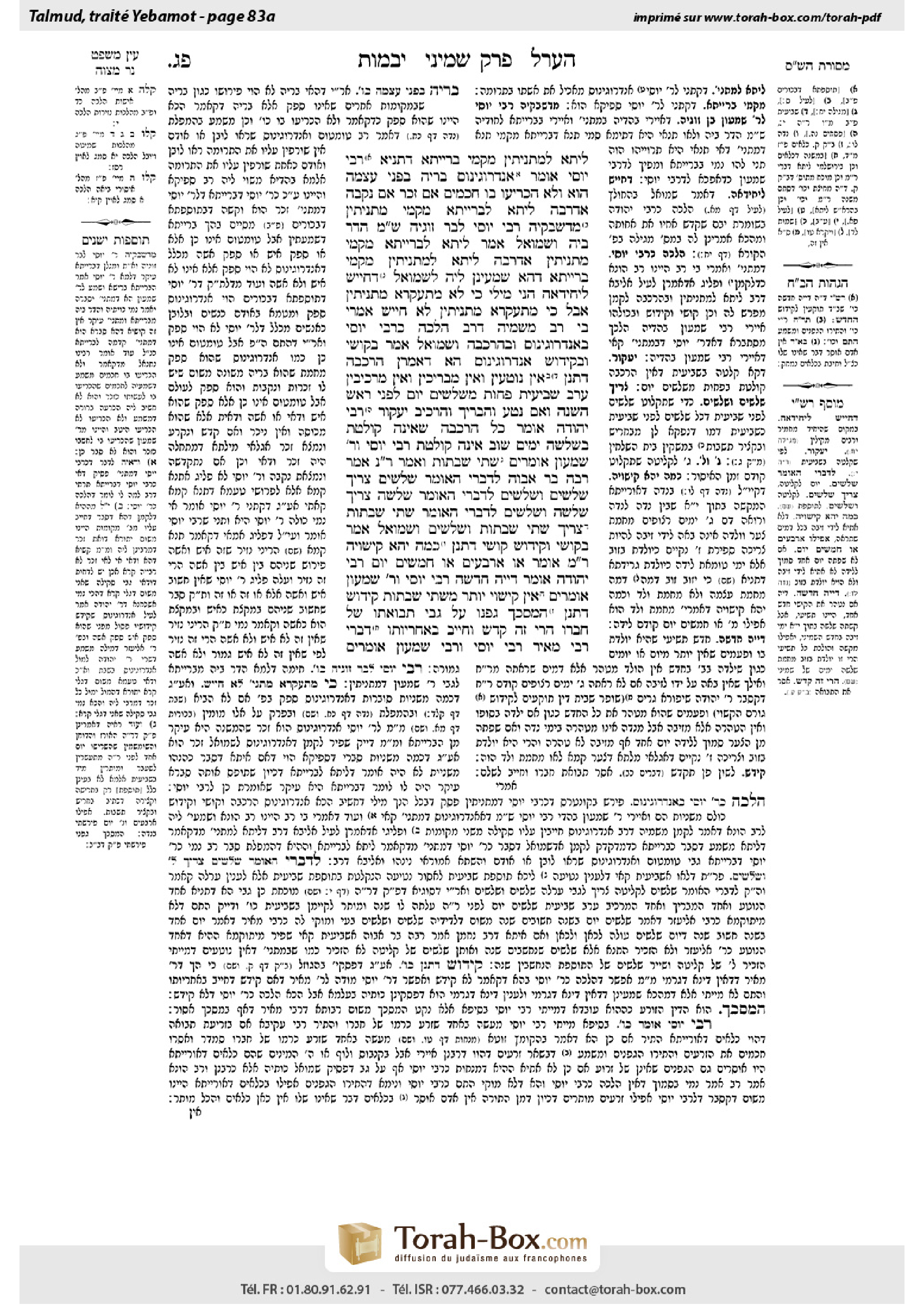
Yevamot 83a: Talmud study for Daf Yomi
Daf Yomi is the daily study of one Talmud folio. Explore 37 tractates with scans, Hebrew text, Sefaria English and AI-generated French translations where annotated.
Passage selection and English or AI-generated French translation are available where the scan has annotations. Daf Study is independent of Torah-Box and Sefaria.
Browse Yevamot · יבמות · All tractatesYevamot 83a text and translations
This page of Yevamot includes the Aramaic text, an English translation and an AI-generated French translation, alongside the scan above.
יבמות פ״ג א · Aramaic and Hebrew text
לֵיתַהּ לְמַתְנִיתִין מִקַּמֵּי בָּרַיְיתָא, דְּתַנְיָא: רַבִּי יוֹסֵי אוֹמֵר: אַנְדְּרוֹגִינוֹס — בְּרִיָּה בִּפְנֵי עַצְמָהּ הוּא, וְלֹא הִכְרִיעוּ בּוֹ חֲכָמִים אִם זָכָר אִם נְקֵבָה.
אַדְּרַבָּה לֵיתַהּ לְבָרַיְיתָא מִקַּמֵּי מַתְנִיתִין! מִדְּשַׁבְקֵיהּ רַבִּי יוֹסֵי לְבַר זוּגֵיהּ — שְׁמַע מִינַּהּ הֲדַר בֵּיהּ.
וּשְׁמוּאֵל אָמַר: לֵיתַהּ לְבָרַיְיתָא מִקַּמֵּי מַתְנִיתִין. אַדְּרַבָּה, לֵיתָא לְמַתְנִיתִין מִקַּמֵּי בָּרַיְיתָא, דְּהָא שָׁמְעִינַן לֵיהּ לִשְׁמוּאֵל דְּחָיֵישׁ לִיחִידָאָה! הָנֵי מִילֵּי, כִּי לָא מִתְעַקְרָא מַתְנִיתִין, אֲבָל כִּי מִתְעַקְרָא מַתְנִיתִין — לָא חָיֵישׁ.
אָמְרִי בֵּי רַב מִשְּׁמֵיהּ דְּרַב: הֲלָכָה כְּרַבִּי יוֹסֵי בְּאַנְדְּרוֹגִינוֹס וּבְהַרְכָּבָה, וּשְׁמוּאֵל אָמַר: בְּקוֹשִׁי וּבְקִידּוּשׁ.
אַנְדְּרוֹגִינוֹס — הָא דַּאֲמַרַן. הַרְכָּבָה — דִּתְנַן: אֵין נוֹטְעִין וְאֵין מַבְרִיכִין וְאֵין מַרְכִּיבִין עֶרֶב שְׁבִיעִית פָּחוֹת מִשְּׁלֹשִׁים יוֹם לִפְנֵי רֹאשׁ הַשָּׁנָה. וְאִם נָטַע וְהִבְרִיךְ וְהִרְכִּיב — יַעֲקוֹר. רַבִּי יְהוּדָה אוֹמֵר: כׇּל הַרְכָּבָה שֶׁאֵינָהּ קוֹלֶטֶת בִּשְׁלֹשָׁה יָמִים — שׁוּב אֵינָהּ קוֹלֶטֶת. רַבִּי יוֹסֵי וְרַבִּי שִׁמְעוֹן אוֹמְרִים: שְׁתֵּי שַׁבָּתוֹת.
וְאָמַר רַב נַחְמָן אָמַר רַבָּה בַּר אֲבוּהּ: לְדִבְרֵי הָאוֹמֵר שְׁלֹשִׁים — צָרִיךְ שְׁלֹשִׁים ושְׁלֹשִׁים. לְדִבְרֵי הָאוֹמֵר שְׁלֹשָׁה — צָרִיךְ שְׁלֹשָׁה ושְׁלֹשִׁים. לְדִבְרֵי הָאוֹמֵר שְׁתֵּי שַׁבָּתוֹת — צָרִיךְ שְׁתֵּי שַׁבָּתוֹת וּשְׁלֹשִׁים.
וּשְׁמוּאֵל אָמַר: בְּקוֹשִׁי וְקִידּוּשׁ. קוֹשִׁי — דִּתְנַן:
כַּמָּה יְהֵא קִישּׁוּיָהּ — רַבִּי מֵאִיר אוֹמֵר: אוֹ אַרְבָּעִים אוֹ חֲמִשִּׁים יוֹם. רַבִּי יְהוּדָה אוֹמֵר: דַּיָּיהּ חׇדְשָׁהּ. רַבִּי יוֹסֵי וְרַבִּי שִׁמְעוֹן אוֹמְרִים: אֵין קִישּׁוּי יוֹתֵר מִשְּׁתֵּי שַׁבָּתוֹת.
קִידּוּשׁ — דִּתְנַן: הַמְסַכֵּךְ גַּפְנוֹ עַל גַּבֵּי תְּבוּאָתוֹ שֶׁל חֲבֵרוֹ — הֲרֵי זֶה קִדֵּשׁ, וְחַיָּיב בְּאַחְרָיוּתוֹ, דִּבְרֵי רַבִּי מֵאִיר. רַבִּי יוֹסֵי וְרַבִּי שִׁמְעוֹן אוֹמְרִים:
Yevamot 83a · English translation
The mishna here, which states that according to Rabbi Yosei a priest who is a hermaphrodite enables his wife to eat teruma, is not to be relied upon in the presence of a baraita that teaches otherwise. As it is taught in a baraita that Rabbi Yosei says: A hermaphrodite is a creature unto himself, and the Sages did not determine whether he is a male or a female. He is consequently prohibited from marrying a woman, and if he does so he does not enable her to eat teruma.
The Gemara asks: On the contrary, say that the baraita is not to be relied upon in the presence of the mishna here, as baraitot are generally considered less authoritative than mishnayot. The Gemara answers: From the fact that Rabbi Yosei left his colleague, Rabbi Shimon, as the mishna’s ruling is attributed to both Rabbi Yosei and Rabbi Shimon whereas the teaching of the baraita is reported only in the name of Rabbi Yosei, learn from this that Rabbi Yosei retracted his original opinion that he had maintained together with Rabbi Shimon and reached a different conclusion.
And Shmuel said the reverse: The baraita is not to be relied upon in the presence of the mishna here. The Gemara asks: On the contrary, say that the mishna here is not to be relied upon in the presence of the baraita, as we have heard that Shmuel takes into consideration even an individual dissenting opinion appearing in a baraita. The Gemara answers: This applies only when the mishna itself is not thereby uprooted, as the baraita merely adds to it. But when the mishna is uprooted by a contrary statement taught in a baraita, he does not take it into consideration.
The Sages of the school of Rav said in the name of Rav that the halakha is in accordance with the opinion of Rabbi Yosei, both with regard to the halakha of a hermaphrodite and with regard to the halakha of grafting. And Shmuel says: The halakha is in accordance with his opinion with regard to the laws of protracted labor and forfeiture.
The Gemara clarifies: The halakha of a hermaphrodite is that which we just said, that he is considered a creature unto himself (Rabbeinu Ḥananel). The halakha of grafting is as we learned in a mishna (Shevi’it 2:6): One may not plant, or sink the shoot of a vine into the ground, or graft a shoot onto a tree on the eve of the Sabbatical Year less than thirty days before Rosh HaShana, lest it take root in the seventh year. And if he planted or sank or grafted, he must uproot it. Rabbi Yehuda says: Any graft that does not take root in three days will never take root, and therefore it is prohibited to plant only for three days before the start of the Sabbatical Year. Rabbi Yosei and Rabbi Shimon say that it takes two weeks for a plant to take root.
And Rav Naḥman said that Rabba bar Avuh said: According to the first tanna, who says thirty days, he means that thirty days are required for the tree to take root and another thirty days are required for the addition to the Sabbatical Year, as the prohibitions of the Sabbatical Year apply already during the last thirty days of the sixth year. It is consequently prohibited to plant sixty days before Rosh HaShana. And similarly, according to Rabbi Yehuda, who says three days, he means that three days are required for the tree to take root and another thirty days are required for the addition to the Sabbatical Year. And so too, according to Rabbi Yosei and Rabbi Shimon, who say two weeks, they mean that two weeks are required for the tree to take root and another thirty days are required for the addition to the Sabbatical Year. Rav rules on this matter in accordance with the opinion of Rabbi Yosei.
And Shmuel said that the halakha is ruled in accordance with the opinion of Rabbi Yosei with regard to protracted labor and proscription as well. The Gemara explains: What is the case of protracted labor? As we learned in a mishna (Nidda 36b): Ordinarily a woman who experiences a flow of blood on three consecutive days during a time of the month when she does not expect to experience menstrual bleeding is rendered ritually impure as a zava. However, if she experiences such bleeding while she is in protracted labor, the bleeding is attributed to her labor, and she is governed by the halakhot of a woman after childbirth.
The tanna’im disagree about the question: How long is a woman’s period of protracted labor? For what period of time prior to her giving birth is the bleeding attributed to her labor? Rabbi Meir says: It is up to forty or fifty days before she delivers. Rabbi Yehuda says: Her month suffices for her, i.e., it is from the beginning of the month in which she gives birth. Rabbi Yosei and Rabbi Shimon say: Protracted labor does not last for more than two weeks. Shmuel rules in accordance with Rabbi Yosei in this case.
What is this halakha of proscription? As we learned in a mishna (Kilayim 7:4): If one causes his grapevine to overshadow the grain of another, he has proscribed it, rendering it forbidden as a food crop in a vineyard, and he bears financial responsibility for it, i.e., he must compensate the other individual for the loss of the produce that has been rendered forbidden. This is the statement of Rabbi Meir. Rabbi Yosei and Rabbi Shimon say:
Yevamot 83a · Traduction française (IA)
La Michna ici, qui affirme que, selon Rabbi Yosei, un prêtre androgyne permet à son épouse de consommer de la terouma, ne saurait prévaloir face à une baraïta qui enseigne le contraire. En effet, une baraïta enseigne que Rabbi Yosei dit : « Un androgyne est un être à part, et les Sages n’ont pas déterminé s’il est mâle ou femelle. Il lui est donc interdit d’épouser une femme et, s’il le fait, il ne lui permet pas de consommer de la terouma. »
La Guemara demande : Au contraire, disons que la baraïta ne saurait prévaloir face à la Michna ici, puisque les baraïtot sont généralement considérées comme moins autoritaires que les Michnayot. La Guemara répond : Du fait que Rabbi Yosei s’est séparé de son collègue Rabbi Shimon — puisque la décision de la Michna est attribuée à Rabbi Yosei et à Rabbi Shimon, tandis que l’enseignement de la baraïta est rapporté au seul nom de Rabbi Yosei —, déduis que Rabbi Yosei est revenu sur l’opinion qu’il soutenait initialement avec Rabbi Shimon et qu’il est parvenu à une conclusion différente.
Et Shmuel a dit le contraire : la baraïta ne saurait prévaloir face à la Michna ici. La Guemara demande : Au contraire, disons que la Michna ici ne saurait prévaloir face à la baraïta, puisque nous savons que Shmuel tient compte même d’une opinion dissidente individuelle exprimée dans une baraïta. La Guemara répond : Cela ne s’applique que lorsque la Michna elle-même n’est pas ainsi déracinée, car la baraïta ne fait que la compléter. Mais lorsque la Michna est déracinée par une déclaration contraire enseignée dans une baraïta, Shmuel n’en tient pas compte.
Les Sages de l’école de Rav ont dit au nom de Rav que la halakha suit l’opinion de Rabbi Yosei, tant pour ce qui concerne l’androgyne que pour la greffe. Et Shmuel dit que la halakha suit son opinion en ce qui concerne le travail prolongé et l’interdiction.
La Guemara précise : La halakha relative à l’androgyne est celle que nous venons d’énoncer : il est considéré comme un être à part (Rabbeinu Ḥananel). La halakha relative à la greffe est celle que nous avons apprise dans une Michna (Shevi’it 2:6) : On ne peut ni planter, ni enfoncer dans le sol un sarment de vigne, ni greffer un sarment sur un arbre, à la veille de l’année sabbatique, moins de trente jours avant Roch Hachana, de peur qu’il ne prenne racine pendant la septième année. Si quelqu’un a planté, enfoncé ou greffé, il doit l’arracher. Rabbi Yehuda dit : Toute greffe qui ne prend pas racine en trois jours ne prendra jamais racine ; il est donc interdit de planter seulement durant les trois jours précédant le début de l’année sabbatique. Rabbi Yosei et Rabbi Shimon disent qu’il faut deux semaines à une plante pour prendre racine.
Et Rav Naḥman a dit au nom de Rabba bar Avuh : Selon le premier tanna, qui parle de trente jours, il faut comprendre que trente jours sont nécessaires pour que l’arbre prenne racine, et que trente jours supplémentaires sont requis au titre de l’ajout à l’année sabbatique, car les interdictions de l’année sabbatique s’appliquent déjà pendant les trente derniers jours de la sixième année. Il est donc interdit de planter soixante jours avant Roch Hachana. De même, selon Rabbi Yehuda, qui parle de trois jours, il faut comprendre que trois jours sont nécessaires pour que l’arbre prenne racine, et que trente jours supplémentaires sont requis au titre de l’ajout à l’année sabbatique. De même, selon Rabbi Yosei et Rabbi Shimon, qui parlent de deux semaines, il faut comprendre que deux semaines sont nécessaires pour que l’arbre prenne racine, et que trente jours supplémentaires sont requis au titre de l’ajout à l’année sabbatique. Rav statue sur cette question conformément à l’opinion de Rabbi Yosei.
Et Shmuel a dit que la halakha suit également l’opinion de Rabbi Yosei concernant le travail prolongé et l’interdiction. La Guemara explique : En quoi consiste le cas du travail prolongé ? Comme nous l’avons appris dans une Michna (Nidda 36b) : En temps ordinaire, une femme qui connaît un écoulement de sang pendant trois jours consécutifs à un moment du mois où elle ne s’attend pas à avoir ses règles devient rituellement impure en tant que zava. Cependant, si elle connaît un tel écoulement alors qu’elle est en travail prolongé, le saignement est attribué au travail, et elle relève des halakhot applicables à une femme après l’accouchement.
Les tannaïm sont en désaccord sur la question suivante : combien de temps dure la période de travail prolongé d’une femme ? Pendant quelle période précédant l’accouchement le saignement est-il attribué au travail ? Rabbi Meir dit : jusqu’à quarante ou cinquante jours avant l’accouchement. Rabbi Yehuda dit : son mois suffit, c’est-à-dire que cela commence au début du mois où elle accouche. Rabbi Yosei et Rabbi Shimon disent : le travail prolongé ne dure pas plus de deux semaines. Shmuel statue conformément à l’opinion de Rabbi Yosei dans ce cas.
En quoi consiste cette halakha d’interdiction ? Comme nous l’avons appris dans une Michna (Kilayim 7:4) : Si quelqu’un fait ombrager sa vigne sur le grain d’autrui, il le rend interdit, le rendant impropre à la consommation en tant que produit d’un vignoble, et il en est financièrement responsable, c’est-à-dire qu’il doit indemniser l’autre personne pour la perte de la récolte rendue interdite. Telle est la déclaration de Rabbi Meir. Rabbi Yosei et Rabbi Shimon disent :
Traduction française générée par IA à partir de l’édition anglaise de Sefaria. Vérifie toujours un passage avec le texte source.
Text from Sefaria: William Davidson Edition - Vocalized Aramaic (CC BY NC); William Davidson Edition - English (CC BY NC).