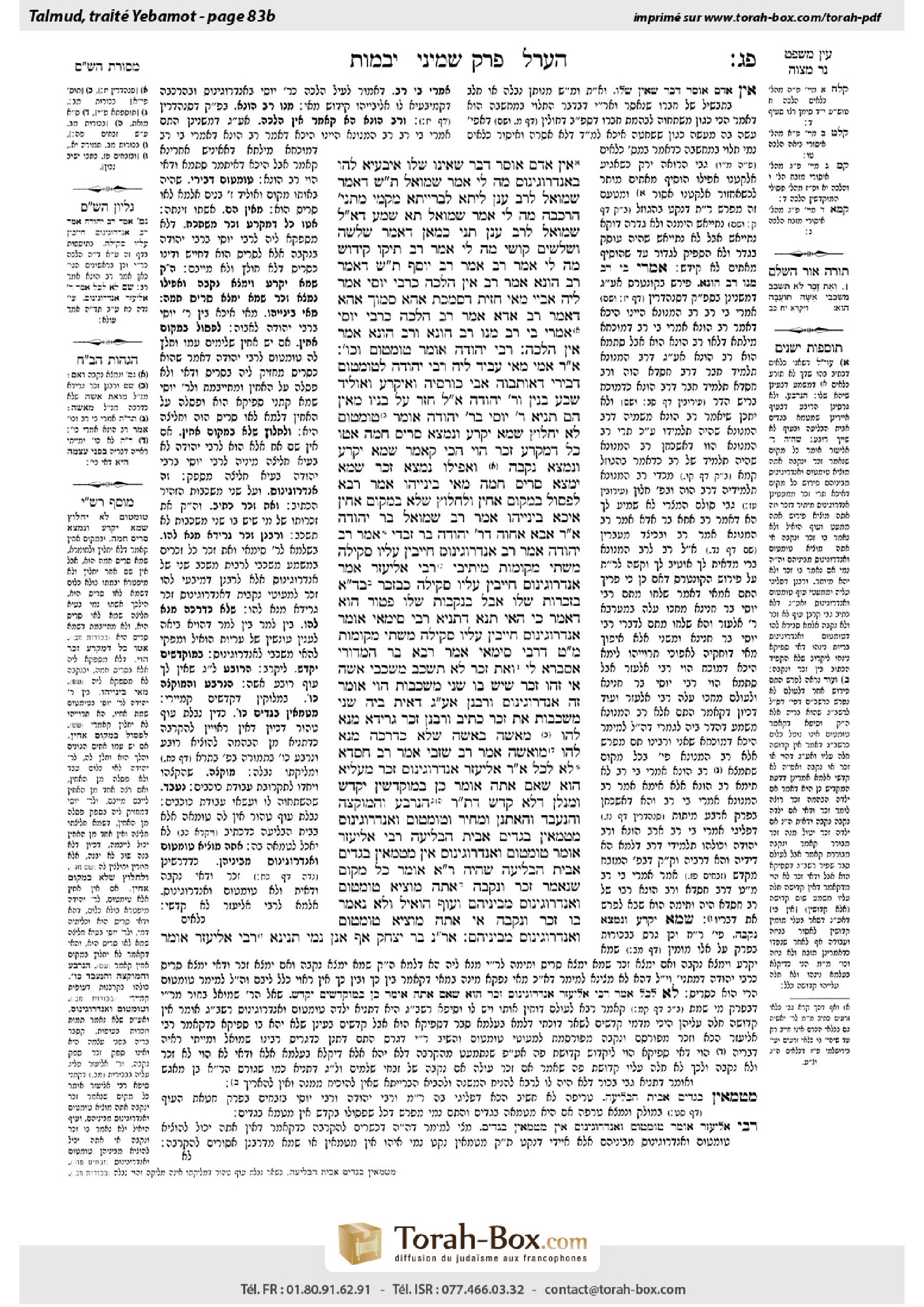
Yevamot 83b: Talmud study for Daf Yomi
Daf Yomi is the daily study of one Talmud folio. Explore 37 tractates with scans, Hebrew text, Sefaria English and AI-generated French translations where annotated.
Passage selection and English or AI-generated French translation are available where the scan has annotations. Daf Study is independent of Torah-Box and Sefaria.
Browse Yevamot · יבמות · All tractatesYevamot 83b text and translations
This page of Yevamot includes the Aramaic text, an English translation and an AI-generated French translation, alongside the scan above.
יבמות פ״ג ב · Aramaic and Hebrew text
אֵין אָדָם אוֹסֵר דָּבָר שֶׁאֵינוֹ שֶׁלּוֹ.
אִיבַּעְיָא לְהוּ: בְּאַנְדְּרוֹגִינוֹס מָה לִי אָמַר שְׁמוּאֵל? תָּא שְׁמַע, דְּאָמַר שְׁמוּאֵל לְרַב עָנָן: לֵיתַהּ לְבָרַיְיתָא מִקַּמֵּי מַתְנִיתִין.
הַרְכָּבָה מָה לִי אָמַר שְׁמוּאֵל? תָּא שְׁמַע, דַּאֲמַר לֵיהּ שְׁמוּאֵל לְרַב עָנָן: תְּנִי כְּמַאן דְּאָמַר שְׁלֹשָׁה וּשְׁלֹשִׁים.
קוֹשִׁי מָה לִי אָמַר רַב? תֵּיקוּ.
קִידּוּשׁ מָה לִי אָמַר רַב? אָמַר רַב יוֹסֵף: תָּא שְׁמַע, דְּאָמַר רַב הוּנָא אָמַר רַב: אֵין הֲלָכָה כְּרַבִּי יוֹסֵי. אֲמַר לֵיהּ אַבָּיֵי: מַאי חָזֵית דְּסָמְכַתְּ אַהָא? סְמוֹךְ אַהָא! דְּאָמַר רַב אַדָּא אָמַר רַב: הֲלָכָה כְּרַבִּי יוֹסֵי. ״אָמְרִי בֵּי רַב״ — מַנּוּ? רַב הוּנָא, וְרַב הוּנָא אָמַר: אֵין הֲלָכָה.
רַבִּי יְהוּדָה אוֹמֵר: טוּמְטוּם וְכוּ׳. אָמַר רַבִּי אַמֵּי: מַאי עָבֵיד לֵיהּ רַבִּי יְהוּדָה לְטוּמְטוּם דְּבֵירֵי, דְּאוֹתְבוּהּ אַבֵּי כּוּרְסְיָה וְאִיקְּרַע, וְאוֹלֵיד שְׁבַע בְּנִין! וְרַבִּי יְהוּדָה אָמַר לָךְ: חַזֵּר עַל בָּנָיו מֵאַיִן הֵם.
תַּנְיָא, רַבִּי יוֹסֵי בְּרַבִּי יְהוּדָה אוֹמֵר: טוּמְטוּם לֹא יַחְלוֹץ, שֶׁמָּא יִקָּרַע וְנִמְצָא סְרִיס חַמָּה. אַטּוּ כֹּל דְּמִקְּרַע זָכָר הָוֵי? הָכִי קָאָמַר: שֶׁמָּא יִקָּרַע וְנִמְצָא נְקֵבָה, וַאֲפִילּוּ נִמְצָא זָכָר — שֶׁמָּא יִמָּצֵא סָרִיס חַמָּה.
מַאי בֵּינַיְיהוּ? אָמַר רָבָא: לִפְסוֹל בִּמְקוֹם אַחִין וְלַחְלוֹץ שֶׁלֹּא בִּמְקוֹם אַחִין אִיכָּא בֵּינַיְיהוּ.
אָמַר רַב שְׁמוּאֵל בַּר יְהוּדָה אָמַר רַבִּי אַבָּא אֲחוּהּ דְּרַבִּי יְהוּדָה בַּר זַבְדִּי אָמַר רַב יְהוּדָה אָמַר רַב: אַנְדְּרוֹגִינוֹס חַיָּיבִין עָלָיו סְקִילָה, מִשְּׁתֵּי מְקוֹמוֹת. מֵיתִיבִי, רַבִּי אֱלִיעֶזֶר אָמַר: אַנְדְּרוֹגִינוֹס חַיָּיבִין עָלָיו סְקִילָה כַּזָּכָר. בַּמֶּה דְּבָרִים אֲמוּרִים — בְּזַכְרוּת שֶׁלּוֹ, אֲבָל בְּנַקְבוּת שֶׁלּוֹ — פָּטוּר!
הוּא דְּאָמַר כִּי הַאי תַּנָּא, דְּתַנְיָא, רַבִּי סִימַאי אוֹמֵר: אַנְדְּרוֹגִינוֹס חַיָּיבִין עָלָיו סְקִילָה מִשְּׁתֵּי מְקוֹמוֹת. מַאי טַעְמָא דְּרַבִּי סִימַאי? אָמַר רָבָא: בַּר הַמְדּוּרֵי אַסְבְּרַהּ לִי: ״וְאֶת זָכָר לֹא תִשְׁכַּב מִשְׁכְּבֵי אִשָּׁה״, אֵי זֶהוּ זָכָר שֶׁיֵּשׁ בּוֹ שְׁנֵי מִשְׁכָּבוֹת — הֱוֵי אוֹמֵר זֶה אַנְדְּרוֹגִינוֹס.
וְרַבָּנַן, אַף עַל גַּב דְּאִית בֵּיהּ שְׁנֵי מִשְׁכָּבוֹת — ״אֶת זָכָר״ כְּתִיב.
וְרַבָּנַן, זָכָר גְּרֵידָא מְנָא לְהוּ? מֵ״אִשָּׁה״. בְּאִשָּׁה שֶׁלֹּא כְּדַרְכָּהּ מְנָא לְהוּ? מִ״וְּאִשָּׁה״.
אָמַר רַב שֵׁזְבִי אָמַר רַב חִסְדָּא: לֹא לַכֹּל אָמַר רַבִּי אֱלִיעֶזֶר אַנְדְּרוֹגִינוֹס זָכָר מְעַלְּיָא הוּא, שֶׁאִם אַתָּה אוֹמֵר כֵּן, בְּמוּקְדָּשִׁין — יִקְדַּשׁ.
וּמְנָלַן דְּלָא קָדֵשׁ — דְּתָנוּ רַבָּנַן: הַנִּרְבָּע וְהַמּוּקְצֶה וְהַנֶּעֱבָד וְהָאֶתְנַן וּמְחִיר וְטוּמְטוּם וְאַנְדְּרוֹגִינוֹס — מְטַמְּאִין בְּגָדִים אַבֵּית הַבְּלִיעָה.
רַבִּי אֱלִיעֶזֶר אוֹמֵר: טוּמְטוּם וְאַנְדְּרוֹגִינוֹס אֵין מְטַמְּאִין בְּגָדִים אַבֵּית הַבְּלִיעָה. שֶׁהָיָה רַבִּי אֱלִיעֶזֶר אוֹמֵר: כׇּל מָקוֹם שֶׁנֶּאֱמַר זָכָר וּנְקֵבָה — אַתָּה מוֹצִיא טוּמְטוּם וְאַנְדְּרוֹגִינוֹס מִבֵּינֵיהֶם. וְעוֹף, הוֹאִיל וְלֹא נֶאֱמַר בּוֹ זָכָר וּנְקֵבָה — אִי אַתָּה מוֹצִיא טוּמְטוּם וְאַנְדְּרוֹגִינוֹס מִבֵּינֵיהֶם.
אָמַר רַב נַחְמָן בַּר יִצְחָק: אַף אֲנַן נָמֵי תְּנֵינָא, רַבִּי אֱלִיעֶזֶר אוֹמֵר:
Yevamot 83b · English translation
A person cannot render forbidden an item that is not his. Since the grain does not belong to him, he cannot render it forbidden. According to Shmuel, the halakha is in accordance with Rabbi Yosei in this case as well.
A dilemma was raised before the Sages: As for a hermaphrodite, what did Shmuel say? It was stated in the name of Rav that the halakha is ruled in accordance with the opinion of Rabbi Yosei with regard to a hermaphrodite, but no ruling was attributed to Shmuel concerning this case. The Gemara suggests: Come and hear, as Shmuel said to Rav Anan: The baraita is not to be relied upon in the presence of the mishna. This indicates that Shmuel rejects Rabbi Yosei’s opinion as stated in the baraita that a hermaphrodite is considered a creature unto himself.
The Gemara asks further: Concerning grafting, what did Shmuel say? The Gemara suggests: Come and hear, as Shmuel said to Rav Anan that he should teach in accordance with the opinion of the one who said that it is prohibited to plant for thirty-three days before Rosh HaShana of the Sabbatical Year. Evidently, he ruled on this matter in accordance with the opinion of Rabbi Yehuda, and not that of Rabbi Yosei.
The Gemara continues to ask along these lines: With regard to the case of protracted labor, what did Rav say? Does he accept Rabbi Yosei’s opinion, as does Shmuel? No resolution was found for this question, and the Gemara concludes that this dilemma shall stand unresolved.
The Gemara further inquires: With regard to proscription, what did Rav say? Rav Yosef said: Come and hear, as Rav Huna said that Rav said that the halakha is not in accordance with the opinion of Rabbi Yosei. Abaye said to him: What did you see that led you to rely on that source? Rely on this source; as Rav Adda said that Rav said that the halakha is in fact in accordance with the opinion of Rabbi Yosei. There is, then, a tradition that Rav accepted Rabbi Yosei’s view. The Gemara responds: When it is stated that the Sages of the school of Rav said a teaching, to whom is it referring? The reference is to Rav Huna. And it was Rav Huna who said that the halakha is not in accordance with the opinion of Rabbi Yosei. It may be presumed, then, that Rav Adda’s version of Rav’s ruling is in error, as preference is given to the report of Rav’s preeminent disciple, Rav Huna.
§ It is taught in the mishna that Rabbi Yehuda says: If a tumtum, whose external sexual organs are indeterminate, was torn open so that his genitals were exposed, and he was found to be a male, he must not perform ḥalitza because he is treated like a eunuch. Rabbi Ami said: What would Rabbi Yehuda do with the tumtum living in the town of Biri, who was placed in a seat for an operation, and the tissue covering his genitals was torn open and he later fathered seven children? Evidently, a tumtum who was torn open is not necessarily sexually impotent. The Gemara answers that Rabbi Yehuda could have said to you: Go and inquire about his children and find out from where they came. He did not believe that they were fathered by this man but rather by someone else.
It is taught in a baraita: Rabbi Yosei, son of Rabbi Yehuda, says: A tumtum must not perform ḥalitza, as perhaps he will be torn open and found to be a eunuch by natural causes. The Gemara asks: Why did he formulate his teaching in this manner? Is that to say that every tumtum who is torn open is a male? It is certainly possible for a tumtum to be found to be a female. The Gemara explains: This is what he said: A tumtum must not perform ḥalitza, as perhaps he will be torn open and found to be a female, who certainly cannot perform ḥalitza, and even if he is found to be a male, perhaps he will be found to be a eunuch by natural causes.
The Gemara asks: What is the practical halakhic difference between the opinions of Rabbi Yehuda and Rabbi Yosei? Rava said: There is a practical difference between them as to whether the ḥalitza performed by a tumtum disqualifies the brothers in a case where there are other brothers in addition to the tumtum. According to Rabbi Yehuda, a tumtum is regarded as definitely sexually impotent, and therefore his ḥalitza is of no consequence. Therefore, if the tumtum went ahead and performed ḥalitza, he has not disqualified the other brothers from performing levirate marriage. According to Rabbi Yosei, however, he is only doubtfully sexually impotent, and therefore he has disqualified the other brothers from performing levirate marriage. And there is also a difference between them as to whether the tumtum must perform ḥalitza where there are no other brothers besides him. According to Rabbi Yehuda he need not do so, whereas according to Rabbi Yosei he must perform ḥalitza owing to his uncertain status.
§ Rav Shmuel bar Yehuda said that Rabbi Abba, brother of Rabbi Yehuda bar Zavdi, said that Rav Yehuda said that Rav said: With regard to a hermaphrodite, one is liable to receive the punishment of stoning on his account for intercourse at two places, whether one penetrated him anally, in the manner of homosexual intercourse, or through his female organ. The Gemara raises an objection against this from the following teaching. Rabbi Eliezer said: If one had intercourse with a hermaphrodite, he is liable to be punished with stoning on his account as if he had relations with a male. In what case is this statement said? It is if he had relations with him through his male organ, i.e., in the manner of homosexual intercourse, but if he engaged in intercourse with him through his female organ, he is exempt.
The Gemara answers that Rav stated his opinion in accordance with the opinion of this tanna, as it is taught in the following baraita: Rabbi Simai says: With regard to a hermaphrodite, one is liable to be punished with stoning on his account for intercourse at two places. The Gemara asks: What is the reasoning of Rabbi Simai? Rava said: The Sage bar Hamedurei explained the matter to me, based on an allusion to this halakha found in the Bible. The verse states: “And you shall not lie with a male as with a woman [mishkevei isha]” (Leviticus 18:22). The phrase mishkevei isha, referring to lying with a woman, appears in the plural. Now, what male has two manners of lying? You must say that this is referring to a hermaphrodite, and the plural form mishkevei, meaning: Lyings, indicates that there is liability for both manners of intercourse with him.
The Gemara asks: And how do the Rabbis who disagree with Rabbi Simai counter this argument? The Gemara explains: Although he has two manners of lying, it is nevertheless written: “With a male,” indicating that one is liable to be stoned on a hermaphrodite’s account only if he had relations with him in the manner of a male.
The Gemara asks: And the Rabbis, who explain this entire verse as referring to a hermaphrodite, from where do they derive that a man is prohibited from engaging in relations with an ordinary male? The Gemara answers: They derive it from the words “a woman.” The Gemara asks further: And from where do the Rabbis derive that one is liable to be punished for engaging in intercourse with a woman who is forbidden to him even if he engaged in relations in an unnatural manner, i.e., anal intercourse? The Gemara responds: They derive it from the inclusive “and” in “and…with a woman.”
§ Rav Shezvi said that Rav Ḥisda said: Not in all regards did Rabbi Eliezer say that a hermaphrodite is a proper male. As, if you say so, that a hermaphrodite is a proper male in every aspect, then with regard to consecrated animals an animal that is a hermaphrodite should become sacred if one consecrated it.
And from where do we derive that it does not become sacred? As the Sages taught in a baraita: With regard to a bird used for sexual relations with a human being, and one set aside for idolatrous purposes, and one that itself was worshipped as an idol, and one given as payment to a prostitute (see Deuteronomy 23:19), and one that was the price of a dog received in exchange for the sale of a dog (see Deuteronomy 23:19), and similarly, a bird that is a tumtum or a hermaphrodite, if one killed any of these birds by pinching their necks in the manner of an offering rather than by ritual slaughter, the birds render him and the garments he is wearing ritually impure, when the birds are eaten and come into contact with his throat. The reason is that pinching is valid only for sacrificial birds; any other bird that is killed by pinching is deemed an unslaughtered carcass. Since none of these birds are fit to be sacrificed, pinching their necks renders them unslaughtered carcasses, and the unslaughtered carcass of a clean bird imparts ritual impurity when it is eaten and reaches the individual’s throat.
Rabbi Eliezer says: If one pinched the neck of a bird that is a tumtum or a hermaphrodite, it does not render him and the garments he is wearing ritually impure when it is eaten and comes into contact with his throat, as the sanctity of an offering does in fact apply to it. As Rabbi Eliezer would say: Wherever it is explicitly stated in the Torah “male” and “female,” you are to remove a tumtum and a hermaphrodite from among them, as their gender status is in doubt. This is true of animal offerings, with regard to which the Torah uses the terms male and female. In the case of a bird-offering, however, since male and female are not stated with regard to it, but instead the Torah simply mentions turtledoves and young pigeons, you are not to remove a tumtum and a hermaphrodite from among them, as they are fit for the altar. It is evident then that Rabbi Eliezer maintains that a hermaphrodite is not considered a proper male with respect to offerings.
Rav Naḥman bar Yitzḥak said: We too learned this explicitly in a baraita that states: Rabbi Eliezer says:
Yevamot 83b · Traduction française (IA)
Une personne ne peut pas rendre interdit un bien qui ne lui appartient pas. Puisque le grain ne lui appartient pas, il ne peut pas le rendre interdit. Selon Shmuel, dans ce cas également, la halakha suit l’opinion de Rabbi Yosei.
Une question fut posée aux Sages : qu’a dit Shmuel au sujet d’un androgyne ? Il a été rapporté au nom de Rav que la halakha suit l’opinion de Rabbi Yosei concernant un androgyne, mais aucune décision de Shmuel n’a été rapportée à ce sujet. La Guemara suggère : Viens et entends, car Shmuel dit à Rav Anan : « On ne doit pas se fier à la baraïta en présence de la Michna. » Cela indique que Shmuel rejette l’opinion de Rabbi Yosei, énoncée dans la baraïta, selon laquelle un androgyne est considéré comme une créature à part entière.
La Guemara demande encore : qu’a dit Shmuel au sujet de la greffe ? La Guemara suggère : Viens et entends, car Shmuel dit à Rav Anan d’enseigner selon l’opinion de celui qui dit qu’il est interdit de planter pendant les trente-trois jours précédant Roch Hachana de l’année sabbatique. Il apparaît donc qu’il a tranché cette question selon l’opinion de Rabbi Yehuda, et non selon celle de Rabbi Yosei.
La Guemara poursuit dans le même sens : qu’a dit Rav au sujet d’un accouchement prolongé ? Admet-il l’opinion de Rabbi Yosei, comme Shmuel ? Cette question n’a pas été résolue et la Guemara conclut qu’elle restera sans réponse.
La Guemara demande encore : qu’a dit Rav au sujet de l’interdiction ? Rav Yosef dit : Viens et entends, car Rav Huna a dit que Rav avait déclaré que la halakha ne suit pas l’opinion de Rabbi Yosei. Abaye lui dit : Qu’as-tu vu pour te fier à cette source ? Fie-toi plutôt à cette autre source : Rav Adda a dit que Rav avait déclaré que la halakha suit effectivement l’opinion de Rabbi Yosei. Il existe donc une tradition selon laquelle Rav acceptait l’avis de Rabbi Yosei. La Guemara répond : Quand on rapporte un enseignement des Sages de l’école de Rav, de qui s’agit-il ? De Rav Huna. Or c’est Rav Huna qui a dit que la halakha ne suit pas l’opinion de Rabbi Yosei. On peut donc supposer que la version de Rav Adda concernant la décision de Rav est erronée, car on donne la préférence au témoignage du disciple éminent de Rav, Rav Huna.
§ Il est enseigné dans la Michna que Rabbi Yehuda dit : si un toumtoum, dont les organes sexuels externes sont indéterminés, est incisé de sorte que ses organes génitaux soient exposés et qu’on découvre qu’il est mâle, il ne doit pas accomplir la ḥalitsa, car il est traité comme un eunuque. Rabbi Ami dit : Que ferait Rabbi Yehuda du toumtoum qui vivait dans la ville de Biri, qu’on plaça sur une table d’opération et dont le tissu recouvrant les organes génitaux fut incisé, et qui, par la suite, engendra sept enfants ? Il apparaît donc qu’un toumtoum incisé n’est pas nécessairement impuissant. La Guemara répond que Rabbi Yehuda aurait pu te dire : Va te renseigner sur ses enfants et découvre de qui ils sont issus. Il ne croyait pas que cet homme les avait engendrés, mais pensait qu’ils étaient ceux d’un autre.
Il est enseigné dans une baraïta : Rabbi Yosei, fils de Rabbi Yehuda, dit : un toumtoum ne doit pas accomplir la ḥalitsa, car il se peut qu’on l’incise et qu’on découvre qu’il est un eunuque de naissance. La Guemara demande : pourquoi a-t-il formulé son enseignement ainsi ? Cela signifie-t-il que tout toumtoum incisé est mâle ? Il est certainement possible qu’on découvre qu’un toumtoum est une femelle. La Guemara explique : voici ce qu’il a dit : un toumtoum ne doit pas accomplir la ḥalitsa, car il se peut qu’on l’incise et qu’on découvre qu’il est une femelle, qui ne peut assurément pas accomplir la ḥalitsa ; et même si l’on découvre qu’il est mâle, il se peut qu’on découvre qu’il est un eunuque de naissance.
La Guemara demande : quelle différence pratique y a-t-il, du point de vue de la halakha, entre les opinions de Rabbi Yehuda et de Rabbi Yosei ? Rava dit : leur désaccord porte sur la question de savoir si la ḥalitsa accomplie par un toumtoum disqualifie ses frères lorsqu’il a d’autres frères. Selon Rabbi Yehuda, un toumtoum est considéré comme certainement impuissant ; sa ḥalitsa est donc sans effet. Par conséquent, si le toumtoum a tout de même accompli la ḥalitsa, il n’a pas disqualifié ses autres frères pour le mariage léviratique. Selon Rabbi Yosei, en revanche, il est seulement douteux qu’il soit impuissant ; il a donc disqualifié ses autres frères pour le mariage léviratique. Il existe également une différence entre eux quant à savoir si le toumtoum doit accomplir la ḥalitsa lorsqu’il n’a pas d’autre frère. Selon Rabbi Yehuda, il n’a pas à le faire, tandis que selon Rabbi Yosei, il doit accomplir la ḥalitsa en raison de l’incertitude de son statut.
§ Rav Shmuel bar Yehuda dit que Rabbi Abba, frère de Rabbi Yehuda bar Zavdi, dit que Rav Yehuda dit que Rav dit : dans le cas d’un androgyne, on est passible de lapidation pour avoir eu des rapports avec lui de deux manières, que l’on ait pénétré son anus, à la manière d’un rapport homosexuel, ou son organe féminin. La Guemara soulève une objection à partir de l’enseignement suivant. Rabbi Eliezer dit : si quelqu’un a eu des rapports avec un androgyne, il est passible de lapidation comme s’il avait eu des rapports avec un mâle. Dans quel cas cette affirmation s’applique-t-elle ? S’il a eu des rapports avec lui par son organe masculin, c’est-à-dire à la manière d’un rapport homosexuel ; mais s’il a eu des rapports avec lui par son organe féminin, il est exempt.
La Guemara répond que Rav a exprimé son opinion conformément à celle de ce tanna, comme l’enseigne la baraïta suivante : Rabbi Simai dit : dans le cas d’un androgyne, on est passible de lapidation pour avoir eu des rapports avec lui de deux manières. La Guemara demande : quel est le raisonnement de Rabbi Simai ? Rava dit : le Sage bar Hamedurei me l’a expliqué en s’appuyant sur une allusion à cette halakha dans la Bible. Le verset dit : « Tu ne coucheras pas avec un mâle comme on couche avec une femme [mishkevei isha] » (Lévitique 18:22). L’expression mishkevei isha, qui désigne les rapports avec une femme, apparaît au pluriel. Or, quel mâle connaît deux manières de coucher ? Il faut donc dire que le verset fait référence à un androgyne ; la forme plurielle mishkevei, qui signifie « manières de coucher », indique qu’on est passible pour les deux manières d’avoir des rapports avec lui.
La Guemara demande : comment les Rabbins qui contestent Rabbi Simai réfutent-ils cet argument ? La Guemara explique : bien qu’il connaisse deux manières de coucher, il est néanmoins écrit « avec un mâle », ce qui indique qu’on n’est passible de lapidation pour avoir eu des rapports avec un androgyne que si on a eu des rapports avec lui à la manière d’un mâle.
La Guemara demande : et les Rabbins, qui expliquent que tout ce verset fait référence à un androgyne, d’où déduisent-ils qu’un homme a interdiction d’avoir des rapports avec un mâle ordinaire ? La Guemara répond : ils le déduisent des mots « une femme ». La Guemara demande encore : et d’où les Rabbins déduisent-ils qu’on est passible pour avoir eu des rapports avec une femme qui nous est interdite, même si l’on a eu des rapports de manière non naturelle, c’est-à-dire par voie anale ? La Guemara répond : ils le déduisent du waw inclusif dans « et… avec une femme ».
§ Rav Shezvi dit que Rav Ḥisda dit : Rabbi Eliezer n’a pas dit à tous égards qu’un androgyne est un mâle à part entière. En effet, si l’on disait qu’un androgyne est un mâle à part entière sous tous les rapports, alors, en ce qui concerne les animaux consacrés, un animal androgyne devrait devenir sacré si quelqu’un le consacrait.
Et d’où déduisons-nous qu’il ne devient pas sacré ? Les Sages ont enseigné dans une baraïta : si l’on pince le cou d’un oiseau ayant servi à des rapports sexuels avec un être humain, d’un oiseau mis à part à des fins idolâtres, d’un oiseau qui a lui-même été adoré comme une idole, d’un oiseau donné en paiement à une prostituée (voir Deutéronome 23:19), d’un oiseau qui était le prix d’un chien reçu en échange de la vente d’un chien (voir Deutéronome 23:19), ou encore d’un oiseau qui est un toumtoum ou un androgyne, à la manière d’un sacrifice plutôt que de l’abattre rituellement, ces oiseaux rendent rituellement impurs celui qui les mange et les vêtements qu’il porte, lorsqu’ils sont mangés et atteignent sa gorge. En effet, le pincement du cou n’est valide que pour les oiseaux sacrificiels ; tout autre oiseau tué de cette manière est considéré comme une carcasse non abattue. Puisqu’aucun de ces oiseaux n’est apte à être offert en sacrifice, le pincement de leur cou en fait des carcasses non abattues ; or la carcasse non abattue d’un oiseau pur transmet l’impureté rituelle lorsqu’elle est mangée et atteint la gorge de la personne.
Rabbi Eliezer dit : si l’on pince le cou d’un oiseau qui est un toumtoum ou un androgyne, il ne rend rituellement impurs ni celui qui le mange ni les vêtements qu’il porte lorsqu’il est mangé et atteint sa gorge, car la sainteté d’une offrande s’applique effectivement à lui. Rabbi Eliezer disait en effet : partout où la Torah mentionne explicitement « mâle » et « femelle », il faut exclure les toumtoums et les androgynes, puisque leur sexe est incertain. Cela vaut pour les offrandes animales, à propos desquelles la Torah emploie les termes « mâle » et « femelle ». En revanche, pour une offrande d’oiseau, la Torah ne mentionne pas les termes « mâle » et « femelle », mais simplement des tourterelles et de jeunes pigeons ; il ne faut donc pas exclure les toumtoums et les androgynes, car ils sont aptes à être offerts sur l’autel. Il apparaît donc que Rabbi Eliezer considère qu’un androgyne n’est pas un mâle à part entière en ce qui concerne les offrandes.
Rav Naḥman bar Yitzḥak dit : nous aussi, nous avons appris cela explicitement dans une baraïta qui enseigne : Rabbi Eliezer dit :
Traduction française générée par IA à partir de l’édition anglaise de Sefaria. Vérifie toujours un passage avec le texte source.
Text from Sefaria: William Davidson Edition - Vocalized Aramaic (CC BY NC); William Davidson Edition - English (CC BY NC).