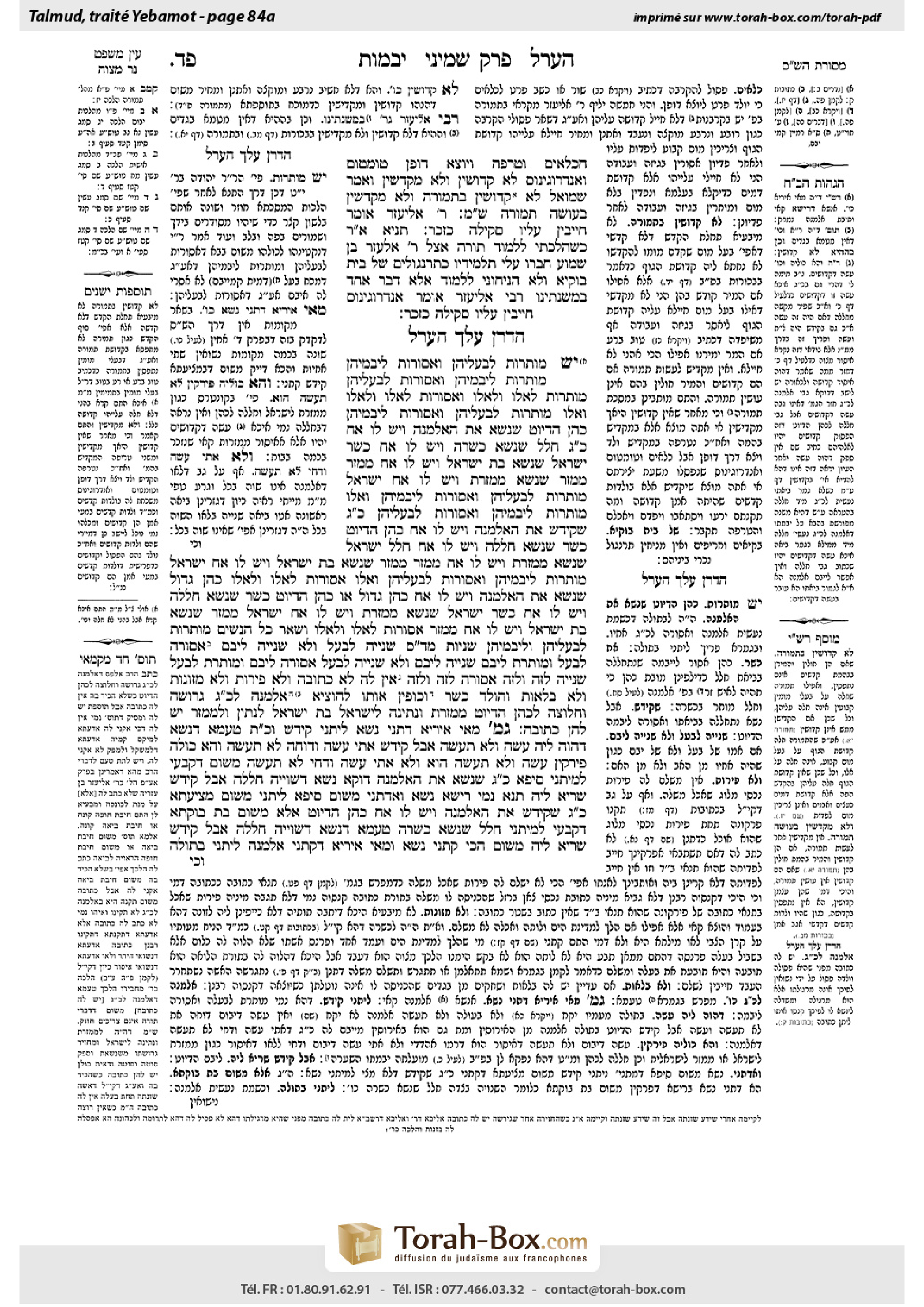
Yevamot 84a: Talmud study for Daf Yomi
Daf Yomi is the daily study of one Talmud folio. Explore 37 tractates with scans, Hebrew text, Sefaria English and AI-generated French translations where annotated.
Passage selection and English or AI-generated French translation are available where the scan has annotations. Daf Study is independent of Torah-Box and Sefaria.
Browse Yevamot · יבמות · All tractatesYevamot 84a text and translations
This page of Yevamot includes the Aramaic text, an English translation and an AI-generated French translation, alongside the scan above.
יבמות פ״ד א · Aramaic and Hebrew text
הַכִּלְאַיִם וּטְרֵפָה וְיוֹצֵא דּוֹפֶן, טוּמְטוּם וְאַנְדְּרוֹגִינוֹס — לֹא קְדוֹשִׁין וְלֹא מַקְדִּישִׁין.
וְאָמַר שְׁמוּאֵל: לֹא קְדוֹשִׁין — בִּתְמוּרָה. וְלֹא מַקְדִּישִׁין — בְּעוֹשֶׂה תְּמוּרָה. שְׁמַע מִינַּהּ.
רַבִּי אֱלִיעֶזֶר אוֹמֵר: חַיָּיבִין עָלָיו סְקִילָה כַּזָּכָר. תַּנְיָא, אָמַר רַבִּי: כְּשֶׁהָלַכְתִּי לִלְמוֹד תּוֹרָה אֵצֶל רַבִּי אֶלְעָזָר בֶּן שַׁמּוּעַ, חָבְרוּ עָלַי תַּלְמִידָיו כְּתַרְנְגוֹלִים שֶׁל בֵּית בּוּקְיָא, וְלֹא הִנִּיחוּנִי לִלְמוֹד אֶלָּא דָּבָר אֶחָד בְּמִשְׁנָתֵינוּ — רַבִּי אֱלִיעֶזֶר אוֹמֵר: אַנְדְּרוֹגִינוֹס חַיָּיבִין עָלָיו סְקִילָה כַּזָּכָר.
הֲדַרַן עֲלָךְ הֶעָרֵל
יֵשׁ מוּתָּרוֹת לְבַעְלֵיהֶן וַאֲסוּרוֹת לְיִבְמֵיהֶן, מוּתָּרוֹת לְיִבְמֵיהֶן וַאֲסוּרוֹת לְבַעְלֵיהֶן. מוּתָּרוֹת לָאֵלּוּ וְלָאֵלּוּ, וַאֲסוּרוֹת לָאֵלּוּ וְלָאֵלּוּ.
וְאֵלּוּ מוּתָּרוֹת לְבַעְלֵיהֶן וַאֲסוּרוֹת לְיִבְמֵיהֶן: כֹּהֵן הֶדְיוֹט שֶׁנָּשָׂא אֶת הָאַלְמָנָה, וְיֵשׁ לוֹ אָח כֹּהֵן גָּדוֹל; חָלָל שֶׁנָּשָׂא כְּשֵׁרָה, וְיֵשׁ לוֹ אָח כָּשֵׁר;
יִשְׂרָאֵל שֶׁנָּשָׂא בַּת יִשְׂרָאֵל, וְיֵשׁ לוֹ אָח מַמְזֵר; מַמְזֵר שֶׁנָּשָׂא מַמְזֶרֶת, וְיֵשׁ לוֹ אָח יִשְׂרָאֵל — מוּתָּרוֹת לְבַעְלֵיהֶן וַאֲסוּרוֹת לְיִבְמֵיהֶן.
וְאֵלּוּ מוּתָּרוֹת לְיִבְמֵיהֶן וַאֲסוּרוֹת לְבַעְלֵיהֶן: כֹּהֵן גָּדוֹל שֶׁקִּידֵּשׁ אֶת הָאַלְמָנָה, וְיֵשׁ לוֹ אָח כֹּהֵן הֶדְיוֹט; כָּשֵׁר שֶׁנָּשָׂא חֲלָלָה, וְיֵשׁ לוֹ אָח חָלָל; יִשְׂרָאֵל שֶׁנָּשָׂא מַמְזֶרֶת, וְיֵשׁ לוֹ אָח מַמְזֵר; מַמְזֵר שֶׁנָּשָׂא בַּת יִשְׂרָאֵל, וְיֵשׁ לוֹ אָח יִשְׂרָאֵל — מוּתָּרוֹת לְיִבְמֵיהֶן וַאֲסוּרוֹת לְבַעְלֵיהֶן.
וְאֵלּוּ אֲסוּרוֹת לָאֵלּוּ וְלָאֵלּוּ: כֹּהֵן גָּדוֹל שֶׁנָּשָׂא אֶת הָאַלְמָנָה, וְיֵשׁ לוֹ אָח כֹּהֵן גָּדוֹל; אוֹ כֹּהֵן הֶדְיוֹט כָּשֵׁר שֶׁנָּשָׂא חֲלָלָה, וְיֵשׁ לוֹ אָח כָּשֵׁר; יִשְׂרָאֵל שֶׁנָּשָׂא מַמְזֶרֶת, וְיֵשׁ לוֹ אָח יִשְׂרָאֵל; מַמְזֵר שֶׁנָּשָׂא בַּת יִשְׂרָאֵל, וְיֵשׁ לוֹ אָח מַמְזֵר — אֲסוּרוֹת לָאֵלּוּ וְלָאֵלּוּ, וּשְׁאָר כׇּל הַנָּשִׁים מוּתָּרוֹת לְבַעְלֵיהֶן וּלְיִבְמֵיהֶן.
שְׁנִיּוֹת מִדִּבְרֵי סוֹפְרִים, שְׁנִיָּיה לַבַּעַל וְלֹא שְׁנִיָּיה לַיָּבָם — אֲסוּרָה לַבַּעַל, וּמוּתֶּרֶת לַיָּבָם. שְׁנִיָּיה לַיָּבָם וְלֹא שְׁנִיָּיה לַבַּעַל — אֲסוּרָה לַיָּבָם וּמוּתֶּרֶת לַבַּעַל, שְׁנִיָּיה לָזֶה וְלָזֶה — אֲסוּרָה לָזֶה וְלָזֶה.
אֵין לָהּ לֹא כְּתוּבָה וְלֹא פֵּירוֹת וְלֹא מְזוֹנוֹת וְלֹא בְּלָאוֹת. וְהַוָּלָד כָּשֵׁר, וְכוֹפִין אוֹתוֹ לְהוֹצִיא.
אַלְמָנָה לְכֹהֵן גָּדוֹל, גְּרוּשָׁה וַחֲלוּצָה לְכֹהֵן הֶדְיוֹט, מַמְזֶרֶת וּנְתִינָה לְיִשְׂרָאֵל, בַּת יִשְׂרָאֵל לְנָתִין וּלְמַמְזֵר — יֵשׁ לָהֶן כְּתוּבָּה.
גְּמָ׳ מַאי אִירְיָא דְּתָנֵי ״נָשָׂא״? לִיתְנֵי ״קִידֵּשׁ״!
וְכִי תֵּימָא: טַעְמָא דְּנָשָׂא — דְּהָוֵה לֵיהּ עֲשֵׂה וְלֹא תַעֲשֶׂה, אֲבָל קִידֵּשׁ — אָתֵי עֲשֵׂה וְדוֹחֶה לֹא תַעֲשֶׂה, וְהָא כּוּלֵּהּ פִּירְקִין עֲשֵׂה וְלֹא תַעֲשֶׂה הוּא, וְלָא אָתֵי עֲשֵׂה וְדָחֵי לֹא תַעֲשֶׂה!
מִשּׁוּם דְּקָבָעֵי לְמִיתְנֵי סֵיפָא ״כֹּהֵן גָּדוֹל שֶׁנָּשָׂא אֶת הָאַלְמָנָה״, דַּוְקָא נָשָׂא — דְּשַׁוְּיַיהּ חֲלָלָהּ, אֲבָל קִידֵּשׁ — שַׁרְיָא לֵיהּ, תַּנָּא נָמֵי רֵישָׁא ״נָשָׂא״!
וְאַדְּתָנֵי מִשּׁוּם סֵיפָא, לִיתְנֵי מִשּׁוּם מְצִיעֲתָא: כֹּהֵן גָּדוֹל שֶׁקִּידֵּשׁ אֶת הָאַלְמָנָה וְיֵשׁ לוֹ אָח כֹּהֵן הֶדְיוֹט! אֶלָּא מִשּׁוּם בַּת בּוּקְתָּא, דְּקָבָעֵי לְמִיתְנֵי ״חָלָל שֶׁנָּשָׂא כְּשֵׁרָה״, טַעְמָא דְּנָשָׂא — דְּשַׁוְּיַיהּ חֲלָלָה, אֲבָל קִידֵּשׁ — שַׁרְיָא לֵיהּ, מִשּׁוּם הָכִי קָתָנֵי ״נָשָׂא״.
וּמַאי אִירְיָא דְּקָתָנֵי אַלְמָנָה? לִיתְנֵי בְּתוּלָה!
Yevamot 84a · English translation
Forbidden crossbred livestock, an animal with a condition that will cause it to die within twelve months [tereifa], an animal delivered through the abdominal wall, and an animal that is a tumtum or a hermaphrodite do not become sacred and do not render another animal sacred in their place.
And Shmuel said: They do not become sacred by way of substitution, i.e., if one had an animal that had been designated as an offering, and he wished to substitute one of these animals for it, the substituted animal does not become sacred. And they themselves do not render another animal sacred when it is made a substitute for them. If one designated one of these animals as an offering and he wished to substitute another animal for it, it does not become sacred. The Gemara concludes: Learn from this that Rabbi Eliezer does not consider a hermaphrodite to be a proper male.
It is taught in the mishna that Rabbi Eliezer says: If one had intercourse with a hermaphrodite, one is liable to be punished with stoning on his account as if one had relations with a male. It is taught on this matter in a baraita that Rabbi Yehuda HaNasi says: When I went to learn Torah from Rabbi Elazar ben Shamua, his students joined together against me like the roosters of Beit Bukya, highly aggressive animals that do not allow other creatures to remain among them, and they did not let me learn there. Therefore, I managed to learn only one thing in our mishna, which is that Rabbi Eliezer says: If one had intercourse with a hermaphrodite, one is liable to be punished with stoning on his account as if one had relations with a male.
MISHNA: There are women who are permitted to their husbands and forbidden to their yevamin, while others are permitted to their yevamin and forbidden to their husbands. Certain women are permitted both to these and to those, and others are forbidden to both these and to those.
The mishna elaborates: And these are cases of women who are permitted to their husbands and forbidden to their yevamin: In the case of a common priest who married a widow, and he has a brother who is the High Priest, the widow, who was permitted to her husband, is forbidden to her yavam, as it is prohibited for the High Priest to marry a widow. The same is true in the case of a priest disqualified due to flawed lineage [ḥalal], e.g., the son of a priest and a divorcée, who married a woman fit to marry a priest, and he has a brother who is a priest fit for service. That woman was permitted to marry the ḥalal but is forbidden to his brother. Having engaged in intercourse with the ḥalal, she is rendered a ḥalala, a woman disqualified from marrying a priest.
Another example is the case of an Israelite of unflawed lineage who married an Israelite woman of similar lineage, and he has a brother who is a son born from an incestuous or adulterous relationship [mamzer]; or a mamzer who married a daughter born from an incestuous or adulterous relationship [mamzeret], and he has a brother who is an Israelite of unflawed lineage. A mamzer is permitted to marry a mamzeret, but neither is permitted to a Jew of unflawed lineage. In each of these cases, these women are permitted to their husbands and forbidden to their yevamin.
And these are cases of women who are permitted to their yevamin and forbidden to their husbands: For example, there is the case of a High Priest who betrothed a widow, and he has a brother who is a common priest, whom she is permitted to marry. This is true only if the High Priest merely betrothed her. However, if he consummated the marriage, he rendered her a ḥalala forbidden to all priests, including her yavam. The additional cases are a priest fit for service who married a ḥalala and he has a brother who is a ḥalal; an Israelite of unflawed lineage who married a mamzeret, and he has a brother who is a mamzer; and a mamzer who married an Israelite woman of unflawed lineage, and he has a brother who is, similarly, an Israelite of unflawed lineage. All of these women are permitted to their yevamin and forbidden to their husbands.
And these are cases where women are forbidden both to these and to those: A High Priest who married a widow, and he has a brother who is a High Priest or a common priest; a priest fit for service who married a ḥalala, and he has a brother who is a priest fit for service; an Israelite of unflawed lineage who married a mamzeret, and he has a brother who is similarly an ordinary Israelite, or a mamzer who married an Israelite woman of unflawed lineage, and he has a brother who is a mamzer. All of these women are forbidden both to these and to those. And all other women are permitted to their husbands and to their yevamin.
With regard to secondary relatives, who are forbidden by rabbinic law, if the woman is a secondary relative to the husband but not a secondary relative to the yavam, she is forbidden to the husband and permitted to the yavam. Conversely, if she is a secondary relative to the yavam but not a secondary relative to the husband, she is forbidden to the yavam and permitted to the husband. If she is a secondary relative both to this man and to that man, she is forbidden to this one and to that one.
Furthermore, if a man marries a woman forbidden to him as a secondary relative, she does not have the right to receive payment for her marriage contract if divorced or widowed, nor is she entitled to payment from her husband for the produce of her property that he used, nor is she entitled to provisions for her sustenance from his estate, nor does she get back her worn clothes or other objects she brought with her to her marriage. And the lineage of the offspring is unflawed, and the court forces him to divorce her.
In contrast, a widow married to a High Priest, a divorcée or a yevama who performed ḥalitza [ḥalutza] married to a common priest, a mamzeret or a Gibeonite woman married to an Israelite of unflawed lineage, and an Israelite woman of unflawed lineage married to a Gibeonite or to a mamzer all have the right to receive payment for their marriage contract, although it was prohibited for them to marry.
GEMARA: As an example of a woman who is permitted to her husband and forbidden to her yavam, the mishna cites the case of a widow married to a common priest whose brother was a High Priest. The Gemara asks: Why does the tanna specifically teach a case where the priest married the widow? Let him teach that he betrothed her, as even if she is widowed after betrothal she requires levirate marriage or ḥalitza.
And if you would say: The reason that the tanna cited the case where they were married is that in this case there is a positive mitzva that the High Priest marry a virgin and also a prohibition to marry a widow, and therefore she is forbidden to him. However, if he betrothed her, the positive mitzva of levirate marriage comes and overrides the prohibition against marrying a widow. To counter this argument, the tanna states: But that cannot be the case, as the entire chapter discusses cases involving the positive mitzva of levirate marriage and prohibitions, and in all those cases, the positive mitzva does not come and override the prohibition, even in the absence of an additional positive mitzva.
The Gemara answers: The mishna could have cited a case where the priest betrothed the widow. Instead, the mishna cites a case where the priest married a widow, due to the fact that the tanna wants to teach in the latter clause of the mishna the case of a High Priest who married a widow who has a brother who is a common priest. That case is specifically if he married her, because he thereby rendered her a ḥalala. However, if he only betrothed her, she is permitted to his brother who is a common priest, as it is permitted for him to marry a widow. Therefore, the tanna also taught in the first clause the case where the priest married her.
The Gemara asks: But rather than teaching a case where she was married in the first clause due to the latter clause of the mishna, let him teach a case where she was betrothed in the first clause due to the middle clause, which speaks of a High Priest who betrothed a widow, and he has a brother who is a common priest. The Gemara concludes: Rather, the reason the tanna taught the case where the priest married the widow is due to the halakha that is its neighbor [bat bukta], i.e., due to the fact that in the adjacent case he wants to teach the case of a ḥalal who married a woman fit to marry a priest. There, the reason that the woman is forbidden to his brother is specifically that the ḥalal married her, as he rendered her a ḥalala by consummating the marriage. However, if the ḥalal merely betrothed her, she is permitted to him. Due to that reason, the tanna teaches the case where the priest married the widow.
The Gemara asks: And why does the tanna specifically teach the case of a common priest who married a widow? Let him teach that the priest married a virgin. Since in any case she becomes a widow upon his death, what difference is there whether she was previously a widow?
Yevamot 84a · Traduction française (IA)
Les animaux issus de croisements interdits, les animaux atteints d’une affection qui entraînera leur mort dans les douze mois [tereifa], les animaux nés par césarienne, ainsi que les animaux tumtum ou hermaphrodites ne sont pas consacrés et ne consacrent pas un autre animal en substitution.
Et Shmuel a dit : Ils ne sont pas consacrés par substitution, c’est-à-dire que si quelqu’un possède un animal désigné comme offrande et souhaite lui substituer l’un de ces animaux, l’animal substitué n’est pas consacré. Eux-mêmes ne consacrent pas non plus un autre animal lorsqu’on le leur substitue. Si quelqu’un désigne l’un de ces animaux comme offrande et souhaite lui substituer un autre animal, celui-ci n’est pas consacré. La Guemara conclut : apprends-en que Rabbi Eliezer ne considère pas un hermaphrodite comme un mâle à part entière.
Il est enseigné dans la Michna que Rabbi Eliezer dit : Si quelqu’un a des relations avec un hermaphrodite, il encourt la lapidation à cause de celui-ci, comme s’il avait eu des relations avec un homme. Une baraïta enseigne à ce sujet que Rabbi Yehuda HaNasi dit : Lorsque je suis allé étudier la Torah auprès de Rabbi Elazar ben Shamua, ses élèves se sont ligués contre moi comme les coqs de Beit Bukya, des animaux très agressifs qui ne tolèrent pas la présence d’autres créatures parmi eux, et ils ne m’ont pas laissé étudier là-bas. Je n’ai donc réussi à apprendre qu’une seule chose dans notre Michna : Rabbi Eliezer dit que si quelqu’un a des relations avec un hermaphrodite, il encourt la lapidation à cause de celui-ci, comme s’il avait eu des relations avec un homme.
MICHNA : Certaines femmes sont permises à leurs maris et interdites à leurs yevamin, tandis que d’autres sont permises à leurs yevamin et interdites à leurs maris. Certaines femmes sont permises aux uns comme aux autres, tandis que d’autres sont interdites aux uns comme aux autres.
La Michna précise : voici les cas de femmes permises à leurs maris et interdites à leurs yevamin : lorsqu’un prêtre ordinaire a épousé une veuve et qu’il a un frère qui est grand prêtre, la veuve, permise à son mari, est interdite à son yavam, car un grand prêtre ne peut pas épouser une veuve. Il en va de même lorsqu’un prêtre disqualifié en raison de son ascendance [ḥalal], par exemple le fils d’un prêtre et d’une femme divorcée, a épousé une femme apte à épouser un prêtre et a un frère prêtre apte au service. Cette femme pouvait épouser le ḥalal, mais elle est interdite à son frère. Ayant eu des relations avec le ḥalal, elle devient une ḥalala, c’est-à-dire une femme disqualifiée pour épouser un prêtre.
Autre exemple : un Israélite de lignée sans défaut a épousé une Israélite de lignée semblable et a un frère né d’une union incestueuse ou adultère [mamzer] ; ou bien un mamzer a épousé une fille née d’une union incestueuse ou adultère [mamzeret] et a un frère Israélite de lignée sans défaut. Un mamzer peut épouser une mamzeret, mais ni l’un ni l’autre ne peut épouser un Juif de lignée sans défaut. Dans chacun de ces cas, ces femmes sont permises à leurs maris et interdites à leurs yevamin.
Et voici les cas de femmes permises à leurs yevamin et interdites à leurs maris : un grand prêtre a fiancé une veuve et a un frère prêtre ordinaire, qu’elle peut épouser. Cela n’est vrai que si le grand prêtre s’est contenté de la fiancer. En revanche, s’il a consommé le mariage, il l’a rendue ḥalala, interdite à tous les prêtres, y compris à son yavam. Les autres cas sont ceux d’un prêtre apte au service qui a épousé une ḥalala et a un frère ḥalal ; d’un Israélite de lignée sans défaut qui a épousé une mamzeret et a un frère mamzer ; et d’un mamzer qui a épousé une Israélite de lignée sans défaut et a un frère qui est également un Israélite de lignée sans défaut. Toutes ces femmes sont permises à leurs yevamin et interdites à leurs maris.
Et voici les cas où les femmes sont interdites aux uns comme aux autres : un grand prêtre a épousé une veuve et a un frère grand prêtre ou prêtre ordinaire ; un prêtre apte au service a épousé une ḥalala et a un frère prêtre apte au service ; un Israélite de lignée sans défaut a épousé une mamzeret et a un frère qui est également un Israélite ordinaire ; ou un mamzer a épousé une Israélite de lignée sans défaut et a un frère mamzer. Toutes ces femmes sont interdites aux uns comme aux autres. Toutes les autres femmes sont permises à leurs maris et à leurs yevamin.
En ce qui concerne les parentes interdites par décret rabbinique : si la femme est une parente de cette catégorie pour son mari, mais pas pour son yavam, elle est interdite à son mari et permise à son yavam. À l’inverse, si elle est une parente de cette catégorie pour son yavam, mais pas pour son mari, elle est interdite à son yavam et permise à son mari. Si elle est une parente de cette catégorie aussi bien pour cet homme que pour l’autre, elle est interdite à l’un comme à l’autre.
De plus, si un homme épouse une femme qui lui est interdite en tant que parente interdite par décret rabbinique, celle-ci n’a pas droit au montant de sa ketouba si elle est divorcée ou veuve ; elle n’a pas non plus droit à une compensation de son mari pour les fruits de ses biens qu’il a utilisés, ni à une pension alimentaire prélevée sur la succession de son mari, et elle ne récupère pas ses vêtements usés ni les autres objets qu’elle avait apportés lors de son mariage. La lignée des enfants n’est pas entachée, et le tribunal contraint le mari à divorcer d’elle.
En revanche, une veuve épousée par un grand prêtre, une femme divorcée ou une yevama ayant subi la ḥalitsa [ḥalutza] épousée par un prêtre ordinaire, une mamzeret ou une femme guivéonite épousée par un Israélite de lignée sans défaut, ainsi qu’une Israélite de lignée sans défaut épousée par un Guivéonite ou par un mamzer, ont toutes droit au montant de leur ketouba, bien que leur mariage leur ait été interdit.
GUEMARA : Comme exemple d’une femme permise à son mari et interdite à son yavam, la Michna cite le cas d’une veuve épousée par un prêtre ordinaire dont le frère était grand prêtre. La Guemara demande : Pourquoi le tanna enseigne-t-il précisément le cas où le prêtre a épousé la veuve ? Qu’il enseigne plutôt qu’il l’a fiancée, car même si elle devient veuve après les fiançailles, elle doit contracter un mariage léviratique ou subir la ḥalitsa.
Et si tu dis que le tanna a cité le cas où ils étaient mariés parce qu’il y a alors une mitsva positive imposant au grand prêtre d’épouser une vierge, ainsi qu’une interdiction d’épouser une veuve, de sorte que celle-ci lui est interdite, tandis que, s’il l’avait fiancée, la mitsva positive du mariage léviratique viendrait écarter l’interdiction d’épouser une veuve, le tanna répond : cela ne peut pas être le cas, car tout le chapitre traite de situations où la mitsva positive du mariage léviratique se heurte à des interdictions, et, dans tous ces cas, la mitsva positive ne vient pas écarter l’interdiction, même en l’absence d’une mitsva positive supplémentaire.
La Guemara répond : la Michna aurait pu citer le cas où le prêtre avait fiancé la veuve. Elle cite plutôt le cas où le prêtre l’a épousée, parce que le tanna veut enseigner dans la clause suivante de la Michna le cas d’un grand prêtre qui a épousé une veuve et dont le frère est prêtre ordinaire. Ce cas suppose précisément qu’il l’a épousée, car il l’a ainsi rendue ḥalala. En revanche, s’il s’était contenté de la fiancer, elle aurait été permise à son frère, prêtre ordinaire, puisqu’il lui est permis d’épouser une veuve. C’est pourquoi le tanna a également enseigné dans la première clause le cas où le prêtre l’a épousée.
La Guemara demande : Mais, plutôt que d’enseigner dans la première clause le cas où elle était mariée en raison de la clause suivante de la Michna, qu’il enseigne dans la première clause le cas où elle était fiancée, en raison de la clause intermédiaire, qui parle d’un grand prêtre qui a fiancé une veuve et a un frère prêtre ordinaire. La Guemara conclut : la raison pour laquelle le tanna enseigne le cas où le prêtre a épousé la veuve tient plutôt à la halakha qui lui est contiguë [bat bukta], c’est-à-dire au fait qu’il veut enseigner dans le cas voisin celui d’un ḥalal qui a épousé une femme apte à épouser un prêtre. Là, la raison pour laquelle cette femme est interdite à son frère est précisément que le ḥalal l’a épousée, car il l’a rendue ḥalala en consommant le mariage. En revanche, si le ḥalal s’était contenté de la fiancer, elle lui aurait été permise. C’est pour cette raison que le tanna enseigne le cas où le prêtre a épousé la veuve.
La Guemara demande : Et pourquoi le tanna enseigne-t-il précisément le cas d’un prêtre ordinaire qui a épousé une veuve ? Qu’il enseigne plutôt le cas où le prêtre a épousé une vierge. Puisqu’elle devient de toute façon veuve à sa mort, quelle différence cela fait-il qu’elle ait déjà été veuve auparavant ?
Traduction française générée par IA à partir de l’édition anglaise de Sefaria. Vérifie toujours un passage avec le texte source.
Text from Sefaria: William Davidson Edition - Vocalized Aramaic (CC BY NC); William Davidson Edition - English (CC BY NC).