Yevamot 84b: Talmud study for Daf Yomi
Daf Yomi is the daily study of one Talmud folio. Explore 37 tractates with scans, Hebrew text, Sefaria English and AI-generated French translations where annotated.
Passage selection and English or AI-generated French translation are available where the scan has annotations. Daf Study is independent of Torah-Box and Sefaria.
Browse Yevamot · יבמות · All tractatesYevamot 84b text and translations
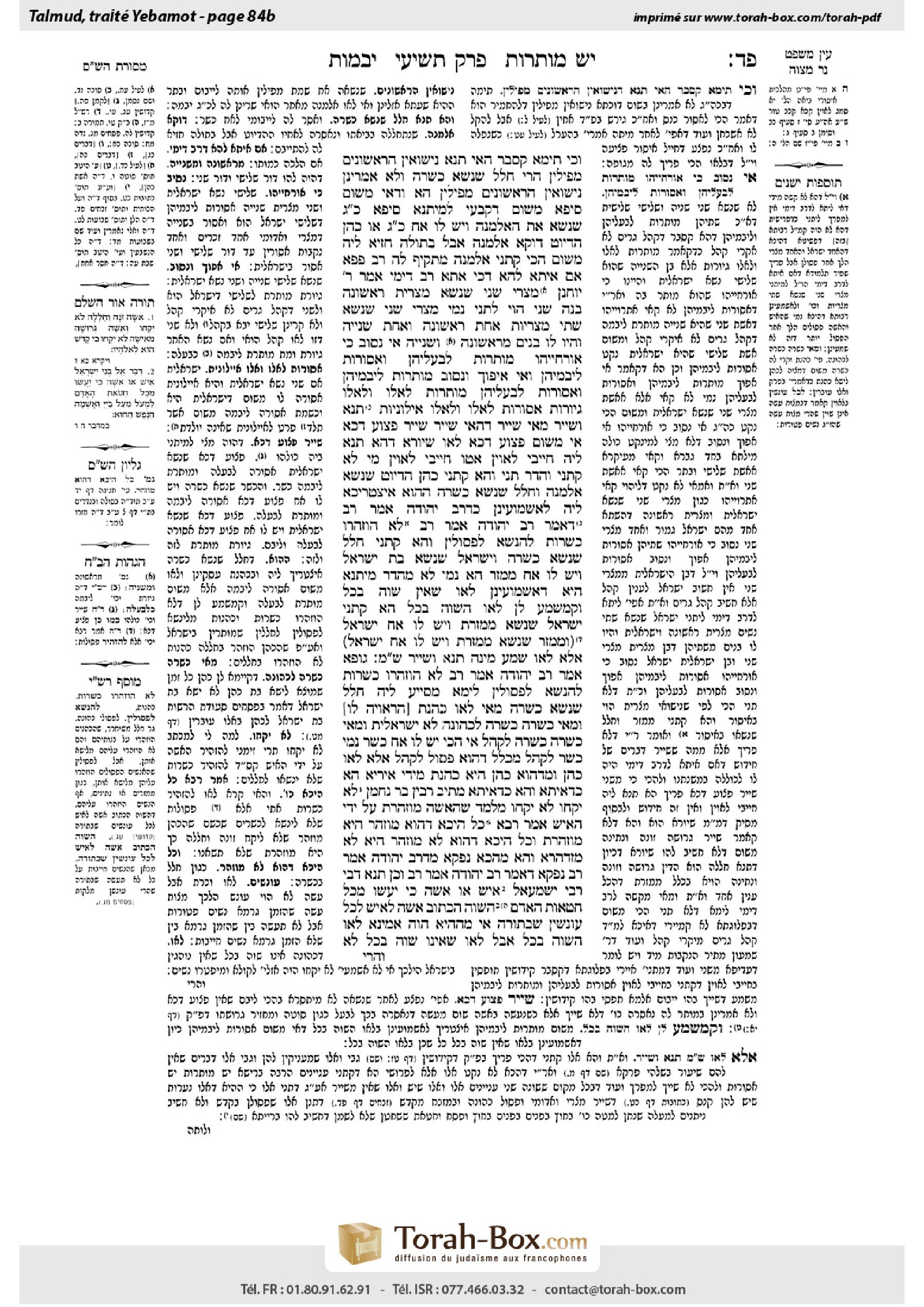
This page of Yevamot includes the Aramaic text, an English translation and an AI-generated French translation, alongside the scan above.
יבמות פ״ד ב · Aramaic and Hebrew text
וְכִי תֵּימָא: קָסָבַר הַאי תַּנָּא נִישּׂוּאִין הָרִאשׁוֹנִים מַפִּילִין — הֲרֵי חָלָל שֶׁנָּשָׂא כְּשֵׁרָה, וְלָא אָמְרִינַן נִישּׂוּאִין הָרִאשׁוֹנִים מַפִּילִין!
הָא וַדַּאי מִשּׁוּם סֵיפָא, מִשּׁוּם דְּקָבָעֵי לְמִיתְנָא סֵיפָא: כֹּהֵן גָּדוֹל שֶׁנָּשָׂא אֶת הָאַלְמָנָה, וְיֵשׁ לוֹ אָח כֹּהֵן גָּדוֹל אוֹ כֹּהֵן הֶדְיוֹט. דַּוְקָא אַלְמָנָה — אֲבָל בְּתוּלָה חַזְיָא לֵיהּ, מִשּׁוּם הָכִי קָתָנֵי אַלְמָנָה.
מַתְקֵיף לַהּ רַב פָּפָּא: אִם אִיתָא לְהָא דְּכִי אֲתָא רַב דִּימִי, אָמַר רַבִּי יוֹחָנָן: מִצְרִי שֵׁנִי שֶׁנָּשָׂא מִצְרִית רִאשׁוֹנָה — בְּנָהּ שֵׁנִי הָוֵי, לִתְנֵי נָמֵי:
מִצְרִי שֵׁנִי שֶׁנָּשָׂא שְׁתֵּי מִצְרִיּוֹת, אַחַת רִאשׁוֹנָה וְאַחַת שְׁנִיָּיה, וְהָיוּ לוֹ בָּנִים מֵרִאשׁוֹנָה וּשְׁנִיָּיה. אִי נְסוּב כִּי אוֹרְחַיְיהוּ — מוּתָּרוֹת לְבַעְלֵיהֶן וַאֲסוּרוֹת לְיִבְמֵיהֶן.
וְאִי אֵיפוּךְ וּנְסוּב — מוּתָּרוֹת לְיִבְמֵיהֶן וַאֲסוּרוֹת לְבַעְלֵיהֶן. מוּתָּרוֹת לָאֵלּוּ וְלָאֵלּוּ — גִּיּוֹרוֹת. אֲסוּרוֹת לָאֵלּוּ וְלָאֵלּוּ — אַיְלוֹנִיּוֹת!
תְּנָא וְשַׁיַּיר. מַאי שַׁיַּיר דְּהַאי שַׁיַּיר? שַׁיַּיר פְּצוּעַ דַּכָּא.
אִי מִשּׁוּם פְּצוּעַ דַּכָּא — לָאו שִׁיּוּרָא, דְּהָא תְּנָא לֵיהּ חַיָּיבֵי לָאוִין!
אַטּוּ חַיָּיבֵי לָאוִין מִי לָא קָתָנֵי וַהֲדַר תָּנֵי? וְהָא קָתָנֵי כֹּהֵן הֶדְיוֹט שֶׁנָּשָׂא אַלְמָנָה, וְחָלָל שֶׁנָּשָׂא כְּשֵׁרָה!
הָהוּא, אִיצְטְרִיכָא לֵיהּ לְאַשְׁמוֹעִינַן כִּדְרַב יְהוּדָה אָמַר רַב. דְּאָמַר רַב יְהוּדָה אָמַר רַב: לֹא הוּזְהֲרוּ כְּשֵׁרוֹת לְהִנָּשֵׂא לִפְסוּלִין.
וְהָא קָתָנֵי: חָלָל שֶׁנָּשָׂא כְּשֵׁרָה, וְיִשְׂרָאֵל שֶׁנָּשָׂא בַּת יִשְׂרָאֵל וְיֵשׁ לוֹ אָח מַמְזֵר! הָא נָמֵי, לָא מִהְדָּר מִיתְנָא הִיא, דְּאִשְׁמוּעִינַן לָאו שֶׁאֵין שָׁוֶה בַּכֹּל, וְקָמַשְׁמַע לַן לָאו הַשָּׁוֶה בַּכֹּל.
הָא קָתָנֵי: יִשְׂרָאֵל שֶׁנָּשָׂא מַמְזֶרֶת וְיֵשׁ לוֹ אָח יִשְׂרָאֵל (וּמַמְזֵר שֶׁנָּשָׂא מַמְזֶרֶת וְיֵשׁ לוֹ אָח יִשְׂרָאֵל), אֶלָּא לָאו, שְׁמַע מִינַּהּ תְּנָא וְשַׁיַּיר. שְׁמַע מִינַּהּ.
גּוּפָא. אָמַר רַב יְהוּדָה אָמַר רַב: לֹא הוּזְהֲרוּ כְּשֵׁרוֹת לְהִנָּשֵׂא לִפְסוּלִין. לֵימָא מְסַיַּיע לֵיהּ: חָלָל שֶׁנָּשָׂא כְּשֵׁרָה, מַאי לָאו כֹּהֶנֶת [הָרְאוּיָה לוֹ], וּמַאי ״כְּשֵׁרָה״ — כְּשֵׁרָה לִכְהוּנָּה?
לָא, יִשְׂרְאֵלִית. וּמַאי ״כְּשֵׁרָה״ — כְּשֵׁרָה לַקָּהָל.
אִי הָכִי: ״יֵשׁ לוֹ אָח כָּשֵׁר״, נָמֵי כָּשֵׁר לַקָּהָל, מִכְּלָל דְּהוּא פָּסוּל לַקָּהָל! אֶלָּא לָאו — כֹּהֵן, וּמִדְּהוּא כֹּהֵן, הִיא כֹּהֶנֶת! מִידֵּי אִירְיָא — הָא כִּדְאִיתָא וְהָא כִּדְאִיתָא.
מֵתִיב רָבִין בַּר נַחְמָן: ״לֹא יִקָּחוּ ... לֹא יִקָּחוּ״, מְלַמֵּד שֶׁהָאִשָּׁה מוּזְהֶרֶת עַל יְדֵי הָאִישׁ!
אָמַר רָבָא: כֹּל הֵיכָא דְּהוּא מוּזְהָר — הִיא מוּזְהֶרֶת, וְכׇל הֵיכָא דְּהוּא לֹא מוּזְהָר — הִיא לֹא מוּזְהֶרֶת.
וְהָא מֵהָכָא נָפְקָא? מִדְּרַב יְהוּדָה אָמַר רַב נָפְקָא! דְּאָמַר רַב יְהוּדָה אָמַר רַב, וְכֵן תָּנָא דְּבֵי רַבִּי יִשְׁמָעֵאל: ״אִישׁ אוֹ אִשָּׁה כִּי יַעֲשׂוּ מִכׇּל חַטֹּאת הָאָדָם״ — הִשְׁוָה הַכָּתוּב אִשָּׁה לְאִישׁ לְכׇל עוֹנָשִׁין שֶׁבַּתּוֹרָה!
אִי מֵהַהִיא, הֲוָה אָמֵינָא: לָאו הַשָּׁוֶה בַּכֹּל. אֲבָל לָאו שֶׁאֵינוֹ שָׁוֶה בַּכֹּל, לָא.
Yevamot 84b · English translation
And if you would say that this tanna holds that it is her status at the time of the first marriage that determines her status when she happens before the yavam for levirate marriage, and not her status at the time of her husband’s death, and therefore if she had been a virgin when she married she would have been permitted to enter into levirate marriage with a High Priest, that cannot be so, as the mishna cites the case of a ḥalal who married a woman fit to marry a priest, in which case the woman is permitted to her husband and forbidden to her yavam. And in that case, we do not say that the first marriage determines her status when she happens before him for levirate marriage, as the woman was fit to marry the brother when she married the ḥalal and was rendered a ḥalala only as a result of her marriage.
The Gemara answers: That fact, that the mishna cited a case where the priest married a widow, is certainly due to the latter clause of the mishna, i.e., due to the fact that the tanna wants to teach in the latter clause: A High Priest who married a widow, and he has a brother who is the High Priest or a common priest. In the case where the yavam is a common priest, the widow is forbidden to him specifically if the High Priest married a widow, as by consummating the marriage he rendered her a ḥalala. However, had she been a virgin when the High Priest married her, he would not render her a ḥalala, and when the High Priest dies she would be fit for his brother. It is due to that reason that the tanna teaches the case of a widow in the first clause as well.
§ Rav Pappa objects to the mishna: If it is so, that the halakha is in accordance with Rabbi Yoḥanan’s opinion, as when Rav Dimi came from Eretz Yisrael he reported that Rabbi Yoḥanan said that in the case of a second-generation Egyptian who married a first-generation Egyptian woman, her son is considered a second-generation Egyptian, as the child’s status in this matter is determined according to the mother, then let the tanna of the mishna also teach the following case:
With regard to a second-generation Egyptian who married two Egyptian women, one of whom was a first-generation Egyptian convert and one of whom was from the second generation, and he had sons from both the first and second women, if these two sons married in their proper way, meaning that the third-generation Egyptian married an ordinary Jewish woman, and the second-generation convert married another second-generation Egyptian, then it is also true of these women that they are permitted to their husbands and forbidden to their yevamin. The second-generation Egyptian is forbidden to his Jewish yevama, while the third-generation Egyptian is an ordinary Jew and therefore prohibited to marry his yevama, who is a second-generation Egyptian woman.
And if they married in the reverse manner, i.e., the third-generation convert married a second-generation Egyptian woman, and the second-generation man married an ordinary Jewish woman, they are permitted to their yevamin and forbidden to their husbands. Similarly, they are permitted both to these and to those if these sons married converts, for an Egyptian convert is permitted to marry a convert of a different nationality. And there is also a case in which they are forbidden to these and to those, namely if they married sexually underdeveloped women [ayloniot]. If an Egyptian married an aylonit, she is forbidden to him as a Jewish woman, and she is forbidden to his brother, a third-generation Egyptian convert who is permitted to marry a Jewish woman, because levirate marriage is prohibited with an aylonit. The fact that the mishna omits these cases appears to indicate that the halakha is not in accordance with Rabbi Yoḥanan.
The Gemara answers: There is no proof from here with regard to the halakha, as the tanna of the mishna did not mention all possible examples. Rather, he taught certain cases and omitted others. The Gemara asks: What else did he omit that he omitted this? The tanna would not have omitted only one example. The Gemara answers: He omitted the case of a man with crushed testicles or with other wounds to his genitals. If the husband is such a man, the wife is forbidden to her husband and permitted to her yavam. If the yavam is such a man, the opposite is true.
The Gemara asks: If this mishna is determined to have taught certain cases and omitted others due to the omission of the case of a man with crushed testicles or other wounds to his genitals, this is not an omission, as in this mishna the tanna taught a principle that applies to all forbidden relationships for which one is liable for violating a prohibition. This category includes such a case, and therefore it was not omitted.
The Gemara answers: Is that to say that with regard to those relationships for which one is liable for violating a prohibition, he does not teach a principle and again teach them in detail? But this is not the case. He teaches the case of a common priest who married a widow and he had a brother who was a high priest, and the case of a ḥalal who married a woman fit to marry a priest and he had a brother who was a priest fit for service, both of whom are forbidden as they are liable for violating a prohibition. Therefore, since the tanna did not specifically teach the case of the man with crushed testicles, this constitutes an omission.
The Gemara responds: That clause of the mishna is not merely a specification of the previous general halakha, as it was necessary for the tanna to mention these cases individually in order to teach us another halakha that Rav Yehuda said that Rav said, as Rav Yehuda said that Rav said: It is not prohibited for daughters of priests who are fit to marry priests to marry men who are disqualified from the priesthood, although this marriage disqualifies them from subsequently marrying a priest.
The Gemara challenges that answer: But the mishna also teaches these cases: A ḥalal who married a woman fit to marry a priest; and an Israelite of unflawed lineage who married an Israelite woman of unflawed lineage, and he has a brother who is a mamzer. These are specifications that do not teach additional halakhot. The Gemara answers: This too is not a case of the tanna going back and teaching additional examples of the same halakha without adding anything, as he teaches us something new through each of these two examples. The first example is referring to a prohibition that is not equally applicable to all, such as one concerning priests, and the second example is referring to a prohibition that is equally applicable to all, such as one involving a mamzer.
The Gemara further challenges the answer: But the mishna also teaches the case of an Israelite of unflawed lineage who married a mamzeret and who has a brother who is an Israelite of similar lineage, and the example of a mamzer who married a mamzeret and he has a brother who is an Israelite of unflawed lineage. Consequently, the tanna does in fact teach the same halakha several times with regard to a prohibition that is equally applicable to all. Rather, isn’t it correct to conclude from it that he taught and omitted certain cases and did not list all possible examples? The Gemara concludes: Indeed, conclude from it that this is the case, and therefore there is no proof from here that the halakha is not in accordance with Rabbi Yoḥanan.
§ The Gemara returns to a statement cited incidentally above, in order to discuss the matter itself: Rav Yehuda said that Rav said: It is not prohibited for daughters of priests who are fit to marry priests to marry men who are disqualified from the priesthood, although this marriage would disqualify them from subsequently marrying a priest, and they may do so even ab initio. The Gemara suggests: Let us say that the following statement of the mishna supports his opinion: A ḥalal who married a woman who is fit, and he has a brother who is a priest fit for service, this woman is permitted to her husband and forbidden to her yavam. What, is it not referring to a priestess, i.e., a priest’s daughter, who is appropriate to marry him? And what is the meaning of: Fit? This means that she is fit for the priesthood, and yet the mishna says she is permitted to her husband, the ḥalal.
The Gemara rejects this suggestion: No, it is possible that the mishna is speaking of an Israelite woman. And what is the meaning of: Fit? It means that she is fit to enter the congregation of the Jewish people, through marriage. According to this explanation, there is no proof from the mishna about daughters of priests.
The Gemara raises a difficulty: If so, consider the phrase: A ḥalal who married a woman fit to marry a priest, and he has a brother who is also fit. Consistency demands that here too it means that the brother is fit to enter the congregation. Can it not therefore be deduced by inference that he, the deceased ḥalal, was unfit to enter the congregation? But such an inference would be an error, as a ḥalal is disqualified only from the priesthood. Rather, is it not referring to a priest, and from the fact that he must be a priest, she too must be a priestess? The Gemara rejects this claim: Are the cases comparable? This case, of the ḥalal, is as it is, i.e., he is fit for the priesthood. And that case, of the woman, is as it is, i.e., she is fit to enter the congregation.
Ravin bar Naḥman raised an objection against Rav’s ruling from the following baraita: The verse states about priests: “They may not take a woman who is a harlot [zona], or profaned [ḥalala]” (Leviticus 21:7). The same verse says: “They also may not take a woman divorced from her husband.” This repetition of “they may not take” teaches us that the woman is also prohibited by means of the prohibition addressed to the man. Therefore, we can conclude that there is a prohibition for a daughter of a priest to marry a ḥalal.
Rava said: Ravin bar Naḥman’s objection is not valid. All that the baraita teaches is that anywhere that a prohibition of sexual intercourse applies to him, i.e., to a man, the same prohibition applies to her, his female partner. And anywhere that a prohibition does not apply to him, the prohibition does not apply to her either. It does not, however, indicate that since it is prohibited for a priest to marry a ḥalala it is also prohibited for the daughter of a priest to marry a ḥalal.
The Gemara asks with regard to the baraita itself: And is this matter derived from here? It is derived from a different statement that Rav Yehuda said that Rav said, as Rav Yehuda said that Rav said, and the school of Rabbi Yishmael similarly taught: The verse states: “When a man or woman shall commit any sin that people commit” (Numbers 5:6). The verse here equates a woman to a man with regard to all punishments of the Torah. Consequently, the halakhot of forbidden marriages apply equally to women and to men. Why then do we need to learn the same thing from the repetition of “they may not take”?
The Gemara answers: If it was derived only from that verse, I would say that this principle is true of a prohibition that is equally applicable to all, but with regard to a prohibition that is not equally applicable to all, such as the prohibitions pertaining to priests, this is not the case. Since these prohibitions only apply to priests, we might have thought that they do not extend to women. The verse therefore teaches that the prohibition applies to women in the same manner as men.
Yevamot 84b · Traduction française (IA)
Et si tu dis que ce tanna considère que c’est son statut au moment de son premier mariage qui détermine son statut lorsqu’elle se présente devant le yavam pour le mariage léviratique, et non son statut au moment de la mort de son mari, de sorte que, si elle avait été vierge lorsqu’elle s’est mariée, elle aurait été autorisée à contracter un mariage léviratique avec un grand prêtre, cela ne peut être le cas : la Michna cite l’exemple d’un ḥalal qui a épousé une femme apte à épouser un prêtre, auquel cas elle est autorisée à son mari et interdite à son yavam. Dans ce cas, nous ne disons pas que le premier mariage détermine son statut lorsqu’elle se présente devant lui pour le mariage léviratique, car elle était apte à épouser le frère lorsqu’elle a épousé le ḥalal et n’est devenue ḥalala qu’à la suite de ce mariage.
La Guemara répond : Le fait que la Michna ait cité le cas d’un prêtre qui a épousé une veuve s’explique certainement par la clause suivante de la Michna, c’est-à-dire parce que le tanna veut enseigner dans cette clause le cas d’un grand prêtre qui a épousé une veuve et dont le frère est un grand prêtre ou un prêtre ordinaire. Lorsque le yavam est un prêtre ordinaire, la veuve lui est interdite précisément parce que le grand prêtre a épousé une veuve : en consommant le mariage, il l’a rendue ḥalala. Mais si elle avait été vierge lorsque le grand prêtre l’a épousée, il ne l’aurait pas rendue ḥalala et, à la mort du grand prêtre, elle aurait été apte à épouser son frère. C’est pour cette raison que le tanna enseigne également le cas d’une veuve dans la première clause.
§ Rav Pappa objecte à la Michna : S’il en est ainsi, et que la halakha suit l’avis de Rabbi Yoḥanan — puisque, lorsque Rav Dimi est venu d’Eretz Israël, il a rapporté que Rabbi Yoḥanan avait dit que, dans le cas d’un Égyptien de deuxième génération qui a épousé une Égyptienne de première génération, leur fils est considéré comme un Égyptien de deuxième génération, car, sur ce point, le statut de l’enfant est déterminé d’après celui de sa mère —, que le tanna de la Michna enseigne également le cas suivant :
Un Égyptien de deuxième génération a épousé deux Égyptiennes, dont l’une était une convertie égyptienne de première génération et l’autre une femme de deuxième génération, et il a eu des fils de chacune d’elles. Si ces deux fils se sont mariés selon la combinaison qui leur convenait, c’est-à-dire si l’Égyptien de troisième génération a épousé une femme juive ordinaire et si le converti de deuxième génération a épousé une autre Égyptienne de deuxième génération, il est également vrai de ces femmes qu’elles sont autorisées à leurs maris et interdites à leurs yevamim. L’Égyptien de deuxième génération est interdit à sa yevama juive, tandis que l’Égyptien de troisième génération est un Juif ordinaire et ne peut donc pas épouser sa yevama, qui est une Égyptienne de deuxième génération.
Et s’ils se sont mariés selon la combinaison inverse, c’est-à-dire si le converti de troisième génération a épousé une Égyptienne de deuxième génération et si l’homme de deuxième génération a épousé une femme juive ordinaire, ces femmes sont autorisées à leurs yevamim et interdites à leurs maris. De même, elles sont autorisées aux uns comme aux autres si ces fils ont épousé des converties, car un converti égyptien peut épouser une convertie d’une autre origine nationale. Il existe également un cas où elles sont interdites aux uns comme aux autres : si ces fils ont épousé des femmes qui ne peuvent procréer [ayloniot]. Si un Égyptien épouse une aylonit, celle-ci lui est interdite en tant que femme juive ; elle est aussi interdite à son frère, un converti égyptien de troisième génération, qui peut épouser une femme juive, car le mariage léviratique est interdit avec une aylonit. Le fait que la Michna omette ces cas semble indiquer que la halakha ne suit pas l’avis de Rabbi Yoḥanan.
La Guemara répond : On ne peut tirer de là aucune preuve concernant la halakha, car le tanna de la Michna n’a pas mentionné tous les exemples possibles. Il a enseigné certains cas et en a omis d’autres. La Guemara demande : Qu’a-t-il omis d’autre pour qu’on puisse dire qu’il a omis aussi celui-ci ? Le tanna n’aurait pas omis un seul exemple. La Guemara répond : Il a omis le cas d’un homme aux testicules écrasés ou présentant d’autres lésions aux organes génitaux. Si le mari est dans cette situation, sa femme lui est interdite et elle est autorisée à son yavam. Si c’est le yavam qui est dans cette situation, c’est l’inverse.
La Guemara demande : Si l’on conclut que cette Michna enseigne certains cas et en omet d’autres parce qu’elle ne mentionne pas le cas d’un homme aux testicules écrasés ou présentant d’autres lésions aux organes génitaux, il ne s’agit pas d’une omission : dans cette Michna, le tanna a enseigné un principe qui s’applique à toutes les unions interdites pour lesquelles on est passible d’une peine pour avoir transgressé une interdiction. Cette catégorie comprend un tel cas ; il n’a donc pas été omis.
La Guemara répond : Faut-il en déduire que, pour les unions interdites pour lesquelles on est passible d’une peine, le tanna n’énonce pas un principe avant d’en reprendre les cas en détail ? Pourtant, ce n’est pas le cas. Il enseigne le cas d’un prêtre ordinaire qui a épousé une veuve et dont le frère était un grand prêtre, ainsi que celui d’un ḥalal qui a épousé une femme apte à épouser un prêtre et dont le frère était un prêtre apte au service ; dans les deux cas, l’union est interdite, car l’homme est passible d’une peine pour avoir transgressé une interdiction. Par conséquent, puisque le tanna n’a pas enseigné explicitement le cas de l’homme aux testicules écrasés, cela constitue une omission.
La Guemara répond : Cette clause de la Michna n’est pas simplement une précision de la halakha générale précédente, car le tanna devait mentionner ces cas séparément afin de nous enseigner une autre halakha énoncée par Rav Yehuda au nom de Rav : il n’est pas interdit aux filles de prêtres, aptes à épouser des prêtres, d’épouser des hommes disqualifiés de la prêtrise, bien que ce mariage les disqualifie ensuite pour épouser un prêtre.
La Guemara conteste cette réponse : Mais la Michna enseigne aussi les cas suivants : un ḥalal qui a épousé une femme apte à épouser un prêtre ; et un Israélite de lignée irréprochable qui a épousé une Israélite de lignée irréprochable et dont le frère est un mamzer. Il s’agit là de précisions qui n’enseignent aucune halakha supplémentaire. La Guemara répond : Ici non plus, le tanna ne revient pas simplement sur la même halakha pour en enseigner d’autres exemples sans rien ajouter, car chacun de ces deux exemples nous apprend quelque chose de nouveau. Le premier exemple concerne une interdiction qui ne s’applique pas également à tous, comme celles qui concernent les prêtres, et le second une interdiction qui s’applique également à tous, comme celle qui concerne un mamzer.
La Guemara conteste encore cette réponse : Mais la Michna enseigne aussi le cas d’un Israélite de lignée irréprochable qui a épousé une mamzeret et dont le frère est un Israélite de lignée semblable, ainsi que celui d’un mamzer qui a épousé une mamzeret et dont le frère est un Israélite de lignée irréprochable. Le tanna enseigne donc bien plusieurs fois la même halakha au sujet d’une interdiction qui s’applique également à tous. Ne faut-il pas plutôt en conclure qu’il a enseigné certains cas et en a omis d’autres, sans énumérer tous les exemples possibles ? La Guemara conclut : En effet, conclus de là qu’il en est ainsi ; par conséquent, rien ne prouve ici que la halakha ne suit pas l’avis de Rabbi Yoḥanan.
§ La Guemara revient sur une déclaration mentionnée incidemment plus haut afin de l’examiner en elle-même : Rav Yehuda a dit au nom de Rav qu’il n’est pas interdit aux filles de prêtres, aptes à épouser des prêtres, d’épouser des hommes disqualifiés de la prêtrise, bien que ce mariage les disqualifie ensuite pour épouser un prêtre, et qu’elles peuvent le faire même a priori. La Guemara suggère : Disons que l’énoncé suivant de la Michna étaye son avis : un ḥalal qui a épousé une femme apte et dont le frère est un prêtre apte au service ; cette femme est autorisée à son mari et interdite à son yavam. Ne s’agit-il pas d’une femme de prêtre, c’est-à-dire de la fille d’un prêtre, qui est apte à épouser un prêtre ? Et que signifie « apte » ? Cela signifie qu’elle est apte à la prêtrise ; pourtant, la Michna dit qu’elle est autorisée à son mari, le ḥalal.
La Guemara rejette cette suggestion : Non, il est possible que la Michna parle d’une Israélite. Et que signifie « apte » ? Cela signifie qu’elle est apte à entrer dans l’assemblée du peuple juif par le mariage. Selon cette explication, la Michna ne prouve rien au sujet des filles de prêtres.
La Guemara soulève une difficulté : Dans ce cas, considérons l’expression « un ḥalal qui a épousé une femme apte à épouser un prêtre et dont le frère est lui aussi apte ». La cohérence exige qu’ici aussi, cela signifie que le frère est apte à entrer dans l’assemblée. Ne peut-on donc pas en déduire que lui, le ḥalal défunt, n’était pas apte à entrer dans l’assemblée ? Mais une telle déduction serait erronée, car un ḥalal est disqualifié uniquement de la prêtrise. Ne faut-il donc pas plutôt dire qu’il s’agit d’un prêtre et que, puisqu’il doit être prêtre, elle aussi doit être une fille de prêtre ? La Guemara rejette cette affirmation : Ces deux cas sont-ils comparables ? Dans le cas du ḥalal, les choses sont ce qu’elles sont, c’est-à-dire qu’il est apte à la prêtrise. Dans le cas de la femme, les choses sont ce qu’elles sont, c’est-à-dire qu’elle est apte à entrer dans l’assemblée.
Ravin bar Naḥman soulève une objection contre la décision de Rav à partir de la baraïta suivante : Au sujet des prêtres, le verset dit : « Ils ne prendront pas une femme prostituée [zona] ou profanée [ḥalala] » (Lévitique 21:7). Le même verset dit : « Ils ne prendront pas non plus une femme répudiée par son mari. » Cette répétition de « ils ne prendront pas » nous enseigne que l’interdiction visant l’homme s’applique également à la femme. On peut donc conclure qu’il est interdit à une fille de prêtre d’épouser un ḥalal.
Rava dit : L’objection de Ravin bar Naḥman n’est pas valable. Tout ce que la baraïta enseigne, c’est que partout où une interdiction de relation sexuelle s’applique à lui, c’est-à-dire à l’homme, la même interdiction s’applique à elle, sa partenaire. Et partout où une interdiction ne s’applique pas à lui, elle ne s’applique pas non plus à elle. Toutefois, cela n’indique pas que, puisqu’il est interdit à un prêtre d’épouser une ḥalala, il est également interdit à la fille d’un prêtre d’épouser un ḥalal.
La Guemara demande à propos de la baraïta elle-même : Cette règle est-elle donc déduite de là ? Elle découle d’un autre enseignement de Rav Yehuda au nom de Rav, que la maison d’étude de Rabbi Yishmael a également enseigné : Le verset dit : « Lorsqu’un homme ou une femme commettra l’un des péchés que les hommes commettent » (Nombres 5:6). Ici, le verset assimile la femme à l’homme pour toutes les peines prévues par la Torah. Par conséquent, les halakhot des unions interdites s’appliquent également aux femmes et aux hommes. Pourquoi donc faut-il déduire la même chose de la répétition de « ils ne prendront pas » ?
La Guemara répond : Si cette règle était déduite uniquement de ce verset, j’aurais dit qu’elle vaut pour une interdiction qui s’applique également à tous, mais pas pour une interdiction qui ne s’applique pas également à tous, comme celles qui concernent les prêtres. Puisque ces interdictions ne concernent que les prêtres, on aurait pu penser qu’elles ne s’étendent pas aux femmes. Le verset enseigne donc que l’interdiction s’applique aux femmes de la même manière qu’aux hommes.
Traduction française générée par IA à partir de l’édition anglaise de Sefaria. Vérifie toujours un passage avec le texte source.
Text from Sefaria: William Davidson Edition - Vocalized Aramaic (CC BY NC); William Davidson Edition - English (CC BY NC).