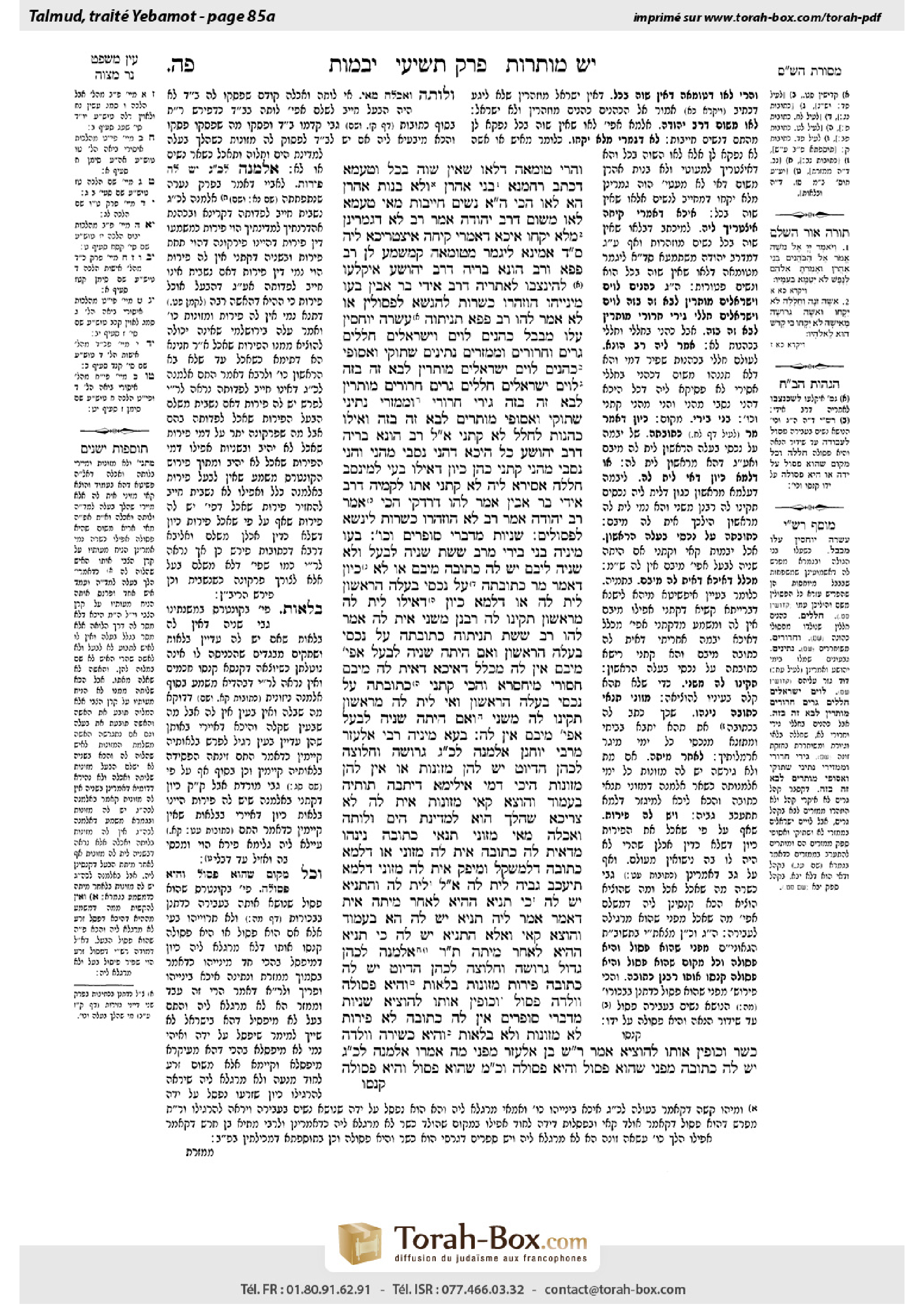
Yevamot 85a: Talmud study for Daf Yomi
Daf Yomi is the daily study of one Talmud folio. Explore 37 tractates with scans, Hebrew text, Sefaria English and AI-generated French translations where annotated.
Passage selection and English or AI-generated French translation are available where the scan has annotations. Daf Study is independent of Torah-Box and Sefaria.
Browse Yevamot · יבמות · All tractatesYevamot 85a text and translations
This page of Yevamot includes the Aramaic text, an English translation and an AI-generated French translation, alongside the scan above.
יבמות פ״ה א · Aramaic and Hebrew text
וַהֲרֵי טוּמְאָה, דְּלָאו שֶׁאֵין שָׁוֶה בַּכֹּל, וְטַעְמָא דִּכְתַב רַחֲמָנָא ״בְּנֵי אַהֲרֹן״ וְלֹא בְּנוֹת אַהֲרֹן, הָא לָאו הָכִי, הֲוָה אָמֵינָא נָשִׁים חַיָּיבוֹת, מַאי טַעְמָא? לָאו מִשּׁוּם דְּרַב יְהוּדָה אָמַר רַב?
לָא, דְּגָמְרִינַן מִ״לֹּא יִקָּחוּ״.
אִיכָּא דְּאָמְרִי: קִיחָה אִיצְטְרִיכָא לֵיהּ, סָלְקָא דַּעְתָּךְ אָמֵינָא: לִיגְמַר מִטּוּמְאָה — קָמַשְׁמַע לַן.
רַב פָּפָּא וְרַב הוּנָא בְּרֵיהּ דְּרַב יְהוֹשֻׁעַ אִיקְּלַעוּ לְהִינְצְבוּ, לְאַתְרֵיהּ דְּרַב אִידִי בַּר אָבִין. בְּעוֹ מִינַּיְיהוּ: הוּזְהֲרוּ כְּשֵׁרוֹת לְהִנָּשֵׂא לִפְסוּלִין, אוֹ לָא?
אֲמַר לְהוּ רַב פָּפָּא, תְּנֵיתוּהָ: עֲשָׂרָה יוּחֲסִין עָלוּ מִבָּבֶל: כֹּהֲנִים, לְוִיִּם, וְיִשְׂרְאֵלִים, חֲלָלִים, גֵּרִים, וַחֲרוּרִים, וּמַמְזֵרִים, נְתִינִים, שְׁתוּקֵי, וַאֲסוּפֵי. כֹּהֲנִים לְוִיִּם יִשְׂרְאֵלִים — מוּתָּרִין לָבֹא זֶה בָּזֶה. לְוִיִּם, יִשְׂרְאֵלִים, חֲלָלִים, גֵּרִים, חֲרוּרִים — מוּתָּרִין לָבֹא זֶה בָּזֶה. גֵּירֵי, חֲרוֹרֵי, וּמַמְזֵרֵי, נְתִינֵי, שְׁתוּקֵי, וַאֲסוּפֵי — מוּתָּרִים לָבֹא זֶה בָּזֶה. וְאִילּוּ כֹּהֶנֶת לְחָלָל — לָא קָתָנֵי.
אֲמַר לֵיהּ רַב הוּנָא בְּרֵיהּ דְּרַב יְהוֹשֻׁעַ: כֹּל הֵיכָא דְּהָנֵי נָסְבִי מֵהָנֵי וְהָנֵי נָסְבִי מֵהָנֵי — קָתָנֵי. כֹּהֵן, כֵּיוָן דְּאִילּוּ בָּעֵי לְמִינְסַב חֲלָלָה אֲסִירָא לֵיהּ — לָא קָתָנֵי. אֲתוֹ לְקַמֵּיהּ דְּרַב אִידִי בַּר אָבִין. אֲמַר לְהוּ: דַּרְדְּקֵי, הָכִי אָמַר רַב יְהוּדָה אָמַר רַב: לֹא הוּזְהֲרוּ כְּשֵׁרוֹת לִינָּשֵׂא לִפְסוּלִים.
שְׁנִיּוֹת מִדִּבְרֵי סוֹפְרִים וְכוּ׳. בְּעוֹ מִינֵּיהּ בְּנֵי בֵירֵי מֵרַב שֵׁשֶׁת: שְׁנִיָּה לַבַּעַל וְלֹא שְׁנִיָּה לַיָּבָם, יֵשׁ לָהּ כְּתוּבָּה מִיָּבָם אוֹ לָא? כֵּיוָן דְּאָמַר מָר: כְּתוּבָּתָהּ עַל נִכְסֵי בַּעְלָהּ הָרִאשׁוֹן — לֵית לַהּ,
אוֹ דִלְמָא: כֵּיוָן דְּאִילּוּ לֵית לַהּ מֵרִאשׁוֹן, תַּקִּינוּ לַהּ רַבָּנַן מִשֵּׁנִי — אִית לַהּ?
אֲמַר לְהוּ רַב שֵׁשֶׁת, תְּנֵיתוּהָ: כְּתוּבָּתָהּ עַל נִכְסֵי בַּעְלָהּ הָרִאשׁוֹן. וְאִם הָיְתָה שְׁנִיָּה לַבַּעַל — אֲפִילּוּ מִיָּבָם אֵין לָהּ.
מִכְּלָל דְּאִיכָּא דְּאִית לַהּ מִיָּבָם? חַסּוֹרֵי מִיחַסְּרָא, וְהָכִי קָתָנֵי: כְּתוּבָּתָהּ עַל נִכְסֵי בַּעְלָהּ הָרִאשׁוֹן, וְאִי לֵית לַהּ מֵרִאשׁוֹן — תַּקִּינוּ לַהּ מִשֵּׁנִי. וְאִם הָיְתָה שְׁנִיָּה לַבַּעַל — אֲפִילּוּ מִיָּבָם אֵין לָהּ.
בְּעָא מִינֵּיהּ רַבִּי אֶלְעָזָר מֵרַבִּי יוֹחָנָן: אַלְמָנָה לְכֹהֵן גָּדוֹל, גְּרוּשָׁה וַחֲלוּצָה לְכֹהֵן הֶדְיוֹט, יֵשׁ לָהֶן מְזוֹנוֹת אוֹ אֵין לָהֶן מְזוֹנוֹת? הֵיכִי דָמֵי: אִילֵּימָא דְּיָתְבָה תּוּתֵיהּ, בַּ״עֲמוֹד וְהוֹצֵא״ קָאֵי, מְזוֹנוֹת אִית לַהּ? לָא צְרִיכָא, שֶׁהָלַךְ הוּא לִמְדִינַת הַיָּם, וְלָוְתָה וְאָכְלָה. מַאי?
מְזוֹנֵי תְּנַאי כְּתוּבָה נִינְהוּ, מִדְּאִית לַהּ כְּתוּבָה אִית לַהּ מְזוֹנֵי, אוֹ דִלְמָא: כְּתוּבָּה דִּלְמִשְׁקַל וּמִיפַּק — אִית לַהּ, מְזוֹנֵי, דִּלְמָא תִּיעַכַּב גַּבֵּיהּ — לֵית לַהּ? אֲמַר לֵיהּ: לֵית לַהּ.
וְהָתַנְיָא: יֵשׁ לָהּ! כִּי תַּנְיָא הָהִיא — לְאַחַר מִיתָה.
אִית דְּאָמַר: אֲמַר לֵיהּ, תַּנְיָא: יֵשׁ לָהּ. הָא בַּ״עֲמוֹד וְהוֹצֵא״ קָאֵי? וְאֶלָּא, הָתַנְיָא יֵשׁ לָהּ! כִּי תַּנְיָא הָהִיא, לְאַחַר מִיתָה.
תָּנוּ רַבָּנַן: אַלְמָנָה לְכֹהֵן גָּדוֹל, גְּרוּשָׁה וַחֲלוּצָה לְכֹהֵן הֶדְיוֹט — יֵשׁ לָהּ כְּתוּבָּה, פֵּירוֹת, מְזוֹנוֹת, בְּלָאוֹת, וְהִיא פְּסוּלָה, וּוְלָדָהּ פָּסוּל, וְכוֹפִין אוֹתוֹ לְהוֹצִיא. שְׁנִיּוֹת מִדִּבְרֵי סוֹפְרִים — אֵין לָהּ כְּתוּבָּה, לֹא פֵּירוֹת, לֹא מְזוֹנוֹת, וְלֹא בְּלָאוֹת, וְהִיא כְּשֵׁירָה, וּוְלָדָהּ כָּשֵׁר, וְכוֹפִין אוֹתוֹ לְהוֹצִיא.
אָמַר רַבִּי שִׁמְעוֹן בֶּן אֶלְעָזָר: מִפְּנֵי מָה אָמְרוּ אַלְמָנָה לְכֹהֵן גָּדוֹל יֵשׁ לָהּ כְּתוּבָּה — מִפְּנֵי שֶׁהוּא פָּסוּל וְהִיא פְּסוּלָה. וְכׇל מָקוֹם שֶׁהוּא פָּסוּל וְהִיא פְּסוּלָה —
Yevamot 85a · English translation
The Gemara asks: But there is the prohibition for priests to contract ritual impurity from a corpse, which is a prohibition that is not equally applicable to all, as only priests are bound by this prohibition, and the reason that this command applies only to male priests is that the Merciful One writes: “Speak to the priests the sons of Aaron, and say to them: None shall defile himself” (Leviticus 21:1), from which it is inferred: The sons of Aaron and not the daughters of Aaron. Therefore, were it not for this specific derivation, I would say that women from priestly families are also obligated to avoid becoming ritually impure. What is the reason for this? Is it not due to the principle that Rav Yehuda said that Rav said, that women are equated to men with regard to all punishments in the Torah, including those that are not equally applicable to all?
The Gemara rejects this proof: No, that initial assumption, that the daughters of priests might be obligated to avoid ritual impurity, is not due to the halakha that Rav Yehuda said that Rav said, but rather it is something that we learn through tradition from the words “they may not take.” This phrase teaches that women are included in the marital prohibitions of the priesthood, and we might therefore have thought that they are included in all halakhot pertaining to priests.
There are those who say a different version of this answer: With regard to that verse about taking, it was necessary for him to mention this explicitly, for it might enter your mind to say: We should learn this halakha from the prohibition of impurity and conclude that just as only male descendants of Aaron are prohibited from contracting ritual impurity, the restrictions of marriage also apply only to men. The verse therefore teaches us, with the words “they may not take,” that this is not the case.
The Gemara relates: Rav Pappa and Rav Huna, son of Rav Yehoshua, arrived at the town of Hintzevu, to the place of Rav Idi bar Avin. The townspeople asked them: Is it prohibited for daughters of priests who are fit to marry priests to marry men disqualified from the priesthood or not?
Rav Pappa said to them: You learned it in a mishna (Kiddushin 69a): People of ten types of lineages ascended from Babylonia: Priests, Levites, and Israelites, ḥalalim, converts, and freed slaves, and mamzerim, Gibeonites, children of unknown paternity [shetukim], and foundlings. With regard to Priests, Levites, and Israelites, they are permitted to marry into one another’s families; Levites, Israelites, ḥalalim, converts, and freed slaves are permitted to marry into one another’s families; converts, freed slaves, and mamzerim, Gibeonites, shetukim, and foundlings are permitted to marry into one another’s families; whereas the tanna does not teach that priestesses, i.e., daughters of priests, are permitted to marry a ḥalal. This must mean they are forbidden to them.
Rav Huna, son of Rav Yehoshua, said to him: There is no proof from here, for he teaches the halakha anywhere that these men may marry those women, and there is also a parallel case where these women may marry those men. With regard to the case of a priest, however, since if he wants to marry a ḥalala this is prohibited to him, the tanna does not teach this halakha. Consequently, there is no proof from this mishna that daughters of priests who are fit to marry priests are warned against marrying men disqualified from the priesthood. They came before Rav Idi bar Avin and told him about the question and their debate about the matter. He said to them: Children, this is what Rav Yehuda said that Rav said: Daughters of priests who are fit to marry priests are not warned against marrying men disqualified from the priesthood.
§ We learned in the mishna that secondary forbidden relatives, whose status is established by rabbinic law, are sometimes forbidden to the husband and sometimes to the yavam. The residents of the town of Biri inquired of Rav Sheshet: Is a woman who is a secondary forbidden relative of the husband but not a secondary forbidden relative of the yavam entitled to a marriage contract from the yavam or not? The Gemara clarifies the sides of the dilemma: Perhaps, since the Master said that in a levirate marriage, the payment of her marriage contract is due from the property of her first husband, and this woman, who was a secondary relative of her first husband, does not receive a marriage contract from him, she consequently does not have the right to one from the yavam either.
Or perhaps, since there is a principle in levirate marriage that if she does not have a marriage contract from the first husband, e.g., he died without leaving behind any property, the Sages instituted a marriage contract for her from the second one, we should say that she has a marriage contract from the yavam?
Rav Sheshet said to them: You learned it in a baraita: Payment of her marriage contract is due from the property of her first husband, and if she was a secondary forbidden relative of the husband, she does not have one even from the yavam. This baraita clearly answers the question.
The Gemara asks: Can it be concluded by inference from the baraita that there is a case of a woman in a levirate marriage who does have a marriage contract from the yavam? The Gemara answers: The baraita is incomplete and this is what it is teaching: Payment of her marriage contract is due from the property of her first husband, and if she does not have anything from the first husband because he died without property, they instituted a marriage contract for her from the second one. And if she was a secondary forbidden relative of the husband, she does not have one even from the yavam.
Rabbi Elazar inquired of Rabbi Yoḥanan: Do women in cases like a widow married to a High Priest and a divorcée or a ḥalutza married to a common priest have rights to payment for their sustenance from their husbands, or do they not have a right to sustenance? The Gemara asks: What are the circumstances of the case under discussion? If we say that she is dwelling under his roof, he stands in a position where he is obligated to arise and divorce her. In such a situation, does she have a right to sustenance? It is obvious that she does not. The Gemara clarifies: No, it is necessary to ask this question with regard to a case where he went overseas and therefore is not present to divorce her, and in the meantime she borrowed money for her sustenance and ate. What is the halakha in that case?
Is it correct to say that sustenance is a stipulation in the marriage contract, and since she has a marriage contract she also has a right to sustenance, and therefore the husband must pay her debt? Or perhaps there is a difference between the cases: Concerning a marriage contract, which gives her motivation to take the money and leave him, she has rights to it, as the Sages wanted to motivate her to seek divorce and end the prohibited marriage. However, with regard to sustenance, we are worried that if he provides for her sustenance, perhaps she might tarry with him, as she would have no reason to rush the divorce, and consequently she does not have rights to it. He said to him: She does not have a right to sustenance.
The Gemara raises a difficulty: But isn’t it taught in a baraita that she does have a right to sustenance? The Gemara answers: When that baraita is taught, it is referring to sustenance she receives after his death. At that point, she is no longer in violation of a prohibition, while the obligation to sustain her remains intact.
Some say a different version of the discussion, which is that he said to him: It is taught in a baraita that she has a right to sustenance. He replied: He stands in a position where he is obligated to arise and divorce her. He should not be required to provide for her sustenance. He again asked: But isn’t it taught in a baraita that she has a right to sustenance? He responded: When that baraita is taught it is referring to the period after his death.
The Sages taught: A widow married to a High Priest, or a divorcée or a ḥalutza married to a common priest has the right to receive payment for her marriage contract; and for the produce of her property that her husband used; and sustenance; and she gets back her worn clothes and other objects she brought to the marriage; and she is disqualified as a ḥalala from marrying a priest; and her offspring is disqualified from the priesthood as a ḥalal; and the court forces him to divorce her. A woman who is a secondary relative prohibited by rabbinic law has neither a marriage contract; nor payment for the produce of her property; nor sustenance; nor does she get back her worn clothes; and she is fit to marry a priest and her offspring is fit for the priesthood; and the court forces him to divorce her.
Rabbi Shimon ben Elazar said: For what reason did they say that a widow married to a High Priest has a marriage contract? Because he is disqualified from the priesthood by his marriage to her, as a priest who marries a woman forbidden to him is barred from the Temple service until he divorces her and agrees not to remarry her, and she is rendered a ḥalala and disqualified from the priesthood by intercourse with him, and any place where he is disqualified and she is disqualified,
Yevamot 85a · Traduction française (IA)
La Guemara demande : Mais il y a l’interdiction faite aux prêtres de contracter l’impureté rituelle au contact d’un mort, interdiction qui ne s’applique pas à tous de la même manière, puisque seuls les prêtres y sont astreints. Si ce commandement ne s’applique qu’aux prêtres de sexe masculin, c’est parce que le Miséricordieux écrit : « Parle aux prêtres, fils d’Aaron, et dis-leur : Que nul ne se rende impur » (Lévitique 21, 1), d’où l’on déduit : les fils d’Aaron, mais non les filles d’Aaron. Par conséquent, sans cette déduction particulière, j’aurais dit que les femmes issues de familles sacerdotales sont elles aussi tenues d’éviter de se rendre rituellement impures. Pour quelle raison ? N’est-ce pas en vertu du principe que Rav Yehouda a rapporté au nom de Rav, selon lequel les femmes sont assimilées aux hommes pour toutes les sanctions prévues par la Torah, y compris celles qui ne s’appliquent pas à tous de la même manière ?
La Guemara rejette cette preuve : Non, cette supposition initiale selon laquelle les filles de prêtres pourraient être tenues d’éviter l’impureté rituelle ne découle pas de la halakha rapportée par Rav Yehouda au nom de Rav ; nous l’apprenons plutôt par tradition des mots « elles ne prendront pas ». Cette expression enseigne que les femmes sont incluses dans les interdictions matrimoniales propres à la prêtrise ; on aurait donc pu penser qu’elles sont incluses dans toutes les halakhot concernant les prêtres.
Certains donnent une autre version de cette réponse : au sujet du verset concernant le fait de prendre épouse, il fallait le mentionner explicitement, car on aurait pu penser : nous devrions déduire cette halakha de l’interdiction de contracter l’impureté et conclure que, de même que seuls les descendants masculins d’Aaron sont soumis à l’interdiction de contracter l’impureté rituelle, les restrictions matrimoniales ne s’appliquent elles aussi qu’aux hommes. Le verset nous enseigne donc, par les mots « elles ne prendront pas », qu’il n’en est pas ainsi.
La Guemara rapporte : Rav Pappa et Rav Houna, fils de Rav Yehoshoua, arrivèrent dans la ville de Hintzevu, chez Rav Idi bar Avin. Les habitants leur demandèrent : Est-il interdit aux filles de prêtres aptes à épouser des prêtres d’épouser des hommes disqualifiés pour la prêtrise, ou non ?
Rav Pappa leur dit : Vous l’avez appris dans une Michna (Kiddouchin 69a) : dix catégories de lignées montèrent de Babylonie : les prêtres, les lévites et les Israélites, les ḥalalim, les convertis et les esclaves affranchis, les mamzerim, les Guivéonites, les enfants de paternité inconnue [shetukim] et les enfants trouvés. Les prêtres, les lévites et les Israélites peuvent se marier entre eux ; les lévites, les Israélites, les ḥalalim, les convertis et les esclaves affranchis peuvent se marier entre eux ; les convertis, les esclaves affranchis, les mamzerim, les Guivéonites, les shetukim et les enfants trouvés peuvent se marier entre eux. Or le tanna n’enseigne pas que les femmes de famille sacerdotale, c’est-à-dire les filles de prêtres, peuvent épouser un ḥalal. Cela signifie nécessairement que cela leur est interdit.
Rav Houna, fils de Rav Yehoshoua, lui dit : Cela ne prouve rien, car le tanna enseigne la halakha chaque fois que ces hommes peuvent épouser ces femmes, et il existe aussi un cas parallèle où ces femmes peuvent épouser ces hommes. Dans le cas d’un prêtre, toutefois, puisqu’il lui est interdit d’épouser une ḥalala, le tanna n’enseigne pas cette halakha. Par conséquent, cette Michna ne prouve pas que les filles de prêtres aptes à épouser des prêtres sont averties de ne pas épouser des hommes disqualifiés pour la prêtrise. Ils se présentèrent devant Rav Idi bar Avin et lui exposèrent la question ainsi que leur débat à ce sujet. Il leur dit : Mes enfants, voici ce que Rav Yehouda a rapporté au nom de Rav : les filles de prêtres aptes à épouser des prêtres ne sont pas averties de ne pas épouser des hommes disqualifiés pour la prêtrise.
§ Nous avons appris dans la Michna que les parentes interdites au second degré par la loi rabbinique sont parfois interdites à l’époux et parfois au yavam. Les habitants de la ville de Biri demandèrent à Rav Sheshet : Une femme qui est une parente interdite au second degré pour son époux, mais pas pour le yavam, a-t-elle droit à une ketouba de la part du yavam, ou non ? La Guemara précise les deux possibilités du dilemme : peut-être que, puisque le Maître a dit que, dans un mariage léviratique, sa ketouba est prélevée sur les biens de son premier mari, et que cette femme, qui était une parente interdite au second degré pour son premier mari, ne reçoit pas de ketouba de sa part, elle n’a donc pas non plus droit à une ketouba de la part du yavam.
Ou peut-être que, puisqu’il existe un principe en matière de mariage léviratique selon lequel, si elle n’a pas de ketouba à percevoir de son premier mari, par exemple parce qu’il est mort sans laisser de biens, les Sages lui ont institué une ketouba à la charge du second, il faut conclure qu’elle a droit à une ketouba de la part du yavam ?
Rav Sheshet leur dit : Vous l’avez appris dans une baraïta : sa ketouba est prélevée sur les biens de son premier mari ; si elle était une parente interdite au second degré pour son époux, elle n’a pas droit à une ketouba, même de la part du yavam. Cette baraïta répond clairement à la question.
La Guemara demande : Peut-on déduire de la baraïta qu’il existe un cas où une femme en mariage léviratique a droit à une ketouba de la part du yavam ? La Guemara répond : La baraïta est incomplète, et voici ce qu’elle enseigne : sa ketouba est prélevée sur les biens de son premier mari ; si elle ne peut rien percevoir de son premier mari parce qu’il est mort sans laisser de biens, les Sages lui ont institué une ketouba à la charge du second. Mais si elle était une parente interdite au second degré pour son époux, elle n’a pas droit à une ketouba, même de la part du yavam.
Rabbi Elazar demanda à Rabbi Yoḥanan : Les femmes dans des cas tels qu’une veuve mariée à un grand prêtre, ou une divorcée ou une ḥaloutsa mariée à un prêtre ordinaire, ont-elles droit à une pension alimentaire de la part de leurs maris, ou n’y ont-elles pas droit ? La Guemara demande : Quelles sont les circonstances du cas discuté ? Si nous supposons qu’elle vit sous son toit, il est dans une situation où il est tenu de se lever et de la répudier. Dans ce cas, aurait-elle droit à une pension alimentaire ? Il est évident qu’elle n’y a pas droit. La Guemara précise : Non, la question porte sur le cas où il est parti outre-mer et n’est donc pas là pour la répudier, et où, entre-temps, elle a emprunté de l’argent pour subvenir à ses besoins. Quelle est la halakha dans ce cas ?
Faut-il dire que la pension alimentaire est une clause de la ketouba et que, puisqu’elle a une ketouba, elle a également droit à une pension alimentaire, de sorte que le mari doit rembourser la dette qu’elle a contractée ? Ou peut-être faut-il distinguer les cas : en ce qui concerne la ketouba, qui l’incite à prendre l’argent et à le quitter, elle y a droit, car les Sages ont voulu l’inciter à demander le divorce et à mettre fin au mariage interdit. Mais, en ce qui concerne la pension alimentaire, nous craignons que, s’il subvient à ses besoins, elle ne s’attarde auprès de lui, puisqu’elle n’aurait aucune raison de hâter le divorce ; par conséquent, elle n’y a pas droit. Il lui répondit : Elle n’a pas droit à une pension alimentaire.
La Guemara soulève une difficulté : Mais n’est-il pas enseigné dans une baraïta qu’elle a droit à une pension alimentaire ? La Guemara répond : Cette baraïta se rapporte à la pension alimentaire qu’elle reçoit après la mort de son mari. À ce moment-là, elle ne transgresse plus aucune interdiction, tandis que l’obligation de subvenir à ses besoins demeure.
Certains rapportent une autre version de la discussion : il lui dit qu’une baraïta enseigne qu’elle a droit à une pension alimentaire. Il lui répondit : Il est dans une situation où il est tenu de se lever et de la répudier ; il ne devrait pas être tenu de subvenir à ses besoins. Il demanda de nouveau : Mais n’est-il pas enseigné dans une baraïta qu’elle a droit à une pension alimentaire ? Il répondit : Cette baraïta se rapporte à la période qui suit la mort de son mari.
Les Sages ont enseigné : une veuve mariée à un grand prêtre, ou une divorcée ou une ḥaloutsa mariée à un prêtre ordinaire, a droit au paiement de sa ketouba, aux fruits de ses biens utilisés par son mari, à une pension alimentaire et à la restitution de ses vêtements usés et des autres objets qu’elle a apportés au mariage. Elle est disqualifiée en tant que ḥalala et ne peut épouser un prêtre ; sa descendance est disqualifiée pour la prêtrise en tant que ḥalal ; et le tribunal le contraint à la répudier. Une femme qui est une parente interdite au second degré selon la loi rabbinique n’a droit ni à une ketouba, ni au paiement des fruits de ses biens, ni à une pension alimentaire, ni à la restitution de ses vêtements usés ; elle peut épouser un prêtre et sa descendance est apte à la prêtrise ; et le tribunal le contraint à la répudier.
Rabbi Shimon ben Elazar a dit : Pour quelle raison a-t-on dit qu’une veuve mariée à un grand prêtre a droit à une ketouba ? Parce que lui est disqualifié pour la prêtrise du fait de son mariage avec elle : un prêtre qui épouse une femme qui lui est interdite est exclu du service au Temple jusqu’à ce qu’il la répudie et accepte de ne pas l’épouser de nouveau ; quant à elle, elle devient ḥalala et est disqualifiée pour la prêtrise par les rapports sexuels qu’elle a avec lui. Et partout où lui est disqualifié et elle est disqualifiée,
Traduction française générée par IA à partir de l’édition anglaise de Sefaria. Vérifie toujours un passage avec le texte source.
Text from Sefaria: William Davidson Edition - Vocalized Aramaic (CC BY NC); William Davidson Edition - English (CC BY NC).