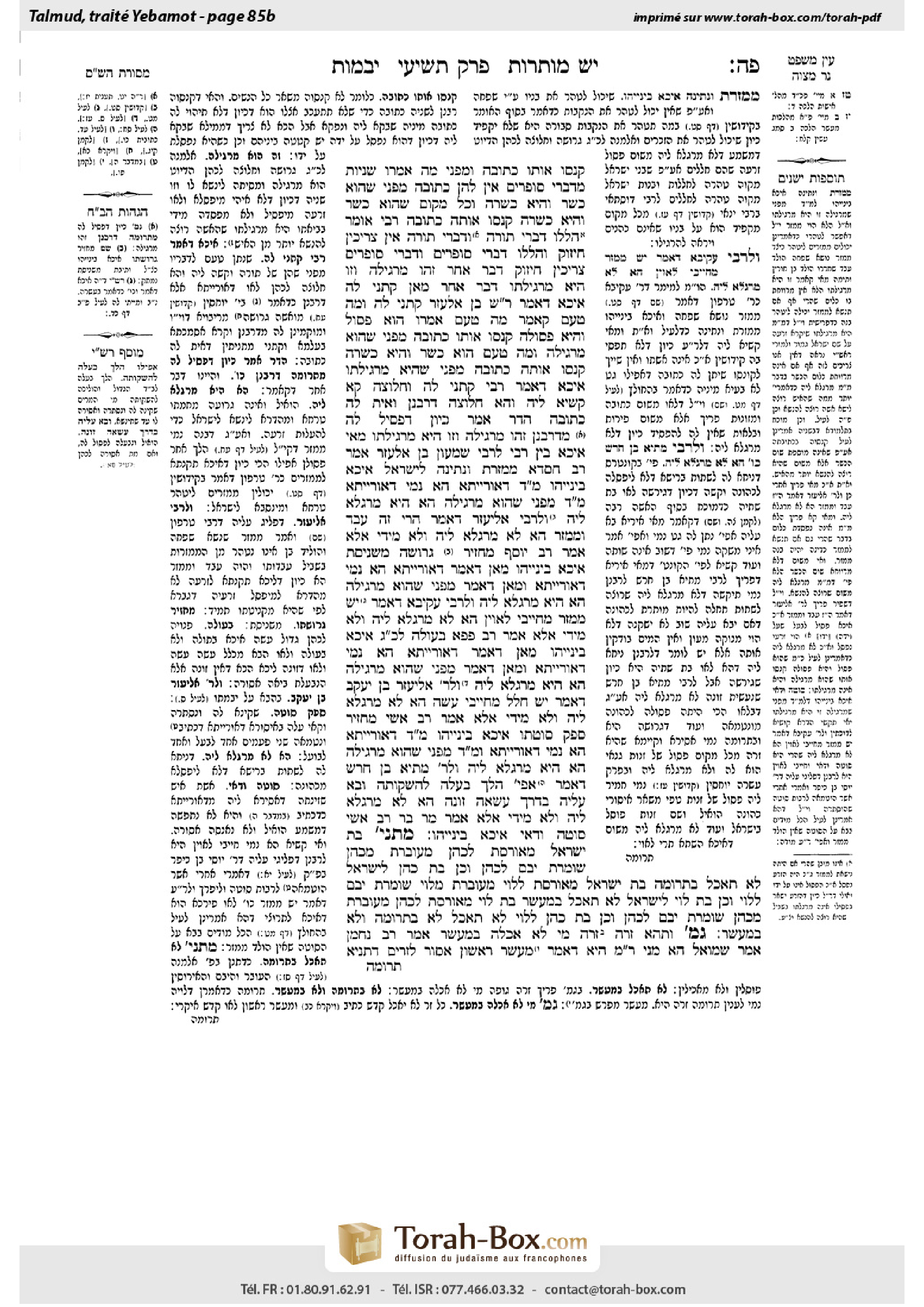
Yevamot 85b: Talmud study for Daf Yomi
Daf Yomi is the daily study of one Talmud folio. Explore 37 tractates with scans, Hebrew text, Sefaria English and AI-generated French translations where annotated.
Passage selection and English or AI-generated French translation are available where the scan has annotations. Daf Study is independent of Torah-Box and Sefaria.
Browse Yevamot · יבמות · All tractatesYevamot 85b text and translations
This page of Yevamot includes the Aramaic text, an English translation and an AI-generated French translation, alongside the scan above.
יבמות פ״ה ב · Aramaic and Hebrew text
קָנְסוּ אוֹתוֹ כְּתוּבָּה. וּמִפְּנֵי מָה אָמְרוּ שְׁנִיּוֹת מִדִּבְרֵי סוֹפְרִים אֵין לָהֶן כְּתוּבָּה — מִפְּנֵי שֶׁהוּא כָּשֵׁר וְהִיא כְּשֵׁרָה. וְכׇל מָקוֹם שֶׁהוּא כָּשֵׁר וְהִיא כְּשֵׁרָה — קָנְסוּ אוֹתָהּ כְּתוּבָּה.
רַבִּי אוֹמֵר: הַלָּלוּ דִּבְרֵי תוֹרָה — וְדִבְרֵי תוֹרָה אֵין צְרִיכִין חִיזּוּק. וְהַלָּלוּ דִּבְרֵי סוֹפְרִים — וְדִבְרֵי סוֹפְרִים צְרִיכִין חִיזּוּק. דָּבָר אַחֵר: זֶה — הוּא מַרְגִּילָהּ, וְזוֹ — הִיא מַרְגִּילָתוֹ.
דָּבָר אַחֵר מַאן קָתָנֵי לַהּ? אִיכָּא דְּאָמַר: רַבִּי שִׁמְעוֹן בֶּן אֶלְעָזָר קָתָנֵי לַהּ, וּמָה טַעַם קָאָמַר. מָה טַעַם אָמְרוּ הוּא פָּסוּל וְהִיא פְּסוּלָה קָנְסוּ אוֹתוֹ כְּתוּבָּה — מִפְּנֵי שֶׁהוּא מַרְגִּילָהּ. וּמָה טַעַם הוּא כָּשֵׁר וְהִיא כְּשֵׁרָה קָנְסוּ אוֹתָהּ כְּתוּבָּה — מִפְּנֵי שֶׁהִיא מַרְגִּילָתוֹ.
אִיכָּא דְּאָמַר: רַבִּי קָתָנֵי לַהּ, וַחֲלוּצָה קָא קַשְׁיָא לֵיהּ: וְהָא חֲלוּצָה דְּרַבָּנַן, וְאִית לַהּ כְּתוּבָּה! הֲדַר אָמַר: כֵּיוָן דְּפָסֵיל לָהּ מִדְּרַבָּנַן, זֶה — הוּא מַרְגִּילָהּ, וְזוֹ — הִיא מַרְגִּילָתוֹ.
מַאי אִיכָּא בֵּין רַבִּי לְרַבִּי שִׁמְעוֹן בֶּן אֶלְעָזָר? אָמַר רַב חִסְדָּא: מַמְזֶרֶת וּנְתִינָה לְיִשְׂרָאֵל אִיכָּא בֵּינַיְיהוּ.
מַאן דְּאָמַר דְּאוֹרָיְיתָא — הָא נָמֵי דְּאוֹרָיְיתָא, מַאן דְּאָמַר מִפְּנֵי שֶׁהוּא מַרְגִּילָהּ — הָא הִיא מַרְגְּלָא לֵיהּ.
וּלְרַבִּי אֱלִיעֶזֶר דְּאָמַר הֲרֵי זֶה עֶבֶד וּמַמְזֵר, הָא לָא מַרְגְּלָא לֵיהּ וְלָא מִידֵּי! אֶלָּא אָמַר רַב יוֹסֵף: מַחֲזִיר גְּרוּשָׁה מִשֶּׁנִּיסֵּת אִיכָּא בֵּינַיְיהוּ. מַאן דְּאָמַר דְּאוֹרָיְיתָא — הָא נָמֵי דְּאוֹרָיְיתָא, וּמַאן דְּאָמַר מִפְּנֵי שֶׁהוּא מַרְגִּילָהּ — הָא הִיא מַרְגְּלָא לֵיהּ.
וּלְרַבִּי עֲקִיבָא דְּאָמַר יֵשׁ מַמְזֵר מֵחַיָּיבֵי לָאוִין, הָא לָא מַרְגְּלָא לֵיהּ וְלָא מִידֵּי! אֶלָּא אָמַר רַב פָּפָּא: בְּעוּלָה לְכֹהֵן גָּדוֹל אִיכָּא בֵּינַיְיהוּ. מַאן דְּאָמַר דְּאוֹרָיְיתָא — הָא נָמֵי דְּאוֹרָיְיתָא, וּמַאן דְּאָמַר מִפְּנֵי שֶׁהוּא מַרְגִּילָהּ — הָא הִיא מַרְגְּלָא לֵיהּ.
וּלְרַבִּי אֱלִיעֶזֶר בֶּן יַעֲקֹב דְּאָמַר יֵשׁ חָלָל מֵחַיָּיבֵי עֲשֵׂה, הָא לָא מַרְגְּלָא לֵיהּ וְלָא מִידֵּי! אֶלָּא אָמַר רַב אָשֵׁי: מַחֲזִיר סָפֵק סוֹטָתוֹ אִיכָּא בֵּינַיְיהוּ.
מַאן דְּאָמַר דְּאוֹרָיְיתָא — הָא נָמֵי דְּאוֹרָיְיתָא, וּמַאן דְּאָמַר מִפְּנֵי שֶׁהוּא מַרְגִּילָהּ — הָא הִיא מַרְגְּלָא לֵיהּ. וּלְרַבִּי מַתְיָא בֶּן חָרָשׁ, דְּאָמַר: אֲפִילּוּ הָלַךְ בַּעְלָהּ לְהַשְׁקוֹתָהּ, וּבָא עָלֶיהָ בַּדֶּרֶךְ — עֲשָׂאָהּ זוֹנָה, הָא לָא מַרְגְּלָא לֵיהּ וְלָא מִידֵּי! אֶלָּא אָמַר מָר בַּר רַב אָשֵׁי: סוֹטָה וַדַּאי אִיכָּא בֵּינַיְיהוּ.
מַתְנִי׳ בַּת יִשְׂרָאֵל מְאוֹרֶסֶת לְכֹהֵן, מְעוּבֶּרֶת מִכֹּהֵן, שׁוֹמֶרֶת יָבָם לְכֹהֵן, וְכֵן בַּת כֹּהֵן לְיִשְׂרָאֵל — לֹא תֹּאכַל בִּתְרוּמָה. בַּת יִשְׂרָאֵל מְאוֹרֶסֶת לְלֵוִי, מְעוּבֶּרֶת מִלֵּוִי, שׁוֹמֶרֶת יָבָם לְלֵוִי, וְכֵן בַּת לֵוִי לְיִשְׂרָאֵל — לֹא תֹּאכַל בְּמַעֲשֵׂר.
בַּת לֵוִי מְאוֹרֶסֶת לְכֹהֵן, מְעוּבֶּרֶת מִכֹּהֵן, שׁוֹמֶרֶת יָבָם לְכֹהֵן, וְכֵן בַּת כֹּהֵן לְלֵוִי — לֹא תֹאכַל לֹא בִּתְרוּמָה וְלֹא בְּמַעֲשֵׂר.
גְּמָ׳ וּתְהֵא זָרָה, זָרָה מִי לָא אָכְלָה בְּמַעֲשֵׂר?! אָמַר רַב נַחְמָן אָמַר שְׁמוּאֵל: הָא מַנִּי — רַבִּי מֵאִיר הִיא, דְּאָמַר: מַעֲשֵׂר רִאשׁוֹן אָסוּר לְזָרִים. דְּתַנְיָא:
Yevamot 85b · English translation
they penalized him through the marriage contract. In other words, the Sages did not exempt him from payment of the marriage contract in that case. Since he is disqualified from the priesthood until he divorces her, the marriage will not last, and they did not force her to forfeit her marriage contract. And for what reason did they say that women forbidden as secondary relatives by rabbinic law do not have a marriage contract? Because he is fit for the priesthood and she is similarly fit, the couple therefore sees no need to divorce, and any place where he is fit and she is fit they penalized her by exempting him from payment of the marriage contract, in order to speed up the divorce.
Rabbi Yehuda HaNasi says a different reason: These cases, a widow married to a High Priest and a divorcée married to a common priest, are prohibited by Torah law, and Torah law does not require strengthening by means of additional enactments. But those secondary relatives are forbidden by rabbinic law, and rabbinic law does require strengthening. Alternatively, the Gemara presents a second explanation: In this case, when they are both disqualified, it is he who encourages her to live with him despite the deleterious effect the prohibition will have on her and her offspring. Therefore, they penalized him by making him pay the marriage contract. But in that case, when they both remain fit for the priesthood despite the prohibited nature of their marriage, it is she who encourages him, and they consequently penalized her.
The Gemara asks: Who teaches the alternative explanation; whose opinion does it follow? Some say that Rabbi Shimon ben Elazar teaches it and is saying: What is the reason? In other words, the latter part of the baraita provides the rationale for the previous statement: What is the reason that they said that if he is disqualified from the priesthood and she is similarly disqualified, they penalized him through the marriage contract? It is because in such a case he primarily encourages her to violate the prohibition, as the main disqualification concerns her, so they penalize him for enticing her to sin. And for what reason did they say that when he is fit and she is fit they penalized her through the marriage contract? It is because in such a case she encourages him, since she is not disqualified and therefore may care less about the sin. The Sages therefore penalized her.
Conversely, some say that Rabbi Yehuda HaNasi is the one who teaches it, and the case of a ḥalutza poses a difficulty to his opinion, as it seems to contradict his principle that rabbinic law requires strengthening: A ḥalutza is forbidden to a priest by rabbinic law, and yet she does have a marriage contract. In response, he then said an additional explanation: Since he disqualifies her from the priesthood by rabbinic law, in this case it is he who encourages her, and in that case of secondary relatives, when neither of them is disqualified, she encourages him.
The Gemara asks: Practically speaking, what difference is there between the explanations of Rabbi Yehuda HaNasi and Rabbi Shimon ben Elazar? Rav Ḥisda said: The practical difference between them concerns the cases of a mamzeret or a Gibeonite woman married to a Jew of unflawed lineage.
According to the one who says that the reason the marriage contract is not revoked from a widow who is married to the High Priest is because this relationship is prohibited by Torah law, which doesn’t require strengthening, this too is by Torah law, and therefore she receives her marriage contract. But according to the one who says it is because he encourages her, in this case she encourages him, as the woman is disqualified regardless, and she wants to marry a Jew because there is a way for her descendants to be fit to enter the congregation: If her mamzer son marries a maidservant and has children, they will be slaves who can then be freed and enter the congregation.
The Gemara asks: But according to Rabbi Eliezer, who said in a mishna (Kiddushin 69a) that if a mamzer marries a maidservant and they have a child, their son is both a slave and a mamzer, since she has no hope of her descendants being fit to enter into the congregation, she does not encourage him at all. Rather, Rav Yosef said: The practical difference between them is with regard to one who remarries his divorcée after she has married another man. According to the one who says that it depends on whether the prohibition is by Torah law, this too is prohibited by Torah law. And according to the one who says it is because he encourages her, in this case she encourages him, as she and her children are unaffected by this marriage.
The Gemara raises a difficulty: But according to Rabbi Akiva, who said that offspring from forbidden intercourse for which one is liable for violating a prohibition is a mamzer, she does not encourage him at all, because according to this opinion her children would be adversely affected by the marriage. Rather, Rav Pappa said: The practical difference between them involves a non-virgin married to a High Priest. According to the one who says that it depends on whether the prohibition is by Torah law, this too is prohibited by Torah law. And according to the one who says it is because he encourages her, in this case she encourages him, as the marriage merely violates a positive mitzva, which does not disqualify her children.
The Gemara asks: But according to Rabbi Eliezer ben Ya’akov, who said that offspring conceived through intercourse with a priest for which one is liable for violating a positive mitzva is a ḥalal, she does not encourage him at all. Rather, Rav Ashi said: The practical difference between them is with regard to the case of one who remarries his wife when there is an uncertainty if she is an adulteress. If a married woman was in seclusion with another man after her husband had become suspicious and had warned her concerning that man, and the husband did not subsequently bring her to be examined by the bitter waters as a sota, but rather continued to live with her, he has acted contrary to Torah law, as she is forbidden to him.
In this case, according to the one who says that it depends on whether the prohibition is by Torah law, this too is prohibited by Torah law. And according to the one who says it is because he encourages her, in this case she encourages him, as her children are not disqualified by such a relationship. The Gemara asks: But according to Rabbi Matya ben Ḥarash, who said that even if her husband went to cause her to drink the bitter waters and had intercourse with her on the way, he has thereby rendered her a zona and disqualified her from the priesthood, she does not encourage him at all. Rather, Mar bar Rav Ashi said: The practical difference between them is with regard to the case of a definite adulteress. In such a case, all agree that their children are not mamzerim, despite the prohibition against their cohabitation. Consequently, she encourages him to sin.
MISHNA: If there is an Israelite woman betrothed to a priest or pregnant from a priest, and he died; and a widow awaiting her yavam, who is a priest; and similarly, the daughter of a priest who is betrothed, pregnant from, or is a widow waiting for her yavam, who is an Israelite, she may not partake of teruma. If there is an Israelite woman betrothed to a Levite or pregnant from a Levite; and a widow awaiting her yavam, who is a Levite; and similarly the daughter of a Levite who is betrothed, pregnant from, or a widow waiting for her yavam, who is an Israelite, she may not partake of tithes.
If there is a daughter of a Levite betrothed to a priest or pregnant from a priest; and a widow awaiting her yavam, who is a priest; and similarly a daughter of a priest who is betrothed to or pregnant from a Levite, or is a widow waiting for her yavam, who is a Levite, she may partake of neither teruma nor tithes. This follows the halakha that betrothal, pregnancy, and waiting for a yavam disqualify the daughter of a priest from eating teruma, but they do not enable an Israelite woman to partake of teruma.
GEMARA: The mishna states that an Israelite woman betrothed to a Levite may not partake of tithes. The Gemara is puzzled by this ruling: And let her even be a complete foreigner who is not a Levite; may a foreigner not partake of tithes? In contradistinction to teruma, no special sanctity pertains to tithes; they are merely the possession of the Levite. What difference does it make, then, whether she is a Levite or not? Rav Naḥman said that Shmuel said: In accordance with whose opinion is this mishna? It is in accordance with the opinion of Rabbi Meir, who said that the first tithe is forbidden to foreigners, i.e., non-Levites, as it is taught in a baraita:
Yevamot 85b · Traduction française (IA)
Ils l’ont pénalisé au moyen de la ketouba. Autrement dit, dans ce cas, les Sages ne l’ont pas dispensé du paiement de la ketouba. Puisqu’il est disqualifié pour la prêtrise jusqu’à ce qu’il la divorce, leur mariage ne durera pas et ils ne l’ont pas contrainte à renoncer à sa ketouba. Pourquoi ont-ils dit que les femmes interdites comme parentes secondaires par la loi rabbinique n’ont pas droit à une ketouba ? Parce qu’il est apte à la prêtrise et qu’elle l’est également, le couple ne voit aucune raison de divorcer. Ainsi, chaque fois qu’il est apte et qu’elle l’est aussi, ils l’ont pénalisée en le dispensant du paiement de la ketouba, afin d’accélérer le divorce.
Rabbi Yehuda HaNasi donne une autre raison : ces cas — une veuve mariée à un grand prêtre et une divorcée mariée à un prêtre ordinaire — sont interdits par la Torah, et la Torah n’exige pas qu’on renforce ses dispositions par des décrets supplémentaires. En revanche, ces parentes secondaires sont interdites par la loi rabbinique, et la loi rabbinique, elle, exige d’être renforcée. Autre explication : dans ce cas, où ils sont tous deux disqualifiés, c’est lui qui l’encourage à vivre avec lui, malgré les conséquences néfastes que l’interdit aura pour elle et sa descendance. On l’a donc pénalisé en lui imposant le paiement de la ketouba. Mais dans l’autre cas, où tous deux restent aptes à la prêtrise malgré l’interdit qui frappe leur mariage, c’est elle qui l’encourage, et on l’a donc pénalisée.
La Guemara demande : Qui enseigne cette autre explication ? De quel avis s’agit-il ? Certains disent que c’est Rabbi Shimon ben Elazar qui l’enseigne et qui demande : Pour quelle raison ? Autrement dit, la dernière partie de la baraïta fournit la raison de l’affirmation précédente : pourquoi a-t-on dit que, s’il est disqualifié pour la prêtrise et qu’elle l’est également, on l’a pénalisé au moyen de la ketouba ? Parce que, dans un tel cas, c’est principalement lui qui l’incite à transgresser l’interdit, puisque la disqualification concerne surtout la femme ; on le pénalise donc pour l’avoir incitée à pécher. Pourquoi a-t-on dit que, lorsqu’il est apte et qu’elle l’est également, on l’a pénalisée au moyen de la ketouba ? Parce que, dans un tel cas, c’est elle qui l’incite, puisqu’elle n’est pas disqualifiée et peut donc se soucier moins de la faute. Les Sages l’ont donc pénalisée.
À l’inverse, certains disent que c’est Rabbi Yehuda HaNasi qui enseigne cette explication, et le cas d’une ḥaloutsa pose une difficulté à son avis, car il semble contredire son principe selon lequel la loi rabbinique doit être renforcée : une ḥaloutsa est interdite à un prêtre par la loi rabbinique, et pourtant elle a droit à une ketouba. Il donna alors une explication supplémentaire : puisqu’il la disqualifie pour la prêtrise par la loi rabbinique, c’est lui qui l’incite dans ce cas ; tandis que dans le cas des parentes secondaires, où aucun des deux n’est disqualifié, c’est elle qui l’incite.
La Guemara demande : En pratique, quelle différence y a-t-il entre les explications de Rabbi Yehuda HaNasi et de Rabbi Shimon ben Elazar ? Rav Ḥisda dit : La différence pratique entre eux concerne les cas d’une mamzéret ou d’une femme guibonite mariée à un Juif de filiation irréprochable.
Selon celui qui dit qu’on ne retire pas la ketouba à une veuve mariée au grand prêtre parce que cette union est interdite par la Torah, laquelle n’exige pas qu’on renforce ses dispositions, ce cas est lui aussi interdit par la Torah et elle reçoit donc sa ketouba. Mais selon celui qui dit que c’est parce qu’il l’encourage, dans ce cas, c’est elle qui l’encourage, car la femme est de toute façon disqualifiée et souhaite épouser un Juif, puisqu’il existe un moyen pour que ses descendants puissent être admis dans l’assemblée : si son fils mamzer épouse une servante et a des enfants, ceux-ci seront des esclaves qui pourront ensuite être affranchis et entrer dans l’assemblée.
La Guemara demande : Mais selon Rabbi Eliezer, qui a dit dans une Michna (Kiddushin 69a) que si un mamzer épouse une servante et qu’ils ont un enfant, leur fils est à la fois esclave et mamzer, puisqu’elle n’a aucun espoir que ses descendants puissent être admis dans l’assemblée, elle ne l’encourage nullement. Rav Yosef dit plutôt : La différence pratique entre eux concerne celui qui reprend son ex-femme après qu’elle a épousé un autre homme. Selon celui qui dit que cela dépend du fait que l’interdit relève ou non de la Torah, ce cas est lui aussi interdit par la Torah. Et selon celui qui dit que c’est parce qu’il l’encourage, dans ce cas, c’est elle qui l’encourage, car ni elle ni ses enfants ne sont affectés par ce mariage.
La Guemara soulève une difficulté : Mais selon Rabbi Akiva, qui a dit que la descendance issue d’un rapport interdit passible de la violation d’un interdit est mamzer, elle ne l’encourage nullement, car, selon cet avis, ses enfants seraient lésés par ce mariage. Rav Pappa dit plutôt : La différence pratique entre eux concerne une femme non vierge mariée à un grand prêtre. Selon celui qui dit que cela dépend du fait que l’interdit relève ou non de la Torah, ce cas est lui aussi interdit par la Torah. Et selon celui qui dit que c’est parce qu’il l’encourage, dans ce cas, c’est elle qui l’encourage, car ce mariage ne transgresse qu’une mitsva positive, ce qui ne disqualifie pas ses enfants.
La Guemara demande : Mais selon Rabbi Eliezer ben Ya’akov, qui a dit que la descendance conçue lors d’un rapport avec un prêtre passible de la violation d’une mitsva positive est ḥalal, elle ne l’encourage nullement. Rav Ashi dit plutôt : La différence pratique entre eux concerne le cas de celui qui reprend sa femme alors qu’il existe un doute quant à son adultère. Si une femme mariée s’est retrouvée seule avec un autre homme après que son mari a eu des soupçons et l’a mise en garde au sujet de cet homme, et que le mari ne l’a pas ensuite conduite à l’épreuve des eaux amères en tant que sota, mais a continué à vivre avec elle, il a agi à l’encontre de la Torah, car elle lui est interdite.
Dans ce cas, selon celui qui dit que cela dépend du fait que l’interdit relève ou non de la Torah, cette union est elle aussi interdite par la Torah. Et selon celui qui dit que c’est parce qu’il l’encourage, dans ce cas, c’est elle qui l’encourage, car ses enfants ne sont pas disqualifiés par une telle union. La Guemara demande : Mais selon Rabbi Matya ben Ḥarash, qui a dit que même si son mari l’a conduite pour lui faire boire les eaux amères et a eu des rapports avec elle en chemin, il l’a ainsi rendue zona et disqualifiée pour la prêtrise, elle ne l’encourage nullement. Mar bar Rav Ashi dit plutôt : La différence pratique entre eux concerne le cas d’une adultère avérée. Dans un tel cas, tous conviennent que leurs enfants ne sont pas mamzerim, malgré l’interdit qui frappe leur cohabitation. Par conséquent, elle l’encourage à pécher.
MICHNA : Si une Israélite est fiancée à un prêtre ou enceinte d’un prêtre, et que celui-ci meurt ; si une veuve attend son yavam, qui est prêtre ; et de même, si la fille d’un prêtre est fiancée à un Israélite, enceinte d’un Israélite ou veuve en attente de son yavam, qui est Israélite, elle ne peut pas consommer de terouma. Si une Israélite est fiancée à un Lévite ou enceinte d’un Lévite ; si une veuve attend son yavam, qui est Lévite ; et de même, si la fille d’un Lévite est fiancée à un Israélite, enceinte d’un Israélite ou veuve en attente de son yavam, qui est Israélite, elle ne peut pas consommer de première dîme.
Si la fille d’un Lévite est fiancée à un prêtre ou enceinte d’un prêtre ; si une veuve attend son yavam, qui est prêtre ; et de même, si la fille d’un prêtre est fiancée à un Lévite, enceinte d’un Lévite ou veuve en attente de son yavam, qui est Lévite, elle ne peut consommer ni terouma ni première dîme. Cela découle de la halakha selon laquelle les fiançailles, la grossesse et l’attente d’un yavam empêchent la fille d’un prêtre de consommer de la terouma, mais ne permettent pas à une Israélite d’en consommer.
GUEMARA : La Michna affirme qu’une Israélite fiancée à un Lévite ne peut pas consommer de première dîme. La Guemara s’étonne de cette décision : qu’elle soit même une étrangère complète, qui n’est pas lévite ; une étrangère ne peut-elle donc pas consommer de première dîme ? Contrairement à la terouma, la première dîme ne comporte aucune sainteté particulière ; elle appartient simplement au Lévite. Quelle différence cela fait-il alors qu’elle soit lévite ou non ? Rav Naḥman dit que Shmuel a dit : De quel avis cette Michna relève-t-elle ? De celui de Rabbi Meïr, qui a dit que la première dîme est interdite aux étrangers, c’est-à-dire aux non-Lévites, comme cela est enseigné dans une baraïta :
Traduction française générée par IA à partir de l’édition anglaise de Sefaria. Vérifie toujours un passage avec le texte source.
Text from Sefaria: William Davidson Edition - Vocalized Aramaic (CC BY NC); William Davidson Edition - English (CC BY NC).