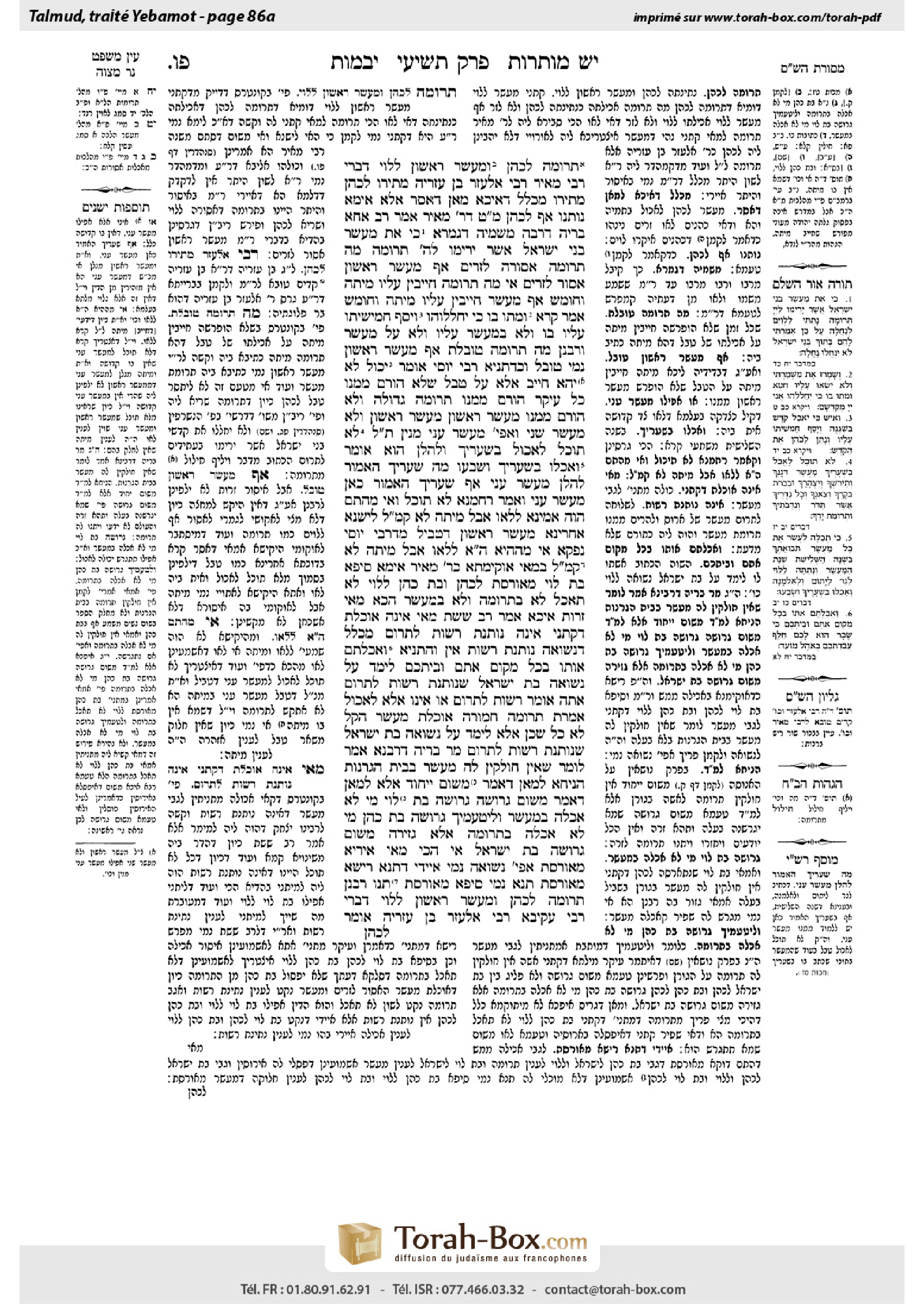
Yevamot 86a: Talmud study for Daf Yomi
Daf Yomi is the daily study of one Talmud folio. Explore 37 tractates with scans, Hebrew text, Sefaria English and AI-generated French translations where annotated.
Passage selection and English or AI-generated French translation are available where the scan has annotations. Daf Study is independent of Torah-Box and Sefaria.
Browse Yevamot · יבמות · All tractatesYevamot 86a text and translations
This page of Yevamot includes the Aramaic text, an English translation and an AI-generated French translation, alongside the scan above.
יבמות פ״ו א · Aramaic and Hebrew text
תְּרוּמָה לְכֹהֵן, וּמַעֲשֵׂר רִאשׁוֹן לְלֵוִי, דִּבְרֵי רַבִּי מֵאִיר. רַבִּי אֶלְעָזָר בֶּן עֲזַרְיָה מַתִּירוֹ לְכֹהֵן. מַתִּירוֹ?! מִכְּלָל דְּאִיכָּא מַאן דְּאָסַר? אֶלָּא אֵימָא: נוֹתְנוֹ אַף לְכֹהֵן.
מַאי טַעְמָא דְּרַבִּי מֵאִיר? אָמַר רַב אַחָא בְּרֵיהּ דְּרַבָּה מִשְּׁמֵיהּ דִּגְמָרָא: ״כִּי אֶת מַעְשַׂר בְּנֵי יִשְׂרָאֵל אֲשֶׁר יָרִימוּ לַה׳ תְּרוּמָה״. מָה תְּרוּמָה אֲסוּרָה לְזָרִים, אַף מַעֲשֵׂר רִאשׁוֹן אָסוּר לְזָרִים. אִי מָה תְּרוּמָה חַיָּיבִין עָלָיו מִיתָה וָחוֹמֶשׁ — אַף מַעֲשֵׂר חַיָּיבִין עָלָיו מִיתָה וָחוֹמֶשׁ?
אָמַר קְרָא: ״וּמֵתוּ בוֹ כִּי יְחַלְּלֻהוּ״, ״וְיָסַף חֲמִישִׁיתוֹ עָלָיו״. ״בּוֹ״ — וְלֹא בְּמַעֲשֵׂר, ״עָלָיו״ — וְלֹא עַל מַעֲשֵׂר. וְרַבָּנַן, מָה תְּרוּמָה טוֹבֶלֶת, אַף מַעֲשֵׂר רִאשׁוֹן נָמֵי טוֹבֵל.
וְכִדְתַנְיָא, רַבִּי יוֹסֵי אוֹמֵר: יָכוֹל לֹא יְהֵא חַיָּיב אֶלָּא עַל טֶבֶל שֶׁלֹּא הוּרַם מִמֶּנּוּ כׇּל עִיקָּר. הוּרַם מִמֶּנּוּ תְּרוּמָה גְּדוֹלָה וְלֹא הוּרַם מִמֶּנּוּ מַעֲשֵׂר רִאשׁוֹן מַעֲשֵׂר רִאשׁוֹן וְלֹא מַעֲשֵׂר שֵׁנִי, וַאֲפִילּוּ מַעְשַׂר עָנִי, מִנַּיִן?
תַּלְמוּד לוֹמַר: ״לֹא תוּכַל לֶאֱכוֹל בִּשְׁעָרֶיךָ״, וּלְהַלָּן הוּא אוֹמֵר: ״וְאָכְלוּ בִשְׁעָרֶיךָ וְשָׂבֵעוּ״. מָה ״שְׁעָרֶיךָ״ הָאָמוּר לְהַלָּן — מַעְשַׂר עָנִי, אַף ״שְׁעָרֶיךָ״ הָאָמוּר כָּאן — מַעְשַׂר עָנִי, וְאָמַר רַחֲמָנָא ״לֹא תוּכַל״.
וְאִי מֵהָתָם, הֲוָה אָמֵינָא לְלָאו, אֲבָל מִיתָה — לָא, קָא מַשְׁמַע לַן.
לִישָּׁנָא אַחֲרִינָא: מַעֲשֵׂר רִאשׁוֹן דְּטָבֵיל, מִדְּרַבִּי יוֹסֵי נָפְקָא! אִי מֵהַהִיא, הֲוָה אָמֵינָא לְלָאו, אֲבָל מִיתָה — לָא, קָא מַשְׁמַע לַן.
בְּמַאי אוֹקֵימְתַּהּ — כְּרַבִּי מֵאִיר, אֵימָא סֵיפָא: בַּת לֵוִי מְאוֹרֶסֶת לְכֹהֵן, וּבַת כֹּהֵן לְלֵוִי — לֹא תֹּאכַל לֹא בִּתְרוּמָה וְלֹא בְּמַעֲשֵׂר, הָכָא מַאי זָרוּת אִיכָּא! אָמַר רַב שֵׁשֶׁת: מַאי ״אֵינָהּ אוֹכֶלֶת״ דְּקָתָנֵי — אֵינָהּ נוֹתֶנֶת רְשׁוּת לִתְרוֹם.
מִכְלָל דִּנְשׂוּאָה נוֹתֶנֶת רְשׁוּת? אִין, וְהָתַנְיָא: ״וַאֲכַלְתֶּם אוֹתוֹ בְּכׇל מָקוֹם אַתֶּם וּבֵיתְכֶם״ — לִימֵּד עַל נְשׂוּאָה בַּת יִשְׂרָאֵל שֶׁנּוֹתֶנֶת רְשׁוּת לִתְרוֹם.
אַתָּה אוֹמֵר רְשׁוּת לִתְרוֹם, אוֹ אֵינוֹ אֶלָּא לֶאֱכוֹל? אָמְרַתְּ: תְּרוּמָה חֲמוּרָה אוֹכֶלֶת, מַעֲשֵׂר הַקַּל לֹא כׇּל שֶׁכֵּן?! אֶלָּא לִימֵּד עַל נְשׂוּאָה בַּת יִשְׂרָאֵל שֶׁנּוֹתֶנֶת רְשׁוּת לִתְרוֹם.
מָר בְּרֵיהּ דְּרַבְנָא אָמַר: לוֹמַר שֶׁאֵין חוֹלְקִין לָהּ מַעֲשֵׂר בְּבֵית הַגְּרָנוֹת. הָנִיחָא לְמַאן דְּאָמַר מִשּׁוּם יִיחוּד, אֶלָּא לְמַאן דְּאָמַר מִשּׁוּם גְּרוּשָׁה, גְּרוּשָׁה בַּת לֵוִי מִי לָא אָכְלָה בְּמַעֲשֵׂר?!
וְלִיטַעְמָיךְ, גְּרוּשָׁה בַּת כֹּהֵן מִי לָא אָכְלָה בִּתְרוּמָה? אֶלָּא גְּזֵירָה מִשּׁוּם גְּרוּשָׁה בַּת יִשְׂרָאֵל.
אִי הָכִי, מַאי אִירְיָא מְאוֹרֶסֶת? אֲפִילּוּ נְשׂוּאָה נָמֵי! אַיְּידֵי דִּתְנָא רֵישָׁא מְאוֹרֶסֶת, תְּנָא נָמֵי סֵיפָא מְאוֹרֶסֶת.
תָּנוּ רַבָּנַן: תְּרוּמָה לְכֹהֵן, וּמַעֲשֵׂר רִאשׁוֹן לְלֵוִי, דִּבְרֵי רַבִּי עֲקִיבָא. רַבִּי אֶלְעָזָר בֶּן עֲזַרְיָה אוֹמֵר:
Yevamot 86a · English translation
Teruma is for a priest and the first tithe is for a Levite; this is the statement of Rabbi Meir. Rabbi Elazar ben Azarya permits it, i.e., the first tithe, to a priest, as he too is from the tribe of Levi. The Gemara is puzzled by this last statement: It says: Permits it. Does this prove by inference that there is one tanna that prohibits a priest from partaking of tithes? But a priest is also a Levite and cannot be considered a foreigner. Rather, say that Rabbi Elazar ben Azarya meant that one may give it even to a priest. The tithe does not have to be handed to a Levite; one may choose to give it to a priest instead.
The Gemara inquires: What is the reason for Rabbi Meir’s opinion? Rav Aḥa, son of Rabba, said in the name of tradition that the verse states: “For the tithe of the children of Israel that they set apart as a teruma to the Lord, I have given to the Levites for an inheritance” (Numbers 18:24). From the fact that this verse calls the tithe “teruma,” we learn: Just as teruma is forbidden to foreigners, so too is the first tithe forbidden to foreigners, i.e., non-Levites. The Gemara asks: If so, is it true that just as with teruma, a foreigner who eats it is liable to receive the punishment of death at the hand of Heaven and to pay the additional fifth for it, so too, with regard to tithes, a foreigner who eats it should be liable for it to receive the punishment of death at the hand of Heaven and to pay the additional fifth?
The Gemara answers that the verse states: “They will die through it if they profane it” (Leviticus 22:9), and a different verse states: “Then he shall add the fifth part thereof unto it” (Leviticus 22:14). A close reading of these verses shows that the Torah is emphasizing that the death penalty comes through it, teruma, and not through tithes, and that a fifth must be added to it, but not to tithes. The Gemara asks: And the Rabbis, who disagree with Rabbi Meir, how do they account for the comparison in the above verse? The Gemara answers: They would say it teaches that just as the requirement to separate teruma produces the status of forbidden untithed produce, so too the requirement to separate the first tithe also produces the status of forbidden untithed produce.
And this is as it is taught in a baraita: Rabbi Yosei says: One might have thought a person should be liable only for untithed produce from which no terumot or tithes have been separated at all, but if the great teruma has been separated from it and the first tithe has not been separated from it; or if the first tithe has been separated from it and the second tithe has not; or even if the poor man’s tithe, which is merely given to the poor and has no sanctity, has not been separated, from where is it derived that such produce also has the status of untithed produce?
The verse states: “You may not eat within your gates the tithe of your grain” (Deuteronomy 12:17), and below, with regard to the poor man’s tithe, it states: “That they may eat within your gates and be satisfied” (Deuteronomy 26:12). Just as “your gates” stated below is referring to the poor man’s tithe, so too “your gates” stated here is referring to the poor man’s tithe, and the Merciful One states in the Torah “you may not eat,” implying that it may be eaten only after separation.
And if we had learned it only from there, I would say that it merely teaches a prohibition against partaking of untithed produce of this type, but the death penalty is not warranted. The comparison to teruma consequently teaches us that eating this type of untithed produce is also punishable by death at the hand of Heaven.
A different version of this discussion presents it in the form of a question: Isn’t it the case that the halakha that failure to separate the first tithe creates the status of untithed produce is derived from the halakha that Rabbi Yosei taught? If so, there is no need for the exposition of the verse referring to tithes as teruma. The Gemara answers: If the proof was from that source alone, I would say that it is only prohibited by a prohibition but the death penalty is not warranted. He therefore teaches us that all the stringencies of untithed produce are in force.
§ The Gemara asks: In what manner did you establish the mishna? In accordance with the opinion of Rabbi Meir. But if so, say the latter clause: The daughter of a Levite betrothed to a priest and the daughter of a priest betrothed to a Levite may eat neither teruma nor tithe. Here, what foreignness is there that prohibits her from partaking of the tithe? Even according to the opinion that prohibits the first tithe to foreigners, this woman is a Levite on both sides. Rav Sheshet said: What is the meaning of: She may not eat, that the mishna teaches? It means that she may not give permission to others to separate the teruma from the tithe. As long as she is merely betrothed to a Levite, she may not appoint a messenger to set aside the teruma from the tithe on behalf of the Levite, as she is not yet his wife.
The Gemara asks: Is it to be concluded by inference that a married woman may give permission to separate teruma from the tithe? The Gemara answers: Yes, and isn’t it taught: “And you may eat it in any place, you and your households” (Numbers 18:31)? This teaches that an Israelite woman married to a Levite may give permission to another to separate teruma from the Levite’s tithe.
The baraita continues to discuss this halakha: Do you say she may give permission to separate teruma from the tithe, or perhaps it is only referring to eating? Say in response: If an Israelite woman married to a priest may partake of teruma, which is stringent, is it not all the more so true for tithe, which is lenient? Consequently, there is no need to teach us this halakha. Rather, the verse teaches that an Israelite woman married to a Levite may give permission to another to separate teruma from the tithe.
Mar, son of Rabbana, said: The mishna is not teaching that the daughter of a Levite who was betrothed to a priest may not partake of tithe, but rather it is coming to say that we do not distribute tithe to her in the granary. The Gemara asks: This works out well according to the one who says that the reason for the decree against distributing teruma to a woman in the granary is due to the prohibition (Yevamot 100a) against a woman being alone with a strange man in the granary, which is a secluded place, as this concern applies equally to the case here. But according to the one who says that the Sages prohibited this practice due to concern that the woman might be a divorcée, who is no longer entitled to teruma, this concern should not apply to the daughter of a Levite. Does she not partake of tithe on her own account, even after she is divorced?
The Gemara refutes this argument: And according to your reasoning that rejects the explanation of Mar, son of Rabbana, with regard to the daughter of a Levite, does a divorcée who is the daughter of a priest not partake of teruma? Why should the daughter of a priest married to a priest not receive teruma in a granary? Rather, this is a rabbinic decree that was enacted primarily due to a priest’s divorcée who is the daughter of a non-priest, as she may no longer partake of teruma after her divorce. They also applied this decree to the daughter of a priest divorced from a priest. For this reason, they also decreed against a Levite woman receiving a portion in the granary.
The Gemara raises a difficulty: If so, why specifically one who was betrothed; the same would hold true even for a married woman as well. The Gemara answers: There is no difference between them in this regard, but since the tanna taught in the first clause of the mishna: Betrothed, he also taught in the latter clause: Betrothed, although the halakha in the latter clause does not apply exclusively to a betrothed woman.
§ The Sages taught: Teruma is given to a priest, and the first tithe is given only to a Levite; this is the statement of Rabbi Akiva. Rabbi Elazar ben Azarya says:
Yevamot 86a · Traduction française (IA)
La terouma est destinée à un prêtre et la première dîme à un Lévite ; telle est l’opinion de Rabbi Meïr. Rabbi Elazar ben Azarya permet de la donner à un prêtre, c’est-à-dire de donner la première dîme à un prêtre, puisqu’il est lui aussi issu de la tribu de Lévi. La Guemara s’étonne de cette dernière déclaration : il est dit « permet ». Cela implique-t-il qu’il existe un tanna qui interdit à un prêtre de consommer les dîmes ? Pourtant, un prêtre est lui aussi un Lévite et ne peut être considéré comme un étranger. Il faut plutôt comprendre que Rabbi Elazar ben Azarya voulait dire qu’on peut la donner même à un prêtre. La dîme n’a pas nécessairement à être remise à un Lévite ; on peut choisir de la donner plutôt à un prêtre.
La Guemara demande : Quelle est la raison de l’opinion de Rabbi Meïr ? Rav Aḥa, fils de Rabba, transmit par tradition que le verset dit : « Car la dîme des enfants d’Israël, qu’ils prélèvent comme terouma pour l’Éternel, Je l’ai donnée aux Lévites en héritage » (Nombres 18, 24). Puisque ce verset appelle la dîme « terouma », nous apprenons que, de même que la terouma est interdite aux étrangers, la première dîme l’est aussi aux étrangers, c’est-à-dire aux non-Lévites. La Guemara demande : Dans ce cas, de même qu’un étranger qui consomme de la terouma est passible de la peine de mort infligée par le Ciel et doit payer le cinquième supplémentaire, un étranger qui consomme une dîme devrait lui aussi être passible de la peine de mort infligée par le Ciel et devoir payer le cinquième supplémentaire ?
La Guemara répond que le verset dit : « Ils mourront à cause de cela s’ils le profanent » (Lévitique 22, 9), et un autre verset dit : « Il y ajoutera le cinquième » (Lévitique 22, 14). Une lecture attentive de ces versets montre que la Torah souligne que la peine de mort s’applique à cause de la terouma, et non des dîmes, et qu’il faut lui ajouter un cinquième, mais pas aux dîmes. La Guemara demande : Et comment les Sages, qui ne sont pas d’accord avec Rabbi Meïr, expliquent-ils la comparaison dans le verset cité plus haut ? La Guemara répond : Ils diraient que cela enseigne que, de même que l’obligation de prélever la terouma confère au produit le statut de produit interdit tant qu’il n’a pas été dîmé, l’obligation de prélever la première dîme lui confère également ce statut.
Et c’est ce qui est enseigné dans une baraïta : Rabbi Yossei dit : On aurait pu penser qu’une personne n’est passible que pour du produit non dîmé dont aucune terouma ni aucune dîme n’a été prélevée. Mais si la grande terouma en a été prélevée et que la première dîme ne l’a pas été, ou si la première dîme en a été prélevée et que la seconde dîme ne l’a pas été, ou même si la dîme du pauvre, qui est simplement donnée aux pauvres et n’a aucune sainteté, n’en a pas été prélevée, d’où déduit-on que ce produit a lui aussi le statut de produit non dîmé ?
Le verset dit : « Tu ne mangeras pas dans tes portes la dîme de ton grain » (Deutéronome 12, 17), et plus loin, à propos de la dîme du pauvre, il est dit : « Afin qu’ils en mangent dans tes portes et soient rassasiés » (Deutéronome 26, 12). De même que l’expression « dans tes portes », mentionnée plus loin, désigne la dîme du pauvre, de même l’expression « dans tes portes », ici, désigne la dîme du pauvre ; et le Miséricordieux dit dans la Torah : « Tu ne mangeras pas », ce qui implique qu’on ne peut en manger qu’après son prélèvement.
Et si nous ne l’avions appris que de là, j’aurais dit que cela enseigne seulement l’interdiction de consommer un produit non dîmé de ce type, mais que la peine de mort n’est pas encourue. La comparaison avec la terouma nous enseigne donc que la consommation de ce type de produit non dîmé est elle aussi passible de la peine de mort infligée par le Ciel.
Une autre version de cette discussion la présente sous forme de question : La halakha selon laquelle le défaut de prélèvement de la première dîme confère au produit le statut de produit non dîmé ne découle-t-elle pas de la halakha enseignée par Rabbi Yossei ? Si tel est le cas, il n’est pas nécessaire d’interpréter le verset qui désigne les dîmes comme une terouma. La Guemara répond : Si la preuve ne venait que de cette source, j’aurais dit que le produit est simplement interdit, mais que la peine de mort n’est pas encourue. Le verset nous enseigne donc que toutes les rigueurs applicables au produit non dîmé s’appliquent.
§ La Guemara demande : Selon quelle opinion avez-vous établi la Michna ? Selon celle de Rabbi Meïr. Mais dans ce cas, examinons la dernière partie : la fille d’un Lévite fiancée à un prêtre et la fille d’un prêtre fiancée à un Lévite ne peuvent consommer ni terouma ni dîme. En l’occurrence, quelle qualité d’étrangère l’empêche de consommer la dîme ? Même selon l’opinion qui interdit la première dîme aux étrangers, cette femme est lévite des deux côtés. Rav Sheshet dit : Que signifie l’expression « elle ne peut pas manger » dans la Michna ? Elle signifie qu’elle ne peut pas autoriser d’autres personnes à prélever la terouma sur la dîme. Tant qu’elle est seulement fiancée à un Lévite, elle ne peut pas mandater quelqu’un pour prélever la terouma sur la dîme au nom du Lévite, puisqu’elle n’est pas encore son épouse.
La Guemara demande : Faut-il en déduire qu’une femme mariée peut autoriser le prélèvement de la terouma sur la dîme ? La Guemara répond : Oui. N’est-il pas enseigné : « Vous la mangerez en tout lieu, vous et vos maisonnées » (Nombres 18, 31) ? Cela enseigne qu’une Israélite mariée à un Lévite peut autoriser quelqu’un d’autre à prélever la terouma sur la dîme du Lévite.
La baraïta poursuit sur cette halakha : Veut-on dire qu’elle peut autoriser le prélèvement de la terouma sur la dîme, ou cela ne concerne-t-il peut-être que sa consommation ? Réponds : si une Israélite mariée à un prêtre peut consommer de la terouma, qui est soumise à des règles plus strictes, n’est-ce pas à plus forte raison vrai pour la dîme, qui est moins stricte ? Il n’était donc pas nécessaire de nous enseigner cette halakha. Le verset enseigne plutôt qu’une Israélite mariée à un Lévite peut autoriser quelqu’un d’autre à prélever la terouma sur la dîme.
Mar, fils de Rabbana, dit : La Michna n’enseigne pas que la fille d’un Lévite fiancée à un prêtre ne peut pas consommer de dîme ; elle veut plutôt dire qu’on ne lui distribue pas de dîme dans l’aire de battage. La Guemara demande : Cela convient selon celui qui dit que l’interdiction de distribuer la terouma à une femme dans l’aire de battage est due à l’interdiction (Yevamot 100a) pour une femme de se trouver seule avec un homme étranger dans l’aire de battage, lieu isolé, car cette préoccupation s’applique tout autant au cas présent. Mais selon celui qui dit que les Sages ont interdit cette pratique par crainte que la femme soit divorcée et n’ait donc plus droit à la terouma, cette préoccupation ne devrait pas s’appliquer à la fille d’un Lévite. Ne consomme-t-elle pas de la dîme de son propre chef, même après son divorce ?
La Guemara réfute cet argument : Et selon ton raisonnement, qui écarte l’explication de Mar, fils de Rabbana, au sujet de la fille d’un Lévite, une divorcée qui est fille de prêtre ne consomme-t-elle pas de terouma ? Pourquoi la fille d’un prêtre mariée à un prêtre ne recevrait-elle pas de terouma dans une aire de battage ? En réalité, il s’agit d’un décret rabbinique, promulgué principalement à cause de la divorcée d’un prêtre qui est fille d’un non-prêtre, car elle ne peut plus consommer de terouma après son divorce. Les Sages ont également appliqué ce décret à la fille d’un prêtre divorcée d’un prêtre. Pour cette raison, ils ont aussi interdit à une femme lévite de recevoir une portion dans l’aire de battage.
La Guemara soulève une difficulté : Dans ce cas, pourquoi préciser qu’elle est fiancée ? La même règle s’appliquerait aussi à une femme mariée. La Guemara répond : Il n’y a pas de différence entre elles à cet égard, mais puisque le tanna a enseigné dans la première partie de la Michna : « fiancée », il a également enseigné dans la dernière partie : « fiancée », bien que la halakha de cette dernière partie ne s’applique pas exclusivement à une femme fiancée.
§ Les Sages ont enseigné : La terouma est donnée à un prêtre, et la première dîme est donnée uniquement à un Lévite ; telle est l’opinion de Rabbi Akiva. Rabbi Elazar ben Azarya dit :
Traduction française générée par IA à partir de l’édition anglaise de Sefaria. Vérifie toujours un passage avec le texte source.
Text from Sefaria: William Davidson Edition - Vocalized Aramaic (CC BY NC); William Davidson Edition - English (CC BY NC).