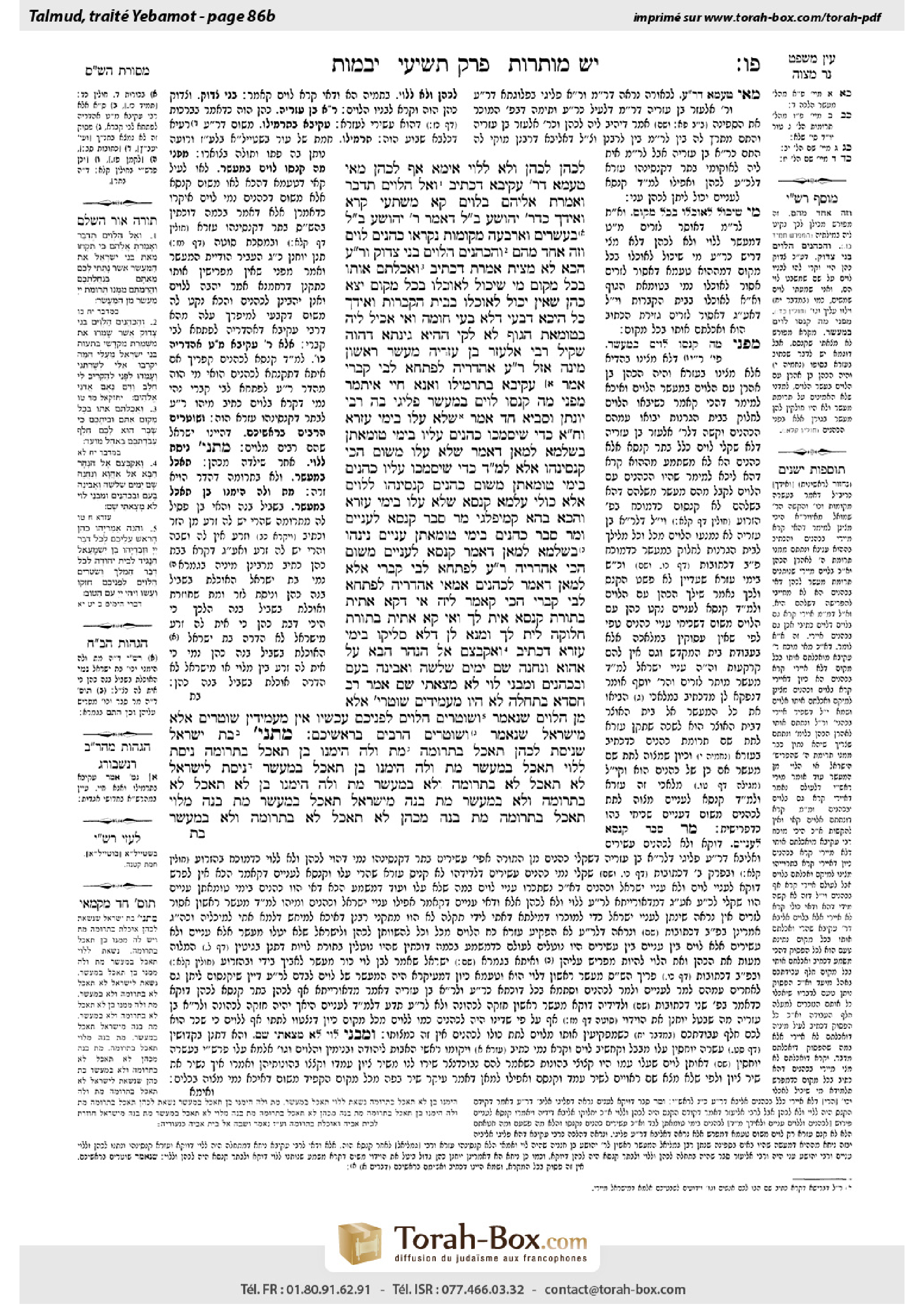
Yevamot 86b: Talmud study for Daf Yomi
Daf Yomi is the daily study of one Talmud folio. Explore 37 tractates with scans, Hebrew text, Sefaria English and AI-generated French translations where annotated.
Passage selection and English or AI-generated French translation are available where the scan has annotations. Daf Study is independent of Torah-Box and Sefaria.
Browse Yevamot · יבמות · All tractatesYevamot 86b text and translations
This page of Yevamot includes the Aramaic text, an English translation and an AI-generated French translation, alongside the scan above.
יבמות פ״ו ב · Aramaic and Hebrew text
לְכֹהֵן. לְכֹהֵן וְלֹא לְלֵוִי? אֵימָא אַף לְכֹהֵן. מַאי טַעְמָא דְּרַבִּי עֲקִיבָא — דִּכְתִיב: ״וְאֶל הַלְוִיִּם תְּדַבֵּר וְאָמַרְתָּ אֲלֵיהֶם״, בִּלְוִיִּם קָא מִשְׁתַּעֵי קְרָא. וְאִידַּךְ כִּדְרַבִּי יְהוֹשֻׁעַ בֶּן לֵוִי, דְּאָמַר רַבִּי יְהוֹשֻׁעַ בֶּן לֵוִי: בְּעֶשְׂרִים וְאַרְבָּעָה מְקוֹמוֹת נִקְרְאוּ כֹּהֲנִים לְוִיִּם, וְזֶה אֶחָד מֵהֶם: ״וְהַכֹּהֲנִים הַלְוִיִּם בְּנֵי צָדוֹק״.
וְרַבִּי עֲקִיבָא, הָכָא לָא מָצֵית אָמְרַתְּ, דִּכְתִיב: ״וַאֲכַלְתֶּם אוֹתוֹ בְּכׇל מָקוֹם״, מִי שֶׁיָּכוֹל לְאוֹכְלוֹ בְּכׇל מָקוֹם. יָצָא כֹּהֵן, שֶׁאֵין יָכוֹל לְאוֹכְלוֹ בְּבֵית הַקְּבָרוֹת. וְאִידַּךְ? כֹּל הֵיכָא דְּבָעֵי — דְּלָא בָּעֵי חוֹמָה, וְאִי אָכֵיל לֵיהּ בְּטוּמְאַת הַגּוּף — לָא לָקֵי.
הָהִיא גִּינְּתָא דַּהֲוָה שָׁקֵיל רַבִּי אֶלְעָזָר בֶּן עֲזַרְיָה מַעֲשֵׂר רִאשׁוֹן מִינַּהּ. אֲזַל רַבִּי עֲקִיבָא אַהְדְּרֵיהּ לְפִתְחָא לְבֵי קִבְרֵי. אֲמַר: עֲקִיבָא בְּתַרְמִילוֹ, וַאֲנָא חָיֵי?
אִיתְּמַר, מִפְּנֵי מָה קָנְסוּ לְוִיִּם בְּמַעֲשֵׂר? פְּלִיגִי בַּהּ רַבִּי יוֹנָתָן וְסָבַיָּא. חַד אָמַר: שֶׁלֹּא עָלוּ בִּימֵי עֶזְרָא. וְחַד אָמַר: כְּדֵי שֶׁיִּסְמְכוּ כֹּהֲנִים עָלָיו בִּימֵי טוּמְאָתָן.
בִּשְׁלָמָא לְמַאן דְּאָמַר שֶׁלֹּא עָלוּ — מִשּׁוּם הָכִי קַנְסִינְהוּ. אֶלָּא לְמַאן דְּאָמַר כְּדֵי שֶׁיִּסְמְכוּ עָלָיו כֹּהֲנִים בִּימֵי טוּמְאָתָן — מִשּׁוּם כֹּהֲנִים קַנְסִינְהוּ לַלְוִיִּם?! אֶלָּא כּוּלֵּי עָלְמָא קְנָסָא שֶׁלֹּא עָלוּ בִּימֵי עֶזְרָא. וְהָכָא בְּהָא קָמִיפַּלְגִי: מָר סָבַר: קְנָסָא לַעֲנִיִּים, וּמָר סָבַר: כֹּהֲנִים בִּימֵי טוּמְאָתָן — עֲנִיִּים נִינְהוּ.
בִּשְׁלָמָא לְמַאן דְּאָמַר קְנָסָא לַעֲנִיִּים — מִשּׁוּם הָכִי אַהְדְּרֵיהּ רַבִּי עֲקִיבָא לְפִתְחָא לְבֵי קִבְרֵי. אֶלָּא לְמַאן דְּאָמַר לְכֹהֲנִים, אַמַּאי אַהְדְּרֵיהּ לְפִתְחָא לְבֵי קִבְרֵי? הָכִי קָאָמַר לֵיהּ: אִי דְּקָא אָתֵית בְּתוֹרַת קְנָסָא — אִית לָךְ, וְאִי קָא אָתֵית בְּתוֹרַת חֲלוּקָּה — לֵית לָךְ.
וּמְנָא לַן דְּלָא סְלִיקוּ בִּימֵי עֶזְרָא? דִּכְתִיב: ״וָאֶקְבְּצֵם אֶל הַנָּהָר הַבָּא עַל אַהֲוָא וַנַּחֲנֶה שָׁם יָמִים שְׁלֹשָׁה וָאָבִינָה בָעָם וּבַכֹּהֲנִים וּמִבְּנֵי לֵוִי לֹא מָצָאתִי שָׁם״. אָמַר רַב חִסְדָּא: בַּתְּחִלָּה לֹא הָיוּ מֵעֲמִידִים שׁוֹטְרִים אֶלָּא מִן הַלְוִיִּם, שֶׁנֶּאֱמַר: ״וְשׁוֹטְרִים הַלְוִיִּם לִפְנֵיכֶם״, עַכְשָׁיו אֵין מַעֲמִידִין שׁוֹטְרִים אֶלָּא מִיִּשְׂרָאֵל, שֶׁנֶּאֱמַר: ״וְשׁוֹטְרִים הָרַבִּים בְּרָאשֵׁיכֶם״.
מַתְנִי׳ בַּת יִשְׂרָאֵל שֶׁנִּיסֵּת לְכֹהֵן — תֹּאכַל בִּתְרוּמָה. מֵת וְלָהּ הֵימֶנּוּ בֵּן — תֹּאכַל בִּתְרוּמָה. נִיסֵּת לְלֵוִי — תֹּאכַל בְּמַעֲשֵׂר. מֵת וְלָהּ הֵימֶנּוּ בֵּן — תֹּאכַל בְּמַעֲשֵׂר. נִיסֵּת לְיִשְׂרָאֵל — לֹא תֹּאכַל לֹא בִּתְרוּמָה וְלֹא בְּמַעֲשֵׂר. מֵת וְלָהּ הֵימֶנּוּ בֵּן — לֹא תֹּאכַל לֹא בִּתְרוּמָה וְלֹא בְּמַעֲשֵׂר.
מֵת בְּנָהּ מִיִּשְׂרָאֵל — תֹּאכַל בְּמַעֲשֵׂר. מֵת בְּנָהּ מִלֵּוִי — תֹּאכַל בִּתְרוּמָה. מֵת בְּנָהּ מִכֹּהֵן — לֹא תֹּאכַל לֹא בִּתְרוּמָה וְלֹא בְּמַעֲשֵׂר.
Yevamot 86b · English translation
The first tithe is given to a priest. The Gemara is puzzled: To a priest and not to a Levite? But the Torah expressly states that the first tithe is for Levites. The Gemara answers: Say he means it can be given also to a priest. The Gemara clarifies: What is the reason for Rabbi Akiva’s opinion? As it is written: “You shall speak to the Levites, and you shall say to them” (Numbers 18:26). Clearly, the verse speaks of Levites, not priests. And the other tanna, Rabbi Eliezer, maintains in accordance with the opinion of Rabbi Yehoshua ben Levi, as Rabbi Yehoshua ben Levi said: In twenty-four places in the Bible the priests are called Levites. And this is one of those verses: “And the priests the Levites, the sons of Zadok” (Ezekiel 44:15).
And Rabbi Akiva replies: Here you cannot say the verse is referring to priests, as it is written: “And you may eat it in any place” (Numbers 18:31), from which we learn that the tithe is given to one who can eat it in any place. This excludes a priest, who cannot eat it in a cemetery, as he is prohibited from entering such a place. Consequently, the verse cannot be referring to priests. And the other Sage, Rabbi Eliezer, how does he respond to this claim? He explains the verse as follows: He may eat it anywhere that he wishes, that is, in any city, as it does not require the wall of Jerusalem, like the second tithe. And we further learn from here that if he eats it in a state of bodily impurity he is not flogged. Consequently, we can say that tithe may be eaten by priests in any place.
The Gemara relates: There was a certain garden from which Rabbi Elazar ben Azarya, a priest, would take the first tithe, in accordance with his opinion that priests are also entitled to this tithe. Rabbi Akiva went, closed up the garden, and changed its entrance so that it would be facing toward the cemetery, to prevent Rabbi Elazar ben Azarya from entering the garden. Rabbi Elazar said in the form of a lighthearted exaggeration: Akiva, a former shepherd, comes with his satchel, but I have to live; from where will I receive my livelihood if I cannot claim the first tithe? Rabbi Elazar was actually a very wealthy man and did not need the produce from this garden. However, his point was that Rabbi Akiva acted in order to stop him from receiving something that he felt was rightfully his.
§ It was stated that amora’im disagreed about the following question: For what reason did the Sages penalize the Levites with regard to their tithe, by declaring that it may be given to priests as well? Rabbi Yonatan and the Elders who were with him disagree with regard to this matter. One said it was because they did not ascend, i.e., immigrate to the land of Israel, in the days of Ezra. And one said that it was not a penalty at all, but they gave the first tithe to the priests so that they could rely on it during their days of impurity. Because it is prohibited for priests to consume teruma while in a state of impurity, they would have had nothing to eat if they were dependent exclusively on teruma. It is permitted, however, to eat the tithe while impure.
The Gemara asks: Granted, according to the one who says it was because they did not ascend, we can understand that due to that reason they penalized the Levites by forcing them to share their tithe with the priests. But according to the one who says it was done so that the priests could rely on it during their days of impurity, should we penalize the Levites for the benefit of priests? Rather, everyone agrees that it was a penalty for the fact that they did not ascend in the days of Ezra, and here they disagree about this: One Sage holds that the penalty is that the tithe must be given to the poor, and one Sage holds that priests are classified as poor in the days of their impurity.
The Gemara asks: Granted, according to the one who says that the penalty imposed on the Levites is that the tithe must be given to the poor, due to that reason Rabbi Akiva changed the garden entrance so that it would be facing toward the cemetery, as Rabbi Elazar ben Azarya was a wealthy man. But according to the one who says the tithe was given to the priests, why did he change the entrance so that it would be toward the cemetery? The Gemara answers: This is what he said to him, i.e., this is what he meant: If you come to receive the tithe by virtue of the penalty imposed on the Levites, you may have it, but if you come by the standard halakha of distribution, demanding your share with the Levites, you may not have the tithe. If the owner of the garden chooses to give it to you, you may accept it, but you may not take it yourself.
The Gemara asks with regard to the penalty imposed on Levites: And from where do we derive that the Levites did not ascend in the days of Ezra? As it is written: “And I gathered them together to the river that runs to Ahava; and we encamped there for three days; and I viewed the people, and the priests, and found there none of the sons of Levi” (Ezra 8:15). With regard to this, Rav Ḥisda said: Initially they would establish officers over the people only from among the Levites, as it states: “And the officers, the Levites, before you” (II Chronicles 19:11), but now they establish officers only from among the Israelites, as it is stated: And the officers of the many at your heads. This indicates that officers were appointed from: The many, meaning the largest group, ordinary Israelites.
MISHNA: An Israelite woman married to a priest may partake of teruma. If the priest died and she had a child from him, she may continue to partake of teruma. If she subsequently married a Levite, she may no longer partake of teruma but she may partake of the first tithe on his account. If he, too, died and she had a child from him, she may continue to partake of tithe on account of the child. If she then married an Israelite, she may partake of neither teruma nor tithe. If her Israelite husband died and she had a child from him, she still may partake of neither teruma nor tithe.
If her child from the Israelite also died, while her son from the Levite remained alive, she may partake of tithe on account of the Levite’s child. If her child from the Levite died, leaving her with a son from the priest, she may once again partake of teruma. If her child from the priest died as well, she may no longer partake of either teruma or tithe.
Yevamot 86b · Traduction française (IA)
La première dîme est donnée à un prêtre. La Guemara s’étonne : À un prêtre et non à un lévite ? Pourtant, la Torah dit expressément que la première dîme est destinée aux lévites. La Guemara répond : Il faut comprendre qu’elle peut aussi être donnée à un prêtre. La Guemara précise : Quelle est la raison de l’opinion de Rabbi Akiva ? Comme il est écrit : « Tu parleras aux lévites et tu leur diras » (Nombres 18:26). De toute évidence, le verset parle des lévites et non des prêtres. Quant à l’autre tanna, Rabbi Eliezer, il suit l’opinion de Rabbi Yehoshua ben Levi, car Rabbi Yehoshua ben Levi a dit : En vingt-quatre endroits de la Bible, les prêtres sont appelés lévites. Voici l’un de ces versets : « Et les prêtres lévites, les fils de Tsadok » (Ézéchiel 44:15).
Rabbi Akiva répond : Ici, on ne peut pas dire que le verset fasse référence aux prêtres, car il est écrit : « Tu la mangeras en tout lieu » (Nombres 18:31). Nous apprenons de là que la dîme est donnée à quelqu’un qui peut la manger en tout lieu. Cela exclut un prêtre, qui ne peut pas la manger dans un cimetière, puisqu’il lui est interdit d’entrer dans un tel lieu. Par conséquent, le verset ne peut pas faire référence aux prêtres. Et comment l’autre Sage, Rabbi Eliezer, répond-il à cet argument ? Il explique le verset ainsi : Il peut la manger où il le souhaite, c’est-à-dire dans n’importe quelle ville, car elle n’a pas besoin d’être consommée à l’intérieur des remparts de Jérusalem, contrairement à la seconde dîme. Nous apprenons également de là que s’il la mange alors qu’il est en état d’impureté corporelle, il n’est pas passible de flagellation. Par conséquent, on peut dire que la dîme peut être mangée par les prêtres en tout lieu.
La Guemara rapporte : Il y avait un certain jardin dont Rabbi Elazar ben Azarya, un prêtre, prélevait la première dîme, conformément à son opinion selon laquelle les prêtres ont eux aussi droit à cette dîme. Rabbi Akiva vint, ferma le jardin et en déplaça l’entrée de façon qu’elle donne sur le cimetière, afin d’empêcher Rabbi Elazar ben Azarya d’entrer dans le jardin. Rabbi Elazar dit sur le ton d’une plaisanterie exagérée : « Akiva, l’ancien berger, arrive avec sa besace, mais moi, il faut bien que je vive ; d’où tirerai-je ma subsistance si je ne peux pas réclamer la première dîme ? » Rabbi Elazar était en réalité très riche et n’avait pas besoin des produits de ce jardin. Il voulait toutefois dire que Rabbi Akiva avait agi pour l’empêcher de recevoir quelque chose qu’il estimait lui revenir de droit.
§ Il a été rapporté que des amoraïm étaient en désaccord sur la question suivante : Pour quelle raison les Sages ont-ils pénalisé les lévites au sujet de leur dîme, en déclarant qu’elle pouvait aussi être donnée aux prêtres ? Rabbi Yonatan et les Anciens qui étaient avec lui sont en désaccord sur ce point. Selon l’un, c’était parce que les lévites n’étaient pas montés en terre d’Israël à l’époque d’Ezra. Selon l’autre, il ne s’agissait pas d’une pénalité : la première dîme était donnée aux prêtres afin qu’ils puissent compter sur elle pendant leurs périodes d’impureté. Comme il est interdit aux prêtres de consommer de la terouma lorsqu’ils sont en état d’impureté, ils n’auraient rien eu à manger s’ils avaient dépendu exclusivement de la terouma. En revanche, il est permis de manger la dîme en état d’impureté.
La Guemara demande : Il est compréhensible que, selon celui qui dit que c’était parce que les lévites n’étaient pas montés en terre d’Israël, on les ait pénalisés pour cette raison en les obligeant à partager leur dîme avec les prêtres. Mais selon celui qui dit que c’était pour que les prêtres puissent compter sur elle pendant leurs périodes d’impureté, faut-il pénaliser les lévites au profit des prêtres ? Au contraire, tous conviennent qu’il s’agissait d’une pénalité parce que les lévites n’étaient pas montés à l’époque d’Ezra ; leur désaccord porte sur la nature de cette pénalité : selon un Sage, la dîme doit être donnée aux pauvres ; selon l’autre, les prêtres sont considérés comme pauvres pendant leurs périodes d’impureté.
La Guemara demande : Il est compréhensible que, selon celui qui dit que la pénalité imposée aux lévites consiste à devoir donner la dîme aux pauvres, Rabbi Akiva ait déplacé l’entrée du jardin de façon qu’elle donne sur le cimetière, puisque Rabbi Elazar ben Azarya était riche. Mais selon celui qui dit que la dîme était donnée aux prêtres, pourquoi a-t-il déplacé l’entrée de façon qu’elle donne sur le cimetière ? La Guemara répond : Voici ce qu’il lui disait, c’est-à-dire ce qu’il voulait dire : « Si tu viens recevoir la dîme en vertu de la pénalité imposée aux lévites, tu peux la prendre ; mais si tu la réclames selon la halakha habituelle de répartition, en exigeant ta part avec les lévites, tu ne peux pas la prendre. Si le propriétaire du jardin choisit de te la donner, tu peux l’accepter, mais tu ne peux pas la prendre toi-même. »
La Guemara demande au sujet de la pénalité imposée aux lévites : D’où savons-nous que les lévites ne sont pas montés en terre d’Israël à l’époque d’Ezra ? Comme il est écrit : « Je les rassemblai près du fleuve qui coule vers Ahava ; nous campâmes là trois jours ; j’examinai le peuple et les prêtres, et je n’y trouvai aucun des fils de Lévi » (Esdras 8:15). À ce sujet, Rav Ḥisda a dit : Auparavant, on ne désignait des responsables pour le peuple que parmi les lévites, comme il est dit : « Et les responsables, les lévites, sont devant vous » (II Chroniques 19:11). Mais à présent, on ne désigne des responsables que parmi les Israélites, comme il est dit : « Et les responsables de la multitude à vos têtes. » Cela indique que les responsables étaient choisis parmi « la multitude », c’est-à-dire le groupe le plus nombreux, les Israélites ordinaires.
MICHNA : Une Israélite mariée à un prêtre peut consommer de la terouma. Si le prêtre meurt et qu’elle a eu un enfant de lui, elle peut continuer à consommer de la terouma. Si elle épouse ensuite un lévite, elle ne peut plus consommer de terouma, mais elle peut consommer la première dîme grâce à lui. S’il meurt lui aussi et qu’elle a eu un enfant de lui, elle peut continuer à consommer la dîme grâce à cet enfant. Si elle épouse ensuite un Israélite, elle ne peut consommer ni terouma ni dîme. Si son mari israélite meurt et qu’elle a eu un enfant de lui, elle ne peut toujours consommer ni terouma ni dîme.
Si son enfant issu de l’Israélite meurt lui aussi, tandis que son fils issu du lévite est encore vivant, elle peut consommer la dîme grâce à l’enfant du lévite. Si son enfant issu du lévite meurt et qu’il ne lui reste qu’un fils issu du prêtre, elle peut de nouveau consommer de la terouma. Si son enfant issu du prêtre meurt lui aussi, elle ne peut plus consommer ni terouma ni dîme.
Traduction française générée par IA à partir de l’édition anglaise de Sefaria. Vérifie toujours un passage avec le texte source.
Text from Sefaria: William Davidson Edition - Vocalized Aramaic (CC BY NC); William Davidson Edition - English (CC BY NC).