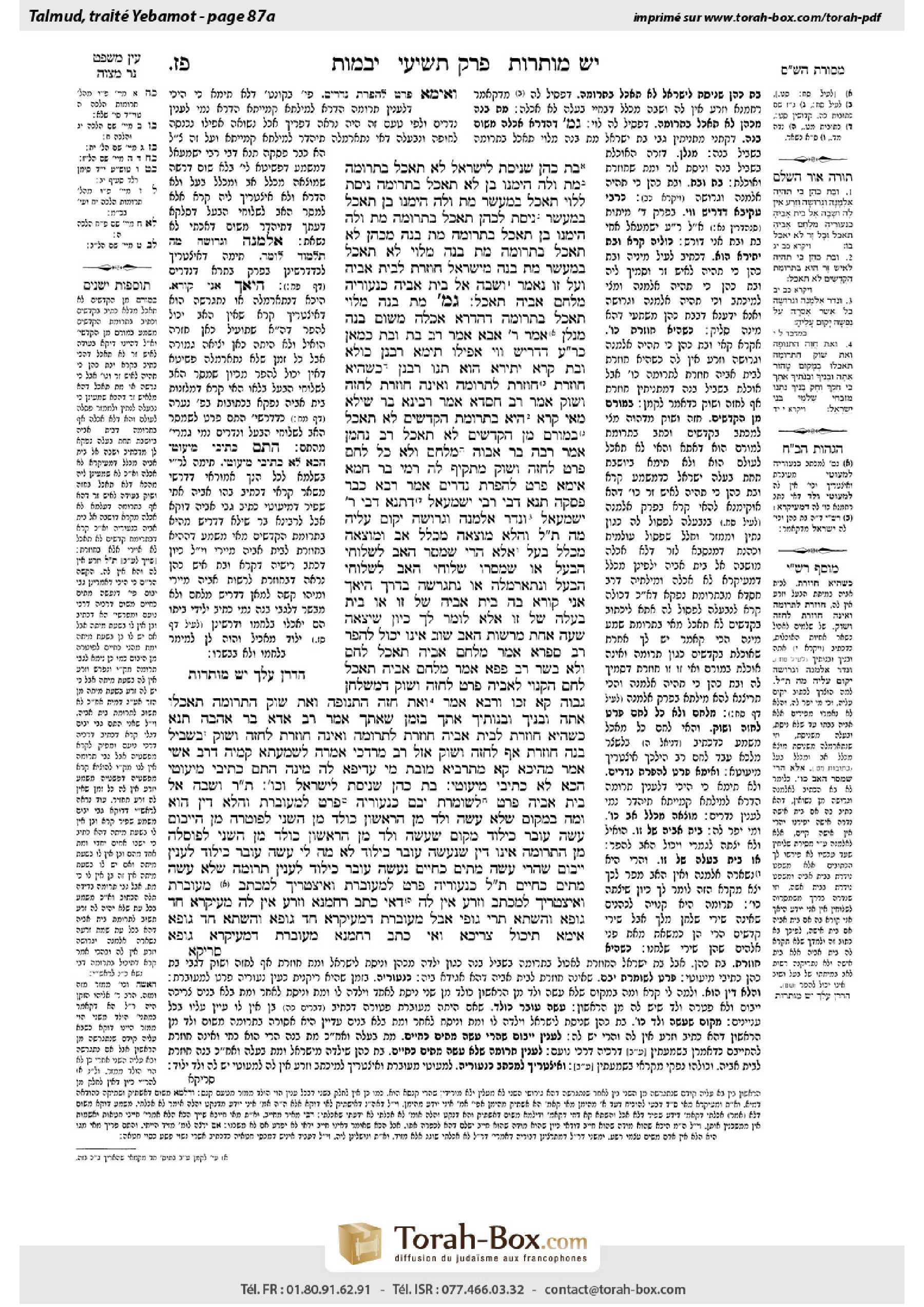
Yevamot 87a: Talmud study for Daf Yomi
Daf Yomi is the daily study of one Talmud folio. Explore 37 tractates with scans, Hebrew text, Sefaria English and AI-generated French translations where annotated.
Passage selection and English or AI-generated French translation are available where the scan has annotations. Daf Study is independent of Torah-Box and Sefaria.
Browse Yevamot · יבמות · All tractatesYevamot 87a text and translations
This page of Yevamot includes the Aramaic text, an English translation and an AI-generated French translation, alongside the scan above.
יבמות פ״ז א · Aramaic and Hebrew text
בַּת כֹּהֵן שֶׁנִּיסֵּת לְיִשְׂרָאֵל — לֹא תֹּאכַל בִּתְרוּמָה. מֵת וְלָהּ הֵימֶנּוּ בֵּן — לֹא תֹּאכַל בִּתְרוּמָה. נִיסֵּת לְלֵוִי — תֹּאכַל בְּמַעֲשֵׂר. מֵת וְלָהּ הֵימֶנּוּ בֵּן — תֹּאכַל בְּמַעֲשֵׂר. נִיסֵּת לְכֹהֵן — תֹּאכַל בִּתְרוּמָה. מֵת וְלָהּ הֵימֶנּוּ בֵּן — תֹּאכַל בִּתְרוּמָה.
מֵת בְּנָהּ מִכֹּהֵן — לֹא תֹּאכַל בִּתְרוּמָה. מֵת בְּנָהּ מִלֵּוִי — לֹא תֹּאכַל בְּמַעֲשֵׂר. מֵת בְּנָהּ מִיִּשְׂרָאֵל — חוֹזֶרֶת לְבֵית אָבִיהָ, וְעַל זוֹ נֶאֱמַר: ״וְשָׁבָה אֶל בֵּית אָבִיהָ כִּנְעוּרֶיהָ מִלֶּחֶם אָבִיהָ תֹּאכֵל״.
גְּמָ׳ מֵת בְּנָהּ מִלֵּוִי — תֹּאכַל בִּתְרוּמָה. דְּהָדְרָא אָכְלָה מִשּׁוּם בְּנָהּ, מְנָלַן? אָמַר רַבִּי אַבָּא אָמַר רַב: ״בַּת״ ״וּבַת״.
כְּמַאן, כְּרַבִּי עֲקִיבָא דְּדָרֵישׁ וָוֵי? אֲפִילּוּ תֵּימָא רַבָּנַן, כּוּלֵּהּ ״וּבַת״ קְרָא יַתִּירָא הוּא.
תָּנוּ רַבָּנַן: כְּשֶׁהִיא חוֹזֶרֶת — חוֹזֶרֶת לִתְרוּמָה, וְאֵינָהּ חוֹזֶרֶת לְחָזֶה וָשׁוֹק. אָמַר רַב חִסְדָּא אָמַר רָבִינָא בַּר שֵׁילָא: מַאי קְרָא — ״הִיא בִּתְרוּמַת הַקֳּדָשִׁים לֹא תֹאכֵל״, בַּמּוּרָם מִן הַקֳּדָשִׁים לֹא תֹאכֵל. רַב נַחְמָן אָמַר רַבָּה בַּר אֲבוּהּ: ״מִלֶּחֶם״, וְלֹא כׇּל לֶחֶם, פְּרָט לְחָזֶה וָשׁוֹק.
מַתְקֵיף לַהּ רָמֵי בַּר חָמָא: אֵימָא: פְּרָט לַהֲפָרַת נְדָרִים! אָמַר רָבָא: כְּבָר פַּסְקַהּ תַּנָּא דְּבֵי רַבִּי יִשְׁמָעֵאל, דְּתָנָא דְּבֵי רַבִּי יִשְׁמָעֵאל: ״וְנֵדֶר אַלְמָנָה וּגְרוּשָׁה יָקוּם עָלֶיהָ״, מָה תַּלְמוּד לוֹמַר? וַהֲלֹא מוּצָאָה מִכְּלַל אָב, וּמוּצָאָה מִכְּלַל בַּעַל!
אֶלָּא, הֲרֵי שֶׁמָּסַר הָאָב לִשְׁלוּחֵי הַבַּעַל, אוֹ שֶׁמָּסְרוּ שְׁלוּחֵי הָאָב לִשְׁלוּחֵי הַבַּעַל, וְנִתְאַרְמְלָה אוֹ נִתְגָּרְשָׁה בַּדֶּרֶךְ, הֵיאַךְ אֲנִי קוֹרֵא בָּהּ בֵּית אָבִיהָ שֶׁל זוֹ, אוֹ בֵּית בַּעְלָהּ שֶׁל זוֹ, אֶלָּא לוֹמַר לְךָ: כֵּיוָן שֶׁיָּצְאָה שָׁעָה אַחַת מֵרְשׁוּת הָאָב — שׁוּב אֵינוֹ יָכוֹל לְהָפֵר.
רַב סָפְרָא אָמַר: ״מִלֶּחֶם אָבִיהָ תֹּאכֵל״, לֶחֶם וְלֹא בָּשָׂר. רַב פָּפָּא אָמַר: ״מִלֶּחֶם אָבִיהָ תֹּאכֵל״, לֶחֶם הַקָּנוּי לְאָבִיהָ, פְּרָט לְחָזֶה וָשׁוֹק — דְּמִשֻּׁלְחַן גָּבוֹהַּ קָא זָכוּ.
וְרָבָא אָמַר: ״וְאֵת חֲזֵה הַתְּנוּפָה וְאֵת שׁוֹק הַתְּרוּמָה תֹּאכְלוּ אַתָּה וּבָנֶיךָ וּבְנוֹתֶיךָ אִתָּךְ״ — בִּזְמַן שֶׁאִתְּךָ.
אָמַר רַב אַדָּא בַּר אַהֲבָה, תָּנָא: כְּשֶׁהִיא חוֹזֶרֶת לְבֵית אָבִיהָ — חוֹזֶרֶת לִתְרוּמָה, וְאֵינָהּ חוֹזֶרֶת לְחָזֶה וָשׁוֹק. בִּשְׁבִיל בְּנָהּ — חוֹזֶרֶת אַף לְחָזֶה וָשׁוֹק.
אֲזַל רַב מָרְדֳּכַי, אַמְרַהּ לִשְׁמַעְתָּא קַמֵּיהּ דְּרַב אָשֵׁי. אֲמַר: מֵהֵיכָא קָא מִתְרַבְּיָא — מִ״וּבַת״, מִי עֲדִיפָא לַהּ מִינַּהּ? הָתָם כְּתִיבִי מִיעוּטֵי, הָכָא לָא כְּתִיבִי מִיעוּטֵי.
בַּת כֹּהֵן שֶׁנִּיסֵּת לְיִשְׂרָאֵל וְכוּ׳. תָּנוּ רַבָּנַן: ״וְשָׁבָה אֶל בֵּית אָבִיהָ״ — פְּרָט לְשׁוֹמֶרֶת יָבָם. ״כִּנְעוּרֶיהָ״ — פְּרָט לִמְעוּבֶּרֶת.
וַהֲלֹא דִין הוּא: וּמָה בִּמְקוֹם שֶׁלֹּא עָשָׂה וָלָד מִן הָרִאשׁוֹן כְּוָלָד מִן הַשֵּׁנִי לְפוֹטְרָהּ מִן הַיִּיבּוּם — עָשָׂה עוּבָּר כְּיָלוּד,
מָקוֹם שֶׁעָשָׂה וָלָד מִן הָרִאשׁוֹן כְּוָלָד מִן הַשֵּׁנִי לְפוֹסְלָהּ מִן הַתְּרוּמָה — אֵינוֹ דִּין שֶׁנַּעֲשֶׂה עוּבָּר כְּיָלוּד?!
לָא, מָה לִי עָשָׂה עוּבָּר כְּיָלוּד לְעִנְיַן יִיבּוּם, שֶׁהֲרֵי עָשָׂה מֵתִים כְּחַיִּים — נַעֲשֶׂה עוּבָּר כְּיָלוּד לְעִנְיַן תְּרוּמָה, שֶׁלֹּא עָשָׂה מֵתִים כְּחַיִּים?! תַּלְמוּד לוֹמַר: ״כִּנְעוּרֶיהָ״ — פְּרָט לִמְעוּבֶּרֶת.
וְאִיצְטְרִיךְ לְמִכְתַּב מְעוּבֶּרֶת, וְאִיצְטְרִיךְ לְמִכְתַּב ״וְזֶרַע אֵין לָהּ״. דְּאִי כְּתַב רַחֲמָנָא ״וְזֶרַע אֵין לָהּ״, מֵעִיקָּרָא חַד גּוּפָא וְהַשְׁתָּא תְּרֵי גוּפֵי, אֲבָל מְעוּבֶּרֶת, דְּמֵעִיקָּרָא חַד גּוּפָא וְהַשְׁתָּא חַד גּוּפָא — אֵימָא תֵּיכוֹל, צְרִיכָא. וְאִי כְּתַב רַחֲמָנָא מְעוּבֶּרֶת, דְּמֵעִיקָּרָא גּוּפָא
Yevamot 87a · English translation
The daughter of a priest married to an Israelite may not partake of teruma. If the Israelite died and she has a son from him, she may not partake of teruma as long as that son is alive. If she subsequently married a Levite she may partake of tithe. If he died, and she had a son from him, she may still partake of tithe. If she subsequently married a priest, she may partake of teruma. If the priest died and she had a son from him, she may partake of teruma.
If her son from the priest also died, she may not partake of teruma, but she may partake of tithe, as she has a son from a Levite. If her son from the Levite died, she may no longer partake of tithe. If her son from the Israelite died, she returns to her father’s house and may once again partake of teruma. And with regard to this woman, it is stated: “And she is returned unto her father’s house, as in her youth; she may eat of her father’s bread” (Leviticus 22:13).
GEMARA: We learned in the mishna: If her son from the Levite died she may partake of teruma. The Gemara asks: This halakha with regard to a woman previously married to a priest, who had a child from the priest and was then married to a Levite and separated from him, that she once again may partake due to her son from the priest, from where do we derive it? Rabbi Abba said that Rav said: It states: “But if a priest’s daughter be a widow, or divorced, and have no child, and is returned unto her father’s house, as in her youth” (Leviticus 22:13). The verse could have stated: If a priest’s daughter. Instead, it states: “But if a priest’s daughter,” with an extra word, represented by the single Hebrew letter vav, to include this case.
The Gemara asks: In accordance with the opinion of which Sage is this exposition? Is it only in accordance with Rabbi Akiva, who expounds the additional letter vav, representing the word “and,” as an inclusive term? The Gemara refutes this suggestion: It can be understood even if you say it is in accordance with the Rabbis, who do not usually derive halakhot from an additional vav, as in this case the entire phrase: “But if a priest’s daughter,” is superfluous, as the previous verse had already specified that we are dealing with “the daughter of a priest.” Therefore, everyone agrees that in this context the additional letter in the text comes to include the additional case.
§ The Sages taught: With regard to the daughter of a priest, when she returns to her father’s house after having been married to a non-priest and then separated from her husband, she returns to partaking of teruma but she does not return to partake of the breast and right hind leg of peace-offerings. Rav Ḥisda said that Ravina bar Sheila said: What is the verse that teaches us this halakha? “She may not eat of that which is set apart from the sacred things” (Leviticus 22:12). This verse indicates: From that which is separated from the sacred things, i.e., offerings, and given to a priest, she may not eat. Rav Naḥman said that Rabba bar Avuh said that this halakha comes from a different source: We infer from the words “she may eat of her father’s bread” (Leviticus 22:13), that she may not eat all bread; this comes to exclude the breast and right hind leg.
Rami bar Ḥama objects to this: But we can say that the verse comes to exclude nullification of vows. The Torah would consequently be teaching us that even after she “is returned unto her father’s house, as in her youth” (Leviticus 22:13), she does not return to her youth in all ways, as her father may not nullify her vows. Rava said: The connection between her and her father’s house with regard to vows has already been severed, as taught by the school of Rabbi Yishmael, as the school of Rabbi Yishmael taught: “But the vow of a widow, or of a divorcée…shall stand against her” (Numbers 30:10). What is the meaning when the verse states this? She was removed from the category of one who is under the authority of her father when she married, and she has likewise been removed from the category of one who is under the authority of her husband, as she is no longer married to him.
Rather, the verse is referring to a case where the father transferred his daughter to the husband’s agents for the purpose of marriage, and she consequently left her father’s house. Or, it is referring to a case where the father’s agents transferred her to the husband’s agents and she was widowed or divorced on the way, before she arrived at her husband’s house. How shall I consider her? Is she in the house of this one, her father, or is she in the house of that one, her husband? Rather, this comes to tell you: Since she has entirely left her father’s jurisdiction when she was transferred to the husband’s agents, even if for just one moment, her father is no longer able to nullify her vows. We learn from here that a father cannot annul his daughter’s vows after she has been married, and there is no need for an additional verse to teach this halakha.
Rav Safra said: The halakha that she does not return to her father’s house with regard to the breast and the right hind leg is derived from the verse: “From her father’s bread she may eat,” which indicates that she partakes of the “bread” of teruma but not of the meat of the breast and hind leg. Rav Pappa said a different interpretation: “From her father’s bread she may eat” is referring to bread owned by her father, such as teruma, which is the property of the priest, which excludes the breast and right hind leg, as the priests receive their portion from the table of the Most High. Unlike teruma, the breast and right hind leg do not belong to the priests. Rather, after the offering is sacrificed to God, they eat these portions but are not considered to own them.
And Rava said: It states: “And the breast of waving and the hind leg of heaving you shall eat…you, and your sons and your daughters with you” (Leviticus 10:14). This indicates that daughters of priests may eat at a time when they are “with you,” but once they have left the priest’s domain, e.g., by marrying an ordinary Israelite, they may no longer partake of these gifts even if they subsequently return to his household.
Rav Adda bar Ahava said: It was taught: With regard to the daughter of a priest, when she returns to her father’s house, after marrying and separating from her husband without a child, she returns for the purposes of eating teruma, but she does not return for the purposes of eating the breast and right hind leg. By contrast, if an Israelite woman ate on account of her son from a priest, if she later married an Israelite and he died, she returns to partake even of the breast and right hind leg.
Rav Mordekhai went and stated this halakha before Rav Ashi, who said to him: From where does he include the case of a woman who partakes of teruma on account of her son? From the verse “but if a priest’s daughter” (Leviticus 22:13). Is the Israelite woman preferable to her, the daughter of a priest herself, who does not return to eating the breast and hind leg? The Gemara answers: There, the Torah writes exclusions, as we learned above, which teach us that she does not return in all regards, whereas here it does not write exclusions. Consequently, although the halakha of a woman who has a son from a priest is itself derived from the case of the daughter of a priest returning to her father’s house, she has more abilities than the latter.
§ The Gemara returns to the mishna. The mishna taught: The daughter of a priest married to an Israelite may not partake of teruma. The Sages taught: “And she is returned unto her father’s house” (Leviticus 22:13); this excludes a widow awaiting her yavam, for she cannot go back to her father’s house as long as she is still waiting for the yavam to perform levirate marriage. “As in her youth”; this excludes a pregnant woman, as her pregnancy has changed her, and she is no longer as she was in her youth.
But could this not be derived through an a fortiori inference, without the need for a special exposition of a verse? If in a place, i.e., a case, where the Torah did not make the halakha pertaining to a child from the first husband like the halakha pertaining to a child from the second husband to exempt her from levirate marriage; this is the case of a woman who married a man, had a son with him, was widowed, remarried, and her second husband died childless. She requires levirate marriage despite the fact that she has a child, as the first husband’s child is irrelevant with regard to her need for levirate marriage for the second husband. Despite this limitation, the Torah made the status of a fetus like that of a child who was born, as a pregnant woman does not perform levirate marriage.
If this is so, then in a place where the Torah did make the halakha pertaining to a child from the first husband like the halakha pertaining to a child from the second husband to disqualify her from teruma; this is the case of a daughter of a priest who married an Israelite, had a son with him, was widowed, and afterward married another Israelite, who died childless. She may not partake of teruma on account of her son from the first husband. Is it not, therefore, right that we should make a fetus like a child who was born with regard to teruma, that would prevent her from returning to partake of teruma if she is pregnant? If this reasoning is correct, there is no need for the biblical exposition.
However, this proof can be refuted: No, what I should say is that the Torah made a fetus like a child who was born with regard to levirate marriage, because with regard to levirate marriage the Torah made the dead like the living: If the woman had a child at the time of her husband’s death she is entirely exempt from levirate marriage, even if her son subsequently died. The deceased child is like a living one in the sense that he continues to exempt his mother from the requirement of levirate marriage. Shall we then make a fetus like a child who was born with regard to teruma, where the Torah did not make the dead like the living? In the case of teruma, as long as the daughter of a priest has a living son from her Israelite husband, she is disqualified from teruma, but if he dies she may partake of teruma again, as we do not consider him like a living son. Consequently, we cannot learn the halakha of teruma from levirate marriage with regard to the status of a fetus. Therefore, the verse states “as in her youth” to exclude a pregnant woman.
The Gemara comments: And it was necessary to write this verse that teaches the halakha of a pregnant woman, and it was necessary also to write “and she have no child” (Leviticus 22:13) because had the Merciful One written only: “And she have no child,” I would have said that at the outset she was only one body when she ate teruma, and now, upon her return, there are two bodies, and that is why she is no longer “as in her youth.” But a pregnant woman, who at the outset was one body and now is still one body, one might say that she may partake of teruma until the birth of her son. Consequently, it is necessary for a verse to teach the halakha. And vice-versa, had the Merciful One written the halakha with regard to a pregnant woman, I might have said that this is true only of a pregnant woman because at the outset her body
Yevamot 87a · Traduction française (IA)
La fille d’un prêtre mariée à un Israélite ne peut pas consommer de terouma. Si l’Israélite meurt et qu’elle a eu un fils de lui, elle ne peut pas consommer de terouma tant que ce fils est en vie. Si elle épouse ensuite un Lévite, elle peut consommer la dîme. S’il meurt et qu’elle a eu un fils de lui, elle peut encore consommer la dîme. Si elle épouse ensuite un prêtre, elle peut consommer de la terouma. Si le prêtre meurt et qu’elle a eu un fils de lui, elle peut consommer de la terouma.
Si son fils du prêtre meurt également, elle ne peut pas consommer de terouma, mais elle peut consommer la dîme, puisqu’elle a un fils d’un Lévite. Si son fils du Lévite meurt, elle ne peut plus consommer la dîme. Si son fils de l’Israélite meurt, elle retourne dans la maison de son père et peut de nouveau consommer de la terouma. À son sujet, il est dit : « Elle est retournée dans la maison de son père, comme dans sa jeunesse ; elle peut manger du pain de son père » (Lévitique 22,13).
GUEMARA : Nous avons appris dans la Michna : Si son fils du Lévite meurt, elle peut consommer de la terouma. La Guemara demande : D’où déduit-on cette halakha concernant une femme auparavant mariée à un prêtre, qui a eu un enfant de lui, puis a été mariée à un Lévite et s’est séparée de lui, et qui peut de nouveau consommer de la terouma grâce à son fils du prêtre ? Rabbi Abba a dit au nom de Rav : Il est écrit : « Mais si la fille d’un prêtre est veuve ou divorcée et n’a pas d’enfant, et qu’elle retourne dans la maison de son père, comme dans sa jeunesse » (Lévitique 22,13). Le verset aurait pu dire : « Si une fille de prêtre ». Au lieu de cela, il dit : « Mais si la fille d’un prêtre », avec un mot supplémentaire, représenté par la lettre hébraïque vav, qui inclut ce cas.
La Guemara demande : Selon quel Sage cette interprétation est-elle formulée ? Est-ce uniquement selon Rabbi Akiva, qui interprète la lettre vav supplémentaire, représentant le mot « et », comme un terme d’inclusion ? La Guemara réfute cette proposition : On peut le comprendre même si l’on dit que c’est selon les Rabbins, qui ne déduisent généralement pas de halakhot d’un vav supplémentaire. En effet, dans ce cas, toute l’expression « mais si la fille d’un prêtre » est superflue, puisque le verset précédent avait déjà précisé qu’il s’agissait de « la fille d’un prêtre ». Par conséquent, tous reconnaissent que, dans ce contexte, la lettre supplémentaire du texte vient inclure ce cas additionnel.
§ Les Sages ont enseigné : La fille d’un prêtre qui retourne dans la maison de son père après avoir été mariée à un non-prêtre, puis s’être séparée de son mari, peut de nouveau consommer de la terouma, mais elle ne peut pas de nouveau consommer la poitrine et la cuisse droite des sacrifices de paix. Rav Ḥisda a dit que Ravina bar Sheila a dit : Quel verset nous enseigne cette halakha ? « Elle ne mangera pas de ce qui est prélevé sur les choses saintes » (Lévitique 22,12). Ce verset indique qu’elle ne peut pas manger ce qui est prélevé sur les choses saintes, c’est-à-dire les offrandes, puis donné à un prêtre. Rav Naḥman a dit que Rabba bar Avuh a dit que cette halakha provient d’une autre source : Nous déduisons des mots « elle peut manger du pain de son père » (Lévitique 22,13) qu’elle ne peut pas manger toute sorte de pain ; cela vient exclure la poitrine et la cuisse droite.
Rami bar Ḥama objecte : Mais nous pouvons dire que le verset vient exclure l’annulation des vœux. La Torah nous enseignerait ainsi que, même après qu’elle « est retournée dans la maison de son père, comme dans sa jeunesse » (Lévitique 22,13), elle ne retrouve pas sa condition de jeunesse à tous égards, car son père ne peut pas annuler ses vœux. Rava dit : Le lien entre elle et la maison de son père en matière de vœux a déjà été rompu, comme l’enseigne l’école de Rabbi Yishmael. En effet, l’école de Rabbi Yishmael a enseigné : « Mais le vœu d’une veuve ou d’une divorcée […] sera maintenu contre elle » (Nombres 30,10). Pourquoi le verset précise-t-il cela ? Lorsqu’elle s’est mariée, elle a été retirée de la catégorie de celles qui sont sous l’autorité de leur père, et elle a de même été retirée de la catégorie de celles qui sont sous l’autorité de leur mari, puisqu’elle n’est plus mariée à lui.
Au contraire, le verset fait référence au cas où le père a remis sa fille aux mandataires du mari en vue du mariage, et où elle a par conséquent quitté la maison de son père. Ou bien il fait référence au cas où les mandataires du père l’ont remise aux mandataires du mari et où elle est devenue veuve ou a été divorcée en chemin, avant d’arriver dans la maison de son mari. Comment faut-il la considérer ? Est-elle dans la maison de celui-ci, son père, ou dans la maison de celui-là, son mari ? Le verset vient plutôt nous apprendre ceci : puisqu’elle a entièrement quitté l’autorité de son père lorsqu’elle a été remise aux mandataires du mari, ne serait-ce qu’un instant, son père ne peut plus annuler ses vœux. Nous apprenons donc qu’un père ne peut pas annuler les vœux de sa fille après qu’elle s’est mariée, et qu’aucun verset supplémentaire n’est nécessaire pour enseigner cette halakha.
Rav Safra a dit : La halakha selon laquelle elle ne retrouve pas, en retournant dans la maison de son père, le droit de consommer la poitrine et la cuisse droite se déduit du verset : « Elle peut manger du pain de son père », ce qui indique qu’elle consomme le « pain » de terouma, mais pas la viande de la poitrine et de la cuisse. Rav Pappa propose une autre interprétation : « Elle peut manger du pain de son père » désigne le pain appartenant à son père, comme la terouma, qui est la propriété du prêtre ; cela exclut la poitrine et la cuisse droite, puisque les prêtres reçoivent leur part de la table du Très-Haut. Contrairement à la terouma, la poitrine et la cuisse droite n’appartiennent pas aux prêtres. En effet, après le sacrifice offert à Dieu, ils mangent ces morceaux, mais ne sont pas considérés comme en être propriétaires.
Rava a dit : Il est écrit : « Vous mangerez la poitrine de présentation et la cuisse de prélèvement […] toi, tes fils et tes filles avec toi » (Lévitique 10,14). Cela indique que les filles de prêtres peuvent manger lorsqu’elles sont « avec toi », mais qu’une fois sorties du domaine du prêtre, par exemple en épousant un Israélite ordinaire, elles ne peuvent plus consommer ces dons, même si elles retournent par la suite dans sa maison.
Rav Adda bar Ahava a dit : Il a été enseigné : La fille d’un prêtre qui retourne dans la maison de son père après s’être mariée puis séparée de son mari sans avoir eu d’enfant retrouve le droit de consommer de la terouma, mais pas celui de consommer la poitrine et la cuisse droite. En revanche, si une Israélite consommait ces morceaux grâce à son fils d’un prêtre, puis épousait un Israélite qui mourait, elle retrouve le droit de consommer même la poitrine et la cuisse droite.
Rav Mordekhaï alla présenter cette halakha devant Rav Ashi, qui lui dit : D’où tire-t-il que le cas d’une femme qui consomme de la terouma grâce à son fils est inclus ? Du verset « mais si la fille d’un prêtre » (Lévitique 22,13). L’Israélite serait-elle mieux lotie que cette femme, la fille d’un prêtre elle-même, qui ne retrouve pas le droit de manger la poitrine et la cuisse ? La Guemara répond : Dans le premier cas, la Torah formule des exclusions, comme nous l’avons appris plus haut, qui nous enseignent que cette femme ne retrouve pas ses droits à tous égards ; ici, elle ne formule aucune exclusion. Par conséquent, bien que la halakha concernant une femme qui a un fils d’un prêtre soit elle-même déduite du cas de la fille d’un prêtre qui retourne dans la maison de son père, cette femme a davantage de droits que cette dernière.
§ La Guemara revient à la Michna. La Michna a enseigné : La fille d’un prêtre mariée à un Israélite ne peut pas consommer de terouma. Les Sages ont enseigné : « Elle retourne dans la maison de son père » (Lévitique 22,13) exclut une veuve qui attend son yavam, car elle ne peut pas retourner dans la maison de son père tant qu’elle attend que son yavam contracte le mariage léviratique. « Comme dans sa jeunesse » exclut une femme enceinte, car la grossesse l’a changée et elle n’est plus comme dans sa jeunesse.
Mais ne pouvait-on pas déduire cela au moyen d’un raisonnement a fortiori, sans qu’une interprétation particulière du verset soit nécessaire ? Dans un cas où la Torah n’a pas assimilé la halakha concernant un enfant du premier mari à celle concernant un enfant du second mari pour la dispenser du mariage léviratique — le cas d’une femme qui a épousé un homme, a eu un fils de lui, est devenue veuve, s’est remariée, puis dont le second mari est mort sans enfant —, elle est tenue au mariage léviratique malgré le fait qu’elle a un enfant, car l’enfant du premier mari n’a aucune incidence sur son obligation de mariage léviratique envers le second mari. Malgré cette limite, la Torah a assimilé le statut d’un fœtus à celui d’un enfant né, puisqu’une femme enceinte n’accomplit pas le mariage léviratique.
S’il en est ainsi, dans un cas où la Torah a assimilé la halakha concernant un enfant du premier mari à celle concernant un enfant du second mari pour la disqualifier de la consommation de terouma — le cas d’une fille de prêtre qui a épousé un Israélite, a eu un fils de lui, est devenue veuve, puis a épousé un autre Israélite, qui est mort sans enfant —, elle ne peut pas consommer de terouma grâce à son fils du premier mari. N’est-il donc pas juste d’assimiler, pour ce qui est de la terouma, un fœtus à un enfant né, ce qui l’empêcherait de consommer de nouveau de la terouma si elle est enceinte ? Si ce raisonnement est correct, l’interprétation biblique n’est pas nécessaire.
Cependant, cette preuve peut être réfutée : non, il faut plutôt dire que la Torah a assimilé un fœtus à un enfant né en matière de mariage léviratique, parce qu’en cette matière la Torah a assimilé le mort au vivant : si la femme avait un enfant au moment de la mort de son mari, elle est entièrement dispensée du mariage léviratique, même si son fils meurt par la suite. L’enfant décédé est comme un enfant vivant en ce sens qu’il continue à dispenser sa mère de l’obligation du mariage léviratique. Assimilerons-nous alors un fœtus à un enfant né en matière de terouma, alors que la Torah n’a pas assimilé le mort au vivant ? En matière de terouma, tant que la fille d’un prêtre a un fils vivant de son mari israélite, elle ne peut pas consommer de terouma ; mais s’il meurt, elle peut de nouveau en consommer, car nous ne le considérons pas comme un fils vivant. Par conséquent, nous ne pouvons pas déduire du mariage léviratique la halakha concernant le statut d’un fœtus en matière de terouma. C’est pourquoi le verset dit « comme dans sa jeunesse », pour exclure une femme enceinte.
La Guemara fait remarquer : Il était nécessaire d’écrire le verset qui enseigne la halakha concernant une femme enceinte, et il était également nécessaire d’écrire « et n’a pas d’enfant » (Lévitique 22,13). Car si le Miséricordieux n’avait écrit que « et n’a pas d’enfant », j’aurais dit qu’au départ, lorsqu’elle consommait de la terouma, elle n’était qu’un seul corps, tandis qu’à présent, à son retour, il y a deux corps, et que c’est pour cette raison qu’elle n’est plus « comme dans sa jeunesse ». Mais une femme enceinte, qui au départ était un seul corps et qui est encore un seul corps à présent, pourrait, dirais-je, consommer de la terouma jusqu’à la naissance de son fils. Il faut donc un verset pour enseigner cette halakha. Et inversement, si le Miséricordieux avait écrit la halakha concernant une femme enceinte, j’aurais pu dire que cela ne vaut que pour une femme enceinte, parce qu’au départ son corps
Traduction française générée par IA à partir de l’édition anglaise de Sefaria. Vérifie toujours un passage avec le texte source.
Text from Sefaria: William Davidson Edition - Vocalized Aramaic (CC BY NC); William Davidson Edition - English (CC BY NC).