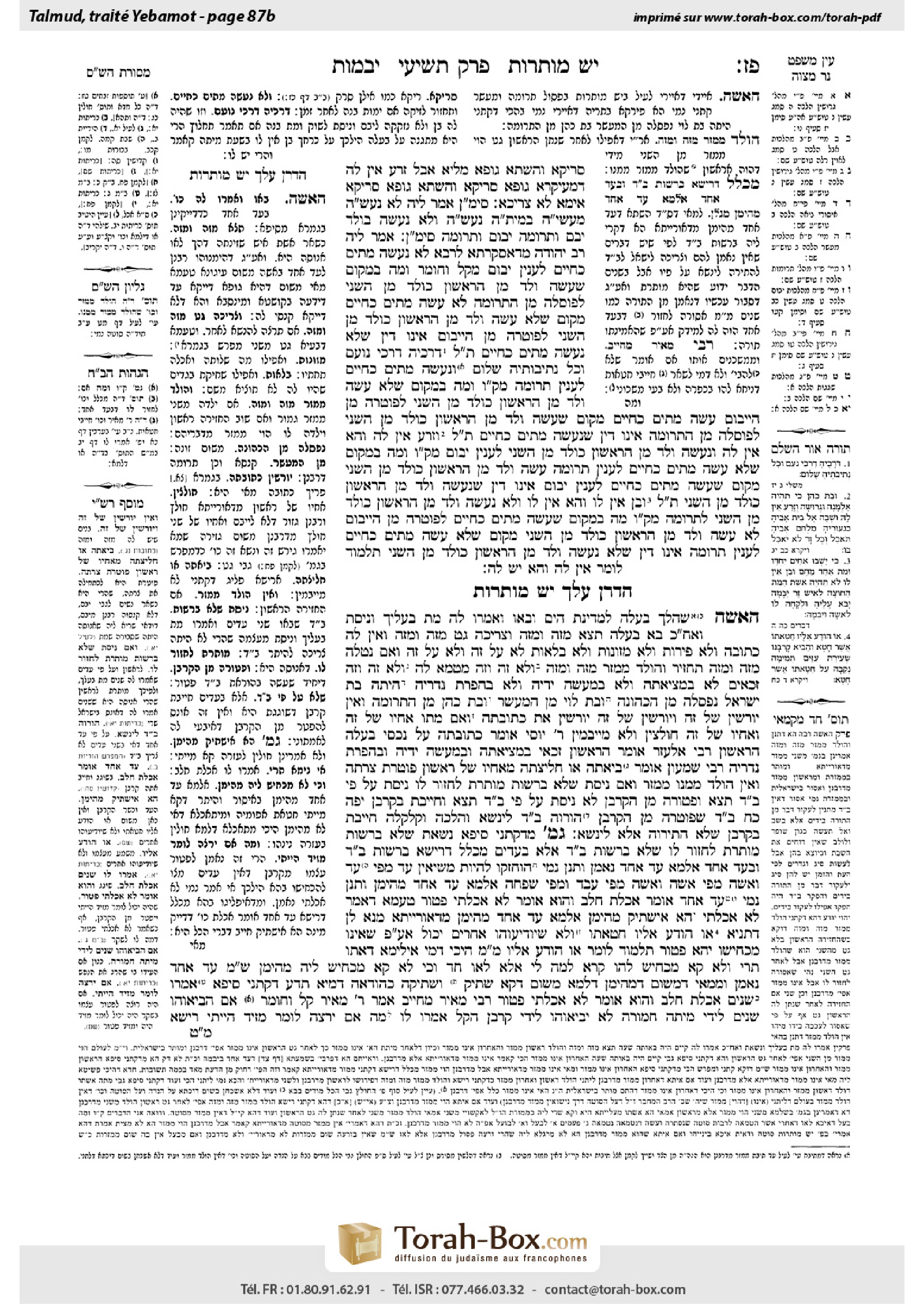
Yevamot 87b: Talmud study for Daf Yomi
Daf Yomi is the daily study of one Talmud folio. Explore 37 tractates with scans, Hebrew text, Sefaria English and AI-generated French translations where annotated.
Passage selection and English or AI-generated French translation are available where the scan has annotations. Daf Study is independent of Torah-Box and Sefaria.
Browse Yevamot · יבמות · All tractatesYevamot 87b text and translations
This page of Yevamot includes the Aramaic text, an English translation and an AI-generated French translation, alongside the scan above.
יבמות פ״ז ב · Aramaic and Hebrew text
סְרִיקָא וְהַשְׁתָּא גּוּפָא מַלְיָא. אֲבָל ״זֶרַע אֵין לָהּ״, דְּמֵעִיקָּרָא גּוּפָא סְרִיקָא וְהַשְׁתָּא גּוּפָא סְרִיקָא — אֵימָא לָא, צְרִיכָא.
[סִימָן: (אָמַר לֵיהּ) לֹא נַעֲשֶׂה מַעֲשֶׂיהָ בְּמִיתָה נַעֲשֶׂה וְלֹא נַעֲשֶׂה בְּוָלָד יִבֻּם וּתְרוּמָה יִבּוּם וּתְרוּמָה — סִימָן].
אֲמַר לֵיהּ רַב יְהוּדָה מִדִּאסְקַרְתָּא לְרָבָא: לֹא נַעֲשֶׂה מֵתִים כְּחַיִּים לְעִנְיַן יִבּוּם מִקַּל וְחוֹמֶר: וּמָה בְּמָקוֹם שֶׁעָשָׂה וָלָד מִן הָרִאשׁוֹן כְּוָלָד מִן הַשֵּׁנִי לְפוֹסְלָהּ מִן הַתְּרוּמָה — לֹא עָשָׂה מֵתִים כְּחַיִּים; מָקוֹם שֶׁלֹּא עָשָׂה וָלָד מִן הָרִאשׁוֹן כְּוָלָד מִן הַשֵּׁנִי לְפוֹטְרָהּ מִן הַיִּיבּוּם — אֵינוֹ דִּין שֶׁלֹּא נַעֲשֶׂה מֵתִים כְּחַיִּים?!
תַּלְמוּד לוֹמַר: ״דְּרָכֶיהָ דַרְכֵי נוֹעַם וְכׇל נְתִיבוֹתֶיהָ שָׁלוֹם״.
וְנַעֲשָׂה מֵתִים כְּחַיִּים לְעִנְיַן תְּרוּמָה מִקַּל וְחוֹמֶר: וּמָה בְּמָקוֹם שֶׁלֹּא עָשָׂה וָלָד מִן הָרִאשׁוֹן כְּוָלָד מִן הַשֵּׁנִי לְפוֹטְרָהּ מִן הַיִּיבּוּם — עָשָׂה מֵתִים כְּחַיִּים; מָקוֹם שֶׁעָשָׂה וָלָד מִן הָרִאשׁוֹן כְּוָלָד מִן הַשֵּׁנִי לְפוֹסְלָהּ מִן הַתְּרוּמָה — אֵינוֹ דִּין שֶׁנַּעֲשֶׂה מֵתִים כְּחַיִּים?! תַּלְמוּד לוֹמַר: ״וְזֶרַע אֵין לָהּ״, וְהָא אֵין לָהּ.
וְנַעֲשֶׂה וָלָד מִן הָרִאשׁוֹן כְּוָלָד מִן הַשֵּׁנִי לְעִנְיַן יִבּוּם מִקַּל וְחוֹמֶר: וּמָה בְּמָקוֹם שֶׁלֹּא עָשָׂה מֵתִים כְּחַיִּים לְעִנְיַן תְּרוּמָה — עָשָׂה וָלָד מִן הָרִאשׁוֹן כְּוָלָד מִן הַשֵּׁנִי; מָקוֹם שֶׁעָשָׂה מֵתִים כְּחַיִּים לְעִנְיַן יִבּוּם — אֵינוֹ דִּין שֶׁנַּעֲשֶׂה וָלָד מִן הָרִאשׁוֹן כְּוָלָד מִן הַשֵּׁנִי?! תַּלְמוּד לוֹמַר: ״וּבֵן אֵין לוֹ״, וְהָא אֵין לוֹ.
וְלֹא נַעֲשֶׂה וָלָד מִן הָרִאשׁוֹן כְּוָלָד מִן הַשֵּׁנִי לִתְרוּמָה מִקַּל וְחוֹמֶר: מָה בִּמְקוֹם שֶׁעָשָׂה מֵתִים כְּחַיִּים לְפוֹטְרָהּ מִן הַיִּיבּוּם — לֹא עָשָׂה וָלָד מִן הָרִאשׁוֹן כְּוָלָד מִן הַשֵּׁנִי; מָקוֹם שֶׁלֹּא עָשָׂה מֵתִים כְּחַיִּים לְעִנְיַן תְּרוּמָה — אֵינוֹ דִּין שֶׁלֹּא נַעֲשֶׂה וָלָד מִן הָרִאשׁוֹן כְּוָלָד מִן הַשֵּׁנִי?! תַּלְמוּד לוֹמַר: ״אֵין לָהּ״, וְהָא יֵשׁ לָהּ.
הֲדַרַן עֲלָךְ יֵשׁ מוּתָּרוֹת
הָאִשָּׁה שֶׁהָלַךְ בַּעְלָהּ לִמְדִינַת הַיָּם, וּבָאוּ וְאָמְרוּ לָהּ ״מֵת בַּעְלִיךְ״, וְנִיסֵּת, וְאַחַר כָּךְ בָּא בַּעְלָהּ — תֵּצֵא מִזֶּה וּמִזֶּה, וּצְרִיכָה גֵּט מִזֶּה וּמִזֶּה,
וְאֵין לָהּ כְּתוּבָּה, וְלֹא פֵּירוֹת, וְלֹא מְזוֹנוֹת, וְלֹא בְּלָאוֹת — לֹא עַל זֶה וְלֹא עַל זֶה. וְאִם נָטְלָה מִזֶּה וּמִזֶּה — תַּחְזִיר.
וְהַוָּלָד מַמְזֵר מִזֶּה וּמִזֶּה. וְלֹא זֶה וָזֶה מִטַּמֵּא לָהּ, וְלֹא זֶה וָזֶה זַכָּאִים לֹא בִּמְצִיאָתָהּ, וְלֹא בְּמַעֲשֵׂה יָדֶיהָ, וְלֹא בַּהֲפָרַת נְדָרֶיהָ.
הָיְתָה בַּת יִשְׂרָאֵל — נִפְסְלָה מִן הַכְּהוּנָּה. וּבַת לֵוִי — מִן הַמַּעֲשֵׂר, וּבַת כֹּהֵן — מִן הַתְּרוּמָה. וְאֵין יוֹרְשִׁין שֶׁל זֶה וְיוֹרְשִׁין שֶׁל זֶה יוֹרְשִׁין אֶת כְּתוּבָּתָהּ. וְאִם מֵתוּ — אָחִיו שֶׁל זֶה וְאָחִיו שֶׁל זֶה חוֹלְצִין וְלֹא מְיַיבְּמִין.
רַבִּי יוֹסֵי אוֹמֵר: כְּתוּבָּתָהּ עַל נִכְסֵי בַּעְלָהּ הָרִאשׁוֹן. רַבִּי אֶלְעָזָר אוֹמֵר: הָרִאשׁוֹן זַכַּאי בִּמְצִיאָתָהּ וּבְמַעֲשֵׂה יָדֶיהָ וּבַהֲפָרַת נְדָרֶיהָ. רַבִּי שִׁמְעוֹן אוֹמֵר: בִּיאָתָהּ אוֹ חֲלִיצָתָהּ מֵאָחִיו שֶׁל רִאשׁוֹן פּוֹטֶרֶת צָרָתָהּ. וְאֵין הַוָּלָד מִמֶּנּוּ מַמְזֵר.
וְאִם נִיסַּת שֶׁלֹּא בִּרְשׁוּת — מוּתֶּרֶת לַחְזוֹר לוֹ. נִיסֵּת עַל פִּי בֵּית דִּין — תֵּצֵא, וּפְטוּרָה מִן הַקׇּרְבָּן.
לֹא נִיסֵּת עַל פִּי בֵּית דִּין — תֵּצֵא, וְחַיֶּיבֶת בְּקׇרְבָּן. יִפָּה כֹּחַ בֵּית דִּין, שֶׁפּוֹטְרָהּ מִן הַקׇּרְבָּן. הוֹרוּהָ בֵּית דִּין לִינָּשֵׂא, וְהָלְכָה וְקִלְקְלָה — חַיֶּיבֶת בְּקׇרְבָּן, שֶׁלֹּא הִתִּירוּהָ אֶלָּא לִינָּשֵׂא.
גְּמָ׳ מִדְּקָתָנֵי סֵיפָא: נִשֵּׂאת שֶׁלֹּא בִּרְשׁוּת — מוּתֶּרֶת לַחְזוֹר לוֹ, שֶׁלֹּא בִּרְשׁוּת בֵּית דִּין, אֶלָּא בְּעֵדִים. מִכְּלָל דְּרֵישָׁא בִּרְשׁוּת בֵּית דִּין, וּבְעֵד אֶחָד. אַלְמָא עֵד אֶחָד נֶאֱמָן.
וּתְנַן נָמֵי: הוּחְזְקוּ לִהְיוֹת מַשִּׂיאִין עֵד מִפִּי עֵד, וְאִשָּׁה מִפִּי אִשָּׁה, וְאִשָּׁה מִפִּי עֶבֶד וּמִפִּי שִׁפְחָה. אַלְמָא עֵד אֶחָד מְהֵימַן.
וּתְנַן נָמֵי: עֵד אֶחָד אוֹמֵר ״אָכַלְתָּ חֵלֶב״, וְהוּא אוֹמֵר ״לֹא אָכַלְתִּי״ — פָּטוּר. טַעְמָא דְּאָמַר ״לֹא אָכַלְתִּי״, הָא אִישְׁתִּיק — מְהֵימַן. אַלְמָא עֵד אֶחָד מְהֵימַן מִדְּאוֹרָיְיתָא.
מְנָא לַן? דְּתַנְיָא: ״אוֹ הוֹדַע אֵלָיו חַטָּאתוֹ״. וְלֹא שֶׁיּוֹדִיעוּהוּ אֲחֵרִים. יָכוֹל אַף עַל פִּי שֶׁאֵינוֹ מַכְחִישׁוֹ יְהֵא פָּטוּר? תַּלְמוּד לוֹמַר: ״אוֹ הוֹדַע אֵלָיו״ — מִכׇּל מָקוֹם.
הֵיכִי דָמֵי? אִילֵּימָא דַּאֲתוֹ תְּרֵי וְלָא קָא מַכְחִישׁ לְהוּ, קְרָא לְמָה לִי? אֶלָּא לָאו — חַד, וְכִי לָא קָא מַכְחִישׁ לֵיהּ — מְהֵימַן, שְׁמַע מִינַּהּ עֵד אֶחָד נֶאֱמָן. וּמִמַּאי דְּמִשּׁוּם דִּמְהֵימַן? דִּלְמָא מִשּׁוּם דְּקָא שָׁתֵיק, וּשְׁתִיקָה כְּהוֹדָאָה דָמְיָא?
תֵּדַע, דְּקָתָנֵי סֵיפָא: אָמְרוּ שְׁנַיִם ״אָכַלְתָּ חֵלֶב״, וְהוּא אוֹמֵר ״לֹא אָכַלְתִּי״ — פָּטוּר. רַבִּי מֵאִיר מְחַיֵּיב. אָמַר רַבִּי מֵאִיר: קַל וָחוֹמֶר, אִם הֱבִיאוּהוּ שְׁנַיִם לִידֵי מִיתָה חֲמוּרָה — לֹא יְבִיאוּהוּ לִידֵי קׇרְבָּן הַקַּל?
אָמְרוּ לוֹ: מָה אִם יִרְצֶה לוֹמַר ״מֵזִיד הָיִיתִי״! רֵישָׁא
Yevamot 87b · English translation
was empty, and now her body is full with the child, and therefore she is no longer “as in her youth.” But in a situation where “she has no child,” when at the outset her body was empty and now her body is also empty, as she has given birth, you might say that she should not be disqualified. Therefore, it is necessary to write both verses.
Parenthetically, the Gemara lists terms signifying the following discussions, to serve as a mnemonic device: Said to him, we should not make, by death, we should make and not make, by a child, yavam and teruma, levirate marriage and teruma. This list of terms, taken from the introductions or key phrases in each of the ensuing discussions, is the mnemonic.
Rav Yehuda from De’iskarta said to Rava, in continuation of the discussion of the baraita: Should we not make the halakha concerning dead children like the halakha concerning living children with regard to levirate marriage by an a fortiori inference, and say: And if in a place where the Torah made the halakha with regard to a child from the first husband like the halakha with regard to a child from the second husband, to disqualify her from teruma, for as long as she has a child who is not a priest she is prohibited from partaking of teruma, the Torah nevertheless did not make dead children like living ones; therefore, in a place where the Torah did not make a child from the first husband like a child from the second to exempt her from levirate marriage, is it not right that we should not make the dead like the living? Why, then, is a yevama exempt from levirate marriage if her late husband’s only child dies?
The verse states: “Her ways are the ways of pleasantness, and all her paths are peace” (Proverbs 3:17). In other words, since the ways of Torah are those of pleasantness, the Torah would not obligate a woman who has married in the meantime to subsequently perform ḥalitza, as this might demean her in her husband’s eyes.
The Gemara inquires: And let us make the halakha with regard to dead children like the halakha with regard to living ones with regard to teruma, from an a fortiori inference: And if in a place where the Torah did not make a child from the first husband like a child from the second to exempt her from levirate marriage, it nevertheless made the living like the dead, as a woman whose husband died and left a child is exempt from levirate marriage even if that child subsequently dies; then, in a place where the Torah made a child from the first like a child from the second to disqualify her from teruma, is it not right that we should make the living like the dead? The Gemara responds: Therefore, the verse states “and she have no child, she is returned unto her father’s house, as in her youth” (Leviticus 22:13), and here she does not currently have children.
The Gemara further suggests: And let us make her child from the first husband like her child from the second one with regard to levirate marriage, again from an a fortiori inference: And if in a place where the Torah did not make the living like the dead with regard to teruma, it still made a child from the first husband like a child from the second, then in a place where it made the living like the dead, with regard to levirate marriage, is it not right that we should make a child from the first husband like a child from the second, and thereby exempt her from levirate marriage? The Gemara answers: The verse states about levirate marriage: “And he has no child” (Deuteronomy 25:5), and in fact he had none at the time of his death.
The Gemara offers another possibility: And should we make a child from the first husband not like a child from the second one with regard to teruma, from an a fortiori inference: If in a place where the Torah made the living like the dead to exempt her from levirate marriage, it still did not make a child from the first husband like a child from the second, then in a place where the Torah did not make the living like the dead, with regard to teruma, is it not right that we should not make the child from the first husband like the child from the second? The Gemara responds: Therefore, the verse states: “And she have no child,” but in fact this woman has children.
MISHNA: With regard to a woman whose husband went overseas, and witnesses came and they said to her: Your husband is dead, and she married another man on the basis of this testimony, and afterward her husband came back from out of the country, she must leave both this man and that one, as they are both forbidden to her. And she requires a bill of divorce from this one and that one.
And furthermore, she has a claim to neither payment of her marriage contract, nor the profits of her property used by either of them, nor sustenance, nor the worn clothes she brought to the marriage. She has rights to these claims neither against this man nor against that one, i.e., she cannot collect these payments from either her first or second husband. And if she took any of these items from this man or from that one, she must return them to him.
And the offspring is a mamzer from this one and from that one. Her child from the second husband is a definite mamzer, as she was never divorced from her first husband, and the Sages decreed that if she returned to her first husband, a child born later from him is also a mamzer. And neither this man nor that man may become impure for her upon her death, if they are priests. And neither this one nor that one is entitled to the rights that stem from the marriage bond: Neither to her found articles, nor to her earnings, nor to the nullification of her vows.
If she was a regular Israelite woman, she is disqualified from marrying into the priesthood, as her intercourse with the second husband is considered an act of illicit sexual relations, and the daughter of a Levite is disqualified from partaking of the first tithe, and the daughter of a priest is disqualified from partaking of teruma. And neither the heirs of this man nor the heirs of that one inherit her marriage contract, as she is not considered married to either of them. This clause will be explained in the Gemara. And if they both died childless, the brothers of this one and the brothers of this one must perform ḥalitza and they do not enter into levirate marriage.
Rabbi Yosei disagrees with the first tanna and says that she does receive payment of her marriage contract, and the obligation of her marriage contract is upon the property of her first husband. Rabbi Elazar says: The first husband is entitled to her found articles, to her earnings, and to the nullification of her vows. Since her second marriage was an error, the first husband does not forfeit his rights. Rabbi Shimon says an even more far-reaching ruling: Her sexual relations or her ḥalitza with the brothers of the first husband exempts her rival wife, as it is considered a proper levirate marriage or ḥalitza, and certainly she does not require ḥalitza from the brother of the second husband. And if she returns to her first husband, the child from him is not a mamzer.
All these halakhot refer to a situation when she married with the permission of the court, after hearing that her husband had died. But if she married without the consent of the court, basing herself entirely on the testimony she heard, and her husband returned, it is permitted for her to return to her first husband. The mishna adds another difference between these two scenarios: If she married by permission of the court, she must leave both of them and she is exempt from bringing the offering, i.e., the sin-offering for her unwitting adultery, as she had the authorization of the court and is therefore considered to have acted under duress.
If, however, she did not marry by permission of the court, she must leave her second husband and is liable to bring an offering for mistakenly having relations with a man forbidden to her. In this regard, the power of the court is greater, as she is exempt from bringing an offering. If the court instructed her to marry on the basis of inaccurate testimony, and she went and ruined herself by engaging in licentious relations outside matrimony, she is liable to bring an offering, as they permitted her only to marry, and not to engage in licentious relations.
GEMARA: From the fact that the latter clause of the mishna teaches: If she married without the consent of the court she is permitted to return to him, this indicates that she did so not by the consent of the court, but rather by witnesses, i.e., as there are two witnesses, she does not require special permission from the court. With this in mind, it may be inferred that the first clause of the mishna, which speaks of one who acted with the consent of the court, is referring to a situation when there was one witness. Apparently, one witness is deemed credible when he testifies about a husband’s death, i.e., the court will permit a wife to marry on the basis of the testimony of a lone witness.
And we also learned in a mishna (122a): They established that they would allow a woman to marry if her husband was reported dead by one witness, based solely on what he learned from the mouth of another witness, i.e., hearsay testimony, and also the testimony of a woman who heard from another woman, and even the testimony of a woman who heard from a slave or from a maidservant. Apparently, one witness is deemed credible in this regard, as whenever hearsay testimony is accepted, the testimony of one witness is also valid.
And we also learned in a mishna (Karetot 11b) that if one witness says to someone: You ate forbidden fat, and the accused says: I did not eat it, the accused is exempt from bringing an offering. The Gemara infers: The reason he is exempt is that the individual in question said: I did not eat it, which indicates that if he had been silent and failed to deny the accusation, the lone witness is deemed credible. Apparently, one witness is deemed credible by Torah law with regard to certain issues.
§ The Gemara asks: From where do we derive this? The Gemara answers: As it is taught in a baraita that the verse states: “Or if his sin be known to him” (Leviticus 4:23, 28). This indicates that he himself must be aware of his sin, and not if it was made known to him by others. In other words, one is not obligated to bring an offering due to the testimony of others, even if they testify that he had transgressed. I might have thought he should be exempt even though he does not contradict the witness’s claim. Therefore, the verse states: If his sin be known to him, which indicates that in any case, however he comes by this knowledge, he is liable.
The Gemara clarifies this halakha. What are the circumstances? If we say that two witnesses came and informed him and he does not contradict them, why do I need a verse to teach this ruling? After all, the testimony of two witnesses is always accepted. Rather, is it not referring to one witness, and yet if he does not contradict the sole witness, that witness is deemed credible? One can learn from this that one witness is deemed credible with regard to prohibitions. The Gemara refutes this claim: And from where do you infer that the reason is due to the fact that the one witness is deemed credible? Perhaps the accused must bring an offering because he remains silent, as there is a principle that silence is considered like an admission.
And you should know that this is the reason, as the latter clause of that same baraita teaches that if two witnesses said to him: You ate forbidden fat, and he says: I did not eat it, he is exempt, and Rabbi Meir obligates him to bring an offering. Rabbi Meir said that this is an a fortiori inference: If two witnesses can bring him to the severe penalty of death by testifying that he had committed a transgression for which one is liable to receive the death penalty, should they not bring him to the more lenient obligation of an offering?
The Rabbis said to him: There is a difference between the two cases, as with regard to an offering, what is the halakha if he would choose to say: I was an intentional sinner? One who sins intentionally is not liable to bring an offering. Since the accused in the latter clause of the baraita can negate the testimony that would have rendered him liable to bring an offering, he can likewise deny the act itself, whereas if witnesses testify that he performed an action that incurs the death penalty, his denial has no bearing on the case. The Gemara clarifies: In the first clause
Yevamot 87b · Traduction française (IA)
était vide, et maintenant son corps est plein de l’enfant ; elle n’est donc plus « comme au temps de sa jeunesse ». Mais dans le cas où « elle n’a pas d’enfant », alors qu’au départ son corps était vide et qu’il l’est encore maintenant, puisqu’elle a accouché, on pourrait dire qu’elle ne devrait pas être disqualifiée. Il faut donc écrire les deux versets.
À titre incident, la Guemara énumère des termes qui désignent les discussions qui suivent, afin de servir de moyen mnémotechnique : « Il lui dit » ; « nous ne faisons pas » ; « par la mort » ; « nous ferons et ne ferons pas » ; « par un enfant » ; « yavam et terouma » ; « mariage léviratique et terouma ». Cette liste de termes, tirés des formules d’introduction ou des expressions clés de chacune des discussions qui suivent, constitue le moyen mnémotechnique.
Rav Yehouda de De’iskarta dit à Rava, dans le prolongement de la discussion de la baraïta : Ne devrions-nous pas assimiler, par raisonnement a fortiori, la halakha concernant les enfants morts à celle concernant les enfants vivants pour ce qui est du mariage léviratique ? Disons : si, dans un domaine où la Torah a assimilé l’enfant du premier mari à celui du second afin de la disqualifier de la terouma — car tant qu’elle a un enfant qui n’est pas prêtre, elle ne peut pas consommer de terouma —, la Torah n’a néanmoins pas assimilé les enfants morts aux enfants vivants, alors, dans un domaine où la Torah n’a pas assimilé l’enfant du premier mari à celui du second afin de la dispenser du mariage léviratique, ne convient-il pas à plus forte raison de ne pas assimiler les morts aux vivants ? Pourquoi, dès lors, une yevama est-elle dispensée du mariage léviratique si l’unique enfant de son mari défunt meurt ?
Le verset dit : « Ses voies sont des voies agréables, et tous ses sentiers sont paisibles » (Proverbes 3:17). Autrement dit, puisque les voies de la Torah sont agréables, la Torah n’imposerait pas à une femme qui s’est entre-temps remariée d’accomplir ensuite la ḥalitsa, car cela pourrait la déconsidérer aux yeux de son mari.
La Guemara demande : Ne devrions-nous pas assimiler, par raisonnement a fortiori, la halakha concernant les enfants morts à celle concernant les enfants vivants pour ce qui est de la terouma ? Si, dans un domaine où la Torah n’a pas assimilé l’enfant du premier mari à celui du second afin de la dispenser du mariage léviratique, elle a néanmoins assimilé les vivants aux morts — car une femme dont le mari est mort en laissant un enfant est dispensée du mariage léviratique, même si cet enfant meurt par la suite —, alors, dans un domaine où la Torah a assimilé l’enfant du premier mari à celui du second afin de la disqualifier de la terouma, ne convient-il pas à plus forte raison d’assimiler les vivants aux morts ? La Guemara répond : C’est pourquoi le verset dit : « Et qu’elle n’ait pas d’enfant, elle retournera dans la maison de son père, comme au temps de sa jeunesse » (Lévitique 22:13) ; or, dans ce cas, elle n’a pas d’enfant actuellement.
La Guemara propose encore : Ne devrions-nous pas assimiler, pour le mariage léviratique, l’enfant du premier mari à celui du second, là encore par raisonnement a fortiori ? Si, dans un domaine où la Torah n’a pas assimilé les vivants aux morts pour ce qui est de la terouma, elle a tout de même assimilé l’enfant du premier mari à celui du second, alors, dans un domaine où elle a assimilé les vivants aux morts — pour le mariage léviratique —, ne convient-il pas à plus forte raison d’assimiler l’enfant du premier mari à celui du second, et ainsi de la dispenser du mariage léviratique ? La Guemara répond : Le verset dit, à propos du mariage léviratique : « Et il n’a pas d’enfant » (Deutéronome 25:5), alors qu’en réalité il n’en avait aucun au moment de sa mort.
La Guemara propose une autre possibilité : Ne devrions-nous pas, par raisonnement a fortiori, ne pas assimiler l’enfant du premier mari à celui du second pour ce qui est de la terouma ? Si, dans un domaine où la Torah a assimilé les vivants aux morts afin de la dispenser du mariage léviratique, elle n’a tout de même pas assimilé l’enfant du premier mari à celui du second, alors, dans un domaine où la Torah n’a pas assimilé les vivants aux morts — pour ce qui est de la terouma —, ne convient-il pas à plus forte raison de ne pas assimiler l’enfant du premier mari à celui du second ? La Guemara répond : C’est pourquoi le verset dit : « Et qu’elle n’ait pas d’enfant », alors qu’en réalité cette femme a des enfants.
Michna : Une femme dont le mari est parti outre-mer et à qui des témoins sont venus dire : « Ton mari est mort », puis qui s’est remariée sur la foi de ce témoignage, doit, lorsque son mari revient de l’étranger, quitter cet homme comme l’autre, car ils lui sont tous deux interdits. Elle doit recevoir un acte de divorce de l’un comme de l’autre.
De plus, elle n’a droit ni au paiement de sa ketouba, ni aux bénéfices tirés de ses biens par l’un ou l’autre, ni à l’entretien, ni aux vêtements usés qu’elle avait apportés au mariage. Elle ne peut réclamer aucun de ces droits ni à cet homme ni à l’autre, c’est-à-dire qu’elle ne peut percevoir ces paiements ni de son premier mari ni du second. Et si elle a reçu l’un de ces éléments de cet homme ou de l’autre, elle doit le lui rendre.
L’enfant est un mamzer de l’un comme de l’autre. L’enfant qu’elle a eu de son second mari est certainement un mamzer, puisqu’elle n’a jamais été divorcée de son premier mari ; et les Sages ont décrété que si elle retourne auprès de son premier mari, l’enfant qu’elle aura ensuite de lui sera également un mamzer. Ni cet homme ni l’autre ne peut se rendre impur pour elle à sa mort, s’ils sont prêtres. Ni l’un ni l’autre ne bénéficie des droits découlant du lien matrimonial : ni ses objets trouvés, ni ses revenus, ni l’annulation de ses vœux.
Si elle était une Israélite ordinaire, elle est disqualifiée pour épouser un prêtre, car ses relations avec son second mari sont considérées comme des relations sexuelles illicites ; la fille d’un lévite est disqualifiée pour consommer la première dîme, et la fille d’un prêtre est disqualifiée pour consommer la terouma. Ni les héritiers de cet homme ni ceux de l’autre n’héritent de sa ketouba, puisqu’elle n’est considérée comme mariée à aucun des deux. Cette clause sera expliquée dans la Guemara. Et si tous deux meurent sans enfant, les frères de cet homme comme ceux de l’autre doivent accomplir la ḥalitsa, mais ils ne contractent pas de mariage léviratique.
Rabbi Yossei est en désaccord avec le premier tanna et dit qu’elle reçoit bien le paiement de sa ketouba, lequel est à la charge des biens de son premier mari. Rabbi Elazar dit : Le premier mari a droit à ses objets trouvés, à ses revenus et à l’annulation de ses vœux. Puisque son second mariage était une erreur, le premier mari ne perd pas ses droits. Rabbi Shimon énonce une règle encore plus étendue : ses relations sexuelles avec les frères de son premier mari ou la ḥalitsa accomplie avec eux dispensent sa coépouse, car elles sont considérées comme un mariage léviratique ou une ḥalitsa valable ; à plus forte raison, elle n’a pas besoin d’accomplir la ḥalitsa avec le frère de son second mari. Et si elle retourne auprès de son premier mari, l’enfant qu’elle aura de lui ne sera pas un mamzer.
Toutes ces halakhot concernent le cas où elle s’est mariée avec l’autorisation du tribunal, après avoir appris que son mari était mort. Mais si elle s’est mariée sans l’accord du tribunal, en se fondant entièrement sur le témoignage qu’elle avait entendu, et que son mari est revenu, elle peut retourner auprès de son premier mari. La Michna ajoute une autre différence entre ces deux situations : si elle s’est mariée avec l’autorisation du tribunal, elle doit quitter les deux hommes et elle est dispensée d’apporter un sacrifice, c’est-à-dire un sacrifice expiatoire pour avoir eu involontairement des relations adultères, puisqu’elle avait reçu l’autorisation du tribunal et qu’elle est donc considérée comme ayant agi sous la contrainte.
En revanche, si elle ne s’est pas mariée avec l’autorisation du tribunal, elle doit quitter son second mari et elle est tenue d’apporter un sacrifice pour avoir eu par erreur des relations avec un homme qui lui est interdit. À cet égard, le pouvoir du tribunal est supérieur, puisqu’elle est dispensée d’apporter un sacrifice. Si le tribunal lui a ordonné de se marier sur la foi d’un témoignage inexact et qu’elle est allée se dégrader en ayant des relations licencieuses hors mariage, elle est tenue d’apporter un sacrifice, car on ne lui a permis que de se marier, non d’avoir des relations licencieuses.
Guemara : Puisque la dernière clause de la Michna enseigne que si elle s’est mariée sans l’accord du tribunal, elle peut retourner auprès de lui, cela indique qu’elle ne l’a pas fait avec l’accord du tribunal, mais sur la foi de témoins ; autrement dit, puisqu’il y a deux témoins, elle n’a pas besoin d’une autorisation spéciale du tribunal. On peut en déduire que la première clause de la Michna, qui parle de celle qui a agi avec l’accord du tribunal, concerne le cas où il n’y avait qu’un seul témoin. Apparemment, un seul témoin est jugé crédible lorsqu’il témoigne de la mort d’un mari : le tribunal autorisera donc une femme à se marier sur la foi du témoignage d’un témoin unique.
Et nous avons également appris dans une Michna (122a) : On a établi qu’une femme pouvait se marier si la mort de son mari avait été rapportée par un seul témoin, même si celui-ci l’avait seulement apprise de la bouche d’un autre témoin, c’est-à-dire sur la foi d’un témoignage indirect ; de même, on accepte le témoignage d’une femme qui l’a appris d’une autre femme, et même celui d’une femme qui l’a appris d’un esclave ou d’une servante. Apparemment, un témoin unique est jugé crédible à cet égard, car dès lors qu’un témoignage indirect est accepté, le témoignage d’un seul témoin l’est aussi.
Et nous avons également appris dans une Michna (Keritot 11b) que si un témoin dit à quelqu’un : « Tu as mangé du suif interdit », et que l’accusé répond : « Je ne l’ai pas mangé », celui-ci est dispensé d’apporter un sacrifice. La Guemara en déduit que la raison de cette dispense est que l’intéressé a dit : « Je ne l’ai pas mangé », ce qui indique que s’il était resté silencieux et n’avait pas nié l’accusation, le témoin unique aurait été jugé crédible. Apparemment, selon la Torah, un seul témoin est jugé crédible dans certains domaines.
§ La Guemara demande : D’où tirons-nous cela ? La Guemara répond : Il est enseigné dans une baraïta que le verset dit : « Ou si son péché lui est connu » (Lévitique 4:23, 28). Cela indique qu’il doit avoir lui-même connaissance de son péché, et non que celui-ci lui ait été révélé par autrui. Autrement dit, une personne n’est pas tenue d’apporter un sacrifice sur la foi du témoignage d’autres personnes, même si elles attestent qu’elle a transgressé. J’aurais pu penser qu’elle est dispensée même si elle ne contredit pas la déclaration du témoin. C’est pourquoi le verset dit : « Si son péché lui est connu », ce qui indique que, dans tous les cas, quelle que soit la manière dont il en prend connaissance, il est tenu d’apporter un sacrifice.
La Guemara précise cette halakha. Dans quelles circonstances ? Si nous disons que deux témoins sont venus l’informer et qu’il ne les contredit pas, pourquoi faut-il un verset pour enseigner cette règle ? Après tout, le témoignage de deux témoins est toujours accepté. Ne s’agit-il pas plutôt d’un témoin unique, auquel cas, s’il ne contredit pas ce seul témoin, celui-ci est jugé crédible ? On peut en déduire qu’un témoin unique est jugé crédible en matière d’interdits. La Guemara réfute cette affirmation : d’où déduisez-vous que la raison est que le témoin unique est jugé crédible ? Peut-être l’accusé doit-il apporter un sacrifice parce qu’il garde le silence, selon le principe voulant que le silence vaille aveu.
Et sachez que telle est la raison, car la dernière clause de cette même baraïta enseigne que si deux témoins lui disent : « Tu as mangé du suif interdit », et qu’il répond : « Je ne l’ai pas mangé », il est dispensé, tandis que Rabbi Meïr le tient pour obligé d’apporter un sacrifice. Rabbi Meïr dit qu’il s’agit d’un raisonnement a fortiori : si deux témoins peuvent entraîner pour lui la peine sévère de mort en attestant qu’il a commis une transgression passible de la peine capitale, ne devraient-ils pas pouvoir l’assujettir à l’obligation, plus légère, d’apporter un sacrifice ?
Les Sages lui dirent : Il y a une différence entre les deux cas, car, pour ce qui est d’un sacrifice, quelle serait la halakha s’il choisissait de dire : « J’ai péché intentionnellement » ? Celui qui pèche intentionnellement n’est pas tenu d’apporter un sacrifice. Puisque l’accusé, dans la dernière clause de la baraïta, peut réfuter le témoignage qui l’aurait rendu passible d’apporter un sacrifice, il peut de même nier l’acte lui-même ; en revanche, si des témoins attestent qu’il a commis un acte passible de la peine de mort, sa négation n’a aucun effet sur l’affaire. La Guemara précise : Dans la première clause
Traduction française générée par IA à partir de l’édition anglaise de Sefaria. Vérifie toujours un passage avec le texte source.
Text from Sefaria: William Davidson Edition - Vocalized Aramaic (CC BY NC); William Davidson Edition - English (CC BY NC).