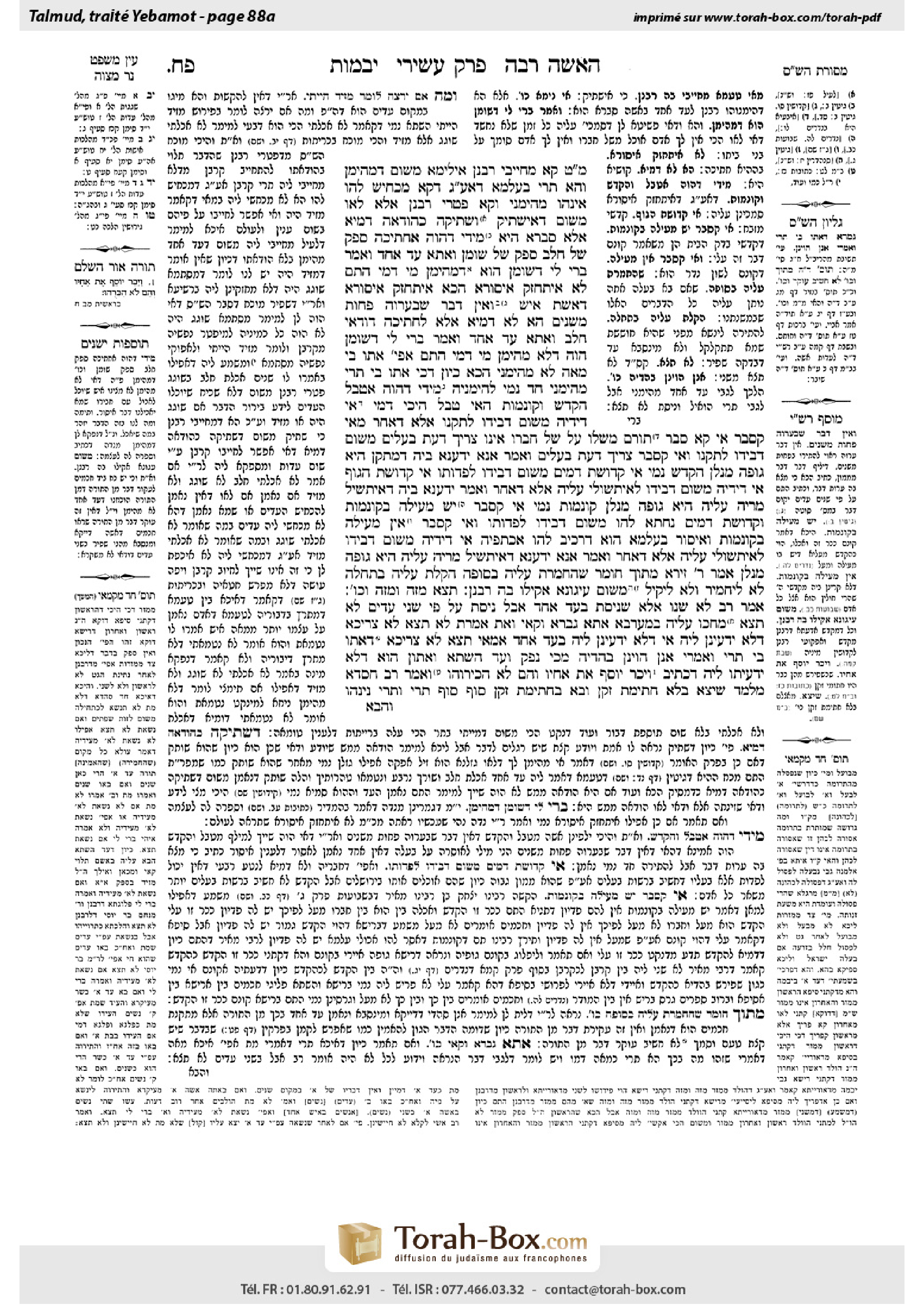
Yevamot 88a: Talmud study for Daf Yomi
Daf Yomi is the daily study of one Talmud folio. Explore 37 tractates with scans, Hebrew text, Sefaria English and AI-generated French translations where annotated.
Passage selection and English or AI-generated French translation are available where the scan has annotations. Daf Study is independent of Torah-Box and Sefaria.
Browse Yevamot · יבמות · All tractatesYevamot 88a text and translations
This page of Yevamot includes the Aramaic text, an English translation and an AI-generated French translation, alongside the scan above.
יבמות פ״ח א · Aramaic and Hebrew text
מַאי טַעְמָא קָא מְחַיְּיבִי רַבָּנַן? אִילֵּימָא מִשּׁוּם דִּמְהֵימַן — וְהָא תְּרֵי בְּעָלְמָא, דְּאַף עַל גַּב דְּקָא מַכְחִישׁ לְהוּ אִינְהוּ — מְהֵימְנִי, וְקָא פָּטְרִי רַבָּנַן. אֶלָּא לָאו, מִשּׁוּם דְּאִישְׁתִּיק — וּשְׁתִיקָה כְּהוֹדָאָה דָמְיָא.
אֶלָּא סְבָרָא הִיא, מִידֵּי דְּהָוֵה אַחֲתִיכָה סָפֵק שֶׁל חֵלֶב סָפֵק שֶׁל שׁוּמָּן, וַאֲתָא עֵד אֶחָד וְאָמַר: בָּרִי לִי, דְּשׁוּמָּן הוּא — דִּמְהֵימַן.
מִי דָּמֵי? הָתָם לָא אִיתַּחְזַק אִיסּוּרָא, הָכָא אִיתַּחְזַק אִיסּוּרָא דְּאֵשֶׁת אִישׁ, וְאֵין דָּבָר שֶׁבְּעֶרְוָה פָּחוֹת מִשְּׁנַיִם!
הָא לָא דָּמְיָא אֶלָּא לַחֲתִיכָה דְּוַדַּאי חֵלֶב, וַאֲתָא עֵד אֶחָד וְאָמַר: בָּרִי לִי דְּשׁוּמָּן הֲוָה — דְּלָא מְהֵימַן! מִי דָּמֵי? הָתָם, אֲפִילּוּ אָתוּ בֵּי מְאָה לָא מְהֵימְנִי. הָכָא, כֵּיוָן דְּכִי אָתוּ בֵּי תְרֵי מְהֵימְנִי — חַד נָמֵי לְהֵימְנֵיהּ, מִידֵּי דְּהָוֵה אַטֶּבֶל, הֶקְדֵּשׁ, וְקֻוֽנָּמוֹת.
הַאי טֶבֶל, הֵיכִי דָמֵי? אִי דִּידֵיהּ — מִשּׁוּם דִּבְיָדוֹ לְתַקְּנוֹ. אֶלָּא דְּאַחֵר, מַאי קָסָבַר:
אִי קָא סָבַר: תּוֹרֵם מִשֶּׁלּוֹ עַל שֶׁל חֲבֵרוֹ אֵינוֹ צָרִיךְ דַּעַת בְּעָלִים — מִשּׁוּם דִּבְיָדוֹ לְתַקְּנוֹ, וְאִי קָסָבַר: צָרִיךְ דַּעַת בְּעָלִים, וְאָמַר: אֲנָא יָדַעְנָא בֵּיהּ דִּמְתַקַּן, הִיא גּוּפַהּ מְנָלַן?
הֶקְדֵּשׁ נָמֵי, אִי קְדוּשַּׁת דָּמִים — מִשּׁוּם דִּבְיָדוֹ לִפְדּוֹתוֹ. אִי קְדוּשַּׁת הַגּוּף, אִי דִּידֵיהּ — מִשּׁוּם דִּבְיָדוֹ לְאִיתְּשׁוֹלֵי עֲלֵיהּ. אֶלָּא דְּאַחֵר, וְאָמַר: יָדַעְנָא בֵּיהּ דְּאִיתְּשִׁיל מָרֵיהּ עֲלֵיהּ, הִיא גּוּפַהּ מְנָלַן?
קֻוֽנָּמוֹת נָמֵי, אִי קָסָבַר: יֵשׁ מְעִילָה בְּקֻוֽנָּמוֹת, וּקְדוּשַּׁת דָּמִים נָחֲתָא לְהוּ — מִשּׁוּם דִּבְיָדוֹ לִפְדּוֹתוֹ, וְאִי קָסָבַר: אֵין מְעִילָה בְּקֻוֽנָּמוֹת, וְאִיסּוּר בְּעָלְמָא הוּא דְּרָכֵיב לְהוּ אַכַּתְפֵּיהּ, אִי דִּידֵיהּ — מִשּׁוּם דִּבְיָדוֹ לְאִיתְּשׁוֹלֵי עֲלֵיהּ,
אֶלָּא דְּאַחֵר, וְאָמַר: אֲנָא יָדַעְנָא דְּאִיתְּשִׁיל מָרֵיהּ עֲלֵיהּ — הִיא גּוּפַהּ מְנָלַן?
אָמַר רַבִּי זֵירָא: מִתּוֹךְ חוֹמֶר שֶׁהֶחְמַרְתָּ עָלֶיהָ בְּסוֹפָהּ — הֵקַלְתָּ עָלֶיהָ בַּתְּחִלָּה. לָא לַיחְמַיר וְלָא לַיקֵּיל!
מִשּׁוּם עִיגּוּנָא אַקִּילוּ בַּהּ רַבָּנַן.
תֵּצֵא מִזֶּה וּמִזֶּה וְכוּ׳. אָמַר רַב: לֹא שָׁנוּ אֶלָּא שֶׁנִּיסֵּת בְּעֵד אֶחָד, אֲבָל נִיסֵּת עַל פִּי שְׁנֵי עֵדִים — לֹא תֵּצֵא. מַחֲכוּ עֲלֵיהּ בְּמַעְרְבָא: אֲתָא גַּבְרָא וְקָאֵי, וְאַתְּ אָמְרַתְּ לֹא תֵּצֵא? לָא צְרִיכָא, דְּלָא יָדְעִינַן לֵיהּ.
אִי דְּלָא יָדְעִינַן לֵיהּ, בְּעֵד אֶחָד אַמַּאי תֵּצֵא? לָא צְרִיכָא, דַּאֲתוֹ בֵּי תְרֵי וְאָמְרִי: אֲנַן הֲוֵינַן בַּהֲדֵיהּ מִכִּי נְפַק וְעַד הַשְׁתָּא, וְאַתּוּן הוּא דְּלָא יָדְעִיתוּ לֵיהּ, דִּכְתִיב: ״וַיַּכֵּר יוֹסֵף אֶת אֶחָיו וְהֵם לֹא הִכִּירוּהוּ״, וְאָמַר רַב חִסְדָּא: מְלַמֵּד שֶׁיָּצָא בְּלֹא חֲתִימַת זָקָן, וּבָא בַּחֲתִימַת זָקָן.
סוֹף סוֹף תְּרֵי וּתְרֵי נִינְהוּ,
Yevamot 88a · English translation
of the mishna, what is the reason that when he remains silent, the Rabbis obligate him to bring to an offering based on the testimony of one witness? If we say it is because the witness is deemed credible, but there is the case of an ordinary pair of witnesses, where even though he contradicts their claim they are deemed credible, and yet the Rabbis exempt him from bringing an offering. If so, they would certainly not obligate him to bring an offering due to the testimony of a lone witness. Rather, is it not because he remained silent, and silence is considered like an admission? If this is the reason why he brings an offering, there is no proof from here that the testimony of one witness is accepted.
Rather, this is evidently based on logical reasoning: Just as it is in the case of a piece of meat about which it is uncertain if it is forbidden fat and uncertain if it is of permitted fat, and there is no way of clarifying which it is, and one witness comes and says: It is clear to me that it is permitted fat, the halakha is that he is deemed credible. Here too, the testimony of a single witness can resolve the uncertainty.
The Gemara raises a difficulty: Is it comparable? There, the presumption of a prohibition has not been established, as there is no proof that the piece was ever forbidden, and one can therefore rely on the witness who permits it, whereas here, the presumption of the prohibition with regard to a married woman is established, and there is a principle that nothing involving those with whom relations are forbidden can be determined by fewer than two witnesses.
In fact, this is comparable only to a case involving a piece of meat that is definitely forbidden fat, and one witness comes and says: It is clear to me that it is permitted fat, as the halakha is that he is not deemed credible. The Gemara refutes this claim: Is it comparable? There, when it is established as forbidden fat, even if one hundred witnesses come they are not deemed credible. Here, since if two witnesses come and say the husband is dead they would be deemed credible, let us also deem one witness credible. This is just as it is in the case of untithed produce, i.e., produce from which neither teruma nor tithe has been separated, consecrated property, and konamot, an alternative term for offerings [korbanot] used in vows creating prohibitions. Such vows are called by the generic term: Konamot.
The Gemara asks: With regard to this case of untithed produce, what are the circumstances? If it is his, and he testifies that terumot and tithes have been separated from it, he should be deemed credible because it is within his power to prepare the produce for consumption by separating tithes whenever he wishes. Rather, you must say that he testifies with regard to untithed produce of another, but if so, what does the anonymous Sage who cited this example hold in this case?
The Gemara elaborates: If he holds that one who separates tithes from his produce for that of another does not require the owner’s knowledge, and he can prepare his friend’s produce for consumption whenever he chooses, in this case too his testimony is deemed credible because it is within his power to prepare it. And if he holds that the owner’s knowledge is required before someone else can separate the gifts, and this is referring to a situation where the witness comes and says: I know with regard to it that it is prepared, in that case, it itself, this very halakha, from where do we derive it? Why is the case of untithed produce more obvious than the testimony with regard to a missing husband?
Similarly, with regard to consecrated property too, if it is merely sanctity that inheres in its value, i.e., it is not an actual offering but an item that has been dedicated to the Temple upkeep, then the reason why the testimony of one witness who says it is not consecrated is accepted is due to the fact that it is within his power to redeem it. And if this is referring to inherent sanctity, the matter still remains to be clarified: If it is his offering, then the reason is due to the fact that it is within his power to request from a Sage that the vow be dissolved, like any other vow. Rather, you must say that it is referring to the offering of another, and he said: I know with regard to it that its owner requested from a Sage that his vow be dissolved. However, here too, in this case itself, from where do we derive that he is deemed credible?
In the case of konamot too, if he holds that there is misuse of consecrated objects with regard to konamot, i.e., he holds that articles sanctified by a konam have the status of consecrated property, and that the sanctity that inheres in its value applies to them, then his claim is accepted because it is within his power to redeem it. And if he maintains that there is no misuse of consecrated objects in the case of konamot, and it is an ordinary prohibition that rides on its shoulders, i.e., it is forbidden due to its similarity to consecrated property despite the fact that is not fully sacred, even in this case the above argument applies: If the property in question is his, it is permitted because it is within his power to request from a Sage that his vow be dissolved.
Rather, you will say that the konam must belong to another, and he said: I know with regard to it that its owner requested from a Sage that his vow be dissolved. However, with regard to this halakha itself, that one witness is deemed credible in this case, from where do we derive it? Consequently, after the Gemara has refuted these attempts to explain why one witness should be deemed credible, the question remains: Why is the testimony of a single witness accepted in the case of a missing husband?
Rabbi Zeira said: Due to the stringency that you were stringent with her, the woman who married on the basis of a single witness, at the end, i.e., if it turns out that the testimony was incorrect and the husband is still alive, the halakha is very severe with her and she loses out in all regards, you are lenient with her at the beginning, by accepting the testimony of a single witness to enable the woman to marry. The Gemara suggests: If so, let us not be stringent at the end and not be lenient at the beginning.
The Gemara answers: Due to the case of a deserted wife, the Sages were lenient with her. Since it is not always easy to find two witnesses to attest to a husband’s death, the Sages realized that if the testimony of one witness were not accepted, the woman would be likely to remain a deserted wife, unable to remarry. However, to prevent this leniency from causing mistakes and licentiousness, they were very stringent with her in a case where the testimony is found to be erroneous, to ensure that she is very careful not to accept untrustworthy accounts.
§ The mishna teaches that if she was informed that her husband was dead and she married another man, and her husband later returned, she must leave this one and this one. Rav said: They taught this halakha only if she married by virtue of the testimony of one witness, but if she married on the basis of the testimony of two witnesses, she does not have to leave him. They laughed at him in the West, Eretz Yisrael: The man, the first husband, has come and stands before us, and yet you say she does not have to leave her second husband. The Gemara explains: No, it is necessary in a situation when we do not know the man who comes before us claiming to be the first husband.
The Gemara asks: If we do not know him, even if she married by one witness, why should she leave? The testimony of the witness who says the husband is dead should be accepted. The Gemara answers: No, it is necessary for a case when two others came and said: We were with him from when he left until now, and it is you who do not recognize him, as his appearance has changed over the course of time. This is as it is written: “And Joseph recognized his brothers but they did not recognize him” (Genesis 42:8), and Rav Ḥisda said that this verse teaches that Joseph left his brothers without a full beard, and he came with a full beard, which is why they failed to recognize him. This shows that one’s appearance can change so much over time that even his own family members are unable to identify him.
The Gemara asks: Even in this case, ultimately they are two against two. Initially, two witnesses testified that the man was dead, and now another pair arrives saying he is alive. Why should the testimony of the witnesses who say he is dead be accepted, allowing her to remain with the second husband, while other witnesses claim he is still alive?
Yevamot 88a · Traduction française (IA)
de la Michna : pour quelle raison les Sages l’obligent-ils, lorsqu’il garde le silence, à apporter un sacrifice sur la foi du témoignage d’un seul témoin ? Si l’on dit que le témoin est réputé digne de foi, il y a pourtant le cas ordinaire de deux témoins : même s’il conteste leur affirmation, ils sont réputés dignes de foi, et pourtant les Sages l’exemptent d’apporter un sacrifice. À plus forte raison ne l’obligeraient-ils pas à apporter un sacrifice sur la foi d’un seul témoin. N’est-ce donc pas plutôt parce qu’il a gardé le silence, lequel est considéré comme un aveu ? Si c’est pour cette raison qu’il apporte un sacrifice, ce passage ne prouve pas que le témoignage d’un seul témoin soit accepté.
Il faut donc manifestement s’appuyer sur un raisonnement logique : de même que, dans le cas d’un morceau de viande dont on ne sait pas s’il s’agit de graisse interdite ou de graisse permise, sans qu’il soit possible de déterminer laquelle, un témoin se présente et dit : « Je sais avec certitude qu’il s’agit de graisse permise », et qu’il est réputé digne de foi selon la halakha, de même, ici, le témoignage d’un seul témoin peut lever le doute.
La Guemara soulève une difficulté : les deux cas sont-ils comparables ? Dans le premier cas, aucune présomption d’interdiction n’a été établie, puisqu’il n’est pas prouvé que le morceau ait jamais été interdit ; on peut donc se fier au témoin qui l’autorise. Ici, en revanche, la présomption d’interdiction concernant une femme mariée est établie, et il existe un principe selon lequel rien de ce qui relève des unions interdites ne peut être établi par moins de deux témoins.
En réalité, le seul cas comparable est celui d’un morceau de viande dont on sait avec certitude qu’il s’agit de graisse interdite, lorsqu’un témoin se présente et dit : « Je sais avec certitude qu’il s’agit de graisse permise » ; selon la halakha, il n’est alors pas réputé digne de foi. La Guemara réfute cet argument : les deux cas sont-ils comparables ? Là, une fois qu’il est établi qu’il s’agit de graisse interdite, même si cent témoins se présentent, ils ne sont pas réputés dignes de foi. Ici, puisque deux témoins qui se présenteraient pour dire que le mari est mort seraient réputés dignes de foi, considérons également un seul témoin comme digne de foi. C’est comme dans le cas des produits non soumis aux prélèvements, c’est-à-dire des produits dont ni la terouma ni les dîmes n’ont été prélevées, des biens consacrés et des konamot, terme alternatif désignant les offrandes [korbanot] dans les vœux qui créent des interdictions. Ces vœux sont désignés par le terme générique de konamot.
La Guemara demande : dans le cas de ces produits non soumis aux prélèvements, quelles sont les circonstances ? S’il s’agit de ses propres produits et qu’il témoigne que la terouma et les dîmes en ont été prélevées, il devrait être réputé digne de foi, puisqu’il est en son pouvoir de rendre les produits propres à la consommation en prélevant les dîmes quand il le souhaite. Il faut donc dire qu’il témoigne au sujet des produits non soumis aux prélèvements d’un autre. Mais, dans ce cas, quelle position le Sage anonyme qui a cité cet exemple adopte-t-il ?
La Guemara développe : s’il estime que celui qui prélève des dîmes de ses propres produits pour ceux d’un autre n’a pas besoin de l’accord du propriétaire et qu’il peut rendre les produits de son ami propres à la consommation quand il le souhaite, alors, dans ce cas également, son témoignage est réputé digne de foi, puisqu’il est en son pouvoir de les rendre propres à la consommation. Et s’il estime que l’accord du propriétaire est nécessaire avant que quelqu’un d’autre puisse prélever les dons, et qu’il s’agit d’un cas où le témoin se présente et dit : « Je sais que ces produits sont propres à la consommation », alors, dans ce cas même, d’où déduisons-nous cette règle ? Pourquoi le cas des produits non soumis aux prélèvements serait-il plus évident que celui du témoignage concernant un mari disparu ?
De même, concernant les biens consacrés, s’il s’agit uniquement d’une consécration de leur valeur — c’est-à-dire qu’il ne s’agit pas d’une offrande proprement dite, mais d’un bien affecté à l’entretien du Temple —, la raison pour laquelle le témoignage d’un seul témoin qui affirme qu’ils ne sont pas consacrés est accepté est qu’il est en son pouvoir de les racheter. Et s’il s’agit d’une sainteté inhérente à l’objet, la question reste à clarifier : s’il s’agit de sa propre offrande, c’est parce qu’il est en son pouvoir de demander à un Sage de délier son vœu, comme tout autre vœu. Il faut donc dire qu’il s’agit de l’offrande d’un autre, et que le témoin a dit : « Je sais que son propriétaire a demandé à un Sage de délier son vœu. » Mais ici aussi, dans ce cas même, d’où déduisons-nous qu’il est réputé digne de foi ?
Dans le cas des konamot également, s’il estime qu’il y a détournement de biens consacrés dans le cas des konamot — c’est-à-dire qu’il considère que les objets sanctifiés par un konam ont le statut de biens consacrés et que la consécration de leur valeur s’applique à eux —, son affirmation est acceptée parce qu’il est en son pouvoir de les racheter. Mais s’il estime qu’il n’y a pas de détournement de biens consacrés dans le cas des konamot et qu’il s’agit d’une interdiction ordinaire qui s’y attache, c’est-à-dire que l’objet est interdit par analogie avec un bien consacré, bien qu’il ne soit pas pleinement sacré, le même argument s’applique : si le bien en question lui appartient, il est permis, puisqu’il est en son pouvoir de demander à un Sage de délier son vœu.
Il faut donc dire que le konam appartient à un autre, et que le témoin a dit : « Je sais que son propriétaire a demandé à un Sage de délier son vœu. » Mais, concernant cette règle même — selon laquelle un seul témoin est réputé digne de foi dans ce cas —, d’où la déduisons-nous ? Ainsi, après que la Guemara a réfuté ces tentatives visant à expliquer pourquoi un seul témoin devrait être réputé digne de foi, la question demeure : pourquoi accepte-t-on le témoignage d’un seul témoin dans le cas d’un mari disparu ?
Rabbi Zeira dit : en raison de la rigueur à laquelle vous la soumettez à la fin — la femme qui s’est mariée sur la foi d’un seul témoin subit une halakha très sévère et perd à tous égards si l’on découvre que le témoignage était erroné et que son mari est toujours vivant —, vous faites preuve d’indulgence envers elle au début, en acceptant le témoignage d’un seul témoin afin de lui permettre de se marier. La Guemara suggère : dans ce cas, ne soyons pas sévères à la fin et ne soyons pas indulgents au début.
La Guemara répond : c’est en raison de la situation de la femme abandonnée que les Sages ont fait preuve d’indulgence envers elle. Comme il n’est pas toujours facile de trouver deux témoins attestant la mort d’un mari, les Sages ont compris que si le témoignage d’un seul témoin n’était pas accepté, la femme risquerait de rester abandonnée, sans pouvoir se remarier. Toutefois, afin d’éviter que cette indulgence n’entraîne des erreurs et de la débauche, ils se montrent très sévères envers elle lorsque le témoignage s’avère erroné, pour qu’elle veille scrupuleusement à ne pas se fier à des récits douteux.
§ La Michna enseigne que si l’on a annoncé à une femme que son mari était mort et qu’elle a épousé un autre homme, puis que son mari est revenu, elle doit quitter l’un comme l’autre. Rav dit : cette halakha n’a été enseignée que si elle s’est mariée sur la foi du témoignage d’un seul témoin ; mais si elle s’est mariée sur la foi du témoignage de deux témoins, elle n’est pas obligée de quitter son second mari. En Erets Israël, on se moqua de lui : « Le premier mari est venu et se tient devant nous, et tu dis pourtant qu’elle n’est pas obligée de quitter son second mari ! » La Guemara explique : non, cette règle est nécessaire dans le cas où nous ne reconnaissons pas l’homme qui se présente en prétendant être le premier mari.
La Guemara demande : si nous ne le reconnaissons pas, même si elle s’est mariée sur la foi d’un seul témoin, pourquoi devrait-elle le quitter ? Le témoignage du témoin qui affirme que son mari est mort devrait être accepté. La Guemara répond : non, cette règle est nécessaire dans le cas où deux autres hommes viennent dire : « Nous avons été avec lui depuis son départ jusqu’à maintenant ; c’est vous qui ne le reconnaissez pas, car son apparence a changé avec le temps. » Cela correspond à ce qui est écrit : « Joseph reconnut ses frères, mais eux ne le reconnurent pas » (Genèse 42, 8). Rav Ḥisda a dit que ce verset enseigne que Joseph avait quitté ses frères sans barbe complète et qu’il revint avec une barbe complète, raison pour laquelle ils ne le reconnurent pas. Cela montre que l’apparence d’une personne peut tellement changer avec le temps que même les membres de sa propre famille sont incapables de l’identifier.
La Guemara demande : même dans ce cas, il y a finalement deux témoins contre deux. Au départ, deux témoins ont affirmé que l’homme était mort, et maintenant une autre paire de témoins se présente pour dire qu’il est vivant. Pourquoi devrait-on accepter le témoignage des témoins qui disent qu’il est mort, ce qui lui permettrait de rester avec son second mari, alors que d’autres témoins affirment qu’il est toujours vivant ?
Traduction française générée par IA à partir de l’édition anglaise de Sefaria. Vérifie toujours un passage avec le texte source.
Text from Sefaria: William Davidson Edition - Vocalized Aramaic (CC BY NC); William Davidson Edition - English (CC BY NC).