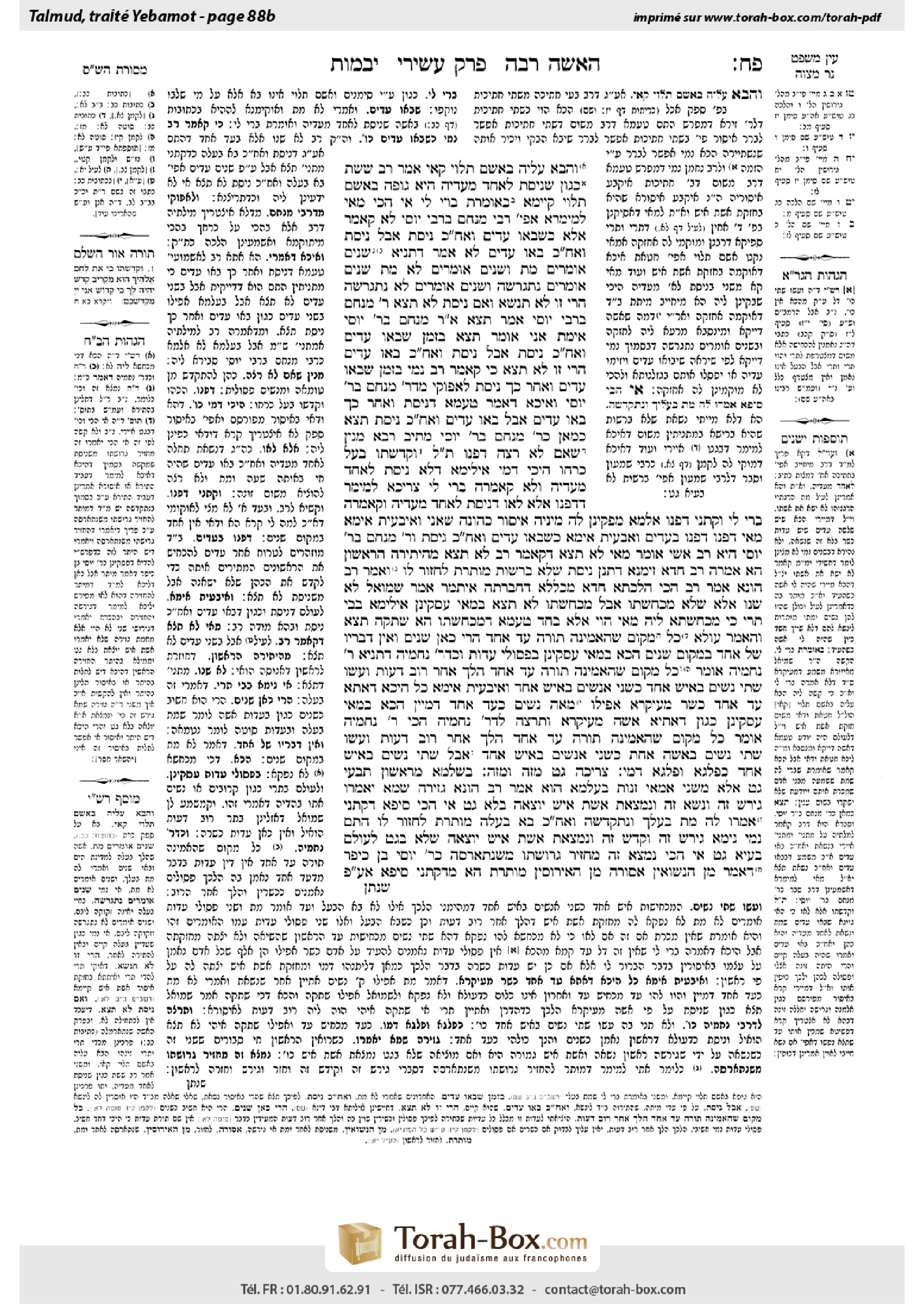
Yevamot 88b: Talmud study for Daf Yomi
Daf Yomi is the daily study of one Talmud folio. Explore 37 tractates with scans, Hebrew text, Sefaria English and AI-generated French translations where annotated.
Passage selection and English or AI-generated French translation are available where the scan has annotations. Daf Study is independent of Torah-Box and Sefaria.
Browse Yevamot · יבמות · All tractatesYevamot 88b text and translations
This page of Yevamot includes the Aramaic text, an English translation and an AI-generated French translation, alongside the scan above.
יבמות פ״ח ב · Aramaic and Hebrew text
וְהַבָּא עָלֶיהָ בְּאָשָׁם תָּלוּי קָאֵי! אָמַר רַב שֵׁשֶׁת: כְּגוֹן שֶׁנִּיסֵּת לְאֶחָד מֵעֵדֶיהָ.
הִיא גּוּפַהּ בְּאָשָׁם תָּלוּי קָיְימָא! בְּאוֹמֶרֶת ״בָּרִי לִי״. אִי הָכִי, מַאי לְמֵימְרָא? אֲפִילּוּ רַבִּי מְנַחֵם בְּרַבִּי יוֹסֵי לָא קָאָמַר אֶלָּא כְּשֶׁבָּאוּ עֵדִים וְאַחַר כָּךְ נִיסֵּת, אֲבָל נִיסֵּת וְאַחַר כָּךְ בָּאוּ עֵדִים — לָא אָמַר.
דְּתַנְיָא: שְׁנַיִם אוֹמְרִים ״מֵת״ וּשְׁנַיִם אוֹמְרִים ״לָא מֵת״, שְׁנַיִם אוֹמְרִים ״נִתְגָּרְשָׁה״ וּשְׁנַיִם אוֹמְרִים ״לֹא נִתְגָּרְשָׁה״ — הֲרֵי זוֹ לֹא תִּנָּשֵׂא, וְאִם נִיסֵּת — לֹא תֵּצֵא. רַבִּי מְנַחֵם בְּרַבִּי יוֹסֵי אָמַר: תֵּצֵא. אָמַר רַבִּי מְנַחֵם בְּרַבִּי יוֹסֵי: אֵימַת אֲנִי אוֹמֵר תֵּצֵא? בִּזְמַן שֶׁבָּאוּ עֵדִים וְאַחַר כָּךְ נִיסֵּת. אֲבָל נִיסֵּת וְאַחַר כָּךְ בָּאוּ עֵדִים — הֲרֵי זוֹ לֹא תֵּצֵא!
כִּי קָאָמַר רַב נָמֵי, בִּזְמַן שֶׁבָּאוּ עֵדִים וְאַחַר כָּךְ נִיסֵּת. לְאַפּוֹקֵי מִדְּרַבִּי מְנַחֵם בְּרַבִּי יוֹסֵי. וְאִיכָּא דְּאָמַר: טַעְמָא דְּנִיסֵּת וְאַחַר כָּךְ בָּאוּ עֵדִים, אֲבָל בָּאוּ עֵדִים וְאַחַר כָּךְ נִיסֵּת — תֵּצֵא. כְּמַאן — כְּרַבִּי מְנַחֵם בְּרַבִּי יוֹסֵי.
מֵתִיב רָבָא: מִנַּיִן שֶׁאִם לֹא רָצָה — דׇּפְנוֹ, תַּלְמוּד לוֹמַר: ״וְקִדַּשְׁתּוֹ״, בְּעַל כׇּרְחוֹ.
הֵיכִי דָמֵי, אִילֵּימָא דְּלָא נִיסֵּת לְאֶחָד מֵעֵדֶיהָ וְלֹא קָאָמְרָה ״בָּרִי לִי״, צְרִיכָא לְמֵימַר דְּדׇפְנוֹ? אֶלָּא לָאו, דְּנִיסֵּת לְאֶחָד מֵעֵדֶיהָ, וְקָאָמְרָה ״בָּרִי לִי״, וְקָתָנֵי דׇּפְנוֹ. אַלְמָא, מַפְּקִינַן לַהּ מִינֵּיהּ!
אִיסּוּר כְּהוּנָּה שָׁאנֵי. וְאִיבָּעֵית אֵימָא: מַאי דׇּפְנוֹ — דׇּפְנוֹ בְּעֵדִים. וְאִבָּעֵית אֵימָא: כְּשֶׁבָּאוּ עֵדִים וְאַחַר כָּךְ נִיסֵּת, וְרַבִּי מְנַחֵם בְּרַבִּי יוֹסֵי הִיא.
רַב אָשֵׁי אוֹמֵר: מַאי ״לֹא תֵּצֵא״ דְּקָאָמַר רַב — לֹא תֵּצֵא מֵהֶיתֵּירָהּ הָרִאשׁוֹן.
הָא אַמְרַהּ רַב חֲדָא זִימְנָא, דִּתְנַן: נִיסֵּת שֶׁלֹּא בִּרְשׁוּת — מוּתֶּרֶת לַחְזוֹר לוֹ. וְאָמַר רַב הוּנָא אֲמַר רַב: הָכִי הִלְכְתָא! חֲדָא מִכְּלָלָא דַּחֲבֶרְתַּהּ אִיתְּמַר.
אָמַר שְׁמוּאֵל: לֹא שָׁנוּ אֶלָּא שֶׁלֹּא מַכְחַשְׁתּוֹ, אֲבָל מַכְחַשְׁתּוֹ — לֹא תֵּצֵא. בְּמַאי עָסְקִינַן? אִילֵימָא בְּבֵי תְרֵי, כִּי מַכְחֲשָׁא לֵיהּ מַאי הָוֵי! אֶלָּא בְּחַד, טַעְמָא דְּמַכְחַשְׁתּוֹ, הָא שָׁתְקָה — תֵּצֵא.
וְהָאָמַר עוּלָּא: כׇּל מָקוֹם שֶׁהֶאֱמִינָה תּוֹרָה עֵד אֶחָד, הֲרֵי כָּאן שְׁנַיִם, וְאֵין דְּבָרָיו שֶׁל אֶחָד בִּמְקוֹם שְׁנַיִם! הָכָא בְּמַאי עָסְקִינַן — בִּפְסוּלֵי עֵדוּת, וְכִדְרַבִּי נְחֶמְיָה.
דְּתַנְיָא, רַבִּי נְחֶמְיָה אוֹמֵר: כׇּל מָקוֹם שֶׁהֶאֱמִינָה תּוֹרָה עֵד אֶחָד — הַלֵּךְ אַחַר רוֹב דֵּעוֹת. וְעָשׂוּ שְׁתֵּי נָשִׁים בְּאִישׁ אֶחָד כִּשְׁנֵי אֲנָשִׁים בְּאִישׁ אֶחָד.
וְאִיבָּעֵית אֵימָא: כֹּל הֵיכָא דַּאֲתָא עֵד אֶחָד כָּשֵׁר מֵעִיקָּרָא, אֲפִילּוּ מֵאָה נָשִׁים — כְּעֵד אֶחָד דָּמְיָין. הָכָא בְּמַאי עָסְקִינַן, כְּגוֹן דְּאָתְיָא אִשָּׁה מֵעִיקָּרָא.
וְתָרְצַהּ לִדְרַבִּי נְחֶמְיָה הָכִי: רַבִּי נְחֶמְיָה אוֹמֵר: כׇּל מָקוֹם שֶׁהֶאֱמִינָה תּוֹרָה עֵד אֶחָד — הַלֵּךְ אַחַר רוֹב דֵּעוֹת, וְעָשׂוּ שְׁתֵּי נָשִׁים בְּאִשָּׁה אַחַת — כִּשְׁנֵי אֲנָשִׁים בְּאִישׁ אֶחָד אֲבָל שְׁתֵּי נָשִׁים בְּאִישׁ אֶחָד — כְּפַלְגָא וּפַלְגָא דָּמֵי.
צְרִיכָה גֵּט מִזֶּה וּמִזֶּה. בִּשְׁלָמָא מֵרִאשׁוֹן תִּבְעֵי גֵּט, אֶלָּא מִשֵּׁנִי אַמַּאי? זְנוּת בְּעָלְמָא הוּא!
אָמַר רַב הוּנָא: גְּזֵירָה שֶׁמָּא יֹאמְרוּ גֵּירַשׁ זֶה וְנָשָׂא זֶה, וְנִמְצֵאת אֵשֶׁת אִישׁ יוֹצְאָה בְּלָא גֵּט. אִי הָכִי, סֵיפָא דְּקָתָנֵי: אָמְרוּ לָהּ ״מֵת בַּעְלִךְ״ וְנִתְקַדְּשָׁה, וְאַחַר כָּךְ בָּא בַּעְלָהּ — מוּתֶּרֶת לַחְזוֹר לוֹ. הָתָם נָמֵי, נֵימָא: גֵּירַשׁ זֶה וְקִדֵּשׁ זֶה, וְנִמְצֵאת אֵשֶׁת אִישׁ יוֹצְאָה שֶׁלֹּא בַּגֵּט!
לְעוֹלָם בָּעֲיָא גֵּט. אִי הָכִי, נִמְצָא זֶה מַחֲזִיר גְּרוּשָׁתוֹ מִשֶּׁנִּתְאָרְסָה! כְּרַבִּי יוֹסֵי בֶּן כִּיפָּר, דְּאָמַר: מִן הַנִּשּׂוּאִין — אֲסוּרָה, מִן הָאֵירוּסִין — מוּתֶּרֶת.
הָא מִדְּקָתָנֵי סֵיפָא: אַף עַל פִּי
Yevamot 88b · English translation
And as this is an uncertain case, one who has intercourse with her stands obligated to bring an uncertain guilt-offering. Since before she remarried some witnesses say she is a married woman while others claim she is now a widow, her relations with her second husband involve a possible prohibition that entails karet, and whoever mistakenly performs an action of this kind is liable to bring an uncertain guilt-offering. If so, this second husband must certainly divorce her. Rav Sheshet said: We are dealing with a case where that woman married one of her witnesses, who testified that her husband had died. Since the witness himself has no doubt as to the truth, he is not liable to bring an uncertain guilt-offering.
The Gemara asks: Even so, she herself stands obligated to bring a uncertain guilt-offering, as she has no personal knowledge of the matter and relied on the witness. The Gemara answers: It is referring to a case where she says: It is clear to me. For whatever reason, she is certain that this is not her husband and that he is dead, and therefore she too is not liable to bring an uncertain guilt-offering. The Gemara asks: If so, what is the purpose of stating this? That is, if Rav is referring only to this particular case, he has not taught anything new, as even Rabbi Menaḥem, son of Rabbi Yosei, stated his opinion only with regard to a case where witnesses came and afterward she married, but in the case where she married and afterward witnesses came, he did not state his halakha with regard to this case.
To what ruling is the Gemara referring? As it is taught in a baraita: If two witnesses say that the husband is dead and two say he is not dead, or if two say that this woman was divorced and two say she was not divorced, this woman may not marry; and if she married regardless, she need not leave her new husband, as there is no uncontroverted testimony that she is forbidden to him. Rabbi Menaḥem, son of Rabbi Yosei, said: She must leave him. Rabbi Menaḥem, son of Rabbi Yosei, further said: When do I say she must leave him? When the witnesses who contradicted the first pair by claiming she is still married came and afterward she married, despite their testimony. However, if she married and afterward the second pair of witnesses came, this woman need not leave her second husband.
The Gemara answers: When Rav spoke too, he was referring to a case when the second pair of witnesses came and testified that this is her husband, and afterward she married. Rav claims that even in that case she need not leave her second husband. His ruling serves to exclude the opinion of Rabbi Menaḥem, son of Rabbi Yosei, in favor of that of the first tanna. And some say that Rav’s teaching should be understood as follows: The reason is that she married and afterward witnesses came; however, if witnesses came and afterward she married, she must leave him. According to whose opinion is this ruling of Rav? It is in accordance with the opinion of Rabbi Menaḥem, son of Rabbi Yosei.
Rava raised an objection from a baraita: From where is it derived that if a priest does not want to observe the strictures against disqualified women, that the court forces him [dafno] by flogging him, and it sanctifies him despite his wishes? The verse states, at the end of the chapter that deals with the prohibitions of the priesthood: “And you shall sanctify him…he shall be sacred for you” (Leviticus 21:8), which indicates that this is performed even against his will.
Rava analyzes this baraita: What are the circumstances? Assuming that this is referring to a priest who married a woman whose status as a divorced woman or a zona is uncertain, if we say that she did not marry one of her witnesses and did not say: It is clear to me, that the opposing witnesses were speaking the truth, need this be said that the court forces him? Since both of them are clearly in violation of a transgression, it is obvious that they must be separated. Rather, is it not referring to a case when she married one of her witnesses and she says: It is clear to me, and even so the baraita is teaching that the court forces him? Apparently, the halakha is that they remove her from him, which contradicts Rav’s opinion that one who married based on the testimony of two witnesses need not leave her second husband.
The Gemara answers: A prohibition with regard to the priesthood is different, as uncertainties with regard to priests are treated stringently, as though they were definite. And if you wish, say: What is the meaning of the phrase: The court forces him? It means that it forces him by witnesses. In other words, only if another pair of witnesses comes and clarifies the matter does the court prevent the marriage ab initio. However, if she has already married she need not leave her husband. And if you wish, say instead that it is referring to a situation when witnesses came and afterward she married, and this baraita, which claims that the court forces him to divorce her in that case, is in accordance with the opinion of Rabbi Menaḥem, son of Rabbi Yosei.
Rav Ashi said: What is the meaning of the phrase: She need not leave him, that Rav said? It means that she need not leave her state of being permitted to her first husband. Since she married according to halakha, on the basis of witness testimony, she is considered to have acted under duress. Like any other woman not married to a priest who was unfaithful against her will, she may return to her first husband upon his return.
The Gemara asks: If that is what he meant, Rav already said it once. As we learned in the mishna: If she married without the consent of the court, but rather by witnesses’ testimony, it is permitted for her to return to him. And Rav Huna said that Rav said: That is the halakha. Evidently, Rav already ruled that she does not forfeit her original permitted status. The Gemara answers: One ruling was stated by inference from the other. In other words, Rav did not state both halakhot explicitly, but only one of them, from which his other statement was inferred.
Shmuel said: They taught that she must leave her second husband only if she does not contradict the witness who claims her first husband is alive. However, if she contradicts him, she need not leave her second husband. The Gemara inquires: With what are we dealing here? If we say we are dealing with two witnesses who testified that her husband is still alive, even if she contradicts him, what of it? The testimony of the two witnesses is fully accepted. Rather, it must be referring to one witness, from which it may be inferred that the reason that she need not leave her second husband is that she contradicts him, which indicates that if she remains silent and does not contradict his testimony, she must leave him.
The Gemara asks: But didn’t Ulla say that wherever you find that the Torah relies on one witness, this is a full testimony equal to that of two witnesses, and the statement of one witness has no bearing in a place where it is contradicted by two witnesses? If so, there is no difference between one witness and two witnesses in this case. The Gemara answers: With what are we dealing here? With a case where the pair who said he was alive were disqualified from giving testimony, and this is in accordance with the opinion of Rabbi Neḥemya.
As it is taught in a baraita that Rabbi Neḥemya says: Wherever you find that the Torah relies on one witness, follow the majority of opinions. If the testimony is valid, the account of two witnesses is the same as one hundred, as no greater credence is granted to the larger number. However, when the testimony is invalid the majority opinion is accepted. And in these cases they established the testimony of two women against one man like the testimony of two men against one man, whose claim is not considered equivalent to two. In this case, if the wife also contradicts their account she joins the single witness, and therefore the testimony of the disqualified witnesses is not accepted.
And if you wish, say instead that anywhere that one valid witness came initially and testified that the husband was dead, even one hundred women claiming that he is alive are considered like one witness, and their contrary account is not accepted. And with what are we dealing here? In a case where a woman came and testified initially.
And you must accordingly amend the statement of Rabbi Neḥemya so that it reads as follows: Rabbi Neḥemya says: Wherever you find that the Torah relies on one witness, follow the majority of opinions, and they established two women against one woman like two men against one man. However, in a case involving two women against one man who is a valid witness, this is like half against half, i.e., they are equal. With regard to Shmuel’s statement, if the wife herself remains silent, the testimony of the first woman that the husband is dead has been negated, as her account was contradicted by two women. But if the claim of the wife is joined to that of the first woman she need not leave her second husband.
§ The mishna teaches that if she remarried as the result of an error, then when her first husband returns she requires a bill of divorce from this one and from that one. The Gemara asks: Granted, from the first husband she requires a bill of divorce, as she is his actual wife. But from the second, why does she need a bill of divorce? Surely their relationship is merely licentious. Since her first husband was alive at the time, her marriage to the second is entirely invalid, as one cannot betroth a married woman. A woman does not require a bill of divorce for engaging in sexual relations.
Rav Huna said: It is a rabbinic decree lest those who are unaware of the entire story say that this first husband divorced her and afterward this second man married her. And if she subsequently leaves him without a bill of divorce, they will claim that we find a married woman leaving her husband without a bill of divorce. The Gemara asks: If so, consider the latter clause of the mishna (92a), that teaches that if they said to her: Your husband is dead, and she became betrothed to another, and afterward her husband came, it is permitted for her to return to her first husband. There too, let us say that people might think that this one divorced her and that one betrothed her, and we find a married woman leaving her husband, i.e., her second husband, without a bill of divorce.
The Gemara answers: Actually, even if she was merely betrothed she requires a bill of divorce from the second man before she can return to her first husband. The Gemara raises a difficulty: If so, people will say that we find this one remarrying his divorcée after she was betrothed to another. The Gemara answers: In this regard the tanna holds in accordance with the opinion of Rabbi Yosei ben Keifar, who stated a principle with regard to a divorcée who formed a relationship with another man, that if she came from marriage it is prohibited for her to return to her first husband, but if she came from betrothal it is permitted. Consequently, even if people do claim as above, there is no cause for concern.
The Gemara raises a further difficulty: From the fact that the latter clause of the mishna (92a) teaches: Even though
Yevamot 88b · Traduction française (IA)
Et comme il s’agit d’un cas incertain, celui qui a des relations avec elle est tenu d’apporter un sacrifice de culpabilité pour cas incertain. En effet, avant qu’elle ne se remarie, certains témoins affirment que son mari est encore vivant, tandis que d’autres soutiennent qu’il est mort ; ses relations avec son second mari comportent donc une possible transgression passible de karet, et quiconque commet par erreur un acte de ce genre est tenu d’apporter un sacrifice de culpabilité pour cas incertain. Dans ce cas, ce second mari doit certainement divorcer d’elle. Rav Chéchet dit : Nous parlons d’un cas où cette femme a épousé l’un des témoins qui avaient attesté la mort de son mari. Comme ce témoin lui-même n’a aucun doute quant à la véracité de son témoignage, il n’est pas tenu d’apporter un sacrifice de culpabilité pour cas incertain.
La Guemara demande : Malgré cela, elle-même est tenue d’apporter un sacrifice de culpabilité pour cas incertain, car elle ne sait pas personnellement ce qu’il en est et s’est fiée au témoin. La Guemara répond : Il s’agit d’un cas où elle dit : « C’est clair pour moi. » Pour une raison ou une autre, elle est certaine que cet homme n’est pas son mari et que celui-ci est mort ; elle n’est donc pas non plus tenue d’apporter un sacrifice de culpabilité pour cas incertain. La Guemara demande : Dans ce cas, à quoi bon le préciser ? Autrement dit, si Rav ne parle que de ce cas particulier, il n’a rien enseigné de nouveau, puisque même Rabbi Menaḥem, fils de Rabbi Yossei, n’a exprimé son avis qu’au sujet d’un cas où les témoins sont venus, puis où elle s’est mariée ; mais, dans le cas où elle s’est mariée et où les témoins sont venus ensuite, il n’a pas formulé sa halakha à ce sujet.
À quelle décision la Guemara fait-elle référence ? À celle qui est enseignée dans une baraïta : si deux témoins disent que le mari est mort et que deux autres disent qu’il n’est pas mort, ou si deux témoins disent que cette femme a été divorcée et que deux autres disent qu’elle ne l’a pas été, elle ne peut pas se marier ; mais si elle s’est malgré tout mariée, elle n’a pas à quitter son nouveau mari, car aucun témoignage incontesté n’établit qu’elle lui est interdite. Rabbi Menaḥem, fils de Rabbi Yossei, dit : Elle doit le quitter. Rabbi Menaḥem, fils de Rabbi Yossei, dit encore : Quand dis-je qu’elle doit le quitter ? Lorsque les témoins qui ont contredit le premier groupe en affirmant qu’elle est toujours mariée sont venus, puis qu’elle s’est mariée malgré leur témoignage. En revanche, si elle s’est mariée et que le second groupe de témoins est venu ensuite, elle n’a pas à quitter son second mari.
La Guemara répond : Lorsque Rav a parlé, lui aussi faisait référence au cas où le second groupe de témoins est venu attester qu’il s’agissait de son mari, puis où elle s’est mariée. Rav affirme que même dans ce cas, elle n’a pas à quitter son second mari. Sa décision écarte l’avis de Rabbi Menaḥem, fils de Rabbi Yossei, en faveur de celui du premier tanna. Certains disent que l’enseignement de Rav doit plutôt être compris ainsi : la raison est qu’elle s’est mariée et que les témoins sont venus ensuite ; toutefois, si les témoins sont venus puis qu’elle s’est mariée, elle doit le quitter. Selon l’avis de qui cette décision de Rav est-elle formulée ? Selon celui de Rabbi Menaḥem, fils de Rabbi Yossei.
Rava soulève une objection à partir d’une baraïta : D’où apprend-on que, si un prêtre ne veut pas respecter les restrictions concernant les femmes dont le statut est disqualifiant, le tribunal le contraint [dafno] en le faisant fouetter et le sanctifie contre son gré ? Le verset dit, à la fin du chapitre consacré aux interdictions propres à la prêtrise : « Tu le sanctifieras… il sera saint pour toi » (Lévitique 21,8), ce qui indique que cela se fait même contre sa volonté.
Rava analyse cette baraïta : Dans quelles circonstances ? Si l’on suppose qu’il s’agit d’un prêtre qui a épousé une femme dont le statut de divorcée ou de zona est incertain, et qu’elle n’a épousé aucun de ses témoins et n’a pas dit : « C’est clair pour moi », c’est-à-dire qu’elle est convaincue que les témoins qui affirment que son mari est mort disent la vérité, faut-il préciser que le tribunal le contraint ? Puisqu’ils transgressent tous deux manifestement une interdiction, il va de soi qu’ils doivent être séparés. Ne s’agit-il pas plutôt d’un cas où elle a épousé l’un de ses témoins et dit : « C’est clair pour moi », et où, malgré cela, la baraïta enseigne que le tribunal le contraint ? Il semble donc que la halakha soit qu’on la sépare de lui, ce qui contredit l’avis de Rav selon lequel une femme qui s’est mariée sur la base du témoignage de deux témoins n’a pas à quitter son second mari.
La Guemara répond : Une interdiction liée à la prêtrise est différente, car les cas incertains concernant les prêtres sont traités avec rigueur, comme s’ils étaient certains. Et si tu le souhaites, dis plutôt : Que signifie l’expression « le tribunal le contraint » ? Cela signifie qu’il le contraint par le recours à des témoins. Autrement dit, ce n’est que si un autre groupe de témoins vient éclaircir la situation que le tribunal empêche le mariage avant qu’il ait lieu. Toutefois, si elle s’est déjà mariée, elle n’a pas à quitter son mari. Et si tu le souhaites, dis plutôt qu’il s’agit d’un cas où des témoins sont venus, puis où elle s’est mariée ; cette baraïta, qui affirme que le tribunal le contraint à divorcer d’elle dans ce cas, est conforme à l’avis de Rabbi Menaḥem, fils de Rabbi Yossei.
Rav Achi dit : Que signifie l’expression « elle n’a pas à le quitter » employée par Rav ? Cela signifie qu’elle n’a pas à renoncer à son statut qui lui permet de retourner auprès de son premier mari. Puisqu’elle s’est mariée conformément à la halakha, sur la base du témoignage de témoins, on considère qu’elle a agi sous la contrainte. Comme toute autre femme qui n’est pas mariée à un prêtre et qui a été infidèle contre son gré, elle peut retourner auprès de son premier mari lorsque celui-ci revient.
La Guemara demande : Si c’est ce qu’il voulait dire, Rav l’a déjà dit une fois. Car nous avons appris dans la Michna : si elle s’est mariée sans l’autorisation du tribunal, mais sur la foi du témoignage de témoins, elle peut retourner auprès de son premier mari. Et Rav Houna a dit au nom de Rav : Telle est la halakha. De toute évidence, Rav a déjà statué qu’elle ne perd pas son statut initial qui lui permet de retourner auprès de son premier mari. La Guemara répond : L’une des décisions se déduisait de l’autre. Autrement dit, Rav n’a pas énoncé explicitement les deux halakhot, mais seulement l’une, dont on a déduit l’autre.
Chmouel dit : Ils ont enseigné qu’elle doit quitter son second mari uniquement si elle ne contredit pas le témoin qui affirme que son premier mari est vivant. En revanche, si elle le contredit, elle n’a pas à quitter son second mari. La Guemara demande : De quel cas s’agit-il ? Si l’on dit qu’il s’agit de deux témoins qui ont attesté que son mari est toujours vivant, qu’importe qu’elle les contredise ? Le témoignage des deux témoins est pleinement accepté. Il faut donc plutôt parler d’un témoin unique. On peut en déduire que la raison pour laquelle elle n’a pas à quitter son second mari est qu’elle contredit ce témoin ; cela indique que si elle reste silencieuse et ne contredit pas son témoignage, elle doit le quitter.
La Guemara demande : Mais Oulla n’a-t-il pas dit que partout où l’on trouve que la Torah s’appuie sur un témoin unique, son témoignage équivaut pleinement à celui de deux témoins, et que la déclaration d’un seul témoin n’a aucune portée lorsqu’elle est contredite par deux témoins ? Dans ce cas, il n’y a pas de différence entre un témoin et deux témoins. La Guemara répond : De quel cas s’agit-il ? Du cas où les deux témoins qui ont affirmé que son mari était vivant étaient disqualifiés pour témoigner, conformément à l’avis de Rabbi Neḥemya.
Car il est enseigné dans une baraïta que Rabbi Neḥemya dit : Partout où l’on trouve que la Torah s’appuie sur un témoin unique, on suit l’opinion majoritaire. Si le témoignage est valide, le témoignage de deux témoins vaut celui de cent, car un nombre supérieur ne bénéficie pas d’une crédibilité plus grande. En revanche, lorsque le témoignage est invalide, on suit l’opinion majoritaire. Dans ces cas, ils ont établi que le témoignage de deux femmes contre un homme équivaut au témoignage de deux hommes contre un homme ; le témoignage de cet homme n’est pas considéré comme équivalant à celui de deux témoins. Dans ce cas, si l’épouse contredit également leur récit, elle se joint au témoin unique ; le témoignage des témoins disqualifiés n’est donc pas accepté.
Et si tu le souhaites, dis plutôt que, partout où un témoin valide est venu en premier et a attesté que le mari était mort, même cent femmes affirmant qu’il est vivant sont considérées comme un seul témoin, et leur témoignage contraire n’est pas accepté. De quel cas s’agit-il donc ici ? D’un cas où une femme est venue témoigner en premier.
Il faut donc modifier en conséquence la déclaration de Rabbi Neḥemya, pour qu’elle se lise ainsi : Rabbi Neḥemya dit : Partout où l’on trouve que la Torah s’appuie sur un témoin unique, on suit l’opinion majoritaire, et ils ont établi que deux femmes contre une femme équivalent à deux hommes contre un homme. Toutefois, dans un cas impliquant deux femmes contre un homme qui est un témoin valide, les témoignages s’équilibrent, c’est-à-dire qu’ils sont à égalité. Concernant la déclaration de Chmouel, si l’épouse elle-même garde le silence, le témoignage de la première femme, selon lequel le mari est mort, est annulé, puisque son récit a été contredit par deux femmes. Mais si l’affirmation de l’épouse se joint à celle de la première femme, elle n’a pas à quitter son second mari.
§ La Michna enseigne que si elle s’est remariée par erreur, alors, lorsque son premier mari revient, elle doit recevoir un acte de divorce de celui-ci comme de celui-là. La Guemara demande : Il est entendu qu’elle doit recevoir un acte de divorce de son premier mari, puisqu’elle est sa véritable épouse. Mais pourquoi aurait-elle besoin d’un acte de divorce du second ? Leur relation n’est-elle pas simplement une relation de débauche ? Puisque son premier mari était vivant à ce moment-là, son mariage avec le second est entièrement invalide, car on ne peut pas épouser une femme mariée. Une femme n’a pas besoin d’un acte de divorce pour avoir des relations sexuelles.
Rav Houna dit : C’est un décret rabbinique, de crainte que ceux qui ignorent toute l’histoire ne disent que ce premier mari a divorcé d’elle, puis que cet autre homme l’a épousée. Et si elle le quitte ensuite sans acte de divorce, ils prétendront qu’une femme mariée peut quitter son mari sans acte de divorce. La Guemara demande : Dans ce cas, considérons la clause suivante de la Michna (92a), qui enseigne que si l’on lui a dit : « Ton mari est mort », qu’elle s’est fiancée à un autre, puis que son mari est revenu, elle peut retourner auprès de son premier mari. Là aussi, ne craignons-nous pas que les gens pensent que celui-ci a divorcé d’elle et que cet autre l’a fiancée, et qu’ils voient ainsi une femme mariée quitter son mari, c’est-à-dire son second mari, sans acte de divorce ?
La Guemara répond : En réalité, même si elle a seulement été fiancée, elle doit recevoir un acte de divorce du second homme avant de pouvoir retourner auprès de son premier mari. La Guemara soulève une difficulté : Dans ce cas, les gens diront que l’on voit cet homme reprendre son épouse divorcée après qu’elle a été fiancée à un autre. La Guemara répond : À cet égard, le tanna suit l’avis de Rabbi Yossei ben Keifar, qui a énoncé un principe concernant une femme divorcée ayant noué une relation avec un autre homme : si elle était mariée à cet homme, il lui est interdit de retourner auprès de son premier mari ; mais si elle n’était que fiancée à lui, cela lui est permis. Par conséquent, même si les gens font effectivement cette déduction, il n’y a pas lieu de s’en inquiéter.
La Guemara soulève une autre difficulté : Le fait que la clause suivante de la Michna (92a) enseigne : « Même si »
Traduction française générée par IA à partir de l’édition anglaise de Sefaria. Vérifie toujours un passage avec le texte source.
Text from Sefaria: William Davidson Edition - Vocalized Aramaic (CC BY NC); William Davidson Edition - English (CC BY NC).