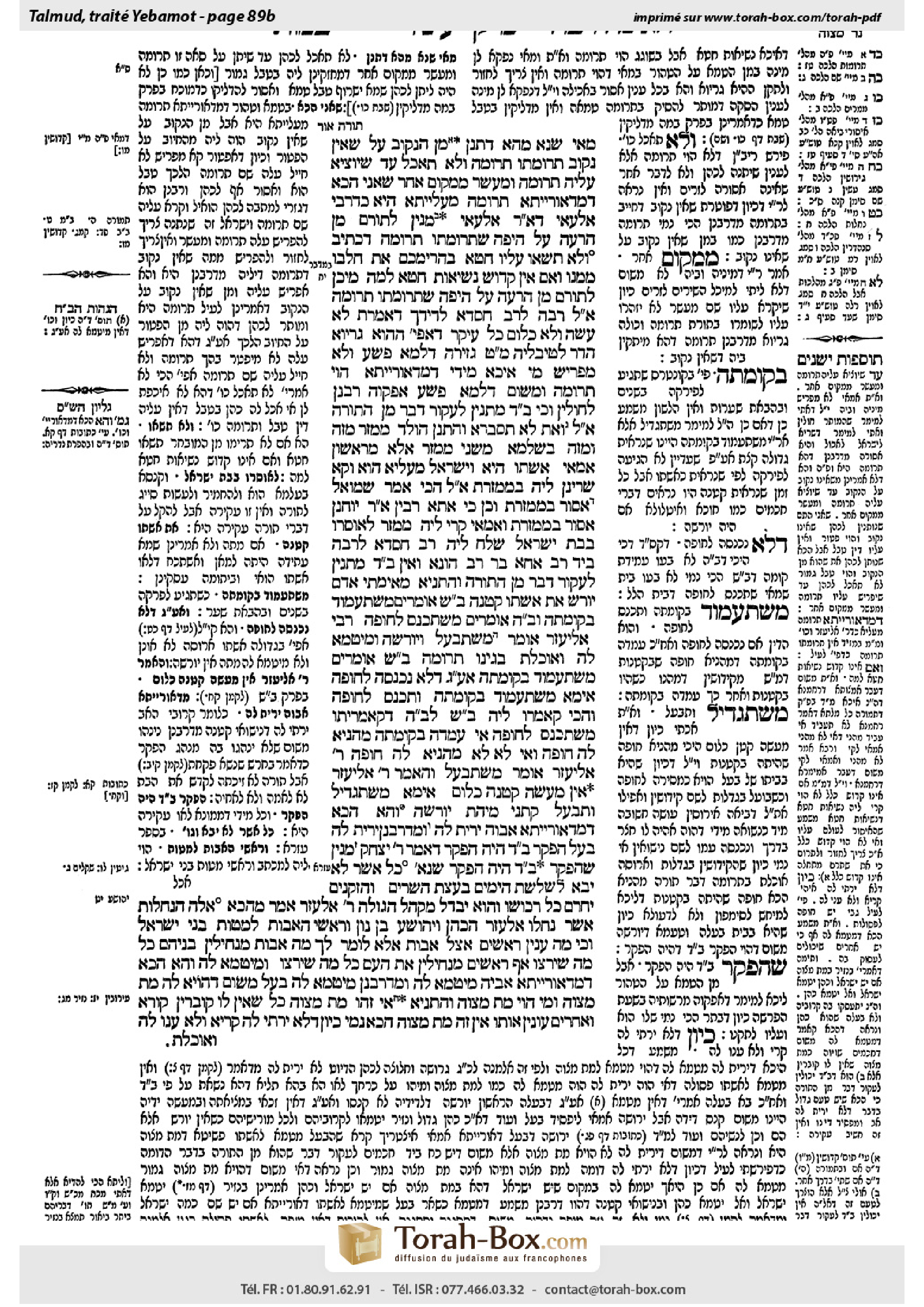
Yevamot 89b: Talmud study for Daf Yomi
Daf Yomi is the daily study of one Talmud folio. Explore 37 tractates with scans, Hebrew text, Sefaria English and AI-generated French translations where annotated.
Passage selection and English or AI-generated French translation are available where the scan has annotations. Daf Study is independent of Torah-Box and Sefaria.
Browse Yevamot · יבמות · All tractatesYevamot 89b text and translations
This page of Yevamot includes the Aramaic text, an English translation and an AI-generated French translation, alongside the scan above.
יבמות פ״ט ב · Aramaic and Hebrew text
מַאי שְׁנָא מֵהָא דִּתְנַן: מִן הַנָּקוּב עַל שֶׁאֵין נָקוּב — תְּרוּמָתוֹ תְּרוּמָה, וְלֹא תֵּאָכֵל עַד שֶׁיּוֹצִיא עָלֶיהָ תְּרוּמָה וּמַעֲשֵׂר מִמָּקוֹם אַחֵר.
שָׁאנֵי הָכָא, דְּמִדְּאוֹרָיְיתָא תְּרוּמָה מְעַלַּיְיתָא הִיא, כִּדְרַבִּי אִלְעַאי. דְּאָמַר רַבִּי אִלְעַאי: מִנַּיִן לַתּוֹרֵם מִן הָרָעָה עַל הַיָּפָה שֶׁתְּרוּמָתוֹ תְּרוּמָה — דִּכְתִיב: ״וְלֹא תִשְׂאוּ עָלָיו חֵטְא בַּהֲרִימְכֶם אֶת חֶלְבּוֹ מִמֶּנּוּ״.
וְאִם אֵין קָדוֹשׁ — נְשִׂיאוּת חֵטְא לָמָּה? מִיכָּן לַתּוֹרֵם מִן הָרָעָה עַל הַיָּפָה — שֶׁתְּרוּמָתוֹ תְּרוּמָה.
אֲמַר לֵיהּ רַבָּה לְרַב חִסְדָּא: לְדִידָךְ דְּאָמְרַתְּ לֹא עָשָׂה וְלֹא כְּלוּם כׇּל עִיקָּר, דַּאֲפִילּוּ הָהוּא גְּרִיוָא הָדַר לְטִיבְלֵיהּ, מַאי טַעְמָא — גְּזֵירָה דִּלְמָא פָּשַׁע וְלָא מַפְרֵישׁ, מִי אִיכָּא מִידֵּי דְּמִדְּאוֹרָיְיתָא הָוֵי תְּרוּמָה, וּמִשּׁוּם דִּלְמָא פָּשַׁע אַפְּקוּהּ רַבָּנַן לְחוּלִּין? וְכִי בֵּית דִּין מַתְנִין לַעֲקוֹר דָּבָר מִן הַתּוֹרָה?
אֲמַר לֵיהּ: וְאַתְּ לָא תִּסְבְּרַאּ? וְהָתְנַן: הַוָּלָד מַמְזֵר מִזֶּה וּמִזֶּה. בִּשְׁלָמָא מִשֵּׁנִי מַמְזֵר — אֶלָּא מֵרִאשׁוֹן אַמַּאי? אִשְׁתּוֹ הִיא, וְיִשְׂרָאֵל מְעַלְּיָא הוּא, וְקָא שָׁרֵינַן לֵיהּ בְּמַמְזֶרֶת!
אֲמַר לֵיהּ, הָכִי אָמַר שְׁמוּאֵל: אָסוּר בְּמַמְזֶרֶת. וְכֵן כִּי אֲתָא רָבִין אָמַר רַבִּי יוֹחָנָן: אָסוּר בְּמַמְזֶרֶת. וְאַמַּאי קָרֵי לֵיהּ ״מַמְזֵר״ — לְאוֹסְרוֹ בְּבַת יִשְׂרָאֵל.
שְׁלַח לֵיהּ רַב חִסְדָּא לְרַבָּה בְּיַד רַב אַחָא בַּר רַב הוּנָא: וְאֵין בֵּית דִּין מַתְנִין לַעֲקוֹר דָּבָר מִן הַתּוֹרָה? וְהָתַנְיָא: מֵאֵימָתַי אָדָם יוֹרֵשׁ אֶת אִשְׁתּוֹ קְטַנָּה? בֵּית שַׁמַּאי אוֹמְרִים: מִשֶּׁתַּעֲמוֹד בְּקוֹמָתָהּ, וּבֵית הִלֵּל אוֹמְרִים: מִשֶּׁתִּכָּנֵס לַחוּפָּה, רַבִּי אֱלִיעֶזֶר אוֹמֵר: מִשֶּׁתִּבָּעֵל. וְיוֹרְשָׁהּ, וּמִיטַּמֵּא לָהּ, וְאוֹכֶלֶת בְּגִינוֹ תְּרוּמָה.
בֵּית שַׁמַּאי אוֹמְרִים: מִשֶּׁתַּעֲמוֹד בְּקוֹמָתָהּ. אַף עַל גַּב דְּלֹא נִכְנְסָה לַחוּפָּה? אֵימָא: מִשֶּׁתַּעֲמוֹד בְּקוֹמָתָהּ וְתִכָּנֵס לַחוּפָּה. וְהָכִי קָאָמְרוּ לֵיהּ בֵּית שַׁמַּאי לְבֵית הִלֵּל: דְּקָאָמְרִיתוּ מִשֶּׁתִּכָּנֵס לַחוּפָּה, אִי עָמְדָה בְּקוֹמָתָהּ — מַהְנְיָא לַהּ חוּפָּה, וְאִי לָא — לָא מַהְנְיָא לַהּ חוּפָּה.
רַבִּי אֱלִיעֶזֶר אוֹמֵר: מִשֶּׁתִּבָּעֵל. וְהָאָמַר רַבִּי אֱלִיעֶזֶר: אֵין מַעֲשֵׂה קְטַנָּה כְּלוּם! אֵימָא: מִשֶּׁתַּגְדִּיל וְתִבָּעֵל.
קָתָנֵי מִיהַת יוֹרְשָׁהּ — וְהָא הָכָא, דְּמִדְּאוֹרָיְיתָא אֲבוּהָ יָרֵית לַהּ, וּמִדְּרַבָּנַן יָרֵית לַהּ בַּעַל?! הֶפְקֵר בֵּית דִּין הֶפְקֵר.
דְּאָמַר רַבִּי יִצְחָק: מִנַּיִן שֶׁהֶפְקֵר בֵּית דִּין הֶפְקֵר — שֶׁנֶּאֱמַר: ״כֹּל אֲשֶׁר לֹא יָבֹא לִשְׁלֹשֶׁת הַיָּמִים בַּעֲצַת הַשָּׂרִים וְהַזְּקֵנִים יׇחֳרַם כׇּל רְכוּשׁוֹ וְהוּא יִבָּדֵל מִקְּהַל הַגּוֹלָה״.
רַבִּי אֶלְעָזָר אָמַר, מֵהָכָא: ״אֵלֶּה הַנְּחָלוֹת אֲשֶׁר נִחֲלוּ אֶלְעָזָר הַכֹּהֵן וִיהוֹשֻׁעַ בִּן נוּן וְרָאשֵׁי הָאָבוֹת לְמַטּוֹת בְּנֵי יִשְׂרָאֵל״, וְכִי מָה עִנְיַן רָאשִׁים אֵצֶל אָבוֹת? אֶלָּא לוֹמַר לָךְ: מָה אָבוֹת מַנְחִילִין בְּנֵיהֶם כׇּל מַה שֶּׁיִּרְצוּ — אַף רָאשִׁים מַנְחִילִין אֶת הָעָם כׇּל מַה שֶּׁיִּרְצוּ.
וּמִיטַּמֵּא לָהּ. וְהָא הָכָא, דְּמִדְּאוֹרָיְיתָא אָבִיהָ מִיטַּמֵּא לָהּ, וּמִדְּרַבָּנַן מִיטַּמֵּא לָהּ בַּעַל! מִשּׁוּם דְּהָוְיָא לַהּ מֵת מִצְוָה.
וּמִי הָוְיָ[א] מֵת מִצְוָה? וְהָתַנְיָא: אֵי זֶהוּ מֵת מִצְוָה — כֹּל שֶׁאֵין לוֹ קוֹבְרִין. קוֹרֵא וַאֲחֵרִים עוֹנִין אוֹתוֹ — אֵין זֶה מֵת מִצְוָה! הָכָא נָמֵי, כֵּיוָן דְּלָא יָרְתִי לַהּ — קָרְיָא וְלָא עָנוּ לַהּ.
Yevamot 89b · English translation
in what way is this case different from that which we learned in a mishna (Demai 5:10): If one separates teruma from that which grew in a perforated pot for that which is from a non-perforated pot, his teruma is teruma, but it may not be eaten until he removes on behalf of that portion itself teruma and tithe from another place? In other words, the portion he separated as teruma is not entirely consecrated, as it too is considered untithed produce in the sense that teruma must be separated for it. In contrast, one who sets aside impure teruma does not have to separate teruma from that portion itself.
The Gemara answers: Here, with regard to ritually impure teruma, it is different, as by Torah law it is in fact full-fledged teruma, but the Sages penalized him by making him separate teruma again. This is in accordance with the opinion of Rabbi Elai, as Rabbi Elai said: From where is it derived with regard to one who separates teruma from poor-quality produce for superior-quality produce that his teruma is teruma? As it is written with regard to teruma: “And you shall bear no sin by reason of it, seeing that you have set apart from it its best” (Numbers 18:32). This verse states that if one separated teruma from inferior-quality produce he has committed a sin, which shows that his action is effective, as Rabbi Elai proceeds to explain.
Rabbi Elai elaborates: And if this inferior portion is not sanctified as teruma at all, why is there a bearing of sin? If the produce does not have the status of teruma he has not done anything, which means that his action cannot be considered a transgression. From here we learn with regard to one who separated from the bad for the good that his teruma is teruma after the fact. Similarly, the teruma of one who separates ritually impure food for pure food is valid teruma by Torah law.
After clarifying the opinions themselves, the Gemara analyzes the case in greater detail. Rabba said to Rav Ḥisda: According to your opinion, that you said he has done nothing at all, meaning that even that se’a he set aside returns to its former untithed state, what is the reason for this? It is a rabbinic decree, as perhaps he will be negligent and will not separate teruma a second time. However, is there anything that by Torah law is teruma, as stated by Rabbi Elai, and yet due to the concern: Perhaps he will be negligent, the Sages removed its status as sacred and gave to it the status of non-sacred food? And can the court stipulate and enact a decree to uproot something that applies by Torah law?
Rav Ḥisda said to Rabba: And you, do you not hold that the Sages have the power to do so? But didn’t we learn in the mishna that the child is a mamzer from this one and from that one? Granted, the child from the second man is a mamzer, as he was born to a married woman from a man who was not her husband. However, with regard to the child from the first husband, why is he a mamzer? After all, she is his wife, and by Torah law their son is a full-fledged Jew. And the Sages’ declaration that he is a mamzer cannot be seen as a mere stringency, as they thereby permit him to a mamzeret. This shows that a rabbinical decree can uproot a Torah prohibition.
Rabba said to Rav Ḥisda that Shmuel said as follows: It is forbidden for the child of the first husband to marry a mamzeret. And similarly, when Ravin came from Eretz Yisrael, he said that Rabbi Yoḥanan said that the child is forbidden to a mamzeret. And if so, why does the mishna call him a mamzer? This is to teach us that the Sages are stringent and render it prohibited for him to marry a regular Jewish woman. With regard to the issue at hand, as he may not marry a mamzeret, the Sages did not in fact uproot a mitzva that applies by Torah law.
Rav Ḥisda sent a proof to Rabba, in the hand of Rav Aḥa bar Rav Huna: And can the court not stipulate to uproot something prohibited by Torah law? But isn’t it taught in a baraita: From when does a man inherit from his minor wife, who was married off by her mother or brother, as enacted by the Sages, a marriage that is not valid by Torah law? Beit Shammai say: From when she stands at her fully developed height, i.e., when she grows up and reaches the age of maturity. And Beit Hillel say: From when she enters the wedding canopy. Rabbi Eliezer says: From when she has sexual relations. As soon as she is considered his wife, all the halakhot of a wife apply to her. And he inherits from her and becomes impure for her if she dies, even if he is a priest, and she eats teruma on his account if he is a priest.
The Gemara first clarifies various details of this baraita. Beit Shammai say: From when she stands at her height. The Gemara expresses surprise at this statement: Is this the case even though she has not yet entered the wedding canopy? Betrothal alone, without the marriage canopy, is not enough to enable a man to inherit from an adult woman, let alone a minor. The Gemara answers: You must say that Beit Shammai meant from when she stands at her fully developed height and enters the wedding canopy. And Beit Shammai said to Beit Hillel as follows: That which you said, that he inherits her from when she enters the wedding canopy, is not enough. Rather, if she stands at her fully developed height, the wedding canopy is effective for bringing about her marriage, and if not, the wedding canopy is not effective for bringing about her marriage.
The Gemara continues its analysis of the baraita. Rabbi Eliezer says: From when she has sexual relations. The Gemara again expresses surprise: But didn’t Rabbi Eliezer say that the actions of a minor girl are nothing, which indicates that marriage and intercourse with her are not considered an act of acquisition. Rather, we must say that he meant from when she matures and has sexual relations.
The Gemara returns to the issue at hand, whether the court can stipulate to uproot something prohibited by Torah law. In any event the baraita is teaching that he inherits from her. But here is a case where by Torah law her father, i.e., his relatives, as he is dead, inherits from her, as a minor orphan cannot marry by Torah law, and yet by rabbinic law the husband inherits from her. This shows that the Sages can uproot a Torah mitzva. The Gemara answers: This is no proof, as in monetary matters property declared ownerless by the court is ownerless, and therefore the court can allocate her inheritance as they see fit.
As Rabbi Yitzḥak said: From where is it derived that property declared ownerless by the court is ownerless? As it is stated: “And whoever does not come within three days, according to the council of the princes and the Elders, all his property should be forfeited, and himself separated from the congregation of the captivity” (Ezra 10:8). This verse indicates that the court can confiscate anyone’s possessions.
Rabbi Elazar says that the proof that the court can declare property ownerless is from here: “These are the inheritances that Elazar the priest, and Joshua, son of Nun, and the heads of the fathers’ houses of the tribes of the children of Israel distributed for inheritance” (Joshua 19:51). What do heads have to do with fathers? The expression “the heads of the fathers’ houses of the tribes” is unusual and vague. Rather, this comes to tell you: Just as fathers bequeath to their sons anything they want to, so too, the heads, i.e., the leaders and judges of the people, bequeath to the people anything they want to. This shows that the leaders can take property from one individual and give it to another.
It was stated that the husband of a minor becomes impure for her, even if he is a priest. The Gemara asks: But here is a case where by Torah law her father, not the man she married, is obligated to become impure for her, as the latter is not his wife by Torah law, and yet by rabbinic law her husband defiles himself for her. The Gemara answers: This is because she is considered like a corpse with no one to bury it [met mitzva], for which even a priest must become impure. Once she is married, her relatives from her father’s family no longer care for her welfare, which means her husband is the only one who is entrusted with her burial.
The Gemara asks: And is she in fact a met mitzva? But isn’t it taught in a baraita: Which corpse is a met mitzva? Any corpse that does not have anyone to bury it. If it was in a place where if one calls and others would answer him, this is not a met mitzva. In contrast, this girl does have relatives who can bury her, if necessary. The Gemara answers: Here too, since the members of her father’s family do not inherit from her, she would call and they would not answer her, as they have no desire to go to any trouble for her. Since her husband inherits from her, it is his duty to tend to her burial, and he must therefore become impure for her, as she has the status of a met mitzva.
Yevamot 89b · Traduction française (IA)
En quoi ce cas est-il différent de celui que nous avons appris dans une Michna (Demai 5:10) : Si un homme sépare la terouma de ce qui a poussé dans un pot percé pour ce qui provient d'un pot non percé, sa terouma est terouma, mais elle ne peut pas être mangée jusqu'à ce qu'il sépare, pour cette portion elle-même, la terouma et la dîme d'un autre endroit ? Autrement dit, la portion qu'il a séparée en tant que terouma n'est pas entièrement sanctifiée, car elle est également considérée comme des produits non dîmés, dans le sens où la terouma doit être séparée pour elle. En revanche, celui qui met de côté une terouma impure n'a pas à séparer la terouma de cette portion elle-même.
La Guemara répond : Ici, en ce qui concerne la terouma rituellement impure, la situation est différente, car selon la loi de la Torah, c'est en fait une terouma à part entière, mais les Sages l'ont pénalisé en lui faisant séparer la terouma à nouveau. Cela est conforme à l'opinion de Rabbi Elai, car Rabbi Elai a dit : D'où est-il déduit, en ce qui concerne celui qui sépare la terouma de produits de qualité inférieure pour des produits de qualité supérieure, que sa terouma est terouma ? Comme il est écrit à propos de la terouma : « Et vous ne porterez pas de péché à cause d'elle, puisque vous en avez mis à part le meilleur » (Nombres 18:32). Ce verset indique que si un homme a séparé la terouma de produits de qualité inférieure, il a commis un péché, ce qui montre que son acte est efficace, comme Rabbi Elai s'apprête à l'expliquer.
Rabbi Elai précise : Et si cette portion inférieure n'est pas sanctifiée en tant que terouma du tout, pourquoi y a-t-il un portage de péché ? Si les produits n'ont pas le statut de terouma, il n'a rien fait, ce qui signifie que son acte ne peut pas être considéré comme une transgression. D'ici, nous apprenons, en ce qui concerne celui qui a séparé du mauvais pour le bon, que sa terouma est terouma a posteriori. De même, la terouma de celui qui sépare de la nourriture rituellement impure pour de la nourriture pure est une terouma valide selon la loi de la Torah.
Après avoir clarifié les opinions elles-mêmes, la Guemara analyse le cas plus en détail. Rabba dit à Rav Ḥisda : Selon ton opinion, selon laquelle tu as dit qu'il n'a rien fait du tout, ce qui signifie que même cette se'a qu'il a mise de côté revient à son état antérieur de non-dîmé, quelle est la raison de cela ? C'est un décret rabbinique, car peut-être qu'il sera négligent et ne séparera pas la terouma une seconde fois. Cependant, y a-t-il quelque chose qui, selon la loi de la Torah, est terouma, comme l'a dit Rabbi Elai, et pourtant, en raison de la crainte : Peut-être qu'il sera négligent, les Sages ont-ils retiré son statut sacré et lui ont-ils donné le statut de nourriture non sacrée ? Et le tribunal peut-il stipuler et établir un décret pour déraciner quelque chose qui s'applique selon la loi de la Torah ?
Rav Ḥisda dit à Rabba : Et toi, n'es-tu pas d'avis que les Sages ont le pouvoir de le faire ? Mais n'avons-nous pas appris dans la Michna que l'enfant est un mamzer de celui-ci et de celui-là ? Certes, l'enfant du deuxième homme est un mamzer, car il est né d'une femme mariée d'un homme qui n'était pas son mari. Cependant, en ce qui concerne l'enfant du premier mari, pourquoi est-il un mamzer ? Après tout, elle est sa femme, et selon la loi de la Torah, leur fils est un Juif à part entière. Et la déclaration des Sages qu'il est un mamzer ne peut pas être considérée comme une simple rigueur, car ils lui permettent ainsi de se marier avec une mamzeret. Cela montre qu'un décret rabbinique peut déraciner une interdiction de la Torah.
Rabba dit à Rav Ḥisda que Shmuel a dit ce qui suit : Il est interdit à l'enfant du premier mari de se marier avec une mamzeret. Et de même, lorsque Ravin est venu d'Eretz Yisrael, il a dit que Rabbi Yoḥanan a dit que l'enfant est interdit à une mamzeret. Et si c'est le cas, pourquoi la Michna l'appelle-t-elle un mamzer ? C'est pour nous enseigner que les Sages sont rigoureux et rendent interdit pour lui de se marier avec une femme juive ordinaire. En ce qui concerne la question en cours, comme il ne peut pas se marier avec une mamzeret, les Sages n'ont en fait pas déraciné une mitsva qui s'applique selon la loi de la Torah.
Rav Ḥisda a envoyé une preuve à Rabba, par l'intermédiaire de Rav Aḥa bar Rav Huna : Le tribunal ne peut-il pas stipuler pour déraciner quelque chose d'interdit par la loi de la Torah ? Mais n'est-il pas enseigné dans une baraïta : À partir de quand un homme hérite-t-il de sa femme mineure, qui a été mariée par sa mère ou son frère, conformément à l'établissement des Sages, un mariage qui n'est pas valide selon la loi de la Torah ? Beit Chammaï disent : À partir du moment où elle atteint sa taille pleinement développée, c'est-à-dire lorsqu'elle grandit et atteint l'âge de la maturité. Et Beit Hillel disent : À partir du moment où elle entre sous la tente nuptiale. Rabbi Eliezer dit : À partir du moment où elle a des relations sexuelles. Dès qu'elle est considérée comme sa femme, toutes les halakhot d'une femme s'appliquent à elle. Et il hérite d'elle et devient impur pour elle si elle meurt, même s'il est un cohen, et elle mange la terouma à son compte s'il est un cohen.
La Guemara clarifie d'abord divers détails de cette baraïta. Beit Chammaï disent : À partir du moment où elle atteint sa taille. La Guemara exprime sa surprise face à cette déclaration : Est-ce le cas même si elle n'est pas encore entrée sous la tente nuptiale ? La fiançaille seule, sans la tente nuptiale, ne suffit pas pour permettre à un homme d'hériter d'une femme adulte, à plus forte raison d'une mineure. La Guemara répond : Tu dois dire que Beit Chammaï ont voulu dire à partir du moment où elle atteint sa taille pleinement développée et entre sous la tente nuptiale. Et Beit Chammaï ont dit à Beit Hillel ce qui suit : Ce que vous avez dit, qu'il hérite d'elle à partir du moment où elle entre sous la tente nuptiale, ne suffit pas. Plutôt, si elle atteint sa taille pleinement développée, la tente nuptiale est efficace pour établir son mariage, et si ce n'est pas le cas, la tente nuptiale n'est pas efficace pour établir son mariage.
La Guemara poursuit son analyse de la baraïta. Rabbi Eliezer déclare : À partir du moment où elle a des relations sexuelles. La Guemara exprime à nouveau sa surprise : Mais n'est-ce pas Rabbi Eliezer qui a dit que les actes d'une fille mineure ne sont rien, ce qui indique que le mariage et les rapports sexuels avec elle ne sont pas considérés comme un acte d'acquisition ? Il faut plutôt dire qu'il a voulu dire à partir du moment où elle atteint la maturité et a des relations sexuelles.
La Guemara revient à la question en cours, à savoir si le tribunal peut stipuler de déraciner quelque chose d'interdit par la loi de la Torah. En tout état de cause, la baraïta enseigne qu'il hérite d'elle. Mais ici, nous avons un cas où, selon la loi de la Torah, son père, c'est-à-dire ses proches, hérite d'elle, car il est mort, et un orphelin mineur ne peut pas se marier selon la loi de la Torah, et pourtant, selon la loi rabbinique, le mari hérite d'elle. Cela montre que les Sages peuvent déraciner une mitsva de la Torah. La Guemara répond : Ce n'est pas une preuve, car dans les affaires monétaires, les biens déclarés sans maître par le tribunal sont sans maître, et par conséquent, le tribunal peut allouer son héritage comme il le juge opportun.
Comme l'a dit Rabbi Yitzḥak : D'où est-il dérivé que les biens déclarés sans maître par le tribunal sont sans maître ? Comme il est écrit : « Et quiconque ne viendra pas dans les trois jours, selon le conseil des princes et des Anciens, tous ses biens seront confisqués, et lui-même séparé de la congrégation de la captivité » (Esdras 10:8). Ce verset indique que le tribunal peut confisquer les possessions de quiconque.
Rabbi Elazar affirme que la preuve que le tribunal peut déclarer des biens sans maître se trouve ici : « Voici les héritages que le prêtre Elazar, et Josué, fils de Nun, et les chefs des maisons des pères des tribus des enfants d'Israël ont distribués en héritage » (Josué 19:51). Que viennent faire les chefs avec les pères ? L'expression « les chefs des maisons des pères des tribus » est inhabituelle et vague. Plutôt, cela vient vous dire : Tout comme les pères léguent à leurs fils tout ce qu'ils veulent, de même, les chefs, c'est-à-dire les dirigeants et les juges du peuple, lèguent au peuple tout ce qu'ils veulent. Cela montre que les dirigeants peuvent prendre les biens d'un individu et les donner à un autre.
Il a été dit que le mari d'une mineure devient impur pour elle, même s'il est un prêtre. La Guemara demande : Mais ici, nous avons un cas où, selon la loi de la Torah écrite, son père, et non l'homme qu'elle a épousé, est obligé de devenir impur pour elle, car ce dernier n'est pas son mari selon la loi de la Torah écrite, et pourtant, selon la loi rabbinique, son mari se rend impur pour elle. La Guemara répond : C'est parce qu'elle est considérée comme un cadavre sans personne pour l'enterrer [met mitsva], pour lequel même un prêtre doit devenir impur. Une fois qu'elle est mariée, ses proches de la famille de son père ne s'occupent plus de son bien-être, ce qui signifie que son mari est le seul à qui est confié son enterrement.
La Guemara demande : Et est-elle en réalité une met mitsva ? Mais n'est-il pas enseigné dans une baraïta : Quel cadavre est une met mitsva ? Tout cadavre qui n'a personne pour l'enterrer. S'il se trouve dans un endroit où, si l'on appelle, d'autres lui répondraient, ce n'est pas une met mitsva. Or, cette fille a des proches qui peuvent l'enterrer, si nécessaire. La Guemara répond : Ici aussi, puisque les membres de la famille de son père n'héritent pas d'elle, elle appellerait et ils ne lui répondraient pas, car ils n'ont pas le désir de se donner la peine pour elle. Puisque son mari hérite d'elle, c'est son devoir de s'occuper de son enterrement, et il doit donc contracter l'impureté pour elle, car elle a le statut d'une met mitsva.
Traduction française générée par IA à partir de l’édition anglaise de Sefaria. Vérifie toujours un passage avec le texte source.
Text from Sefaria: William Davidson Edition - Vocalized Aramaic (CC BY NC); William Davidson Edition - English (CC BY NC).