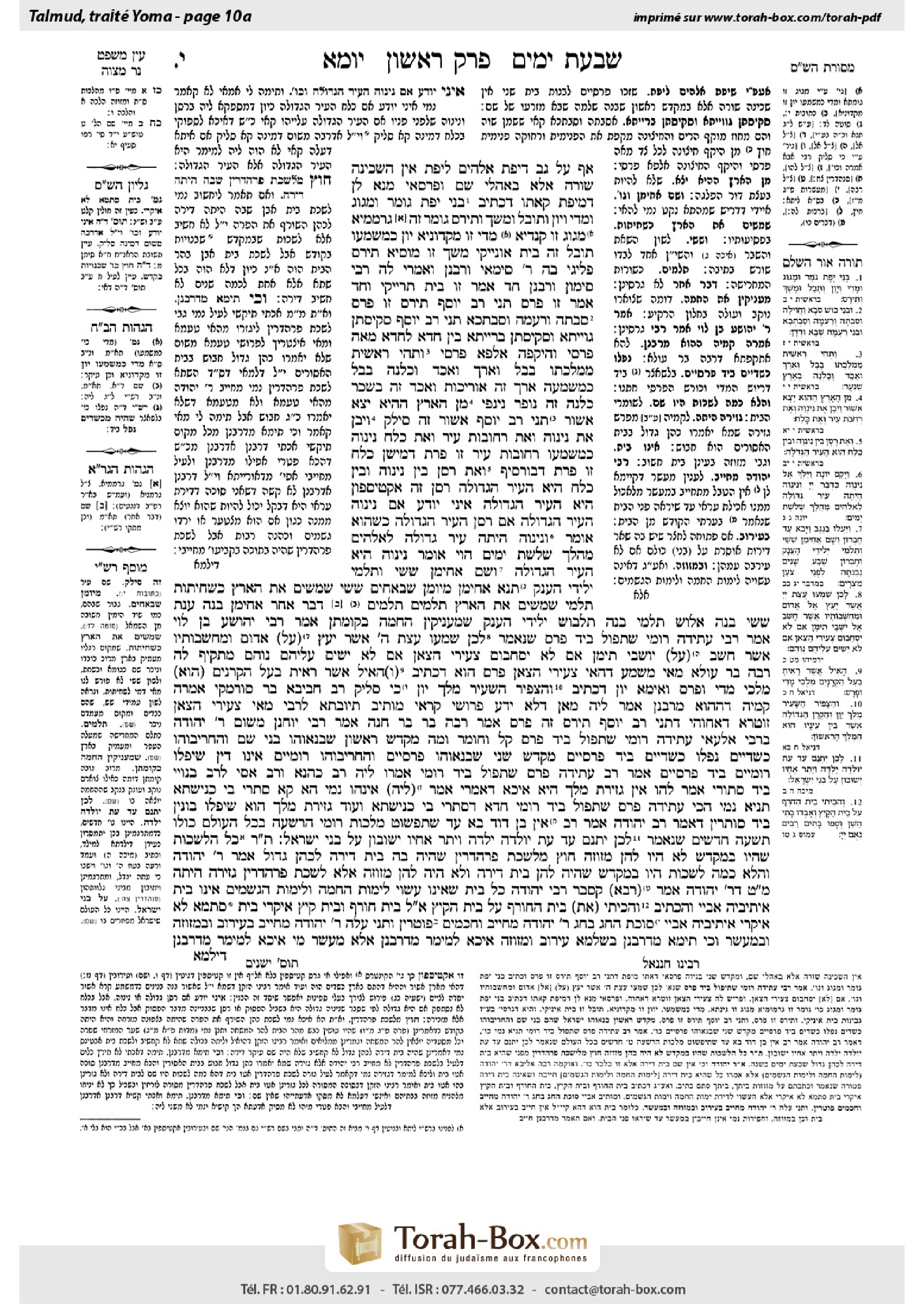
Yoma 10a: Talmud study for Daf Yomi
Daf Yomi is the daily study of one Talmud folio. Explore 37 tractates with scans, Hebrew text, Sefaria English and AI-generated French translations where annotated.
Passage selection and English or AI-generated French translation are available where the scan has annotations. Daf Study is independent of Torah-Box and Sefaria.
Browse Yoma · יומא · All tractatesYoma 10a text and translations
This page of Yoma includes the Aramaic text, an English translation and an AI-generated French translation, alongside the scan above.
יומא י׳ א · Aramaic and Hebrew text
אַף עַל גַּב דְּ״יַפְתְּ אֱלֹהִים לְיֶפֶת״ — אֵין הַשְּׁכִינָה שׁוֹרָה אֶלָּא בְּאׇהֳלֵי שֵׁם.
וּפָרְסָאֵי מְנָא לַן דְּמִיֶּפֶת קָאָתוּ, דִּכְתִיב: ״בְּנֵי יֶפֶת גּוֹמֶר וּמָגוֹג וּמָדַי וְיָוָן וְתוּבָל וּמֶשֶׁךְ וְתִירָס״. גּוֹמֶר — זֶה גֶּרְמַמְיָא, מָגוֹג — זוֹ קַנְדִּיָּא, מָדַי — זוֹ מַקֵדוֹנְיָא, יָוָן — כְּמַשְׁמָעוֹ, תּוּבָל — זֶה בֵּית אוּנַיְיקִי, מֶשֶׁךְ — זוֹ מוּסְיָא, תִּירָס, פְּלִיגִי בַּהּ רַבִּי סִימַאי וְרַבָּנַן, וְאָמְרִי לַהּ רַבִּי סִימוֹן וְרַבָּנַן, חַד אָמַר: זוֹ בֵּית תְּרַיְיקִי, וְחַד אָמַר: זוֹ פָּרַס. תָּנֵי רַב יוֹסֵף: תִּירָס — זוֹ פָּרַס.
״סַבְתָּה וְרַעְמָה וְסַבְתְּכָא״, תָּנֵי רַב יוֹסֵף: סַקִּיסְתָּן גַּוָּיְיתָא וְסַקִּיסְתָּן בָּרַיְיתָא, בֵּין חֲדָא לַחֲדָא מְאָה פַּרְסֵי, וְהֶיקֵּפַהּ אַלְפָּא פַּרְסֵי.
״וַתְּהִי רֵאשִׁית מַמְלַכְתּוֹ בָּבֶל וְאֶרֶךְ וְאַכַּד וְכַלְנֵה״, בָּבֶל — כְּמַשְׁמְעָה, אֶרֶךְ — זֶה אוֹרִיכוּת, וְאַכַּד — זֶה בַּשְׁכַּר, כַּלְנֵה — זֶה נוּפַר נִינְפִי.
״מִן הָאָרֶץ הָהִיא יָצָא אַשּׁוּר״, תָּנֵי רַב יוֹסֵף: אַשּׁוּר — זֶה סִילַק. ״וַיִּבֶן אֶת נִינְוֵה וְאֶת רְחוֹבוֹת עִיר וְאֶת כָּלַח״, נִינְוֵה — כְּמַשְׁמָעוֹ, רְחוֹבוֹת עִיר — זוֹ פְּרָת דְּמֵישָׁן, כָּלַח — זוֹ פְּרָת דְּבוֹרְסִיף. ״וְאֶת רֶסֶן בֵּין נִינְוֵה וּבֵין כָּלַח הִיא הָעִיר הַגְּדוֹלָה״, רֶסֶן — זֶה אַקְטִיסְפוֹן. ״הִיא הָעִיר הַגְּדוֹלָה״ — אֵינִי יוֹדֵעַ אִם נִינְוֵה הָעִיר הַגְּדוֹלָה, אִם רֶסֶן הָעִיר הַגְּדוֹלָה. כְּשֶׁהוּא אוֹמֵר ״וְנִינְוֵה הָיְתָה עִיר גְּדוֹלָה לֵאלֹהִים מַהֲלַךְ שְׁלֹשֶׁת יָמִים״, הֱוֵי אוֹמֵר: נִינְוֵה הִיא הָעִיר הַגְּדוֹלָה.
״וְשָׁם אֲחִימַן שֵׁשַׁי וְתַלְמַי יְלִידֵי הָעֲנָק״, תָּנָא: אֲחִימַן — מְיוּמָּן שֶׁבָּאַחִים, שֵׁשַׁי — שֶׁמֵּשִׂים אֶת הָאָרֶץ כִּשְׁחִיתוֹת, תַּלְמַי — שֶׁמֵּשִׂים אֶת הָאָרֶץ תְּלָמִים תְּלָמִים. דָּבָר אַחֵר: אֲחִימַן בָּנָה עֲנָת, שֵׁשַׁי בָּנָה אָלוּשׁ, תַּלְמַי בָּנָה תַּלְבּוּשׁ. ״יְלִידֵי הָעֲנָק״ — שֶׁמַּעֲנִיקִין הַחַמָּה בְּקוֹמָתָן.
אָמַר רַבִּי יְהוֹשֻׁעַ בֶּן לֵוִי אָמַר רַבִּי: עֲתִידָה רוֹמִי שֶׁתִּפּוֹל בְּיַד פָּרַס, שֶׁנֶּאֱמַר: ״לָכֵן שִׁמְעוּ עֲצַת ה׳ אֲשֶׁר יָעַץ (עַל) אֱדוֹם וּמַחְשְׁבוֹתָיו אֲשֶׁר חָשַׁב (עַל) יוֹשְׁבֵי תֵימָן אִם לֹא יִסְחָבוּם צְעִירֵי הַצֹּאן אִם לֹא יַשִּׁים עֲלֵיהֶם נְוֵהֶם״.
מַתְקֵיף לַהּ רַבָּה בַּר עוּלָּא: מַאי מַשְׁמַע דְּהַאי ״צְעִירֵי הַצֹּאן״ פָּרַס הוּא — דִּכְתִיב: ״הָאַיִל אֲשֶׁר רָאִיתָ בַּעַל הַקְּרָנָיִם (הוּא) מַלְכֵי מָדַי וּפָרָס״. וְאֵימָא יָוָן, דִּכְתִיב: ״וְהַצָּפִיר הַשָּׂעִיר מֶלֶךְ יָוָן״!
כִּי סְלֵיק רַב חֲבִיבָא בַּר סוֹרְמַקִי, אַמְרַהּ קַמֵּיהּ דְּהָהוּא מֵרַבָּנַן, אֲמַר לֵיהּ: מַאן דְּלָא יָדַע פָּרוֹשֵׁי קְרָאֵי מוֹתֵיב תְּיוּבְתָּא לְרַבִּי?! מַאי ״צְעִירֵי הַצֹּאן״ — זוּטְרָא דַּאֲחוֹהִי. דְּתָנֵי רַב יוֹסֵף: תִּירָס — זֶה פָּרַס.
אָמַר רַבָּה בַּר בַּר חָנָה אָמַר רַבִּי יוֹחָנָן מִשּׁוּם רַבִּי יְהוּדָה בְּרַבִּי אִלְעַאי: עֲתִידָה רוֹמִי שֶׁתִּפּוֹל בְּיַד פָּרַס, קַל וָחוֹמֶר: וּמָה מִקְדָּשׁ רִאשׁוֹן שֶׁבְּנָאוּהוּ בְּנֵי שֵׁם וְהֶחְרִיבוּהוּ כַּשְׂדִּיִּים — נָפְלוּ כַּשְׂדִּיִּים בְּיַד פָּרְסִיִּים. מִקְדָּשׁ שֵׁנִי שֶׁבְּנָאוּהוּ פָּרְסִיִּים וְהֶחְרִיבוּהוּ רוֹמִיִּים — אֵינוֹ דִּין שֶׁיִּפְּלוּ רוֹמִיִּים בְּיַד פָּרְסִיִּים?
אָמַר רַב: עֲתִידָה פָּרַס שֶׁתִּפּוֹל בְּיַד רוֹמִי. אֲמַרוּ לֵיהּ רַב כָּהֲנָא וְרַב אַסִּי לְרַב: בָּנוֹיֵי בְּיַד סָתוֹרֵי?! אֲמַר לְהוּ: אִין, גְּזֵירַת מֶלֶךְ הִיא. אִיכָּא דְאָמְרִי, אֲמַר (לֵיהּ): אִינְהוּ נָמֵי הָא קָא סָתְרִי בֵּי כְנִישְׁתָּא.
תַּנְיָא נָמֵי הָכִי: עֲתִידָה פָּרַס שֶׁתִּפּוֹל בְּיַד רוֹמִי, חֲדָא — דְּסָתְרִי בֵּי כְנִישְׁתָּא, וְעוֹד: גְּזֵירַת מֶלֶךְ הוּא שֶׁיִּפְּלוּ בּוֹנִין בְּיַד סוֹתְרִין. דְּאָמַר רַב יְהוּדָה אָמַר רַב: אֵין בֶּן דָּוִד בָּא עַד שֶׁתִּפְשׁוֹט מַלְכוּת רוֹמִי הָרְשָׁעָה בְּכׇל הָעוֹלָם כּוּלּוֹ תִּשְׁעָה חֳדָשִׁים, שֶׁנֶּאֱמַר: ״לָכֵן יִתְּנֵם עַד עֵת יוֹלֵדָה יָלָדָה וְיֶתֶר אֶחָיו יְשׁוּבוּן עַל בְּנֵי יִשְׂרָאֵל״.
תָּנוּ רַבָּנַן: כׇּל הַלְּשָׁכוֹת שֶׁהָיוּ בְּמִקְדָּשׁ לֹא הָיוּ לָהֶן מְזוּזָה, חוּץ מִלִּשְׁכַּת פַּרְהֶדְרִין, שֶׁהָיָה בָּהּ בֵּית דִּירָה לְכֹהֵן גָּדוֹל.
אָמַר רַבִּי יְהוּדָה: וַהֲלֹא כַּמָּה לְשָׁכוֹת הָיוּ בְּמִקְדָּשׁ שֶׁהָיָה לָהֶן בֵּית דִּירָה, וְלֹא הָיָה לָהֶן מְזוּזָה? אֶלָּא לִשְׁכַּת פַּרְהֶדְרִין גְּזֵירָה הָיְתָה.
מַאי טַעְמָא דְּרַבִּי יְהוּדָה? אָמַר (רָבָא): קָסָבַר רַבִּי יְהוּדָה: כׇּל בַּיִת שֶׁאֵינוֹ עָשׂוּי לִימוֹת הַחַמָּה וְלִימוֹת הַגְּשָׁמִים — אֵינוֹ בַּיִת. אֵיתִיבֵיהּ אַבָּיֵי, וְהָכְתִיב: ״וְהִכֵּיתִי (אֶת) בֵּית הַחוֹרֶף עַל בֵּית הַקָּיִץ״! אֲמַר לֵיהּ: ״בֵּית חוֹרֶף״ וּ״בֵית קַיִץ״ אִיקְּרִי, ״בַּיִת״ סְתָמָא לָא אִיקְּרִי.
אֵיתִיבֵיהּ אַבָּיֵי: סוּכַּת הֶחָג בֶּחָג, רַבִּי יְהוּדָה מְחַיֵּיב וַחֲכָמִים פּוֹטְרִין. וְתָנֵי עֲלַהּ: רַבִּי יְהוּדָה מְחַיֵּיב בְּעֵירוּב וּבִמְזוּזָה וּבְמַעֲשֵׂר!
וְכִי תֵּימָא מִדְּרַבָּנַן, בִּשְׁלָמָא עֵירוּב וּמְזוּזָה אִיכָּא לְמֵימַר מִדְּרַבָּנַן, אֶלָּא מַעֲשֵׂר, מִי אִיכָּא לְמֵימַר מִדְּרַבָּנַן?
Yoma 10a · English translation
The Gemara explains: Although God will enlarge Japheth, referring to the Persians, who descended from Japheth and who assisted in constructing the Second Temple, the Divine Presence rests only in the tents of Shem, in the First Temple, which was built by King Solomon without the patronage of a foreign power.
§ The Gemara asks: From where do we derive that the Persians descend from Japheth? The Gemara answers: As it is written: “The sons of Japheth were Gomer and Magog and Madai and Javan and Tuval and Meshech and Tiras” (Genesis 10:2). The Gemara explains: Gomer, that is Germamya; Magog, that is Kandiya; Madai, that is Macedonia; Javan, in accordance with its plain meaning, Greece; Tuval, that is the nation called Beit Unaiki; Meshech, that is Musya. With regard to Tiras, Rabbi Simai and the Rabbis disagree, and some say the dispute is between Rabbi Simon and the Rabbis: One said: That is Beit Teraiki, and one said: That is Persia. According to that approach, Persia is listed among the descendants of Japheth. Rav Yosef taught: Tiras is Persia.
The list of nations continues: “And Sabtah and Raamah and Sabteca” (Genesis 10:7). Rav Yosef taught: These are the inner Sakistan and the outer Sakistan. Between one and the other there was a distance of one hundred parasangs, and the circumference of the land was one thousand parasangs.
The Gemara continues interpreting the verses. It is stated: “And the beginning of his kingdom was Babel, and Erech, and Accad, and Calneh, in the land of Shinar” (Genesis 10:10). Babel in accordance with its plain meaning, Babylonia; Erech, that is the city known then as Orikhut; and Accad, that is the place known then as Baskar; Calneh, that is Nofer Ninefi.
The Torah continues: “Out of that land went forth Asshur” (Genesis 10:11). Rav Yosef taught: Asshur, that is Silek, meaning that is the region where the town Silkiya was built. “And built Nineveh and Rehoboth-ir and Calah” (Genesis 10:11). Nineveh, in accordance with its plain meaning; Rehovoth-ir, that is the town later known as Perat of Meishan; Calah, that is Perat of Bursif. “And Resen between Nineveh and Calah, it is the great city” (Genesis 10:12). Resen, that is the town later known as Akteisfon. It is the great city; I do not know whether this means that Nineveh is the great city, or whether it means that Resen is the great city. When it says: “And Nineveh was a great city of God, a three-day journey across” (Jonah 3:3), you must say that Nineveh is the great city.
The Gemara continues to discuss the interpretation of names in the Bible. The Torah says: “And there were Ahiman, Sheshai, and Talmai, the children of Anak” (Numbers 13:22). It was taught: Ahiman was so called because he was the greatest and most skillful [meyuman] of his brothers. Ahiman is a contraction of brother [aḥ] and right [yamin], which is the skilled hand. Sheshai was so called because he renders the ground like pits [sheḥitot] with his strides. Talmai was so called because he renders the ground filled with furrows [telamim] with his strides. Alternatively: Ahiman built the city of Anat; Sheshai built the town Alush; Talmai built the city of Talbush. The children of Anak is referring to the fact that it appears that the sun is a necklace [shema’anikin] around their necks because of their height.
§ Apropos the opinion that Tiras is Persia, the Gemara addresses a related matter. Rabbi Yehoshua ben Levi said that Rabbi Yehuda HaNasi said: Rome is destined to fall into the hands of Persia, as it is stated: “Now hear the plan that the Lord has devised for Edom, and the thoughts He has considered for the residents of Teiman. Surely the youngest of the flock will drag them away, surely their habitation will be appalled due to them” (Jeremiah 49:20).
Rabba bar Ulla strongly objected to this. From where may it be inferred that this phrase: Youngest of the flock, is Persia? It is as it is written: “The ram that you saw sporting two horns are the kings of Media and Persia” (Daniel 8:20), and the ram is a member of the flock mentioned in the verse. Still, how is that proof? And say that youngest of the flock refers to Greece, who will overthrow Rome, as it is written: “The goat is the king of Greece” (Daniel 8:21). The goat, too, could be characterized as a member of the flock.
When Rav Ḥaviva bar Surmakei ascended from Babylonia to Eretz Yisrael, he stated this difficulty before a certain one of the Sages. That Sage said to him: One who does not know how to interpret verses is so arrogant that he raises an objection to the opinion of the great Rabbi Yehuda HaNasi? Indeed, Rabba bar Ulla misunderstood the basis of Rabbi Yehuda HaNasi’s interpretation. What is the meaning of the phrase: The youngest of the flock? It means the youngest of the brothers, a reference to Persia, as Rav Yosef taught: Tiras, the youngest of Japheth’s sons, that is Persia.
Similarly, Rabba bar bar Ḥana said that Rabbi Yoḥanan said in the name of Rabbi Yehuda, son of Rabbi Elai: Rome is destined to fall into the hands of Persia. This is derived by means of an a fortiori inference: Just as the First Temple, that the descendants of Shem built it and the Chaldeans destroyed it, and in turn the Chaldeans, ruled by Belshazzar, fell to Persians, ruled by Darius the Mede and his son-in-law Cyrus the Persian; the Second Temple, that the Persians built it and the Romans destroyed it, is it not right that the Romans will fall into the hands of the Persians?
In contrast, Rav said: Persia is destined to fall into the hands of Rome. Rav Kahana and Rav Asi, Rav’s students, said to Rav: The builders will fall into the hands of the destroyers? Is that justice? He said to them: Although it seems unjust, yes, that is the King’s decree. Some say that he said this to them: They, too, are destroyers of synagogues, and they are no better than the Romans.
That was also taught in a baraita: Persia is destined to fall into the hands of Rome. One reason is that they destroyed synagogues. And furthermore, it is the King’s decree that the builders will fall into the hands of the destroyers, as Rav Yehuda said that Rav said: The son of David will come only when the wicked kingdom of Rome spreads its dominance throughout the world for nine months, as it is stated: “Therefore He will give them up until she who is to bear has borne; then the remnants of his brethren will return with the children of Israel” (Micah 5:2). The duration of Rome’s rule over the world will be the duration of a pregnancy, nine months.
§ The Gemara resumes the discussion of the High Priest’s relocation to the Parhedrin chamber. The Rabbis taught: None of the chambers in the Temple had a mezuza except for the Chamber of Parhedrin, in which there was a place of residence of the High Priest. Only residences in which one sleeps require a mezuza, and the only chamber in the Temple that fits that description was the Parhedrin chamber.
Rabbi Yehuda said: That is not the reason; after all, weren’t there several chambers in the Temple in which there was a place of residence designated for priests to sit and sleep, and yet they did not have a mezuza? Rather, the mezuza in the Chamber of Parhedrin was there because there was a rabbinic decree.
The Gemara asks: What is the reason for the opinion of Rabbi Yehuda that there was no fundamental obligation to affix a mezuza in the Parhedrin chamber, and that one was affixed there due to a decree? Rava said that Rabbi Yehuda holds: The legal status of any house that is not designated for residence both for the summer and for the rainy season is not that of a house and therefore does not require a mezuza. Abaye raised an objection to his opinion from a verse. How could you suggest that the legal status of a residence occupied for only part of the year is not that of a house? Isn’t it written: “I will strike the winter-house with the summer-house” (Amos 3:15)? Apparently, even a residence occupied only half the year is a house. Rava said to him: A residence occupied only part of the year may be called the winter-house or the summer-house. It is not called a house unmodified. A house is a structure used year round.
Abaye raised a different objection to the opinion of Rava, from a mishna: If one brought produce from the field into the sukka that he constructed for the festival of Sukkot on the festival of Sukkot, Rabbi Yehuda obligates him to tithe the produce and the Rabbis exempt him from tithing the produce. And it was taught concerning the mishna: Rabbi Yehuda obligates the owner of that sukka to include the sukka in the joining of courtyards, like any of the houses in the courtyard; and in the mitzva of affixing a mezuza in the sukka; and in separating tithes from produce brought into the sukka. One is obligated to tithe his produce only when its processing has been completed. When he brings the produce into the house, he is obligated to tithe it. Rabbi Yehuda holds that the legal status of a sukka, in which one resides for a mere seven days, is that of a house in terms of the mitzva of mezuza.
And if you say that Rabbi Yehuda rules that by rabbinic law the status of the sukka is like that of a house, but that by Torah law his opinion is consistent with Rava’s opinion, granted, with regard to the joining of courtyards and mezuza, it is possible to say that the obligation is by rabbinic law; however, with regard to tithes, is it possible to say that according to Rabbi Yehuda the obligation is by rabbinic law?
Yoma 10a · Traduction française (IA)
La Guemara explique : Bien que Dieu agrandisse Japhet — ce qui désigne les Perses, descendants de Japhet, qui contribuèrent à la construction du Second Temple —, la Présence divine ne réside que dans les tentes de Sem, c’est-à-dire dans le Premier Temple, construit par le roi Salomon sans le patronage d’une puissance étrangère.
§ La Guemara demande : D’où savons-nous que les Perses descendent de Japhet ? Elle répond : Car il est écrit : « Les fils de Japhet furent Gomer, Magog, Madaï, Yavân, Touval, Méchekh et Tiras » (Genèse 10, 2). La Guemara explique : Gomer, c’est Germamya ; Magog, c’est Kandiya ; Madaï, c’est la Macédoine ; Yavân, au sens littéral, c’est la Grèce ; Touval, c’est le peuple appelé Beit Unaiki ; Méchekh, c’est Mousya. Quant à Tiras, Rabbi Simai et les Rabbins sont en désaccord ; certains disent que le désaccord oppose Rabbi Simon aux Rabbins. L’un affirme qu’il s’agit de Beit Teraiki, l’autre qu’il s’agit de la Perse. Selon cette approche, la Perse figure parmi les descendants de Japhet. Rav Yossef enseignait : Tiras, c’est la Perse.
La liste des peuples se poursuit : « Et Sabta, Raama et Sabteka » (Genèse 10, 7). Rav Yossef enseignait : Il s’agit du Sakistan intérieur et du Sakistan extérieur. La distance entre les deux était de cent parasanges, et le pourtour du pays était de mille parasanges.
La Guemara poursuit l’interprétation des versets. Il est écrit : « Le commencement de son royaume fut Babel, Érekh, Akkad et Kalné, au pays de Chinear » (Genèse 10, 10). Babel, au sens littéral, c’est la Babylonie ; Érekh, c’est la ville alors connue sous le nom d’Orikhout ; Akkad, c’est le lieu alors connu sous le nom de Baskar ; Kalné, c’est Nofer Ninefi.
La Torah poursuit : « De ce pays sortit Assour » (Genèse 10, 11). Rav Yossef enseignait : Assour, c’est Silek, c’est-à-dire la région où fut construite la ville de Silkiya. « Et il bâtit Ninive, Rehovot-Ir et Calah » (Genèse 10, 11). Ninive, au sens littéral ; Rehovot-Ir, c’est la ville appelée plus tard Perat de Meishan ; Calah, c’est Perat de Bursif. « Et Resen, entre Ninive et Calah ; c’est la grande ville » (Genèse 10, 12). Resen, c’est la ville appelée plus tard Akteisfon. « C’est la grande ville » : je ne sais pas si cela signifie que Ninive est la grande ville ou que Resen est la grande ville. Mais quand il est écrit : « Ninive était une grande ville devant Dieu, à trois jours de marche » (Jonas 3, 3), il faut en conclure que Ninive est la grande ville.
La Guemara poursuit l’interprétation des noms dans la Bible. La Torah dit : « Il y avait Ahiman, Sheshaï et Talmaï, les fils d’Anak » (Nombres 13, 22). Il a été enseigné : Ahiman fut ainsi nommé parce qu’il était le plus grand et le plus habile [meyuman] de ses frères. Ahiman est une contraction de « frère » [aḥ] et de « droite » [yamin], c’est-à-dire la main habile. Sheshaï fut ainsi nommé parce que ses enjambées creusaient le sol comme des fosses [sheḥitot]. Talmaï fut ainsi nommé parce que ses enjambées couvraient le sol de sillons [telamim]. Autre explication : Ahiman bâtit la ville d’Anat ; Sheshaï bâtit la ville d’Alush ; Talmaï bâtit la ville de Talbush. L’expression « les fils d’Anak » indique que, du fait de leur taille, le soleil semblait être un collier [shema’anikin] autour de leur cou.
§ À propos de l’opinion selon laquelle Tiras désigne la Perse, la Guemara aborde une question connexe. Rabbi Yehoshua ben Lévi rapporte au nom de Rabbi Yehouda HaNassi que Rome est destinée à tomber aux mains de la Perse, comme il est écrit : « Écoutez donc le dessein que l’Éternel a formé contre Édom, et les pensées qu’il a conçues contre les habitants de Téiman. Oui, les plus jeunes du troupeau les entraîneront ; oui, leur demeure sera épouvantée à leur sujet » (Jérémie 49, 20).
Rabba bar Oulla s’y opposa vivement. Comment déduire que l’expression « les plus jeunes du troupeau » désigne la Perse ? Car il est écrit : « Le bélier que tu as vu, avec ses deux cornes, ce sont les rois de Médie et de Perse » (Daniel 8, 20), et le bélier appartient au troupeau mentionné dans le verset. Mais en quoi cela constitue-t-il une preuve ? On pourrait dire que « les plus jeunes du troupeau » désigne la Grèce, qui renversera Rome, comme il est écrit : « Le bouc, c’est le roi de Grèce » (Daniel 8, 21). Le bouc aussi pourrait être considéré comme un membre du troupeau.
Lorsque Rav Ḥaviva bar Surmakei monta de Babylonie en Eretz Israël, il exposa cette difficulté à l’un des Sages. Celui-ci lui dit : « Celui qui ne sait pas interpréter les versets est-il assez arrogant pour s’opposer à l’opinion du grand Rabbi Yehouda HaNassi ? » En réalité, Rabba bar Oulla avait mal compris le fondement de l’interprétation de Rabbi Yehouda HaNassi. Que signifie l’expression « les plus jeunes du troupeau » ? Elle signifie « le plus jeune des frères » et désigne la Perse, car Rav Yossef enseignait : Tiras, le plus jeune des fils de Japhet, c’est la Perse.
De même, Rabba bar bar Ḥana rapporte au nom de Rabbi Yoḥanan, qui le tenait de Rabbi Yehouda, fils de Rabbi Elai, que Rome est destinée à tomber aux mains de la Perse. On le déduit par raisonnement a fortiori : de même que le Premier Temple, construit par les descendants de Sem et détruit par les Chaldéens, fut suivi de la chute des Chaldéens, sous le règne de Belshatsar, aux mains des Perses, sous le règne de Darius le Mède et de son gendre Cyrus le Perse, ne convient-il pas que les Romains, qui détruisirent le Second Temple construit par les Perses, tombent à leur tour aux mains des Perses ?
À l’inverse, Rav dit : La Perse est destinée à tomber aux mains de Rome. Rav Kahana et Rav Assi, les élèves de Rav, lui dirent : « Les bâtisseurs tomberont aux mains des destructeurs ? Est-ce juste ? » Il leur répondit : « Même si cela semble injuste, oui, telle est la décision du Roi. » Selon certains, il leur dit : « Eux aussi détruisent des synagogues et ne valent pas mieux que les Romains. »
Cela a également été enseigné dans une baraïta : La Perse est destinée à tomber aux mains de Rome, notamment parce que les Perses ont détruit des synagogues. De plus, c’est la décision du Roi que les bâtisseurs tombent aux mains des destructeurs, comme Rav Yehouda rapporte au nom de Rav : Le fils de David ne viendra que lorsque le royaume impie de Rome aura étendu sa domination sur le monde pendant neuf mois, comme il est écrit : « C’est pourquoi il les abandonnera jusqu’à ce que celle qui doit enfanter ait enfanté ; alors le reste de ses frères reviendra auprès des enfants d’Israël » (Michée 5, 2). La domination de Rome sur le monde durera le temps d’une grossesse, soit neuf mois.
§ La Guemara reprend la discussion sur le transfert du grand prêtre dans la chambre de Parhedrin. Les Rabbins enseignaient : Aucune des chambres du Temple n’avait de mezouza, à l’exception de la chambre de Parhedrin, où se trouvait le lieu de résidence du grand prêtre. Seules les résidences où l’on dort nécessitent une mezouza, et la chambre de Parhedrin était la seule du Temple à répondre à cette description.
Rabbi Yehouda dit : Ce n’est pas la raison ; en effet, plusieurs chambres du Temple étaient aménagées pour que les prêtres puissent s’y installer, s’asseoir et dormir, et pourtant elles n’avaient pas de mezouza. La mezouza de la chambre de Parhedrin y avait plutôt été placée en vertu d’un décret rabbinique.
La Guemara demande : Pour quelle raison Rabbi Yehouda considère-t-il qu’il n’existait pas d’obligation fondamentale d’apposer une mezouza dans la chambre de Parhedrin et qu’elle y fut placée en vertu d’un décret ? Rava dit que, selon Rabbi Yehouda, une maison qui n’est pas destinée à servir de résidence aussi bien en été qu’en saison des pluies n’a pas le statut de maison et ne nécessite donc pas de mezouza. Abaye conteste cette opinion à partir d’un verset : Comment peux-tu suggérer qu’un lieu de résidence occupé seulement une partie de l’année n’a pas le statut de maison ? N’est-il pas écrit : « Je frapperai la maison d’hiver ainsi que la maison d’été » (Amos 3, 15) ? Il semble donc qu’un lieu de résidence occupé seulement la moitié de l’année soit tout de même une maison. Rava lui répondit : Un lieu de résidence occupé seulement une partie de l’année peut être appelé « maison d’hiver » ou « maison d’été », mais on ne l’appelle pas « maison » sans précision. Une maison est une construction utilisée toute l’année.
Abaye soulève une autre objection contre l’opinion de Rava, à partir d’une Michna : Si quelqu’un apporte des produits des champs dans la soukka qu’il a construite pour la fête de Soukkot, pendant la fête de Soukkot, Rabbi Yehouda lui impose de prélever la dîme sur ces produits, tandis que les Rabbins l’en dispensent. Il a été enseigné au sujet de cette Michna que Rabbi Yehouda impose au propriétaire de cette soukka de l’inclure dans l’érouv des cours, comme n’importe quelle maison de la cour, et de lui appliquer la mitsva d’apposer une mezouza ; il lui impose également de prélever les dîmes sur les produits qu’il y a apportés. On n’est tenu de prélever la dîme sur ses produits qu’une fois leur traitement achevé. Lorsqu’on apporte les produits dans une maison, on est tenu d’en prélever la dîme. Rabbi Yehouda considère donc que la soukka, où l’on ne réside que sept jours, a le statut d’une maison pour ce qui concerne la mitsva de mezouza.
Et si tu dis que, selon Rabbi Yehouda, la soukka a le statut d’une maison en vertu de la loi rabbinique, tandis que, du point de vue de la Torah, son opinion concorde avec celle de Rava, cela peut se comprendre pour l’érouv des cours et la mezouza : on peut dire que l’obligation relève de la loi rabbinique. Mais en ce qui concerne les dîmes, peut-on dire que, selon Rabbi Yehouda, l’obligation relève de la loi rabbinique ?
Traduction française générée par IA à partir de l’édition anglaise de Sefaria. Vérifie toujours un passage avec le texte source.
Text from Sefaria: William Davidson Edition - Vocalized Aramaic (CC BY NC); William Davidson Edition - English (CC BY NC).