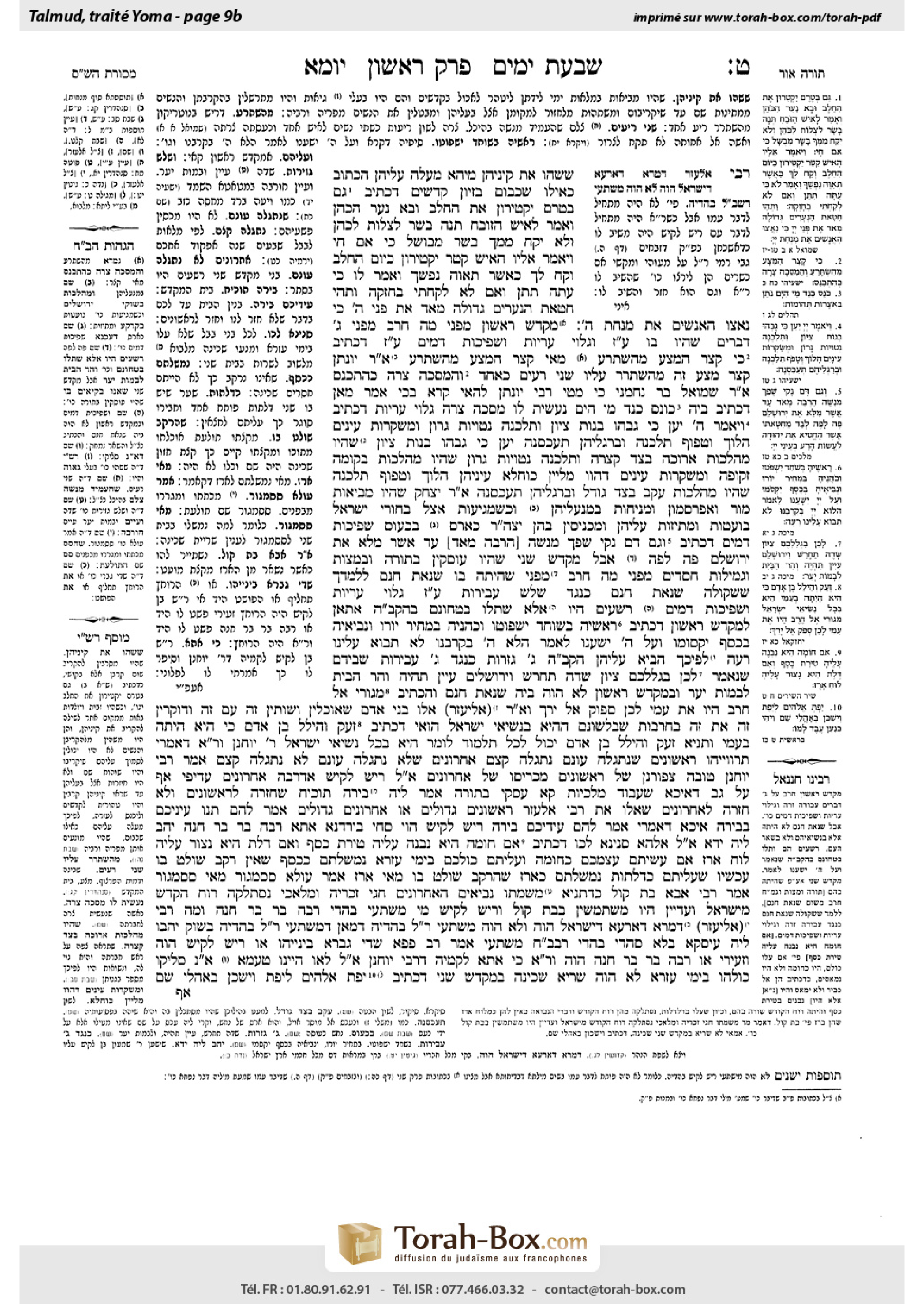
Yoma 9b: Talmud study for Daf Yomi
Daf Yomi is the daily study of one Talmud folio. Explore 37 tractates with scans, Hebrew text, Sefaria English and AI-generated French translations where annotated.
Passage selection and English or AI-generated French translation are available where the scan has annotations. Daf Study is independent of Torah-Box and Sefaria.
Browse Yoma · יומא · All tractatesYoma 9b text and translations
This page of Yoma includes the Aramaic text, an English translation and an AI-generated French translation, alongside the scan above.
יומא ט׳ ב · Aramaic and Hebrew text
שֶׁשִּׁהוּ אֶת קִינֵּיהֶן, מִיהָא מַעֲלֶה עֲלֵיהֶן הַכָּתוּב כְּאִילּוּ שְׁכָבוּם.
בִּזְיוֹן קֳדָשִׁים, דִּכְתִיב: ״גַּם בְּטֶרֶם יַקְטִרוּן אֶת הַחֵלֶב וּבָא נַעַר הַכֹּהֵן וְאָמַר לָאִישׁ הַזּוֹבֵחַ תְּנָה בָשָׂר לִצְלוֹת לַכֹּהֵן וְלֹא יִקַּח מִמְּךָ בָּשָׂר מְבוּשָּׁל כִּי אִם חָי. וַיֹּאמֶר אֵלָיו הָאִישׁ קַטֵּר יַקְטִירוּן כַּיּוֹם הַחֵלֶב וְקַח לְךָ כַּאֲשֶׁר תְּאַוֶּה נַפְשֶׁךָ וְאָמַר לוֹ כִּי עַתָּה תִתֵּן וְאִם לֹא לָקַחְתִּי בְחׇזְקָה. וַתְּהִי חַטַּאת הַנְּעָרִים גְּדוֹלָה מְאֹד אֶת פְּנֵי ה׳ כִּי נִאֲצוּ הָאֲנָשִׁים אֵת מִנְחַת ה׳״.
מִקְדָּשׁ רִאשׁוֹן מִפְּנֵי מָה חָרַב — מִפְּנֵי שְׁלֹשָׁה דְּבָרִים שֶׁהָיוּ בּוֹ: עֲבוֹדָה זָרָה, וְגִלּוּי עֲרָיוֹת, וּשְׁפִיכוּת דָּמִים. עֲבוֹדָה זָרָה, דִּכְתִיב: ״כִּי קָצַר הַמַּצָּע מֵהִשְׂתָּרֵעַ״.
מַאי ״קָצַר הַמַּצָּע מֵהִשְׂתָּרֵעַ״? אָמַר רַבִּי יוֹנָתָן: קָצַר מַצָּע זֶה מֵהִשְׂתָּרֵר עָלָיו שְׁנֵי רֵעִים כְּאֶחָד.
״וְהַמַּסֵּכָה צָרָה כְּהִתְכַּנֵּס״, אָמַר רַבִּי שְׁמוּאֵל בַּר נַחְמָנִי: כִּי מָטֵי רַבִּי יוֹנָתָן לְהַאי קְרָא בָּכֵי, אֲמַר: מַאן דִּכְתִיב בֵּיהּ ״כּוֹנֵס כַּנֵּד מֵי הַיָּם״, נַעֲשֵׂית לוֹ מַסֵּכָה צָרָה?
גִּלּוּי עֲרָיוֹת, דִּכְתִיב: ״וַיֹּאמֶר ה׳ יַעַן כִּי גָבְהוּ בְּנוֹת צִיּוֹן וַתֵּלַכְנָה נְטוּיוֹת גָּרוֹן וּמְשַׂקְּרוֹת עֵינָיִם הָלוֹךְ וְטָפוֹף תֵּלַכְנָה וּבְרַגְלֵיהֶן תְּעַכַּסְנָה״. ״יַעַן כִּי גָּבְהוּ בְּנוֹת צִיּוֹן״ — שֶׁהָיוּ מְהַלְּכוֹת אֲרוּכָּה בְּצַד קְצָרָה. ״וַתֵּלַכְנָה נְטוּיוֹת גָּרוֹן״ — שֶׁהָיוּ מְהַלְּכוֹת בְּקוֹמָה זְקוּפָה. ״וּמְשַׂקְּרוֹת עֵינַיִם״ — דַּהֲווֹ מָלְיָין כּוּחְלָא עֵינֵיהֶן. ״הָלוֹךְ וְטָפוֹף תֵּלַכְנָה״ — שֶׁהָיוּ מְהַלְּכוֹת עָקֵב בְּצַד גּוּדָל. ״וּבְרַגְלֵיהֶן תְּעַכַּסְנָה״ — אָמַר רַבִּי יִצְחָק: שֶׁהָיוּ מְבִיאוֹת מוֹר וַאֲפַרְסְמוֹן וּמַנִּיחוֹת בְּמִנְעֲלֵיהֶן, וּכְשֶׁמַּגִּיעוֹת אֵצֶל בַּחוּרֵי יִשְׂרָאֵל בּוֹעֲטוֹת וּמַתִּיזוֹת עֲלֵיהֶן, וּמַכְנִיסִין בָּהֶן יֵצֶר הָרָע כְּאֶרֶס בְּכָעוּס.
שְׁפִיכוּת דָּמִים, דִּכְתִיב: ״וְגַם דָּם נָקִי שָׁפַךְ מְנַשֶּׁה [הַרְבֵּה מְאֹד] עַד אֲשֶׁר מִלֵּא אֶת יְרוּשָׁלִַם פֶּה לָפֶה״.
אֲבָל מִקְדָּשׁ שֵׁנִי שֶׁהָיוּ עוֹסְקִין בְּתוֹרָה וּבְמִצְוֹת וּגְמִילוּת חֲסָדִים, מִפְּנֵי מָה חָרַב? מִפְּנֵי שֶׁהָיְתָה בּוֹ שִׂנְאַת חִנָּם. לְלַמֶּדְךָ שֶׁשְּׁקוּלָה שִׂנְאַת חִנָּם כְּנֶגֶד שָׁלֹשׁ עֲבֵירוֹת: עֲבוֹדָה זָרָה, גִּלּוּי עֲרָיוֹת, וּשְׁפִיכוּת דָּמִים.
רְשָׁעִים הָיוּ, אֶלָּא שֶׁתָּלוּ בִּטְחוֹנָם בְּהַקָּדוֹשׁ בָּרוּךְ הוּא. אֲתָאן לְמִקְדָּשׁ רִאשׁוֹן, דִּכְתִיב: ״רָאשֶׁיהָ בְּשׁוֹחַד יִשְׁפּוֹטוּ וְכֹהֲנֶיהָ בִּמְחִיר יוֹרוּ וּנְבִיאֶיהָ בְּכֶסֶף יִקְסוֹמוּ וְעַל ה׳ יִשָּׁעֵנוּ לֵאמֹר הֲלֹא ה׳ בְּקִרְבֵּנוּ לֹא תָבוֹא עָלֵינוּ רָעָה״. לְפִיכָךְ הֵבִיא עֲלֵיהֶן הַקָּדוֹשׁ בָּרוּךְ הוּא שָׁלֹשׁ גְּזֵרוֹת כְּנֶגֶד שָׁלֹשׁ עֲבֵירוֹת שֶׁבְּיָדָם, שֶׁנֶּאֱמַר: ״לָכֵן בִּגְלַלְכֶם צִיּוֹן שָׂדֶה תֵחָרֵשׁ וִירוּשָׁלִַים עִיִּין תִּהְיֶה וְהַר הַבַּיִת לְבָמוֹת יָעַר״.
וּבְמִקְדָּשׁ רִאשׁוֹן לָא הֲוָה בֵּיהּ שִׂנְאַת חִנָּם? וְהָכְתִיב: ״מְגוּרֵי אֶל חֶרֶב הָיוּ אֶת עַמִּי לָכֵן סְפוֹק אֶל יָרֵךְ״, וְאָמַר רַבִּי (אֱלִיעֶזֶר): אֵלּוּ בְּנֵי אָדָם שֶׁאוֹכְלִין וְשׁוֹתִין זֶה עִם זֶה וְדוֹקְרִין זֶה אֶת זֶה בַּחֲרָבוֹת שֶׁבִּלְשׁוֹנָם.
הַהִיא בִּנְשִׂיאֵי יִשְׂרָאֵל הֲוַאי, דִּכְתִיב: ״זְעַק וְהֵילֵל בֶּן אָדָם כִּי הִיא הָיְתָה בְעַמִּי״, וְתַנְיָא: ״זְעַק וְהֵילֵל בֶּן אָדָם״, יָכוֹל לַכֹּל? תַּלְמוּד לוֹמַר: ״הִיא בְּכׇל נְשִׂיאֵי יִשְׂרָאֵל״.
רַבִּי יוֹחָנָן וְרַבִּי אֶלְעָזָר דְּאָמְרִי תַּרְוַויְיהוּ: רִאשׁוֹנִים שֶׁנִּתְגַּלָּה עֲוֹנָם — נִתְגַּלָּה קִצָּם. אַחֲרוֹנִים שֶׁלֹּא נִתְגַּלָּה עֲוֹנָם — לֹא נִתְגַּלָּה קִצָּם.
אָמַר רַבִּי יוֹחָנָן: טוֹבָה צִפּוֹרְנָן שֶׁל רִאשׁוֹנִים, מִכְּרֵיסוֹ שֶׁל אַחֲרוֹנִים. אֲמַר לֵיהּ רֵישׁ לָקִישׁ: אַדְּרַבָּה אַחֲרוֹנִים עֲדִיפִי, אַף עַל גַּב דְּאִיכָּא שִׁעְבּוּד מַלְכִיּוֹת — קָא עָסְקִי בְּתוֹרָה. אֲמַר לֵיהּ: בִּירָה תּוֹכִיחַ, שֶׁחָזְרָה לָרִאשׁוֹנִים וְלֹא חָזְרָה לָאַחֲרוֹנִים.
שָׁאֲלוּ אֶת רַבִּי אֶלְעָזָר: רִאשׁוֹנִים גְּדוֹלִים, אוֹ אַחֲרוֹנִים גְּדוֹלִים? אָמַר לָהֶם: תְּנוּ עֵינֵיכֶם בַּבִּירָה. אִיכָּא דְּאָמְרִי, אָמַר לָהֶם: עֵידֵיכֶם בִּירָה,
רֵישׁ לָקִישׁ הֲוֵי סָחֵי בְּיַרְדְּנָא אֲתָא רַבָּה בַּר בַּר חָנָה יְהַב לֵיהּ יְדָא. אֲמַר לֵיהּ: אֱלָהָא! סָנֵינָא לְכוּ — דִּכְתִיב: ״אִם חוֹמָה הִיא נִבְנֶה עָלֶיהָ טִירַת כָּסֶף וְאִם דֶּלֶת הִיא נָצוּר עָלֶיהָ לוּחַ אָרֶז״. אִם עֲשִׂיתֶם עַצְמְכֶם כְּחוֹמָה וַעֲלִיתֶם כּוּלְּכֶם בִּימֵי עֶזְרָא — נִמְשַׁלְתֶּם כְּכֶסֶף שֶׁאֵין רָקָב שׁוֹלֵט בּוֹ, עַכְשָׁיו שֶׁעֲלִיתֶם כִּדְלָתוֹת — נִמְשַׁלְתֶּם כְּאֶרֶז שֶׁהָרָקָב שׁוֹלֵט בּוֹ.
מַאי אֶרֶז? אָמַר עוּלָּא: סַסְמָגוֹר. מַאי סַסְמָגוֹר? אָמַר רַבִּי אַבָּא: בַּת קוֹל. כִּדְתַנְיָא: מִשֶּׁמֵּתוּ נְבִיאִים הָאַחֲרוֹנִים חַגַּי זְכַרְיָה וּמַלְאָכִי נִסְתַּלְּקָה רוּחַ הַקֹּדֶשׁ מִיִּשְׂרָאֵל, וַעֲדַיִין הָיוּ מִשְׁתַּמְּשִׁין בְּבַת קוֹל.
וְרֵישׁ לָקִישׁ, מִי מִשְׁתַּעֵי בַּהֲדֵי רַבָּה בַּר בַּר חָנָה? וּמָה רַבִּי (אֱלִיעֶזֶר), דְּמָרָא דְּאַרְעָא דְּיִשְׂרָאֵל הֲוָה, וְלָא הֲוָה מִשְׁתַּעֵי רֵישׁ לָקִישׁ בַּהֲדֵיהּ, דְּמַאן דְּמִשְׁתַּעֵי רֵישׁ לָקִישׁ בַּהֲדֵיהּ בְּשׁוּקָא, יָהֲבוּ לֵיהּ עִיסְקָא בְּלָא סָהֲדֵי — בַּהֲדֵי רַבָּה בַּר בַּר חָנָה מִשְׁתַּעֵי?!
אָמַר רַב פָּפָּא, שְׁדִי גַּבְרָא בֵּינַיְיהוּ: אוֹ רֵישׁ לָקִישׁ הֲוָה וּזְעֵירִי, אוֹ רַבָּה בַּר בַּר חָנָה הֲוָה וְרַבִּי אֶלְעָזָר. כִּי אֲתָא לְקַמֵּיהּ דְּרַבִּי יוֹחָנָן, אֲמַר לֵיהּ: לָאו הַיְינוּ טַעְמָא, אִי נָמֵי סְלִיקוּ כּוּלְּהוּ בִּימֵי עֶזְרָא לָא הֲוָה שָׁרְיָא שְׁכִינָה בְּמִקְדָּשׁ שֵׁנִי, דִּכְתִיב: ״יַפְתְּ אֱלֹהִים לְיֶפֶת וְיִשְׁכֹּן בְּאׇהֳלֵי שֵׁם״,
Yoma 9b · English translation
that they deferred the sacrifice of their bird-offerings by women after childbirth; nevertheless, the verse ascribes to them as if they lay with them. These women came to the Tabernacle to sacrifice doves or pigeons as bird-offerings as part of their purification process, which would permit them to engage in sexual relations with their husbands. Eli’s sons delayed the sacrifice of these offerings and thereby delayed the return of these women to their husbands and their fulfillment of the mitzva of procreation. Even though, according to this opinion, Eli’s sons did not actually engage in sexual relations with these women, the verse attributes that degree of severity to their conduct.
Eli’s sons also sinned in the degradation of consecrated items, as it is written: “Before the fat was made burned, the priest’s servant came and said to the man who sacrificed: Hand over some flesh to roast for the priest, for he will not take cooked flesh from you, but raw. And if the man said to him: Let the fat be burnt first and then take as much as you want, then he would say: No, hand it over right now, or I will take it by force. The sin of the young men against the Lord was very great, for the men treated the Lord’s offerings with contempt” (I Samuel 2:15–17).
§ The Tosefta continues with a discussion of the sins of the Jewish people over the generations: Due to what reason was the First Temple destroyed? It was destroyed due to the fact that there were three matters that existed in the First Temple: Idol worship, forbidden sexual relations, and bloodshed. Idol worship, as it is written: “The bed is too short for stretching [mehistare’a], and the cover is too narrow for gathering” (Isaiah 28:20).
What is the meaning of: “The bed is too short for stretching?” Rabbi Yonatan said: This bed is too short for two counterparts [re’im] to dominate [mehistarer]. Mehistare’a is a contraction of mehistarer re’im. It is inconceivable that there would be in one Temple both service of God and worship of the idol placed there by King Manasseh.
What is the meaning of: And the cover [vehamasseikha] is too narrow [tzara] for gathering [kehitkannes]? Rabbi Shmuel bar Naḥmani said that when Rabbi Yonatan reached this verse, he wept and said: For He about Whom it is written: “He gathers [kones] waters of the sea together as a heap” (Psalms 33:7), the idol [masseikha] became a rival [tzara]? In the homiletic interpretation, masseikha is interpreted as idol and tzara is interpreted as rival, as in the term used to describe the relationship between two women married to the same husband, isha tzara.
With regard to forbidden sexual relations, it is written: “The Lord says because the daughters of Zion are haughty and walk with outstretched necks and wanton eyes, walking and mincing as they go and making a tinkling with their feet” (Isaiah 3:16).
Because the daughters of Zion are haughty, indicates a tall woman walking alongside a short one so that the tall woman would stand out.
And walk with outstretched necks, indicates that they would walk with upright stature and carry themselves in an immodest way.
And wanton eyes, indicates that they would fill their eyes with blue eye shadow in order to draw attention to their eyes.
Walking and mincing as they go, indicates that they would walk in small steps, heel to toe, so onlookers would notice them.
Making a tinkling [te’akasna] with their feet, Rabbi Yitzḥak said: This teaches that they would bring myrrh and balsam and place them in their shoes and would walk in the marketplaces of Jerusalem. And once they approached a place where young Jewish men were congregated, they would stamp their feet on the ground and splash the perfume toward them and instill the evil inclination into them like venom of a viper [ke’eres bikhos].
With regard to bloodshed it is written: “Moreover, Manasseh shed innocent blood very much, until he had filled Jerusalem from one end to another” (II Kings 21:16).
However, considering that the people during the Second Temple period were engaged in Torah study, observance of mitzvot, and acts of kindness, and that they did not perform the sinful acts that were performed in the First Temple, why was the Second Temple destroyed? It was destroyed due to the fact that there was wanton hatred during that period. This comes to teach you that the sin of wanton hatred is equivalent to the three severe transgressions: Idol worship, forbidden sexual relations and bloodshed.
The Gemara continues: They were wicked; however, they put their faith in the Holy One, Blessed be He. With that statement we have come to the First Temple era, about which it is written: “Her chiefs judge for bribes, her priests give rulings for a fee, and her prophets divine for pay; yet they rely on the Lord, saying: The Lord is in our midst, no tragedy will overtake us” (Micah 3:11). At least the final portion of the verse was to their credit. Therefore, the Holy One, Blessed be He, brought upon them three decrees corresponding to their three wicked sins, as it is stated: “Therefore, due to you Zion will be plowed as a field, Jerusalem will become heaps of ruins, and the Temple Mount will be a like a shrine in the woods” (Micah 3:12).
The Gemara asks: And in the First Temple era was there really no baseless hatred? Isn’t it written: “Cry and wail, son of man, for this will befall my people, this will befall all the princes of Israel: They will be cast before the sword together with my people, therefore strike the thigh” (Ezekiel 21:17)? Rabbi Eliezer interpreted this verse and said: These are people who eat and drink with each other, and stab each other with verbal barbs. Apparently, even those who were close were filled with hatred toward one another.
The Gemara answers: That behavior was found only among the princes of Israel, as it is written: “Cry and wail, son of man, for this will befall my people”; and it was taught in a baraita: “Cry and wail, son of man, for this will befall my people”; one might have thought that this unsavory trait was common to all. Therefore, the verse states: “This will befall all the princes of Israel.” It was only the leaders of the nation who harbored baseless hatred for each other; the people of the nation as a whole did not hate one another.
§ It was Rabbi Yoḥanan and Rabbi Elazar who both said: In the case of the former, the people in the First Temple era, whose sin was exposed and no attempt was made to disguise their conduct, the end of their punishment was exposed, and the prophet informed them that they would return to their land in seventy years. In the case of the latter, the people in the Second Temple era, whose sin was not exposed; rather, they attempted to disguise their conduct, the end of their punishment was not exposed.
Rabbi Yoḥanan said: The fingernails of the former are preferable to the belly of the latter. Reish Lakish said to him: On the contrary, the latter were superior; even though there is subjugation by the kingdoms, they are engaged in Torah study. Rabbi Yoḥanan said to Reish Lakish: The Temple will prove that the former were superior, as it was restored to the former. The Second Temple was constructed after the destruction of the first. However, after the destruction of the Second Temple, it was not restored to the latter. Apparently, the former were superior to the latter.
Similarly, the Sages asked Rabbi Elazar: Are the former greater or are the latter greater? He said to them: Look to the Temple and see if it has been restored, as it was to our predecessors. Some say the exchange was slightly different: He said to them: The Temple is your witness. The restoration of the Temple after the destruction of the First Temple, attests to the fact that the former generation was greater.
Reish Lakish was swimming in the Jordan River when Rabba bar bar Ḥana came and gave him a hand to help him out. Reish Lakish said to him: My God! I hate you Babylonians, as it is written: “If she be a wall we will build a silver turret upon her, if she be a door we will cover her with boards of cedar” (Song of Songs 8:9). This is the meaning of the verse as it applies to the Jewish people: Had you rendered yourselves a solid bloc like a wall and all ascended to Eretz Yisrael in the days of Ezra, you would have been likened to silver, which rot does not infest, in the sense that you would have merited experiencing the Divine Presence in all its glory. Now that you ascended like doors, and only some of you came to Eretz Yisrael, you are likened to cedar, which rot infests, and you merit experiencing only partial revelation of the Divine Presence.
The Gemara asks: What rot infests cedar? Ulla said: It is sasmagor, a type of worm. The Gemara asks: What does sasmagor have to do with the Divine Presence during the Second Temple era? Rabbi Abba said: Just as little remains from a cedar tree infested by this worm, similarly, all that remained from the Divine Presence during the Second Temple period was a Divine Voice, as it was taught in a baraita: After the last prophets Haggai, Zechariah, and Malachi died, the Divine Spirit of prophetic revelation departed from the Jewish people, and they were still utilizing a Divine Voice, which they heard as an echo of prophecy.
The Gemara asks: And would Reish Lakish speak with Rabba bar bar Ḥana in public? Just as Rabbi Elazar, who was the master of Eretz Yisrael in wisdom and character, and nevertheless, Reish Lakish would not speak with him in public, as Reish Lakish was sparing in his speech and extended friendship to only a select few prominent, righteous people, to the extent that a person to whom Reish Lakish was seen speaking in the marketplace, one would give him a loan and do business with him without witnesses; would he have spoken with Rabba bar bar Ḥana?
Rav Pappa said: Cast a man between them, and say that the incident did not involve Reish Lakish and Rabba bar bar Ḥana. It was either Reish Lakish bathing in the river and Ze’iri, the prominent Babylonian Sage, who extended him a hand, or it was Rabba bar bar Ḥana who was in the river and Rabbi Elazar extended a hand to him. In any event, when the Sage who heard what Reish Lakish said came before Rabbi Yoḥanan and related it, Rabbi Yoḥanan said to him: That is not the reason; even had they all ascended in the days of Ezra, the Divine Presence would not have rested in the Second Temple, as it is written: “God will enlarge Japheth, and dwell in the tents of Shem” (Genesis 9:27).
Yoma 9b · Traduction française (IA)
qu’ils retardaient le sacrifice des offrandes d’oiseaux apportées par les femmes après un accouchement ; pourtant, le verset leur attribue une conduite comme s’ils avaient couché avec elles. Ces femmes venaient au Tabernacle pour offrir des tourterelles ou des pigeons dans le cadre de leur purification, qui leur permettrait d’avoir des relations sexuelles avec leurs maris. Les fils d’Éli retardaient le sacrifice de ces offrandes et, par là même, le retour de ces femmes auprès de leurs maris et l’accomplissement de la mitsva de procréation. Même si, selon cette opinion, les fils d’Éli n’avaient pas réellement de relations sexuelles avec ces femmes, le verset attribue à leur conduite une gravité équivalente.
Les fils d’Éli péchèrent aussi en dégradant les objets consacrés, comme il est écrit : « Avant que la graisse ne soit brûlée, le serviteur du prêtre venait dire à l’homme qui offrait le sacrifice : “Donne de la viande à rôtir pour le prêtre, car il ne prendra pas de viande cuite de ta part, mais de la viande crue.” Et si l’homme lui disait : “Qu’on brûle d’abord la graisse, puis prends-en autant que tu veux”, il répondait : “Non, donne-la-moi tout de suite, ou je la prendrai de force.” Le péché de ces jeunes gens contre le Seigneur était très grand, car ils traitaient avec mépris les offrandes du Seigneur » (I Samuel 2:15–17).
§ La Tosefta poursuit son examen des péchés du peuple juif au fil des générations : Pour quelle raison le Premier Temple fut-il détruit ? Il le fut parce que trois fautes étaient présentes à l’époque du Premier Temple : l’idolâtrie, les relations sexuelles interdites et le meurtre. Concernant l’idolâtrie, il est écrit : « Le lit est trop court pour s’étendre [mehistare’a], et la couverture trop étroite pour se replier » (Isaïe 28:20).
Que signifie : « Le lit est trop court pour s’étendre » ? Rabbi Yonatan dit : Ce lit est trop court pour que deux rivaux [re’im] le dominent [mehistarer]. Mehistare’a est une contraction de mehistarer re’im. Il est inconcevable qu’un même Temple abrite à la fois le culte de Dieu et celui de l’idole que le roi Manassé y avait installée.
Que signifie : « Et la couverture [vehamasseikha] est trop étroite [tzara] pour se replier [kehitkannes] » ? Rabbi Shmuel bar Naḥmani rapporte que lorsque Rabbi Yonatan arriva à ce verset, il pleura et dit : « Pour Celui dont il est écrit : “Il rassemble [kones] les eaux de la mer comme un monceau” (Psaumes 33:7), l’idole [masseikha] serait-elle devenue une rivale [tzara] ? » Dans cette interprétation homilétique, masseikha est compris comme « idole » et tzara comme « rivale », comme dans l’expression désignant la relation entre deux femmes mariées au même homme, isha tzara.
Au sujet des relations sexuelles interdites, il est écrit : « Le Seigneur dit : Parce que les filles de Sion sont orgueilleuses, qu’elles marchent le cou tendu et les yeux provocants, qu’elles avancent en marchant à petits pas et qu’elles font tinter leurs pieds » (Isaïe 3:16). « Parce que les filles de Sion sont orgueilleuses » indique qu’une grande femme marchait aux côtés d’une petite afin de se faire remarquer. « Et qu’elles marchent le cou tendu » indique qu’elles se tenaient droites et se comportaient de manière indécente. « Et les yeux provocants » indique qu’elles se fardaient les yeux de bleu afin d’attirer l’attention sur eux. « Qu’elles avancent en marchant à petits pas » indique qu’elles marchaient à petits pas, du talon aux orteils, afin que les passants les remarquent. « Et qu’elles font tinter [te’akasna] leurs pieds » : Rabbi Yitzḥak dit : Cela enseigne qu’elles apportaient de la myrrhe et du baume, les mettaient dans leurs chaussures et parcouraient les marchés de Jérusalem. Lorsqu’elles arrivaient près d’un endroit où de jeunes hommes juifs étaient rassemblés, elles frappaient le sol du pied, projetaient leur parfum vers eux et éveillaient en eux le mauvais penchant comme le venin d’une vipère [ke’eres bikhos].
Au sujet du meurtre, il est écrit : « De plus, Manassé répandit abondamment le sang innocent, jusqu’à remplir Jérusalem d’un bout à l’autre » (II Rois 21:16).
Cependant, puisque les gens de l’époque du Second Temple étudiaient la Torah, observaient les mitsvot et accomplissaient des actes de bonté, et qu’ils ne commettaient pas les fautes qui avaient été commises à l’époque du Premier Temple, pourquoi le Second Temple fut-il détruit ? Il le fut parce qu’à cette époque régnait une haine gratuite. Cela vient t’enseigner que le péché de la haine gratuite équivaut aux trois transgressions graves : l’idolâtrie, les relations sexuelles interdites et le meurtre.
La Guemara poursuit : Ils étaient méchants ; pourtant, ils avaient confiance dans le Saint, béni soit-Il. Cette affirmation nous ramène à l’époque du Premier Temple, au sujet de laquelle il est écrit : « Ses chefs rendent la justice pour des pots-de-vin, ses prêtres donnent leurs décisions contre rémunération et ses prophètes pratiquent la divination pour de l’argent ; pourtant, ils s’appuient sur le Seigneur et disent : “Le Seigneur est au milieu de nous, aucun malheur ne nous atteindra” » (Michée 3:11). Du moins, la dernière partie du verset jouait en leur faveur. C’est pourquoi le Saint, béni soit-Il, fit peser sur eux trois décrets correspondant à leurs trois péchés infâmes, comme il est dit : « À cause de vous, Sion sera labourée comme un champ, Jérusalem deviendra un amas de ruines, et le mont du Temple, un sanctuaire dans les bois » (Michée 3:12).
La Guemara demande : À l’époque du Premier Temple, n’y avait-il vraiment aucune haine gratuite ? N’est-il pas écrit : « Crie et gémis, fils d’homme, car cela va arriver à mon peuple, cela va arriver à tous les princes d’Israël : ils seront livrés à l’épée avec mon peuple ; frappe donc ta cuisse » (Ézéchiel 21:17) ? Rabbi Eliezer interpréta ce verset et dit : Il s’agit de gens qui mangent et boivent ensemble, puis se poignardent à coups de traits verbaux. Il apparaît donc que même ceux qui étaient proches les uns des autres étaient remplis de haine mutuelle.
La Guemara répond : Ce comportement ne se trouvait que chez les princes d’Israël, comme il est écrit : « Crie et gémis, fils d’homme, car cela va arriver à mon peuple » ; et il a été enseigné dans une baraïta : « Crie et gémis, fils d’homme, car cela va arriver à mon peuple » ; on aurait pu penser que ce trait détestable était commun à tous. C’est pourquoi le verset précise : « Cela va arriver à tous les princes d’Israël. » Seuls les dirigeants du peuple nourrissaient une haine gratuite les uns envers les autres ; le peuple dans son ensemble ne se haïssait pas.
§ Rabbi Yoḥanan et Rabbi Elazar ont tous deux dit : Pour les premiers, les gens de l’époque du Premier Temple, dont le péché était manifeste et qui ne cherchaient pas à dissimuler leur conduite, le terme de leur châtiment fut révélé, et le prophète leur annonça qu’ils retourneraient dans leur pays au bout de soixante-dix ans. Pour les derniers, les gens de l’époque du Second Temple, dont le péché n’était pas manifeste, puisqu’ils cherchaient à dissimuler leur conduite, le terme de leur châtiment ne fut pas révélé.
Rabbi Yoḥanan dit : Les ongles des premiers valent mieux que le ventre des derniers. Reish Lakish lui dit : Au contraire, les derniers étaient supérieurs ; même s’ils sont soumis aux royaumes, ils étudient la Torah. Rabbi Yoḥanan dit à Reish Lakish : Le Temple prouvera que les premiers étaient supérieurs, puisqu’il fut reconstruit pour eux. Le Second Temple fut édifié après la destruction du premier. En revanche, après la destruction du Second Temple, il ne fut pas reconstruit pour les derniers. Il apparaît donc que les premiers étaient supérieurs aux derniers.
De même, les Sages demandèrent à Rabbi Elazar : Les premiers étaient-ils supérieurs ou les derniers ? Il leur répondit : Regardez le Temple et voyez s’il a été reconstruit, comme il l’a été pour nos prédécesseurs. Selon certains, l’échange fut légèrement différent : il leur dit : « Le Temple est votre témoin. » La reconstruction du Temple après la destruction du Premier Temple atteste que la génération précédente était supérieure.
Reish Lakish nageait dans le Jourdain lorsque Rabba bar bar Ḥana arriva et lui tendit la main pour l’aider à sortir. Reish Lakish lui dit : « Par Dieu ! Je vous déteste, Babyloniens », comme il est écrit : « Si elle est un mur, nous bâtirons sur elle une tourelle d’argent ; si elle est une porte, nous la couvrirons de planches de cèdre » (Cantique des Cantiques 8:9). Voici le sens du verset appliqué au peuple juif : si vous vous étiez rendus solides comme un mur et étiez tous montés en Eretz Yisrael à l’époque d’Ezra, vous auriez été comparés à l’argent, que la pourriture n’attaque pas, en ce sens que vous auriez mérité de connaître la Présence divine dans toute sa gloire. Maintenant que vous êtes montés comme des portes et que seuls certains d’entre vous sont venus en Eretz Yisrael, vous êtes comparés au cèdre, que la pourriture attaque, et vous ne méritez de connaître qu’une révélation partielle de la Présence divine.
La Guemara demande : Quelle pourriture attaque le cèdre ? Ulla dit : C’est le sasmagor, une sorte de ver. La Guemara demande : Quel rapport le sasmagor a-t-il avec la Présence divine à l’époque du Second Temple ? Rabbi Abba dit : De même qu’il reste peu de chose d’un cèdre infesté par ce ver, de même, tout ce qui subsistait de la Présence divine à l’époque du Second Temple était une Voix divine, comme il a été enseigné dans une baraïta : Après la mort des derniers prophètes, Aggée, Zacharie et Malachie, l’Esprit divin de la révélation prophétique quitta le peuple juif, mais celui-ci entendait encore une Voix divine, comme un écho de la prophétie.
La Guemara demande : Reish Lakish aurait-il parlé en public avec Rabba bar bar Ḥana ? Même avec Rabbi Elazar, qui était le maître d’Eretz Yisrael en sagesse et en caractère, Reish Lakish ne parlait pas en public. En effet, il était avare de paroles et ne se liait d’amitié qu’avec un petit nombre de personnes éminentes et justes, au point que si l’on voyait Reish Lakish parler avec quelqu’un sur la place du marché, on lui accordait un prêt et on faisait des affaires avec lui sans témoins. Aurait-il donc parlé avec Rabba bar bar Ḥana ?
Rav Pappa dit : Intercalons un homme entre eux et disons que l’incident ne mettait pas en scène Reish Lakish et Rabba bar bar Ḥana. Soit Reish Lakish se baignait dans le fleuve et Ze’iri, le Sage babylonien éminent, lui tendit la main, soit Rabba bar bar Ḥana se trouvait dans le fleuve et Rabbi Elazar lui tendit la main. Quoi qu’il en soit, lorsque le Sage qui avait entendu les paroles de Reish Lakish se présenta devant Rabbi Yoḥanan et les lui rapporta, Rabbi Yoḥanan lui dit : « Ce n’est pas là la raison ; même si tous étaient montés à l’époque d’Ezra, la Présence divine ne se serait pas manifestée dans le Second Temple », comme il est écrit : « Que Dieu agrandisse Japhet, et qu’il habite dans les tentes de Sem » (Genèse 9:27).
Traduction française générée par IA à partir de l’édition anglaise de Sefaria. Vérifie toujours un passage avec le texte source.
Text from Sefaria: William Davidson Edition - Vocalized Aramaic (CC BY NC); William Davidson Edition - English (CC BY NC).