Yoma 11a: Talmud study for Daf Yomi
Daf Yomi is the daily study of one Talmud folio. Explore 37 tractates with scans, Hebrew text, Sefaria English and AI-generated French translations where annotated.
Passage selection and English or AI-generated French translation are available where the scan has annotations. Daf Study is independent of Torah-Box and Sefaria.
Browse Yoma · יומא · All tractatesYoma 11a text and translations
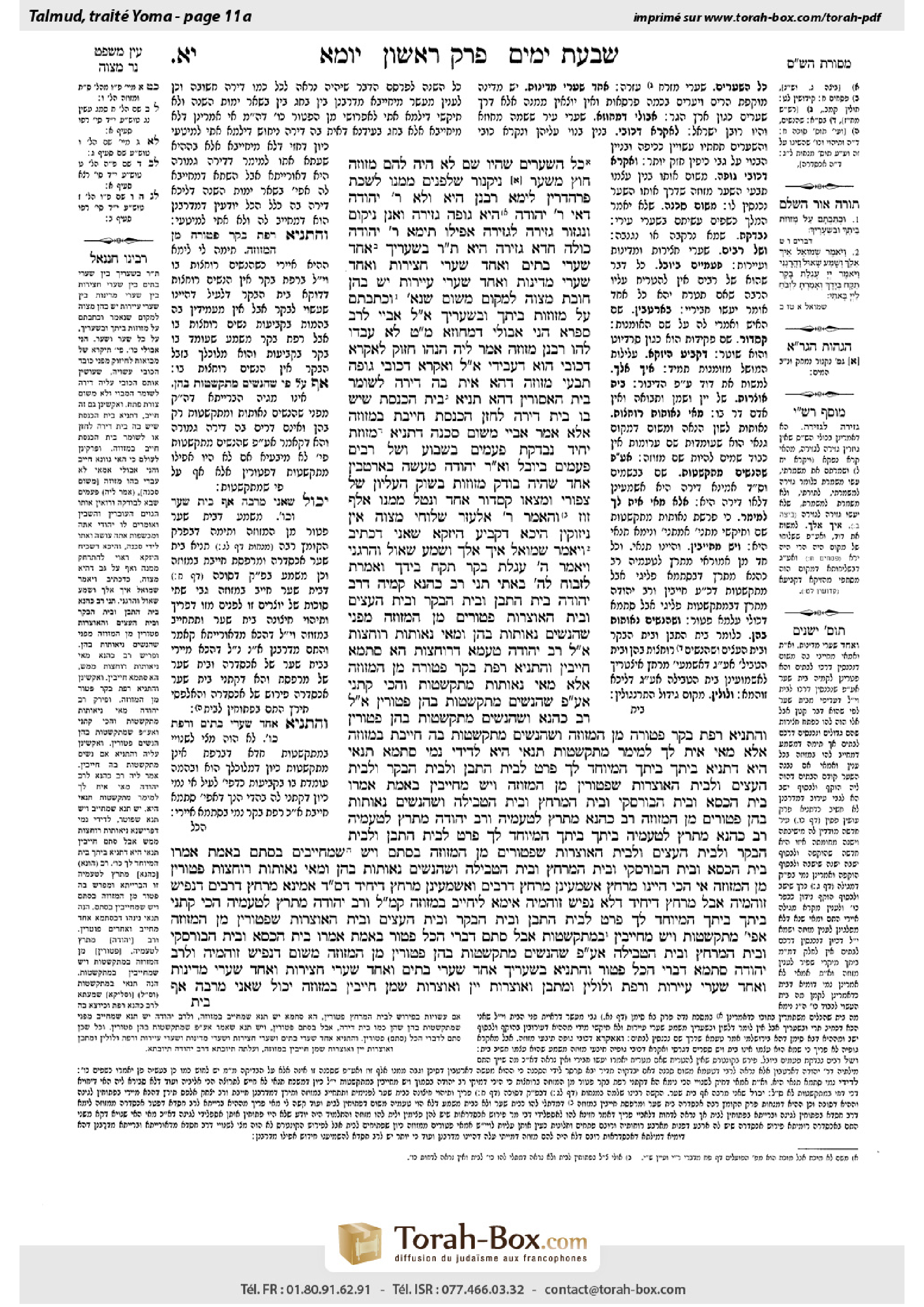
This page of Yoma includes the Aramaic text, an English translation and an AI-generated French translation, alongside the scan above.
יומא י״א א · Aramaic and Hebrew text
כׇּל הַשְּׁעָרִים שֶׁהָיוּ שָׁם לֹא הָיָה לָהֶם מְזוּזָה, חוּץ מִשַּׁעַר נִיקָנוֹר, שֶׁלִּפְנִים מִמֶּנּוּ לִשְׁכַּת פַּרְהֶדְרִין.
לֵימָא רַבָּנַן הִיא וְלָא רַבִּי יְהוּדָה? דְּאִי רַבִּי יְהוּדָה, הִיא גּוּפַהּ גְּזֵירָה, וַאֲנַן נֵיקוּם וְנִגְזוֹר גְּזֵירָה לִגְזֵירָה? אֲפִילּוּ תֵּימָא רַבִּי יְהוּדָה, כּוּלַּהּ חֲדָא גְּזֵירָה הִיא.
תָּנוּ רַבָּנַן: ״בִּשְׁעָרֶיךָ״ — אֶחָד שַׁעֲרֵי בָתִּים וְאֶחָד שַׁעֲרֵי חֲצֵירוֹת וְאֶחָד שַׁעֲרֵי מְדִינוֹת וְאֶחָד שַׁעֲרֵי עֲיָירוֹת יֵשׁ בָּהֶן חוֹבַת מִצְוָה לַמָּקוֹם, מִשּׁוּם שֶׁנֶּאֱמַר: ״וּכְתַבְתָּם עַל מְזוּזוֹת בֵּיתֶךָ וּבִשְׁעָרֶיךָ״.
אֲמַר לֵיהּ אַבָּיֵי לְרַב סָפְרָא: הָנֵי אֲבוּלֵּי דְמָחוֹזָא מַאי טַעְמָא לָא עֲבַדוּ לְהוּ רַבָּנַן מְזוּזָה? אֲמַר לֵיהּ: הָנְהוּ חִזּוּק לְאַקְרָא דְכוּבֵי הוּא דַּעֲבִידִי. אָמַר לֵיהּ: וְאַקְרָא דְכוּבֵי גּוּפַהּ תִּבְעֵי מְזוּזָה, דְּהָא אִית בַּהּ דִּירָה לְשׁוֹמֵר בֵּית הָאֲסוּרִין, דְּהָא תַּנְיָא: בֵּית הַכְּנֶסֶת שֶׁיֵּשׁ בּוֹ בֵּית דִּירָה לְחַזַּן הַכְּנֶסֶת חַיֶּיבֶת בִּמְזוּזָה!
אֶלָּא אָמַר אַבָּיֵי: מִשּׁוּם סַכָּנָה. דְּתַנְיָא: מְזוּזַת יָחִיד נִבְדֶּקֶת פַּעֲמַיִם בַּשָּׁבוּעַ, וְשֶׁל רַבִּים פַּעֲמַיִם בַּיּוֹבֵל.
וְאָמַר רַבִּי יְהוּדָה: מַעֲשֶׂה בְּאַרְטָבִין אֶחָד שֶׁהָיָה בּוֹדֵק מְזוּזוֹת בַּשּׁוּק הָעֶלְיוֹן שֶׁל צִפּוֹרִי, וּמְצָאוֹ קַסְדּוֹר אֶחָד וְנָטַל מִמֶּנּוּ אֶלֶף זוּז. וְהָאָמַר רַבִּי אֶלְעָזָר: שְׁלוּחֵי מִצְוָה אֵין נִיזּוֹקִין? הֵיכָא דִּקְבִיעַ הֶיזֵּקָא, שָׁאנֵי. דִּכְתִיב: ״וַיֹּאמֶר שְׁמוּאֵל אֵיךְ אֵלֵךְ וְשָׁמַע שָׁאוּל וַהֲרָגָנִי וַיֹּאמֶר ה׳ עֶגְלַת בָּקָר תִּקַּח בְּיָדֶךָ וְאָמַרְתָּ לִזְבּוֹחַ לַה׳ בָּאתִי״.
תָּנֵי רַב כָּהֲנָא קַמֵּיהּ דְּרַב יְהוּדָה: בֵּית הַתֶּבֶן וּבֵית הַבָּקָר וּבֵית הָעֵצִים וּבֵית הָאוֹצָרוֹת פְּטוּרִים מִן הַמְּזוּזָה, מִפְּנֵי שֶׁהַנָּשִׁים נְאוֹתוֹת בָּהֶן. וּמַאי ״נְאוֹתוֹת״? רוֹחֲצוֹת. אֲמַר לֵיהּ רַב יְהוּדָה: טַעְמָא דְּרוֹחֲצוֹת, הָא סְתָמָא — חַיָּיבִין? וְהָתַנְיָא: רֶפֶת בָּקָר פְּטוּרָה מִן הַמְּזוּזָה!
אֶלָּא: מַאי ״נְאוֹתוֹת״ — מִתְקַשְּׁטוֹת. וְהָכִי קָתָנֵי: אַף עַל פִּי שֶׁהַנָּשִׁים מִתְקַשְּׁטוֹת בָּהֶן, פְּטוּרִין. אֲמַר לֵיהּ רַב כָּהֲנָא: וְשֶׁהַנָּשִׁים מִתְקַשְּׁטוֹת בָּהֶן פְּטוּרִין, וְהָתַנְיָא: רֶפֶת בָּקָר פְּטוּרָה מִן הַמְּזוּזָה, וְשֶׁהַנָּשִׁים מִתְקַשְּׁטוֹת בָּהּ חַיֶּיבֶת בִּמְזוּזָה!
אֶלָּא מַאי אִית לָךְ לְמֵימַר, מִתְקַשְּׁטוֹת תַּנָּאֵי הִיא? לְדִידִי נָמֵי סְתָמָא תַּנָּאֵי הִיא. דְּתַנְיָא: ״בֵּיתֶךָ״ — בֵּיתְךָ הַמְיוּחָד לָךְ, פְּרָט לְבֵית הַתֶּבֶן וּלְבֵית הַבָּקָר וּלְבֵית הָעֵצִים וּלְבֵית הָאוֹצָרוֹת, שֶׁפְּטוּרִין מִן הַמְּזוּזָה, וְיֵשׁ מְחַיְּיבִין.
בֶּאֱמֶת אָמְרוּ, בֵּית הַכִּסֵּא וּבֵית הַבּוּרְסְקִי וּבֵית הַמֶּרְחָץ וּבֵית הַטְּבִילָה, וְשֶׁהַנָּשִׁים נְאוֹתוֹת בָּהֶן פְּטוּרִים מִן הַמְּזוּזָה. רַב כָּהֲנָא מְתָרֵץ לְטַעְמֵיהּ וְרַב יְהוּדָה מְתָרֵץ לְטַעְמֵיהּ.
רַב כָּהֲנָא מְתָרֵץ לְטַעְמֵיהּ: ״בֵּיתֶךָ״ — בֵּיתְךָ הַמְיוּחָד לָךְ, פְּרָט לְבֵית הַתֶּבֶן וּלְבֵית הַבָּקָר וּלְבֵית הָעֵצִים וּלְבֵית הָאוֹצָרוֹת, שֶׁפְּטוּרִים מִן הַמְּזוּזָה בִּסְתָם. וְיֵשׁ שֶׁמְּחַיְּיבִים בִּסְתָם. בֶּאֱמֶת אָמְרוּ: בֵּית הַכִּסֵּא וּבֵית הַבּוּרְסְקִי וּבֵית הַמֶּרְחָץ וּבֵית הַטְּבִילָה וְשֶׁהַנָּשִׁים נְאוֹתוֹת בָּהֶן, וּמַאי ״נְאוֹתוֹת״ — רוֹחֲצוֹת, פְּטוּרִין מִן הַמְּזוּזָה.
אִי הָכִי, הַיְינוּ מֶרְחָץ! אַשְׁמְעִינַן מֶרְחָץ דְּרַבִּים וְאַשְׁמְעִינַן מֶרְחָץ דְּיָחִיד. דְּסָלְקָא דַּעְתָּךְ אָמֵינָא: מֶרְחָץ דְּרַבִּים דִּנְפִישׁ זוּהֲמֵיהּ, אֲבָל מֶרְחָץ דְּיָחִיד דְּלָא נְפִישׁ זוּהֲמֵיהּ — אֵימָא לִיחַיַּיב בִּמְזוּזָה, קָא מַשְׁמַע לַן.
וְרַב יְהוּדָה מְתָרֵץ לְטַעְמֵיהּ, הָכִי קָתָנֵי: ״בֵּיתֶךָ״ — בֵּיתְךָ הַמְיוּחָד לָךְ, פְּרָט לְבֵית הַתֶּבֶן וּבֵית הַבָּקָר וּבֵית הָעֵצִים וּבֵית הָאוֹצָרוֹת שֶׁפְּטוּרִין מִן הַמְּזוּזָה, אֲפִילּוּ מִתְקַשְּׁטוֹת, וְיֵשׁ מְחַיְּיבִין בְּמִתְקַשְּׁטוֹת, אֲבָל סְתָם דִּבְרֵי הַכֹּל פָּטוּר. בֶּאֱמֶת אָמְרוּ: בֵּית הַכִּסֵּא וּבֵית הַבּוּרְסְקִי וּבֵית הַמֶּרְחָץ וּבֵית הַטְּבִילָה, אַף עַל פִּי שֶׁהַנָּשִׁים מִתְקַשְּׁטוֹת בָּהֶן פְּטוּרִין מִן הַמְּזוּזָה, מִשּׁוּם דִּנְפִישׁ זוּהֲמֵיהּ.
וּלְרַב יְהוּדָה סְתָמָא דִּבְרֵי הַכֹּל פָּטוּר, וְהָתַנְיָא: ״בִּשְׁעָרֶיךָ״ — אֶחָד שַׁעֲרֵי בָתִּים וְאֶחָד שַׁעֲרֵי חֲצֵירוֹת וְאֶחָד שַׁעֲרֵי מְדִינוֹת וְאֶחָד שַׁעֲרֵי עֲיָירוֹת, וְרֶפֶת וְלוּלִין וּמַתְבֵּן וְאוֹצְרוֹת יַיִן וְאוֹצְרוֹת שֶׁמֶן חַיָּיבִין בִּמְזוּזָה. יָכוֹל שֶׁאֲנִי מְרַבֶּה אַף
Yoma 11a · English translation
All the gates that were there on the east side of the Temple courtyard did not have a mezuza except for the Gate of Nicanor, as in the courtyard just inside the gate was the Chamber of Parhedrin, in which there is an obligation to affix a mezuza. Therefore, a mezuza was affixed to the gate as well.
Let us say that the baraita is in accordance with the opinion of the Rabbis and not in accordance with the opinion of Rabbi Yehuda, as, if it were in accordance with the opinion of Rabbi Yehuda, a difficulty arises. The principle is that decrees are issued only to prevent violation of a Torah prohibition. The fact that a mezuza was affixed to the Parhedrin chamber itself is due to a rabbinic decree, and will we then proceed to issue a decree to affix a mezuza on the gate before the chamber in order to prevent violation of the existing decree? The Gemara rejects this reasoning: Even if you say that the baraita is in accordance with the opinion of Rabbi Yehuda, it is not difficult, as the entire obligation to affix the mezuza on both the chamber and the gate is the result of a single decree.
§ Apropos the mezuza in the High Priest’s chamber, the Gemara discusses other halakhot of mezuza. The Sages taught with regard to the verse: “And you will write them upon the doorposts of your houses and upon your gates” (Deuteronomy 6:9): With regard to the gates of houses, and the gates of courtyards, and the gates of cities, and the gates of towns, all of them are obligated in the mitzva of mezuza in that place, due to the fact that it is stated: “And you will write them upon the doorposts of your houses and upon your gates.”
Abaye said to Rav Safra: If there is an obligation to affix a mezuza on city gates, with regard to those city gates [abbulei] of Meḥoza, a city with a Jewish majority, what is the reason that the Sages did not affix a mezuza on them? Rav Safra said to him: Those gates are not the city gates. They are made as reinforcement to the fort [akra] of turrets above the gate, and therefore no mezuza is required. Abaye said to him: And shouldn’t the fort of turrets itself require a mezuza, since there is a residence for the prison guard in the fort? As, wasn’t a similar case taught in a baraita: A synagogue in which there is a residence for the synagogue attendant requires a mezuza? Although no one lives in the synagogue itself, since the attendant lives in an adjacent room, the synagogue requires a mezuza.
Rather, Abaye said: The reason that no mezuza was affixed there was due to the danger involved. The gates of a city populated by Jews certainly require a mezuza; however, since gentiles live there as well, the danger is that the gentiles would suspect the Jews of witchcraft or espionage, as it was taught in a baraita: The mezuza belonging to an individual is examined twice every seven years to determine whether it was stolen or became disqualified. And in order to avoid excessive burden on the community, the mezuza belonging to the public is examined twice in a fifty-year Jubilee period.
And Rabbi Yehuda said: There was an incident involving an examiner [artavin], who was examining mezuzot in the upper marketplace of Tzippori during a period when decrees were issued against the Jewish people, and a Roman official [kasdor] found him and collected a fine of one thousand zuz from him. The Gemara raises a difficulty: But didn’t Rabbi Elazar say that those on the path to perform a mitzva are not susceptible to harm throughout the process of performing the mitzva? The Gemara responds: In a place where danger is permanent it is different, as one should not rely on a miracle, as it is written with regard to God’s command to Samuel to anoint David as king in place of Saul: “And Samuel said: How will I go, and Saul will hear and kill me; and God said: Take in your hand a calf and say: I have come to offer a sacrifice to God” (I Samuel 16:2). Even when God Himself issues the command, there is concern with regard to a clear and present danger.
§ Rav Kahana taught a baraita before Rav Yehuda: A storehouse for hay, and a cattle barn, and a woodshed, and a storehouse are exempt from the obligation of mezuza, due to the fact that the women make use of them. And what is the meaning of the term: Make use? It means that the women bathe in them. Since women bathe there unclothed, it is inappropriate to affix a mezuza there. Rabbi Yehuda said to him: The reason that there is no requirement to affix a mezuza there is due to the fact that women bathe there; one can learn by inference that standard buildings of this kind, where women do not bathe, are obligated in the mitzva of affixing a mezuza there. But wasn’t it taught in a different baraita: A cattle barn is exempt from the obligation of mezuza, unrelated to whether or not women bathe there?
Rather, the term should be understood otherwise. What is the meaning of the term: Make use? It means that the women adorn themselves there, and this is what the baraita is teaching: Although these structures are solid and clean to the extent that the women adorn themselves in them, they are exempt from the obligation of mezuza since they are not residences. Rav Kahana said to him: Are you saying that structures where the women adorn themselves are exempt from the mitzva of mezuza? But wasn’t it taught in a different baraita: A cattle stable is exempt from the obligation of mezuza, and a barn in which women adorn themselves is obligated in the mitzva of mezuza?
Rather, what have you to say, that with regard to the requirement of mezuza the status of places where women adorn themselves is subject to a dispute between tanna’im? Just as there are different opinions in that case, in my opinion, the status of standard cattle barns is also subject to a dispute between tanna’im, as it was taught in a baraita that it is written: Upon the doorposts of your house, meaning your house that is designated as a residence, to the exclusion of a storehouse for hay, and a cattle barn, and a woodshed, and a storehouse, which are exempt from the mitzva of mezuza, and some obligate these structures in the mitzva of mezuza. Apparently, the Rabbis dispute the requirement of affixing a mezuza in a standard stable.
Actually they said: There is a legal tradition that a building housing a bathroom, and a building housing a tannery [burseki], and a bathhouse, and a building housing a ritual bath for immersion, and any places of which women make use are exempt from the obligation of mezuza. This baraita is inconsistent with the opinions of both Rav Kahana and Rav Yehuda. Therefore, Rav Kahana interprets the baraita according to his line of reasoning, and Rav Yehuda interprets it according to his line of reasoning.
Rav Kahana interprets it according to his line of reasoning: Your house means your house that is designated for your residence, to the exclusion of a storehouse for hay, and a cattle barn, and a woodshed, and a storehouse, which are exempt from the mitzva of mezuza in a case where their use is standard and they are not used for bathing or other immodest acts. And some obligate these structures in the mitzva of mezuza in a case where their use is standard. In truth they said the following with regard to a bathroom, and a tannery, and a bathhouse, and a ritual bath for immersion, and any places of which women make use; and what is the meaning of the term: Make use? It is that women bathe there. These places are exempt from the obligation of mezuza.
The Gemara challenges this interpretation: If so, that make use in this context means bathe, this is identical to the bathhouse. Why would the baraita need to list both a bathhouse and a place where women bathe? The Gemara answers: The baraita teaches us the halakha with regard to the bathhouse of the public, and it teaches us the halakha with regard to the bathhouse of an individual. As it could enter your mind to say: A bathhouse of the public, whose filth is extensive, is exempt from mezuza; however, the bathhouse of an individual, whose filth is not extensive, as only women of that house bathe there, I would say it is obligated in the mitzva of affixing a mezuza. Therefore, the baraita teaches us that the bathhouse of an individual is also exempt.
And Rav Yehuda interprets the baraita according to his line of reasoning, and this is what it is teaching: Your house means your house that is designated for your residence, to the exclusion of a storehouse for hay, and a cattle barn, and a woodshed, and a storehouse, which are exempt from the mitzva of mezuza even in a case where women adorn themselves there. And some obligate these structures in the mitzva of mezuza in a case where women adorn themselves there. However, in a case where use of the building is standard, everyone agrees that these structures are exempt from the mitzva of mezuza. In truth they said that a bathroom, and a tannery, and a bathhouse, and a ritual bath for immersion, even though women adorn themselves there, are exempt from the obligation of mezuza, because its filth is extensive.
The Gemara asks: And according to Rav Yehuda, in cases where use of the building is standard, does everyone agree that a storehouse is exempt from the mitzva of mezuza? But wasn’t it taught in a baraita that it is written with regard to the mitzva to affix a mezuza: And upon your gates, meaning that with regard to the gates of houses, and the gates of courtyards, and the gates of cities, and the gates of towns, and a barn, and chicken coops, and a hay storehouse, and wine storehouses, and oil storehouses, all of them are obligated in the mitzva of mezuza? I might have thought that I include in the obligation of mezuza even
Yoma 11a · Traduction française (IA)
Toutes les portes situées à l’est de la cour du Temple étaient dépourvues de mezouza, à l’exception de la porte de Nicanor, car, dans la cour, juste à l’intérieur de cette porte, se trouvait la chambre de Parhedrin, à laquelle s’applique l’obligation de fixer une mezouza. C’est pourquoi une mezouza était également fixée à la porte.
Disons que la baraïta suit l’opinion des Rabbins et non celle de Rabbi Yehouda, car si elle suivait l’opinion de Rabbi Yehouda, une difficulté se poserait. En principe, on ne promulgue des décrets que pour prévenir la transgression d’une interdiction de la Torah. Le fait qu’une mezouza ait été fixée à la chambre de Parhedrin elle-même relève d’un décret rabbinique. Va-t-on alors promulguer un décret imposant de fixer une mezouza à la porte située devant la chambre, afin d’éviter la transgression du décret existant ? La Guemara rejette ce raisonnement : même si tu dis que la baraïta suit l’opinion de Rabbi Yehouda, il n’y a pas de difficulté, car l’obligation de fixer une mezouza aussi bien à la chambre qu’à la porte résulte d’un seul et même décret.
§ À propos de la mezouza de la chambre du Grand Prêtre, la Guemara examine d’autres halakhot relatives à la mezouza. Les Sages ont enseigné au sujet du verset : « Tu les écriras sur les montants de tes maisons et sur tes portes » (Deutéronome 6, 9) : les portes des maisons, les portes des cours, les portes des villes et les portes des bourgs sont toutes soumises à la mitsva de la mezouza, car il est dit : « Tu les écriras sur les montants de tes maisons et sur tes portes. »
Abayé dit à Rav Safra : s’il est obligatoire de fixer une mezouza aux portes des villes, pourquoi les Sages n’en ont-ils pas fixé aux portes de la ville de Meḥoza [abbulei], où les Juifs sont majoritaires ? Rav Safra lui répondit : ces portes ne sont pas les portes de la ville. Elles servent à renforcer la forteresse [akra] des tourelles situées au-dessus de la porte ; elles ne requièrent donc pas de mezouza. Abayé lui dit : et la forteresse des tourelles elle-même ne devrait-elle pas requérir une mezouza, puisqu’elle abrite le logement du gardien de la prison ? N’a-t-on pas enseigné un cas semblable dans une baraïta : une synagogue où se trouve le logement de son préposé requiert une mezouza ? Même si personne n’habite dans la synagogue elle-même, puisque le préposé vit dans une pièce attenante, la synagogue requiert une mezouza.
Abayé dit plutôt : si aucune mezouza n’y a été fixée, c’est en raison du danger que cela comportait. Les portes d’une ville peuplée de Juifs requièrent assurément une mezouza ; toutefois, puisque des non-Juifs y vivent également, ceux-ci risqueraient de soupçonner les Juifs de sorcellerie ou d’espionnage. En effet, on a enseigné dans une baraïta : la mezouza d’un particulier est examinée deux fois tous les sept ans, afin de déterminer si elle a été volée ou si elle est devenue invalide. Quant à la mezouza du public, afin d’éviter une charge excessive à la communauté, elle est examinée deux fois au cours d’une période jubilaire de cinquante ans.
Et Rabbi Yehouda a dit : il est arrivé qu’un inspecteur [artavin] examine des mezouzot dans le marché supérieur de Tsippori, à une époque où des décrets étaient pris contre le peuple juif. Un fonctionnaire romain [kasdor] le trouva et lui imposa une amende de mille zouz. La Guemara soulève une difficulté : Rabbi Elazar n’a-t-il pas dit que ceux qui sont en chemin pour accomplir une mitsva ne sont pas exposés au danger pendant qu’ils l’accomplissent ? La Guemara répond : le cas d’un lieu où le danger est permanent est différent, car il ne faut pas compter sur un miracle. En effet, il est écrit au sujet de l’ordre donné par Dieu à Samuel d’oindre David comme roi à la place de Saül : « Samuel dit : Comment irai-je ? Saül l’apprendra et me tuera. Et Dieu dit : Prends avec toi un veau et dis : Je suis venu offrir un sacrifice à Dieu » (I Samuel 16, 2). Même lorsque Dieu lui-même donne l’ordre, il faut tenir compte d’un danger manifeste et immédiat.
§ Rav Kahana enseigna une baraïta devant Rav Yehouda : un grenier à foin, une étable, un bûcher et un entrepôt sont dispensés de l’obligation de mezouza, car les femmes s’en servent. Que signifie l’expression « s’en servent » ? Cela signifie que les femmes s’y baignent. Puisque les femmes s’y baignent dévêtues, il ne convient pas d’y fixer une mezouza. Rabbi Yehouda lui dit : s’il n’est pas obligatoire d’y fixer une mezouza, c’est parce que les femmes s’y baignent ; on peut en déduire que les bâtiments ordinaires de ce type, où les femmes ne se baignent pas, sont soumis à la mitsva d’y fixer une mezouza. Mais n’a-t-on pas enseigné dans une autre baraïta qu’une étable est dispensée de l’obligation de mezouza, que les femmes s’y baignent ou non ?
Il faut plutôt comprendre autrement l’expression. Que signifie « s’en servent » ? Cela signifie que les femmes s’y font belles. Voici ce qu’enseigne la baraïta : bien que ces bâtiments soient solides et propres au point que les femmes s’y font belles, ils sont dispensés de l’obligation de mezouza, puisqu’ils ne sont pas des lieux d’habitation. Rav Kahana lui dit : prétends-tu que les bâtiments où les femmes se font belles sont dispensés de la mitsva de mezouza ? Mais n’a-t-on pas enseigné dans une autre baraïta : une étable est dispensée de l’obligation de mezouza, tandis qu’une grange où les femmes se font belles est soumise à la mitsva de mezouza ?
Que réponds-tu donc ? Que, concernant l’obligation de mezouza, le statut des lieux où les femmes se font belles fait l’objet d’une controverse entre tannaïm ? De même qu’il existe des opinions divergentes dans ce cas, à mon avis, le statut des étables ordinaires fait lui aussi l’objet d’une controverse entre tannaïm. En effet, on a enseigné dans une baraïta : il est écrit « sur les montants de ta maison », c’est-à-dire la maison destinée à servir de lieu d’habitation, à l’exclusion d’un grenier à foin, d’une étable, d’un bûcher et d’un entrepôt, qui sont dispensés de la mitsva de mezouza ; certains soumettent ces bâtiments à la mitsva de mezouza. Il apparaît donc que les Rabbins sont en désaccord sur l’obligation de fixer une mezouza dans une étable ordinaire.
En réalité, ils ont transmis la tradition suivante : un bâtiment abritant des toilettes, une tannerie [burseki], un établissement de bains, un bâtiment abritant un mikvé destiné à l’immersion, ainsi que tous les lieux dont les femmes se servent, sont dispensés de l’obligation de mezouza. Cette baraïta est en contradiction avec les opinions de Rav Kahana comme avec celles de Rav Yehouda. Rav Kahana interprète donc la baraïta selon sa propre approche, et Rav Yehouda l’interprète selon la sienne.
Rav Kahana l’interprète selon sa propre approche : « ta maison » signifie la maison destinée à servir de lieu d’habitation, à l’exclusion d’un grenier à foin, d’une étable, d’un bûcher et d’un entrepôt, qui sont dispensés de la mitsva de mezouza lorsque leur usage est ordinaire et qu’on ne s’en sert ni pour se baigner ni pour d’autres activités indécentes. Certains soumettent ces bâtiments à la mitsva de mezouza lorsque leur usage est ordinaire. En réalité, ils ont transmis la règle suivante concernant les toilettes, une tannerie, un établissement de bains, un mikvé destiné à l’immersion, ainsi que tous les lieux dont les femmes se servent. Que signifie « se servent » ? Cela signifie que les femmes s’y baignent. Ces lieux sont dispensés de l’obligation de mezouza.
La Guemara conteste cette interprétation : si, dans ce contexte, « se servir » signifie se baigner, cela revient à parler de l’établissement de bains. Pourquoi la baraïta aurait-elle besoin de mentionner à la fois un établissement de bains et un lieu où les femmes se baignent ? La Guemara répond : la baraïta nous enseigne la halakha concernant l’établissement de bains public et celle concernant l’établissement de bains d’un particulier. On pourrait penser qu’un établissement de bains public, où les saletés sont abondantes, est dispensé de mezouza, mais qu’un établissement de bains privé, où les saletés sont peu nombreuses puisque seules les femmes de cette maison s’y baignent, est soumis à la mitsva de fixer une mezouza. La baraïta nous enseigne donc que l’établissement de bains d’un particulier en est lui aussi dispensé.
Rav Yehouda interprète la baraïta selon sa propre approche. Voici ce qu’elle enseigne : « ta maison » signifie la maison destinée à servir de lieu d’habitation, à l’exclusion d’un grenier à foin, d’une étable, d’un bûcher et d’un entrepôt, qui sont dispensés de la mitsva de mezouza même lorsque les femmes s’y font belles. Certains soumettent ces bâtiments à la mitsva de mezouza lorsque les femmes s’y font belles. Toutefois, lorsque leur usage est ordinaire, tous reconnaissent que ces bâtiments sont dispensés de la mitsva de mezouza. En réalité, ils ont transmis la règle suivante : les toilettes, une tannerie, un établissement de bains et un mikvé destiné à l’immersion sont dispensés de l’obligation de mezouza, même si les femmes s’y font belles, car les saletés y sont abondantes.
La Guemara demande : selon Rav Yehouda, lorsque l’usage du bâtiment est ordinaire, tous conviennent-ils qu’un entrepôt est dispensé de la mitsva de mezouza ? Mais n’a-t-on pas enseigné dans une baraïta qu’il est écrit au sujet de la mitsva de fixer une mezouza : « et sur tes portes », ce qui signifie que les portes des maisons, les portes des cours, les portes des villes, les portes des bourgs, une grange, des poulaillers, un grenier à foin, des entrepôts à vin et des entrepôts à huile sont tous soumis à la mitsva de mezouza ? J’aurais pu penser que j’inclus dans l’obligation de mezouza même
Traduction française générée par IA à partir de l’édition anglaise de Sefaria. Vérifie toujours un passage avec le texte source.
Text from Sefaria: William Davidson Edition - Vocalized Aramaic (CC BY NC); William Davidson Edition - English (CC BY NC).