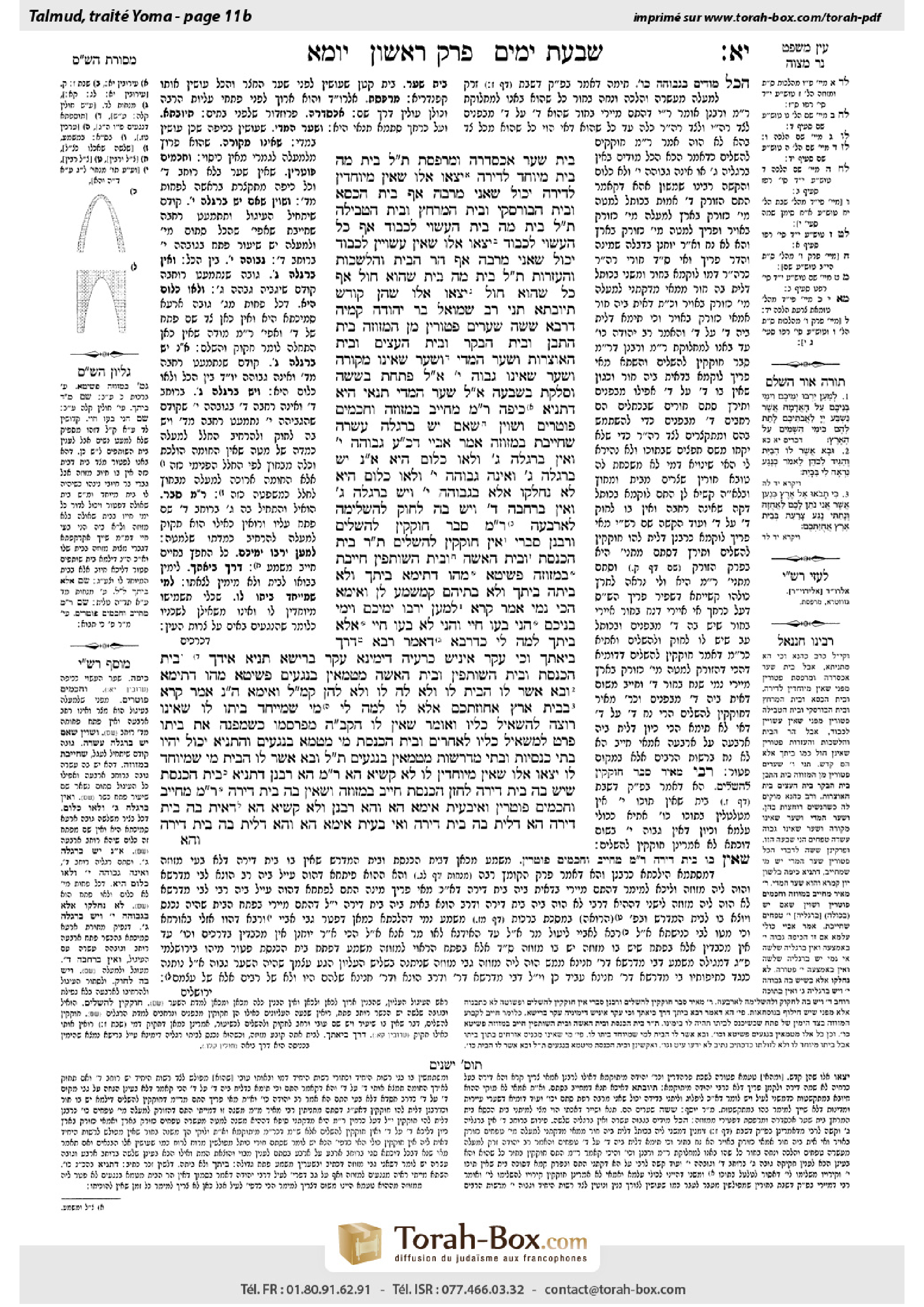
Yoma 11b: Talmud study for Daf Yomi
Daf Yomi is the daily study of one Talmud folio. Explore 37 tractates with scans, Hebrew text, Sefaria English and AI-generated French translations where annotated.
Passage selection and English or AI-generated French translation are available where the scan has annotations. Daf Study is independent of Torah-Box and Sefaria.
Browse Yoma · יומא · All tractatesYoma 11b text and translations
This page of Yoma includes the Aramaic text, an English translation and an AI-generated French translation, alongside the scan above.
יומא י״א ב · Aramaic and Hebrew text
בֵּית שַׁעַר, אַכְסַדְרָה וּמִרְפֶּסֶת — תַּלְמוּד לוֹמַר: ״בַּיִת״, מָה בַּיִת מְיוּחָד לְדִירָה, יָצְאוּ אֵלּוּ שֶׁאֵין מְיוּחָדִין לְדִירָה.
יָכוֹל שֶׁאֲנִי מְרַבֶּה אַף בֵּית הַכִּסֵּא וּבֵית הַבּוּרְסְקִי וּבֵית הַמֶּרְחָץ וּבֵית הַטְּבִילָה — תַּלְמוּד לוֹמַר: ״בַּיִת״, מָה בַּיִת הֶעָשׂוּי לְכָבוֹד — אַף כֹּל הֶעָשׂוּי לְכָבוֹד, יָצְאוּ אֵלּוּ שֶׁאֵין עֲשׂוּיִין לְכָבוֹד.
יָכוֹל שֶׁאֲנִי מְרַבֶּה אַף הַר הַבַּיִת וְהַלְּשָׁכוֹת וְהָעֲזָרוֹת — תַּלְמוּד לוֹמַר: ״בַּיִת״, מָה בַּיִת שֶׁהוּא חוֹל — אַף כֹּל שֶׁהוּא חוֹל, יָצְאוּ אֵלּוּ שֶׁהֵן קוֹדֶשׁ. תְּיוּבְתָּא.
תָּנֵי רַב שְׁמוּאֵל בַּר יְהוּדָה קַמֵּיהּ דְּרָבָא: שִׁשָּׁה שְׁעָרִים פְּטוּרִין מִן הַמְּזוּזָה: בֵּית הַתֶּבֶן, וּבֵית הַבָּקָר, וּבֵית הָעֵצִים, וּבֵית הָאוֹצָרוֹת, וְשַׁעַר הַמָּדִי, וְשַׁעַר שֶׁאֵינוֹ מְקוֹרֶה, וְשַׁעַר שֶׁאֵינוֹ גָּבוֹהַּ עֲשָׂרָה. אֲמַר לֵיהּ: פָּתְחַתְּ בְּשִׁשָּׁה, וְסָלְקַתְּ בְּשִׁבְעָה!
אֲמַר לֵיהּ: שַׁעַר הַמָּדִי תַּנָּאֵי הִיא. דְּתַנְיָא: כִּיפָּה, רַבִּי מֵאִיר מְחַיֵּיב בִּמְזוּזָה, וַחֲכָמִים פּוֹטְרִים. וְשָׁוִין שֶׁאִם יֵשׁ בְּרַגְלָהּ עֲשָׂרָה, שֶׁחַיֶּיבֶת בִּמְזוּזָה. אָמַר אַבָּיֵי: דְּכוּלֵּי עָלְמָא, גְּבוֹהָה עֲשָׂרָה וְאֵין בְּרַגְלָהּ שְׁלֹשָׁה — וְלָאו כְּלוּם הִיא. אִי נָמֵי, יֵשׁ בְּרַגְלָהּ שְׁלֹשָׁה וְאֵינָהּ גְּבוֹהָה עֲשָׂרָה — וְלָאו כְּלוּם הִיא.
לֹא נֶחְלְקוּ אֶלָּא בִּגְבוֹהָה עֲשָׂרָה וְיֵשׁ בְּרַגְלָהּ שְׁלֹשָׁה וְאֵין בְּרׇחְבָּהּ אַרְבָּעָה, וְיֵשׁ בָּהּ לָחוֹק לְהַשְׁלִימָהּ לְאַרְבָּעָה. רַבִּי מֵאִיר סָבַר: חוֹקְקִין לְהַשְׁלִים. וְרַבָּנַן סָבְרִי: אֵין חוֹקְקִין לְהַשְׁלִים.
תָּנוּ רַבָּנַן: בֵּית הַכְּנֶסֶת וּבֵית הָאִשָּׁה וּבֵית הַשּׁוּתָּפִין חַיֶּיבֶת בִּמְזוּזָה. פְּשִׁיטָא? מַהוּ דְּתֵימָא: ״בֵּיתֶךָ״ — וְלֹא בֵּיתָהּ, ״בֵּיתֶךָ״ — וְלֹא בָּתֵּיהֶם, קָמַשְׁמַע לַן.
וְאֵימָא הָכִי נָמֵי? אָמַר קְרָא: ״לְמַעַן יִרְבּוּ יְמֵיכֶם וִימֵי בְנֵיכֶם״, הָנֵי בָּעוּ חַיֵּי וְהָנֵי לָא בָּעוּ חַיֵּי?!
אֶלָּא, ״בֵּיתֶךָ״ לְמָה לִי? כִּדְרָבָא, דְּאָמַר רָבָא: דֶּרֶךְ בִּיאָתְךָ, וְכִי עָקַר אִינִישׁ — כַּרְעֵיהּ דְּיַמִּינָא עָקַר בְּרֵישָׁא.
תַּנְיָא אִידַּךְ: בֵּית הַכְּנֶסֶת וּבֵית הַשּׁוּתָּפִין וּבֵית הָאִשָּׁה מִטַּמְּאִין בִּנְגָעִים. פְּשִׁיטָא? מַהוּ דְּתֵימָא: ״וּבָא אֲשֶׁר לוֹ הַבַּיִת״, ״לוֹ״ — וְלֹא לָהּ, ״לוֹ״ — וְלֹא לָהֶן, קָא מַשְׁמַע לַן.
וְאֵימָא הָכִי נָמֵי! אָמַר קְרָא: ״בְּבֵית אֶרֶץ אֲחוּזַּתְכֶם״. אֶלָּא ״לוֹ״ לְמָה לִי? מִי שֶׁמְּיַיחֵד בֵּיתוֹ לוֹ, שֶׁאֵינוֹ רוֹצֶה לְהַשְׁאִיל כֵּלָיו וְאוֹמֵר שֶׁאֵין לוֹ, הַקָּדוֹשׁ בָּרוּךְ הוּא מְפַרְסְמוֹ כְּשֶׁמְּפַנֶּה אֶת בֵּיתוֹ. פְּרָט לְמַשְׁאִיל כֵּלָיו לַאֲחֵרִים.
וּבֵית הַכְּנֶסֶת מִי מִטַּמֵּא בִּנְגָעִים? וְהָתַנְיָא: יָכוֹל יִהְיוּ בָּתֵּי כְנֵסִיּוֹת וּבָתֵּי מִדְרָשׁוֹת מִטַּמְּאִין בִּנְגָעִים, תַּלְמוּד לוֹמַר: ״וּבָא אֲשֶׁר לוֹ הַבַּיִת״ — מִי שֶׁמְיוּחָד לוֹ, יָצְאוּ אֵלּוּ שֶׁאֵין מְיוּחָדִין לוֹ!
לָא קַשְׁיָא: הָא — רַבִּי מֵאִיר, הָא — רַבָּנַן. דְּתַנְיָא: בֵּית הַכְּנֶסֶת שֶׁיֵּשׁ בָּהּ בֵּית דִּירָה לְחַזַּן הַכְּנֶסֶת — חַיָּיב בִּמְזוּזָה, וְשֶׁאֵין בָּהּ בֵּית דִּירָה — רַבִּי מֵאִיר מְחַיֵּיב, וַחֲכָמִים פּוֹטְרִין.
וְאִיבָּעֵית אֵימָא: הָא וְהָא רַבָּנַן, וְלָא קַשְׁיָא: הָא — דְּאִית בַּהּ בֵּית דִּירָה, הָא — דְּלֵית בַּהּ בֵּית דִּירָה.
וְאִי בָּעֵית אֵימָא: הָא וְהָא דְּלֵית בָּהּ בֵּית דִּירָה,
Yoma 11b · English translation
a gatehouse, used to guard the entrance to a courtyard, a portico [akhsadra], an open porch, and a balcony serving as a corridor to several residences. Therefore, the verse states: House; just as a house is a place that is designated for residence and is obligated in the mitzva of mezuza, so too all similar structures are obligated. This is to the exclusion of those structures that are not designated for residence but for other purposes, which are exempt from the mitzva of mezuza.
I might have thought that I include in the obligation of mezuza even a bathroom, and a tannery, and a bathhouse, and a ritual bath for immersion. Therefore, the verse states: House; just as a house is a place that is designed to honor people who enter it, so too, all places that are designed to honor those who enter are obligated in the mitzva of mezuza, excluding those structures that are not designed to honor.
I might have thought that I include in the obligation of mezuza even the Temple Mount and its chambers and courtyards. Therefore, the verse states: House; just as a house is a place that is non-sacred, so too any place that is non-sacred is obligated in the mitzva of mezuza, excluding those places that are sacred. For the purposes of this discussion, the baraita teaches that there are Sages who hold that barns and storehouses whose use is standard require a mezuza, contrary to the opinion of Rav Yehuda that everyone agrees that these structures are exempt. Consequently, the baraita is a conclusive refutation of his opinion and support for the contention of Rav Kahana that this matter is the subject of a tannaitic debate.
§ Rav Shmuel bar Yehuda taught a baraita before Rava: Six gates are exempt from the mitzva of mezuza: The gate of a storehouse for hay, and of a cattle barn, and a woodshed, and a storehouse, and a Median gate, which is a dome, lacking two doorposts and a lintel, and an unroofed gate, and a gate that is not ten handbreadths high. Rava said to him: You began your statement with six gates that do not require a mezuza, and you concluded with seven.
Rava said to him: The obligation to affix a mezuza to a Median gate is subject to a dispute between tanna’im, as it was taught in a baraita: With regard to the gateway of a dome, i.e., an arched gateway, Rabbi Meir obligates it in the mitzva of mezuza, and the Rabbis exempt it. And they agree that if, at the foot of the entrance, there are doorposts ten handbreadths high before the arch of the dome begins narrowing the width of the entrance, it is obligated in the mitzva of mezuza since the sides form a usual doorway. Abaye said: However, everyone agrees that if the entire opening is only ten handbreadths high and at the foot of its entrance there are doorposts not even three handbreadths high, it is nothing. It is not considered an entrance and is exempt from the mitzva of mezuza. Alternatively, if at the foot of its entrance there are doorposts three handbreadths high, but the entrance is not ten handbreadths high, it is nothing, as it is not considered a viable entrance.
They disagree only with regard to a case where the entrance is ten handbreadths high, and at the foot of the entrance there are doorposts three handbreadths high, but at no point is the width of the opening four handbreadths. However, the space in the dome alongside the entrance is wide enough to theoretically carve out space to complete a width of four handbreadths. Rabbi Meir holds that in all cases where a certain minimum area is required for a specific halakha to take effect and the existing area is smaller, if circumstances would theoretically allow one to carve out and create an area of the requisite size, its legal status is as if one carves out the space to complete it. Therefore, the opening is considered wide enough to require a mezuza. And the Rabbis hold: One does not carve out the space to complete it. Since the width of the opening is not actually four handbreadths, it is exempt from the mitzva of mezuza.
§ The Sages taught in a baraita: A synagogue, a woman’s house, and a house jointly owned by partners are all obligated in the mitzva of mezuza. The Gemara asks: That is obvious; why would these structures be exempt? Lest you say that it is written: “Your house,” in the masculine, and not her house; “Your house,” in the singular, and not their house, excluding a jointly owned house. Therefore, the baraita teaches us that those houses are obligated in the mitzva of mezuza like all others.
And say it is indeed so that a woman’s house and a jointly owned house are exempt. The Gemara rejects this possibility: Immediately following the mitzva of mezuza is the reward for its fulfillment, as the verse states: “So that your days be numerous, as well as the days of your sons” (Deuteronomy 11:21). If these structures were exempt from the mitzva, the question would arise: Do these men and individuals require long life, and these, meaning women and partners, do not require long life? The mitzva of mezuza clearly applies to all of them.
The Gemara then asks: Rather, why do I need the emphasis of the verse: Your house, if every house is obligated in the mitzva of mezuza? The Gemara answers: This could be understood in accordance with the opinion of Rava, as Rava said: Your house is interpreted to mean that the mezuza is placed in the way that you enter the house. And when a person lifts his foot to begin walking, he lifts his right foot first. Therefore, the mezuza is affixed on the right side of the doorway.
§ Apropos the baraita just cited, the Gemara cites a related baraita that addresses a different topic. It was taught in another baraita: A synagogue, a house jointly owned by partners, and a woman’s house become impure with the impurity of leprosy of the house, like all other houses. The Gemara asks: That is obvious; why wouldn’t they become impure? The Gemara explains: Lest you say that it is written with regard to leprosy: “And the one whom the house is his will come” (Leviticus 14:35), which could be interpreted: His and not hers; his and not theirs, to the exclusion of a house owned by a woman or by partners. Therefore, it teaches us that these houses are also included in this halakha.
And say it is indeed so that a woman’s house and a jointly owned house are excluded from the impurity of leprosy. The Gemara responds that the verse states: “In a house of the land of your possession” (Leviticus 14:34). The word your is written in the plural form to teach that all houses in Eretz Yisrael are subject to this impurity. The Gemara asks: Rather, why do I need the emphasis of the term: His, if every house is subject to the impurity of leprosy? The Gemara answers that the term does not teach a halakha but reveals why a house might be afflicted with leprosy. The house belonging to one who dedicates his house to himself alone, who refuses to lend his vessels to others and says that he does not have them, will be punished. The Holy One, Blessed be He, publicizes his possessions for all to see when he is forced to empty them from his house due to leprosy. This excludes one who lends his vessels to others; his house is not afflicted with leprosy.
The Gemara raises another question: And with regard to a synagogue, does it become impure with the impurity of leprosy? But wasn’t it taught in a baraita: One might have thought that synagogues and study halls become impure with the impurity of leprosy. Therefore, the verse states: And the one whom the house is his will come; this is referring to a house that is designated for him, excluding those houses that are not designated for him but are public property.
The Gemara responds: This is not difficult, as it is the subject of a tannaitic dispute. This baraita, which states that a synagogue can become impure with the impurity of leprosy, is in accordance with the opinion of Rabbi Meir; that baraita, which states that a synagogue cannot become impure with the impurity of leprosy, is in accordance with the opinion of the Rabbis, as it was taught in a baraita: A synagogue in which there is a residence for the synagogue attendant is obligated in the mitzva of mezuza, as it is a dwelling. With regard to a synagogue in which there is no residence, Rabbi Meir obligates it in the mitzva of mezuza, and the Rabbis exempt it. Rabbi Meir deems a synagogue like a residence with regard to both a mezuza and its susceptibility to leprosy.
And if you wish, say instead a different resolution to the contradiction between the baraitot with regard to the synagogue. Both this baraita and that baraita are in accordance with the opinion of the Rabbis, and it is not difficult. This baraita, which states that it can become impure, is referring to a synagogue in which there is a place of residence; that baraita, which states that it cannot become impure, is referring to a synagogue in which there is not a place of residence.
And if you wish, say instead yet a different resolution to the contradiction between the baraitot: Both this baraita and that baraita are referring to synagogues in which there is not a place of residence,
Yoma 11b · Traduction française (IA)
un poste de garde, destiné à surveiller l’entrée d’une cour, un portique [akhsadra], un porche ouvert et un balcon servant de couloir à plusieurs logements. C’est pourquoi le verset dit : « Maison » ; de même qu’une maison est un lieu destiné à l’habitation et soumis à la mitsva de la mezouza, de même toutes les constructions semblables y sont soumises. Cela exclut les constructions qui ne sont pas destinées à l’habitation, mais à d’autres usages, et qui sont exemptées de la mitsva de la mezouza.
J’aurais pu penser que l’obligation de mezouza s’applique également à des toilettes, à une tannerie, à un bain public et à un mikvé. Le verset dit donc : « Maison » ; de même qu’une maison est un lieu destiné à honorer ceux qui y entrent, de même tous les lieux destinés à honorer ceux qui y entrent sont soumis à la mitsva de la mezouza, à l’exclusion des constructions qui ne sont pas destinées à honorer ceux qui y entrent.
J’aurais pu penser que l’obligation de mezouza s’applique également au mont du Temple, à ses chambres et à ses cours. Le verset dit donc : « Maison » ; de même qu’une maison est un lieu profane, de même tout lieu profane est soumis à la mitsva de la mezouza, à l’exclusion des lieux saints. Pour les besoins de cette discussion, la baraïta enseigne que, selon certains Sages, les granges et les entrepôts dont l’usage est courant doivent avoir une mezouza, contrairement à l’opinion de Rav Yehouda, selon laquelle tous reconnaissent que ces constructions en sont exemptées. Par conséquent, la baraïta réfute définitivement son opinion et étaye l’affirmation de Rav Kahana selon laquelle cette question fait l’objet d’un débat entre tannaim.
§ Rav Shmuel bar Yehouda enseigna une baraïta devant Rava : six portes sont exemptées de la mitsva de mezouza : la porte d’un entrepôt à foin, celle d’une étable, celle d’un abri à bois, celle d’un entrepôt, celle d’une porte médique, c’est-à-dire une coupole dépourvue de deux montants et d’un linteau, celle d’une porte sans toit et celle d’une porte qui ne mesure pas dix palmes de haut. Rava lui dit : Tu as commencé par dire que six portes ne requièrent pas de mezouza, et tu as terminé en en énumérant sept.
Rava lui dit : L’obligation de fixer une mezouza à une porte médique fait l’objet d’un débat entre tannaim, comme on l’a enseigné dans une baraïta : au sujet de l’entrée d’une coupole, c’est-à-dire d’une entrée voûtée, Rabbi Meïr la soumet à la mitsva de mezouza, tandis que les Sages l’en exemptent. Ils conviennent que si, au bas de l’entrée, les montants mesurent dix palmes de haut avant que la voûte ne commence à rétrécir le passage, l’entrée est soumise à la mitsva de mezouza, puisque les côtés forment une porte ordinaire. Abayé dit : Toutefois, tous conviennent que si l’ouverture entière ne mesure que dix palmes de haut et que, au bas de l’entrée, les montants ne mesurent même pas trois palmes, cela ne compte pas. Elle n’est pas considérée comme une entrée et est exemptée de la mitsva de mezouza. De même, si les montants mesurent trois palmes de haut au bas de l’entrée, mais que l’entrée ne mesure pas dix palmes de haut, cela ne compte pas non plus, car elle n’est pas considérée comme une entrée valable.
Le désaccord ne porte que sur le cas où l’entrée mesure dix palmes de haut et où, à son bas, les montants mesurent trois palmes, mais où l’ouverture ne mesure jamais quatre palmes de large. Toutefois, l’espace de la voûte, à côté de l’entrée, est assez large pour qu’on puisse théoriquement y tailler une ouverture afin d’atteindre quatre palmes de largeur. Rabbi Meïr estime que, chaque fois qu’une halakha exige une superficie minimale et que la superficie existante est inférieure à celle-ci, si les circonstances permettraient théoriquement de tailler et de créer une superficie de la taille requise, on considère juridiquement qu’on taille l’espace nécessaire pour la compléter. L’ouverture est donc considérée comme suffisamment large pour requérir une mezouza. Les Sages, eux, estiment qu’on ne taille pas l’espace nécessaire pour la compléter. Puisque l’ouverture ne mesure pas effectivement quatre palmes de large, elle est exemptée de la mitsva de mezouza.
§ Les Sages ont enseigné dans une baraïta : une synagogue, la maison d’une femme et une maison appartenant conjointement à plusieurs associés sont toutes soumises à la mitsva de mezouza. La Guemara demande : Cela va de soi ; pourquoi ces constructions en seraient-elles exemptées ? On aurait pu dire qu’il est écrit : « Ta maison », au masculin, et non sa maison à elle ; « Ta maison », au singulier, et non leur maison, ce qui exclurait une maison appartenant conjointement à plusieurs personnes. La baraïta nous enseigne donc que ces maisons sont soumises à la mitsva de mezouza comme toutes les autres.
Et disons qu’il en est effectivement ainsi : la maison d’une femme et une maison appartenant conjointement à plusieurs personnes sont exemptées. La Guemara rejette cette possibilité : immédiatement après la mitsva de mezouza est mentionnée la récompense de son accomplissement, comme il est écrit : « afin que vos jours et les jours de vos fils se multiplient » (Deutéronome 11:21). Si ces constructions étaient exemptées de la mitsva, on pourrait demander : Ces hommes et ces individus ont-ils besoin de vivre longtemps, tandis que ceux-ci — les femmes et les associés — n’en ont pas besoin ? Il est clair que la mitsva de mezouza s’applique à tous.
La Guemara demande alors : Dès lors, pourquoi le verset insiste-t-il en disant « ta maison », si toutes les maisons sont soumises à la mitsva de mezouza ? La Guemara répond que cela peut s’interpréter conformément à l’opinion de Rava, car Rava a dit : « Ta maison » signifie que la mezouza est placée du côté par lequel tu entres dans la maison. Or, lorsqu’une personne lève le pied pour commencer à marcher, elle lève d’abord le pied droit. La mezouza est donc fixée du côté droit de l’embrasure.
§ À propos de la baraïta qui vient d’être citée, la Guemara rapporte une baraïta connexe portant sur un autre sujet. On a enseigné dans une autre baraïta : une synagogue, une maison appartenant conjointement à plusieurs associés et la maison d’une femme sont toutes susceptibles d’être frappées par l’impureté de la lèpre des maisons, comme toutes les autres maisons. La Guemara demande : Cela va de soi ; pourquoi ne seraient-elles pas susceptibles d’être frappées par cette impureté ? La Guemara explique : On aurait pu dire qu’au sujet de la lèpre il est écrit : « Celui à qui appartient la maison viendra » (Lévitique 14:35), ce qui pourrait s’interpréter ainsi : la sienne, et non la sienne à elle ; la sienne, et non la leur, excluant ainsi une maison appartenant à une femme ou à des associés. La baraïta nous enseigne donc que ces maisons sont également incluses dans cette halakha.
Et disons qu’il en est effectivement ainsi : la maison d’une femme et une maison appartenant conjointement à plusieurs personnes sont exclues de l’impureté de la lèpre. La Guemara répond que le verset dit : « Dans une maison du pays de votre possession » (Lévitique 14:34). Le mot « votre » est au pluriel, pour enseigner que toutes les maisons d’Eretz Israël sont soumises à cette impureté. La Guemara demande : Dès lors, pourquoi le verset insiste-t-il sur les mots « à qui appartient la maison », si toutes les maisons sont soumises à l’impureté de la lèpre ? La Guemara répond que ces termes n’enseignent pas une halakha, mais révèlent pourquoi une maison peut être frappée par la lèpre. Celui qui se réserve sa maison à lui seul, refuse de prêter ses ustensiles aux autres et prétend ne pas les posséder verra sa maison frappée. Le Saint, béni soit-Il, rend ses biens publics aux yeux de tous lorsqu’il est contraint de les sortir de sa maison à cause de la lèpre. Cela exclut celui qui prête ses ustensiles aux autres : sa maison n’est pas frappée par la lèpre.
La Guemara soulève une autre question : une synagogue est-elle susceptible d’être frappée par l’impureté de la lèpre ? Pourtant, n’a-t-on pas enseigné dans une baraïta : J’aurais pu penser que les synagogues et les maisons d’étude sont susceptibles d’être frappées par l’impureté de la lèpre. Le verset dit donc : « Celui à qui appartient la maison viendra » ; cela désigne une maison qui lui est réservée, à l’exclusion des maisons qui ne lui sont pas réservées, mais sont la propriété du public.
La Guemara répond : Il n’y a pas de difficulté, car cette question fait l’objet d’un débat entre tannaim. La baraïta qui affirme qu’une synagogue peut être frappée par l’impureté de la lèpre est conforme à l’opinion de Rabbi Meïr ; l’autre baraïta, qui affirme qu’une synagogue ne peut pas être frappée par l’impureté de la lèpre, est conforme à l’opinion des Sages, comme on l’a enseigné dans une baraïta : une synagogue où se trouve un logement pour le bedeau est soumise à la mitsva de mezouza, car elle sert d’habitation. Au sujet d’une synagogue où il n’y a pas de logement, Rabbi Meïr la soumet à la mitsva de mezouza, tandis que les Sages l’en exemptent. Rabbi Meïr considère une synagogue comme un lieu d’habitation, tant pour la mezouza que pour sa susceptibilité à être frappée par la lèpre.
Et si tu le souhaites, propose plutôt une autre résolution à la contradiction entre les baraïtot au sujet de la synagogue. Cette baraïta et l’autre sont toutes deux conformes à l’opinion des Sages, et il n’y a pas de difficulté. La baraïta qui affirme que la synagogue peut être frappée par la lèpre parle d’une synagogue où se trouve un logement ; l’autre baraïta, qui affirme qu’elle ne peut pas être frappée par la lèpre, parle d’une synagogue où il n’y a pas de logement.
Et si tu le souhaites, propose encore une autre résolution à la contradiction entre les baraïtot : cette baraïta et l’autre parlent toutes deux de synagogues où il n’y a pas de logement,
Traduction française générée par IA à partir de l’édition anglaise de Sefaria. Vérifie toujours un passage avec le texte source.
Text from Sefaria: William Davidson Edition - Vocalized Aramaic (CC BY NC); William Davidson Edition - English (CC BY NC).