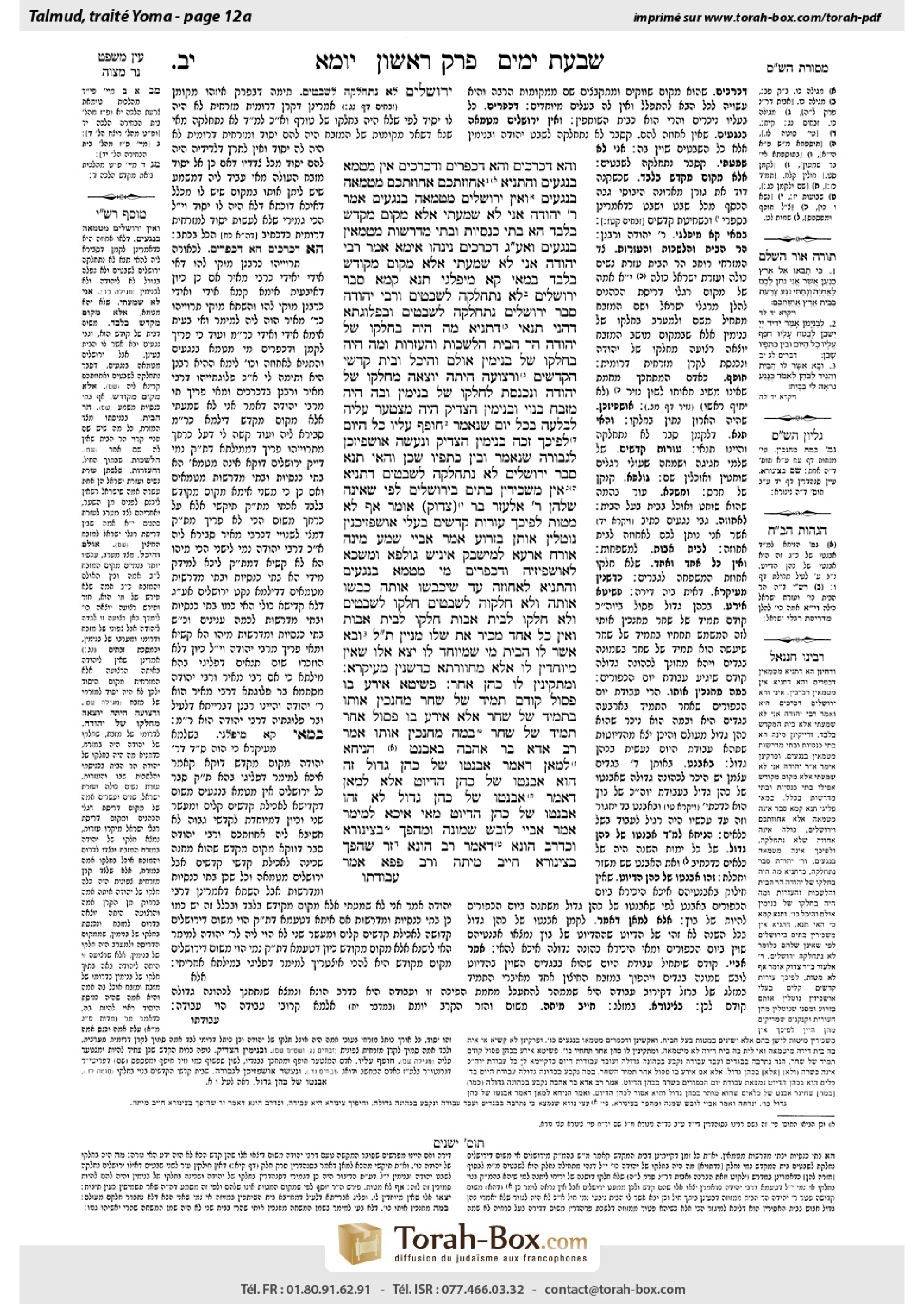
Yoma 12a: Talmud study for Daf Yomi
Daf Yomi is the daily study of one Talmud folio. Explore 37 tractates with scans, Hebrew text, Sefaria English and AI-generated French translations where annotated.
Passage selection and English or AI-generated French translation are available where the scan has annotations. Daf Study is independent of Torah-Box and Sefaria.
Browse Yoma · יומא · All tractatesYoma 12a text and translations
This page of Yoma includes the Aramaic text, an English translation and an AI-generated French translation, alongside the scan above.
יומא י״ב א · Aramaic and Hebrew text
וְהָא — דִּכְרַכִּים, וְהָא — דִּכְפָרִים.
וְדִכְרַכִּים אֵין מִטַּמֵּא בִּנְגָעִים? וְהָתַנְיָא: ״אֲחוּזַּתְכֶם״, אֲחוּזַּתְכֶם מִטַּמְּאָה בִּנְגָעִים, וְאֵין יְרוּשָׁלָיִם מִטַּמְּאָה בִּנְגָעִים. אָמַר רַבִּי יְהוּדָה: אֲנִי לֹא שָׁמַעְתִּי אֶלָּא מְקוֹם מִקְדָּשׁ בִּלְבַד. הָא בָּתֵּי כְנֵסִיּוֹת וּבָתֵּי מִדְרָשׁוֹת מִטַּמְּאִין בִּנְגָעִים, וְאַף עַל גַּב דִּכְרָכִים נִינְהוּ! אֵימָא: אָמַר רַבִּי יְהוּדָה: אֲנִי לֹא שָׁמַעְתִּי אֶלָּא מְקוֹם מְקוּדָּשׁ בִּלְבַד.
בְּמַאי קָא מִיפַּלְגִי? תַּנָּא קַמָּא סָבַר יְרוּשָׁלַיִם לֹא נִתְחַלְּקָה לִשְׁבָטִים, וְרַבִּי יְהוּדָה סָבַר יְרוּשָׁלַיִם נִתְחַלְּקָה לִשְׁבָטִים.
וּבִפְלוּגְתָּא דְּהָנֵי תַּנָּאֵי. דְּתַנְיָא: מֶה הָיָה בְּחֶלְקוֹ שֶׁל יְהוּדָה — הַר הַבַּיִת, הַלְּשָׁכוֹת וְהָעֲזָרוֹת. וּמֶה הָיָה בְּחֶלְקוֹ שֶׁל בִּנְיָמִין — אוּלָם וְהֵיכָל וּבֵית קׇדְשֵׁי הַקֳּדָשִׁים, וּרְצוּעָה הָיְתָה יוֹצְאָה מֵחֶלְקוֹ שֶׁל יְהוּדָה וְנִכְנֶסֶת לְחֶלְקוֹ שֶׁל בִּנְיָמִין, וּבָהּ הָיָה מִזְבֵּחַ בָּנוּי, וּבִנְיָמִין הַצַּדִּיק הָיָה מִצְטַעֵר עָלֶיהָ לְבׇלְעָהּ בְּכׇל יוֹם,
שֶׁנֶּאֱמַר: ״חוֹפֵף עָלָיו כׇּל הַיּוֹם״. לְפִיכָךְ זָכָה בִּנְיָמִין הַצַּדִּיק וְנַעֲשָׂה אוּשְׁפִּיזְכָן לִגְבוּרָה, שֶׁנֶּאֱמַר: ״וּבֵין כְּתֵפָיו שָׁכֵן״.
וְהַאי תַּנָּא סָבַר יְרוּשָׁלַיִם לֹא נִתְחַלְּקָה לִשְׁבָטִים, דְּתַנְיָא: אֵין מַשְׂכִּירִין בָּתִּים בִּירוּשָׁלַיִם לְפִי שֶׁאֵינָהּ שֶׁלָּהֶן. רַבִּי אֶלְעָזָר בַּר (צָדוֹק) אוֹמֵר: אַף לֹא מִטּוֹת. לְפִיכָךְ, עוֹרוֹת קָדָשִׁים — בַּעֲלֵי אוּשְׁפִּיזְכָנִין נוֹטְלִין אוֹתָן בִּזְרוֹעַ. אָמַר אַבָּיֵי: שְׁמַע מִינַּהּ, אוֹרַח אַרְעָא לְמִישְׁבַּק אִינִישׁ גּוּלְפָּא וּמַשְׁכָּא לְאוּשְׁפִּיזֵיהּ.
וְדִכְפָרִים מִי מִטַּמֵּא בִּנְגָעִים? וְהָתַנְיָא: ״לַאֲחוּזָּה״, עַד שֶׁיִּכְבְּשׁוּ אוֹתָהּ. כָּבְשׁוּ אוֹתָהּ וְלֹא חִלְּקוּהָ לִשְׁבָטִים, חִלְּקוּ לִשְׁבָטִים וְלֹא חִלְּקוּ לְבֵית אָבוֹת, חִלְּקוּ לְבֵית אָבוֹת וְאֵין כׇּל אֶחָד מַכִּיר אֶת שֶׁלּוֹ, מִנַּיִין?
תַּלְמוּד לוֹמַר: ״וּבָא אֲשֶׁר לוֹ הַבַּיִת״, מִי שֶׁמְיוּחָד לוֹ, יָצָא אֵלּוּ שֶׁאֵין מְיוּחָדִין לוֹ. אֶלָּא מְחַוַּורְתָּא כִּדְשַׁנִּין מֵעִיקָּרָא.
וּמַתְקִינִין לוֹ כֹּהֵן אַחֵר. פְּשִׁיטָא אֵירַע בּוֹ פְּסוּל קוֹדֶם תָּמִיד שֶׁל שַׁחַר — מְחַנְּכִין אוֹתוֹ בְּתָמִיד שֶׁל שַׁחַר. אֶלָּא אֵירַע בּוֹ פְּסוּל אַחַר תָּמִיד שֶׁל שַׁחַר, בַּמֶּה מְחַנְּכִין אוֹתוֹ?
אָמַר רַב אַדָּא בַּר אַהֲבָה: בְּאַבְנֵט. הָנִיחָא לְמַאן דְּאָמַר אַבְנֵטוֹ שֶׁל כֹּהֵן גָּדוֹל, זֶה הוּא אַבְנֵטוֹ שֶׁל כֹּהֵן הֶדְיוֹט. אֶלָּא לְמַאן דְּאָמַר אַבְנֵטוֹ שֶׁל כֹּהֵן גָּדוֹל לֹא זֶהוּ אַבְנֵטוֹ שֶׁל כֹּהֵן הֶדְיוֹט, מַאי אִיכָּא לְמֵימַר?
אָמַר אַבָּיֵי: לוֹבֵשׁ שְׁמוֹנָה, וּמְהַפֵּךְ בְּצִינּוֹרָא, וְכִדְרַב הוּנָא. דְּאָמַר רַב הוּנָא: זָר שֶׁהִפֵּךְ בְּצִינּוֹרָא — חַיָּיב מִיתָה. וְרַב פָּפָּא אָמַר:
Yoma 12a · English translation
and this baraita, which states that a synagogue does not become impure, is referring to synagogues in large cities. Since those synagogues attract people from different places, the building is not the property of the local residents but that of the public. And that baraita, which states that a synagogue becomes impure, is referring to synagogues in villages, which belong solely to the residents of the village, and its status is like that of a house owned by partners.
The Gemara asks: And do the synagogues in large cities not become ritually impure with the impurity of leprosy? Wasn’t it taught in a baraita that it is written: “In a house of the land of your possession” (Leviticus 14:34); the land of your possession becomes ritually impure with the impurity of leprosy, and the city of Jerusalem does not become ritually impure with the impurity of leprosy, since it belongs to all the Jewish people rather than to a specific tribe? Rabbi Yehuda said: I heard that it is only the site of the Temple [mikdash] alone that does not become ritually impure with the impurity of leprosy. It can be inferred that in the opinion of Rabbi Yehuda, even synagogues and study halls in Jerusalem become ritually impure with the impurity of leprosy, and that is the case even though they are synagogues in large cities. The Gemara rejects this; rather, one must emend the baraita and say that Rabbi Yehuda said: I heard that it is only a sacred [mekudash] site alone. That definition includes synagogues and study halls.
§ The Gemara explains the dispute in the baraita that was cited: With regard to what principle do Rabbi Yehuda and the Rabbis disagree? The first tanna holds: Jerusalem was not divided among the tribes but belonged to all of the Jewish people, and as such it does not become ritually impure with the impurity of leprosy. Rabbi Yehuda holds: Jerusalem was divided between the tribes of Judah and Benjamin. Therefore, the same halakhot of impurity apply there as apply in all other cities in Eretz Yisrael.
The Gemara states: And that dispute corresponds to the dispute between these tanna’im, as it was taught in a baraita: What part of the Temple was located in the portion of the tribe of Judah? It was the part including the entire Temple Mount, excluding those areas in the portion of Benjamin, the chambers, and the courtyards. And what part of the Temple was in the portion of the tribe of Benjamin? It was the part including the Entrance Hall of the Sanctuary, and the Sanctuary, and the Holy of Holies. And a strip of land emerges from the portion of Judah and enters the portion of Benjamin on which the altar is built. And Benjamin the righteous would suffer longing to engulf it every day. The tribe of Benjamin was disappointed that the strip belonging to the tribe of Judah intersected its tribal land and wanted Judah to transfer ownership so that the land with the altar would belong to Benjamin.
An allusion to this is that which is stated in Moses’ blessing to Benjamin: “Ever does he protect him and he rests between his shoulders” (Deuteronomy 33:12), like one who is unable to abide something stuck between his shoulders and constantly rubs it to remove it. Therefore, Benjamin the righteous was privileged to serve as host [ushpizekhan] to the Almighty, as it is stated: “And he rests between his shoulders,” alluding to the fact that the Holy of Holies was located in the territory of Benjamin. According to this baraita, Jerusalem was divided among the tribes.
And this tanna holds: Jerusalem was not divided among the tribes at all, as it was taught in a baraita: Homeowners did not let their houses in Jerusalem because the houses were not actually theirs. Residents of Jerusalem did not own their residences, as the city belonged to the entire Jewish people. Rabbi Elazar bar Tzadok says: Even beds were not rented. Therefore, with regard to hides of consecrated animals of the Festival peace-offerings, which the pilgrims to Jerusalem would give as gifts to their hosts, the hosts were not really entitled to them. This is why the hosts would take them by force. Abaye said: Learn from it that it is customary for a guest to leave his empty wine jug and hides from sacrificial animals and give them to his host.
After discussing the status of Jerusalem, the Gemara addresses the matter of synagogues in villages. The Gemara asks: And do the synagogues in villages become impure with the impurity of leprosy? Wasn’t it taught in a baraita as follows? It is written: “When you enter the land of Canaan that I give you for a possession, and I put the plague of leprosy in a house of the land of your possession” (Leviticus 14:34). The term: “For a possession,” means until you conquer it and it becomes entirely yours. However, in a case where they conquered it but did not divide it among the tribes, or where they divided it among the tribes but did not distribute it to the patrilineal families; or where they distributed it to the patrilineal families, but every one of them does not recognize his individual portion, from where is it derived that it does not become impure?
The verse states: “And the one whom the house is his will come” (Leviticus 14:35); one whom the house is designated for him and who is certain of his ownership, excluding those houses which are not designated for him. Apparently, the legal status of synagogues in villages is that of communal property, as the portion of each individual is not clearly identifiable, and therefore they cannot become impure. Rather, there is no distinction in this regard between synagogues in large cities and those in villages. And with regard to the original question, it is clear as we responded initially with alternative resolutions to the contradiction between the baraitot.
§ It was taught in the mishna: And they would designate another priest in the High Priest’s stead, lest a disqualification due to impurity prevent his entering the Temple on Yom Kippur. The Gemara asks: It is obvious that if disqualification befell the incumbent High Priest prior to the sacrifice of the daily morning offering on Yom Kippur, that one initiates the replacement by dressing him in the eight garments of the High Priest with the daily morning offering, which renders him acting High Priest. However, if disqualification befell the incumbent High Priest after the daily morning offering, how does one initiate the replacement? After the daily morning offering, the High Priest begins the Yom Kippur service clothed in the four linen garments unique to the day, which are the same as the tunic, trousers, turban, and belt of the common priest. How is it evident that he is the acting High Priest?
Rav Adda bar Ahava said: It is evident by means of his belt. The belt worn by the High Priest on Yom Kippur was made of linen, unlike that of the common priest, which was a mixture of the diverse kinds of linen and wool. The Gemara asks: This works out well according to the one who said: Throughout the rest of the year, the belt of the High Priest, which the Torah clearly states is made of a mixture of diverse kinds, is identical to the belt of the common priest, whereas on Yom Kippur, the belt is made of linen. When the replacement priest dons the linen belt he is initiated as the acting High Priest. However, according to the one who said: The belt of the High Priest is not identical to the belt of the common priest, what can be said? According to this approach, throughout the year the High Priest wears a belt of blue and purple wool and linen, while the belts of common priests are made of white linen like the rest of their clothes. Therefore, on Yom Kippur, when the High Priest dons a belt of white linen, his belt is identical to that of a common priest. If so, what initiates the replacement as acting High Priest?
Abaye said: Before the replacement begins serving on Yom Kippur with the four linen garments, he is initiated and promoted to the High Priesthood by donning the eight garments of the High Priest and turning over one of the limbs on the altar with a fork, thereby accelerating the burning of the daily morning offering. By performing part of the service while wearing the garments of the High Priest, he is initiated as acting High Priest. And this is in accordance with the opinion of Rav Huna, as Rav Huna said: A non-priest who turns over part of the offering on the altar with a fork is liable to receive the death penalty because he engaged in Temple service restricted to priests. And Rav Pappa said:
Yoma 12a · Traduction française (IA)
Et cette baraïta, qui enseigne qu’une synagogue ne devient pas impure, parle des synagogues des grandes villes. Comme elles attirent des gens venus de différents endroits, ces synagogues n’appartiennent pas aux habitants locaux, mais au public. L’autre baraïta, qui enseigne qu’une synagogue devient impure, parle des synagogues des villages, qui appartiennent exclusivement aux habitants du village et ont le statut d’une maison appartenant à des associés.
La Guemara demande : Les synagogues des grandes villes ne deviennent-elles donc pas impures par l’impureté de la lèpre ? N’a-t-il pas été enseigné dans une baraïta : « Dans une maison du pays que vous possédez » (Lévitique 14, 34) ? Le pays que vous possédez devient impur par l’impureté de la lèpre, tandis que la ville de Jérusalem ne devient pas impure par l’impureté de la lèpre, puisqu’elle appartient à tout le peuple juif et non à une tribu particulière. Rabbi Yehouda a dit : « J’ai entendu que seul le site du Temple [mikdash] ne devient pas impur par l’impureté de la lèpre. » On peut en déduire que, selon Rabbi Yehouda, même les synagogues et les maisons d’étude de Jérusalem deviennent impures par l’impureté de la lèpre, bien qu’il s’agisse de synagogues de grandes villes. La Guemara rejette cette interprétation : il faut plutôt corriger la baraïta et dire que Rabbi Yehouda a dit : « J’ai entendu que seul un site sacré [mekudash] ne devient pas impur. » Cette définition inclut les synagogues et les maisons d’étude.
§ La Guemara explique le différend dans la baraïta citée : sur quel principe Rabbi Yehouda et les Sages sont-ils en désaccord ? Le premier tanna considère que Jérusalem n’a pas été répartie entre les tribus, mais qu’elle appartenait à tout le peuple juif ; par conséquent, elle ne devient pas impure par l’impureté de la lèpre. Rabbi Yehouda considère que Jérusalem a été répartie entre les tribus de Juda et de Benjamin. Les mêmes halakhot d’impureté s’y appliquent donc que dans toutes les autres villes d’Eretz Israël.
La Guemara affirme : ce différend correspond à celui entre ces tannaïm, comme il a été enseigné dans une baraïta : quelle partie du Temple se trouvait sur le territoire de la tribu de Juda ? La partie comprenant tout le mont du Temple, à l’exception des zones situées sur le territoire de Benjamin, ainsi que les chambres et les cours. Et quelle partie du Temple se trouvait sur le territoire de la tribu de Benjamin ? La partie comprenant le vestibule du Sanctuaire, le Sanctuaire et le Saint des Saints. Une bande de terre part du territoire de Juda et pénètre dans celui de Benjamin ; c’est là que l’autel est construit. Et Benjamin le Juste souffrait chaque jour du désir de l’englober. La tribu de Benjamin était contrariée que la bande appartenant à la tribu de Juda coupe son territoire et souhaitait que Juda lui en cède la propriété, afin que la terre où se trouvait l’autel appartienne à Benjamin.
Cela est suggéré par ce qui est dit dans la bénédiction que Moïse adresse à Benjamin : « Il le protège toujours, et il repose entre ses épaules » (Deutéronome 33, 12), comme quelqu’un qui ne peut supporter quelque chose de coincé entre ses épaules et qui le frotte sans cesse pour l’en retirer. C’est pourquoi Benjamin le Juste eut le mérite d’être l’hôte [ushpizekhan] du Tout-Puissant, comme il est dit : « et il repose entre ses épaules », ce qui fait allusion au fait que le Saint des Saints se trouvait sur le territoire de Benjamin. Selon cette baraïta, Jérusalem a été répartie entre les tribus.
Et ce tanna considère que Jérusalem n’a pas du tout été répartie entre les tribus, comme il a été enseigné dans une baraïta : les propriétaires ne louaient pas leurs maisons à Jérusalem, car celles-ci ne leur appartenaient pas réellement. Les habitants de Jérusalem n’étaient pas propriétaires de leurs logements, puisque la ville appartenait à tout le peuple juif. Rabbi Elazar bar Tsadok dit : « Même les lits n’étaient pas loués. » Par conséquent, les hôtes n’avaient pas véritablement droit aux peaux des animaux consacrés offerts en sacrifices de paix lors de la fête, que les pèlerins venus à Jérusalem leur donnaient en cadeau. C’est pourquoi les hôtes les prenaient de force. Abayé dit : on peut en déduire qu’il est d’usage qu’un invité laisse à son hôte sa cruche à vin vide ainsi que les peaux des animaux offerts en sacrifice.
Après avoir examiné le statut de Jérusalem, la Guemara aborde celui des synagogues des villages. Elle demande : Les synagogues des villages deviennent-elles donc impures par l’impureté de la lèpre ? N’a-t-il pas été enseigné dans une baraïta comme suit ? Il est écrit : « Quand vous entrerez dans le pays de Canaan que je vous donne en possession, et que je mettrai la plaie de la lèpre dans une maison du pays que vous possédez » (Lévitique 14, 34). L’expression « en possession » signifie : jusqu’à ce que vous l’ayez conquis et qu’il vous appartienne entièrement. Toutefois, dans le cas où ils l’ont conquis sans le répartir entre les tribus, ou où ils l’ont réparti entre les tribus sans le distribuer aux familles patrilinéaires, ou encore où ils l’ont distribué aux familles patrilinéaires, mais où chacun ne reconnaît pas sa part individuelle, d’où déduit-on que cela ne devient pas impur ?
Le verset dit : « Celui à qui appartient la maison viendra » (Lévitique 14, 35) : il s’agit de celui à qui la maison est attribuée et qui est certain d’en être propriétaire, à l’exclusion des maisons qui ne lui sont pas attribuées. Apparemment, les synagogues des villages ont le statut de biens communs, puisque la part de chacun n’y est pas clairement identifiable ; elles ne peuvent donc pas devenir impures. Il n’y a donc, à cet égard, aucune différence entre les synagogues des grandes villes et celles des villages. Quant à la question initiale, il est clair qu’il faut retenir les réponses alternatives données au départ à la contradiction entre les baraïtot.
§ Il a été enseigné dans la Michna : on désignait un autre prêtre à la place du grand prêtre, de peur qu’une invalidité due à l’impureté ne l’empêche d’entrer dans le Temple à Yom Kippour. La Guemara demande : Il est évident que si le grand prêtre en fonction devient inapte avant le sacrifice quotidien du matin de Yom Kippour, on investit son remplaçant en le revêtant des huit vêtements du grand prêtre pour le sacrifice quotidien du matin, ce qui fait de lui le grand prêtre en fonction. Mais si le grand prêtre en fonction devient inapte après le sacrifice quotidien du matin, comment investit-on son remplaçant ? Après le sacrifice quotidien du matin, le grand prêtre commence le service de Yom Kippour vêtu des quatre vêtements de lin propres à ce jour, qui sont les mêmes que la tunique, le pantalon, le turban et la ceinture du prêtre ordinaire. Comment sait-on alors qu’il est le grand prêtre en fonction ?
Rav Adda bar Ahava a dit : cela se voit à sa ceinture. La ceinture portée par le grand prêtre à Yom Kippour était en lin, contrairement à celle du prêtre ordinaire, qui était faite d’un mélange de lin et de laine, deux espèces différentes. La Guemara demande : Cela convient selon celui qui dit que, durant le reste de l’année, la ceinture du grand prêtre, que la Torah précise clairement être faite d’un mélange de deux espèces, est identique à celle du prêtre ordinaire, tandis qu’à Yom Kippour la ceinture est en lin. Lorsque le prêtre remplaçant revêt la ceinture de lin, il est investi comme grand prêtre en fonction. Mais que peut-on dire selon celui qui affirme que la ceinture du grand prêtre n’est pas identique à celle du prêtre ordinaire ? Selon cette approche, toute l’année, le grand prêtre porte une ceinture de laine bleue et pourpre mêlée de lin, tandis que les ceintures des prêtres ordinaires sont en lin blanc, comme le reste de leurs vêtements. Par conséquent, à Yom Kippour, lorsque le grand prêtre revêt une ceinture de lin blanc, sa ceinture est identique à celle d’un prêtre ordinaire. Dans ce cas, qu’est-ce qui investit le remplaçant comme grand prêtre en fonction ?
Abayé a dit : avant que le remplaçant ne commence le service de Yom Kippour avec les quatre vêtements de lin, on l’investit et on le fait accéder à la fonction de grand prêtre en le revêtant des huit vêtements du grand prêtre et en retournant avec une fourche l’un des membres sur l’autel, accélérant ainsi la combustion du sacrifice quotidien du matin. En accomplissant une partie du service vêtu des vêtements du grand prêtre, il est investi comme grand prêtre en fonction. Cela correspond à l’opinion de Rav Houna, car Rav Houna a dit : un non-prêtre qui retourne avec une fourche une partie de l’offrande sur l’autel est passible de la peine de mort, parce qu’il a accompli un service du Temple réservé aux prêtres. Et Rav Pappa a dit :
Traduction française générée par IA à partir de l’édition anglaise de Sefaria. Vérifie toujours un passage avec le texte source.
Text from Sefaria: William Davidson Edition - Vocalized Aramaic (CC BY NC); William Davidson Edition - English (CC BY NC).