Yoma 12b: Talmud study for Daf Yomi
Daf Yomi is the daily study of one Talmud folio. Explore 37 tractates with scans, Hebrew text, Sefaria English and AI-generated French translations where annotated.
Passage selection and English or AI-generated French translation are available where the scan has annotations. Daf Study is independent of Torah-Box and Sefaria.
Browse Yoma · יומא · All tractatesYoma 12b text and translations
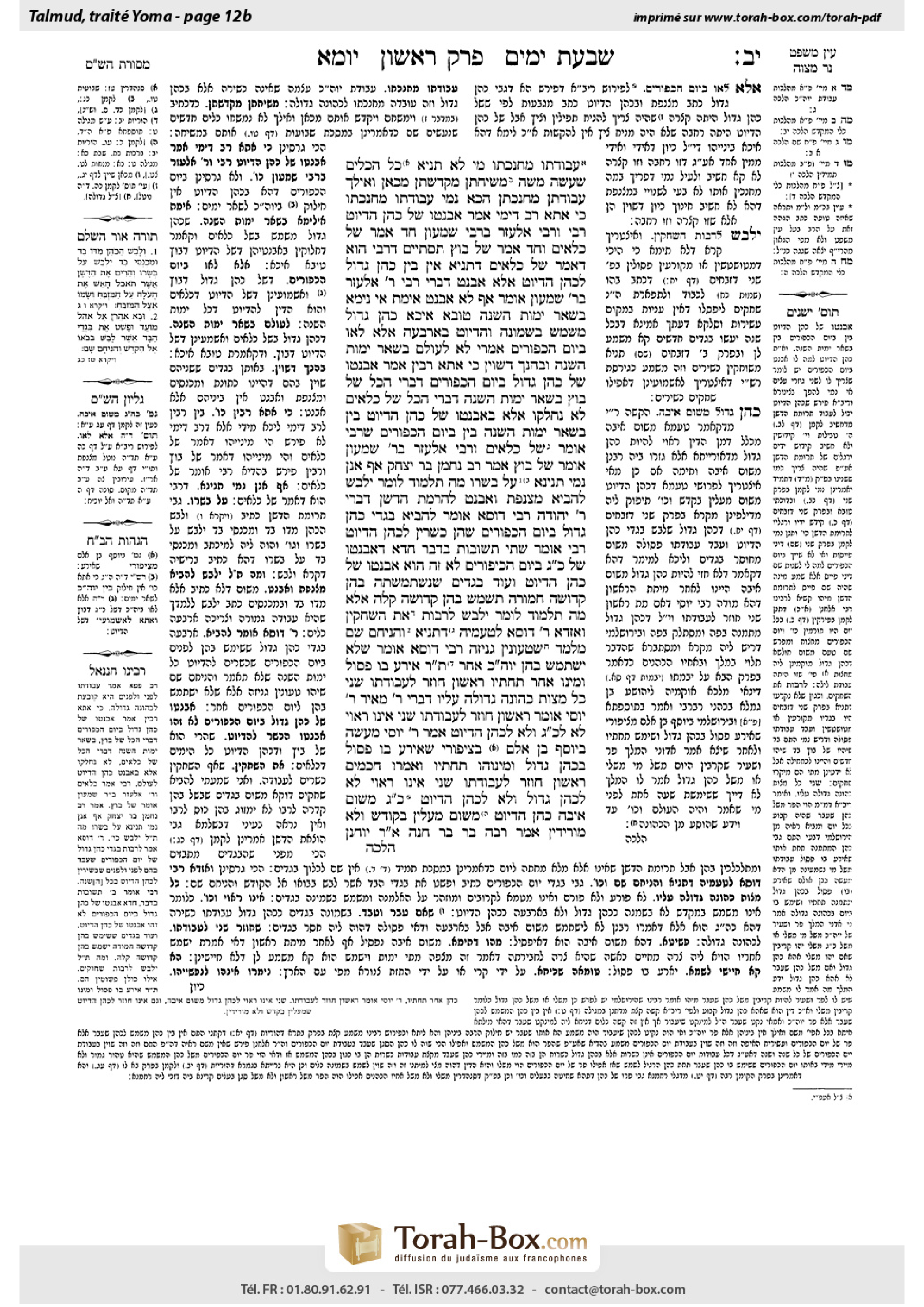
This page of Yoma includes the Aramaic text, an English translation and an AI-generated French translation, alongside the scan above.
יומא י״ב ב · Aramaic and Hebrew text
עֲבוֹדָתוֹ מְחַנַּכְתּוֹ. מִי לָא תַּנְיָא כׇּל הַכֵּלִים שֶׁעָשָׂה מֹשֶׁה — מְשִׁיחָתָן מְקַדַּשְׁתָּן, מִכָּאן וְאֵילָךְ — עֲבוֹדָתָן מְחַנַּכְתָּן. הָכָא נָמֵי — עֲבוֹדָתוֹ מְחַנַּכְתּוֹ.
כִּי אֲתָא רַב דִּימִי, אָמַר: אַבְנֵטוֹ שֶׁל כֹּהֵן הֶדְיוֹט, רַבִּי וְרַבִּי אֶלְעָזָר בְּרַבִּי שִׁמְעוֹן, חַד אָמַר: שֶׁל כִּלְאַיִם, וְחַד אָמַר: שֶׁל בּוּץ.
תִּסְתַּיֵּים דְּרַבִּי הוּא דְּאָמַר שֶׁל כִּלְאַיִם. דְּתַנְיָא: אֵין בֵּין כֹּהֵן גָּדוֹל לְכֹהֵן הֶדְיוֹט אֶלָּא אַבְנֵט, דִּבְרֵי רַבִּי. רַבִּי אֶלְעָזָר בְּרַבִּי שִׁמְעוֹן אוֹמֵר: אַף לֹא אַבְנֵט. אֵימַת? אִי נֵימָא בִּשְׁאָר יְמוֹת הַשָּׁנָה — טוּבָא אִיכָּא: כֹּהֵן גָּדוֹל מְשַׁמֵּשׁ בִּשְׁמוֹנָה וְהֶדְיוֹט בְּאַרְבָּעָה!
אֶלָּא לָאו, בְּיוֹם הַכִּפּוּרִים.
אָמְרִי: לָא, לְעוֹלָם בִּשְׁאָר יְמוֹת הַשָּׁנָה, וּבְהָנָךְ דְּשָׁוִין.
כִּי אֲתָא רָבִין, אָמַר: אַבְנֵטוֹ שֶׁל כֹּהֵן גָּדוֹל בְּיוֹם הַכִּפּוּרִים — דִּבְרֵי הַכֹּל שֶׁל בּוּץ. בִּשְׁאָר יְמוֹת הַשָּׁנָה — דִּבְרֵי הַכֹּל שֶׁל כִּלְאַיִם. לֹא נֶחְלְקוּ אֶלָּא בְּאַבְנֵטוֹ שֶׁל כֹּהֵן הֶדְיוֹט בֵּין בִּשְׁאָר יְמוֹת הַשָּׁנָה, בֵּין בְּיוֹם הַכִּפּוּרִים. שֶׁרַבִּי אוֹמֵר: שֶׁל כִּלְאַיִם, וְרַבִּי אֶלְעָזָר בְּרַבִּי שִׁמְעוֹן אוֹמֵר: שֶׁל בּוּץ.
אָמַר רַב נַחְמָן בַּר יִצְחָק: אַף אֲנַן נָמֵי תְּנֵינָא: ״עַל בְּשָׂרוֹ״, מָה תַּלְמוּד לוֹמַר ״יִלְבַּשׁ״? לְהָבִיא מִצְנֶפֶת וְאַבְנֵט לַהֲרָמַת הַדֶּשֶׁן, דִּבְרֵי רַבִּי יְהוּדָה.
רַבִּי דּוֹסָא אוֹמֵר: לְהָבִיא בִּגְדֵי כֹּהֵן גָּדוֹל בְּיוֹם הַכִּפּוּרִים, שֶׁהֵן כְּשֵׁרִין לְכֹהֵן הֶדְיוֹט. רַבִּי אוֹמֵר: שְׁתֵּי תְשׁוּבוֹת בַּדָּבָר. חֲדָא: דְּאַבְנֵטוֹ שֶׁל כֹּהֵן גָּדוֹל בְּיוֹם הַכִּיפּוּרִים לֹא זֶה הוּא אַבְנֵטוֹ שֶׁל כֹּהֵן הֶדְיוֹט.
וְעוֹד: בְּגָדִים שֶׁנִּשְׁתַּמַּשְׁתָּה בָּהֶן קְדוּשָּׁה חֲמוּרָה, תְּשַׁמֵּשׁ בָּהֶן קְדוּשָּׁה קַלָּה? אֶלָּא מָה תַּלְמוּד לוֹמַר ״יִלְבַּשׁ״? לְרַבּוֹת אֶת הַשְּׁחָקִין.
וְאַזְדָּא רַבִּי דּוֹסָא לְטַעְמֵיהּ, דְּתַנְיָא: ״וְהִנִּיחָם שָׁם״, מְלַמֵּד שֶׁטְּעוּנִין גְּנִיזָה. רַבִּי דּוֹסָא אוֹמֵר: שֶׁלֹּא יִשְׁתַּמֵּשׁ בָּהֶן יוֹם הַכִּפּוּרִים אַחֵר.
תָּנוּ רַבָּנַן: אֵירַע בּוֹ פְּסוּל וּמִינּוּ אַחֵר תַּחְתָּיו, רִאשׁוֹן — חוֹזֵר לַעֲבוֹדָתוֹ, שֵׁנִי — כׇּל מִצְוֹת כְּהוּנָּה גְּדוֹלָה עָלָיו, דִּבְרֵי רַבִּי מֵאִיר.
רַבִּי יוֹסֵי אוֹמֵר: רִאשׁוֹן — חוֹזֵר לַעֲבוֹדָתוֹ, שֵׁנִי — אֵינוֹ רָאוּי לֹא לְכֹהֵן גָּדוֹל, וְלֹא לְכֹהֵן הֶדְיוֹט,
אָמַר רַבִּי יוֹסֵי: מַעֲשֶׂה בְּיוֹסֵף בֶּן אִלֵּם בְּצִיפּוֹרִי שֶׁאֵירַע בּוֹ פְּסוּל בְּכֹהֵן גָּדוֹל וּמִינּוּהוּ תַּחְתָּיו, וְאָמְרוּ חֲכָמִים: רִאשׁוֹן — חוֹזֵר לַעֲבוֹדָתוֹ, שֵׁנִי — אֵינוֹ רָאוּי לֹא לְכֹהֵן גָּדוֹל, וְלֹא לְכֹהֵן הֶדְיוֹט. כֹּהֵן גָּדוֹל — מִשּׁוּם אֵיבָה. כֹּהֵן הֶדְיוֹט, מִשּׁוּם מַעֲלִין בַּקּוֹדֶשׁ וְלֹא מוֹרִידִין.
אָמַר רַבָּה בַּר בַּר חָנָה אָמַר רַבִּי יוֹחָנָן:
Yoma 12b · English translation
That action is unnecessary and therefore superfluous; his service initiates him. The replacement High Priest need not undergo any preliminary initiation. His very performance of the Yom Kippur service, which is valid only if performed by the High Priest, initiates him as acting High Priest. As proof, the Gemara states: Wasn’t it taught in a baraita: With regard to all the sacred vessels that Moses made, their anointment with oil consecrates them. From that point forward, in the generations after Moses, new vessels did not require anointment to be consecrated; rather, their use in Temple service initiates them and renders them fit for use. Here, too, with regard to the High Priest, his service initiates him.
§ Apropos the belt of the High Priest, the Gemara cites the aforementioned dispute in its entirety. When Rav Dimi came from Eretz Yisrael to Babylonia he said: With regard to the belt of the common priest, there is a dispute between Rabbi Yehuda HaNasi and Rabbi Elazar, son of Rabbi Shimon. One said: It was a mixture of diverse kinds of wool and linen, like the belt of the High Priest mentioned in the Torah. And one said: It was made of fine linen, like the rest of the garments of the common priest.
The Gemara suggests: Conclude that it is Rabbi Yehuda HaNasi who said that the belt of the common priest was a mixture of diverse kinds, as it was taught in a baraita: The only difference between a High Priest and a common priest is the belt; this is the statement of Rabbi Yehuda HaNasi. Rabbi Elazar, son of Rabbi Shimon, says: Not even the belt represents a difference between them. The Gemara explains: With regard to the difference between the High Priest and the common priest, when is there a dispute between the tanna’im? If we say that the dispute is with regard to the rest of the days of the year, there are many other differences between them, since the High Priest serves wearing eight garments and the common priest wears four garments. Therefore, that could not be the point of the dispute.
Rather, is it not that the dispute is with regard to the differences between the High Priest and the common priest on Yom Kippur? They agree that the belt of the High Priest on Yom Kippur is made of linen, but disagree with regard to the common priest’s belt. According to Rabbi Yehuda HaNasi, who says that there is a difference between the belts, the belt of the common priest must be made of a mixture of diverse kinds. According to Rabbi Elazar, son of Rabbi Shimon, who says that there is no difference between their belts, the belt of the common priest must be made of linen, like that of the High Priest on Yom Kippur.
The Gemara rejects this proof. The Sages say: No, this is not a proof, as actually, the dispute is with regard to the differences during the rest of the days of the year. However, the dispute is not with regard to all the differences between the High Priest and the common priest, but rather only with regard to those four garments common to both priests: The tunic, trousers, turban, and belt. Based on this understanding that the dispute is with regard to the rest of the year, the analysis of the dispute is reversed: According to Rabbi Yehuda HaNasi the belt of the High Priest is a mixture of diverse kinds and that of the common priest is made of linen, while according to Rabbi Elazar, son of Rabbi Shimon, the belt of the common priest is a mixture of diverse kinds. Therefore, there is no definitive proof from the baraita.
When Ravin came from Eretz Yisrael to Babylonia he stated this tradition in a clearer fashion: With regard to the belt of the High Priest on Yom Kippur, everyone agrees that it is made of fine linen, as stated in the Torah. With regard to the belt of the High Priest during the rest of the days of the year, everyone agrees that it is a mixture of diverse kinds. They disagreed only with regard to the belt of the common priest both during the rest of the days of the year and on Yom Kippur, as Rabbi Yehuda HaNasi says: It was a mixture of diverse kinds, and Rabbi Elazar, son of Rabbi Shimon, says it was made of linen.
Rav Naḥman bar Yitzḥak said: We, too, have learned in a baraita: The Torah says with regard to the removal of the ashes from the altar: “And the priest shall put on his linen garment, and his linen trousers shall he put upon his flesh” (Leviticus 6:3). The baraita questions the formulation of the verse. Since at the beginning of the verse it is written: “And the priest shall put on,” for what purpose does the verse state: “Shall he put upon,” in the latter part of the verse? Rabbi Yehuda says: It comes to include donning the mitre and the belt for the removal of the ashes, even though it is not explicitly stated in the verse. This is the statement of Rabbi Yehuda.
Rabbi Dosa says that the term: Shall put on, comes to include the halakha that the garments of the High Priest on Yom Kippur are fit for a common priest. During the Yom Kippur service, the High Priest wears just four linen garments. Although he may not serve in those garments on Yom Kippur the following year, a common priest may serve in them during the rest of the year. Rabbi Yehuda HaNasi says: There are two responses to reject this statement of Rabbi Dosa. One: The belt of the High Priest on Yom Kippur is not the same as the belt of the common priest during the rest of the year. Clearly, according to Rabbi Yehuda HaNasi, the belt of the High Priest on Yom Kippur is made of linen, and that of the common priest during the year is a mixture of the diverse kinds of wool and linen.
And furthermore, there is another reason to reject the statement of Rabbi Dosa. Could it be that with regard to garments that were used by the High Priest to perform a service of extreme sanctity, the common priest will use them to perform a service of minor sanctity? Rather, according to Rabbi Yehuda HaNasi, for what purpose does the verse state the phrase: Shall put on? It comes to include threadbare garments and to teach that as long as they are not completely tattered, they may be worn for that service.
And Rabbi Dosa follows his line of reasoning, as it was taught in a baraita: That which is written: “And Aaron shall come into the Tent of Meeting, and shall put off the linen garments, which he put on when he went into the Sanctuary, and shall leave them there” (Leviticus 16:23), teaches that the garments worn by the High Priest on Yom Kippur require interment and may not be put to additional use. Rabbi Dosa says: It means only that the High Priest may not use them on Yom Kippur in a different year. According to Rabbi Dosa, they may be worn by a common priest during his service, as they do not require interment.
§ The Gemara returns to the initiation of the acting High Priest. The Sages taught in the Tosefta: If a disqualification befalls the High Priest and they appointed another in his stead, and then the cause of the disqualification of the High Priest is resolved, e.g., he was purified from impurity, the original High Priest returns to his service. With regard to the second, acting High Priest, all the mitzvot of the High Priesthood are incumbent upon him. He serves wearing eight garments and it is prohibited for him to let his hair grow, to rend his garments in mourning the death of a relative, to subject himself to impurity imparted by the corpse of a relative, or to marry a widow. This is the statement of Rabbi Meir.
Rabbi Yosei says: The original priest returns to his service, while the second is fit to serve neither as High Priest with eight garments, because there is a different High Priest; nor as a common priest with four garments, as once he was elevated to a state of extreme sanctity he may not be reduced to a state of minor sanctity.
Rabbi Yosei said as proof for his opinion: There was an incident involving the priest Yosef ben Elem of Tzippori, who, when a reason for disqualification befell a High Priest, the priests appointed him in his stead. After the cause of the disqualification was resolved, the Sages said: The original High Priest returns to his service, while the second is fit to serve neither as High Priest nor as a common priest. The Gemara explains: Neither as a High Priest, due to hatred, jealousy and bitterness that would arise if there were two High Priests with equal standing in the Temple; nor as a common priest, because the principle is: One elevates to a higher level in matters of sanctity and one does not downgrade. Once he has served as a High Priest he cannot be restored to the position of a common priest.
Rabba bar bar Ḥana said that Rabbi Yoḥanan said:
Yoma 12b · Traduction française (IA)
Cette action est inutile et donc superflue : son service l’investit. Le grand prêtre remplaçant n’a pas besoin de subir une investiture préalable. Le fait même d’accomplir le service de Yom Kippour, qui n’est valide que s’il est accompli par le grand prêtre, l’investit dans sa fonction de grand prêtre intérimaire. À l’appui, la Guemara déclare : N’a-t-on pas enseigné dans une baraïta que tous les ustensiles sacrés fabriqués par Moïse sont consacrés par leur onction d’huile ? Dès lors, dans les générations qui suivent Moïse, les nouveaux ustensiles n’ont plus besoin d’être oints pour être consacrés ; leur utilisation dans le service du Temple les investit et les rend aptes à l’usage. Ici aussi, pour le grand prêtre, c’est son service qui l’investit.
§ À propos de la ceinture du grand prêtre, la Guemara rapporte intégralement la controverse mentionnée plus haut. Lorsque Rav Dimi arriva d’Eretz Israël en Babylonie, il dit : Au sujet de la ceinture du prêtre ordinaire, Rabbi Yehouda HaNassi et Rabbi Elazar, fils de Rabbi Shimon, sont en désaccord. Selon l’un, elle était faite d’un mélange de laine et de lin, comme la ceinture du grand prêtre mentionnée dans la Torah. Selon l’autre, elle était en lin fin, comme les autres vêtements du prêtre ordinaire.
La Guemara propose : Concluons que c’est Rabbi Yehouda HaNassi qui a dit que la ceinture du prêtre ordinaire était faite d’un mélange de matières hétérogènes, car il a été enseigné dans une baraïta : La seule différence entre le grand prêtre et le prêtre ordinaire concerne la ceinture ; telle est l’opinion de Rabbi Yehouda HaNassi. Rabbi Elazar, fils de Rabbi Shimon, dit : Même la ceinture ne les distingue pas. La Guemara explique : Quand les tannaïm sont-ils en désaccord au sujet des différences entre le grand prêtre et le prêtre ordinaire ? Si l’on dit que leur désaccord porte sur le reste de l’année, il existe de nombreuses autres différences entre eux, puisque le grand prêtre officie avec huit vêtements et le prêtre ordinaire en porte quatre. Le désaccord ne saurait donc porter sur ce point.
Mais n’est-ce pas plutôt que leur désaccord porte sur les différences entre le grand prêtre et le prêtre ordinaire à Yom Kippour ? Ils s’accordent à dire que la ceinture du grand prêtre à Yom Kippour est en lin, mais ils sont en désaccord au sujet de celle du prêtre ordinaire. Selon Rabbi Yehouda HaNassi, qui affirme qu’il existe une différence entre les ceintures, celle du prêtre ordinaire doit être faite d’un mélange de matières hétérogènes. Selon Rabbi Elazar, fils de Rabbi Shimon, qui affirme qu’il n’y a pas de différence entre leurs ceintures, celle du prêtre ordinaire doit être en lin, comme celle du grand prêtre à Yom Kippour.
La Guemara rejette cette preuve. Les Sages disent : Non, ce n’est pas une preuve, car en réalité, le désaccord porte sur les différences durant le reste de l’année. Toutefois, il ne porte pas sur toutes les différences entre le grand prêtre et le prêtre ordinaire, mais seulement sur les quatre vêtements communs aux deux prêtres : la tunique, le pantalon, la tiare et la ceinture. Si l’on comprend ainsi que le désaccord concerne le reste de l’année, l’analyse de la controverse s’inverse : selon Rabbi Yehouda HaNassi, la ceinture du grand prêtre est faite d’un mélange de matières hétérogènes, tandis que celle du prêtre ordinaire est en lin ; selon Rabbi Elazar, fils de Rabbi Shimon, la ceinture du prêtre ordinaire est faite d’un mélange de matières hétérogènes. La baraïta n’apporte donc aucune preuve concluante.
Lorsque Ravin arriva d’Eretz Israël en Babylonie, il rapporta cette tradition de manière plus claire : au sujet de la ceinture du grand prêtre à Yom Kippour, tous s’accordent à dire qu’elle est en lin fin, comme l’indique la Torah. Au sujet de la ceinture du grand prêtre durant le reste de l’année, tous s’accordent à dire qu’elle est faite d’un mélange de matières hétérogènes. Leur désaccord porte uniquement sur la ceinture du prêtre ordinaire, aussi bien durant le reste de l’année qu’à Yom Kippour : Rabbi Yehouda HaNassi dit qu’elle était faite d’un mélange de matières hétérogènes, et Rabbi Elazar, fils de Rabbi Shimon, dit qu’elle était en lin.
Rav Naḥman bar Yitzḥak dit : Nous aussi, nous avons appris dans une baraïta : La Torah dit au sujet de l’enlèvement des cendres de l’autel : « Le prêtre revêtira sa tunique de lin et mettra sur sa chair son pantalon de lin » (Lévitique 6, 3). La baraïta interroge la formulation du verset. Puisqu’au début du verset il est écrit : « Le prêtre revêtira », pourquoi le verset dit-il, dans sa seconde partie : « mettra sur » ? Rabbi Yehouda dit : Cela vient inclure le port de la tiare et de la ceinture lors de l’enlèvement des cendres, bien que cela ne soit pas explicitement énoncé dans le verset. Telle est l’opinion de Rabbi Yehouda.
Rabbi Dosa dit que l’expression « mettra sur » vient inclure la halakha selon laquelle les vêtements du grand prêtre à Yom Kippour conviennent à un prêtre ordinaire. Durant le service de Yom Kippour, le grand prêtre ne porte que quatre vêtements de lin. Bien qu’il ne puisse pas officier avec ces vêtements à Yom Kippour l’année suivante, un prêtre ordinaire peut les porter pour officier le reste de l’année. Rabbi Yehouda HaNassi dit : Il y a deux réponses pour réfuter cette affirmation de Rabbi Dosa. Premièrement, la ceinture du grand prêtre à Yom Kippour n’est pas la même que celle du prêtre ordinaire le reste de l’année. De toute évidence, selon Rabbi Yehouda HaNassi, la ceinture du grand prêtre à Yom Kippour est en lin, tandis que celle du prêtre ordinaire durant l’année est faite d’un mélange de laine et de lin.
De plus, il y a une autre raison de rejeter l’affirmation de Rabbi Dosa. Se peut-il que le prêtre ordinaire utilise, pour accomplir un service de moindre sainteté, des vêtements dont le grand prêtre s’est servi pour accomplir un service d’une sainteté supérieure ? Rabbi Yehouda HaNassi explique plutôt que l’expression « mettra sur » figure dans le verset pour inclure les vêtements usés et enseigner que, tant qu’ils ne sont pas complètement en lambeaux, ils peuvent être portés pour ce service.
Et Rabbi Dosa suit sa propre logique, comme cela a été enseigné dans une baraïta : Ce qui est écrit : « Aaron entrera dans la Tente d’assignation, ôtera les vêtements de lin qu’il avait revêtus lorsqu’il était entré dans le sanctuaire, et les déposera là » (Lévitique 16, 23), enseigne que les vêtements portés par le grand prêtre à Yom Kippour doivent être enfouis et ne peuvent plus être utilisés. Rabbi Dosa dit que cela signifie seulement que le grand prêtre ne peut pas les utiliser à Yom Kippour une autre année. Selon Rabbi Dosa, un prêtre ordinaire peut les porter durant son service, car ils n’ont pas à être enfouis.
§ La Guemara revient à l’investiture du grand prêtre intérimaire. Les Sages enseignèrent dans la Tossefta : Si une cause d’inaptitude frappe le grand prêtre et qu’ils en nomment un autre à sa place, puis que cette cause disparaît — par exemple, s’il est purifié de son impureté —, le grand prêtre initial reprend son service. Quant au second, le grand prêtre intérimaire, toutes les mitsvot liées à la grande prêtrise lui incombent. Il officie avec huit vêtements, et il lui est interdit de laisser pousser ses cheveux, de déchirer ses vêtements en deuil à la mort d’un proche, de se soumettre à l’impureté transmise par le cadavre d’un proche ou d’épouser une veuve. Telle est l’opinion de Rabbi Meïr.
Rabbi Yossi dit : Le prêtre initial reprend son service, tandis que le second n’est apte à officier ni comme grand prêtre avec huit vêtements, puisqu’il y a un autre grand prêtre, ni comme prêtre ordinaire avec quatre vêtements ; en effet, dès lors qu’il a été élevé à un degré supérieur de sainteté, il ne peut être rabaissé à un degré inférieur.
Rabbi Yossi apporta une preuve à l’appui de son opinion : Un incident eut lieu avec le prêtre Yosef ben Elem de Tzippori. Lorsqu’une cause d’inaptitude frappa un grand prêtre, les prêtres le nommèrent à sa place. Après la disparition de cette cause, les Sages dirent : Le grand prêtre initial reprend son service, tandis que le second n’est apte à officier ni comme grand prêtre ni comme prêtre ordinaire. La Guemara explique : Il ne peut officier comme grand prêtre en raison de la haine, de la jalousie et de l’amertume qui surgiraient si deux grands prêtres avaient le même rang dans le Temple ; ni comme prêtre ordinaire, car le principe est le suivant : en matière de sainteté, on s’élève à un niveau supérieur et on ne rétrograde pas. Dès lors qu’il a servi comme grand prêtre, il ne peut pas être rétabli dans la fonction de prêtre ordinaire.
Rabba bar bar Ḥana dit au nom de Rabbi Yoḥanan :
Traduction française générée par IA à partir de l’édition anglaise de Sefaria. Vérifie toujours un passage avec le texte source.
Text from Sefaria: William Davidson Edition - Vocalized Aramaic (CC BY NC); William Davidson Edition - English (CC BY NC).